Introduction
Giving parents the opportunity to exercise greater choice in where and how their children are educated has been a common theme of educational provision during the last three or four decades (Plank and Sykes, Reference Plank and Sykes2003). This has been achieved in part by encouraging greater diversity of supply and in part through facilitating the expression of demand. Thus, in the US, charter schools run by non-profit organisations have become widespread, while in some states parents can use vouchers to pay for the cost of sending a child to a private rather than a public school (Wolfe, Reference Wolfe2002). Similarly in both Chile and Sweden, nationwide programmes of school decentralisation and the introduction of vouchers have resulted in a dramatic expansion of privately supplied education (Gauri, Reference Gauri1999; Bunar, Reference Bunar2010).
England has not been immune from this trend. Public service reform during the last two decades has seen a move towards greater diversity of provision (Office of Public Service Reform, 2002; Department of Health, 2004, 2010; Conservative Party, 2010; Department for Education, 2010; Gove, Reference Gove2011). Instead of publicly funded services being provided in any one area by a single, monopolistic provider, users are given the opportunity to choose from a variety of providers. These providers may include private businesses and charitable organisations as well as bodies run by the state, all of whom in effect compete for business and thus funding. As elsewhere, by creating a quasi-market mechanism policy makers have hoped to create an environment in which providers are incentivised to become both more efficient and more sensitive to the needs and aspirations of the individual user (Le Grand, Reference Le Grand2003, Reference Le Grand2007).
A key application of this approach has been the introduction of a quasi-market in schools, beginning in the late 1980s and continuing ever since (Gewirtz et al., Reference Gewirtz, Ball and Bowe1995; Gorard et al., Reference Gorard, Fitz and Taylor2003; McAteer, Reference McAteer2005; Greener and Powell, Reference Greener and Powell2008). Specifically, the Education Act of 1980 and the Education Reform Act of 1988, both passed by the Conservative governments of 1979–97, strengthened the right of parents to choose the (state funded) school their children attended (Le Grand and Bartlett, Reference Le Grand and Bartlett1993).Footnote 1 The Conservatives also introduced specialist schools that claimed an expertise in a particular subject area. These initial steps were taken further by the Labour governments of 1997–2010, partly through a substantial expansion of the provision of specialist schools, but most distinctively via a programme of (City) Academies, namely secondary schools run and partly funded by a range of non-state organisations, including charities and private companies, and possessing a degree of flexibility in the curriculum they pursue (Powell, Reference Powell2008; West and Currie, Reference West and Currie2008). Meanwhile, inspired by developments in Sweden and the US (Gove, Reference Gove2011), the current Conservative/Liberal Democrat coalition's Academies Act 2010 has given non-state organisations the right to initiate the founding of new, so-called ‘free schools’, that is all-ability publicly funded schools not controlled by the local authority (Exley and Ball, Reference Exley, Ball and Bochel2011). Thus a system has gradually been developed, whereby individual parents, supposedly used to acting like consumers in the marketplace, can satisfy their particular needs by choosing whichever school they consider best for their child.
These moves towards a quasi-market have, however, largely been eschewed in the rest of the UK outside of England, where the educational systems have always been different from that in England, and where since 1999 education has become the responsibility of separate, devolved administrations rather than the UK government (Paterson, Reference Paterson2003). However, in one important respect there has long been diversity of state school provision throughout the UK (Judge, Reference Judge2002). This is in the form of faith-based schools. These are schools that are run (and, in the case of so-called voluntary aided schools, partly funded) by religious organisations. These schools offer an education that reflects the ethos of the religion in question. In England and Wales, most are associated with either the Anglican or Catholic faiths. In Scotland and Northern Ireland, most are linked with the Catholic Church, with the result that in some areas supposedly non-denominational schools cater for a predominantly Protestant population. Those living in a locality with one or more faith-based schools have long been able to choose whether or not to send their child to such an institution.
This historical legacy was not forgotten in the drive in England to create a more diverse range of provision. For Tony Blair, Labour Prime Minister between 1997 and 2007, the further promotion of faith-based schools was an integral part of the school choice agenda (Walford, Reference Walford2008). Labour's 2001 Green Paper on education, for example, called for ‘diversity within the secondary system . . . by significantly expanding the specialist schools programme, welcoming more faith based schools, continuing to establish City Academies’ (Department for Education and Employment, 2001: 7, emphasis added). One notable development was the introduction of much greater provision of faith-based schools for religious minorities, both Christian and non-Christian. Religious organisations also played a prominent role in sponsoring the Blair government's City Academies.
This link between school choice and the promotion of faith-based schools should not come as a surprise. If charities and other non-state organisations are given the opportunity to create schools that are eligible for state funding while parents are given the means with which to exercise choice, then, so long as parents are willing to send their children to a faith-based school, a framework is created whereby religious organisations can potentially establish schools whose income comes from, in whole or in part, the state. Thus in the US, where the First Amendment bans the establishment of any religion and where many states bar the use of tax dollars to fund faith-based (parochial) schools, in 2002 the Supreme Court found itself in Zelman vs. Simmons-Harris having to decide whether a voucher scheme in Cleveland, Ohio could be used by parents to send their children to such a school. The Court decided that in the particular circumstances of that scheme at least, they could.
But does the provision of faith-based schools sit easily with the individualistic rationale for promoting school choice? Rather than a means of enabling individual parents to express household preferences, it could be argued that such schools are designed primarily to accommodate the interests of a collective social group. After all, they potentially provide a key channel for socialising denominational members and transmitting the values of the faith to the next generation. Due to its minority status in the UK and its members’ experience of discrimination dating back to the Reformation, in the UK the Catholic Church has particularly valued the opportunity for passing on the faith that such schools seemingly present. Thus one of the key goals of faith-based education in Britain has been to help ensure the survival of a minority group identity rather than simply to accommodate the aspirations of individual parents.
The present study examines the character of public support for faith-based schools across the four component territories of the UK in order to establish whether that support really does represent part of a wider demand to give individual parents more choice, or whether instead it is based on a wish to maintain and promote a collective, religious group identity. Unlike much previous research in this area (for example Adler et al., Reference Adler, Petch and Tweedie1989; Echols et al., Reference Echols, McPherson and Willms1990; Burgess et al., Reference Burgess, Greaves, Vignoles and Wilson2009a), our interest lies not in ascertaining why some parents choose to send a child to a faith-based school, but rather in understanding why the public (and thus taxpayers) in general support or oppose the provision of such schools, taking into account the key differences in the religious and educational context of the four component parts of the UK. Although our empirical evidence is confined to the UK, our analysis challenges assumptions that may well be used to promote individual choice anywhere, and especially so where religious identities remain salient.
The article begins with an overview of the individualistic rationale that drives the promotion of choice, including in respect of schools. It then draws on social identity theory to highlight why this rationale might fail to provide an adequate explanation of why people support or oppose faith-based schools. The adequacy of the two competing approaches is tested using data on attitudes towards public services provided by four parallel surveys, one in each of the four component parts of the UK.
Alternative motivations for supporting choice and diversity of provision
For some, choice is of intrinsic value, something that parents value for its own sake. Others point to the extrinsic benefits it supposedly brings (Dowding and John, Reference Dowding and John2009). Parents can ‘vote with their feet’ and move their child from one school to another if they think doing so would enhance their household's utility (Tiebout, Reference Tiebout1956). Meanwhile, paid only for the pupils that they teach, schools have to compete with each other for pupils. The resulting competition between providers should encourage innovation and improve standards.Footnote 2
This approach to the provision of public services has been criticised as viewing the citizen from the overly narrow perspective of ‘homo economicus’: individual actors with myopic interests who rationally calculate cost/benefit trade-offs (Jordan, Reference Jordan2005, Reference Jordan2006; Clarke et al., Reference Clarke, Newman, Smith, Westmarland and Vidler2007). According to one such critique, the promotion of responsive public services ‘constructs the public interest as a series of specific and individualised encounters and interactions: each consumer consumes a particular bit of service. Collective consumption of public services is invisible’ (Clarke, Reference Clarke2004: 39).
In any event, the assumption that parents are autonomous consumers of educational services looking to satisfy particularistic household needs may overlook the importance of social context in shaping individual preferences. Alongside ethnicity, language, class and, more recently, gender and age, religion is a key influence on how people perceive themselves and their interests. Insights of social identity theory might help us understand how religious identity and context might be more important than belief in the merits of an individualised approach to public service delivery in shaping mass attitudes towards certain types of school choice.
Social identity theory describes a process of depersonalisation that helps individuals to reduce the complexity of social life (Tajfel, Reference Tajfel and Tajfel1978, Reference Tajfel1981; Turner et al., Reference Turner, Hogg, Oakes, Reicher and Wetherell1987; for a social policy perspective, see Taylor, Reference Taylor1998). Members of a social group tend to internalise their membership by thinking of themselves in collective rather than individual terms: for example, ‘I am Catholic’. To further simplify social life, members resort to self-categorisation (Turner et al., Reference Turner, Hogg, Oakes, Reicher and Wetherell1987) and assign social objects into us/them categories: us represents the ingroup (e.g., ‘Catholics’), where people feel they belong; them stands for the outgroup (e.g., ‘Protestants’), where non-members are located. To make these categories clear and coherent, members maximise their distance from outsiders through stereotyping. This process leads to feelings of intra-group favouritism, greater concern about group rather than individual interests, antipathy towards outgroup members and perceptions that the outgroup presents a threat to ingroup interests.
A key claim of social identity theory is that people's sense of identity depends on the context in which they find themselves. An individual may have multiple identities, such as religious, occupational, sexual and national, but which of these is activated at any one point in time varies (Lau, Reference Lau1989). Individuals are more likely to define themselves in terms of a religious category – and react accordingly – when faced with situations that have religious connotations. When religious ‘category salience’ is high, such as when a perceived antagonism between religious ingroup and outgroup is prominent, individuals tend to feel a stronger sense of attachment to their religious ingroup and its interests, and a greater tendency to be biased against any religious outgroup. However, when the context primes a different definition of the self (such as occupational membership), then the religious component of self-image becomes weaker and religious intergroup antagonism loses its salience.
This suggests the question of faith-based schooling could be a trigger that stimulates feelings of religious identity and of the group interests attached to this identity. That, for example, is certainly what is suggested by one recent study of the demographic basis of support for faith-based schools in Britain (Clements, Reference Clements2010). Faith-based schools may invoke images of ‘us’ and ‘them’ and a desire to defend ‘us’ from ‘them’. Thus, for example, Catholics in Britain may regard the provision of a Catholic school as a means of protecting the interests of their religious ingroup rather than as a mechanism for facilitating individual choice. Conversely, Protestants may view the provision of Catholic schools as a threat to the country's predominantly Protestant heritage (their own ingroup). Moreover, intergroup conflict of this kind is not necessarily confined to the pious. The non-religious may regard faith-based schools of any description as a threat emanating from a religious outgroup to the secular character of British society (their own – secular – ingroup). In short people's attitudes towards faith-based schools may have much more to do with their collective religious identity than with any demand to see individual preferences reflected in how public services are delivered.
Previous research on school choice
Previous research on how parents exercise school choice has certainly raised questions about whether they do conform to the individualistic rationale of utility maximisers seeking the best environment for their particular child. Much of the literature, largely focused on the US, emphasises the importance of attachment to a religious or other reference group in motivating parents’ choice of secondary school, especially when one's own group is perceived to be under attack or in the minority. For instance, Smith and Meier's (Reference Smith and Meier1995) study uses school enrolment data from Florida districts to demonstrate that the choice parents make is a function of a school's religious or racial composition rather than strictly academic criteria. According to their research, parents that leave the public school system for other options seek a homogenous educational environment, either in its religious or its racial composition. The finding is validated by a number of other studies that use both aggregate and individual level data (e.g., Wells and Crain, Reference Wells, Crain and Cookson1992; Whitty, Reference Whitty1997; Sander, Reference Sander2005; Cohen-Zada, Reference Cohen-Zada2006).
There has been some research in Britain that has examined whether the actual selection calculus and role adopted by users of public services is that of the citizen as individual consumer. Clarke and colleagues (Vidler and Clarke, Reference Vidler and Clarke2005; Newman and Vidler, Reference Newman and Vidler2006; Clarke et al., Reference Clarke, Newman, Smith, Westmarland and Vidler2007) have investigated whether citizens see themselves as customers and shoppers when accessing a range of public services. Using survey and focus group data from two English urban locations and looking across three sectors (health, policing and social care), they find no evidence that users think of themselves in that way. Instead, users tend to assume other identities: activists, citizens, members of the local community or patients.
Meanwhile, a number of studies in both England and Scotland have focused on the motivation behind parental school choice in particular (West et al., Reference West, Varlaam, Mortimore and Hargreaves1984; Stillman and Maychell, Reference Stillman and Maychell1986; Adler et al., Reference Adler, Petch and Tweedie1989; Echols et al., Reference Echols, McPherson and Willms1990; Hunter, Reference Hunter1991; West et al., Reference West, David, Hailes and Ribbens1995; Carroll and Walford, Reference Carroll and Walford1997; Burgess et al., Reference Burgess, Greaves, Vignoles and Wilson2009a, Reference Burgess, Greaves, Vignoles and Wilson2009b). These have asked parents themselves to state the reasons behind their choice of school, and in addition have often examined whether the selection criteria parents use vary by parental class or ethnicity. Their findings suggest parents often select a school based on considerations other than academic performance, including a school's reputation, discipline, proximity to home and the pupil's own preference. However, in contrast to much of the research in the US, this research suggests that a school's religious character is not commonly an important decision criterion.
The present analysis
In this analysis, we take a different approach from most previous studies. We focus on the attitudes of the public in general towards school choice and faith-based schools rather than how and why parents choose a school when presented with the opportunity to do so (for other studies of the views of the public in general see Clements, Reference Clements2010; Exley, Reference Exley2012). Our data come from a module of questions on attitudes towards public services that was administered in 2007 on surveys of the resident adult population in each of the four territories of the UK, with each survey conducted in the same or a functionally equivalent manner.
First, the module was included in the 2007 British Social Attitudes survey (Park et al., Reference Park, Curtice, Phillips and Clery2009) and administered to a probability sample of 2,022 respondents, of whom 1,735 were resident in England and whose answers provide our evidence on opinion in England. Second, the module formed part of the 2007 Scottish Social Attitudes survey (Curtice et al., Reference Curtice, McCrone, McEwen, Marsh and Ormston2009), which interviewed a probability sample of 1,508 respondents. Third, in Wales the questions were included in an ad hoc survey (known as the 2007 Wales Life and Times survey) administered to a probability sample of 884 respondents. All three of these surveys were administered face to face by NatCen Social Research. Finally, in Northern Ireland the module was included in the 2007 Northern Ireland Life and Time survey (http://www.ark.ac.uk/nilt/), which was conducted using much the same methodological approach as the three NatCen surveys, and a probability sample of 1,179 respondents were interviewed. To the best of our knowledge, this exercise provides the first-ever opportunity to compare the attitudes of the public in general towards faith-based schooling across all four parts of the UK. In each case, the data have been weighted to correct for known unequal probabilities of being selected for interview and for differential non-response.
The module contained three attitudinal questions central to our inquiry. First, respondents were asked their views about the general principle of providing parents with the ability to choose a school. It ran:
How much choice should parents of a secondary school child have about which state school their child goes to? Footnote 3
Respondents were invited to respond using a four-point scale ranging from ‘a great deal’ to ‘none at all’. In addition, they were asked their views about one of the new forms of school provision introduced by the UK government in England, namely specialist schools. It read as follows:
Some people say that all schools should offer much the same kind of education. Others say that parents should be able to choose between schools of different kinds. How much do you support or oppose having some schools that specialise in a particular subject, such as maths or music?
In this case respondents were asked to reply using a five-point scale that ranged from ‘strongly support’ to ‘strongly oppose’.
Finally, the module included a question designed to tap attitudes towards the provision of faith-based schools. The wording of this item was as follows:
And how much do you support or oppose having some schools that are linked to a particular religious denomination, such as Roman Catholic?
It should be noted that although respondents were being asked to express their views about faith-based schools in general, the question made reference to one Christian denomination in particular. This was because it was felt that in the absence of such a concrete example respondents may not necessarily fully appreciate the kind of provision – and its connotations – that we wished them to consider. It is recognised that the reference to Catholic schools in particular may well have coloured the views expressed by some respondents, though as will be seen this is, if anything, beneficial to the analysis we undertake. The scale of possible responses to this question was the same as that for the item on specialist schools, which means that the pattern of responses to the two questions on the two different forms of diverse provision is directly comparable.
Meanwhile we should also note that all four surveys carried the same questions on religious affiliation. Respondents were handed a list of religions and denominations and asked:
Do you regard yourself as belonging to any particular religion?
The only difference between the four surveys was that the list of denominational names offered to respondents reflected the organisational structure of religious denominations in their particular part of the UK.
Equipped with the responses to these four questions, the logic of our analysis is as follows. If the provision of faith-based schools is regarded as part of much the same individualistic agenda on school choice as the introduction of specialist schools, we should find the two forms of provision are similar in their levels of popularity and that both are positively correlated (to a similar degree) with attitudes towards school choice in general. Moreover, there is no particular reason why we should expect attitudes towards faith-based schools to be associated with religious identity. If, on the other hand, faith-based schools are considered to be a means of protecting and developing the collective identity and interests of a particular religion, we would expect to find a clear link between religious identity and attitudes towards the provision of such schools, while there may be little or no association with attitudes towards school choice in general or specialist schools in particular.
However, the link between religious identity and attitudes towards school choice may not be the same in all four parts of the UK. Given that the salience of social identities depends on context, and given that the structure of the religious economy and educational provision varies across the four parts of the UK, there is good reason not to expect this to be the case. First, social identity theory anticipates that religious identities will have a greater impact on people's attitudes where antagonism between religious groups is greater. Such antagonism – between Catholics and Protestants – has historically been greater in Scotland and (especially) Northern Ireland than in England and Wales (Bruce, Reference Bruce1985, Reference Bruce1986; Davie, Reference Davie1994). So perhaps in England and Wales attitudes towards faith-based schools are linked more to attitudes towards school choice in general and less to religious identity than in Scotland or Northern Ireland.
Equally, attitudes towards faith-based schools are likely to be influenced by the pattern of educational provision. A religious group that has access to such schools is more likely to be favourable to their existence than one that does not. So where provision is more or less confined to one particular group, faith-based schools are more likely to be regarded as a means of maintaining the values of that particular group and be met with suspicion by those who do not identify with that group. In both Scotland and Northern Ireland, faith-based schools are almost all Catholic schools. For example, out of 377 maintained faith-based schools in Scotland, 373 are associated with the Catholic Church. In contrast, in England, not only are the majority (67 per cent of 6,834) of faith-based schools Church of England (Anglican) schools, but also these co-exist with a substantial provision (29 per cent) of Catholic schools. Footnote 4 The position in Wales is not dissimilar. Thus once again we have reason to anticipate a stronger link between religious identity and attitudes towards faith-based schools in Scotland and Northern Ireland than in England and Wales.
Results
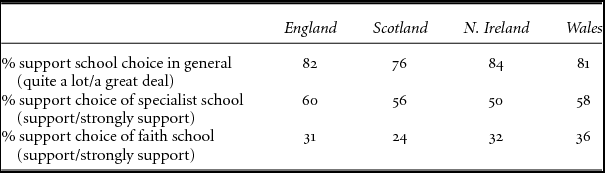
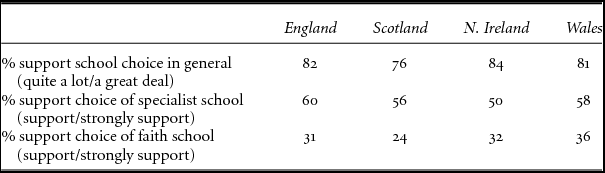
Our first task is to look at the relative popularity of school choice in general and both specialist and faith-based schools in particular. As Table 1 shows, while the abstract principle of school choice is very popular in all four parts of the UK (Curtice and Heath, Reference Curtice, Heath, Park, Curtice, Phillips and Clery2009; Exley, Reference Exley2012), and the idea of specialist schools is backed everywhere by half or more, the provision of faith-based schools is much less popular. Evidently throughout the UK there are many people who support the principle of school choice but who are wary about faith-based schools.
Attitudes towards school choice and diversity of provision throughout the UK
Source: British Social Attitudes 2007 (respondents living in England only); Scottish Social Attitudes 2007, Northern Ireland Life and Times 2007; Wales Life and Times 2007.
We next examine the relationship between attitudes towards the availability of choice in secondary education and those towards the provision of specialist and faith-based schools. If the individualistic demand assumption of the reform agenda is correct, then attitudes towards specific forms of diverse provision should be correlated with attitudes towards the general principle of school choice. In that event, it would seem reasonable to infer that the provision of both specialist and faith-based schools is regarded as a valued means of providing parents with greater choice of how to educate their children.
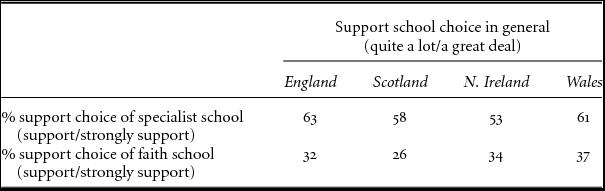
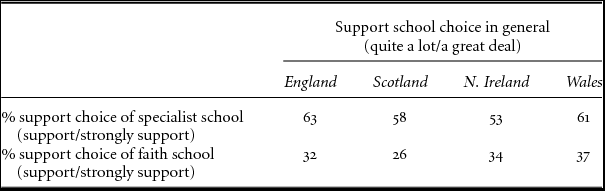
However, the link between support for the principle of school choice and attitudes towards faith-based schools proves to be weak, as demonstrated in Table 2. This shows for each of the four parts of the UK the level of support for both faith-based schools and specialist schools amongst those who back the principle of school choice. In each case, a majority of those who back school choice also support specialist schools, whereas only a minority, typically no more than a third or so, support faith-based schools. In contrast to the position in respect of specialist schools, it is far from clear that the general public regard the provision of faith-based schools as an integral part of an educational service that enables parents to make individualistic choices.
Attitudes towards specialist schools and faith-based schools amongst those in favour of school choice in general
Source: British Social Attitudes 2007 (respondents living in England only); Scottish Social Attitudes 2007, Northern Ireland Life and Times 2007; Wales Life and Times 2007.
That, however, still leaves open the question of what role religious identity plays in shaping attitudes towards faith-based schools. Perhaps such schools are simply less popular in general rather than being a subject on which people's views particularly reflect their religious sympathies. So we now look to see how far attitudes towards school choice in general as well as faith-based schools in particular are associated with religious identity.
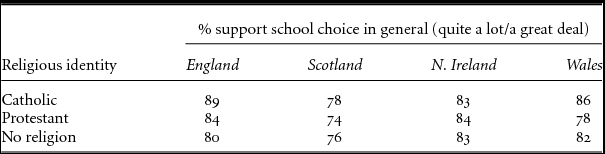
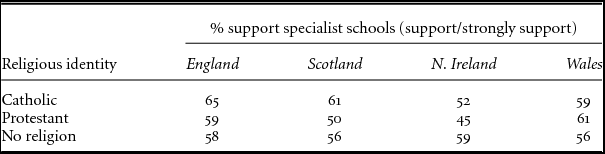
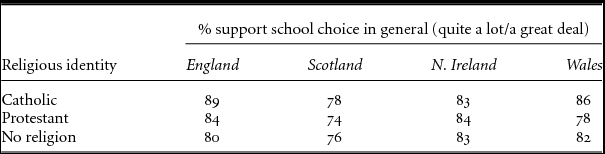
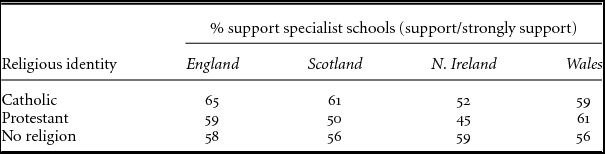
First, in Table 3 we look at attitudes towards the general principle of school choice broken down by religious identity. It indicates that Catholics, Protestants and the non-religious differ little in their attitudes towards the availability of choice in secondary education. The position is much the same in all four parts of the UK; the only difference is that people in Scotland are a little less keen on school choice, irrespective of their religious identity. Meanwhile, Table 4 demonstrates that the association between denominational membership and support for specialist schools is also very weak. Footnote 5
Support for school choice by religious identity
Source: British Social Attitudes 2007 (respondents living in England only); Scottish Social Attitudes 2007, Northern Ireland Life and Times 2007; Wales Life and Times 2007.
Support for specialist schools by religious identity
Source: British Social Attitudes 2007 (respondents living in England only); Scottish Social Attitudes 2007, Northern Ireland Life and Times 2007; Wales Life and Times 2007.
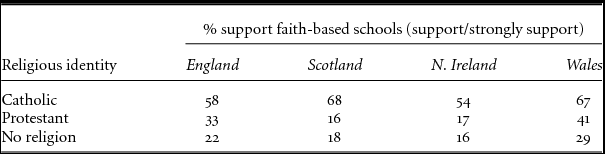
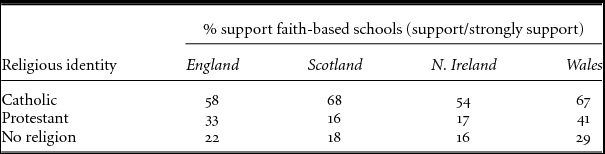
As Table 5 shows, however, the same is not true of attitudes towards faith-based schools. Here we should remember that the survey item in question specifically mentioned Catholic schools, and thus if faith-based schools are regarded as a means of promoting the collective interests and values of a particular social group, we would expect to find that Catholics would be more likely than Protestants or those of no religion to express support for the idea. This is precisely what we find. In every part of the UK, a majority of Catholics express support for faith-based schools, whereas only a minority of Protestants and those of no religious persuasion do so.
Support for faith-based schools by religious identity
Source: British Social Attitudes 2007 (respondents living in England only); Scottish Social Attitudes 2007, Northern Ireland Life and Times 2007; Wales Life and Times 2007.
Equally importantly, however, the extent to which Protestants oppose faith-based schools varies considerably. They are much more likely to be amenable to the idea in both England and Wales (where 33 and 41 per cent respectively are in favour) than in either Scotland or Northern Ireland (where the equivalent figures are 16 and 17 per cent respectively). This is precisely what we anticipated earlier. Where the overall provision of faith-based schools is relatively heterogeneous in character, as in England and Wales, then those who identify with a Protestant denomination are more likely to support the idea than they are where such provision is almost exclusively Catholic, as in Scotland and Northern Ireland. If the term ‘religious schools’ stands for more than ‘Catholic education’ in their part of the UK, Protestants are less likely to see these schools as a means of fostering only the values and ethos of those whom they may regard as an outgroup.
There is a hint that the views of the non-religious are also affected by the context in which they live – they are a little more likely to support faith-based schools in England and Wales than they are in Scotland and Northern Ireland. It may be that in Scotland and Northern Ireland, those who do not identify with any religion are disinclined to support such provision because of the historically greater levels of religious antagonism in their part of the UK. They may be more likely to feel that such schools symbolise if not necessarily help perpetuate the religious sectarianism that is often thought to scar their society.
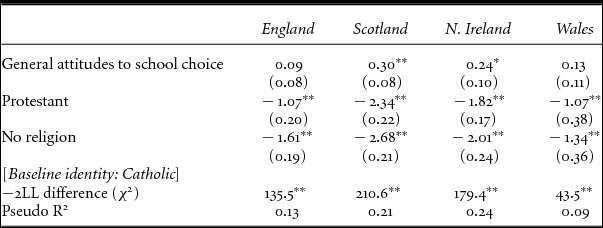
We should, of course, check that the differences of attitudes by religion we have uncovered (together with the weakness of the link between attitudes towards faith-based schooling and those towards the principle of school choice) are not a by-product of other, more important socioeconomic influences. To that end, we ran the same ordered logit regression model for each of the four parts of the UK. The model tests for the existence of a relationship between (i) religious identity and general attitudes towards school choice on the one hand and (ii) attitudes towards faith-based schools (measured on the original five-point scale but with higher scores indicating stronger support) on the other after controlling for the possible effect of respondent's age, occupational class, gender, household income, educational qualifications and whether they are a parent of a child living in the same household. The role of religious identity is measured by including one variable that identifies whether someone is Protestant or not and another that indicates whether they identify with any religion or not (thereby making Catholics the reference category). Those who identify with any other religious group have been excluded from these regressions.
Table 6 summarises the key results. The first row shows the coefficients for the effect of general attitudes towards school choice; they are all either small or insignificant, thereby confirming that attitudes towards the principle of school choice in general have relatively little to do with those towards faith-based schools in particular. The remaining coefficients show whether identifying as Protestant or as non-religious affects a respondent's rank order position on the dependent variable (from ‘strongly oppose’ to ‘strongly support’) as compared with identifying as Catholic. The estimates confirm that the religious gap documented in our bivariate analyses cannot be accounted for by other individual characteristics. The effect of the two religious variables is both large and significant at p < 0.01 in all four samples.
Ordered logit: the impact of general attitudes to school choice and religious identity on attitudes towards faith-based schools
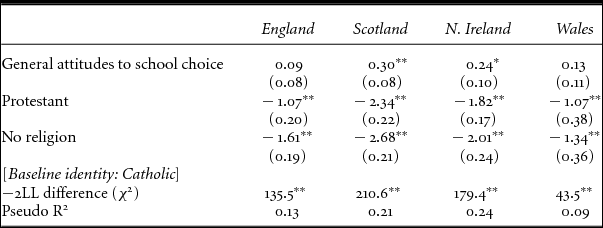
Notes: Dependent variable: attitudes towards faith schools (high values indicate support). Controls included for age, gender, household income, four occupational class dummies (baseline category: managers), two education dummies (baseline category: degree or higher), and parent of a child living in the same household dummy. Some estimates are excluded from the table for simplicity. Main cell entries are ordered log odds coefficients with standard errors in parentheses.
** p < 0.01 * p < 0.05
Source: British Social Attitudes 2007 (respondents living in England only); Scottish Social Attitudes 2007, Northern Ireland Life and Times 2007; Wales Life and Times 2007.
Moreover, the signs of the coefficients are all negative. This means that Protestants and the non-religious alike are significantly less likely to support faith-based schools than Catholics. In addition, these two religious coefficients are larger than those for any other of the predictors in the model (not shown). Therefore, religious identity appears to be a more important influence on attitudes towards faith-based schools than education level, occupational class, being a parent, gender or age, as well as general attitudes to school choice.Footnote 6 Meanwhile, as we would expect the religious coefficients are particularly large in Scotland and Northern Ireland.
Conclusion
In regarding the promotion of faith-based schools as an integral part of an agenda to widen school choice, Tony Blair was at odds with many of his fellow citizens. The principle of school choice is popular, as is indeed what in England at least has been one of the manifestations of a more diverse form of provision, namely secondary schools that specialise in a particular subject. However, faith-based schools are not regarded in the same light. Those who support the principle of school choice do not necessarily support the provision of faith-based schools. Rather people's attitudes to such schools reflect their religious identity and how far the provision of faith-based schools might be thought to promote the values and interests of the group with which they identify – though the degree to which this is the case depends on the extent to which that provision is largely the preserve of one religious group or of a plurality of groups.
Our research suggests further lines of inquiry. Is there indeed much support for faith-based schools in general at all, or are most people's views entirely conditional on the denomination or religion in question? This might be pursued by asking people about their attitudes towards a variety of different types of faith-based schools. Equally we might examine whether the provision of faith-based schools is the only form of more diverse provision to which those who otherwise endorse school choice take exception. Do those who back school choice necessarily back the idea of ‘free schools’ for example? Meanwhile we might need to refine our analysis by using survey questions specifically developed to measure social identity rather than affiliation. Such measures should include multi-item scales to gauge the cognitive and affective components of psychological group attachment. Finally, a more in-depth qualitative approach could help overcome some limitations of the quantitative paradigm, allowing us to develop a richer account of how the impact of people's social identities on their attitudes towards faith-based schooling varies across different religious and educational contexts.
Nevertheless, our findings dovetail with other empirical examinations that indicate that high public support for the principle of choice in public services does not necessarily reveal support for diversity of provision (Curtice and Heath, Reference Curtice, Heath, Park, Curtice, Phillips and Clery2009; Exley, Reference Exley2012). As might have been anticipated from the work of Clements (Reference Clements2010), we have shown that one reason why this can be the case is that rather than reflecting supposedly a-social, individualistic concerns, support for such diversity may be rooted in collective – and potentially antagonistic – social identities. Policy makers interested in pursuing public service reform, whether in the UK or elsewhere, cannot assume that apparent public enthusiasm for choice will necessarily translate into support for forms of provision that are seen to meet the needs and aspirations of a particular outgroup. Even in an age of new religious movements, religious syncretism, believing without belonging, and, of course, a general decline in traditional religious observance, the provision of faith-based schooling can still invoke religious identities that are far more powerful than any abstract commitment to choice.
Acknowledgments
This research was funded by the UK Economic and Social Research Council as part of its Public Services Research Programme (RES-166-25-0043). Further details of the programme can be found at www.publicservices.ac.uk<http://www.publicservices.ac.uk/>. We are grateful to colleagues at NatCen Social Research and the Northern Life and Times Survey for their help and support in conducting the survey work.