Significant outcomes
-
∙ A state of chronic anger may be associated with higher risk of stroke.
-
∙ Anger may also be a consequence of a stroke that led to brain lesions in specific areas.
-
∙ There is a paucity of studies on the association between anger and stroke.
Limitations
-
∙ The methodological assessment of anger varied among authors.
-
∙ There is no clear definition of ‘anger’ in some papers.
-
∙ The conclusions from different papers varied and therefore no uniform overall conclusion can be reached.
-
∙ There are few case-control studies assessing the potential relationship between stroke and anger.
Introduction
Anger is a strong feeling reflecting frustration, annoyance and belligerence towards people who are sources of real (or supposed) grievance and/or towards situations that seem to be uncontrollable. There are many words to define the degrees of anger, such as wrath, enragement, exasperation, irascibility and rage. When chronic, they all reflect a negative state of mind that goes beyond a natural emotional response that provides protection in dealing with unpleasant situations (Reference Beck and Fernandez1). The manifestations of anger are complex, and while some individuals mainly present a state of ‘anger-in’ (tendency to suppress anger), others present ‘anger-out’ (tendency to express anger through verbal or physical means) (Reference Guo, Zhang and Gao2).
An association between anger and cardiovascular disease has long been established. Patients with a psychological trait of chronic anger may be at increased risk of heart ischaemia and worse prognosis for its outcomes (Reference Pimple, Shah and Rooks3,Reference Shurlock4). There seems to be no higher prevalence of ‘anger-in’ or ‘anger-out’ traits of anger (as described above) among patients at risk of cardiovascular events (Reference Hosseini, Mokhberi, Mohammadpour, Mehrabianfard and Lashak5). Although detailed and methodologically sound, papers describing the association between anger and myocardial infarction exist in the literature (Reference Mostofsky, Penner and Mittleman6,Reference Suls7), there is a paucity of studies on a potential bidirectional association between anger and stroke (Reference Everson, Kaplan, Goldberg, Lakka, Sivenius and Salonen8,Reference Ramos-Perdigués, Mané-Santacana and Pintor-Pérez9). Stroke is a leading cause of mortality and morbidity in modern society (Reference Allen and Bayraktutan10), and it has trigger factors similar to those of coronary heart disease (Reference Mahmood, Levy, Vasan and Wang11). The association between stroke and anger is more complex than the association between heart disease and anger, since the location of the brain lesion may be a determinant of behaviour (Reference Ramos-Perdigués, Mané-Santacana and Pintor-Pérez9). Thus, a patient who suffers a stroke and presents anger as a manifestation of the brain lesion may be at risk of further cardiovascular and cerebrovascular disease because of these sequelae. The present paper systematically reviews the potential association between anger and stroke.
Strategy for literature search
The present work followed the recommendations of the Preferred Reporting Items for Systematic Reviews and Meta-Analyses (PRISMA) statement (Reference Moher, Liberati, Tetzlaff and Altman12). Using the population (patients with stroke), intervention (anger), comparison (control) and outcomes (stroke) framework (PICO) (Reference Schardt, Adams, Owens, Keitz and Fontelo13), the authors independently searched for the terms ‘anger’ AND ‘stroke’ OR ‘cerebrovascular’ in the following databases: Medline, PubMed, Scopus, Index Medicus, Biomed Central, LILACS, SciELO, Google Scholar and the Cochrane Database of Systematic Reviews. There was no limit on the starting date in the search that ended in December 2015. Abstracts of articles in any language containing these words in English (in the title, keywords or abstract) were independently reviewed by all authors individually, and then discussed among groups of two or three authors. The list of references of each paper considered to be pertinent to the systematic review was also carefully searched for other potential papers on the subject. Following this initial search, a meeting with all the authors was organised. This meeting was part of the strategy for the systematic review. All papers considered relevant to the review by at least one author were voted by all to decide whether it should really be included.
The outcomes were ‘anger prior to stroke’, ‘anger in association with stroke onset’ and ‘anger post-stroke’. Only articles presenting original work with analysis of at least one of the previously mentioned outcomes among patients with stroke were included. Abstracts from scientific meetings, review papers, anecdotal case reports, validation of assessment tools, comments on other papers, duplicate articles and editorials were excluded. Every effort was made to obtain the full text of all relevant articles, thus resulting in a list of relevant studies fulfilling the data strategy. The present systematic review did not include meta-analyses on results. The studies assessed reported essentially on the prevalence of outcomes (anger associated with stroke) and not interventions.
Results
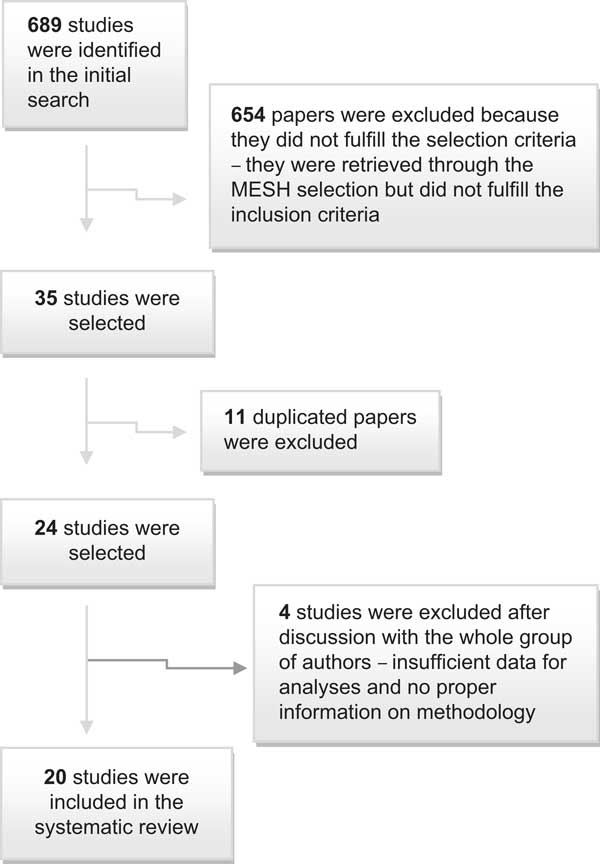
Figure 1 shows the summary from the article search and retrieval of relevant papers. After the initial search and exclusion, 25 papers were taken for detailed analyses and discussion by the authors. These papers fulfilled the inclusion criteria. However, four of these papers were subsequently excluded because either they did not present sufficient information or because their methods of assessment were inadequate. The decision to exclude these papers was based on the excessive confounders they could introduce in the present review. In short, 21 papers were selected as fulfilling the selection criteria and were included in the systematic review (Reference Everson, Kaplan, Goldberg, Lakka, Sivenius and Salonen8,Reference Williams, Nieto, Sanford, Couper and Tyroler14–Reference Farinelli, Panksepp and Gestieri33). They all included adults aged 18 years and above.
Flow diagram of articles selected for the systematic review on the association between anger and stroke. In total, 654 papers were excluded through the initial assessment because their titles were misleading. Some of them dealt with stroke, and some with anger, but all of them had perspectives differing from the ones that we considered to be inclusion criteria. The further exclusion of four papers after group discussion was due to insufficient data for analyses or inadequate methodology.

Eight papers were from the United States (Reference Everson, Kaplan, Goldberg, Lakka, Sivenius and Salonen8,Reference Williams, Nieto, Sanford, Couper and Tyroler14,Reference Eng, Fitzmaurice, Kubzansky, Rimm and Kawachi15,Reference Everson-Rose, Roetker and Lutsey17,Reference Wang and Smyers21,Reference Paradiso, Robinson and Arndt22,Reference Nakhutina, Borod and Zgaljardic27,Reference Chang, Zhang, Xia and Chen29), three from South Korea (Reference Kim, Choi, Kwon and Seo24,Reference Choi-Kwon, Han and Kwon28,Reference Choi-Kwon, Han and Cho30) and two from Italy (Reference Santos, Caeiro, Ferro, Albuquerque and Luísa-Figueira25,Reference Farinelli, Panksepp and Gestieri33) and Switzerland (Reference Ghika-Schmid, Van Melle, Guex and Bogousslavsky23,Reference Aybek, Carota and Ghika-Schmid26), whereas other countries contributed with one paper each: Israel (Reference Koton, Tanne, Bornstein and Green20), Portugal (Reference Santos, Caeiro, Ferro, Albuquerque and Luísa-Figueira25), Japan (Reference Ohira16), Canada (Reference Nobel, Mayo, Hanley, Nadeau and Daskalopoulou18), Taiwan (Reference Huang, Huang and Hu32) and India (Reference Sharma, Prasad and Padma19). Eight studies were observational (Reference Sharma, Prasad and Padma19,Reference Koton, Tanne, Bornstein and Green20,Reference Paradiso, Robinson and Arndt22,Reference Kim, Choi, Kwon and Seo24–Reference Aybek, Carota and Ghika-Schmid26,Reference Choi-Kwon, Han and Cho30,Reference Huang, Huang and Hu32); four were case-control studies (Reference Wang and Smyers21,Reference Nakhutina, Borod and Zgaljardic27,Reference Toscano, Viganò and Puledda31,Reference Farinelli, Panksepp and Gestieri33); one was longitudinal over 4 days (Reference Ghika-Schmid, Van Melle, Guex and Bogousslavsky23) and six were population-based epidemiological studies (Reference Everson, Kaplan, Goldberg, Lakka, Sivenius and Salonen8,Reference Williams, Nieto, Sanford, Couper and Tyroler14–Reference Nobel, Mayo, Hanley, Nadeau and Daskalopoulou18). Two studies were clinical trials for specific treatment of psychological disorders after the stroke (Reference Choi-Kwon, Han and Kwon28,Reference Chang, Zhang, Xia and Chen29).
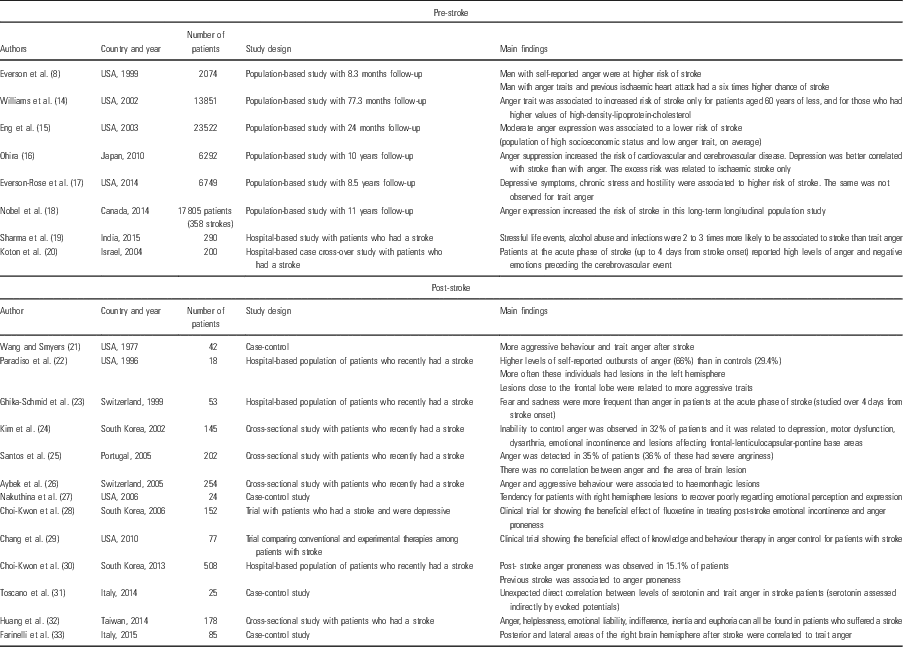
The most frequently used tool for assessing anger was the ‘Spielberger Anger Expression Scales’, which were used in nine studies (Reference Williams, Nieto, Sanford, Couper and Tyroler14–Reference Everson-Rose, Roetker and Lutsey17,Reference Kim, Choi, Kwon and Seo24,Reference Choi-Kwon, Han and Kwon28–Reference Toscano, Viganò and Puledda31). Other papers made use of the ‘Onset Anger Scale’ (Reference Sharma, Prasad and Padma19), ‘Stroke Risk Calculator’ (Reference Nobel, Mayo, Hanley, Nadeau and Daskalopoulou18), ‘Emotional and Social Dysfunction Questionnaire’ (Reference Huang, Huang and Hu32), ‘Affective Neuroscience Personality Scale’ (Reference Farinelli, Panksepp and Gestieri33), ‘Attachment Style Questionnaire’ (Reference Farinelli, Panksepp and Gestieri33), ‘Catastrophic Reaction Scale’ (Reference Santos, Caeiro, Ferro, Albuquerque and Luísa-Figueira25), ‘Mania Rating Scale’ (Reference Santos, Caeiro, Ferro, Albuquerque and Luísa-Figueira25), ‘Emotional Behavior Index’ (Reference Aybek, Carota and Ghika-Schmid26), ‘Comprehensive Psychopathologic Rating Scale’ (Reference Santos, Caeiro, Ferro, Albuquerque and Luísa-Figueira25) and also scales that had been specifically designed for that particular study (Reference Everson, Kaplan, Goldberg, Lakka, Sivenius and Salonen8,Reference Koton, Tanne, Bornstein and Green20–Reference Ghika-Schmid, Van Melle, Guex and Bogousslavsky23,Reference Nakhutina, Borod and Zgaljardic27). All of the scales were used either separately or in association with each other in the different studies. Seven papers assessed anger as a potential causal risk factor for stroke (Reference Everson, Kaplan, Goldberg, Lakka, Sivenius and Salonen8,Reference Williams, Nieto, Sanford, Couper and Tyroler14–Reference Koton, Tanne, Bornstein and Green20) and 14 papers assessed anger post-stroke (Reference Wang and Smyers21–Reference Farinelli, Panksepp and Gestieri33). A summary of the results from these 21 papers is presented in Table 1.
Summary of data from papers selected in this systematic review

Discussion
The physiological response to stressful situations like anger includes haemodynamic and cardiac changes that seem to be able to lead to coronary heart disease or stroke. A sudden or sustained state of catecholamine secretion in the bloodstream (typical of anger reactions), may exert effects on the myocardium and the smooth muscle of blood vessels. Although the relationship between anger and ischaemic heart disease is well documented, the same is not observed in relation to stroke. The present systematic review showed that there are few studies correlating anger and stroke, and they use very different methodological approaches to this matter. Although anger is a potential risk factor for heart disease, it seems to be involved both as a cause and as a consequence of the cerebrovascular event in stroke cases. In analysing only 20 papers with different methodological approaches to these questions, the relationship between anger and stroke seemed to go both ways. The conflicting observations of this review were that anger traits were often reported as being remarkably associated with higher risk of stroke (Reference Everson, Kaplan, Goldberg, Lakka, Sivenius and Salonen8,Reference Williams, Nieto, Sanford, Couper and Tyroler14), or not (Reference Everson-Rose, Roetker and Lutsey17,Reference Sharma, Prasad and Padma19). In fact, one study showed that moderate anger can be a protective factor against stroke (Reference Eng, Fitzmaurice, Kubzansky, Rimm and Kawachi15), and others reported that the trait of anger is not a frequently felt feature observed after a stroke (Reference Ghika-Schmid, Van Melle, Guex and Bogousslavsky23,Reference Huang, Huang and Hu32). These findings may reflect results from papers with various methodological approaches, with different populations of patients, and with a mixture of outcomes assessed by some studies but not by others. Brain lesions caused by stroke might be associated with anger if they occurred in the left brain hemisphere (Reference Paradiso, Robinson and Arndt22), or in the right (Reference Nakhutina, Borod and Zgaljardic27,Reference Farinelli, Panksepp and Gestieri33). However, one paper reported that no correlation between anger and specific areas of brain lesions could be established (Reference Santos, Caeiro, Ferro, Albuquerque and Luísa-Figueira25). Although one paper correlated anger with lesions in the frontal-lenticulocapsular-pontine base areas (Reference Kim, Choi, Kwon and Seo24), another correlated anger with haemorrhagic lesions (Reference Aybek, Carota and Ghika-Schmid26).
Other relevant findings were that more prominent cognitive dysfunction was observed among patients with stroke and anger than among those with stroke, but without the trait of anger (Reference Wang and Smyers21). The only papers on treatment showed that fluoxetine and behavioural techniques may be appropriate approaches for the emotional disturbances (including anger) that follow stroke (Reference Choi-Kwon, Han and Kwon28,Reference Chang, Zhang, Xia and Chen29).
A review on the prevalence of anger and other psychological disorders after stroke was published recently (Reference Ramos-Perdigués, Mané-Santacana and Pintor-Pérez9). That paper differs from the present one, since the authors of that review only used Medline as the search tool. Furthermore, only papers written in the English language were searched for, and the authors addressed the trait of anger after the stroke episode, but not as a risk factor. In addition, other psychological characteristics were also part of that review. Those authors concluded that anger can be a trait after stroke in 15–57.2% of patients, but standard tools to assess psychiatric outcomes after an ictus are of essence in future studies (Reference Ramos-Perdigués, Mané-Santacana and Pintor-Pérez9).
The present study highlighted the conflicting aspects of this potential association between anger and stroke. There are not many studies on this subject, and the results are not consistent. Confounders must be taken into consideration, since age, gender, geographical location, comorbidities, family life and social support may all have influenced the presence of ‘anger’ as an emotion in the studied subjects. Some of these confounders can be easily identified when, for example, population-based studies analyse data over just over 8 months (Reference Everson, Kaplan, Goldberg, Lakka, Sivenius and Salonen8,Reference Everson-Rose, Roetker and Lutsey17), 24 months (Reference Eng, Fitzmaurice, Kubzansky, Rimm and Kawachi15), and many years (Reference Williams, Nieto, Sanford, Couper and Tyroler14,Reference Ohira16,Reference Nobel, Mayo, Hanley, Nadeau and Daskalopoulou18) of follow-up. Likewise, comparison of data between the general population (Reference Everson, Kaplan, Goldberg, Lakka, Sivenius and Salonen8,Reference Williams, Nieto, Sanford, Couper and Tyroler14–Reference Nobel, Mayo, Hanley, Nadeau and Daskalopoulou18) and hospitalised individuals (Reference Sharma, Prasad and Padma19,Reference Koton, Tanne, Bornstein and Green20) can generate confusion in the analyses. Data on patients who presented a stroke in different continents may generate further confounders, since there is no uniform health system care for these patients. The Table summarises data from patients with a stroke seen at the USA (Reference Wang and Smyers21,Reference Paradiso, Robinson and Arndt22,Reference Nakhutina, Borod and Zgaljardic27,Reference Chang, Zhang, Xia and Chen29), Europe (Reference Ghika-Schmid, Van Melle, Guex and Bogousslavsky23,Reference Santos, Caeiro, Ferro, Albuquerque and Luísa-Figueira25,Reference Aybek, Carota and Ghika-Schmid26,Reference Toscano, Viganò and Puledda31,Reference Farinelli, Panksepp and Gestieri33) and Asia (Reference Kim, Choi, Kwon and Seo24,Reference Choi-Kwon, Han and Kwon28,Reference Huang, Huang and Hu32). Cultural, dietary and religious habits from these different continents may render the results extremely difficult to compare when the outcome is the ‘feeling’ of anger.
Conclusion
The potential association between anger and stroke needs to be studied in a systematic manner in order to clarify the very important issues of prevention and sequelae. Many of these matters remain ill-defined. Further research should include large and multicenter databases, using uniform methods for patient evaluation.
Acknowledgements
Author contributions: Y.D.F. designed the study, supervised the work and wrote the final version of the paper. P.B.R., B.O., F.B., R.W.D., R.P.D., T.N. and J.T.A. worked on the systematic review and critically reviewed all stages of the paper drafts. All authors agree with the final version of the paper.
Financial Support
There was no private or public funding given to this work at any time.
Conflicts of Interest
There are no conflicts of interests to declare.