

This article has been written to give the reader an opportunity to increase their knowledge and understanding of the preoperative assessment processes and investigations that are completed in order for practitioners to evaluate their fitness to undertake major arthroplasty surgery.
The author works within a pre-assessment unit where orthopaedic patients are assessed prior to major arthroplasty surgery. Patients with a multitude of orthopaedic conditions are assessed; however, for the purpose of this article the author will limit the discussion to patients requiring elective major arthroplasty surgery, in particular total knee replacements (TKR) or total hip replacements (THR).
A particular aspect of this group of patients is that their mobility is reduced to varying degrees. Although this is commonly due to their actual orthopaedic condition, other co-morbidities also significantly contribute to this. As a result, it is more difficult for the pre-assessment practitioners to accurately assess a patient’s cardiovascular functional reserve from history and observation alone.
Assessing a patient’s cardiovascular functional reserve (in terms of metabolic equivalents (METs)) is a useful way of assessing a patient’s ability to meet the increased metabolic demands posed by major surgery (Hudson and Shinner, Reference Hudson and Shinner2006). The author will discuss the various risk-scoring systems used to predict the perioperative risk and discuss the investigations available to objectively assess patients’ cardiovascular functional reserve preoperatively. The objective is to risk stratify and appropriately modify perioperative clinical management of these patients with the aim of reducing mortality and morbidity.
Rheumatoid arthritis (RA) is a chronic systematic inflammatory condition that affects the synovial lining of the moveable joints. Its prevalence increases with advancing years, with the peak onset falling between 35–50 years, and causes progressive joint destruction and reduces life expectancy. Cardiovascular disease is an additional dimension of this condition due to the inflammatory component (Oliver, Reference Oliver2007). Osteoarthritis (OA) is a common degenerative joint disease, which results in erosion of the cartilage that lines the bone ends. It can be idiopathic in origin or caused by previous trauma to the joint or its surrounding supporting structures. With both conditions, the patient can present with swelling of the joint, pain, reduced range of movement, loss of function, abnormal gait, limited mobility, deformity of limbs (Genu varum and Genu varus) and reduced quality of life, which in some cases causes altered mood (Judge, Reference Judge2007). THR and TKR are usually very successful; however, with an aging population the demand for the surgery is increasing, with the patients presenting for surgery doing so with co-existing morbidities. The leading causes of perioperative morbidity and mortality following non-cardiac surgery are cardiac complications (Romero and de Virgilio, Reference Romero and de Virgilio2001, p. 1370).
The purpose of preoperative assessment is to evaluate a patient’s current medical status, identify systemic problems likely to have an impact on perioperative period and draft a clinical risk profile that will aid the practitioner and anaesthetist to effectively manage the issues. It may be necessary to further evaluate and optimise the patient’s medical conditions (Eagle et al., Reference Eagle, Berger, Calkins, Chaitman, Ewy, Fleischmann, Froehlich, Gusberg, Leppo, Ryan, Schlant and Winters2002, p. 3). Initial preoperative investigations performed are listed in the table below.

Perioperative risk for any adverse surgical or medical outcome depends on the following:
1. Surgery specific risk: Different surgical procedures have different cardiac outcomes. The surgery specific cardiac risk is related to two factors: type of surgery and degree of haemodynamic cardiac stress associated with the particular surgical procedure (Priebe, Reference Priebe2000); see table below.

2. Patient’s clinical risk factors: Should be illustrated in the medical history and identify classification of risk (Eagle et al., Reference Eagle, Berger, Calkins, Chaitman, Ewy, Fleischmann, Froehlich, Gusberg, Leppo, Ryan, Schlant and Winters2002, p. 5); see table below.

3. Functional capacity: It is one of the most important indicators of perioperative outcome (Priebe, Reference Priebe2000). This is evaluated in practice by using Dukes Activity Status Index; see table below.
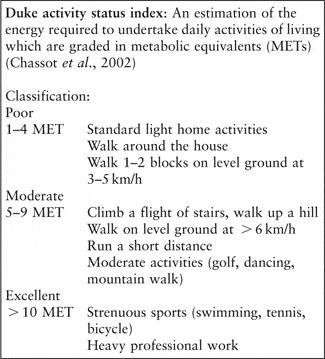
Once the above three factors have been evaluated, the level of perioperative risk can be defined and used as a guide for preoperative non-invasive cardiac testing (Lavi et al., Reference Lavi, Lavi, Daghini and Lerman2007, p. 1019). Using the algorithm by Chassot et al. (Reference Chassot, Delabays and Spahn2002), only patients who are assessed at being intermediate or high risk and with <4 METs for intermediate orthopaedic surgery would be considered for further non-invasive cardiac testing.
A vast majority of orthopaedic patients are unable to meet a 4-MET demand. The causes of this decreased functional capacity are: inadequate cardiac/pulmonary reserve, advanced age, myocardial ischaemia, deconditioning (Eagle et al., Reference Eagle, Berger, Calkins, Chaitman, Ewy, Fleischmann, Froehlich, Gusberg, Leppo, Ryan, Schlant and Winters2002, p. 20) and functional limitations by orthopaedic conditions such as RA, OA, osteoporosis, ankylosing spondylitis, polymyalgia rhuematica and spinal conditions (lordosis, kyphosis and scoliosis) (Estes, Reference Estes2006).
The major aim of further non-invasive cardiac testing is to provide an objective measure of functional capacity, identify the presence of myocardial ischaemia, estimate cardiac risk and identify the long-term prognosis. The goal would then be to improve the outcome with medical management or coronary revascularisation procedures (Eagle et al., Reference Eagle, Berger, Calkins, Chaitman, Ewy, Fleischmann, Froehlich, Gusberg, Leppo, Ryan, Schlant and Winters2002, p. 20). However, if no improvement is possible it would not be deemed necessary to deal with preoperatively. Similarly, the outcome of a patient with active coronary artery disease will not be modified by screening tests (Chassot et al., Reference Chassot, Delabays and Spahn2002).
Stress testing (Dipyridamole-thallium scintigraphy (DTS), Dobutamine stress echocardiography (DSE), exercise ECG) are non-invasive cardiac tests that provide information on ischaemic threshold, maximum tolerated heart rate, localisation and amount of threatened myocardium (Chassot et al., Reference Chassot, Delabays and Spahn2002). Exercise ECG should be used as the first non-invasive test for ambulatory patients; however, most orthopaedic conditions would prevent the patient reaching the needed 85% targeted heart rate (Eagle et al., Reference Eagle, Berger, Calkins, Chaitman, Ewy, Fleischmann, Froehlich, Gusberg, Leppo, Ryan, Schlant and Winters2002, p. 20). Therefore, for patients who can not exercise, DTS or DSE would be the alternative tests (Jin and Chung, Reference Jin and Chung2001).
Older and Hall (Reference Older and Hall2005) opine that the only way to obtain functional capacity measurements objectively is to perform cardiopulmonary exercise testing (CPET); this test simultaneously evaluates ventricular function, respiratory function and myocardial function using a bicycle. CPET provides a means to distinguish cardiac from pulmonary induced dyspnoea (Fleg et al., Reference Fleg, Pina, Balady, Chaitman, Fletcher, Lavie, Limacher, Stein, Williams and Bazzarre2000, p. 1594). However, this test is also not suitable for a majority of orthopaedic patients as it requires a stationary bicycle ride for ten minutes, which equates to 5–9 MET score. If the patient could achieve this MET score they would not be considered for further non-invasive cardiac testing.
The literature reviewed by the author also recognises the importance of evaluating a given patient’s risk of coronary heart disease (CHD)/ischaemia rather than functional capacity. This is important, as those with debilitating conditions such as rheumatoid/osteoarthritis are not always suited to such studies. These conditions manifest with joint inflammation, stiffness, deformity, decreased joint mobility, restriction of movement, excessive weakness and fatigue, and have aggravating factors such as obesity, mental depression, insomnia, anxiety and social withdrawal (Estes, Reference Estes2006). It must be recognised that a few high-risk patients are willing to accept the relatively large risks explained to them by the anaesthetist, just in order to get rid of the pain and debility they suffer on a daily basis, seriously compromising their quality of life. Therefore, the author wonders whether there is any benefit in delaying their surgery for the sake of an academic exercise to accurately assess the cardiac risk, whilst also recognising that these tests may not always be amenable to their individual needs.

In this instance, is there not enough evidence to proceed with surgery with the use of a beta-blockade perioperatively? If the patient could achieve >5 MET with the same intermediate surgery risk the algorithm provides for proceeding with beta blockade. It is therefore the skill and clinical experience of the practitioner to objectively evaluate the patient holistically, paying diligent regard to ‘flare-ups’ and advancing arthritic conditions, and the consequent deterioration in mobility and quality of life rather than focussing only on the possible deterioration due to underlying CHD.
Current evidence suggests that perioperative treatment with beta-blockers is widely advocated, and is associated with reduced myocardial infarction and death after non-cardiac surgery, especially among patients with intermediate/high risk (Lindenauer et al., Reference Lindenauer, Pekow, Wang, Mamidi, Gutierrez and Evan2005, p. 360). The American College of Cardiology/American Heart Association have revised the beta-blocker policy of their 2002 guidelines on perioperative evaluation for non-cardiac surgery. This recommends the continuation of beta-blockers for patients already taking them, and that beta-blockers may be considered in patients undergoing intermediate/high risk procedures who have a single risk factor (Fleisher et al., Reference Fleisher, Beckman, Brown, Calkins, Chaikof, Fleischmann, Freeman, Froehlich, Kasper, Kersten, Riegel and Robb2007, p. 18).
The author recognises that pre-assessment is a key process for the orthopaedic patient in minimising the morbidity and mortality of surgery. Effective preoperative risk stratification may modify preoperative therapy, surgical approach, choice of anaesthetic technique/agents, perioperative monitoring and post-operative care. Preoperative cardiac evaluation, especially in terms of measuring functional reserve in patients with advanced arthritis, is not a simple task, cannot be applied uniformly and is multi-factorial. It encourages collaborative working between pre-assessment practitioners and anaesthetists, achieving patient-centred individualised care, with uniform documentation of patient evaluation. Since the introduction of the 18-week target for all elective surgery by December 2008 (Department of Health, 2004), pre-assessment units are under increasing pressure to evaluate and optimise each patient appropriately for surgery and ensure timely admission and discharge, allowing other patients to follow suit.


