INTRODUCTION
An estimated 78% of combat injuries from Operations Enduring and Iraqi Freedom and New Dawn (OEF/OIF/OND) are associated with blasts (Owens et al., Reference Owens, Kragh, Wenke, Macaitis, Wade and Holcomb2008). Research has focused on the neuropsychological sequelae of concussions (or mild traumatic brain injuries) due to blasts. However, exposures to blasts even without concussion symptoms are common, with nearly half of soldiers who have not experienced a blast-related concussion reporting being near two or more explosions (Hoge et al., Reference Hoge, McGurk, Thomas, Cox, Engel and Castro2008). The long-term consequences of blast exposure as a mechanism independent of concussion, remain unclear. Here, we examine the cognitive effects of blasts at close range in OEF/OIF/OND Veterans, independent of whether blasts were reported as having resulted in concussion symptoms at the time of exposure.
Studies examining blast have primarily defined the injury based on symptoms of concussion experienced at the time of the event. Findings have been inconsistent, with some studies reporting structural and functional changes related to blast concussion (Davenport, Lim, Armstrong, & Sponheim, Reference Davenport, Lim, Armstrong and Sponheim2012; Han et al., Reference Han, Mac Donald, Johnson, Barnes, Wierzechowski, Zonies and Brody2014; Mendez et al., Reference Mendez, Owens, Reza Berenji, Peppers, Liang and Licht2013; MacDonald, Barber, Andre, et al., Reference MacDonald, Barber, Andre, Evans, Panks, Sun and Temkin2017; MacDonald, Barber, Jordan, et al., Reference MacDonald, Barber, Jordan, Johnson, Dikmen, Fann and Temkin2017; Petrie et al., Reference Petrie, Cross, Yarnykh, Richards, Martin, Pagulayan and Peskind2013), and some finding no changes (Jorge et al., Reference Jorge, Acion, White, Tordesillas-Gutierrez, Pierson, Crespo-Facorro and Magnotta2012; Levin et al., Reference Levin, Wilde, Troyanskaya, Petersen, Scheibel, Newsome and Li2010). To explain these disparate findings, researchers have focused on factors other than concussion that may contribute to cognitive complaints. These include poor effort (Clark, Amick, Fortier, Milberg, & McGlinchey, Reference Clark, Amick, Fortier, Milberg and McGlinchey2014) and common co-occurring mental and physical health conditions including posttraumatic stress disorder (PTSD), pain, sleep quality, and substance use (Armstrong, Zald, & Olatunji, Reference Armstrong, Zald and Olatunji2011; Clark, Oscar-Berman, Shagrin, & Pencina, Reference Clark, Oscar-Berman, Shagrin and Pencina2007; Fortier-Brochu, Beaulieu-Bonneau, Ivers, & Morin, Reference Fortier-Brochu, Beaulieu-Bonneau, Ivers and Morin2012; Golinkoff & Sweeney, Reference Golinkoff and Sweeney1989; Iudicello et al., Reference Iudicello, Weber, Grant, Weinborn and Woods2011; Kim et al., Reference Kim, Yang, Lee, Lee, Youn and Cho2015; MacNamara & Proudfit, Reference MacNamara and Proudfit2014; Miller, Reference Miller2015; Montgomery, Seddon, Fisk, Murphy, & Jansari, Reference Montgomery, Seddon, Fisk, Murphy and Jansari2012; Piechatzek et al., Reference Piechatzek, Indlekofer, Daamen, Glasmacher, Lieb, Pfister and Schutz2009; Rourke & Grant, Reference Rourke and Grant2009; Solowij & Battisti, Reference Solowij and Battisti2008). In fact, many have concluded that the persistent cognitive changes initially thought to stem from concussion are more likely attributable to these other health conditions (Belanger, Kretzmer, Yoash-Gantz, Pickett, & Tupler, Reference Belanger, Kretzmer, Yoash-Gantz, Pickett and Tupler2009; Brenner et al., Reference Brenner, Terrio, Homaifar, Gutierrez, Staves, Harwood and Warden2010; Cooper, Chau, Armistead-Jehle, Vanderploeg, & Bowles, Reference Cooper, Chau, Armistead-Jehle, Vanderploeg and Bowles2012; Lippa, Pastorek, Benge, & Thornton, Reference Lippa, Pastorek, Benge and Thornton2010; Luethcke, Bryan, Morrow, & Isler, Reference Luethcke, Bryan, Morrow and Isler2011; Neipert et al., Reference Neipert, Pastorek, Troyanskaya, Scheibel, Petersen and Levin2014; O’Neil et al., Reference O’Neil, Carlson, Storzbach, Brenner, Freeman, Quinones and Kansagara2014; Soble, Spanierman, & Fitzgerald Smith, Reference Soble, Spanierman and Fitzgerald Smith2013; Verfaellie, Lafleche, Spiro, Tun, & Bousquet, Reference Verfaellie, Lafleche, Spiro, Tun and Bousquet2012).
We agree that the above factors play a role in Veterans’ functioning; however, one factor that has received little attention that may contribute to poor outcome is proximity to blast, even if symptoms of concussion at the time of the exposure are not evident. Recent neuroimaging work has identified altered white matter integrity associated with blast exposure, even when the blast was not associated with concussion (Bazarian et al., Reference Bazarian, Donnelly, Peterson, Warner, Zhu and Zhong2012; Taber et al., Reference Taber, Hurley, Haswell, Rowland, Hurt, Lamar and Morey2015). Similarly, two neuroimaging studies using the Translational Research Center for TBI and Stress Disorders (TRACTS) cohort found white matter alterations (Trotter et al., Reference Trotter, Robinson, Milberg, McGlinchey and Salat2015) and functional connectivity changes (Robinson, Lindemer, et al., Reference Robinson, Lindemer, Fonda, Milberg, McGlinchey and Salat2015) due to blast exposure, regardless of whether concussion was incurred. Importantly, both studies adjusted for many comorbid conditions, including PTSD. Trotter et al. reported cross-sectional age-related trends that differed in Veterans with blast exposure, suggesting that blast exposures produce changes that may be progressive. Robinson et al. examined proximity to blast, finding alterations in functional connectivity specific to close-range blasts (within 10 m). Together, these studies found that the effect(s) of blast were independent of comorbid factors and could occur in the absence of concussion.
An important next step is to determine whether these brain changes are associated with changes in cognition. To our knowledge, only one study has examined the impact of blast exposure on neuropsychological function. Storzbach et al. (Reference Storzbach, O’Neil, Roost, Kowalski, Iverson, Binder and Huckins2015) examined performance on various neuropsychological tests across groups of Veterans with blast concussion, blast exposure, no blast exposure, and civilian controls. They noted no differences between concussed and nonconcussed blast-exposed Veterans on cognitive performance. All blast-exposed Veterans were then compared to those without blast exposure, finding group differences in learning and memory. However, adjusting for PTSD eliminated significant group findings on all cognitive measures except immediate and delayed recall. The authors concluded that most if not all of the group differences in cognitive functioning were related to PTSD. However, blast exposure, independent of concussion, was associated with impaired memory function. The present study expands on the approach of Storzbach et al. (Reference Storzbach, O’Neil, Roost, Kowalski, Iverson, Binder and Huckins2015) by considering the relationship between blast proximity and cognitive functioning. Psychosocial factors known to impact cognitive functioning (e.g., sleep quality, pain, substance use disorder) are considered and evaluation of TBI and PTSD is obtained through standardized clinician-administered interviews with the former evaluating for not only blast-associated, but also lifetime, TBI.
In the current analysis, we examined impact of blast exposure on cognitive function in a large, well-characterized cohort of OEF/OIF/OND Veterans. Specifically, we explored relationships between close-range blast exposure (i.e., blast exposures within 10 m, regardless of concussion history, similar to Robinson, Lindermer, et al., Reference Robinson, Lindemer, Fonda, Milberg, McGlinchey and Salat2015) and performance on standardized neuropsychological measures.
Our primary hypothesis was that Veterans who had been in close proximity of a blast explosion would perform more poorly on cognitive measures than those who had not. Subsequent analyses explored aspects of the complicated histories of head trauma that are common in this cohort. Specifically, we consider the role of blast-related concussion in determining cognitive outcomes, as well as the role of multiple exposures to more distant blasts.
METHODS
Participants
This report reflects data from the first 450 consecutively enrolled participants in TRACTS, a VA RR&D TBI National Research Center at VA Boston Healthcare System (VABHS). TRACTS recruitment, exclusions, and study procedures were approved by the VABHS Institutional Review Board, and are described in detail elsewhere (McGlinchey, Milberg, Fonda, & Fortier, Reference McGlinchey, Milberg, Fonda and Fortier2017). For this report, we further excluded participants who had not yet been deployed (n=22); reported a history of moderate or severe TBI or brain surgery (n=20); failed validity measures on the Medical Symptom Validity Test (Green, Reference Green2004) (n=49) or obtained a score of ≤14 on the Forced Choice trial of the California Verbal Learning Test–2nd Edition (Delis, Kramer, Kaplan, & Ober, Reference Delis, Kramer, Kaplan and Ober1999) (n=5); or self-identified as having other psychiatric diagnoses with known cognitive symptoms (e.g., attention deficit hyperactivity disorder) (n=1). Participants with missing information for at least one covariate were excluded from the applicable statistical tests and thus are not reflected in our demographic information. A final sample size of 289–333, depending on the analysis, was included. Proximity to blast was used as a proxy for blast severity. Participants who reported having been within 10 meters of at least one blast were assigned to the Close-Range Blast Exposure group (CBE, n=144), and those who had not been within 10 meters of a blast were assigned to the Non-Close-Range Blast Exposure group (nonCBE, n=189).
Blast and traumatic brain injury assessment
History of head trauma and blast exposure were assessed using the Boston Assessment of TBI–Lifetime [BAT-L, (Fortier et al., Reference Fortier, Amick, Grande, McGlynn, Kenna, Morra and McGlinchey2013)]. This clinician-administered semi-structured interview was validated at TRACTS and developed in conjunction with the Neuropsychology and Polytrauma Services at VA BHS. It is intended to assess head trauma across the lifetime with emphasis on the types of trauma often encountered in this cohort. Military and non-military TBI events were documented. Diagnoses were reviewed at consensus meetings consisting of at least three doctoral-level psychologists, using Department of Defense criteria to grade TBI severity. A diagnosis of mild TBI was operationally defined as a period of altered mental status, post-traumatic amnesia (up to 24 hr), or loss-of-consciousness (up to 30 min) immediately following a head injury or exposure to blast munitions (Management of Concussion/mTBI Working Group, 2009). As degree of detail varied across participants and blast events, distance guidelines were used to classify each blast event into Close, Medium, and Far ranges during the interview (0–10 meters, “length of two parking spaces”; 11–25 meters, “distance from home to 1st base on a baseball diamond”; and 26–100 meters, “length of football field,” respectively). Exploratory analyses included a distant blast exposure (DBE) classification for participants endorsing exposure of 11–100 meters.
Neuropsychological assessment
Verbal memory was examined with the CVLT-II and included the following scores: Total List Learning (Trials 1–5), Short/Long Delay Free/Cued Recall (SDFR, SDCR, LDFR, LDCR), and Recognition Hits (RH) (Delis, Kramer, Kaplan, & Ober, Reference Delis, Kramer, Kaplan and Ober1999). Forced Choice served as a validity measure with cutoff of ≤14. Eighteen participants scored 15/16, but were retained in the analysis unless they failed MSVT validity cut-offs (described below).
Executive functions were evaluated using the Delis Kaplan Executive Function System [DKEFS; (Delis, Kaplan, & Kramer, Reference Delis, Kaplan and Kramer2001)]. The following DKEFS scores were used: Trail Making Test Number-Letter Switching Task (Condition 4) time to complete; Color-Word Interference Test time to complete the Inhibition Trial and Inhibition/Switching Trial; and letter fluency, category fluency, and category switching fluency total scores.
The Test of Variables of Attention [TOVA; (Greenberg & Waldmant, Reference Greenberg and Waldmant1993)] assessed attention and complex attention processes. Attention Performance Index was generated from response consistency, response time, and errors of omission and commission.
Medical Symptom Validity Test (MSVT) is a computerized test of cognitive effort and memory that includes recollection of semantically-related word pairs (Green, Reference Green2004). Intact performance on the MSVT has been documented in patients with significant neurological disease (e.g., dementia, TBI). As such, poor performance on the MSVT is thought to reflect invalid performance. Participants with MSVT recall indicative of invalid performance (85% or less) were excluded.
Clinical assessment
The full details of the clinical assessment for TRACTS have been described elsewhere (McGlinchey et al., Reference McGlinchey, Milberg, Fonda and Fortier2017). In brief, current PTSD was diagnosed using the Clinician Administered PTSD Scale [CAPS, (Blake et al., Reference Blake, Weathers, Nagy, Kaloupek, Gusman, Charney and Keane2006)]. Current substance use disorder was assessed with the Structured Clinical Interview for DSM-IV Disorders (SCID; First, Spitzer, Gibbon & Williams, Reference First, Spitzer, Gibbon and Williams1996). Self-reported pain symptoms were evaluated with the Short Form of the McGill Pain Questionnaire [SF-MPQ, (Melzack, Reference Melzack1987)]. Participants were classified as either endorsing symptoms of pain or endorsing no pain. Sleep quality was evaluated with the Pittsburgh Sleep Quality Index [PSQI, (Buysse, Reynolds, Month, Berman, & Kupfer, Reference Buysse, Reynolds, Month, Berman and Kupfer1989)]. Participants with a global score of five or more (Buysse et al., Reference Buysse, Reynolds, Month, Berman and Kupfer1989) were classified as having poor sleep quality.
Statistical Analysis
Two proximity groups (CBE and nonCBE) were used in the analyses to understand the relationship between blast proximity and cognitive performance. Demographic analyses were assessed using Student’s t tests and chi-square tests. Consideration was given to psychosocial factors known to impact cognitive functioning: age, education, PTSD diagnosis, sleep quality, substance use disorder, and physical pain.
To reduce multiple comparisons, composite scores were calculated using principal components analysis with varimax rotation. The number of components retained was determined by Kaiser’s Criterion (Reference Kaiser1960) of eigenvalues greater than one and subsequently confirmed using parallel analysis (O’Connor, Reference O’Connor2000). Neuropsychological performance was assessed using weighted component scores comprised of weighted composites of the selected test measures in the 289 participants who had scores for all measures. These scores were computed for each participant as the sum of the standardized scores on each variable weighted by the corresponding component loading of the variable for the given component.
Covariates for subsequent analyses were identified by correlations between components and psychosocial measures. Preliminary analyses of covariance (ANCOVAS) evaluated the assumption of homogeneity of regression slopes between components and covariates. After verifying the assumption was valid, final ANCOVAs were conducted on the component scores comparing blast groups after also adjusting for the covariates identified as significant in the correlation analyses. Participants were excluded from this analysis if they were missing any of the neuropsychological or clinical measures included, resulting in our smallest sample size of 289.
To further delineate the differences in cognitive performance, exploratory ANCOVAs were conducted on measures with loading value of 0.30 and greater [the absolute value of twice the critical value necessary for significance of a bivariate correlation at alpha=0.01, as described in Stevens (Reference Stevens2002)] for components that differed between blast groups.
To assess levels of clinical impairment, a standardized score (T-score or z-score) was generated for cognitive variables identified as differing between blast groups from the above analyses. Each participant’s data were classified as impaired if the standardized score was 1.5 SDs or more below the published normative mean: a T-score value of 35 or less, or a z-score of −1.5 or less. All other scores were classified as unimpaired. This cutoff was selected as there has been suggestion that performance at this level represents meaningful deficits (Heaton, Miller, Taylor, & Grant, Reference Heaton, Miller, Taylor and Grant2004; Stricker et al., Reference Stricker, Lippa, Green, McGlynn, Grande, Milberg and McGlinchey2016; Taylor & Heaton, 2011). The rate of impaired performance across the two blast groups was compared using logistic regressions.
Additional exploratory analyses examined effects of blunt and blast concussion and multiple distant blast exposures on memory performance. The role of reported symptomatic concussion was examined by including number of lifetime concussions in the ANCOVA model. Participants in the CBE groups were then divided into those who did and did not report blast concussion symptoms (that is, CBE+/blastTBI+, and CBE+/blastTBI-) and an ANCOVA was conducted on the Memory component for blast-concussion as a fixed factor. Then, a more stringent version of this analysis was conducted (CBE+/blastTBI+/bluntTBI-, CBE+/allTBI-), after excluding any participant with a reported history of other blunt concussion and also comparing to a third control group (CBE-/allTBI-).
Finally, to assess if multiple blast exposures at greater distances have a similar effect on memory as one or more CBE, the role of multiple distant (11–100 meters) blast exposures (DBE) was examined using multiple linear regressions on the square-root transform of number of DBE.
RESULTS
As shown in Table 1, the CBE group (comprised of 144 Veterans who reported at least one blast exposure within 10 meters) was younger – and had fewer years of education, more male participants, and more Caucasian participants. The nonCBE group was comprised of 65 individuals who reported no blast exposures, and 124 who did report blast exposures, but never within 10 meters. Of those, 48 reported experiencing at least one blast within 25 meters, and 76 reported at least one blast within 100 meters. With respect to deployment experiences, the nonCBE group experienced fewer blasts, fewer lifetime concussions, briefer deployments and more recent deployment. Additionally, groups differed in PTSD diagnosis, pain, sleep quality, and substance use disorder; with fewer nonCBE participants meeting criteria for current PTSD diagnosis and substance use disorder and fewer endorsing pain and poor sleep quality.
Description of the study cohort

Note. * p<.05, ** p<.01.
+ : equal variance between groups not assumed.
a : Pearson Chi-Square
Principal Components Analysis
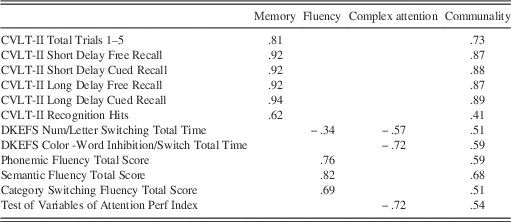
Three principal components were retained based on the results of Kaiser’s Criterion and parallel analysis. These components explained 41%, 16%, and 10% of the variance and correspond roughly to Memory, Verbal Fluency, and Complex Attention (see Table 2). The Memory and Fluency components were associated with education, and the Complex Attention component with age, PTSD diagnosis, and sleep quality (see supplemental materials). For all remaining analyses, these were included as covariates. All covariates met the assumption of homogeneity of regression in these analyses.
Principal component loadings and communalities based on a principal components analysis with varimax rotation for 12 neuropsychological measures (N=289)

Note. Factor loadings <.303 are suppressed.
Effects of Close Blast Exposure
CBE and nonCBE groups were compared using ANCOVAs to assess neuropsychological performance. Bonferroni correction for multiple comparisons was used with a significance level of 0.016. The groups differed on the Memory component F(1,286)=7.082, p=.008, partial η 2=0.024, but did not differ on Fluency and Complex Attention components F(1,286)=1.806, p=.180, partial η 2=0.006 and F(1,274)=0, p=.994, partial η 2=0.000).
A series of ANCOVAs comparing CBE and nonCBE were conducted on the measures included in the Memory component. As before, significant covariates were included in subsequent group analyses. Significant associations were as follows: Learning – age (r=−.159), education (r=.187), and sleep quality (r=−.122); SDFR – education (r=−.131); SDCR – education (r=−.138); LDFR – age(r=−.111); LDCR – none; Recognition – age (r=−.120), and substance use disorder (r=−.121) (see the Supplementary Materials).
Group differences were found on the measures of SDCR, LDFR, and LDCR. Specifically, ANCOVAs comparing performance on SDCR F(1,331)=5.086, p=.025, partial η 2=0.015; LDFR F(1,331)=7.309, p<.007, partial η 2=0.022; and LDCR F(1,331)=5.565, p=.019, partial η 2=0.017 were significant, with the CBE group recalling fewer items. All other dependent measures did not differ between groups.
The small effect sizes and raw CVLT-II test scores were not suggestive of gross differences between the groups, but rather indicative of performance within the average range. For example, the group means for LDFR differed by 0.85 words [nonCBE=11.05 (SD 3.128) and CBE=10.20 (SD 3.246) words]. To better understand the group difference, each participant’s data were evaluated against published age- and education-corrected normative data. Normative data were used as a reference because the number of participants meeting inclusion/exclusion criteria and who were not exposed to blast and had no lifetime TBI was not sufficient to estimate population-level information (n=32). Based on this normative data, CBE significantly increased the risk of impairment on LDFR (OR=1.85; χ2 (1, 333)=4.296; p=.038); and LDCR (OR=1.87; χ2 (1, 333)=4.574; p=.032). Analyses of differences in rates of impairment for SDCR were non-significant. An increase of 9–10 percentage points was observed within the CBE group. Specifically, rates of LDFR impairment were 14.8% (n=28) in the nonCBE group and 24.3% (n=35) in the CBE group, and rates of LDCR impairment were 13.2% (n=25) in the nonCBE group and 22.2% (n=32) in the CBE group. Rates of impairment in SDCR did not differ (see Table 3).
Secondary Analyses: Effects of Concussion History
Additional analyses investigated if a history of concussion (of any etiology) accounted for group differences in memory performance. To examine this, the ANCOVA was repeated (adjusting for education) on the Memory component after also adjusting for total number of lifetime concussions. CBE group differences remained and concussion was not significant [Concussion: F(1,284)=0.030; p=.862; partial η 2<.001; CBE group: F(1,284)=6.554, p=.011; partial η 2=.023].
To specifically address the role of blast-concussions, within the CBE group, we evaluated if participants with blast-associated concussions performed differently. An ANCOVA was conducted for the Memory component score for blast-concussion (as opposed to blast exposure) as a fixed factor for CBE+ participants, adjusting for previously identified covariates. The results revealed that individuals with a blast-related concussion did not perform differently F(1,120)=.330, p=.567, partial η 2=.003.
A final group analysis was conducted to compare the effects of blast exposure and blast concussion, restricting the analysis to those who did not endorse a history of other (unrelated to a blast event) blunt concussion. Groups consisted of (1) participants with no CBE and no concussion history (CBE-/allTBI-, n=71), (2) CBE but no concussion history (CBE+/allTBI-, n=27), and (3) CBE and a blast-related concussion (CBE+/blastTBI+/bluntTBI-, n=21). This analysis revealed no group differences for the Memory component F(2,116)=2.415, p=.094, η 2=.040. However, the low number of participants within the CBE groups may have limited the power of this analysis. Comparison of the rates of impairment on the CVLT-II indices revealed no group difference for either LDFR (χ2 (3, N=333)=0.485, p>.05) or LDCR (χ2 (3, N=333)=0.645, p>.05).
Secondary Analyses: Effects of Multiple Distant Blast Exposures
We additionally examined the effects of multiple distant blast exposures. One might expect that multiple blasts at further distances may have similar effects on brain tissue as CBE. Thus, we conducted a linear regression between number of DBE and the Memory component, adjusting for previously identified covariates. Due to the skewness of numbers of blast exposures, the square root of DBE was used. Results revealed that number of DBE was significantly associated with memory performance, b=−0.043, β=−0.174, t(288)=−2.708, p=.007, partial η 2=.007, R2=.051, ΔR2=.021.
DISCUSSION
This study yielded novel findings related to blast exposure and cognitive functioning. First, Veterans with a self-reported history of close-range (within 10 meters) exposure to blast performed worse on verbal recall than a group of Veterans who did not report close proximity blast exposures. Our findings suggest that close-range blast exposure may have a lingering impact on verbal recall, although a longitudinal analysis will be required to confirm this finding. Recall difficulty was associated with education, but not with PTSD diagnosis or other psychosocial factors. Importantly, Veterans were assessed long after military service (and thus, after their last probable blast exposure), thus our findings suggest a chronic effect of exposure. Although the difference in performance between participants with and without CBE was small in terms of recollection, those with CBE were more likely to perform within the clinically impaired range, exhibiting approximately 1.9 times higher odds of impairment. These findings suggest that there may be lasting functional impairment related to close-range blast exposure in some returning Veterans.
Our primary findings are related to blast exposures, and not necessarily blast-related concussions. In fact, secondary analyses revealed that memory differences were not associated with number of lifetime concussions, or blast concussions. This adds to literature from military (Bazarian et al., Reference Bazarian, Donnelly, Peterson, Warner, Zhu and Zhong2012; Robinson, Lindemer, et al., Reference Robinson, Lindemer, Fonda, Milberg, McGlinchey and Salat2015; Storzbach et al., Reference Storzbach, O’Neil, Roost, Kowalski, Iverson, Binder and Huckins2015; Taber et al., Reference Taber, Hurley, Haswell, Rowland, Hurt, Lamar and Morey2015; Trotter et al., Reference Trotter, Robinson, Milberg, McGlinchey and Salat2015) and sports-related concussion (Breedlove et al., Reference Breedlove, Robinson, Talavage, Morigaki, Yoruk, O’Keefe and Nauman2012; Johnson, Neuberger, Gay, Hallett, & Slobounov, Reference Johnson, Neuberger, Gay, Hallett and Slobounov2014; Koerte et al., Reference Koerte, Lin, Muehlmann, Merugumala, Liao, Starr and Shenton2015; Poole et al., Reference Poole, Abbas, Shenk, Breedlove, Breedlove, Robinson and Dydak2014; Robinson, Shenk, et al., Reference Robinson, Shenk, Breedlove, Leverenz, Nauman and Talavage2015), suggesting symptoms (or lack thereof) immediately following head trauma may not be predictive of long-lasting effects. With few exceptions, previous studies evaluating cognition and blast have defined groups by blast concussion (but see Lippa et al., Reference Lippa, Pastorek, Benge and Thornton2010; & Verfaellie et al., 2014), and found cognitive difficulties related to psychological comorbidities rather than head trauma (Belanger et al., Reference Belanger, Kretzmer, Yoash-Gantz, Pickett and Tupler2009; Brenner et al., Reference Brenner, Terrio, Homaifar, Gutierrez, Staves, Harwood and Warden2010; Cooper et al., Reference Cooper, Chau, Armistead-Jehle, Vanderploeg and Bowles2012; Lippa et al., Reference Lippa, Pastorek, Benge and Thornton2010; Luethcke et al., Reference Luethcke, Bryan, Morrow and Isler2011; Neipert et al., Reference Neipert, Pastorek, Troyanskaya, Scheibel, Petersen and Levin2014; O’Neil et al., Reference O’Neil, Carlson, Storzbach, Brenner, Freeman, Quinones and Kansagara2014; Soble et al., Reference Soble, Spanierman and Fitzgerald Smith2013; Verfaellie et al., Reference Verfaellie, Lafleche, Spiro, Tun and Bousquet2012).
The current study used information related to reported distance from blast, rather than reported concussion status, and also considered physical and psychological factors. Although Veterans with CBE differed on several medical/psychosocial factors, these factors did not account for the differences in memory performance: neither concussion status nor co-occurring psychological factors accounted for the unique role of CBE. It should be noted that blast experience accounts were obtained from a retrospective self-report for events that may have occurred months to years prior. The accuracy of these events and symptoms at the time of the event cannot be confirmed, and there is evidence of inconsistency of TBI recollection in service members with PTSD (Alosco et al., Reference Alosco, Asian, Du, Ko, Grande, Proctor and Vasterling2015). However, the BAT-L (Fortier et al., 2014) has high internal validity and uses a forensic approach taking into account the limitations intrinsic to retrospective interviews.
Exploratory analyses of multiple blast exposures revealed a relationship between memory and multiple DBE. This finding is complex as many participants reported blast exposures at both distances, and participants who report CBE also report a greater total number of blast exposures. Given that this impairment was specific to memory function, it is possible that the hippocampal memory system is particularly susceptible to blast exposures, with one or a few CBE, or multiple instances of DBE, producing impairment. The precise mechanism(s) that bring this about are unknown, however, blast injuries can affect cellular function. For example, hippocampal cells have been observed to express altered RNA after blast injuries (Tweedie et al., Reference Tweedie, Rachmany, Rubovitch, Zhang, Becker, Perez and Greig2013). This or other cellular mechanisms may require only a single close blast that is sufficient to switch pathways, with further blast exposures past this point resulting in no additional observable behavior changes.
This pattern of neurocognitive changes likely indicates that blast exposures represent a spectrum of injuries, with proximity, number and associated concussion symptoms being complementary indicators of severity. Furthermore, different types and severities of head trauma exposure may be detrimental to differing brain areas, resulting in different effects on cognitive outcomes. However, caution must be exercised in interpreting these exploratory analyses, especially as the number of analyses included may inflate the false positive rate. Additionally, the small effect sizes reported in this study limit the generalizability of our findings; however, these small effect sizes are not surprising given our non-clinical sample. As such, further replication is necessary with clinical samples, and this represents a potentially fruitful direction for future research.
The specificity of the effect of CBE on memory findings alone was somewhat unexpected and the underlying mechanism by which CBE is associated with reduced memory retrieval is unknown. However, our findings are consistent with Storzbach and colleagues (2015) who noted relative declines in story recall for a blast exposed group, but comparable attention and executive functioning performance, as well as those of MacDonald and colleagues (MacDonald, Barber, Andre, et al., Reference MacDonald, Barber, Andre, Evans, Panks, Sun and Temkin2017; MacDonald, Barber, Jordan, et al., Reference MacDonald, Barber, Jordan, Johnson, Dikmen, Fann and Temkin2017) who reported that verbal memory and fluency predicted behavioral and neuroimaging changes associated with blast concussion. Neuroimaging studies have provided evidence of alterations in brain function and structure associated with blast exposure, including regions associated with memory, such as the hippocampus, in animal models (Tompkins et al., Reference Tompkins, Tesiram, Lerner, Gonzalez, Lightfoot., Rabb and Brackett2013, and Wong et al., (Reference Wong, Ng, Kan, Tan, Verma, Prakesh and Lu2014); Huber et al., Reference Huber, Meabon, Martin, Mourad, Bennett, Kraemer and Cook2013) and human brain samples (Vogel et al., 2013). Robinson, Lindermer, et al. (Reference Robinson, Lindemer, Fonda, Milberg, McGlinchey and Salat2015) reported connectivity changes of the isthmus of the cingulate, a region receiving hippocampal input that is likely involved in memory function.
As mentioned above, PTSD diagnosis and most of the psychosocial factors included in this study did not account for recall differences between groups. Numerous aspects of military service impact brain health; these factors are often correlated such that isolation of one is not possible. Thus, several factors associated with history of CBE may have contributed to the results and considerable effort was taken to adjust for as many relevant factors as possible. Individuals in this study were participants in a VA research project and there is potential for a selection bias. We have previously shown that the TRACTS sample is representative of the larger OEF/OIF/OND cohort in several relevant factors, including age, gender, ethnicity, and service branch (Lippa et al., Reference Lippa, Fonda, Fortier, Amick, Kenna, Milberg and McGlinchey2014). Participants did not need to be symptomatic to enroll in the study, and as such, they may differ from treatment-seeking Veterans.
Of note, unlike the majority of previous blast studies, PTSD diagnosis was not associated with memory function in this study and additional analyses in which PTSD and other psychosocial factors were adjusted (data not shown) yielded similar results. One reason for this may be associated with the use of PTSD diagnosis, rather than symptom severity. To ensure a consistent analytic approach, all clinical covariates were considered as diagnoses and findings may have differed if symptom severity across clinical measures was used. A second reason may be related to the study sample. The rate of participants performing below cutoff on validity measures (4–9%) was greatly reduced compared to the rate reported in clinical OEF/OIF/OND samples, which range from 17% to 68% (Armistead-Jehle, Reference Armistead-Jehle2010; Cooper, Vanderploeg, Armistead-Jehle, Lewis, & Bowles, Reference Cooper, Vanderploeg, Armistead-Jehle, Lewis and Bowles2014; McCormick, Yoash-Gantz, McDonald, Campbell, & Tupler, Reference McCormick, Yoash-Gantz, McDonald, Campbell and Tupler2013; Whitney, Shepard, Williams, Davis, & Adams, Reference Whitney, Shepard, Williams, Davis and Adams2009). As such, our sample may be more representative of OEF/OIF/OND Veterans at large than those seeking treatment at VA hospitals, and consequently, may experience less distress and/or better symptom management compared to samples included in previous studies.
In the current study, distance from the blast has been used as an indicator of blast severity. It is expected that blast severity is related to the magnitude of the pressure wave; however, direct information about this is not available. Blast distance is not an accurate indicator of blast magnitude; however, it is a metric that is readily available and can be estimated. Many other factors impact blast magnitude, including munitions size and environmental factors such as intervening walls. Additionally, protective equipment and blast directionality may also influence the effect of a blast wave on brain tissue; however, the use of distance as a proxy for severity was sufficient to reveal the effects detailed above. Additionally, mechanism of injury is assumed to be the blast pressure wave, however, explosive munitions include other potential injury mechanisms, including debris, noxious gasses, and electromagnetic pulses, each of which would roughly scale with distance.
Future blast research will likely benefit from a more detailed assessment of memory functions, including non-verbal and incidental memory, as well as non-hippocampal memory (i.e., motor learning) to identify the potential underlying processes associated with memory and CBE. Additionally, the identification of biomarkers, such as neuroimaging and blood-based indicators, will be important in objectively detecting brain injuries that warrant intervention.
As noted above, Storzbach et al. (Reference Storzbach, O’Neil, Roost, Kowalski, Iverson, Binder and Huckins2015) found significant memory differences between Veterans reporting exposure to a blast (at any distance) and those who were not exposed. The effect sizes of our studies are comparable (η 2 ~= 0.02). However, their study did not consider blast distance nor did they consider impairment rate. Another notable difference between these studies is that Storzbach and colleagues found that PTSD accounted for most of the variance in neuropsychological performance, whereas in the current study PTSD diagnosis was not associated with performance on two of the three components.
Participants in the current study do not represent a clinical sample and may reflect a high functioning group that compensates well for the observed memory difficulties. However, these findings provide evidence supporting the possibility that cognitive changes may be observed with blast exposure even in the absence of physical symptoms of concussion. These results may be helpful in alerting clinicians to consider factors such as blast exposure and proximity when assessing Veterans with memory complaints. Furthermore, our findings indicate that not all memory difficulties can be attributed to PTSD or other psychosocial factors, and that treatments for memory complaints directed at these conditions may be insufficient. Importantly, the findings of this study demonstrate that Veterans with a history of close-range blast exposure without symptoms of concussion comprise a population that have not been targeted for treatment but nonetheless may be likely to experience persistent memory difficulties. Future longitudinal studies are needed to confirm the blast-associated memory impairment observed in this cross-sectional study and to track the course of impairment. It will be important going forward to also determine if this impairment recovers with time or is exacerbated by increasing age.
Mean raw scores and frequency of clinical impairment on standardized scores for selected CVLT-II measures for blast group

Note. Impairment determined as T-score≤35, or z-score≤−1.5.
Supplementary material
To view supplementary material for this article, please visit https://doi.org/10.1017/S1355617717001242