Polychrome pavements incorporating exotic materials, notably purple and green porphyry imported from Rome, were not unknown in medieval England. That in Trinity Chapel at Canterbury Cathedral is complete, if considerably restored, and others existed at Old St Paul's, Old Sarum and St Augustine's Abbey, Canterbury.Footnote 1 Such works are best categorised under the generic term of opus sectile. There is one branch of opus sectile, however, that is distinctive enough to have acquired its own name: Cosmatesque. The style was developed from the twelfth century by the so-called Cosmati artists working in Rome and central Italy; it came to an end at the beginning of the fourteenth century when the papal patrons of the Cosmati moved to Avignon.Footnote 2 North of the Alps, Cosmatesque floors are found only at Westminster Abbey: the Great Pavement in the sanctuary carries the name of Odoricus, its maker, and the date of 1268,Footnote 3 while the pavement in the Chapel of St Edward the Confessor may be as late as the 1290s.Footnote 4 It is clear that they were inspired by Abbot Richard Ware's visit to Italy in 1259, and that Cosmati marble workers were commissioned to come to England to design and install them. These pavements are largely composed of stone, although the grave cover of Abbot Wenlock, which forms part of the sanctuary pavement, incorporates an unusual amount of coloured glass.
The Cosmatesque style was applied not only to pavements. On a smaller scale, fine enough to merit the name of mosaic rather than opus sectile, it was also widely used in Italy on such church furnishings as altars, thrones, pulpits, shrines and tombs, in which context its tesserae are mostly of brightly coloured glass. In England, work of this kind is again to be found at Westminster on five royal tombs now (or formerly) in the Confessor's Chapel. These are the shrine of the Confessor (signed by Petrus Romanus civis, ?1279/80),Footnote 5 the tomb of Henry iii (probably under way in 1279, completed by 1290),Footnote 6 the grave-covers of Margaret and John, children of Henry's half-brother William de Valence (d 1276 and 1277), and the altar-tomb now in the south ambulatory, which perhaps belongs to Edward i's son Alfonso (d 1284).Footnote 7 Whatever the precise dates, it is generally agreed that the whole of the Cosmati project at Westminster formed part of, and continued, Henry iii's spectacular campaign of rebuilding and adorning the abbey, and that it occurred between the 1260s and the 1290s.Footnote 8
It has hitherto seemed that in England such monuments were confined to the most prestigious church in the kingdom. The evidence that has emerged for Cosmatesque ornament in the provincial and relatively modest context of Wimborne Minster in Dorset is therefore unexpected.
Around 700 Cuthburga, sister of King Ine of Wessex, founded at Wimborne a double monastery whose church became the resting place of two saints: Cuthburga herself and King Ethelred i, elder brother of Alfred the Great, who died in 871.Footnote 9 It was later re-founded, supposedly by Edward the Confessor, for secular canons, and by 1203 it was a collegiate royal free chapel. The college was dissolved in 1547, although the peculiar and exempt jurisdiction, with its own court and officials, continued until 1847.Footnote 10 Structurally, the core of the existing church belongs to the twelfth century, with a little pre-Conquest work surviving in the crossing and transepts and a Lady Chapel being added to the east of the high altar in the first half of the thirteenth century. A century later the floor of the Lady Chapel was raised to allow the construction beneath it of a vaulted crypt, half underground, which originally measured only 17ft by 21ft (5.2m by 6.4m) but was extended westwards by another 9ft (2.7m) in about 1350. At this stage, it seems, the crypt became the Lady Chapel, the former Lady Chapel became the sanctuary and the former sanctuary became the choir. In 1855–7 the church underwent a drastic restoration.Footnote 11
Of the Minster's architectural history before the Dissolution there is no contemporary record, and the earliest significant descriptions belong to the eighteenth century. The first to be published was John Hutchins's History and Antiquities of the County of Dorset (1774), which went through two further and much enlarged editions (1796–1815 and 1861–73). But Hutchins was not a native or a resident of Wimborne and for the Minster's history the earlier Vindogladia antiqua ac hodierna by Nicholas Russell (1685/6–1763), which has never been published as such, carries greater authority. It exists in four slightly different versions.
When Russell wrote Vindogladia is not known, and his original manuscript does not survive. After his death, however, it was copied by his son Richard (1725/6–72), with scrupulous reference in the margin to the folio numbers of his father's manuscript, an explanatory preface added and some new material at the end that does not concern us.Footnote 12 This version we designate as Russell A. He then made a fair copy (our Russell B), with illustrations by his own hand, which he gave shortly before his death to his cousin, the Revd John Derby of Fordingbridge.Footnote 13 Derby copied it again (our Russell C), with only insignificant changes,Footnote 14 and in 1803 he had it printed (our Russell D). But it was never published.Footnote 15 Instead, Derby sent it to Richard Gough, who was working on the second edition of Hutchins's History, with instructions to incorporate it verbatim. Gough did not wholly obey, but in this way much (though not all) of Nicholas Russell's work finally saw the light of day.Footnote 16
Richard Russell records in his preface that the widespread interest that was shown in the Minster's past:
induced Mr Nicholas Russell my late Father to bestow some of his leasure hours in compiling the greater part of this Treatise for his own private Amusement, and that of his Friends; from a design long before laid for that Intent by his Uncle the Revd Aldrick [sic] Swan one of the Ministers here.Footnote 17
As historian of the Minster, Nicholas Russell was well qualified. He was a Wimborne lawyer who was Register (Registrar) of the peculiar jurisdiction for forty-five years. His father, Robert (d 1718), had preceded him in that post,Footnote 18 and Aldrich Swan (1644–1714, in fact his first cousin once removed) had been a minister at Wimborne from 1680 and Principal Official of the peculiar from 1686.Footnote 19 Thus Nicholas had access not only to official documents now lost but also, although we do not know how far Swan's project had advanced, to the memories and informal records of his predecessors.
For us, Russell's crucial passage is this:
From both the side Isles you descend by eight steps into a chapel directly under the Area of the Chancel, above the Choir; and commonly called the Dungeon … By the Churchwardens books of Accounts in 1495 it appears that this Chappel was adorned with an Organ and the Images of the Virgin Mary, and other Saints finely painted and Gilt … Here was also formerly a fine pavement of the Old mosaic workFootnote 20 now quite broke to pieces by making Mortar thereon for the repairs of the Church and by other abuses. This Chappel was dedicated to the blessed Virgin Mary.Footnote 21
These words were copied or adapted by a number of subsequent histories and guidebooks;Footnote 22 and in the next century, as will shortly be explained, further pieces of ‘rich mosaic’ were discovered ‘whilst making a new vault beneath the stalls on the north side of the choir’.Footnote 23
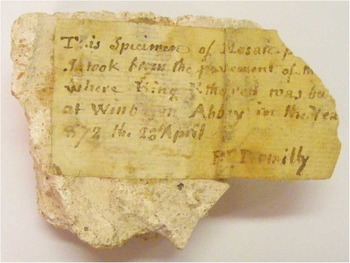
There, with these vague references to a handsome but long-lost mosaic, the matter might have rested. About 1950, however, one of the present authors (MJTL) was given a fragment of mosaic by an elderly relative.Footnote 24 He was then only a boy, and, to his eternal shame he did not investigate it. But in 2008 he dug it out of the cupboard where it had languished for decades and gave it in turn to the second author (LR), who asked a number of questions. Our joint enquiry into its age and provenance gave rise to this paper.
Glued to the mortar bedding of the fragment is a battered paper label (fig 1) with the words, in an eighteenth-century hand:
The label on the back of the Wimborne mosaic fragment (c 95mm × 60mm). Photograph: authors

This Specimen of Mosaic p[attern or pieces?]
I took from the Pavement of th[e crypt?]
where King Ethelred was bu[ried]
at Winb[ou]rn Abbey in the Yea[r]
872 the 23 April
Pr Romilly
There was in eighteenth-century Britain only one family bearing this surname, which was introduced in 1701 by Etienne Romilly (1678–1733), a Huguenot refugee from Montpellier. Among his descendants the only possible identification with the writer of the label is his son Peter (1712–84, baptised as Pierre), a successful merchant jeweller, ‘an admirer of the fine arts’ and a collector, whose home was in Marylebone High Street, then on the north-western fringe of London, and whose business was in Frith Street, Soho.Footnote 25 He had no known connection with Wimborne, which he presumably visited as a tourist,Footnote 26 and one wonders if his professional and artistic eye was caught by the jewel-like size and colours of the mosaic. He took it from the Minster, therefore, before 1784, although we cannot say how long before; and it seems not unreasonable to equate it with one of the broken pieces of handsome mosaic in the crypt recorded by Russell before 1763.Footnote 27
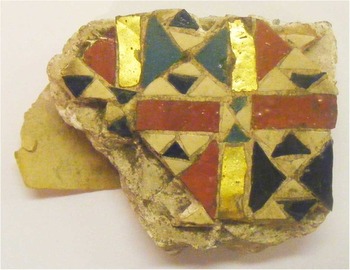
The overall measurements of the fragment (fig 2) are 62mm by 55mm, and the thickness of the tesserae (though they vary slightly) is about 4mm and of the mortar bedding 18mm. The mortar, grainy and whitish with small brown inclusions, is apparently lime-based. The tesserae, of which forty-seven survive, are in six colours: translucent glass of dark blue and of dense copper-red, so deep as to appear black; and opaque glass of brick-red streaked with dark grey, of white, of turquoise, and of gold, the latter being made by fusing gold leaf between a base of the same streaky brick-red and a very thin layer of clear glass. X-ray analysis shows that some tesserae are recycled from Roman material and that they differ from the glass in the Westminster sanctuary pavement, which has also been analysed.Footnote 28 It is not known if they are identical to the glass on the shrine and tombs in the Confessor's Chapel, which has not yet been investigated.Footnote 29
Front view of the Wimborne mosaic fragment. Photograph: authors

It may be asked whether the mosaic, while genuinely Cosmatesque, could have been imported as the fruit of somebody's Grand Tour, much as the Capocci tabernacle from Santa Maria Maggiore was given by Sir William Hamilton in 1768 to Horace Walpole and, after a spell at Strawberry Hill, was partially reused in the 1840s at Wilton church.Footnote 30 The answer must be no. If such a monument, whether complete or in pieces, had found its way to Wimborne, it would surely have been noted – indeed boasted of – by the local historians. Instead, they are totally silent.
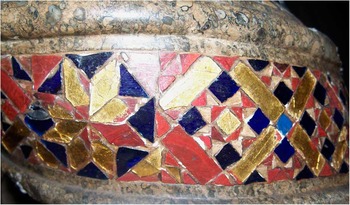
That Russell, and no doubt his colleagues at the Minster, assumed the fragmentary mosaic in the crypt to be from a pavement is easily understood. Local antiquaries in the eighteenth century would be well aware of the Roman mosaics already known in Dorset and, unless they had seen Cosmatesque monuments in Italy or at Westminster, would not unnaturally regard all mosaics as pavements. That Romilly also called it a pavement is equally understandable if he was echoing what the Wimborne verger told him. The fragments, however, were not from the paving of the crypt, which Hutchins described as ‘small glazed bricks, on some of which are lions, and fleur de lys’Footnote 31 – in other words typical medieval inlaid tiles – which could hardly be described as mosaic. Four of them, probably of the fourteenth century, are preserved in the Minster library.Footnote 32 Everything, indeed, about our fragment militates against it being from a pavement at all. It shows no sign of wear. The mortar grouting is remarkably clean. As far as we are aware, gold tesserae were never used on Cosmatesque floors, whether for reasons of high cost or of poor durability (many of the gold pieces on the Confessor's shrine are damaged, as may be seen in fig 3).Footnote 33 And the work is much too fine for a pavement: the largest oblong tesserae measure around 6mm by 16mm and the smallest triangle is 3mm across, compared to the Westminster sanctuary pavement where the glass tesserae are rarely less than 20mm on the smallest dimension. All these features, however, are consistent with the ornament found on such church furnishings as tombs, altars and shrines.
A detail of the twisted column at the north-western corner of the Confessor's shrine, Westminster Abbey (the portion shown measures c 120mm × 40mm). Photograph: courtesy of the Dean and Chapter of Westminster

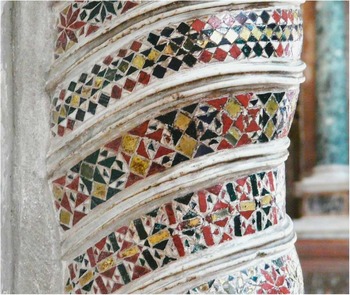
The pattern, whose basic unit is 42mm square, is a thoroughly Cosmatesque one, typically used in linear form on a relatively narrow band or border rather than an extensive surface. On a larger scale, and in stone, a similar pattern is found in the border just south of the central roundel in the Westminster sanctuary pavement.Footnote 34 On a smaller scale, and in glass, the identical pattern, with similar colours but slightly differently distributed, occurs on a paschal candelabrum at Santa Maria in Aracoeli in Rome (fig 4). The two relatively straight sides of our fragment may very well be the original edges, but on at least one of the others the pattern continued, as is attested by impressions of tesserae in the mortar.
A detail of the paschal candelabrum in Santa Maria in Aracoeli, Rome. The pattern on the lowest visible complete spiral is identical to that of the Wimborne fragment. Photograph: Paula Rosser

On furnishings, the mosaic was inlaid in recesses or matrices cut into the stone of which the structure was made – white marble in Italy, Purbeck marble in England. The base of these recesses was left roughly chiselled, which conforms with the slightly irregular underside of the mortar bedding of our mosaic. On the Cosmatesque monuments at Westminster, those recesses that have lost their filling are as deep as 23mm (the tomb in the south ambulatory), 18.5mm (Henry iii's tomb) and 22mm (the Confessor's shrine).Footnote 35 This conforms with the 22mm depth of our fragment. Stylistically, the closest parallel is the Confessor's shrine. Most of its tesserae have been robbed, but the twisted column at the north-west corner survives largely intact. The mosaic here (see fig 3), while differing in pattern, is the counterpart of ours in spirit, in brilliance and in scale. The width of its pattern is, like ours, 42mm, although our fragment has none of the curvature necessary to fit such a column.
The obvious implication is that the Italian craftsmen travelled to Wimborne to create a monument there. But there is an alternative possibility. It is very much easier to inlay mosaic on a horizontal than on a vertical surface. Such furnishings are built up of stone components, and it seems likely that the mosaic was applied while they were lying flat and that they were assembled afterwards. We may therefore wonder if it proved easier and cheaper to transport slabs of Purbeck to the craftsmen at Westminster than to transport the craftsmen to Wimborne. Was the Wimborne monument, in other words, manufactured at Westminster and carried in sections, flat-pack-fashion, to Wimborne for assembly? At this date the flow of Purbeck marble to Westminster was very substantial,Footnote 36 and the ships that brought it would return empty to Poole Harbour.Footnote 37 From there to Wimborne is only five miles by road.
The proximity of Purbeck to Wimborne raises yet another possibility. It has been suggested that the Italians left England in about 1290, but that the pavement in the Confessor's Chapel was made a few years later by Purbeck marblers or abbey craftsmen using some Italian materials for the inlay and what they had picked up from the Italians for the design.Footnote 38 On this analogy, could Purbeck marblers also have made the Wimborne monument with left-over Italian tesserae from Westminster? It is a neat solution. But, unlike the Confessor's pavement, which is decorated with porphyry and off-white stone, our mosaic, like those on the Confessor's shrine and the royal tombs, consists of glass tesserae; and stylistically, as its counterpart in Santa Maria in Aracoeli shows, it belongs wholly in the mainstream of Cosmatesque design. This suggests Italian, not English, workmanship and, like the shrine and tombs, a date in the 1270s or 1280s.
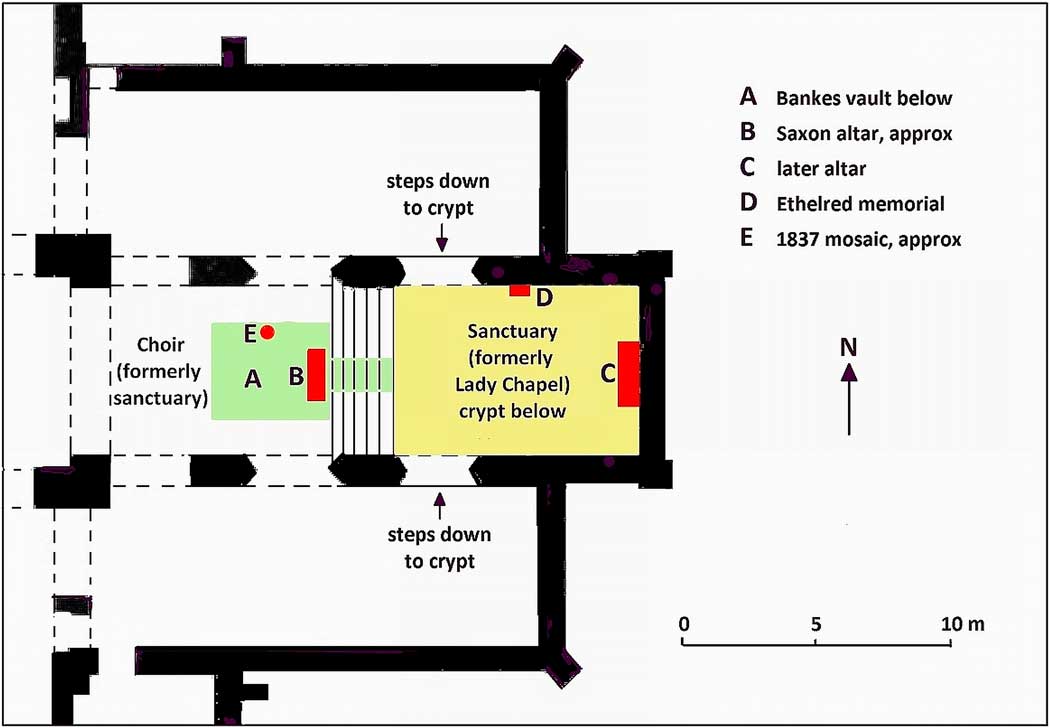
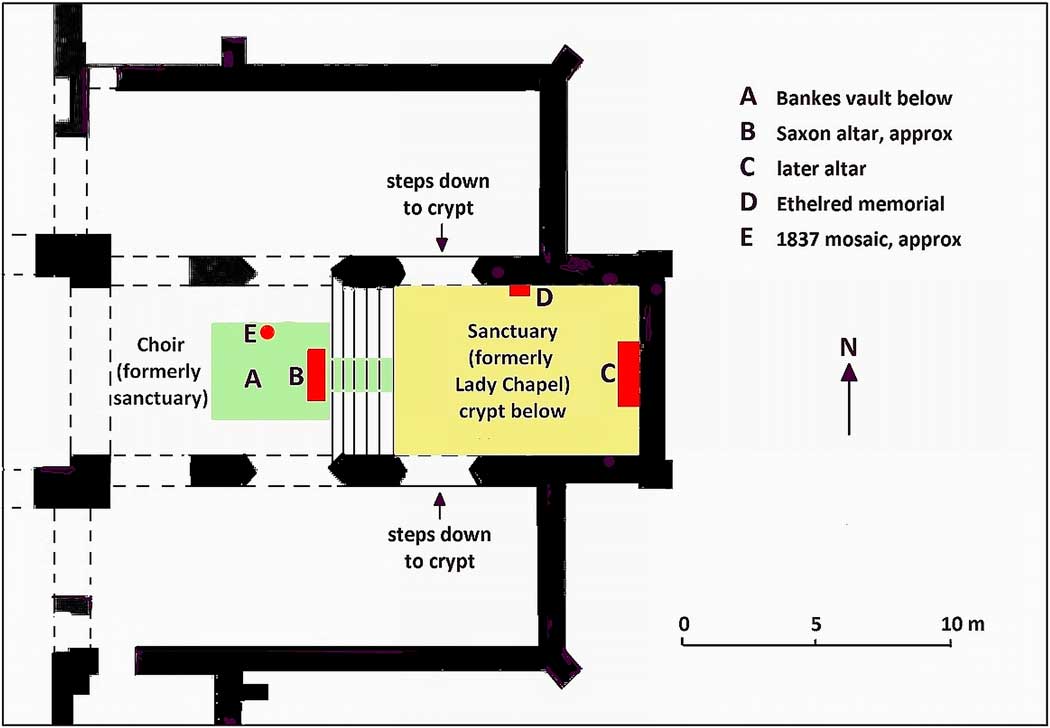
What monument at Wimborne might it have adorned? The most probable answer would be the tomb or shrine of one of the Minster's two saints. Originally, both were surely buried in the place of honour near the high altar of the Saxon church, whose site must correspond roughly with the eastern end of the present choir (fig 5). Both, however, were later translated, at dates unknown but before the Dissolution. Leland, writing in about 1540, says:
Wimborne Minster: a simplified plan of the east end. Drawing: authors
The cryptes in the est part of the chirch is an old peace of work. S. Cuthburga was buryid in the north side of the presbyterie. King Etheldrede was byried by her, whos tumbe was lately repairid, and a marble stone ther layid with an image of a king in a plate brasse with this inscription: In hoc loco quiescit corpus S. Etheldredi, regis Westsaxonum, martyris, qui a°. D i. 827 [sic: a mistake for 872], 13°. die Apr. per manus Danorum Paganorum occubuit. Cuthburga sins was translated to the est end of the high altare.Footnote 39
Leland was almost certainly unaware of the Minster's architectural history and the fact that the Saxon altar had been far to the west of the altar of his day. The implication is that, before Cuthburga's second translation to the rear of the present altar, both saints lay on the north side of the present sanctuary (Leland's presbytery). This is where Ethelred's memorial remains to this day. It comprises a small brass (made about 1440) depicting the king, and a smaller brass with a shield and an inscription on copper (both made about 1680), which replaced the inscription on the brass that Leland saw.Footnote 40 All are mounted on a single Purbeck marble slab which now measures 0.56m by 0.42m (22in. by 16½in.),Footnote 41 having been ‘ruthlessly diminished’ in size during the restoration of 1855–7.Footnote 42 It could be older than the brasses; but there is not room enough for a tomb beneath it, for the vaulting of the crypt approaches too close.Footnote 43 Hutchins thought it ‘not improbable’ that the king's remains were under the floor of the crypt vertically below;Footnote 44 which, if it was a view commonly held at Wimborne, ties in with Romilly's ascription of his mosaic to Ethelred's place of burial.
By the eighteenth century Cuthburga's tomb had long since vanished: ‘Queen Cuthburga is supposed to have been intombed in the East wall’ is all that Hutchins can say.Footnote 45 In the Age of Enlightenment it was the memorials of Ethelred and, from a later period, of the Beauforts and Exeters, that drew the visitors to Wimborne. ‘In this church,’ says a tourist, ‘rests a large collection of royal and noble bones; but the tomb most visited is that of King Ethelred’:Footnote 46 no mention of saintly bones.
In earlier times, however, it was the other way round. In the admittedly scanty records of the medieval and Tudor minster, Ethelred is never mentioned, and it was the abbess Cuthburga who made all the running. By 1355 – and probably long before – the church's dedication, originally to St Mary, had been changed to St Cuthburga.Footnote 47 The tenor bell of 1384 (later recast) was named the Cuthborow bell.Footnote 48 Cuthborough Fair was held annually on Minster Green. Cuthbroggtyde was solemnly observed. On 18 November 1289 Edward i made an offering of 8s ‘to the saint's feretrum in the collegiate church of Wimborne’, while three of his daughters each gave a penny a day for the previous ninety-two days, together making the substantial total of 31s.Footnote 49Feretrum is, strictly, a portable reliquary, which would normally lie in or on a shrine of some elaboration.Footnote 50 Inventories of around 1500, however, which list the Minster's ten altars and many relics, do not include a specific shrine to the saint, although they do mention ‘a relique of St Cuthberga’.Footnote 51 Rather, as is shown by the Tudor churchwardens’ accounts, her lavish image was displayed not on a separate altar or shrine but on the high altar.Footnote 52 For these reasons we suggest that it was Cuthburga's thirteenth-century shrine that our mosaic adorned, but that it did not survive until the Dissolution.
On this hypothesis, where in the Minster was it? All the known Cosmatesque work in England was done between the 1260s and the 1290s, and the shrine and tombs at Westminster probably belong to the 1270s and 1280s. For this the crypt seems too late, even in its original and very poky form of the early fourteenth century. If Cuthburga was translated from near the Saxon high altar to the new Lady Chapel as soon as it was built about 1230, the mosaic must have been installed some forty or fifty years later on the new site, not the old. If, more probably, she was translated when the Lady Chapel became the sanctuary about 1350, the mosaic would have been on the original site in what is now the choir, which is the one place in the Minster where medieval mosaic has indisputably been found.
Fragments were unearthed on two occasions, one probably in the early eighteenth century, one in the nineteenth. Tradition, as we have seen, associates the first with the crypt. Throughout the eighteenth century and the first half of the nineteenth the crypt was in a sorry state. Russell relates that in his time it had long since been abandoned for services ‘on account of the breaking up of the springs, and the Chapple has ever since been discontinued and lain waste’.Footnote 53 This refers to periodic flooding that occurred (as at Winchester, if not so severely) whenever the water table rose – a problem that, despite improvements to the drainage, occasionally recurs to this day. As a result the crypt, at least in Victorian days, was little more than a coal-hole and a rubbish tip where the choirboys relieved themselves.Footnote 54 For a time it was also used for burials. Mayo, speaking in 1860 of its pavement of inlaid tiles, reports that ‘only a few vestiges of it now remain, this part of the church having been, in quite recent times, converted into family vaults. These, however, with their tenants, were ejected some years ago.’Footnote 55
Beneath the present choir, and formerly entered through the west wall of the crypt,Footnote 56 is the substantial private vault of the Bankes family of Kingston Lacy. Its precise extent is not recorded and its doorway has long since been sealed off. It was presumably created in 1703 when the earliest interment was made in it.Footnote 57 Its extension in 1837 produced two interesting finds, as the Gentleman's Magazine reported:
At the enlargement of Mr Bankes's vault, which extends under the presbytery [that is, the present choir], in 1837, the workmen exhumed in the north-east corner, near the original site of the altar, and about two feet under ground, the skeleton of a man, that measured as it lay 6ft 4in.Footnote 58
Whether or not these bones were, as suggested at the time, those of King Ethelred, the site is exactly where the tomb of a Saxon saint would be expected. The other find is even more pertinent. The second edition of Peter Hall's guidebook records, in the course of regurgitating the usual account of the crypt:
There was formerly an altar with images, an organ, and a pavement (some pieces of which were discovered by the present sexton, in 1839, whilst making a new vault beneath the stalls on the north side of the choir) of rich mosaic; these have all been long destroyed; and after remaining for many years under water, the principal space was appropriated by faculty as a private vault for the family of Mr. Bankes.Footnote 59
Despite the slight discrepancy in dates (of which 1837 is the more likely, two Bankeses having died in that year and none in 1839), this evidently refers to the same enlargement of the vault. But although it is certainly wrong in saying that the Bankes vault stole part of the crypt,Footnote 60 and although the fragments in question were apparently not preserved, this record is important because it is difficult to explain how mosaic from near the present altar could have found its way to near the original altar – and underground at that. The mosaic discovered in 1837 was surely more or less in situ. It is therefore likely that the earlier fragments were also encountered in the same area, and much the most probable occasion was when the vault was first excavated in 1703. It seems not implausible that, rather than being removed with the rest of the spoil, they should be left on display as curiosities in the crypt, whence one, its precise provenance long forgotten, was purloined by Romilly before 1784.
Several questions remain. When was the shrine broken up? At the Dissolution the rood and altars were indeed destroyed;Footnote 61 but by then Cuthburga had been translated twice, and the Tudor inventories list nothing that sounds like a Cosmatesque shrine. The most obvious date for her first translation is about 1350, when the high altar was moved east, but why was her shrine not simply dismantled and reassembled on the north side of the new sanctuary? Or was Leland wrong about her having an intermediate resting place there, and was she translated direct to a new tomb behind the high altar? This, ‘the favoured position for major saints’,Footnote 62 might well demand a different design. And what of Russell's tale, which smacks of oral tradition, that the mosaic ‘pavement’ in the crypt was broken to pieces by careless workmen mixing their mortar on it? Because our fragment shows no trace of the scratching that such treatment would inflict, perhaps it was from a band of mosaic bordering a Purbeck panel and thus escaped damage. Or perhaps the tradition had become confused – in 1703, after all, Nicholas Russell was only a boy – and the pavement used for mortar mixing was really the floor of inlaid tiles recorded by Hutchins.
The college of Wimborne Minster was not particularly wealthy, and Cosmatesque mosaics cannot have been cheap. Who commissioned ours? The prime candidate must be Henry de Lacy (1249–1311), fifth Earl of Lincoln and lord of the manor of Kingston Lacy, two miles distant. The manor always maintained close links with the Minster. Lacy's successors – the Beauforts and the Bankeses – were generous benefactors, and Lacy himself gave land to Wimborne's leper hospital of St Margaret.Footnote 63 The manor house frequently hosted medieval monarchs: Henry iii, Edward iii, Henry iv, Henry vFootnote 64 and, most interestingly, Edward i. Between 1275 and 1306 he was in Wimborne on six occasions, on at least three of which he stayed at Kingston Lacy, sometimes staying for weeks at a time.Footnote 65 This is in no way surprising. Henry de Lacy was educated at court as a ward of Henry iii; from 1272 he was ‘in near constant royal service, proving himself to be one of Edward i's most reliable, faithful, and trusted servants and friends’ whom the king consistently entrusted with diplomatic, political and military duties of high importance.Footnote 66 His tenure of the lordship spanned the whole period of Cosmatesque in England, and he was a very wealthy man. Moving in exalted circles as he did, he would not only be familiar with the work currently in progress at Westminster Abbey but also in a position to hire, with the king's blessing, the Cosmati craftsmen there. It is tempting to wonder if Cuthburga's feretrum was new in 1289 when at least four of the royal family were present at Wimborne and made their generous donation to it.
If the Cosmati craftsmen found one English customer outside Westminster, did they find others? It seems likely. In the nave of St Augustine's Abbey in Canterbury many loose tesserae were discovered in a shaft that was backfilled in the early or mid-fourteenth century. Some are of stone, including marble and green porphyry. Others are of glass, including one of ‘streaky reddish-brown and dark grey opaque glass’ with gilding overlain by a thin layer of clear glass. This sounds remarkably similar to the gold tesserae in our fragment and on the Confessor's shrine.Footnote 67 It is purely by chance that the Wimborne example has come to light. It may well be, therefore, that other English churches possessed Cosmatesque ornament that has not survived, or that has not been rediscovered.
The Wimborne fragment has now been donated to the Dorset County Museum, Dorchester.
ABBREVIATIONS AND BIBLIOGRAPHY
- Abbreviations
- DHCD
Dorset History Centre, Dorchester
- WML
Wimborne Minster Library
- Manuscript sources
- DHCD, PE/WM/AQ/1/3, ‘Vindogladia antiqua ac hodierna, or an historical account of the antiquity, ancient funeral monuments and endowments of the collegiate church of Wimborne Minster … by Nicholas Russell’ (our Russell C)
- DHCD, PE/WM/RE/1/3, Wimborne Minster parish register, 1694–1771
- WML (no shelf marks), ‘Vindogladia antiqua ac hodierna, or an Historical Account of the Antiquity, Antient Funeral Monuments and Endowments of the Collegiate Church of Wimborne Minster …’ in three versions (our Russells A, B and D). A gives no author; B has ‘by Nicholas Russell Gent’; D ‘by Nicholas Russell’
Acknowledgements
We owe many debts: at Wimborne, to Christine Oliver and Antony Wakeling for freely imparting their knowledge of the Minster and to Frank Tandy and Judith Monds for unrestricted access to the Chained Library; at Westminster to Vanessa Simeoni, head of conservation, and Ned Schärer for technical insights, and to Paula Rosser for taking photographs for us of the candelabrum in Santa Maria in Aracoeli, Rome; to Stefan Roehrs of the British Museum Research Laboratory, Ian Freestone, FSA, of the UCL Institute of Archaeology, Sandra Davison, FSA, and Kevin Hayward, FSA, for their expert examination of the Wimborne mosaic; to Paul Binski, FSA, for his thoughts; to Jim Rees and Alison Lewis for their patience and for endless discussion; to the anonymous reviewers who commented on this paper on behalf of the Journal editors; and, above all, to Warwick Rodwell, FSA, Consultant Archaeologist to Westminster Abbey, for his unstinting help, advice and encouragement throughout our researches.
APPENDIX
Report on the glass tesserae by Sandra Davison, FSA, FIIC, ACR, August 2008
Blue – small dark blue transparent triangles of glass.
Black – larger black transparent triangles of glass (actually dense copper-red). Both blue and black have a matt surface with fine parallel lines that may suggest their reuse, ie that the tesserae were abraded smooth before they were used.
Turquoise – small triangles of opaque, slightly grainy turquoise glass.
Brick-red – opaque and striated brick-red glass triangles and rectangles. This glass has a glossy fire-polished finish and is full of seed (air bubbles that are elliptical in shape) and possibly small inclusions that have produced small bumps in the surface of the glass. This detail can also be seen on the gold glass tesserae, which might suggest that the same red glass formed the base.
Gold – rectangles (red glass base, gilded and protected with an extremely thin layer of clear glass).
White – small triangles of a white material which, viewed under ×16 magnification, can be seen to have chipped edges at which points the material looks like white marble. However, there is also a possibility that the material is opaque white glass [Dr Kevin Hayward has since confirmed that it is glass].
The fragment was examined under ×16 magnification and was also compared with Cosmati work on three monuments in Westminster Abbey:
The tomb of Henry iii – on which the tesserae are much larger than those on the Wimborne fragment.
The tomb in the south ambulatory – where the tesserae are extremely dirty but appear to be arranged in a chequerboard pattern. Examined by Vanessa Simeoni and Marie Louise Sauerberg in May 2007, the tomb was thought to have ‘deep blue, amber and green glass (although it appears that the amber is often covered with gold leaf and then again with a thin layer of clear glass), traces of light green transparent glass and perhaps clear’. In-depth conservation cleaning will clarify the Cosmati design.
The shrine of Edward the Confessor – the work on the columns most closely matched the colour and design of the Wimborne Minster fragment. On one side of the shrine there are carved lozenges which are deep enough to contain the depth of mortar on the Wimborne Minster fragment, lending support that it may have come from a monument.
Report by Prof Ian Freestone, Cardiff University, based on energy-dispersive X-ray analysis of the tesserae by Dr Stefan Roehrs, British Museum Research Laboratory, January 2009
[The results are] fully consistent with a mid-thirteenth-century date for the material, inferred from its similarity in appearance to the material in the shrine of Edward the Confessor in Westminster Abbey.
The blue and turquoise glasses are apparently reused Roman glass, as is indicated by their low potassium and high antimony. This is consistent with their size, which suggests that they were produced by cutting down antique tesserae. The red glass might also be old Roman ones; Roman opaque red glass frequently has potassium contents approaching those of plant ash glass. The black glass and white cartelline are more ambiguous and could be the result of mixing natron and plant ash-based glasses. It is possible that the white was melted in the medieval period.
The opaque glasses previously analysed from the Cosmati pavement are from the tomb at the edge of the pavement – they are much larger in size than the Wimborne Minster tesserae, and this precludes their being reused Roman material; in fact they are the typical mid-thirteenth-century opaque glass which at that time is coming into use in the production of Limoges enamel, plant ash with tin oxide opacifier (a nice parallel with the style of the tomb). However, the consistent use of old Roman glass in enamelwork continues until 1250; after that its use appears sporadic (it crops up in one or two fourteenth-century Gothic enamels and also in a few other items such as the Basle Head). So its use at about this time in the Wimborne Minster fragment would not be surprising.