




No CrossRef data available.
Conflict as interactional accomplishment in Japanese: Arguments in university faculty meetings
Published online by Cambridge University Press: 01 October 2004
Abstract
Through an analysis of arguments in two different sets of university faculty meetings, this article attempts to demonstrate that episodes of conflict in Japanese can be treated as accomplishments at a local, interactional level. The analysis focuses on turn-taking organizations used by faculty member participants in two meetings to show how talk in one set of meetings was designed to facilitate the onset of arguments, while talk in the other set was constructed to discourage participants from exchanging statements of opposition; and that the organization of talk in the meetings, precisely because it either enabled or constrained the occurrence of arguments, was essential to the institutional work being accomplished by participants. Discussion of the analysis focuses on the tendency in research on Japanese discourse to treat conflict as an inherently disruptive phenomenon that needs to be accounted for in terms preestablished concepts such as harmony and social hierarchy.I want to express my appreciation to two anonymous reviewers for detailed comments and criticisms that were of tremendous help in revising this article. I also would like to thank Jack Bilmes, Dina R. Yoshimi, Jane Hill, and Yumiko Ohara for their valuable suggestions. In addition, I want to acknowledge the assistance of Takehiro Goto, Masaaki Hattori, Dai Kamimaru, and Toshiki Sato in gathering and transcribing the data. I alone am responsible for any errors which may remain.
Information
- Type
- Research Article
- Information
- Copyright
- © 2004 Cambridge University Press
INTRODUCTION
When people come together, whether for a political debate, a public lecture, or just a friendly chat, there exists the possibility that conflict will arise; yet the occurrence of conflict, at least as it is expressed overtly in talk, will undoubtedly vary according to the situation. Social interaction in some speech events, such as a political debate, may be designed to encourage participants to state opposition to one another, whereas the organization of interaction in other contexts, such as a public lecture, may make it difficult for participants to discuss points of opposition explicitly. In fact, designing interaction either to encourage or to discourage conflict is often crucial to the work being accomplished in the speech event. Just as the exchange of opposition in a political debate can make it possible for candidates to discuss issues in front of potential voters, so can the suppression of dissenting voices (from the audience) allow a speaker to complete a public lecture.
This article describes contexts for arguing in Japanese university faculty meetings. Treating arguing as an interactional activity that is constituted by the exchange of oppositions by two or more participants, I concentrate my description on the turn-taking organizations employed in two different sets of monthly faculty meetings: one in which arguments were frequent, and one in which they were rare.1
Prior research has noted two different meanings of the term “argument” – what O'Keefe 1977 refers to as “having” an argument and “making” an argument (see also Hutchby 1996, 2001 and Schiffrin 1985 for discussions of these different meanings). While agreeing with those who stress that it is ultimately difficult to draw a distinct line between these two meanings (Hutchby 1996), I make it clear that I am primarily interested here in how the participants “have” arguments – in other words, how two or more participants collaboratively construct the arguing activity.
By examining the organization of turn-taking as a context for arguments, I argue against a tendency among previous researchers to approach conflict in Japanese interaction as an undesirable phenomenon that must be explained in terms of presupposed cultural notions such as harmony and hierarchy. Some Japan specialists, for example, have gone so far as to suggest that the need to maintain harmony and to attend to hierarchical relationships prevents Japanese people from being able to express opinions freely and to engage in activities such as complaining, disputing, and arguing (e.g. Barnlund 1989, Kunihiro 1976, Nakane 1970, Ozaki 1978). As Nakane noted in her well-known model, which places vertical relationships at the basis of Japanese society, strict adherence to social hierarchies not only obstructs the “development of a dialectic style in a Japanese conversation” but also dictates that conversation tends to follow “the ‘I agree completely style’ of communication, which does not allow for the statement of opposite views” (1970:36). Such a model views communication as the result of fixed cultural principles rather than as a step-by-step construction by social actors as they negotiate conflict in various speech events.
To be sure, Nakane's views have been criticized as too extreme (see, e.g., Befu 1980, Dale 1986, Kelly 1991, Mouer & Sugimoto 1986, Sugimoto & Mouer 1989), and there are now a number of studies that describe episodes of conflict within Japanese society (Bestor 1992; Hamabata 1994; Honda 1999; Iwai 1996; Jones 1990, 1995; Kondo 1994; Noda 1990). Nevertheless, there remains a tendency in accounts of conflict to refer to cultural predispositions toward harmony and hierarchy that supposedly underlie and constrain communication. Jones 1995, for instance, while recognizing the occurrence of a dispute between two Japanese instructors at a Japanese university, focuses her analysis on how the participants used linguistic techniques to “mask” their conflict. She stresses that their masking techniques are an example of “how the cultural ideals of harmony and hierarchy constrain and shape some informal negotiations in Japan” (1995:142). Similarly, Honda 1999, in an investigation of disagreements in newspaper columns, approaches harmony as a preestablished cultural belief that constrains how the writers of the columns express opposition. Even though some researchers have offered analyses of naturalistic data, patterns of communication are still often treated as outcomes of cultural or institutional structures that are deemed to exist prior to the analysis. Consequently, the focus ultimately is placed on how the style of communication reinforces beliefs about Japanese culture and society, rather than on how communication itself might be organized in particular situations to promote or discourage the emergence of conflict.2
The tendency to focus on underlying cultural values in previous research on Japanese discourse and communication is by no means limited to the study of conflict. There is a considerable amount of work that has used prespecified cultural values to explain general patterns of Japanese communication (Barnlund 1989, Goddard & Wierzbicka 1997, Ito 1989, Kunihiro 1976, Midooka 1990, Tsujimura 1987, Watanabe 1993, Yamada 1992).
It is not my purpose to question the relevance to Japanese society of notions such as harmony and hierarchy. In fact, I will note in my conclusion certain ways that cultural concepts identified in previous studies of Japanese discourse and society may enhance understanding of arguments in faculty meetings. Nonetheless, I underscore here that, without necessarily turning to cultural concepts to explain the phenomena found in the data, it is possible to gain an appreciation of the structure of a conflict-relevant activity such as arguing by focusing on interaction as it is constructed sequentially, step by step. This approach to arguing neither reinforces nor challenges previous depictions of Japanese culture and society. Rather, it emphasizes how much an investigation of turn-taking practices can tell us about how conflict is achieved by participants at a local, interactional level in Japanese. Furthermore, although I do not make any judgments concerning the supposedly disruptive nature of argument in general, I endeavor to show that the practices used to construct arguments in the cases discussed here can provide participants with important resources for accomplishing institutional goals.
I rely here primarily on the ideas and principles of conversation analysis (CA). In CA, the invocation of cultural values (e.g., harmony) and factors such as gender, age, and social rank to explain patterns of communication is considered an analytic procedure that can lead researchers to gloss over (and therefore fail to notice) important organizational details of talk (ten Have 1999, Schegloff 1997). Instead of focusing on what might (or might not) underlie talk, CA analysts describe the concrete details of interaction, holding that it is through the in-depth description of actual interactional practices that they will be able to understand how participants accomplish social actions. This analytic mentality has resulted in detailed accounts of turn-taking (Sacks 1992, Sacks et al. 1974) as well as of other social actions that emerge from the sequential structure of interaction, including repair (Schegloff 1979a, 1992; Schegloff et al. 1977), conversational openings and closings (Schegloff 1968, 1979b; Schegloff & Sacks 1973), and also arguing (Bilmes 1995; Coulter 1990; Goodwin 1990; Goodwin & Goodwin 1990; Greatbach & Dingwall, 1997; Hutchby 1996, 2001; S. Maynard 1985; D. Maynard 1986). Placing the analytic focus on sequentially organized expressions of opposition, CA research on arguing has described the ways in which participants initiate opposition and then pursue points of opposition in subsequent turns. My analysis will concentrate, accordingly, on the practices in the meetings that either enabled or hindered participants' ability to initiate and pursue opposition.
CA research now recognizes that the organization of social actions often varies across settings. For example, it has been shown that the practices employed to take turns at talk in institutional settings – including courtrooms, hospitals, clinics, classrooms, and news interviews – can diverge significantly from those in everyday conversation (e.g., Boden & Zimmerman 1991, Drew & Heritage 1992, Drew & Sorjonen 1997). Yet CA research on talk in institutional settings, like that on mundane conversation, does not assume that the setting and identities of the participants are “causing” these differences. Instead, analysts endeavor to show how the participants display in the interaction an orientation to the context. The CA approach to institutional talk, thus, does not treat turn-taking as the product of the setting and the identities of the participants, but rather as an organization that is created by the participants as they engage in the work of the institution. Indeed, it is ultimately through talk that participants accomplish the work that puts institutional structures into place. Research on news reporting is one case in point (Heritage 1985, Heritage & Greatbach 1991). Rather than view the neutral stances taken by reporters as an outcome of the institutional structure of news broadcasts, CA analysts have shown how the reporters themselves, by using practices such as the withholding of assessment, create this sense of neutrality through the interaction. CA is not alone in recognizing the role of interaction in the creation of institutional contexts (e.g., Bourdieu 1977, Duranti & Goodwin 1992, Giddens 1984), but by placing analytic focus squarely on the sequentially produced details of talk, CA has arguably gone the furthest in elucidating the actual interactional practices that are used by participants to create and maintain institutional structure.
Some CA analysts, in fact, have shown that organizing turn-taking either to facilitate or to impede the occurrence of arguments can be an important way participants constitute an institutional context. In his study of talk radio, Hutchby 1996 describes how the participants sequence their turns so as to create the argumentative character for which talk radio is known. Hutchby notes that because the host prompts the caller to go “first” and present an opinion, it becomes easy for the host to use his “second” position to oppose the caller and invite an argument. Turn-taking is thus organized by the participants themselves to facilitate the direct expression of opposition, a constitutive feature of talk radio.
A study that provides an interesting and sharp contrast to talk radio is Garcia's (1991) examination of a mediation program sponsored by a California county. Although the purpose of the interaction is to bring together parties already embroiled in a dispute, Garcia notes that participants design their talk in a way that minimizes the occurrence of arguing. Unlike casual conversation, where participants are usually able to exchange opposition directly by using adjacently sequenced turns, the disputants in Garcia's mediation address their turns to a third-party mediator. This turn-taking practice prevents the disputants from arguing directly with each other, thereby facilitating the mediation process. Following the lead of Hutchby 1996 and Garcia 1991, the analysis presented here of talk in a Japanese university will explicate not only how talk is organized in the two meetings either to facilitate or impede arguing, but also how the design of the talk made it possible for the participants to accomplish work that helped bring the university structure into being.
In applying CA principles to interaction in university faculty meetings in Japan, I hope to contribute to a set of emerging studies that has begun applying the conversation analytic framework to Japanese social interaction (e.g. Hayashi 1999, 2003; Lerner & Takagi 1999; Mori 1999; Tanaka 1999, 2000; Takagi 1999). Concentrating on the details of interaction, and in the process distancing themselves from research that has relied on cultural concepts to explain patterns of interaction, the authors of these studies have offered descriptions of actions engaged in by Japanese social actors. This research includes two works that have explored the expression of opposition in causal conversation. Takagi 1999 finds that interrogative elements such as nani ‘what’, itsu ‘when’, and the particle ka, instead of fulfilling questioning functions, can be used as resources to pursue points of opposition and even to heighten the argumentative sense of the interaction. Mori 1999 described how connective phrases in Japanese, especially kedo ‘but’, demo ‘but’, kara ‘because’, and datte ‘because’, permit participants to manage the delicate balance between the expression of agreement and the delivery of opposition. I have not necessarily found the same interactional phenomena in my data, but this study, by focusing on arguing in university faculty meetings, builds on previous research by stressing the potential of employing CA to study conflict in Japanese in institutional settings.
DATA AND PROCEDURES
The two sets of meetings focused on in this paper are monthly faculty meetings termed kyoojukai ‘professorial meetings’ and kyooshitsu kaigi ‘classroom meetings’ that occurred at a small, private four-year university located in the northern part of Japan. The data were gathered while I was employed for three years at the university as a full-time lecturer (sennin kooshi). I was a participant in both sets of monthly faculty meetings, and I base this analysis on fieldnotes and discussions with colleagues at the university as well as on transcriptions of tape recordings. My description of the organization of talk in one set of meetings, the kyoojukai, is based solely on notes taken as a participant observer in the 32 meetings that I attended over a period of three years. This is not the standard practice in CA; analysts typically work with naturally recorded data.3
There is, however, some precedent in CA for producing descriptions of interaction that are based on researchers' observations. For example, Schegloff 1987 does not utilize any excerpts of transcribed data in describing general features of the turn-taking organizations used in both classrooms and presidential news conferences. Detailed discussion of the use in CA of materials other than naturally recorded data can be found in ten Have 1999.
As noted by Drew & Sojornen 1997, CA research on institutional talk has often adopted a comparative perspective in order to highlight those aspects of the talk through which participants display their orientation to institutional structures. Most commonly, talk in institutional settings has been compared with casual conversation, but the comparison in this paper of two sets of faculty meetings will make it possible to stress how the turn-taking practices employed by participants can diverge across speech events that occur within the same institution.
The kyoojukai and kyooshitsu kaigi were only two of the numerous types of the meetings regularly attended by the faculty members. As I believe is typical of most Japanese universities, they were expected to participate in a myriad of different meetings as part of their job, including some very small, exclusive gatherings attended by only high-ranking officials and other committee meetings devoted to specific aspects of the university such as the budget, the library, the parking lot, the university computer network, the organization of social events, and so on. However, the kyoojukai and kyooshitsu kaigi serve as especially good bases for comparing turn-taking organization for at least three reasons. First, the two meetings were similar in terms of general goals. In contrast to specialized meetings held in order to discuss specific aspects of the university, both the kyoojukai and kyooshitsu kaigi were of a more general nature because they were intended to disseminate information throughout the ranks of the faculty and to provide a forum for discussion of that information. The kyoojukai was held at the school level and was thus intended to provide information to all faculty members affiliated with a specific school. The analysis herein will focus on the kyoojukai of the School of International Cultures, a pseudonym for the school to which I belonged.5
All names of departments and people that appear in the text and the excerpts of transcript are pseudonyms.
The second reason these meetings are a particularly good basis for comparison is the presence in the two meetings of many of the same participants. The International Department was one of the two departments which constituted the School of International Cultures. Accordingly, all eleven members of the International Department were required to attend the kyoojukai of the School of International Cultures as well as their own kyooshitsu kaigi. Including the eleven members of the International Department, a total of 25 people usually attended the kyoojukai: those from the International Department, two nonfaculty members of the university's Schools Affairs Section (gakumuka), and twelve faculty members from the Culture Department. This overlapping participation suggests that we should not attribute differences in the onset of arguments to the personal styles of the participants. It became clear that participants who freely expressed opposition in the kyooshitsu kaigi did not do so in the kyoojukai, an observation that suggests the possibility of accounting for the occurrence of arguments by investigating the turn-taking practices employed in the two meetings (as opposed to individual communicative styles).
The third reason is the presence of multiple participants in each meeting. Even with more than ten participants, interaction in both meetings centered on one “conversation” at a time, with a limited amount of simultaneous talk. Before the participants could accomplish the work of the university in the meetings, they first had to organize their talk to ensure that only one person was speaking at a time. As the analysis shows, the practices used to manage talk were very different. I begin the analysis in the next section by describing turn-taking in the kyoojukai.
THE KYOOJUKAI
Interaction in the kyoojukai was constituted primarily by two categories of talk, shingi jikoo ‘matters to be discussed’ and hookoku jikoo ‘matters to be reported’. That these two categories were meant to be at the center of the meeting was made clear in the written agendas distributed to the faculty members the day before each meeting. The figures below show the agenda for one particular kyoojukai in romanized Japanese (Fig. 1) and also in English translation (Fig. 2).

Written agenda for one kyoojukai (romanized Japanese).

Written agenda for one kyoojukai (English translation).
As the agenda confirms, a distinction was made between these two categories of talk. As I was told by some of the participants, shingi jikoo was reserved for those matters that needed to be discussed, decided, and then admitted into the official record of the university. Hookoku jikoo, on the other hand, was a category of talk designed to relay information to all the participants in the meeting. The agenda displays an orientation to this being the case. The first five items under hookoku jikoo refer to reports from specific participants. For example, item 3, kaku iinkai ‘committee reports’, required faculty members who also served as representatives on smaller committees to inform the entire set of participants in the kyoojukai about the activities undertaken and decisions made in those committees.
Despite the listing of shingi jikoo and hookoku jikoo as separate categories, the procedures used to accomplish them in the kyoojukai were very similar. Central to the accomplishment of both was one participant, usually one of the chairs of the two departments, who functioned as the moderator for that day's meeting.6
Usually, the chairs of the two departments took turns from one kyoojukai to the next serving as the moderator.
Thus, participants serving as the recipients of shingi jikoo and hookoku jikoo were granted space to make comments and pose questions. Still, it is important to emphasize that the recipients were not given this opportunity until the designated participant was finished. Recipients were not able to insert questions or comments into the middle of a shingi jikoo or a hookoku jikoo, nor did the designated participants attempt to solicit talk from the recipients. For the duration of the explanation or report, recipients of the talk remained silent. This was true not only for brief explanations and reports but also for those participants who brought with them a number of different items to talk about. For example, when it came time for the dean of the School of International Cultures to make his report (item 1 under hookoku jikoo in agenda), he would invariably bring with him three or four pages of single-spaced notes which he would basically read through, a process that took at least 20 minutes. Despite the length of time taken, the other participants never attempted to interject questions, comments, or even brief clarifications into the middle of his report. Any participant who happened to have a comment or question regarding even the very first point raised by the dean would have to wait until the moderator's prompt in order to address the issue. Accordingly, given this basic aspect of the organization of talk in kyoojukai, the dean's reports, as well as many of the other hookoku jikoo and shingi jikoo, often took the shape of extended monologues.
That recipients were at least granted an opportunity to ask questions and comments upon the completion of hookoku jikoo and shingi jikoo might suggest that they were able to address the designated speaker directly. This, however, was not the case. Even after the moderator opened the floor to the other participants, they were not given immediate and direct access to the floor and to the participant who just completed a report or an explanation. Instead, a participant would, either by raising a hand or with an utterance such as yoroshii desu ka ‘is it okay?’, first signal her or his desire to take a turn. Only after receiving a short prompt from the moderator, either hai ‘yes’ or doozo ‘go ahead’, would the participant be able to go on to produce a question or a comment.
Once given the opportunity to speak, a participant typically did one of the following two actions: address a question or comment directly to the participant who had just presented the matter, or produce a general comment about one of the matters just raised without necessarily directing it at a specific participant. When the speaker directed a comment or question to the original presenter, the original presenter would then have a chance to provide an answer, rebuttal, or other response. Again, however, rather than being able to advance an immediate and direct reply, talk went through the moderator; the presenter would ask for permission either with an utterance such as chotto yoroshii desu ka ‘is it okay?’, or with an explicit request such as chotto kotaesasete itadakemasu ka ‘can you give me a chance to answer?’. If the two parties – the participant responsible for the explanation or report and the participant producing a comment or question – wanted to pursue talk directly with each other, they would still have to continue filtering their talk through the moderator, first asking for and receiving permission to speak from the moderator before making their points. The turn-taking organization used in the kyoojukai, thus, did not allow the interaction to proceed as it would in ordinary casual conversation. With the moderator taking the central role in managing the talk, participants were not able to exchange talk directly with each other, something that is usually taken for granted in casual conversation.
There is, then, a parallel between the organization of talk in the kyoojukai and the turn-taking practices described by Garcia 1991 in her study of mediation. Although participants in the kyoojukai were not already in the midst of a dispute, the organization of the interaction in the kyoojukai, like that of Garcia's mediation, worked to discourage participants from directly exchanging talk with each other. Given the basic organization of talk in the kyoojukai, with participants first being required to wait until the very end of an explanation or a report before being able to speak and then having to filter all their talk through a moderator, it is not surprising that arguments almost never occurred in the kyoojukai. In the meetings I observed, the moderator's call for comments and questions was typically met with silence. Then, usually after waiting about one second, sometimes less, the moderator would simply move on to the next item of the agenda.
In fact, the only difference I observed between the practices used to accomplish shingi jikoo and hookoku jikoo in the kyoojukai was in the moves made from one item on the agenda to the next. For shingi jikoo, the moderator would first use the collective silence as an opportunity to declare the matter officially approved, with a phrase such as shoochi sareta mono to shimasu ‘we will consider (this issue) approved’, before moving to the next item with a phrase such as de wa tsugi no ni ikimashoo ‘then, let's move on to the next one’. For hookoku jikoo, the moderator would simply move to the next item. Thus, with the phrase shoochi sareta mono to shimasu used to end shingi jikoo, there was an orientation to the existence of a need to approve these items and admit them into the official record of the university. However, despite the label of this category (‘matters to be discussed’), it was apparent that participants were not necessarily required to discuss these items before officially admitting them. On the contrary, it became clear that the practices used to organize talk, by not making it readily possible for participants to talk directly with each other, were designed to get the faculty members to approve of shingi jikoo simply and quickly, with as little discussion as possible.
It is in the way that the turn-taking practices encouraged participants to approve of shingi jikoo that we can see a connection between the organization of talk in the kyoojukai and the institutional structure of the university. All of the shingi jikoo shown in the agenda concerned matters that were important to the administration of the university. For example, it was upon presentation of shingi jikoo 3, gakuseki idoo ni tsuite ‘status changes among students', that the faculty members were informed about students’ requests to take or return from leaves of absences, or of the university's need to deny a student continued enrollment (usually for failing to pay tuition). As I was told by colleagues, it was only after the faculty approved these items that students were given official written notification of the changes. The act of approving these status changes in the kyoojukai was thus essential to the (re)construction of a crucial aspect of the university structure – the composition of the student body. In this sense, the turn-taking practices employed in the kyoojukai, because they facilitated the faculty's approval, were essential to maintaining this important part of the university structure.
Shingi jikoo 4, kamokutoo rishuusei ni tsuite ‘course registration’, exemplifies a similar connection between the structure of the talk and institutional structure. In this shingi jikoo, participants were asked to approve changes in the procedures used by students to register for classes. Typically, these matters focused on changes either in the registration process itself or in the titles of the classes listed in the official university handbook that was distributed to students. Since the handbook was used by students for, among other purposes, choosing and registering for classes, any failure or even delay in approving these changes would potentially affect the students' ability to get the information necessary to register. The turn-taking practices employed in the kyoojukai basically ensured that there would be no delay in officially admitting this shingi jikoo item. Here again, then, the design of the talk allowed the participants effectively to bring into being an important aspect of the university structure: the course registration system.
That the turn-taking organization discouraged the participants from directly discussing shingi jikoo was thus important in terms of the timely admittance of matters into the official record of the university. If the participants were encouraged to discuss and even argue over shingi jikoo, it could have prevented the matters from being approved at that particular time. I did observe a few instances where participants expressed an objection to or a complaint about explanations and reports, but such occurrences were very rare. Of the 32 kyoojukai I observed during three years of employment, I noted only two occasions when participants appeared to be pursuing oppositional stances on a particular matter. In both cases, participants uttered their oppositions only after asking for and receiving permission from the moderator. As opposed to casual conversation, where the organization of talk typically permits participants to address opposition to interlocutors directly and immediately, the turn-taking organization employed in the kyoojukai did not make it easily possible for participants to contradict and oppose each other. That this is an organization that discourages argument will become even clearer when it is compared with talk in the second type of faculty meeting, the kyooshitsu kaigi. As will be shown, the turn-taking organization employed in the kyooshitsu kaigi allowed, and even promoted, the direct exchange of talk, including statements of opposition, between the participants.
THE KYOOSHITSU KAIGI: SIMILARITIES AND DIFFERENCES
Interaction in the kyooshitsu kaigi resembled that of the kyoojukai in at least four respects. First, the same two categories of talk, shingi jikoo and hookoku jikoo, occupied an important place in the kyooshitsu kaigi. As in the kyoojukai, participants brought with them points that were to be explained, reported on, and potentially discussed. Second, the kyooshitsu kaigi always followed a set agenda, although the order of the two main categories of talk was reversed. Meetings always began with a report from the chair (shunin kyooju hookoku), which was followed by a report from a participant who occupied an official position termed kyoomuin (the best English equivalent would be ‘assistant to the chair’). After the kyoomuin's report, the floor was opened to reports from other participants, and then, upon completion of the hookoku jikoo, the category shingi jikoo was invoked by the chair. Third, interaction in the kyooshitsu kaigi was also mediated by a moderator – in the kyooshitsu kaigi of the International Department, always the chair of the department. Similar to the moderator in the kyoojukai, the chair was responsible for moving through the meeting's agenda, announcing the issues, and prompting specified participants to offer explanations and reports. Fourth, when participants brought multiple items to report on to the meeting, interaction in the kyooshitsu kaigi sometimes took on a very monologic character. As in the kyoojukai, reporting participants often moved through their reports without any feedback from the other participants.
However, despite these similarities, there are three crucial ways in which the organization of talk in the kyooshitsu kaigi differed from that of the kyoojukai. The first difference is the treatment of shingi jikoo in the kyooshitsu kaigi. In contrast to the kyoojukai, shingi jikoo in the kyooshitsu kaigi were treated as items that needed to be discussed. For example, after it was discovered that the number of students who applied to take the university's entrance exam had declined considerably, the category of shingi jikoo was used in one kyooshitsu kaigi in order to brainstorm about possible strategies that could be adopted to encourage graduating high school students to enter the International Department.
But while shingi jikoo were viewed as matters requiring discussion, the category itself was not invoked in every kyooshitsu kaigi. It was used only for occasions when there were “big” issues, such as a decreasing number of potential entrants, that required special attention. In the 13 meetings I tape-recorded, the category of shingi jikoo was used in only four. This does not mean, however, that open discussion in the kyooshitsu kaigi was rare. Rather, participants seldom had a need to invoke the shingi jikoo category because hookoku jikoo was treated in the kyooshitsu kaigi as a very interactive category, one that allowed participants to exchange talk actively. In order to demonstrate orientation on the part of the faculty to hookoku jikoo as an interactive category, I turn to the second point of difference between the kyoojukai and the kyooshitsu kaigi: Talk in the kyooshitsu kaigi was not necessarily filtered through the moderator. Excerpt (1) provides an illustration. It focuses on a report by Suzuki, the participant who served as the kyoomuin in the department. As was always the case, he began his report after receiving a prompt from the chair. The excerpt starts a few lines into the report, as Suzuki is explaining the class schedule for the coming year and asking the faculty members to be aware of the number of classes they will teach:7
In order to present the transcribed Japanese data in an economical way that will be as comprehensible as possible to both speakers and non-speakers of Japanese, I first present each extract of data in full using romanized Japanese, then provide a separate block of English translation. The transcription conventions are those commonly employed in CA, with one addition: Following Bilmes 1992, I use an asterisk to represent one-half second of unintelligible talk. The conventions are as follows:


In the arrowed lines 6–7 of this excerpt, Suzuki poses a question to Sasaki, a first pair part which engenders a direct response from Sasaki in line 8. This initial question-answer sequence then leads Sasaki and Suzuki to exchange talk directly through line 16. Suzuki's move to initiate talk with Sasaki strongly suggests a different basic social organization than that of the kyoojukai. In the kyoojukai, participants who received prompts from the moderator to begin explanations and reports never looked to initiate talk with other participants.
Excerpt (1) shows that reporting participants could initiate exchanges with other listening participants, but it was also possible in the kyooshitsu kaigi for listening participants to interject talk into designated participants' reports. This is the third major difference between the two sets of meetings. Unlike those in the kyoojukai, participants in the kyooshitsu kaigi did not have to wait until reporting participants concluded reports before making comments and asking questions. Several examples can be found in (2) in the lines marked with arrows. In this excerpt, Suzuki, as part of his report, is in the midst of informing the participants about his proposal that they write only one syllabus to cover all the seminar classes they will teach. This proposal centered on a major change in the university's basic course curriculum: Seminar classes, instead of being considered year-long classes as they used to be, were going to be divided into semesters. Since the faculty were expected to teach two different seminar classes to third- and fourth-year students respectively, this change meant that, rather than being responsible for a total of two seminars (one to third-year students and one to fourth-year students) as they were in the old system, the faculty were now to be in charge of four seminar classes, two semesters each to third- and fourth-year students. In theory, then, the faculty were going to have to write four different syllabi (one for each semester) in the new curriculum.

As Suzuki explains the details of his one-syllabus proposal in lines 1–6, the other, nonreporting participants remain silent recipients of the information. In this sense, the interaction, at least for these six lines, resembles that of the kyoojukai. However, after Suzuki tells the group (lines 6–7) that they might end up having to write three or four syllabi if they are not careful (heta sureba mittsu mo yottsu: mo kakanakereba naranai n desu), first the chair (line 8) and then Yamada (line 9) interject in order to let Suzuki know that they have already gone ahead and written that many. Suzuki briefly acknowledges these interjections (line 10) and continues in lines (12–21) to further explain his one-syllabus proposal. The chair then speaks again in line 22, this time to ask for clarification, an action that elicits more details from Suzuki (lines 23–25). Following these details, the chair yet again interjects (line 26) to pose a more specific question; he asks what they should write for a title. This request also elicits an answer from Suzuki (line 28), which leads the chair to ask for further clarification (lines 29 and 31–32).
Excerpt (2) thus demonstrates that, in addition to reporting participants initiating exchanges with other participants, it was also possible for other, currently nonreporting participants to initiate talk with a reporting participant. It should be stressed that the interjections made by the chair and Yamada in (2) and the talk addressed by Suzuki to Sasaki in (1) occur in the middle of the designated participants' hookoku jikoo. At no point in either of these excerpts has Suzuki made it clear that he has completed his hookoku jikoo. In fact, in (1), Suzuki, after exchanging talk with Sasaki, continued with his report. In addition, although not shown in (2), after fielding and responding to clarification questions from the chair, Suzuki went on to explain his one-syllabus proposal in further detail.
Data excerpts (1) and (2) show that, unlike in the kyoojukai, hookoku jikoo in the kyooshitsu kaigi were not treated as events involving a one-way reporting of information. Instead, hookoku jikoo in the kyooshitsu kaigi provided designated participants with rather flexible “reporting spaces,” which, on the one hand, could be used to “tell” the entire set of faculty members specific pieces of information and, on the other hand, permitted the entrance of and exchange of talk with other nonreporting participants. It is helpful to think of these flexible reporting spaces in terms of the notion of participation framework (e.g., Goffman 1981, Goodwin 1984, Heath 1984, Kendon 1982). Reporting participants who embarked on reports typically addressed all participants as a whole. Indeed, this would seemingly suit the basic idea of making a report – to distribute information to all of those present. Yet a shift in the participation framework of the meeting's interaction can often be observed in reporting spaces. This is evident in (1), where Suzuki's move to address talk specifically to Sasaki results in a brief yet noticeable shift away from a participation framework in which Suzuki is addressing the entire set of present participants. By addressing talk directly to Sasaki, Suzuki shifts the interaction away from this “reporting framework” to what I will call a “discussion framework” so that he can directly exchange talk with another participant. This type of change in the participation framework is clear in the next excerpt. It begins just after the chair has started the second matter of his report, which concerns a liquid display projector that the department purchased with money borrowed from the dean's special budget. I am particularly concerned with how the interactional move made by Kida in line 8 affects the flow of the organization of the talk:8
At certain key points in this excerpt, particularly lines 14 and 17, my (and my transcription assistants') inability to comprehend what the participant Kida was saying makes it difficult to follow parts of the content of this excerpt. Nonetheless, even with these problems in understanding the content, the excerpt is still important to my point because of the way it is structured sequentially.

Kida in line 8 interjects the phrase iya iya sore ga ne ‘no, no, as for that’ into the chair's reporting space. Rather than attempt to continue with his own report, the chair responds in line 9 with the acknowledgment token un ‘uh-huh’, a move which in turn prompts Kida to elaborate his point (line 10). As the excerpt shows, Kida then proceeds through line 19 to further explain his understanding of what transpired, as the chair provides further utterances of acknowledgment (lines 11, 13, 16, and 18). Then, from line 20, the chair continues with the action of reporting by providing the participants with further information about the machine.
Especially significant in this excerpt is the chair's use of acknowledgment tokens in responding to Kida's interjected talk. Although acknowledgment tokens were never used in the kyoojukai and likewise not employed in the kyooshitsu kaigi by nonreporting participants while the interaction was organized in a reporting framework, research on Japanese discourse has reported that short response utterances such as un occur frequently in Japanese casual conversation (Iwasaki 1997, Kita 1999, Locastro 1987, S. Maynard 1986). Accordingly, the chair's choice of this particular point in the interaction – in response to Kida's interjection – to begin using acknowledgment tokens would seem to indicate his acceptance of a shift into a discussion framework as well as his willingness to pass temporarily on the opportunity to continue with his report so that Kida can elaborate his point, as he does in lines 10–19. Moreover, it can be said that the chair, by being the only participant in the entire group to use acknowledgment tokens actively, is recognizing himself as the main recipient of Kida's talk. Indeed, throughout Kida's elaboration (lines 10–19), it is the chair alone who is supplying acknowledgment tokens (lines 11, 13, 16, and 18) and other talk (lines 13 and 16). This excerpt points to the strong possibility that an interjection into a reporting space by a participant can result in a shift in the participation framework such that two participants are able to discuss particular matters. In fact, recognition that turns are organized so that participants can use interjections to elicit discussion on particular matters will be key to understanding the onset of arguments in the meeting. That interjections can lead to arguments is at least hinted at in (3). As the transcript shows, the chair's reaction to Kida's interjection in line 8 does not necessarily constitute it as an expression of opposition. Instead, following the conclusion of Kida's explanation in line 19, the chair returns (line 20) to the reporting framework in order first to stress the high quality of the new projector and then to offer information about it (lines 20–24). Nonetheless, Kida's repetition at the beginning of his interjection of the linguistic item iya ‘no’, which can be employed to respond negatively to and even to contradict a previous utterance (Saft 1998, 2000), suggests that such an interjection could function as an expression of opposition. Furthermore, the fact that he chooses to utter these linguistic items at a sequential location (line 8) where the chair is giving his own interpretation of the situation further raises the possibility of its being heard as an initiation of opposition.
The rest of the analysis will focus on similar interjections into reporting spaces and will show that these actions, as moves that can shift the interaction to a discussion format, serve as the basic catalyst for the occurrence of arguments. The next section shows that similar types of interjections can prompt reporting participants to pursue opposition and do, thereby, lead into arguments.
THE KYOOSHITSU KAIGI: FROM INTERJECTIONS TO ARGUMENTS
Interjections into reporting spaces in the kyooshitsu kaigi were not treated as intrusive or disaffiliative actions. Although there exist other potentially accurate terms, such as “interruption” or “intrusion,” “interjection” is intended to point to the fact that an utterance is injected into the reporting space of a designated participant. Interjections did always elicit some type of reaction from the reporting participant, but the interjections in my corpus were never treated as violative or intrusive by the participants into whose reporting spaces they were interjected.9
Bilmes 1997 has described a number of practices used by participants in social interaction to display that they have been interrupted. These practices include explicit claims that speaking rights have been violated (i.e., don't interrupt and let me finish). Although I will show later in this section that participants did respond to interjected utterances by opposing the contents of the utterance itself, participants never treated the act of interjecting itself as a violation. They did not, in other words, make any claims that they had been interrupted.

In telling the entire set of panelists about the procedures for grading prospective students who will be interviewed at the university, Tanaka suggests (lines 1–3) that they will have a chance to adjust the students' grades at a later time. This suggestion, however, is objected to by the chair as he interjects (line 4) to tell Tanaka that they cannot do this. Tanaka's response (lines 6–8) to the chair's interjection is crucial to the main argument of this article. As in (3), in which the chair reacts to Kida's interjection with an acknowledgment token, Tanaka (line 6) temporarily preempts his report in order to deal directly with the chair's interjection. Yet instead of uttering an acknowledgment token, he uses this opportunity to oppose the chair's statement directly. After a brief false start (line 6), Tanaka asserts that they do, in fact, proceed in this way. He states that adjustment of the grades can be performed during the kyooshitsu kaigi ‘classroom meeting’ and provides an account for why it should be done like that; it will be important because they will be grading the students on the spot.
That the chair is able to initiate opposition in line 4 and that Tanaka can pursue the opposition in line 6 is due to the turn-taking organization constructed by the participants. It is the flexible nature of the talk, as it allows participants to shift back and forth between reporting and discussion frameworks, which makes it possible for participants not only to make interjections but also to put forth direct and immediate opposition to those interjections. Moreover, as the interaction in (4) demonstrates, the talk is organized so that participants can continue addressing the point of opposition over a sustained period of time. Although, following Tanaka's pursuit of opposition (lines 6–8), the chair appears to be on the verge of agreement in line 9, the chair takes advantage of this discussion format (lines 11–12) to pursue the point further. In these two lines, the chair tells Tanaka that they will not be able to judge the students in such a way because the scores will just be handed to them during a meeting termed the hantei kaigi ‘judgment meeting’, a separate gathering held specifically to choose which candidates will be accepted into the university. The chair, then, has another chance to bolster his point in line 15, which in turn prompts Tanaka to concede the point in lines 17–18. Tanaka's concession, it can be seen, results in the reinvocation of the reporting framework, as the chair first confirms (lines 21–22) the completion of Tanaka's report and then solicits reports from other participants (line 24). Thus, even though this was by no means an extended argument, this excerpt demonstrates how the organization of the talk provides participants with opportunities to make the interactional moves – the initiation and pursuit of opposition – that facilitate the accomplishment of an argument.
In (4), Tanaka reacts to the chair's interjection by opposing it immediately after the interjection. These types of immediate expressions of opposition are not uncommon in the data. However, arguments did not always emerge in such an immediate way. Very frequently, a reporting participant would, as in the exchange between Kida and the chair shown in (3), first react to an interjection with an acknowledgment token, thereby allowing the interjecting participant to develop his point further. Yet, rather than allow the interjecting participant to develop his point and then shift back into a reporting framework, as the chair does in (3), a reporting participant often would, after using a number of acknowledgment tokens, employ a subsequent turn to pursue opposition. The next segment of transcript provides an illustration. Because of the length of the exchange, I have divided it into two excerpts, the first showing the interjection and subsequent acknowledgment tokens, and the second displaying the pursuit of opposition. The two excerpts are taken from the chair's report, which concerns the same change in the university's basic course curriculum introduced upon presentation of (2). Particularly relevant to this excerpt is that third-year seminar classes, which previously constituted only one unit of class credit, were going to be invested with two units in the new system. This change was going to affect both students and the faculty, especially in the following two ways: (i) instead of teaching one 90-minute third-year seminar class for the entire school year, the faculty would now have to teach three hours of seminar classes to third-year students; and (ii) rather than attending the same seminar throughout the year, students could, if they wished, switch seminars after the first semester. This meant that the faculty would teach three hours of third-year seminar classes throughout the year but would have students either leave or enter with the second semester. As the next two excerpts show, both these points became a source of discussion in the kyooshitsu kaigi:

Kida in line 10 interjects tada mukashi ne ‘however, before’, which prompts the chair to produce the acknowledgment token un ‘uh-huh’ in line 11. Much like excerpt (3), which also involves the chair and Kida, Kida then goes on to further explain his point as the chair, and only the chair, provides acknowledgment tokens. The use of acknowledgment tokens by the chair reinforces the fact that the organization of the interaction has shifted from a reporting framework, where one participant addresses a group of silent recipients, to one where two specific participants address talk specifically to each other. Taking advantage of this discussion format, Kida is able use his own past experience of teaching two units of classes back to back to emphasize the advantages of such an arrangement. In lines 23–24, as the last element of his talk, he produces the phrase konran shinai daroo to yuu ki wa suru yo ne ‘I have a feeling that it will not be confusing’, a statement that directly contradicts the chair's original concern in lines 1–9.
This does not mean, however, that the chair will necessarily constitute Kida's interjection as opposition. The chair could choose to deal with it in a number of different ways. He could simply accept it as a clarification, or he could, as he does in (3), use the conclusion of Kida's point as a chance to reinvoke the reporting framework and continue with his report. Yet the continuation, in excerpt (6), shows that the chair takes advantage of the discussion framework to pursue the point, a move that prompts another panelist, Tanaka, to enter the interaction and contribute to an arguing sequence:

Directly after Kida argues (through line 24) that there will not be any confusion, the chair (line 25) begins responding directly to the point just made by Kida. That Kida orients to the fact that the chair's response is directed to him is indicated by Kida's immediate use of the acknowledgment token un (line 26). This displays his recognition both that he is the recipient of the chair's talk and that they are currently extending the discussion format. The chair, then, as he receives one more acknowledgment from Kida (line 28), goes on (through line 32) to produce a counterargument.
The chair's move in this excerpt to use a subsequent turn to pursue the point is, like Tanaka's similar move in (4), made possible by the turn-taking organization constructed by the participants. Since reporting spaces are oriented to as flexible spaces that encourage discussion among the participants, the chair is able to counter Kida's point. Moreover, like the argument shown in (4), (6) demonstrates that the turn-taking organization allows the participants to extend the discussion format to pursue points of contention. In (6), it can be seen that it is possible for a third party to enter the interaction to participate in an argument that is already under way. After Kida uses a question intonation (line 33) to utter the phrase onaji ningen ‘same people’, Tanaka, a participant not currently involved in the interaction, produces a response (line 34). The chair does try to put forth his own response (line 35), but he is overlapped by Tanaka, who elaborates with more information about the new curriculum (line 36). Tanaka tells Kida in this line that new students will be able to enter the class in the second semester. Then, after Kida (line 37) once again uses a question intonation in repeating the phrase jiyuu da ‘it's open’, and after Tanaka adds further commentary (line 38), Kida (lines 39–41) speaks directly to the chair and Tanaka as he claims the irrelevancy of the point just made. In doing so, he uses the phrase giron ni naranai ‘that is not a part of this argument’ (line 41), thereby indicating an orientation to the fact that the participants are supposed to be engaged at that time in the activity of arguing.10
Like the term “argument” in English, giron in Japanese can be used to refer to both the collaborative act of “having” an argument and the monologic act of “making” an argument. Still, the very fact that Kida is using the phrase giron ni naranai to rebuke a prior statement would suggest his orientation to the fact they are currently “having” an argument.
It is important to note that the entrance of a third party has not disturbed the participant framework. In fact, it has reinforced the fact that the interaction has currently taken on a discussion format; the participants have forsaken a reporting framework in order to argue about this issue. Likewise, the entrance of a third party has not discouraged the activity of arguing. It was not unusual for arguments in the kyooshitsu kaigi to involve more than just two participants. Although detailed discussion of the procedures used by third parties to enter arguments that are already in process is beyond the scope of this article (see Saft 2000 for more details), I want to present another excerpt in which a third party enters an argument in progress. This excerpt, the last one of the analysis, underscores just how much the turn-taking organization facilitated the occurrence and accomplishment of arguments. It also highlights a connection between the activity of arguing and the institutional work being attended to by the participants. The example concerns Suzuki's proposal (shown in excerpt 2) to write only one syllabus to cover all of the seminar classes offered by each faculty member. It is the longest example of an argument in my corpus of data, as participants pursued the point of opposition for approximately 15 minutes. The excerpt is taken from the end of the argument.
As explained for (2), soon after Suzuki began describing his one-syllabus idea, the chair interjected into Suzuki's reporting space in order to ask for clarification about the procedures for writing the syllabus. After the chair's clarification questions, Suzuki reinvoked the reporting framework to explain his idea further, but his reporting space was soon interjected into again, this time by Tanaka, who challenged the one-syllabus proposal on the basis that it would be confusing to students. Suzuki and Tanaka went on to exchange opposition on the issue, and the chair proceeded to enter the argument in support of Suzuki's one syllabus proposal. However, after even more resistance from Tanaka, the chair later in the sequence changed his position and began, together with Tanaka, to argue against the idea and suggest instead that they write two syllabi. Excerpt (7) begins as Suzuki makes another point in support of his one-syllabus proposal:
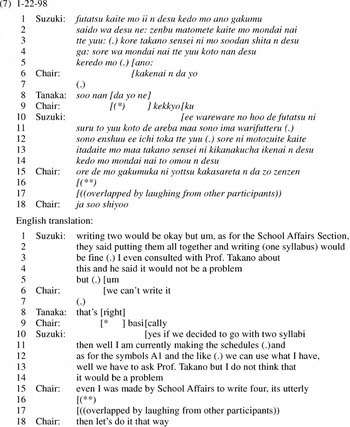
Although Suzuki first agrees (line 1) that it might be possible to write two syllabi, he goes on (lines 2–4) to present further support for his own proposal. He notes that the School Affairs Section, the section of the university ultimately responsible for putting all the syllabi together and distributing them to students, has already agreed to the proposal. He even invokes the name of Professor Takano, who is not only the official head of the School Affairs Section but is also well known to be one of the most powerful people in the university. This strategy, however, only provokes the other parties; first, the chair forcefully asserts (line 9) that they cannot write one syllabus, and then Tanaka follows close behind (line 10) by agreeing with the chair. In response to this reaction, Suzuki almost immediately changes his position. He concedes (lines 11–14) that it probably would be acceptable to write two syllabi, thereby prompting the chair to suggest (line 18) that they do it that way (ja soo shiyoo), a suggestion which in fact proved to be the final decision. That multiple participants were able to engage in this argument and ultimately reach a decision can be attributed to the turn-taking organization employed by the participants. The argument was made possible by the fact that a participant was able to interject talk into Suzuki's reporting space and that the participants were able shift the participant framework into a discussion format that could be used to exchange opposition about this matter directly.
Excerpt (7) also indicates how much institutional work the participants were able to accomplish in the kyooshitsu kaigi. The argument involving Suzuki, the chair, and Tanaka enabled the participants to reach a decision about an issue very important to their jobs as university faculty – the writing of syllabi for their classes, which is particularly important to the university as an institution because students decide which classes to take based on their reading and understanding of the syllabi, which appear in the university handbook distributed to all students. The way syllabi are written accordingly influences the students' ability to register for classes. I would suggest, then, that the participants in the kyooshitsu kaigi have created a specialized turn-taking organization. “Specialized” does not mean that the turn-taking practices used in the meeting are to be found exclusively in this particular context. Interjections, for example, are undoubtedly interactional practices that are employed in other institutional situations and also in casual conversation. Rather, it is intended to emphasize the amount of institution-specific work that the turn-taking organization allows the participants to attend to. The turn-taking organization was designed specifically so that the participants could, on the one hand, report information to their colleagues and, on the other hand, make the interactional moves, particularly interjections, that allowed them to discuss and even argue about institutional matters. In addition to making it possible for the participants to make a decision about writing syllabi (in ex. 7), the turn-taking organization allowed them to discuss and argue over an important change in the university curriculum (exx. 5 and 6), the procedures for judging prospective students (ex. 4), and the management of a new piece of equipment (ex. 3). These are all matters that are important in terms of the structure of the university as an institution. The activity of arguing and the turn-taking practices used to express opposition were, in short, extremely important to carrying out the business of the university and ultimately to putting into place the institutional structure of the university.
In summary, talk in the kyooshitsu kaigi, unlike in the kyoojukai, was organized in a way that made it possible for participants to address utterances directly to one another. Moreover, participants in the kyooshitsu kaigi were able to interject talk into the reporting spaces of other participants, a practice that did not occur in the kyoojukai. Interjections allowed participants in the kyooshitsu kaigi to shift from a reporting framework to a discussion framework in order to discuss and argue over particular matters. Such a shift did not occur in the kyoojukai. Given the use of such divergent practices in organizing talk, it is not surprising that occurrences of argument were much less frequent in the kyoojukai than in the kyooshitsu kaigi. In contrast to the kyoojukai, in which I noted two instances of participants pursuing opposition over three years, I was able to find 18 instances in the nine transcribed kyooshitsu kaigi where participants exchanged oppositions. As the analysis has attempted to illustrate, this difference in the emergence of arguments can be linked to the turn-taking practices employed by the participants. In both meetings, a moderator granted participants opportunities to make explanations and report information, but the approach adopted toward these explanations and reports diverged considerably between the two meetings. While explanations and reports were basically treated as impermeable monologues in the kyoojukai, the hookoku jikoo in the kyooshitsu kaigi were events from which discussion and arguments naturally emerged.
Nevertheless, even though the kyoojukai constrained the onset of arguing, the turn-taking organization there was no less specialized than that employed in the kyooshitsu kaigi. Turn-taking in the kyoojukai was specialized in the sense that it was organized specifically so that participants could readily admit matters into the official university record. As discussed earlier, the matters admitted by the participants were integral aspects of the university's institutional structure. I say more about the connection between the organization of talk and institutional structure in the final section.
CONCLUDING REMARKS
I have attempted to account for the occurrence of arguing in two Japanese university faculty meetings by describing and analyzing the practices used by the participants to take and manage turns at talk. Placing the analytic focus on turn-taking made it possible to gain insight into why arguments occurred far more frequently in the kyooshitsu kaigi than in the kyoojukai. The turn-taking practices used in the kyooshitsu kaigi provided participants with opportunities directly to oppose statements made in reports and subsequently to pursue those oppositions into arguments. The organization in the kyoojukai, in contrast, blocked participants from directly expressing opposition to each other. Participants wishing to address matters raised in shingi jikoo and hookoku jikoo had to filter their talk through the moderator. At the same time, description of the turn-taking practices revealed a connection between the onset of arguments in the two meetings and the structure of the university itself. In the case of the kyooshitsu kaigi, the participants constructed talk such that they could discuss and express their opposition concerning issues, including the writing of class syllabi, which were crucial to the business of the university. The participants in the kyoojukai, by employing a very different turn-taking organization that discouraged the occurrence of arguments, made it possible for matters to be admitted into the official record of the university with very little discussion or opposition.
We can see, then, that arguing is not an inherently disruptive activity that threatened the “harmonious” existence of the university. In the kyooshitsu kaigi, at least, the exchange of opposition allowed the faculty to negotiate and even decide matters pertinent to their jobs. Moreover, arguing was not necessarily determined or constrained by social and cultural factors, such as harmony and hierarchy, that supposedly underlie Japanese social interaction. Making only few references to the cultural backgrounds and the social ranks of the participants, I have instead examined arguing as it emerged (or did not emerge) from the practices used to manage turns at talk in the two meetings.
By concentrating the analysis on turn-taking, however, I did not mean to imply that cultural concepts identified in previous studies of Japanese discourse and society were necessarily irrelevant to the meetings. By way of conclusion, I would like to mention two such concepts that might enhance understanding of arguing in the meetings. First, it is apparent that the official (hierarchical) ranks of the participants, particularly the chair and Suzuki (kyoomuin ‘assistant to the chair’), were important to the interaction. In terms of language use, of the four participants who appeared most frequently in the data excerpts – the chair, Suzuki, Tanaka, and Kida – only Suzuki consistently employed addressee honorifics (also known as the desu/masu form and distal form), which are often used to show deference and/or distance toward the addressee. In contrast, the chair, Tanaka, and Kida all commonly spoke in the plain form (also referred to as the da form and casual form), especially when addressing Suzuki. This difference can be attributed to the fact that Suzuki's rank of kyoomuin was far below that of the other three. Although the chair was the official head of the department, he was in fact outranked by both Tanaka and Kida. Tanaka was the dean of the School of International Cultures, and Kida possessed the official title of gakuchooshitsuchoo ‘head of the president's room’, which made him the highest-ranking participant in the meeting.11
Both Tanaka and Kida were regular participants in the kyooshitsu kaigi because they were also members of the International Department, which meant that the classes they taught, including the third- and fourth-year seminars, were all administered by the department.
In addition, the participants at times invoked hierarchies in their talk. In particular, Suzuki in (7, line 3) refers to Professor Takano in support of his one-syllabus proposal. In making this reference, Suzuki is clearly orienting to Professor Takano's status as one of the most powerful people in the university. This suggests that, instead of assuming the existence of stable social hierarchies which determine patterns of interaction, it would be possible to approach social hierarchies in future research by examining how the participants themselves orient to and invoke them in interaction.
The second concept that could be applied to the data is nemawashi. Nemawashi, which literally means ‘turning the root’, refers to the process of discussing and even deciding issues prior to meetings. It has been used in the literature to account for the lack of open discussion in Japan, especially in business meetings (Arima 1989, De Mente 1989, Graham & Sano 1989, Yamada 1992). During my period of employment at the university where this study took place, I witnessed and was involved in numerous instances of nemawashi. In fact, bringing nemawashi into the analysis can, I believe, shed further light on the relationship between the organization of talk in meetings and the types of institutional work that were being attended to. By questioning my colleagues at the university, I learned that the shingi jikoo in the kyoojukai were all matters that had basically been decided ahead of time, usually based on nemawashi between the administrative section of the university (gakumuka) and higher-ranking faculty members. For example, I was told that status changes among students were already decided “behind the scenes,” usually in negotiations involving the student's family, the university administration, and a few select faculty members. The acceptance of these matters in the kyoojukai was, in a strong sense, a formality, a final necessary step so that official notification could be sent out to the concerned parties. The turn-taking practices, then, because they deterred participants from discussing and arguing over shingi jikoo, more or less ensured the unproblematic admittance of decisions that had been made in advance. Indeed, if a faculty member wanted to oppose, for example, a status change for one of the students, it would potentially cause a problem for the administration. In cases where students failed to pay tuition, the university administration could not permit continued enrollment, no matter what the faculty said. The concept of nemawashi thus helps to explain why the emphasis in the kyoojukai was placed on admitting matters into the official record rather than on discussing or arguing about those matters.
By contrast, there typically was not so much nemawashi prior to the kyooshitsu kaigi. In fact, the chair sometimes announced before a hookoku jikoo that he had just received a request from another part of the university to report or discuss a particular matter with the other faculty in the International Department. These matters had not been discussed or decided prior to the meeting, at least by the members of the department. This information makes it easier to understand why the participants in the kyooshitsu kaigi employed a turn-taking organization that made it possible both to report matters and to discuss and argue about them.
Nemawashi thus provides insight into the question of why there was a need for the participants to construct different turn-taking organizations in the two meetings. It also represents information that cannot be learned only by examining the details of the turn-taking organization. The same is true of the ranks of the participants and other sociocultural information that cannot be included because of space limitations. This information does not emerge as readily from a turn-by-turn examination of the interaction as do the practices used to take turns at talk. Understanding these aspects of the meetings requires ethnographic techniques such as participant observations and informant interviews that take analysts “beyond” the interaction itself. Still, as the above discussion of nemawashi stresses, this “external” information can extend our ability to comprehend the data. As one reviewer of this article suggested, concepts such as nemawashi and hierarchy, together with turn-taking organizations, are ultimately all part of the same “package.” To separate elements of this “package” is potentially to settle for an incomplete understanding of the data. Accordingly, in an attempt to gain a deeper ethnographic understanding of the Japanese university faculty meeting data I have collected, I intend in future research to explore ways of integrating into my analyses more of the information I gained through participant observation and informant interviews.12
I hasten to add, however, that this does not mean that I intend to look for ways to correlate patterns in the interaction with underlying cultural values. Following the suggestions of conversation analysts, most notably Schegloff 1991, 1992, 1997, I would aim to show how the participants themselves were making this information relevant to the interaction.
Nevertheless, by focusing the analysis specifically on description of the turn-taking organizations of the two meetings, this study emphasizes the importance of paying close attention to the details of the interaction itself. Invocation of a concept such as nemawashi may provide insight into the type of work being accomplished in the two meetings, but it cannot tell us what turn-taking practices were used in the meetings, nor can it show us how those turn-taking practices either promoted or discouraged the occurrence of arguments. Nemawashi also cannot show us the details of how turn-taking practices actually facilitated the accomplishment of institutional work. Ultimately, it is from within the incremental turn-by-turn construction of interaction that participants find the resources to utter and pursue statements of opposition, and the analysis presented here has indicated the possibility of studying arguing in Japanese by investigating how turn-taking organizations either enable or hinder participants' abilities to create and use those resources. Furthermore, this study has suggested that a conflict-relevant activity such as arguing can be treated as a potentially “constructive” occurrence – that is, as an occurrence essential to the work of an institution and to the construction and maintenance of institutional structure itself. I hope, then, that as research continues to study the occurrence of conflict in Japanese society, more consideration will be given to the turn-taking organizations employed by participants in specific contexts of interaction.
References
REFERENCES
Arima, Michiko
(1989).
Japanese culture versus schizophrenic interpretation.
Text
9:351–65.Google Scholar
Barnlund, Dean
(1989).
Communicative styles of Japanese and Americans.
Belmont, CA:
Wadsworth.
Befu, Harumi
(1980).
The group model of Japanese society and an alternative.
Rice University Studies
66:169–87.Google Scholar
Bestor, Theodore
(1992).
Conflict, legitimacy, and tradition in a Tokyo neighborhood. In
Takie Lebra (ed.),
Japanese social organization,
23–47.
Honolulu:
University of Hawaii Press.
Bilmes, Jack
(1992).
Dividing the rice: A microanalysis of the mediator's role in a
northern Thai negotiation.
Language in Society
21:569–602.Google Scholar
Bilmes, Jack
(1995).
Negotiation and compromise. In
Alan Firth (ed.),
The discourse of negotiation: Studies of language in the workplace,
61–81.
Oxford:
Pergamon.
Boden, Dierdre, &
Zimmerman, Don H. (eds.)
(1991).
Talk and social structure: Studies in ethnomethodology and
conversation analysis.
Berkeley & Los Angeles:
University of California Press.
Bourdieu, Pierre
(1977).
Outline of a theory of practice.
Trans. R. Nice.
Cambridge:
Cambridge University Press.
Coulter, Jeff
(1990).
Elementary properties of argument sequences. In
George Psathas (ed.),
Interaction competence,
181–203.
Washington D.C.:
International Institute for Ethnomethodology and Conversation Analysis
& University Press of America.
Dale, Peter
(1986).
The myth of Japanese uniqueness.
London:
Croom Helm & Nissan Institute for Japanese Studies.
De Mente, Boye
(1989).
Businessman's guide to Japan: Opening doors … and
closing deals!
Vermont & Tokyo:
Yenbooks.
Drew, Paul, &
Heritage, John (eds.)
(1992).
Talk at work: Interaction in institutional settings.
Cambridge:
Cambridge University Press.
Drew, Paul, &
Sorjonen, Marja-Leena
(1997).
Institutional dialogue. In
T. A. van Dijk, (ed.),
Discourse as social interaction,
92–118.
London:
Sage.
Duranti, Alessandro, &
Goodwin, Charles (eds.)
(1992).
Rethinking context: Language as an interactional phenomenon.
Cambridge:
Cambridge University Press.
Garcia, Angela
(1991).
Dispute resolution without disputing: How the interactional
organization of mediation hearing minimizes argument.
American Sociological Review
56:818–35.Google Scholar
Giddens, Anthony
(1984).
The constitution of society: Outline of a theory of structuration.
Berkeley:
University of California Press.
Goddard, Cliff, &
Wierzbicka, Anna
(1997).
Discourse and culture. In
T. A. van Dijk (ed.),
Discourse as social interaction,
231–57.
London:
Sage.
Goffman, Erving
(1981).
Forms of talk.
Oxford:
Basil Blackwell.
Goodwin, Charles
(1984).
Notes on a story structure and the organization of participation.
In
J. Maxwell Atkinson &
John Heritage (eds.),
Structures of social action: Studies in conversation analysis,
225–46.
Cambridge:
Cambridge University Press.
Goodwin, Charles, &
Goodwin, Marjorie
(1990).
Interstitial argument. In
Allen Grimshaw (ed.),
Conflict talk: Sociolinguistic investigations in conversations,
85–117.
Cambridge:
Cambridge University Press.
Goodwin, Marjorie
(1990).
He-said-she-said: Talk as social organization among black children.
Bloomington:
Indiana University Press.
Graham, John, &
Sano, Yoshihiro
(1989).
Smart bargaining: Doing business with the Japanese.
Ballinger.
Greatbach, David, &
Dingwall, Robert
(1997).
Argumentative talk in divorce mediation sessions.
American Sociological Review
62:151–70.Google Scholar
Hamabata, Matthews
(1994).
The battle to belong: Self-sacrifice and self-fulfillment in the
Japanese family enterprise. In
Jane Bachnik &
Charles Quinn (eds.),
Situated meaning: Inside and outside in Japanese self, society, and
language,
192–208.
Princeton:
Princeton University Press.
Have, Paul ten
(1999).
Doing conversation analysis: A practical guide.
London:
Sage.
Hayashi, Makoto
(1999).
Where grammar and interaction meet: A study of co-participant
completion in Japanese conversation.
Human Studies
22:475–9.Google Scholar
Hayashi, Makoto
(2003).
Joint utterance completion in Japanese conversation.
Amsterdam:
John Benjamins.
Heath, Christian
(1984).
Talk and recipiency: Sequential organization in speech and body
movement. In
J. Maxwell Atkinson &
John Heritage (eds.),
Structures of social action,
247–65.
Cambridge:
Cambridge University Press.
Heritage, John
(1985).
Analyzing news interviews: Aspects of the production of talk for
an overhearing audience. In
T. A. van Djik (ed.),
Handbook of discourse analysis, volume III,
95–117.
London:
Academic Press.
Heritage, John, &
Greatbach, David
(1991).
On the institutional character of institutional talk: The case of
news interviews.
In Boden & Zimmerman 1991,
93–137.
Honda, Atsuko
(1999).
Harmony as an ideological constraint on Japanese behavior. In
Jef Verschueren (ed.),
Language and ideology: Selected papers from the 6th International
Pragmatics Conference,
218–22.
Antwerp:
IPrA.
Hutchby, Ian
(1996).
Confrontation talk: Arguments, asymmetries, and power on talk radio.
Mahwah, NJ:
Lawrence Erlbaum.
Hutchby, Ian
(2001).
‘Oh’, irony and sequential ambiguity in arguments.
Discourse and Society
12:147–5.Google Scholar
Hutchby, Ian, &
Wooffitt, Robin
(1998).
Conversation analysis: Principles, practices, and applications.
Cambridge:
Polity Press.
Ito, Youichi
(1989).
Socio-cultural background of Japanese interpersonal communication
style.
Civilizations
39:101–28.Google Scholar
Iwai, Tomoko
(1996).
Harmony and conflict in Japanese interaction.
Master's thesis,
University of Hawai‘i at Manoa.
Iwasaki, Shoichi
(1997).
The Northridge earthquake conversations: The floor structure and the
‘loop’ sequence in Japanese conversation.
Journal of Pragmatics
28:
661–93.Google Scholar
Jones, Kimberly
(1990).
Conflict in Japanese conversation.
Dissertation,
University of Michigan.
Jones, Kimberly
(1995).
Masked negotiation. In
Alan Firth (ed.),
The discourse of negotiation: Studies of language in the workplace,
141–58.
Oxford:
Pergamon.
Kelly, William
(1991).
Directions in the anthropology of contemporary Japan.
Annual Review of Anthropology
20:395–431.Google Scholar
Kendon, Adam
(1982).
The organization of behavior in face-to-face interaction:
Observations on the development of a methodology. In
Klaus Scherer andPaul Ekman (eds.),
Handbook of methods in nonverbal behavior research,
440–505.
Cambridge:
Cambridge University Press.
Kondo, Dorinne
(1994).
Uchi no kaisha: Company as family. In
Jane Bachnik &
Charles Quinn (eds.),
Situated meaning: Inside and outside in Japanese self, society, and
language,
170–91.
Princeton:
Princeton University Press.
Kunihiro, Masao.
(1976).
The Japanese language and intercultural communication.
Japan Interpreter
(Winter):96–108.Google Scholar
Lerner, Gene, &
Takagi, Tomoyo
(1999).
On the place of linguistic resources in the organization of
talk-in-interaction: A co-investigation of English and Japanese
grammatical practices.
Journal of Pragmatics
31:49–75.Google Scholar
Locastro, Virginia
(1987).
Aizuchi: A Japanese conversational routine. In
Larry Smith (ed.),
Discourse across cultures,
101–13.
New York:
Prentice-Hall.
Maynard, Douglas
(1986).
Offering and soliciting collaboration in multi-party disputes among
children (and other humans).
Human Studies
9:261–85.Google Scholar
Maynard, Senko
(1986).
On back-channel behavior in Japanese and English casual
conversation.
Linguistics
24:1079–1108.Google Scholar
Midooka, Kiyoshi
(1990).
Characteristics of Japanese-style communication.
Media, Culture and Society
12:477–89.Google Scholar
Mori, Junko
(1999).
Negotiating agreement and disagreement in Japanese: Connective
expressions and turn construction.
Amsterdam:
John Benjamins.
Mouer, Ross, &
Sugimoto, Yoshio
(1986).
Images of Japanese society.
New York:
Routledge & Kegan Paul.
Nakane, Chie
(1970).
Japanese society.
Berkeley & Los Angeles:
University of California Press.
Noda, Mari
(1990).
The extended predicate and confrontational discourse in Japanese.
Dissertation,
Cornell University.
O'Keefe, Daniel
(1977).
Two concepts of argument.
Journal of the American Forensic Association
13:121–28.Google Scholar
Ozaki, Robert
(1978).
The Japanese: A cultural portrait.
Tokyo:
Tuttle.
Psathas, George
(1995).
Conversation analysis: The study of talk-in-interaction.
London:
Sage.
Sacks, Harvey
(1992).
Lectures on conversation.
Oxford:
Blackwell.
Sacks, Harvey;
Schegloff, Emanuel; &
Jefferson, Gail
(1974).
A simplest systematics for the organization of turn-taking for
conversation.
Language
50:696–735.Google Scholar
Saft, Scott
(1998).
Some uses and meanings of utterance initial iya in Japanese
discourse. In
Noriko Akatsuka
et al. (eds.),
Japanese/Korean linguistics
7, 121–37.
Stanford:
CSLI Publications.
Saft, Scott
(2000).
Arguing in the institution: Context, culture, and conversation
analysis in a set of Japanese university faculty meetings.
Dissertation,
University of Hawai‘i at Manoa.
Schegloff, Emanuel
(1968).
Sequencing in conversational openings.
American Anthropologist
70:1075–95.Google Scholar
Schegloff, Emanuel
(1979a).
The relevance of repair to syntax-for-conversation. In
T. Givon (ed.),
Syntax and semantics, volume 12: Discourse and syntax,
261–88.
New York:
Academic Press.
Schegloff, Emanuel
(1979b).
Identification and recognition in telephone conversation
openings. In
G. Psathas (ed.)
Everyday language: Studies in ethnomethodology.
Hillsdale, NJ:
Erlbaum.
Schegloff, Emanuel
(1987).
Between macro and micro: Contexts and other connections. In
Jeffrey Alexander
et al. (eds.),
The macro-micro link,
207–34.
Berkeley:
University of California Press.
Schegloff, Emanuel
(1991).
Reflections on talk and social structure.
In Boden & Zimmerman 1991,
44–70.
Schegloff, Emanuel
(1992).
On talk and its institutional occasions.
In Drew & Heritage 1992,
101–34.
Schegloff, Emanuel;
Jefferson, Gail; &
Sacks, Harvey
(1977).
The preference for self-correction in the organization of repair in
conversation.
Language
53:361–82.Google Scholar
Schegloff, Emanuel, &
Sacks, Harvey
(1973).
Opening up closings.
Semiotica
8:
289–327.Google Scholar
Schiffrin, Deborah
(1985).
Everyday argument: The organization of diversity in talk. In
Teun van Dijk (ed.),
Handbook of discourse analysis, volume 3: Discourse and dialogue,
35–46.
London:
Academic Press.
Sugimoto, Yoshio, &
Mouer, Ross (eds.)
(1989).
Constructs for understanding Japan.
London & New York:
Kegan Paul.
Takagi, Tomoyo
(1999).
“Questions” in argument sequences in Japanese.
Human Studies
22:397–423.Google Scholar
Tanaka, Hiroko
(1999).
Turn-taking in Japanese conversation: A study in grammar and
interaction.
Amsterdam:
John Benjamins.
Tanaka, Hiroko
(2000).
The particle ne as a turn-management device in Japanese
conversation.
Journal of Pragmatics
32:1135–76.Google Scholar
Tsujimura, Akira
(1987).
Some characteristics of the Japanese way of communication. In
D. Lawrence Kincaid (ed.),
Communication theory: Eastern and Western perspectives,
115–26.
London:
Academic Press.
Watanabe, Suwako
(1993).
Cultural differences in framing: American and Japanese group
discussions. In
Deborah. Tannen (ed.),
Framing in discourse,
176–209.
Oxford:
Oxford University Press.
Yamada, Haru
(1992).
American and Japanese business discourse: A comparison of
interactional styles.
Norwood, NJ:
Ablex.
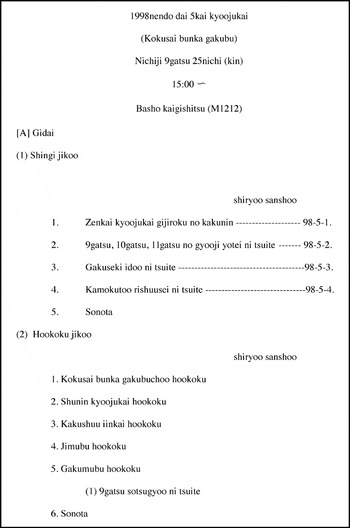
Written agenda for one kyoojukai (romanized Japanese).
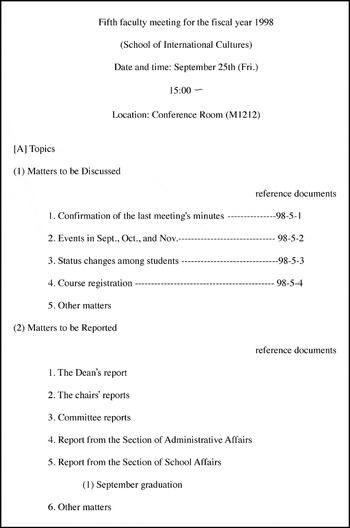
Written agenda for one kyoojukai (English translation).
 You have
Access
- 11
- Cited by