Introduction
Of late, long-term sustainability of agro-ecosystems has become more important than mere maximization of agricultural productivity. Consequently, there has been renewed interest in ecosystem-based pest management strategies such as trap cropping that had previously been neglected. Trap crops are hosts of a particular pest that, when positioned near the main crop, intercept and retain the pest, thereby limiting their numbers on the main crop (Hokkanen, Reference Hokkanen1991; Shelton and Badenes-Perez, Reference Shelton and Badenes-Perez2006). Their use in the management of pests in agro-ecosystems can go a long way in contributing towards ecologically sustainable crop production systems. The principle of trap cropping rests on the fact that herbivores may show a distinct preference for certain plant species, cultivar or crop stage either in their oviposition or feeding behaviour based on visual, tactile, odiferous cues or a combination of stimuli (Hokkanen, Reference Hokkanen1991). In some systems, the amount of plant biomass has also been shown to be of vast importance to some insects’ host plant choice (Reudler Talsma et al., Reference Reudler Talsma, Biere, Harvey and van Nouhuys2008). A lot of research has been carried out on trap cropping; however, most of it has mainly focused on the management of a single pest species on a particular crop (Idris and Grafius, Reference Idris and Grafius1996; Smyth et al., Reference Smyth, Hoffmann and Shelton2003; George et al., Reference George, Collier and Port2009; Karungi et al., Reference Karungi, Lubanga, Kyamanywa and Ekbom2010). More often than not a complex rather than just a single pest species affects crops. More efficient and practical trap cropping systems would evolve from a comprehensive management of the key pests on a particular crop.
Although the diamondback moth Plutella xylostella (L.) (Lepidoptera: Plutellidae) has been recognized as the most devastating pest of crucifers in East Africa, a change in climate leading to longer dry periods and a restriction on synthetic insecticide applications recommended to protect the introduced parasitoids that have been found to be effective in diamondback moth control have led to a gradual shift in its pest status in Uganda. Pests that are favoured by long dry periods and were previously controlled mainly by the use of insecticides, e.g. the cabbage cluster caterpillar Crocidolomia pavonana ( = binotalis) (Fab.) (Lepidoptera: Pyralidae) and the cabbage aphid Brevicoryne brassicae (L.) (Homoptera: Aphididae), seem to have re-emerged. This is a big challenge to farmers who previously depended on synthetic insecticides to control these pests and calls for an urgent provision of alternative control measures that are compatible with the biological control of P. xylostella.
In an earlier study, Karungi et al. (Reference Karungi, Lubanga, Kyamanywa and Ekbom2010) investigated the preference and performance of C. pavonana on different candidate trap crop plants. All tested candidate plants greatly reduced C. pavonana oviposition on cabbage in field trials. Two other insect pests (P. xylostella and B. brassicae) are often present in Ugandan cabbage crops. We wished to explore the influence of trap crops of possible use for C. pavonana control on other frequent pests of cabbage. Therefore, counts of diamondback moth eggs and cabbage aphids were performed in conjunction with the inventories of C. pavonana in field trials (Karungi et al., Reference Karungi, Lubanga, Kyamanywa and Ekbom2010). The aim of this study was to investigate how the presence of putative trap crops might affect infestation levels by diamondback moth and cabbage aphid on cabbage (Brassica oleracea var. capitata) in a system designed for the cabbage cluster caterpillar.
Materials and methods
Study site
The study was performed at the Makerere University Agricultural Research Institute, Kabanyolo, Uganda (MUARIK) (0°28′N, 32°27′E; 1200 m above sea level) in 2007 and 2008. The station soils are Oxisols. The area has a bimodal rainfall pattern with April–May and October–November as the wettest months. The mean daily maximum and minimum temperatures of the area were about 28 and 17°C, respectively.
Host plants
Five cultivated Brassicaceae plants, namely kale (B. oleracea var. acephala L., cultivar Thousand headed), cauliflower (B. oleracea var. botrytis L., cultivar Early snowball), broccoli (B. oleracea var. italica Plenck, cultivar Greens), Chinese cabbage (B. campestris ssp. pekinensis L., cultivar Granat) and Indian mustard (B. juncea (L.), cultivar Czern), were assessed alongside white cabbage (B. oleracea var. capitata L., cultivar Copenhagen). Chinese cabbage and Indian mustard were selected following their previous success as trap crops for C. pavonana in Asia and Guam (Srinivasan and Krishna Moorthy, Reference Srinivasan and Krishna Moorthy1991; Sastrosiswojo and Setiawati, Reference Sastrosiswojo and Setiawati1992; Silva-Krott et al., Reference Silva-Krott, Singh, Lali and Muniappan1995; Muniappan et al., 2001) and laboratory studies in the USA (Smyth et al., Reference Smyth, Hoffmann and Shelton2003). Cauliflower, broccoli and kale were selected because although they are available on the Ugandan market and are known hosts of the pest (Gunn, Reference Gunn1925; Kalshoven, 1981), their possibility of acting as trap crops has not been explored. Seeds were obtained from a local dealer in agricultural inputs, for all test plants except B. juncea that came from Svalöf-Weibull AB (Svalöf, Sweden). Seeds of the different host plants were sown in seeding trays filled with heat-sterilized soil. After germination, seedlings were kept in the trays for 4 weeks and hardened off for 1 week before transplanting them to the field.
Experimental layout and design
A complete randomized block design with seven treatments, each replicated four times, was used in this study. The first five treatments had the two-choice (paired) arrangement with white cabbage paired with each of the other five Brassicaceae plants (i.e. cabbage–broccoli, cabbage–cauliflower, cabbage–kale, cabbage–Chinese cabbage and cabbage–Indian mustard), treatment 6 had the multiple-choice (mixture) arrangement (i.e. all the six host plants together in the same plot) and treatment 7 was the control with the white cabbage monoculture. The two-choice plots had 40 plants evenly distributed into four rows with five cabbage plants and five plants of another host randomly assigned into each row ( = 20 cabbage plants: 20 other host plants per 3 by 2 m plot at a plant spacing of 60 × 30 cm). Mixture plots had 48 plants with two plants of each of the six hosts randomly assigned to each of the four rows in 3.3 by 2 m plots at a plant spacing of 60 × 30 cm ( = 48 plants/plot). Cabbage monoculture plots had 40 plants with 10 plants per row at similar plot dimensions and spacing as the two-choice plots. One-metre alleys separated the individual plots, whereas 2 m alleys separated the blocks. The field trials were conducted twice, in 2007 and 2008. Hand weeding was done twice in each season; manual watering was only carried out when the conditions necessitated it.
Variables to measure host preference assessment
To assess infestation on cabbage, oviposition was considered as the definitive measure of host preference for the two specialist crucifer pests, i.e. the diamondback moth and the cabbage cluster caterpillar, while colonization by alatae and population build-up of apterae were considered as indicators of infestation by the cabbage aphid. Data for diamondback moth and cabbage aphid were collected at the same time as egg counts were done for cabbage cluster moth (Karungi et al., Reference Karungi, Lubanga, Kyamanywa and Ekbom2010).
Data collection
Data collection commenced at 7 days after planting (DAP) for P. xylostella and B. brassicae and at 14 DAP for C. pavonana, corresponding with the days when the pests were first observed in the field. Data collection was done once a week for 4 weeks. Ten plants of cabbage and 10 plants of the other host crop were randomly selected in the two-choice plots; five plants of each host type were randomly selected in the multiple-choice plots; and 10 plants of cabbage in the monoculture. The selected plants were carefully examined for eggs, and the number of eggs of C. pavonana and P. xylostella per sampled plant was then recorded and removed. The number of winged and unwinged B. brassicae was also recorded from the same sampled plants, but aphids were not removed. Means per plant for each plot were calculated for use in the statistical analysis. All the data were collected under natural infestation.
Data analysis
For all data, SAS for Windows version 9.1 was used for statistical analysis. All counts were transformed using logarithm base 10 (n+1). To the complete randomized block analysis, season was added as an additional factor. For the two lepidopterans, C. pavonana and P. xylostella, eggs were removed after each sampling occasion and different sampling dates were considered independently of each other. The mean numbers of eggs laid on cabbage for each cropping combination were compared using a least-squares means t-test with a Bonferroni adjustment. For aphids, which were not removed from the plants, a repeated-measures ANOVA was used. Season was statistically significant for both alatae and apterae aphids and therefore analyses were performed separately for the two seasons.
Results
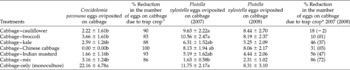
The mean number of eggs per plant oviposited by C. pavonana (F = 12.19; df = 6, 213; P < 0.0001) on cabbage in the different treatments varied significantly (Table 1). The year in which the trial was performed was not significant for C. pavonana (F = 1.79; df = 1, 213; P = 0.18) but was significant for P. xylostella (F = 5.97; df = 1, 213; P = 0.02); thus, for the latter species, the 2 years were analysed separately. In 2007, there was a significant difference between the treatments (F = 4.37; df = 6, 102; P = 0.0006), but not in 2008 (F = 1.59; df = 6, 102; P = 0.16). There was no difference between the monoculture and the two crop treatments in either year, but in 2007, the mixture treatment differed from the monoculture (Table 1). The oviposition of C. pavonana was greatly reduced in all combinations of companion crops. The reduction in the number of P. xylostella eggs was generally lower and more variable (Table 1).
Oviposition by Crocidolomia pavonana and Plutella xylostella on cabbage in different trap crop situations

Mean values ( ± SEM) followed by the same letter in the same column are not significantly different (P < 0.05); least-squared means t-test with a Bonferroni adjustment was used for comparison on transformed data.
* % Reduction = (no. of eggs on cabbage in monoculture − no. of eggs on cabbage in combination)/no. of eggs on cabbage in monoculture.
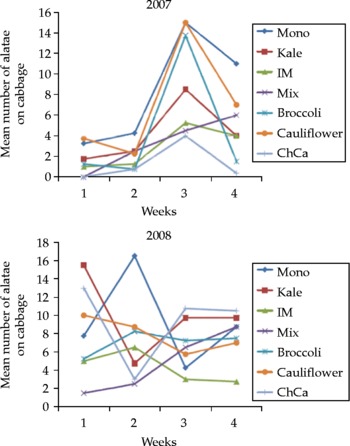
Colonization (represented by the number of alatae aphids) of cabbage by B. brassicae varied significantly among the different crop combinations in 2007 (F = 5.82; df = 6, 18; P = 0.002) and in 2008 (F = 3.35; df = 6, 18; P = 0.02). In week 3, in 2007, more winged aphids were found on monocropped cabbage and in plots with cauliflower and broccoli; in week 4, in 2008, many more aphids were found on cabbage than in plots with cauliflower (Fig. 1). In 2007, there was an effect over time (Wilks’ test: F = 15.02; df = 3, 16; P < 0.0001), but not in 2008 (Wilks’ test: F = 1.22; df = 3, 16; P = 0.34). There was no interaction between treatment and time for either year (2007: Wilks’ test: F = 1.47; df = 18, 45.74; P = 0.14; 2008: Wilks’ test: F = 1.64; df = 18, 45.74; P = 0.09).
Winged (alatae) cabbage aphids found on cabbage in two field trials in 2007 and 2008. Mono, monoculture of cabbage; Kale, cabbage and kale; IM, cabbage and Indian mustard; Mix, all six plant species; Broccoli, cabbage and broccoli; Cauliflower, cabbage and cauliflower; ChCa, cabbage and Chinese cabbage.

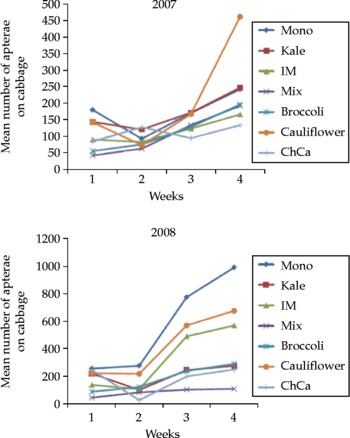
Population build-up (represented by the number of apterae aphids) on cabbage by B. brassicae did not vary significantly among the different crop combinations in 2007 (F = 2.16; df = 6, 18; P = 0.10), but did so in 2008 (F = 8.26; df = 6, 18; P = 0.0002). The highest population at the end of 2007 was found on cabbage grown together with cauliflower, and in 2008, a very high number of aphids was observed on monocropped cabbage (Fig. 2). In both years, there was an effect over time (2007: Wilks’ test: F = 15.16; df = 3, 16; P < 0.0001; 2008: Wilks’ test: F = 14.70; df = 3, 16; P < 0.0001). No interaction between treatment and time was recorded for either year (2007: Wilks’ test: F = 0.93; df = 18, 45.74; P = 0.55; 2008: Wilks’ test: F = 1.43; df = 18, 45.74; P = 0.16). In testing only mean aphid numbers per plant in the final week of counts, there was no significant difference in 2007 (F = 2.09; df = 6, 18; P = 0.11) but there was in 2008 (F = 4.37; df = 6, 18; P = 0.007). Aphid numbers per plant in the mixture plot were significantly lower than those in the monoculture, Indian mustard and cauliflower plots.
Apterae (non-winged) cabbage aphids found on cabbage in two field trials in 2007 and 2008. Mono, monoculture of cabbage; Kale, cabbage and kale; IM, cabbage and Indian mustard; Mix, all six plant species; Broccoli, cabbage and broccoli; Cauliflower, cabbage and cauliflower; ChCa, cabbage and Chinese cabbage.

Discussion and conclusions
Using trap cropping against C. pavonana is not likely to have an easily predictable effect on two other frequent cabbage pests, the diamondback moth and the cabbage aphid. Although varying reductions in the mean number of eggs per plant for P. xylostella were noted, the number of eggs deposited on cabbage in the two crop treatments did not differ significantly from the number of eggs laid on monocropped cabbage. Some differences in numbers of colonizing aphids among the treatments were detected, but there were no consistent patterns between the years. The same was true for apterous aphids. On a positive note, there does not seem to be any trap crop combination that exacerbates problems with diamondback moth or cabbage aphid. Yet if trap cropping is developed for C. pavonana, monitoring for the other pests will have to continue.
Based on the number of eggs laid on cabbage in the two-crop treatments, none of the companion crops used in this study seemed to affect P. xylostella oviposition, suggesting that none of the potential trap crops has the potential to be used to attract P. xylostella away from cabbage. The lowest number of eggs on cabbage occurred in mixture plots, but this is probably a result of the low density of cabbage plants (8 per plot) compared with the other plots (20 per plot in two-crop plots, 40 per plot in monoculture). Plots with kale and Indian mustard reduced P. xylostella egg numbers on cabbage fairly consistently. Idris and Grafius (Reference Idris and Grafius1996) reported higher diamondback moth oviposition on broccoli and kale compared with other wild and cultivated Brassicaceae host plants, while studies from New York by Badenes-Perez et al. (Reference Badenes-Perez, Shelton and Nault2004) also reported similar results on kale. Indian mustard has been suggested as a trap crop for diamondback moth. Studies in India (Srinivasan and Krishna Moorthy, Reference Srinivasan and Krishna Moorthy1991) reported that Indian mustard attracted P. xylostella in cabbage fields, and Silva-Krott et al. (Reference Silva-Krott, Singh, Lali and Muniappan1995) as well as Charleston and Kfir (Reference Charleston and Kfir2000) and Åsman (Reference Åsman2002) have suggested that Indian mustard may be a good trap crop for P. xylostella.
No particular patterns were found for colonization and population build-up of B. brassicae on cabbage in the different treatments. The monoculture generally had more aphids per plant, but this was not always true. Aphids may be more effectively controlled when using non-host companion crops or cover crops in an intercropping design. Broad et al. (Reference Broad, Schellhorn, Lisson, Mendham and Corkrey2008) found, in line with the theory that a reduction of background contrast will limit aphid colonization (Finch and Collier, Reference Finch and Collier2000), that a non-host cover crop lowers cabbage aphid numbers. Mutiga et al. (Reference Mutiga, Gohole and Auma2010) found lower cabbage aphid populations in plots that contained cabbage and spring onions compared with cabbage monocultures, indicating that the presence of a companion crop led to a reduction in both colonization and population build-up by B. brassicae. The suggested mechanism was the presence of volatile organic compounds negative to cabbage aphids (Nottingham and Hardie, Reference Nottingham and Hardie1993; Finch and Collier, Reference Finch and Collier2000).
Overall, this study indicated that there are companion crops that have a great potential to trap C. pavonana away from cabbage, whereas these crops showed, at best, a moderate potential to attract P. xylostella away from cabbage. None of the host plants studied can be used to trap B. brassicae away from cabbage but the increased diversity from the trap crops may help to sometimes reduce aphid infestations. Most importantly, design of a trap cropping system for the cabbage cluster caterpillar will not result in extra damage from diamondback moth and cabbage aphid.
Acknowledgements
This study was funded by the Sida/SAREC through the Sida/SAREC-Makerere University Bilateral Collaborative Program and the Swedish Foreign Ministry Project on Food Security at the Swedish University of Agricultural Sciences.