

1. Introduction
In countries where women have minimal control over resources and a limited voice in decision-making, the exposure to new ideas through international migration can set off, facilitate, or catalyze gender parity [Hugo (Reference Hugo, Presser and Sen2000)]. By looking at the shares of women enrolled in the lower chamber of National Parliaments, this paper explores the role of international migration as a measure of exposure to foreign practices related to female political empowerment.Footnote 1 During their stay abroad, migrants familiarize with different values, norms, and other forms of behaviors which are specific to the host country. They form networks of relationships and acquire knowledge on new economic and institutional conditions. Socialization is likely to occur and migrants accommodate to new practices which can have a substantial impact on their countries of origin.Footnote 2
An increasing number of papers have investigated the role of migration in diffusing norms and values of different natures. Spilimbergo (Reference Spilimbergo2009) has shown, for example, the role of foreign students in promoting democracy in their home country, provided that the foreign education has been acquired in democratic countries. Docquier et al. (Reference Docquier, Lodigiani, Rapoport and Schiff2016) have shown that international migration is an important determinant of institutional quality, as measured by democracy and economic freedom. Focusing on returnees, Mercier (Reference Mercier2016) recognizes the positive role of international migration on the quality of the leadership and the emergence of the elites. Analogously, a few micro studies have contributed to the literature on the transfer of political norms through migration. Chauvet and Mercier (Reference Chauvet and Mercier2014) find a positive effect of Malian returnees from non-African destinations on origin country's participation rates and electoral competitiveness; Barsbai et al. (Reference Barsbai, Rapoport, Steinmayr and Trebesch2017) show how Westward migrants contributed to overthrowing the Communist party in Moldova; and finally, Batista and Vicente (Reference Batista and Vicente2011) show how migration to countries with better governance has increased the demand for political accountability in Cape Verde. The same mechanism has been also applied to attitudes toward fertility. Focusing on Egypt, Morocco, and Turkey, Fargues (Reference Fargues, Ozden and Schiff2007) shows that fertility rates in sending countries are affected by the rates prevailing in their migrants' host countries. Beine et al. (Reference Beine, Docquier and Schiff2013) extend Fargues' conclusions providing evidence of a transfer of fertility norms from international migrants to 208 countries of origin. In a micro setting, Bertoli and Marchetta (Reference Bertoli and Marchetta2015) find that return migration to Egypt from other Arab countries characterized by higher fertility rates has had a significant and positive influence on the total number of children. In a similar vein, Daudin et al. (Reference Daudin, Franck and Rapoport2018) show that internal migration between 1861 and 1911 in France contributes to convergence toward low birth rates by diffusing cultural and economic information about low-fertility behavior.
Our study belongs and contributes to this strand of literature raising the possibility that international migrants transmit back home through various channels attitudes toward gender parity.Footnote 3 This issue is explored by looking at the impact of international emigration on the share of female parliamentary participation between 1970 and 2010. The identification of the exact way through which migration affects attitudes toward women in the countries of origin is difficult both at macro and micro level unless suitable data are available and it goes beyond the scope of this paper. Our empirical analysis addresses whether a “transfer of norms” mechanism is in place and its causal direction. In particular, we show that total international migration to countries where the share of female parliamentary seats is higher increases source country female parliamentary participation in the lower chamber of the National Parliament.
There is strong anecdotal evidence on the role of international migration in shaping female political empowerment in the countries of origin. Correa (Reference Correa1998), for example, finds how the involvement of Puerto Rican female migrants in the New York political arena changed the social role of women as well as their husbands' viewpoint concerning their wives at the origin.Footnote 4 When Nydia Velasquez won the Puerto Rican primary elections and ended up being elected as the first Puerto Rican congresswoman in the US, she was strongly supported by Latino voters willing to accommodate themselves to the idea of female leadership.
Pessar (Reference Pessar2001) studied the behavior of Guatemalans emigrated to Mexico and then returned to their country. She finds that in 1995, on the occasion of a meeting with returnee leaders, Guatemalans were persuaded to sign a document affirming the desirability of making women and men equal owners of the land and the equal accessibility to the community governing directorates. Migrants also keep strong links with their family back home. In Africa, where migration of women is mainly circular, migrants do not break away permanently from their places of origin [Piore (Reference Piore1979)]. The 2011 Nobel Peace Prize Leymah Roberta Gbowee while visiting regularly her origin country, Liberia, where her children used to live, struggled for the safety of women and for women's right. She led the women's peace movement that brought an end to the Second Liberian Civil War in 2003 and contributed then to the election of Ellen Johnson Sirleaf, the first African female President.Footnote 5
Migrants frequently contribute to the development of their village of origin through Home Town Associations (HTAs), which can offer women's empowerment projects.Footnote 6
For example, the South Sudan Women's Empowerment Network (SSWEN), created by Sudanese United States-based migrants, has been deeply involved in building the new South Sudanese National State, whose independence dates back to the 9th of July 2011. The role of the Sudanese diaspora has been so relevant for the involvement of women in development programs (with particular emphasis on political decision-making), that Erickson and Faria (Reference Erickson and Faria2011) describe diasporic Sudanese women as “new and increasingly important citizens and activists in the post-CPA (Comprehensive Peace Agreement) era”.
Finally, external voting also helps in transferring new political values in countries of origin.Footnote 7
In 1916, the province of British Columbia in Canada enabled military personnel overseas to vote in a referendum on women's suffrage which became effective then.Footnote 8
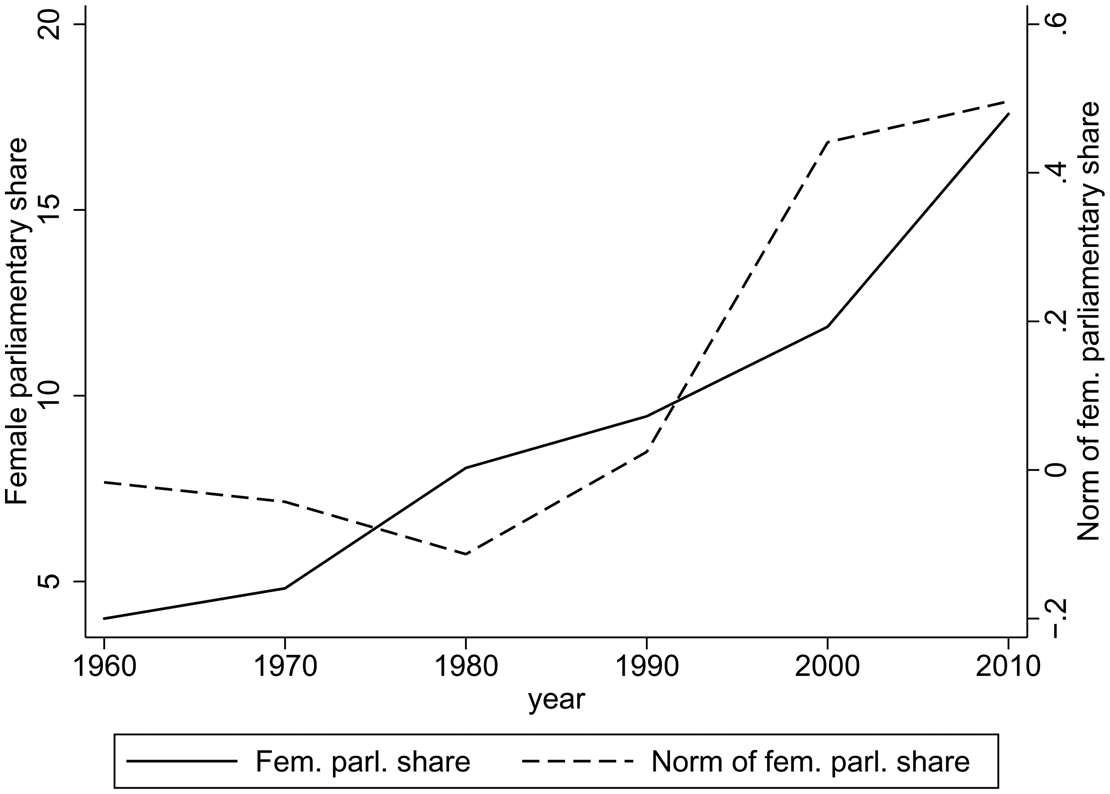
The choice of female parliamentary participation is important for many reasons. Women constitute more than half of the global population. However, female electorate continues to be under-represented in economic and political decision-making bodies at all levels. According to 2010's Inter-Parliamentary Union (IPU) data, the international average representation of women in parliaments has increased over the years, but it is far short of gender parity (see Figure 1).
Female parliamentary share and norm of female parliamentary share over time (1960–2010).

When revising the relationship between gender empowerment and economic development, Duflo (Reference Duflo2012) states that there are two rationales for supporting active policies to promote women. The first is equity: women are currently worse-off than men, and this inequality between genders is unfair in its own right. The second regards the fundamental role women play for development. This is a central issue in policy makers' debates. Baskaran et al. (Reference Baskaran, Bhalotra, Min and Uppal2018) use comprehensive data on competitive elections to India's state legislative assemblies, exploiting close elections between men and women to isolate the causal effect of legislator gender in a regression discontinuity design. They find evidence that women legislators are less likely to be criminal and corrupt, more efficacious, and less vulnerable to political opportunism.
Thomas (Reference Thomas1991) shows that States in the US with a higher female representation have introduced and passed more priority bills dealing with the issues of women, children, and families compared to States with lower female representation. Funk and Gathmann (Reference Funk and Gathmann2008) examine survey data on all federal votes in Switzerland between 1981 and 2003, and find that female voters and politicians favor, among other things, public health provision, and equal gender rights. Besley and Case (Reference Besley and Case2000) find that female legislators apply pressure to increase family assistance and to strengthen child support. When considering Indian data, Clots-Figueras (Reference Clots-Figueras2011) finds that female legislators invest more than men in health, female teachers, early education, and favor “women-friendly” laws.
Along the same lines, Iyer et al. (Reference Iyer, Mani, Mishra and Topalova2011) find that an increase in female representation in local government induces large and significant effects on reporting of crimes against women in India, thus favoring access to justice for women. On the theoretical side, De la Croix and Vander Donckt (Reference De la Croix and Donckt2010) recognize the importance of female empowerment as a multidimensional concept which includes economic participation and opportunity, educational attainment, political empowerment, health, and survival. They argue that a range of socioeconomic outcomes are attached to gender equality, including improved children's development (through better health and education) and growth.
The rest of the paper is structured as follows. Section 2 describes the empirical model implemented to identify the impact of migration on the propagation of female political values at home. Section 3 deals with the datasets used to conduct the empirical analysis and provides some stylized facts. Section 4 goes through the main challenges to be addressed in the empirical analysis. Section 5 provides the empirical results and some robustness checks. Finally, Section 7 concludes.
2. The empirical model
To test for the impact of international migration on female parliamentary seats in the country of origin $\lpar {{\rm seats}_{i\comma t}^F } \rpar$ through a “transfer of norms” mechanism, we consider the following specification by decadeFootnote 9:

where:
• t refers to the year of interest and goes from 1970 to 2010; i refers to the country of origin and j to the country of destination.Footnote 10
• ${\rm seats}_{i\comma t}^F$
 represents the female parliamentary share at time t in country of origin i.
• ${\rm seats}_{i\comma t-10}^F$
represents the female parliamentary share at time (t − 10) in country of origin i.• migij,t−10 is the bilateral total migration stock from i to j at time (t − 10). The reason why we consider total migration instead of female migration is threefold. First, according to the message given on the occasion of the 100th International Women's Day by the Director of the Secretariat of the International Strategy for Disaster Reduction (UN/ISDR) Salvano Briceno, “Advancing gender perspectives and women's rights is not just a job for women, more men must advocate at a high level for the empowerment of women, and for the incorporation of gender budgeting into national and local development plans”. Secondly, if we look at the gender composition of HTAs, there is no evidence that efforts to improve females' conditions are just pursued by female migrants. Recent developments have shown that policies and works towards gender equality face new challenges related to men's role and demands.Footnote 11 Thirdly, according to Doepke and Tertilt (Reference Doepke and Tertilt2009), men care about the other gender in facing a trade-off between the rights they want for their own wives (namely none) and the rights of other women in the economy.
• popi,t−10 is the total population at time (t − 10) in country i.
• $\lsqb {\lpar {{\rm mi}{\rm g}_{ij\comma t-10}/{\rm po}{\rm p}_{i\comma t-10}} \rpar \times \lpar {{\rm seats}_{j\comma t-10}^F -{\rm seats}_{i\comma t-10}^F } \rpar } \rsqb$
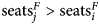
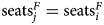
is the “norm” at time (t − 10) through which foreign female parliamentary participation is propagated in the country of origin. Unlike previous works, we multiply the migration rate component migij,t−10/popi,t−10 with the difference between the parliamentary share at destination and that in the country of origin. We expect a positive effect if ${\rm seats}_j^F \gt {\rm seats}_i^F$. In other terms, the origin country takes advantage of the political environment at destination just if the female political conditions at destination are better than those at origin (we will have instead a “negative transfer of norm” if ${\rm seats}_j^F \lt {\rm seats}_i^F$ and no transfer if ${\rm seats}_j^F = {\rm seats}_i^F$). Moreover, the greater the difference, the stronger the effect.• R i,t contains other traditional covariates of interest. We control for political exogenous variables such as the presence of a (de jure) democratic system in the country of origin i at time t; the occurrence of legal elections in between time t and time t − 10 in country i and the number of legal elections with a proportional system between time t and time t − 10 in country i. We account also for the female skill ratio in country i at time t − 10 computed as the ratio of tertiary educated over illiterate females; the number of years since CEDAW (Convention on the Elimination of all Forms of Discrimination against Women) ratification at time t, GDP and trade norms at time t − 10 in country i.
• μ i and φt are country of origin and time fixed effects.




The main references are the studies of Spilimbergo (Reference Spilimbergo2009) and Beine et al. (Reference Beine, Docquier and Schiff2013). To determine the impact of students' migration on democracy at the origin, Spilimbergo (Reference Spilimbergo2009) regresses the index of democracy at time t in country i over the 5 years' lagged value of democracy in country i, the number of students abroad as a share of the total population in the sending country, the average level of democracy in the host countries, and the interaction between the two latter terms. The average level of democracy in the host countries is constructed as the weighted average of the institution in the host countries where the weights are given by the share of students from country i to country j over all students from country i. Beine et al. (Reference Beine, Docquier and Schiff2013) also apply the same specification in a cross-section setting to assess the impact of migration on source country fertility. The norm is constructed as the interaction between the (log of) fertility rate at destination with the size of the diaspora. With respect to previous studies, our norm differs in two aspects. First, it is able to control for asymmetries between the source country and destination's female political empowerment. Secondly, its weights are given by emigration rates in order to test whether the transmission of the norm depends on the intensity of migration. Spilimbergo (Reference Spilimbergo2009) and Beine et al. (Reference Beine, Docquier and Schiff2013) are prevented from doing it because of collinearity problems. The correlation between the norm, the migration rate, and the interaction term between the two is so high that they cannot infer anything on the intensity of migration. In Beine et al. (Reference Beine, Docquier and Schiff2013), in particular, this lack of significance is justified by the complexity of the transfer of norms' mechanism.Footnote 12
3. Data and stylized facts
Our data set is a 10-year unbalanced panel spanning the period between 1970 and 2010, where the start of the date refers to the dependent variable (i.e., t = 1970, t − 10 = 1960). Countries enter the sample if women were eligible at time t and at time t − 10. The country sample is selected on the basis of the availability of the data. We now describe the basic details of the data we use to measure our main variables of interest.
3.1 Political data
Political data on the proportion of seats held by women in national parliaments cover the time span 1960–2010 and relies on two different datasets.Footnote 13 Between 1960 and 2003, the database by Paxton et al. (Reference Paxton, Hughes and Green2006) titled “Women in Parliament, 1945–2003: Cross-National Dataset” is used.Footnote 14 This data collection provides yearly information on women's inclusion in parliamentary bodies in 204 countries from 1945 to 2003. The dataset allows for the extensive, large-scale, cross-national investigation of the factors that explain women's attainment of political power over time and provides comprehensive international and historical information on women in a variety of political positions. Information is provided on female suffrage, the first female member of parliament, yearly percentages of women in parliaments (data refer to the percent of parliamentary women in the lower or single house of each country's national legislature), when women reached important representational milestones, such as 10%, 20%, and 30% of a legislature, and when women achieved highly-visible political positions, such as prime minister, president, or head of parliament. Political information for the remaining 7 years (from 2004 to 2010) has been taken from the World Development Indicators (WDI) 2014. Both Paxton et al. (Reference Paxton, Hughes and Green2006) and WDI (2014) rely on IPU (www.ipu.org) data which make them compatible with each other.
The evolution of the world average female parliamentary share is described in Figure 1. Looking at the world average, the proportion of seats held by women in national parliaments has increased from about 4% in 1960 to about 18% in 2010. While the international average representation of women in parliaments has steadily increased, this is far short of gender parity. In 2010, 58 countries still have no more than 10% of female members in the parliament. Moreover, the gap in women parliamentary participation among regions is high, with the West Europe region being the most “feminized” with an average of 30% of women in the Parliament. The lowest shares belong to the Mena region, with an average of 11.1%.
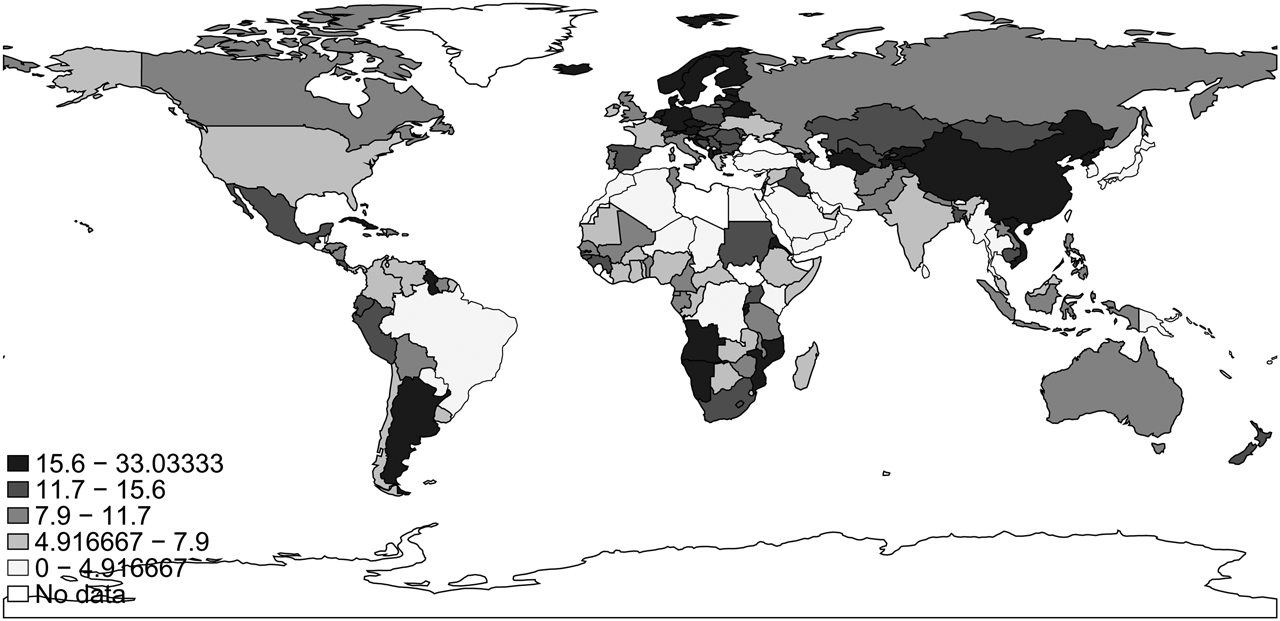
Figure 2 represents cross-country differences in the average level of the proportion of seats held by women in national parliaments over the period 1960–2010. Among the countries with the highest proportions, we find European countries such are Nordic countries, but also some Latin American and Caribbean nations (Cuba at the top) and few African countries, such as Rwanda or Mozambique. Muslim countries and the Arab states lag well below the other countries.
Cross-country differences in female parliamentary share, 1960–2010 average.

In order to be consistent with migration data, we consider political data by decade for 1960, 1970, 1980, 1990, 2000, and 2010.Footnote 15
In the political database by decade, there are some missing values due to the absence of the parliament (i.e., coup d'etat, dictatorship war, “false elections”, no sovereignty, or colonialism).Footnote 16 For the construction of the norm and the empirical analysis, we consider the reduced sample (female parliamentary share is missing because the Parliament is absent). In addition, countries enter the sample if women were eligible at time t and at time t − 10.Footnote 17
3.2 Migration data
Migration information relies on the recently released bilateral database described in Ozden et al. (Reference Ozden, Parsons, Schiff and Walmsley2011).Footnote 18 They provide bilateral migration stocks disaggregated by gender by decades (for the period 1960–2000) for 232 countries, relying primarily on the foreign-born concept. Over 1,000 census and population register records are combined to construct decennial matrices corresponding to census rounds for the entire period. In doing so, the authors provide for the first time, a complete picture of bilateral global migration over the second half of the twentieth century, including for the first time also South-South migration. According to Ozden et al. (Reference Ozden, Parsons, Schiff and Walmsley2011), total migration has steadily increased over the period 1960–2000. The data reveal that the global migrant stock increased from 92 million in 1960 to 165 million in 2000. This figure is largely driven by migrants from developing countries. In section 5.7, for robustness, migration data are complemented by the UN migration dataset for the period 2000–2010. Altogether, these data reveal that the largest increase pertains to the share of immigrants from non-OECD to OECD countries (from 16% in 1960 to 34% in 2010), while the lowest share belongs to migration from OECD to non-OECD countries (from 11% in 1960 to 2% in 2010).
When combining migration with political data, the geographical dimension of the initial migration dataset has been complemented, reconstructing data for Czechoslovakia, the Socialist Federal Republic of Yugoslavia, and USSR for which data were available following their political split.Footnote 19
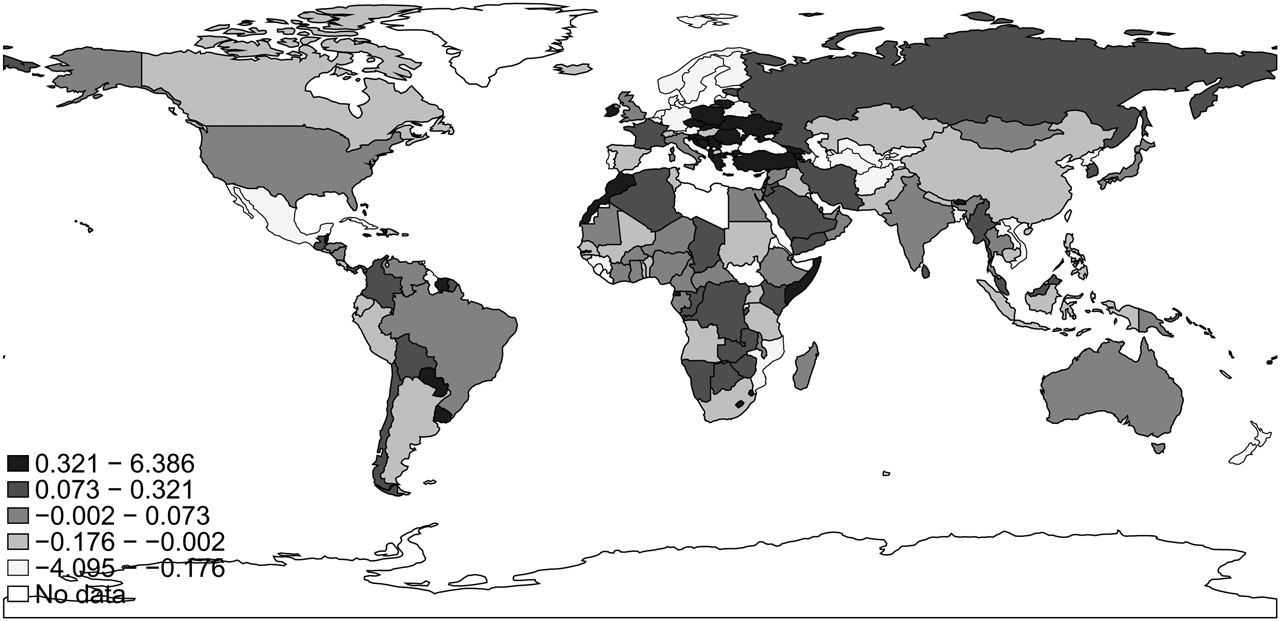
Figure 3 represents cross-country differences in the average level of the norm of female parliamentary share over the period 1960–2010. A large heterogeneity both within developing and developed countries is observed.
Cross-country differences in the norm of female parliamentary share, 1960–2010 average.

The evolution of the world average norm is described in Figure 1. Looking at the world average, the norm has increased from about −0.02 in 1960 to about 0.5 in 2010. This increase might be due to an increase in international migration, but also in the average representation of women in parliaments. Figure 1 shows that the world average female parliamentary share and the average norm are positively correlated.Footnote 20
3.3 Other data
Additional explanatory variables have been collected using the following databases.
Data on total population is provided by the World Population Prospects, the 2012 Revision, by the United Nations (2013). GDP per capita comes from the World Bank Development Indicators 2014. Female human capital indicators used to construct the female skill ratio are taken from Barro and Lee (Reference Barro and Lee2013). Barro and Lee’ s data are available every 5 years. The indicator for democracy is the Polity2 indicator from the POLITY IV data set. This is a combined score that reflects several aspects such as the presence of institutions and procedures through which citizens can express effective preferences about alternative policies and leaders; the existence of institutionalized constraints on the exercise of power by the executive power; and the guarantee of civil liberties to all citizens in their daily lives and in acts of political participation. It ranges from −10 to +10 and it can be considered as a de jure indicator of the quality of institutions in the country.
Data on legal elections and electoral systems (proportional, majoritarian, mixed, and multi-tier) are from Golder (Reference Golder2005). Data on CEDAW ratification has been collected by us. We construct a variable which indicates the number of years since the convention has been ratified by the country.Footnote 21 Data about religion which identifies countries with more than 80% of the Muslim population are taken from La Porta et al. (Reference La Porta, Lopez-de-Silanes, Shleifer and Vishny1999). Data on trade are taken from Feenstra et al. (Reference Feenstra, Lipsey, Deng, Ma and Mo2004) who provide yearly world trade flows in the time span 1962–2000.
4. Econometric issues
OLS regressions generate inconsistent estimates in the presence of omitted variables, reverse causality, reflection problems, and other endogeneity issues. Then, we first estimate equation (1) using fixed-effect cross-country regressions, which account for omitted variables that do not largely vary over time. In order to account for other endogeneity issues, we instrument the main regressor of interest with an external instrument in a standard 2SLS. Finally, as we consider a standard dynamic panel specification, we use SYS-GMM dynamic panel estimations using internal instruments in order to account for persistency and endogeneity of all the covariates.
4.1 Omitted variables
As using pooled OLS, we will not control for possible mis-specifications due to unobserved characteristics, which may jointly affect international migration and the share of female parliamentary seats, we first estimate our empirical model by introducing country fixed effects. Although country fixed effects cannot capture determinants that are both country- and time-specific, they account for many unobservable characteristics. However, it should be noticed that other factors which may affect female parliamentary seats, such as female education, or the quality of political institutions, are very persistent. Therefore, the inclusion of country fixed effects in the regression model mostly accounts for them.
4.2 Reverse causality
A key issue when using fixed-effect regressions to study the relationship between international migration and political environment is the endogeneity of “the norm” $\left({{\mathop \sum \nolimits^ }_j\lpar {{\rm mi}{\rm g}_{ij\comma t-10}/{\rm po}{\rm p}_{i\comma t-10}} \rpar \times \lpar {{\rm seats}_{j\comma t-10}^F -{\rm seats}_{i\comma t-10}^F } \rpar } \right)$ due to a reverse causality issue. From one side, gender (in) egalitarian practices can act as a (push) pull factor: international migrants move to countries with better prospects for women [Ferrant and Tuccio (Reference Ferrant and Tuccio2015), Nejad and Young (Reference Nejad and Young2014)] or international migration acts as a way out of political discrimination [Ruyssen and Salomone (Reference Ruyssen and Salomone2018), Baudassé and Bazillier (Reference Baudassé and Bazillier2014), Hugo (Reference Hugo, Presser and Sen2000)]. From the other side, gender inequality might prevent intended migrants from realizing their aspirations [Ruyssen and Salomone (Reference Ruyssen and Salomone2018)], as it is likely to be correlated with poverty and institutional quality (bad institutions, or low government effectiveness, can be responsible for large administrative costs).
This means that a downward or upward bias can be driven by reverse causality. An external instrumentation strategy is required in order for the coefficient of the “norm” to be unbiased.
The same argument holds for reflection issues [Manski (Reference Manski1993)]. The “norm” can be endogenous because if the equations for each country i were written in a system, the female parliamentary share would appear either as regressand for country i and as regressor within the norm for country i + 1, i + 2, etc.
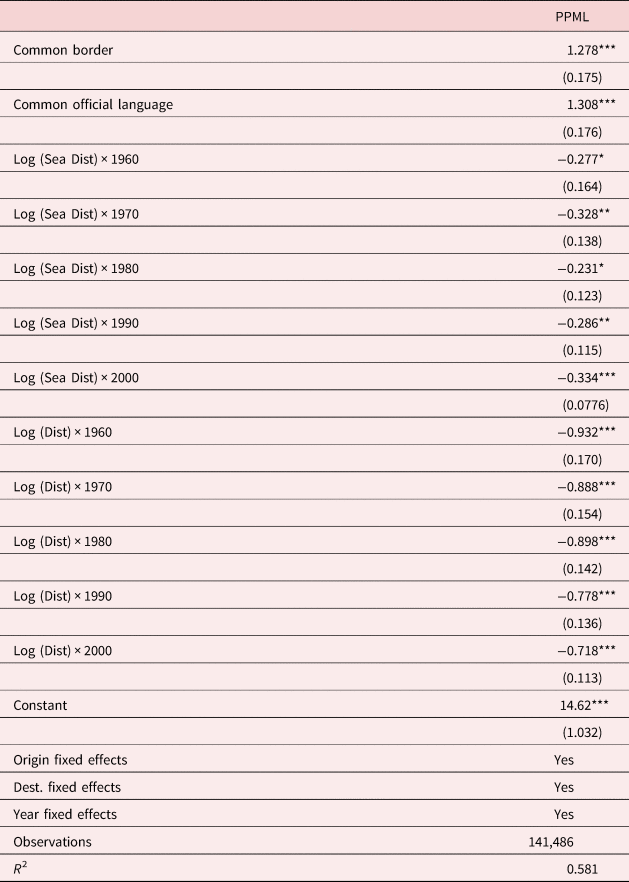
We instrument the “‘migration” part of the norm using a gravity-type equation model based on exogenous geographical and cultural bilateral variables (while controlling for origin and destination fixed effects). We predict bilateral migration stocks, in line with gravity-type equation used to predict trade bilateral pairs [e.g., Frankel and Romer (Reference Frankel and Romer1999)].Footnote 22 As in Feyrer (Reference Feyrer2019), who builds a time-varying geographic instrument for trade based on a gravity-type equation, distances are interacted with time dummies. This introduced time variation captures common shocks in the changes in transportation technology over time which occur at the global level (distances are shorter and shorter time goes by: think about changes in air travel transportation costs). As long as changes in transportation technologies are common to all countries, these time series changes will be exogenous with respect to any particular country, but they will have different effects across country pairs, depending on the relative geographic position. While interacted distances with time dummies can be seen as a very good proxy of the air distance between two countries, the movement of people can occur also through other ways such as the sea. For this reason, we control also for sea distances (interacted with time dummies), which indicate the sea distance between the relevant ports of each one of the country pairs. The following gravity model is estimated:

where the dependent variable migij,t is the stock of immigrants from country i to country j at time t. The explanatory variables from the CEPII database are the distance between country pairs (interacted with time dummies), a dummy for whether country i and j share a common border, a dummy for speaking a common language. Bilateral sea distances (also interacted with time dummies) are taken from Bertoli et al. (Reference Bertoli, Goujon and Santoni2016). We include origin and destination fixed effects, which absorb the origin-specific and the destination-specific regressors, and time fixed effects.
The presence of a large number of zeroes in bilateral migration stocks gives rise to econometric concerns about possible inconsistent OLS estimates. We estimate the above model using the Poisson regression by pseudo-maximum likelihood. We use the PPML command in Stata which implements the method of Santos Silva and Tenreyro (Reference Santos Silva and Tenreyro2011) to identify and drop regressors that may cause the non-existence of the (pseudo-) maximum likelihood estimates. Standard errors are robust and clustered by country pairs.
The resulting exogenous norm to be used as an external instrument is:

4.3 Endogeneity of other regressors
Although the instrumental variable strategy previously described corrects for the “migration” endogeneity part of the “norm”, it does not account for the endogeneity of other regressors. For example, female human capital can be an important determinant for female political participation; however, it could be that women in parliament affect the incentives of women to acquire education. In addition, female parliamentary share is very persistent. A standard panel dynamic framework (with the female parliamentary participation at time t regressed over its 10 years lag) is required [equation (1)]. The introduction of the lagged dependent variable can induce potential biases in the estimation. In addition, the norm is correlated with the lagged dependent as this enters our definition of the norm. In order to overcome endogeneity issues due to the lagged dependent and other lagged explanatory variables, we consider an SYS-GMM technique.
The system GMM estimator accounts for unobservable heterogeneity and it is preferable to a standard fixed-effects estimator since the inclusion of the lagged dependent variable in a fixed-effects model would lead to the so-called Nickell (Reference Nickell1981) bias because the lagged dependent variable is correlated with the error term. However, it should be noticed that in our context, this bias should not be very sizable, given the large time span of our analysis. However, the fixed-effect estimator is not recommended when data are very persistent as it exacerbates measurement error bias [Hauk and Wacziarg (Reference Hauk and Wacziarg2009)], whereas the system GMM is the most appropriate estimator when time series are very persistent as in our case [see Bond et al. (Reference Bond, Hoeffler and Temple2001)].
The system GMM estimator combines the regression in differences with the regression in levels in a single system. The instruments used in the first differentiated equation are the same as in Arellano and Bond (Reference Arellano and Bond1991), but the instruments for the equation in level are the lagged differences of the corresponding variables. In order to use these additional instruments, a moment condition for the level equation, which implies that first differences of pre-determined explanatory variables are orthogonal to the country fixed effects, must be satisfied.
We test the validity of moments conditions by using the test of overidentifying restrictions proposed by Hansen and by testing the null hypothesis that the error term is not second order serially correlated. Furthermore, we test the validity of the additional moment conditions associated with the level equation using the Hansen difference test for all GMM instruments.
A particular concern related to this method is the risk of instrument proliferation. Using too many instruments can bias the GMM estimation results and weaken the Hansen test of the instruments' joint validity [Roodman (Reference Roodman2009)]. We have, therefore, kept the number of instruments lower than the number of groups [as Roodman (Reference Roodman2009) suggests].
The SYS-GMM estimator provides consistent and unbiased estimates but it depends on the particular set of instruments used. However, it is recognized that, with very conservative data, it is the best available estimator [Blundell and Bond (Reference Blundell and Bond1998), Arellano and Bover (Reference Arellano and Bover1995)].
Finally, a sensitivity analysis will also be conducted to check the robustness of the results to the exclusion of certain countries (e.g., socialist countries, Sub-Saharan African countries, and Muslim countries) whose characteristics may exacerbate reverse causality problems.
5. Estimation results
The results are organized in sub-sections. We first provide FE results. Secondly, a two-step procedure is implemented in order to account for endogeneity bias. Subsection 5.2 presents the pseudo-gravity type results, while subsection 5.3 presents 2SLS-FE results using the external instrument. Thirdly, in subsection 5.4, we estimate the dynamic specification as in equation (1) using the SYS-GMM technique, using internal instruments. Fourth, we conduct a sensitivity analysis to check the robustness of our results to the exclusion of certain groups of countries (socialist countries, Sub-Saharan African countries, and Muslim countries). Fifth, we consider an alternative definition of the norm to test for immigration-induced transfers of norms on gender political empowerment. Sixth, we test the robustness of our results considering annual data in order to take into account the complete political evolution of each country.
5.1 Panel analysis with FE results
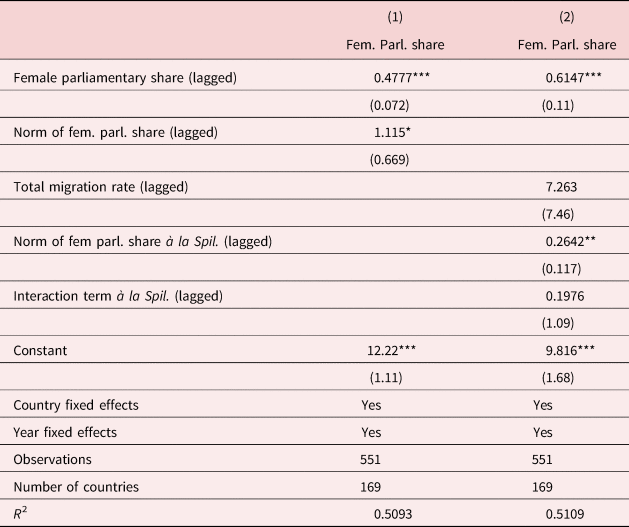
Table 1 reports FE estimates from equation (1). No additional controls other than the lagged dependent and the lagged index of female parliamentary share (i.e., the “norm”) are considered. Standard errors are robust and clustered by country of origin. We observe that in columns (1), the estimated coefficient of the norm is positive and statistically significant at the 10% level.
Estimations: fixed effect

*Significant at the 10% level; **5% level; ***1% level. Robust standard errors clustered by country in parentheses.
For comparison with previous studies, column (2) reports FE results for the base model without additional controls following the Spilimbergo (Reference Spilimbergo2009)'s specification, which includes the total emigration rate, an index for institutional quality in host countries, and an interaction between the two terms.Footnote 23 The new index of female parliamentary share is positive and statistically significant. The total emigration rate (which measures the direct effect of migration) is not statistically significant as in Spilimbergo (Reference Spilimbergo2009), as well as the interaction term, which captures the intensity of emigration with respect to the origin population in the transfer of female political values. Following Spilimbergo's specification, the lagged migration rate has no impact on female parliamentary seats at home while the quality of political institutions in host countries has a strong impact on political institutions at home. It is unclear whether this effect increases with the number of migrants abroad [so as in the original work by Spilimbergo (Reference Spilimbergo2009) and Beine et al. (Reference Beine, Docquier and Schiff2013)]. As the index of female parliamentary share and the interaction term are highly correlated, low significance levels could be due to collinearity problems. Our alternative specification directly captures the intensity of migration in transferring the norm, thus overcoming this concern. We can therefore say that the quality of female political participation in host countries has a positive correlation with female parliamentary share in the country of origin, which increases with the share of migrants abroad with respect to the total population in the country of origin.
5.2 Instrumentation for the norm
Table 2 presents estimation results from the gravity model used to predict the bilateral exogenous migration component of the “norm”. Not surprisingly, geographic characteristics are strong determinants of bilateral migration stocks. As proxies of migration costs, contiguity, and linguistic links favor migration, geographical and sea distances are negatively correlated to those stocks.Footnote 24
Gravity regressions (dep = bilateral migration stocks)

*Significant at the 10% level; **5% level; ***1% level. Robust standard errors clustered by country pairs in parentheses.
5.3 Panel analysis with 2SLS
In Tables 3 and 4, we correct for endogeneity using 2SLS regressions with country and time fixed effects.
Estimations 2SLS-FE

*Significant at the 10% level; **5% level; ***1% level. Robust standard errors clustered by country in parentheses. Kleibergen–Paap rk Wald F statistics to be compared with the Stock–Yogo critical values for weak instrumentation.
Estimations 2SLS-FE

*Significant at the 10% level; **5% level; ***1% level. Robust standard errors clustered by country in parentheses. Kleibergen–Paap rk Wald F statistics to be compared with the Stock–Yogo critical values for weak instrumentation.
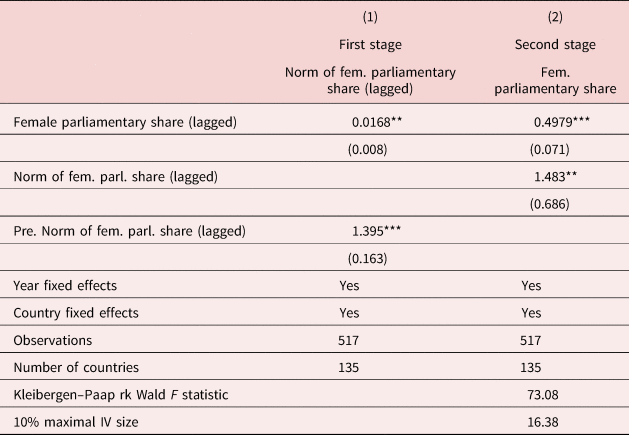
Columns (1) and (2) of Table 3 show both the first and second stages when instrumenting the norm with $\mathop \sum \nolimits_j\lsqb {\lpar {\widehat{{{\rm mi}{\rm g}_{ij\comma t-10}}}/{\rm po}{\rm p}_{i\comma t-10}} \rpar \times \lpar {{\rm seats}_{j\comma t-10}^F -{\rm seats}_{i\comma t-10}^F } \rpar } \rsqb$ . The first stage shows that our instrument is positive and statistically correlated with the norm. Since the Kleibergen–Paap rk Wald F statistic is well above the critical values reported by Stock and Yogo (Reference Andrews2005), we reject the hypothesis that our instrument is weak.
The second stage shows that the estimated coefficient of the “norm” is positive and statistically significant.
Compared with OLS in Table 1, the 2SLS coefficient is larger, suggesting that the OLS coefficient might suffer from a reverse causality (downward) bias: emigration decreases when women's representation in parliament is higher.
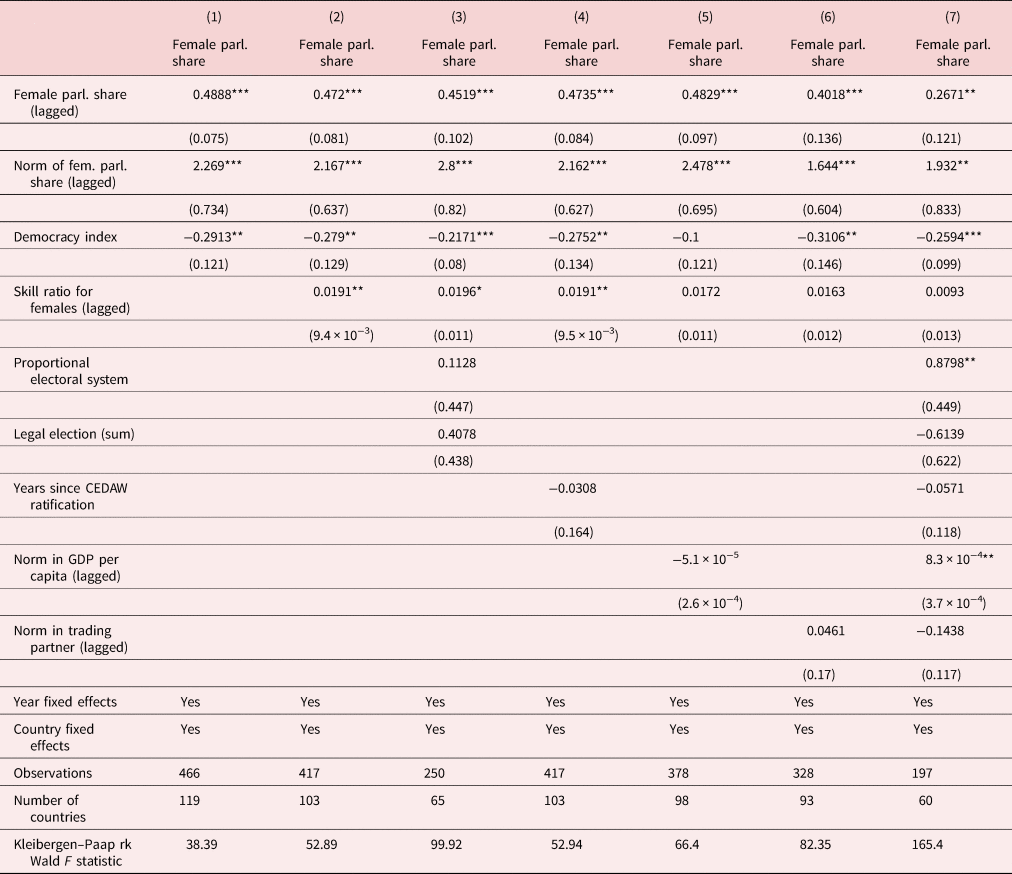
Table 4 adds traditional political and non-political covariates to the above specification.
In column (1), we add a measure of democracy as a proxy for the quality of institutions in the country.
Column (2) refers to the model which we will consider as our baseline specification henceforth. It contains the lagged dependent, the lagged “norm” of female parliamentary share, a lagged measure of female human capital, and a measure of de jure democracy.
Female human capital can be important in explaining female political empowerment: women need human and financial capital (gained through education and work experience) to stand for office [Paxton and Kunovich (Reference Paxton and Kunovich2003)].Footnote 25 As a proxy for female human capital, we generate the ratio between the number of females aged more than 25 years old with tertiary completed education and females with no schooling. In 2SLS regressions with country fixed effects, the estimated coefficient is positive and generally statistically significant.
An indicator of democracy is also considered. Indicators of democracy measure the general openness of political institutions and combine several aspects such as the presence of institutions and procedures through which citizens can express effective preferences about alternative policies and leaders; the existence of institutionalized constraints to the exercise of power by the executive power; and the guarantee of civil liberties to all citizens in their daily lives and in acts of political participation. In our case, we consider a composite index called Polity2 that ranges from −10 to +10, with 10 corresponding to the most democratic set of institutions. It is worth reminding that Polity2 captures the quality of “de jure” institutions, and it is not based on perceptions (not capturing the quality of de facto institutions). The effect of democracy on women's political representation may be ambiguous. On the one hand, it may be easy for women to be elected to a powerless parliament or under an authoritarian system, built on egalitarian ideologies such as ex-communist countries where female parliamentary participation was high. On the other hand, more democratic countries may favor women's political participation. In 2SLS regressions with fixed effects, Polity2 is negative and statistically significant.
In column (3), we control for legal election, which indicates the number of elections to national lower chamber occurred between time t and t − 10, and for the electoral system being proportional. It is recognized in the political science literature that proportional systems, rather than majority ones, help women to access the political system [e.g., Paxton et al. (Reference Paxton, Hughes and Painter2010), Jalalzai and Krook (Reference Jalalzai and Krook2010)]. Proportional systems make use of multi-member districts, which implies that more than one candidate can be elected from a particular district, and often have closed party lists, which means that citizens vote for the party lists of candidates rather than individual candidates. Under a list system, parties may feel compelled to nominate women in order to balance the list. Moreover, the higher the district magnitude, the greater the probability for a woman to be nominated, if the political party is expecting to win several seats in the district.Footnote 26 The election variable is generally positive, but not significant as well as the proportional nature of the electoral system.
From columns (4)–(6), other potential traditional explanatory variables are added to the baseline specification. In particular, we consider years since CEDAW ratification, a norm based on GDP per capita, and a trade “norm” variable.
The CEDAW ratification implies that countries, which ratified the convention, should meet the minimum standards to reach equal women rights. Moreover, the countries involved should regularly provide the measures they have taken to reach this goal. As in True and Mintrom (Reference True and Mintrom2001), CEDAW is not significant (column 4) and this can be due to two reasons. First, some countries decide to ratify just because of international visibility with little intention to change gender relation; secondly, some countries ratify later as a consequence of lack of bureaucratic conditions.
In column (5), we control for the risk that the positive and significant effect of the migration norm could be driven by the fact that what matters is only migration toward richer countries. An alternative norm, based on bilateral migration weights and the difference between GDP per capita at destination and origin, has been constructed. This alternative norm is negative and not statistically significant. It should also be noted that, from one side, development itself matters for women [Burn (Reference Burn2005)]Footnote 27, and from the other side, the correlation between GDP per capita and women's presence in parliament is not clear cut, depending on whether women have effective power in the country. For instance, in Central America, where quota laws are less common, there exists a positive and strong correlation between GDP per capita and female politicians in parliament. In South America, where quotas predominate, the opposite occurs: GDP per capita and women in parliament are negatively correlated [Mala and Piscopo (Reference Mala and Piscopo2010)]. In addition, the estimated coefficient is biased due to reverse causality (women in power promote development).
Column (6) considers a trade index, because economic integration may also convey cultural norms, supporting women's political participation. The trade norm is built in a symmetrical way to the migration one, constructing a weighted average of the difference in female parliamentary share with trading partners where the weights are given by the share of trade between the country of origin and the trading partner over total trade (e.g., $\mathop \sum \nolimits_j\lsqb {\lpar {{\rm trad}{\rm e}_{ij\comma t-1}/{\rm Trad}{\rm e}_{i\comma t-1}} \rpar \times \lpar {{\rm seats}_{j\comma t-1}^F -{\rm seats}_{i\comma t-1}^F } \rpar } \rsqb$ ). Our estimated coefficient is positive, meaning that trade is a measure of openness that goes in the same direction to migration, and not statistically significant.Footnote 28
In the last column, we include all the explanatory variables. Our main results do not change again.
The magnitude of the estimated coefficients of the norm (i.e., the short-run effect) is always positive and statistically significant and it varies between 2.8 and 1.644. Focusing on our baseline specification (column 2), the estimated coefficient of the norm is 2.167. This means, for example, that a one standard deviation increase in the norm raises female parliamentary share by 1.39 percentage points.Footnote 29 This is a reasonable magnitude relative to the mean of female parliamentary share in the baseline sample (12.8), implying an increase of about 11%.Footnote 30
It should also be noticed that most of the control variables are highly persistent; therefore, their effects can be captured by the inclusion of country fixed effects.
Finally, the bottom of the tables reports information regarding the performance of the external instrument we are using. For each specification, we report the Kleibergen–Papp F test (KP), which allows us to reject the null hypothesis of weak instrumentation.
5.4 Panel analysis with SYS-GMM
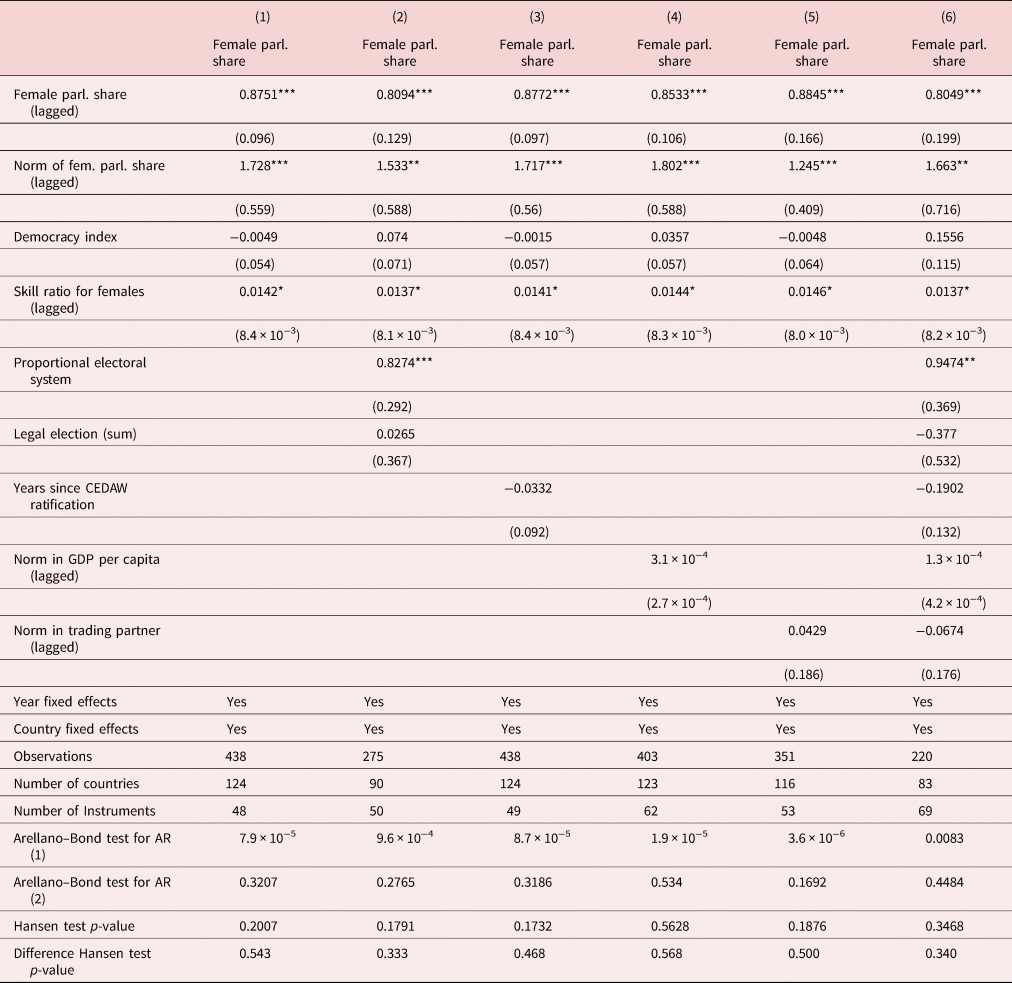
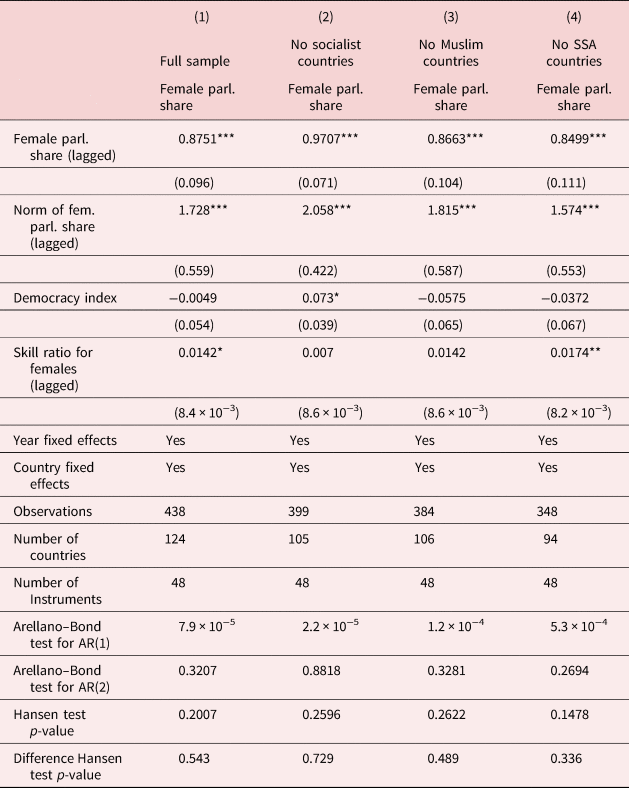
Table 5 reports estimation results in system GMM (the most appropriate estimator in this context). Our dependent variable is the share of seats held by women in the lower or single house in the National Parliament. In particular, column (1) refers to our baseline specification which contains the lagged female parliamentary share, the lagged norm of female parliamentary share, a measure of female human capital, and a measure of democracy. Columns (2) to (5) add additional controls as in the previous sub-section. Standard errors are robust and clustered by country group.
Estimations with SYS-GMM

*Significant at the 10% level; **5% level; *** 1% level. Robust standard errors clustered by country in parentheses. SYS-GMM estimations.
The coefficient for the lagged dependent is positive and statistically significant, and it ranges between 0.81 and 0.88.
In general, results are fairly similar to 2SLS-FE estimations. With respect to previous regressions, the estimated coefficient of Polity2 is no more statistically significant. The proportional electoral system is now positive and statistically significant.
In addition, endogenous variables can be instrumented using their own lagged values.
Importantly, in all the specifications, the norm remains positive and statistically significant, implying that total emigration is a positive and important channel through which female parliamentary share in the origin country raises. The magnitude of the estimated coefficients (i.e., the short-run effect) varies between 1.802 and 1.245. If we consider our baseline specification, the estimated coefficient equals to 1.728. This means that a one standard deviation increase in the norm raises female parliamentary share by 1.11 percentage points.Footnote 31 This is a reasonable magnitude relative to the mean of female parliamentary share in the baseline sample (12.8), implying an increase of about 8.7%.Footnote 32, Footnote 33
In all the empirical specifications just mentioned, we also take into account country and time fixed effects; therefore, the results are robust to all country-specific time-invariant characteristics which may influence female political representation. They encounter religion, colonial history, and many other unobservable characteristics.Footnote 34, Footnote 35
In the SYS-GMM estimations, the instruments used in the first differentiated equation are the same as in Arellano and Bond (Reference Arellano and Bond1991), but the instruments for the equation in level are the lagged differences of the corresponding variables.Footnote 36 In our specifications, the lagged dependent variable is instrumented using from its own first to fifth lags. Our variables of interest, i.e., the lagged index of female parliamentary share, the lagged female human capital, the lagged index in trading partners, the lagged index of GDP per capita, are instrumented using their own first to fifth lags.
The legal election variable, the proportional system variable, the democracy indicator, and the CEDAW variable are considered as exogenous.
We test the validity of moment conditions by using the test of overidentifying restrictions proposed by Hansen and by testing the null hypothesis that the error term is not second order serially correlated. Furthermore, we test the validity of the additional moment conditions associated with the level equation using the Hansen difference test for all GMM instruments. The tests confirm the validity of our instruments.Footnote 37
5.5 Robustness tests: heterogeneity in sample
In order to test for the robustness of our empirical results, we estimate our baseline specification in selected sub-samples. First of all, we exclude socialist countries (i.e., countries which belonged to the Iron Curtain). In the former Communist Bloc, the proportion of women in parliaments was very high, given the fact that these authoritarian systems were built on egalitarian ideologies. After the fall of Communism, as parliaments in post-communist countries gained real power, the percentage of female seats sharply fell. Table 6, column2, shows that our main results are preserved when excluding socialist countries (column1 reports the full sample estimated coefficients). Another concern is whether Muslim countries, where women are sometimes prevented from public activities, may affect our results. Countries with at least 80% of the Muslim population are excluded from our sample.Footnote 38 Again, there is no evidence that heterogeneity plays any role in explaining our results. The last concern refers to the presence of Sub-Saharan Africa countries. Looking at the Global Gender Gap Index (2017), which considers how equitably the available income, resources, and opportunities are distributed between women and men, Sub-Saharan African countries score on average in the lower middle range of the Global Gender Gap Index, and they are characterized by a wider range of gender gap outcomes than any other region. Then, we exclude Sub-Saharan African countries. Our results are preserved.Footnote 39
Estimations with SYS-GMM: Sample heterogeneity

*Significant at the 10% level; **5% level; ***1% level. Robust standard errors clustered by country in parentheses. SYS-GMM estimations.
5.6 Robustness tests: alternative specification of the norm
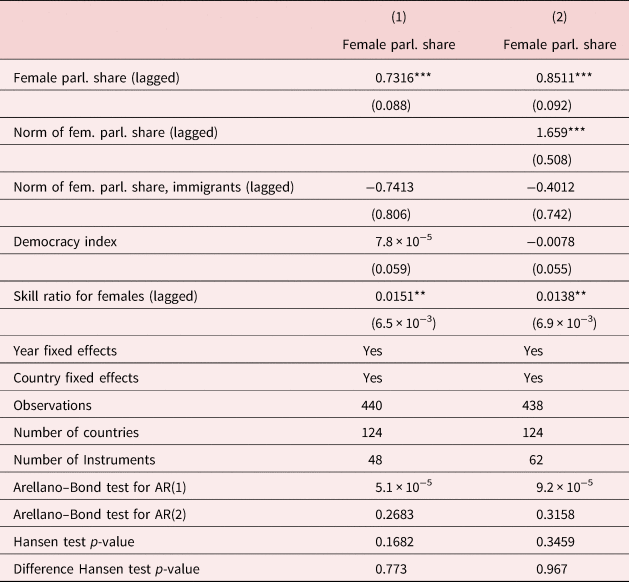
So far, we have focused on the effects of emigrants' destination-country characteristics on female parliamentary share at the origin. A limited set of studies [e.g., Collier (Reference Collier2013)] emphasize the “transfer of norms” effects that immigrants can induce from origin to destination countries. In Table 7, we introduce in our baseline specification a term, which allows to capture the norms that immigrants bring with them when they migrate.Footnote 40 On average, the correlation between this term and the (emigration) norm is small (0.2287), so that both variables can be tested jointly. Controlling for the norm of immigrants does not affect our main results. In addition, the estimated coefficient of the norm of immigrants is negative (probably capturing the fact that over the last decades, an increase of immigrants from developing countries to OECD countries has occurred), but not statistically significant.Footnote 41
Alternative specification of the norm

*Significant at the 10% level; **5% level; ***1% level. Robust standard errors clustered by country in parentheses. SYS-GMM estimations.
5.7 Robustness tests: annual data
In this section, previous results are tested using annual instead of 10-year data. The latter have been chosen in the benchmark analysis for two reasons. First of all, because migration data are only available by decade. Secondly, migrants need to live in the host country for a certain period of time before assimilating and being able to transmit new values to their country. In other words, using 10-year data allows for a longer period of the occurrence of a “transfer of norm” mechanism.
However, in doing so, some important information regarding the annual political evolution by country is not taken into account. This can be particularly relevant if political legislatures last less than 5 years because of political instability or historical events such as geographical split or internal conflicts. This being said, previous estimation results have been tested using yearly data.
Some important changes were required. First of all, since migration data are available by decade, while political data contain yearly observations, the original migration decennial matrix has been extended by interpolation. Missing migration yearly data have been computed applying a constant annual rate of growth within each decade. This strategy looks globally reasonable because of two reasons. Bilateral migration stocks are very persistent which means that they vary slowly and smoothly over time. Bilateral migration stocks are used as weights in the norm whose temporal variability depends on two sources: heterogeneous bilateral migration stocks and country-specific change in the difference in the actual proportion of female parliamentary seats.Footnote 42 Secondly, also the Barro and Lee dataset, which is available every 5 years, has been interpolated using the same technique as for migration data.Footnote 43 Thirdly, migration data are complemented by the UN migration dataset for the period 2000–2010.
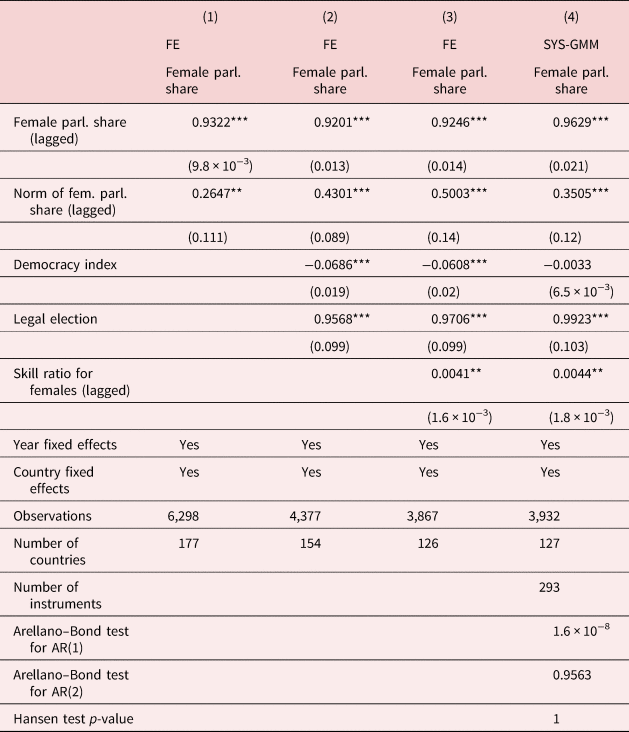
Table 8 shows estimation results using annual data across different econometric specifications. Columns (1) to (3) show FE results. The norm of female parliamentary share is always positive and significant. Column (4) shows SYS-GMM results using internal instruments. In SYS-GMM estimation, the lagged dependent variable is instrumented using its own sixth lag. As on average new elections occur every 5 years, the sixth lag allows to consider as instruments the parliamentary share of previous elections. Our variable of interest, i.e., the lagged norm of female parliamentary share, is instrumented using its own sixth lag.Footnote 44 Again, our variable of interest is positive and statistically significant with a lower coefficient with respect to the 10 years data analysis.
Estimations with annual data

*Significant at the 10% level; **5% level; ***1% level. Robust standard errors clustered by country in parentheses.
6. Counterfactual analysis
In the main text of the paper, we found that the impact of migration in transferring political norms appears to be statistically relevant. In order to further investigate and assess the importance of this effect at the country-specific level, we simulate the counterfactual female parliamentary share obtained in two extreme cases. We consider first a simulated scenario in which migration is set equal to 0 (i.e., no transfers of norms occur). Secondly, we consider another scenario where we assume that all migrants are sent to the destination country with the highest female parliamentary share in our sample (Sweden). The latter case allows us to assess the possible maximum effect of the norm in transferring political values.
To set up the two environments, we start from our empirical model, and we consider the estimated coefficients in the baseline regression in SYS-GMM regressions (column 1 in Table 5). In particular, we focus on the short-run coefficients obtained in the estimations with data by decade and with internal instrumentation.
Let us set up the first counterfactual environment considering the baseline empirical model:

where

Assuming no migration, we have:

where ${\rm indexseats}_{i\comma t-10}^F = 0$ . Taking the difference between (2) and (3) gives us the change in the female parliamentary seats:

which can be re-written as:

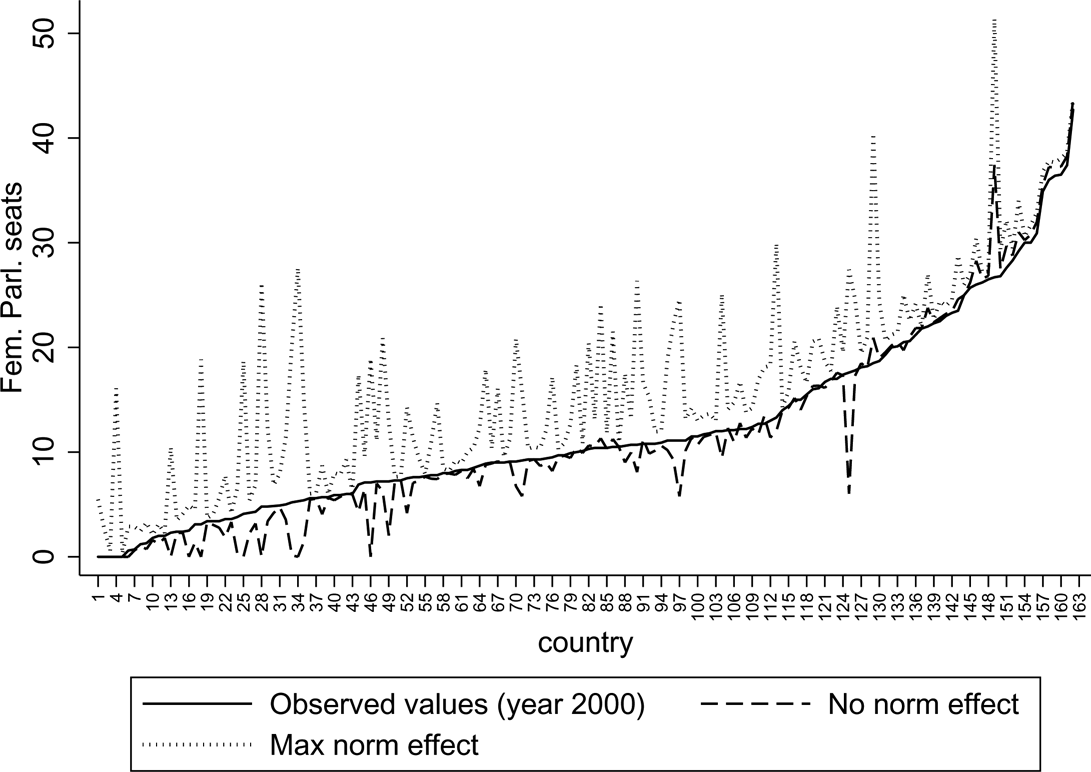
For simplicity, we consider data for the year 2000 and β = 1.728 and we construct the counterfactual values for female parliamentary seats $\lpar {\rm seats}_{i\comma t}^F \rpar$ in each country in the case of no migration (i.e., no transfers of norms). The dashed line in Figure 4 shows the counterfactual value for female parliamentary seats in the case of no migration.Footnote 45 As we can see from the graph, for some countries, the counterfactual value for female parliamentary participation in 2000 is lower than the observed value in the same year of interest. This is especially true for countries with lower female political empowerment, in particular developing countries, for which migration is shown to be particularly relevant in improving women's conditions. For other countries with a high share of females in parliament, such as Sweden, Denmark, Finland, Norway, the Netherlands, however, the counterfactual value is higher than the observed value, meaning that emigration may in some cases decrease female political empowerment. On average, with respect to the median of the distribution, female parliamentary seats will decrease from about 10% to 9.38%.Footnote 46, Footnote 47
Predicting the female parliamentary shares using two counterfactuals.

In a second and symmetric counterfactual experiment, we compute the maximum effect the transfer of norm mechanism could have. We assume that all migrants are sent to the country with the most feminized parliament (i.e., all migrants are sent to Sweden which has 42.7% of female parliamentary seats in 2000).Footnote 48 As the dotted line in Figure 4 shows, all the countries have a higher share of female parliamentary seats. On average, with respect to the median of the distribution, female parliamentary seats will increase from about 10% to 14.7%.Footnote 49, Footnote 50
7. Conclusion
Women make up more than half of the population in the world. Female electorates have globally grown up in the last two decades but yet continue to be under-represented in political decision-making bodies at all levels. The World Development Report 2012 states that gender equality matters for development-enhancing productivity, creating a better environment for the next generation and making institutions more representative. In addition, there is evidence [Clots-Figueras (Reference Clots-Figueras2011), Thomas (Reference Thomas1991)] that women in politics improve development outcomes for women themselves, children, and families.
The World Bank (2011) wonders whether “globalization can help” in fostering gender equality. In this paper, we have partly answered this by providing some evidence on how a globalized outcome such as international migration has contributed to the increase of female parliamentary participation from 1970 to 2010. In other words, international migrants have acted as “informational” channels able to transfer foreign values, create favorable opportunities, reshape attitudes, and create new norms about women in the origin country.
Following the brand new strand of literature on “transfers of norms” [e.g., Spilimbergo (Reference Spilimbergo2009), Beine et al. (Reference Beine, Docquier and Schiff2013)], we have applied the same mechanism to female political participation. To this end, we estimated a dynamic model by decades in which female access to Parliament depends on traditional covariates plus international migration. The empirics contains two important insights. First of all, the norm (through which foreign female parliamentary participation is propagated at origin) has been constructed in such a way that the origin country takes advantage of the political environment at the destination just if the female political conditions at destination are better than those at the origin. Secondly, endogenous issues are taken into account.
Results, which are robust to different geopolitical specifications, show that female political empowerment can be accounted as another migration non-economic externality, suggesting that the launch of domestic public actions can also be supported by the role of active national people from abroad.
Finally, our study can be seen as a complement to the ones which examine the effect of emigration on source-country fertility [e.g., Beine et al. (Reference Beine, Docquier and Schiff2013)]: migration-induced women empowerment could be seen as a specific channel through which international migration conveys a transfer of fertility norms across countries. Empirical evidence indicates that female legislators spend more in health and education, and favor “women-friendly” laws [Clots-Figueras (Reference Clots-Figueras2011)]. Favoring equal gender rights can affect women's bargaining position within their households, and thus lead to lower fertility [Doepke et al. (Reference Doepke, Tertilt and Voena2012)].
Acknowledgements
An early version of this paper circulated as IRES Discussion Papers 2012001, Universite catholique de Louvain [Lodigiani and Salomone (Reference Lodigiani and Salomone2012)]. This work has been supported by the European Social Fund (“Dote ricerca”) from the Lombardia region and the Belgian French-speaking Community (convention ARC 09/14-019 on “Geographical Mobility of Factors”). We thank Massimiliano Bratti, Frédéric Docquier, Giovanni Facchini, Emanuele Forlani, Tommaso Frattini, Julien Martin, Elie Murard, Matteo Picchio, and all the participants to the Conference on “The Economics and Politics of Immigration”, the 2nd TEMPO Conference on International Migration, the ARC Workshop on “Geographical Mobility of Workers and Firms”, the seminar held in the Department of Economics at the University of Modena and Reggio Emilia and the LdA/Paolo Baffi research seminar at Bocconi University, for their constructive comments. We are also highly thankful to Chris Parsons and Pamela Paxton for having shared their data with us.
Appendix A
List of countries
The geographical sample of interest as in the first two columns of Table 1 in the main text is equal to 169 countries. The 169 countries are: Albania, Algeria, Angola, Antigua and Barbuda, Argentina, Armenia, Australia, Austria, Azerbaijan, Bahamas, Bangladesh, Barbados, Belarus, Belgium, Belize, Benin, Bhutan, Bolivia, Bosnia and Herzegovina, Botswana, Brazil, Bulgaria, Burkina Faso, Burundi, Cambodia, Cameroon, Canada, Cape Verde, Central African Republic, Chad, Chile, China, Colombia, Comoros, Congo, Costa Rica, Cote d'Ivoire, Croatia, Cuba, Cyprus, Czech Republic, Czechoslovakia, Democratic People's Republic of Korea, Democratic Republic of the Congo, Denmark, Djibouti, Dominican Republic, Ecuador, Egypt, El Salvador, Equatorial Guinea, Eritrea, Estonia, Ethiopia, Fiji, Finland, France, Gabon, Gambia, Georgia, Germany, Ghana, Greece, Grenada, Guatemala, Guinea-Bissau, Guyana, Haiti, Honduras, Hungary, Iceland, India, Indonesia, Iran (Islamic Republic of), Iraq, Ireland, Israel, Italy, Jamaica, Japan, Jordan, Kazakhstan, Kenya, Kiribati, Kyrgyzstan, Lao People's Democratic Republic, Latvia, Lebanon, Lesotho, Lithuania, Luxembourg, Madagascar, Malawi, Malaysia, Maldives, Mali, Malta, Mauritania, Mauritius, Mexico, Micronesia (Federated States of), Mongolia, Morocco, Mozambique, Namibia, Nepal, The Netherlands, New Zealand, Nicaragua, Niger, Nigeria, Norway, Pakistan, Panama, Papua New Guinea, Paraguay, Peru, Philippines, Poland, Portugal, Republic of Korea, Republic of Moldova, Romania, Russian Federation, Rwanda, Saint Lucia, Saint Vincent and the Grenadines, Samoa, Sao Tome and Principe, Senegal, Serbia and Montenegro, Seychelles, Singapore, Slovakia, Slovenia, Socialist Federal Republic of Yugoslavia, Solomon Islands, South Africa, Spain, Sri Lanka, Sudan, Suriname, Swaziland, Sweden, Switzerland, Syrian Arab Republic, Tajikistan, Thailand, The former Yugoslav Republic of Macedonia, Togo, Tonga, Trinidad and Tobago, Tunisia, Turkey, Turkmenistan, USSR, Uganda, Ukraine, United Kingdom of Great Britain and Northern Ireland, United Republic of Tanzania, United States of America, Uruguay, Uzbekistan, Vanuatu, Venezuela, Viet Nam, Yemen Arab Republic, Zambia, Zimbabwe.
Appendix B
Construction of the norms
In order to construct the “norms” in equation (1) in the main text, the final matrix should be perfectly balanced. By final matrix we mean the matrix comprising: migration data [from Ozden et al. (Reference Ozden, Parsons, Schiff and Walmsley2011) and UN data for year 2010], political data [from Paxton et al. (Reference Paxton, Hughes and Green2006) and World Development Indicators from 2003 to 2010], total population (from World Population Prospects: The 2012 Revision United Nations 2013).
For migration data, data for Czechoslovakia, the Socialist Federal Republic of Yugoslavia, and USSR were not available in the original dataset. We reconstructed missing observations aggregating migration data for the countries belonging to them before the political scission. So for Czechoslovakia before 1993 (replaced by missing values then), we aggregated data from Czech Republic and Slovakia. For the Socialist Federal Republic of Yugoslavia before 1992 (replaced by missing values then), we aggregated data from Bosnia and Herzegovina, Croatia, Serbia and Montenegro, Slovenia, and the Former Yugoslav Republic of Macedonia. For USSR before 1991 (replaced by missing values then), we aggregated data from Ukraine, Russian Federation, Uzbekistan, Kazakhstan, Belarus, Azerbaijan, Georgia, Tajikistan, Republic of Moldova, Kyrgyzstan, Lithuania, Turkmenistan, Armenia, Latvia, and Estonia. For political data, we explained in Appendix D how we deal with “true missing values”, while for the other missing cells (about 31% of the sample) due to political instability, coup d'etat, dictatorship war, presence of “false elections”, lack of sovereignty due to colonialism, we have kept as missing. Once we have dealt with missing values in each dataset to make each of them balanced, we have merged the three of them to obtain the final dataset. Then the norms have been constructed.
Appendix C
Difference with previous studies
Our empirical specification mainly refers to the work by Spilimbergo (Reference Spilimbergo2009). Following step by step his dynamic empirical specification, equation (1) in the main text becomes:

where:
• ${\rm indexseats}_{i\comma t-10}^F = \mathop \sum \nolimits _j\left[{\left({{\rm mi}{\rm g}_{ij\comma t-10}/{\mathop \sum \nolimits^ }_i{\rm mi}{\rm g}_{ij\comma t-10}} \right)\times \lpar {{\rm seats}_{j\comma t-10}^F -{\rm seats}_{i\comma t-10}^F } \rpar } \right]$
. In Spilimbergo (Reference Spilimbergo2009), the exact corresponding variable ${\rm indexseats}_{i\comma t-10}^F$ would be constructed as the weighted average of the female parliamentary share in the host countries, e.g., ${\rm indexseats}_{i\comma t-10}^F = \mathop \sum \nolimits _j\left[{\left({{\rm mi}{\rm g}_{ij\comma t-10}/{\mathop \sum \nolimits^ }_i{\rm mi}{\rm g}_{ij\comma t-10}} \right)\times {\rm seats}_{i\comma t-10}^F } \right]$. Just considering the level of female parliamentary share at destination would have prevented account being taken of political asymmetries between origin and destination countries. With this specification, indeed, the “transfer of norm” is always positive if ${\rm seats}_{i\comma t-10}^F$ is >0, apart from the level of female parliamentary share at origin. In considering the difference between female parliamentary shares between countries of destination and origin, however, we assume that there is a “positive transfer” only when migrants reside in countries where female political conditions are better, and that the transfer is higher, the greater the political difference between the two countries.• migratei,t−10 is the ratio between $\left({{\mathop \sum \nolimits^ }_i{\rm mi}{\rm g}_{ij\comma t-10}/{\rm po}{\rm p}_{i\comma t-10}} \right)$
• inter is the interaction term and corresponds to $\lpar {{\rm migrat}{\rm e}_{i\comma t-10} \times {\rm indexseats}_{i\comma t-10}^F } \rpar$


Equation (1) in the main text and equation (C.1) are symmetric. The only difference consists in the construction of the “norm”. In other words, in equation (C.1), the average female parliamentary share at the destination is computed as:

where the weights are given by emigration shares. In equation (1), however, the weights are given by emigration rates. In other terms, we substitute ${\rm mi}{\rm g}_{ij\comma t-10}/\mathop \sum \nolimits^ _i{\rm mi}{\rm g}_{ij\comma t-10}$ with migij,t−10/popi,t−10. So the norm in the benchmark specification becomes as follows:

Obviously, due to the different nature of Spilimbergo's norm, equation (C.1) also contains the total migration rate calculated as the ratio between total aggregate migration from country i over total population in country i and the interaction term between the total migration rate and the average index of female political participation at the destination.
As already explained in the text, the lagged index of female parliamentary share à la Spilimbergo affects the female parliamentary participation at time t but the interaction with migration rate is not significant as in Beine et al. (Reference Beine, Docquier and Schiff2013) and sometimes in Spilimbergo (Reference Spilimbergo2009). The lack of significance can be due to collinearity since migration rate appears three times as regressor: alone, then it is used as a weight in the norm, and as a multiplicative term (as migration share) in the interaction term. Indeed, the collinearity between the interaction term and the migration rate is more than 90%. A way to avoid collinearity is an alternative construction of the norm as in equation (1) of the main text.
Appendix D
Addressing the “true missing” values in Paxton et al. (Reference Paxton, Hughes and Green2006)
Here is the list of countries which contains true missing values:
• Belarus: data from 1995 to 1999 are true missing. The missing cells have been complemented by the CPDS II [Armingeon and Careja (Reference Armingeon and Careja2008)], which covers 28 post-communist countries for the 1989–2008 period.
• Benin: years 1960, 1961, 1962, 1964 are true missing. Following Benin political and historical information, we transformed true missing values into missing.
• Bhutan: year 1996 is a true missing. It has been replaced with observed data from IPU (01/1996 elections).
• Bosnia-Herzegovina: true missing for 1996–1999. We replaced years 1996–1997 with missing data in accordance with the female parliamentary share in contiguous countries, e.g., Croatia, Serbia, and Montenegro. While years 1998–1999 have been complemented by the CPDS II [Armingeon and Careja (Reference Armingeon and Careja2008)], which covers 28 post-communist countries for the 1989–2008 period.
• Cambodia: year 2003 is a true missing. It has been replaced by the observed positive value from IPU, election 07-2003.
• The Democratic Republic of the Congo: true missing data for 1992–1993, 2000–2002, and 2003. The average female parliamentary share between years 1991 and 1994 replaces the first missing biennium since data are quite stable. True missing data from 2000 to 2002 have been transformed into missing because of political instability and civil war. True missing for 2003 has been replaced by data from IPU election 08/2003.
• Gambia: data from 1977 to 1981 are true missing. They have been replaced by 0 as women started to stand for election from 1982.
• Guinea: true missing data from 1981 to 1984 have been transformed into missing for political instability.
• Guyana: true missing data from 1964 to 1967 have been changed into missing because the first parliamentary election occurs in 1968 [from Golder (Reference Golder2005)].
• Kiribati: true missing for year 2003 has been substituted with the observed positive value from IPU, election 05/2003.
• Latvia: true missing values from 1990 to 1992 have been replaced by missing. Latvia gained independence in 1991. According to Golder (Reference Golder2005) and to the Comparative Political Data Set II from Armingeon and Careja (Reference Armingeon and Careja2008), 1993 is the year of the first election after the fall of communist rule.
• Liberia: the country has been dropped because true missing cells exceed 50%.
• Mali: true missing values from 1988 to 1990 have been replaced by missing because of political instability due to the dictatorship of Moussa Traori, before a coup d'etat.
• Marshall Islands: true missing data from 1995 to 1998 have been replaced by values of the previous (1994) and following (1999) elections which are equal.
• MyanMar: true missing data from 1960 to 1963 have been replaced by missing because of political instability. True missing data for 1985–1987 have been complemented by the average value from previous years.
• Nauru: true missing data from 1992 to 1994 have been replaced by the mean between previous and following years. While true missing for 2003 has been replaced by IPU value for election 05/2003.
• Niger: true missing value for 1992 has been replaced by missing because of political instability.
• Nigeria: all the true missing values have been replaced by missing because of strong political instability and civil wars.
• Pakistan: true missing values from 1960 to 1972 have been replaced by missing because of political instability and lack of constitution. While the true missing for year 1996 has been replaced by the 1995's value, (stable data in the 90s).
• Peru: the true missing value for year 2000 has been replaced by the observed data from IPU (election 04-2000).
• Rwanda: true missing data from 1966 to 1971 have been replaced by missing because of political instability.
• Seychelles: true missing data for the biennium 1991–1992 have been replaced by the value for 1990, for historical reasons. In 1977, a coup d'etat ousted the first president of the republic, James Mancham, who was replaced by France Albert René. The 1979 constitution declared a socialist one-party state, which lasted until 1991. The first draft of a new constitution failed to receive the requisite 60% of voters in 1992, but an amended version was approved in 1993.
• Sri Lanka: true missing data for year 2000 have been replaced by the average between 1999 and 2001 values.
• Tonga: true missing data for 2002–2003 have been replaced by the observed value of the election 03/2002 from IPU.
• Uganda: true missing values from 1962 to 1965 have been replaced by missing because of political instability.
• Tanzania: true missing values from 1965 to 1969 have been replaced by missing because of political instability.
• Vanuatu: true missing values for 1995–1997 have been replaced by missing because of political instability.
Appendix E
Country rankings
Counterfactual analysis