1. Introduction
The dialogue surrounding the Nile River has taken an unprecedented course since Ethiopia announced the construction of the Grand Ethiopian Renaissance Dam (GERD) in 2011. This dam will have a storage capacity of 60–70 billion cubic meters (bcm) of water that will be primarily intended to produce 15 billion kilowatt-hours (bkWh) of electricity from hydropower and, to a lesser extent, to irrigate agricultural land (Chen and Swain, Reference Chen and Swain2014). With the estimated cost of more than US$4 bn, for the first time in its history, Ethiopia will finance the construction of this mega dam from its own resources (GOE, 2014; Salini Impregilo, Reference Impregilo2014). This is the first big project that has ever been attempted by the upstream Nile River riparian countries. It is widely recognized that GERD has the potential to change the hydrological position in controlling the Nile River flow and the economic benefit that riparian countries can derive from the Nile River (Gebreluel, Reference Gebreluel2014; Jeuland and Whittington, Reference Jeuland and Whittington2014).
GERD ushers in a new challenge for loosening up the existing relationships among the riparian countries in the Nile basin, and for disrupting the existing intrabasin water allocation regimes. For instance, Egypt and Sudan initially opposed the construction of GERD. Starting from 2013, Egypt alone has firmly opposed, but Sudan supports the construction of the dam (Gebreluel, Reference Gebreluel2014). With the lack of a basin-wide or sub-basin-wide water allocation agreement and management of the Nile River, the current situations could complicate the cooperative process, known as the Nile Basin Initiative (NBI), which has been in place for the past two decades (Allan, Reference Allan and Dumont2009; Veilleux, Reference Veilleux2013; Gebreluel, Reference Gebreluel2014).
Our argument is that the long-sought basin-wide agreement is not a viable strategy acceptable for Nile River water allocation, as riparian countries are increasingly interested in unilaterally developing the Nile River along their national borders (Cascão, Reference Cascão2009; McCartney and Menker Girma, Reference McCartney and Menker Girma2012). Riparian countries also differ in their economic strengths, political powers and hydrologic and climatic situations (Just and Netanyahu, Reference Just and Netanyahu1998; Martens, Reference Martens2011). Due to some typical characteristics of the region, basin-wide agreement on Nile River water allocation and management is a difficult task (Waterbury, Reference Waterbury2002; Dinar, Reference Dinar2004).
Hence, we propose an alternative institution called intrabasin regional water trade, based on the principle of ‘allocate-and-trade’ designed to use and manage the eastern Nile River Basin (ENRB) for the riparian countries consisting of Ethiopia, Sudan and Egypt.Footnote 1 The principle of ‘allocate-and-trade’ will be tested on the grounds of sub-basin efficiency that can be enacted with agreement among riparian countries. The basic notion of ‘allocate-and-trade’ is that, first, a regional institution such as NBI will assign water rights to the three riparian countries, monitor and evaluate the performance of each riparian country, and then facilitate an intrabasin water trade among riparian countries so that water could be used for projects within the designated basin. The three riparian countries are not required to divert water out of the basin, or to transfer water to other riparian countries that are not included in the agreement, or to sell water to other countries outside the Nile basin. The design for the intended water trade is framed in an analogy to the emission market in which a similar shift in the area of water is long overdue (Olmstead and Stavins, Reference Olmstead and Stavins2008).
Similar to other economic goods, water trade has the potential to allocate water to uses where it produces the highest economic return (Saliba and Bush, Reference Saliba and Bush1987). Market-oriented policy instruments, if well designed and implemented, encourage economic agents to undertake conservation and protection efforts and accommodate changing patterns in society's demand (Easter et al., Reference Easter, Rosegrant and Dinar1998). Studies show that the problem of burgeoning water scarcity and deteriorating water quality could be solved if water is properly treated as an economic good (Sunding, Reference Sunding2000). In a regional setting, water markets are also used to promote economic development and political stability (Whittington et al., Reference Whittington, Waterbury, McClelland, Dinar and Loehman1995), to increase income and crop yield (Meinzen-Dick, Reference Meinzen-Dick, Easter, Rosegrant and Dinar1998) and to improve income distribution (Saliba and Bush, Reference Saliba and Bush1987).
In practice, formal and informal water markets exist in Australia, Chile, India, Mexico, Pakistan, Spain and the United States (Easter et al., Reference Easter, Rosegrant and Dinar1998). Analytically, water markets are designed to address a wide variety of economic and ecological issues (Dinar and Wolf, Reference Dinar and Wolf1994; Becker, Reference Becker1996; Aytemiz, Reference Aytemiz2001; Bhaduri and Barbier, Reference Bhaduri and Barbier2008). For the Nile River in particular, the potential benefits of establishing regional water markets have been considered in the literature in the past (Economist, 1992; Wu, Reference Wu2000). Whittington et al., (Reference Whittington, Waterbury, McClelland, Dinar and Loehman1995) underscored that trading water rights would be the single most notable innovation that could be introduced in a new agreement on Nile water. Abate (Reference Abate1994) also suggested the higher economic value of trading water among riparian countries in this region.
Previous Nile River models were designed to study the impact of: cooperation on the relationship among Nile riparian countries (Whittington et al., Reference Whittington, Waterbury, McClelland, Dinar and Loehman1995); water allocation in a game theory setting (Wu, Reference Wu2000; Wu and Whittington, Reference Wu and Whittington2006; Dinar and Nigatu, Reference Dinar and Nigatu2013); the hydrological impacts of four dams in the Ethiopian highland (Block and Strzepek, Reference Block and Strzepek2010; McCartney and Menker Girma, Reference McCartney and Menker Girma2012); physical water use (Kirby et al., Reference Kirby, Eastham and Mainuddin2010); or water resources planning under climate change (Jeuland and Whittington, Reference Jeuland and Whittington2014). Recently, Kahsay et al., (Reference Kahsay, Kuik, Brouwer and van der Zaag2015) developed a static computable general equilibrium (CGE) model to analyze the impacts of GERD on the three riparian countries by distinguishing impounding and operational stages of the dam.
Introducing some water rights arrangements and water markets, internalizing the externality and evaluating the welfare values of these institutions using an economic and environmental optimization model are, however, relatively new approaches in the ENRB. In addition, this is the first attempt that quantifies the economic and hydrological impact of GERD on the region, and that assesses whether or not GERD would be part of efficient allocation.
The remainder of the paper is developed as follows. Section 2 describes the proposed empirical model. Section 3 provides the source of data and information and a review of the main parameters, while section 4 reviews allocation constraints and water rights arrangements. The research findings, and an insightful analysis of GERD, are discussed in sections 5 and 6, respectively. Finally, section 7 summarizes the main results and policy implications of the paper and reviews some of our model's limitations.
2. The Nile optimization model
The theoretical foundation for the optimization model is backed by a social welfare function that provides efficient resource allocation (Varian, Reference Varian1992). In addition, the support for employing a partial equilibrium optimization model through some form of consumer-surplus function has long been recognized in welfare analysis (Harberger, Reference Harberger1971). For pricing-related policy interventions, partial equilibrium analysis can provide deeper insights for improved welfare, especially when policy makers face limited data and information (Schuh, Reference Schuh and Tsakok1990). With the help of such theoretical bases, we use a partial equilibrium economic optimization model originally developed by Nigatu (Reference Nigatu2012).
Irrigation and hydropower are the two economic sectors on the demand side of the model. The economic value of the volume of water used for irrigation (
 $D_{dt}^{IR}$
in cubic meters (cm)/month) is defined by a non-linear inverse demand equation for each individual riparian country at each demand district, d, and month, t. It is the integral of the inverse demand function that maximizes welfare based on economic surplus, similar to the specification used in Fisher and Huber-Lee (Reference Fisher and Huber-Lee2005). A more detailed specification of the demand equation can be found in the online Appendix, part 1, available at http://journals.cambridge.org/EDE. For hydropower, the economic surplus can be captured using the net benefit of producing hydropower calculated by the product of the amount of electricity produced (in kilowatt hour kWh
dt
) and its unit net price (
 $P_{d}^{HP}$
in $/kWh). This formulation is also widely used in several basin-based hydropower research works (Wu, Reference Wu2000; Aytemiz, Reference Aytemiz2001; Fisher and Huber-Lee, Reference Fisher and Huber-Lee2005). The objective function is specified as
 $$Max\ G ={\sum_d \sum_t \beta\lpar D_{dt}^{IR}\rpar ^{(\alpha +1)}\over{(\alpha+1)}} +\sum_d \sum_t P_d^{HP} (kWh_{dt}),$$
where α<0; β>0; β is a coefficient of the inverse demand function; α is an exponent of the inverse demand function standing for demand elasticity; and subject to the following four major constraints.
First is the irrigation water demand constraint that in turn depends on irrigation water used, based on crop water requirement (CWR) in each district (CWR d in cm/ha/year), amount of land for irrigation (L d in ha), intensity of land use (μ d )
 $$D_{dt}^{IR} = CWR_d L_d \mu_d;$$
on the maximum irrigated land (
 $L_{d}^{MAX}$
) that ensures intrabasin-water allocation
 $$L_d \le L_d^{MAX};$$
and on a bound on irrigation water demand contained through the maximum price, (P MAX in $/cm),
 $$D_{dt}^{IR} \ge \left({P^{MAX}\over{\beta}}\right)^{1\over (\alpha +1)}.$$
Second is the hydropower water demand constraint that can be formulated using hydropower produced (kWh
dt
) based on a conversion factor for generating hydropower (ρ), the volume of water (
 $D_{dt}^{HP}$
), the structural height of the dam (H
d
, in meters), the technical efficiency of the power plant (η)
 $$kWh_{dt} =\rho D_{dt}^{HP} H_d \eta;$$
and assuming the maximum hydropower-producing potential (
 $kWh_{dt}^{MAX}$
) given as
 $$kWh_{dt}\le kWh_{dt}^{MAX}.$$
Third is the water mass balance constraint across the many nodes that depends on the Nile River flow along the various dams and water-use districts, as shown in figure A1 in the online appendix. This condition can be formulated based on the volume of water available for the next month at the reservoir (R
d, t+1 in cm) which in turn depends on the volume of water available for the current month at the given reservoir, (R
dt
in cm), after accounting for the reservoir's evaporation loss (
 $\gamma_{dt}^{R}$
in per cent), the volume of water inflow to a reservoir (WI
dt
in cm/month) and outflow to the next reservoir (WO
dt
in cm/month), for irrigation (
 $D_{dt}^{IR}$
) and for hydropower (
 $D_{dt}^{IR}$
) water demand are expressed as
 $$R_{d,t+1} = \lpar 1-\gamma_{dt}^{R}\rpar R_{dt} +WI_{dt} -D_{dt}^{IR} -D_{dt}^{HP} -WO_{dt};$$
an additional water-water balance constraint that is based on the minimum (
 $R_{dt}^{MIN}$
) and maximum (
 $R_{dt}^{MIN}$
) reservoir capacity
 $$R_{dt}^{MIN} \le R_{dt} \le R_{dt}^{MAX};$$
and on a water flow continuity equation along the water stream measured in each of the districts where volume of water inflow to a current reservoir (WI dt ) is a function of the volume of water inflow from previous reservoir (WI d−1, t ) and a fraction of return flow from previous irrigation (r IR ) and hydropower (r HP ) demand districts and expressed as
 $$WI_{dt} =WO_{d-1,t} +r^{IR}\lpar D_{d-1,t}^{IR}\rpar +r^{HP}\lpar D_{d-1,t}^{HP}\rpar .$$
We assume that 80 per cent of water used to produce hydropower returns to the basin stream (r HP =0.8); except in Egypt, irrigation is assumed to utilize 80 per cent of water going to the tunnel (r IR =0.2) (Hutson, Reference Hutson2004). And finally, it is subject to allocation constraints which will be discussed in section 4.
3. Data and parameters
The United Nations Food and Agricultural Organization (FAO, 1997, 2011; Allen et al., Reference Allen, Pereira, Raes and Smith1998) and the World Bank Development Indicator Database (World Bank, 2009) are the main sources of agricultural (including crop water requirement, area coverage, potential irrigated land, intensity of land use), hydrological and economic data. The Global Runoff Data Center (GRDC) provides the Nile River flow data at various stream gauging stations (GRDC, 2010). Kirby et al. (Reference Kirby, Eastham and Mainuddin2010) furnished additional Nile River flow, its seasonal variability, evapotranspiration and current Nile River water use. The Global Energy Observatory is the main source for hydropower data (for capacity, dam characteristics, technical efficiency and reservoir volume; GEO, 2010). Block and Strzepek (Reference Block and Strzepek2010) provided information about proposed future and current projects in Ethiopia, Sudan and Egypt.
Martinez-Espineira and Nauges (Reference Martinez-Espineira and Nauges2004) reviewed some research results and found that the elasticity value ranges from −0.1 to −0.3. Schoengold et al. (Reference Schoengold, Sunding and Moreno2006) found that the direct own-price elasticity of water for irrigation in California ranges from −0.18 to −0.42. The price elasticity of irrigation water demand in Egypt was estimated at −0.2 (He et al., Reference He, Tyner, Doukkali and Siam2006). Following Fisher and Huber-Lee (Reference Fisher and Huber-Lee2005), who suggest using low-elasticity values for water use in the Middle East, we use −0.2 for the price elasticity of irrigation water demand in all countries.
Similar to Kahsay et al., (Reference Kahsay, Kuik, Brouwer and van der Zaag2015), who modeled GERD, riparian countries do not engage in hydropower trade, and hence transmission loss is not accounted for. It is important to note that there is an effort by NBI to construct a hydropower grid and to establish a regional power market (Kloos et al., Reference Kloos, Legesse, Adugna, Kloos and Legesse2010; NBI, 2015). Unlike Wu, (Reference Wu2000), we use different energy prices for the three countries in the region; US$0.06 per kWh for Ethiopia and US$0.055 per kWh for Sudan are taken from World Bank (2007). For Egypt, US$0.08 per kWh is adapted from the Egyptian Electricity Holding Company (EEHC, 2009).
The detailed specification and construction characteristic of GERD can be found in the Government of Ethiopia (GOE, 2014) and the contractor's website (Salini Impregilo, Reference Impregilo2014). The construction started in 2011, along the Blue Nile River in Ethiopia near the Sudanese border. It is expected to have a storage capacity of 60–70 bcm of water. The primary purpose of the dam is to produce around 6,000 megawatts (MW) of electricity from hydropower starting in 2017.Footnote 2
4. Allocation constraints and water rights arrangements
These constraints are integrated into the model by balancing the total water demanded for economic activities and supplied through various water allocation arrangement scenarios. The following scenarios are identified and briefly explained below.
4.1. Allocation constraints
4.1.1. Baseline allocation
Leaving the detailed hydro-politics aside, the baseline (status quo) allocation can be used as a first reference point for calibrating the economic value for the current water use scheme. It can be specified as
 $$\eqalign {& \sum_d \sum_t \big\vert_{Su} (D_{dt}^{IR}+ D_{dt}^{HP} + Ev_{dt}) \le. 25(\sum\nolimits_{t\vert AHD} S_t)\cr & \sum_d \sum_t \big \vert_{Eg} (D_{dt}^{IR}+ D_{dt}^{HP} + Ev_{dt}) \le. 75(\sum\nolimits_{t\vert AHD} S_t),}$$
where Su and Eg stand for Sudan and Egypt, respectively, and Ev
dt
is evaporation losses (cm/month). The fraction value on the right-hand side of the equation indicates the share for each country from the volume of water that reaches the Aswan High Dam (AHD) on the border between Sudan and Egypt,
 $\sum_{t\vert AHD} S_{t}$
, as specified in the 1959 bilateral agreement (Whittington et al., Reference Whittington, Waterbury, McClelland, Dinar and Loehman1995).
4.1.2. Unilateral use arrangement
This arrangement literally means that a country uses the Nile River according to its natural flow without considering its immediate or distant neighbors. The situation is a prevalent strategy pursued by riparian countries because of the lack of a basin-wide water allocation treaty (Wu and Whittington, Reference Wu and Whittington2006; Cascão, Reference Cascão2009). The model is designed to address a unilateral-use arrangement based on the following specifications.
 $$\eqalign{& \sum_d \sum_t \big\vert_{Et} (D_{dt}^{IR}+ D_{dt}^{HP} + Ev_{dt}) \le \sum_k \sum_t \big\vert_{Et} S_{kt}\cr & \sum_d \sum_t \big\vert_{Su} (D_{dt}^{IR}+ D_{dt}^{HP} + Ev_{dt}) \le \sum_k \sum_t \big\vert_{Su} S_{kt}\cr & \sum_d \sum_t \big\vert_{Eg} (D_{dt}^{IR}+ D_{dt}^{HP} + Ev_{dt}) \le \sum_k \sum_t \big\vert_{Eg} S_{kt},}$$
where Et stands for Ethiopia; k is Nile River tributaries; S
kt
is total volume of water supplied (cm/month);
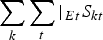 $\sum_{k} \sum_{t} \vert_{Et} S_{kt}$
is total volume of water supplied to Ethiopia from Nile River tributaries, namely Atbara, Blue Nile and Sobat (cm/month);
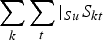 $\sum_{k} \sum_{t} \vert_{Su} S_{kt}$
is total volume of water supplied to Sudan from the White Nile, and the Atbara, Blue Nile and Sobat sub-basin after water is diverted in Ethiopia (cm/month); and
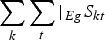 $\sum_{k} \sum_{t} \vert_{Eg} S_{kt}$
is total volume of water supplied to Egypt after water is diverted in Sudan (cm/month).
This arrangement is sometimes supported by upstream riparian countries, such as Ethiopia, that claim the adoption of ‘absolute territorial sovereignty’ water rights in managing transboundary rivers (Dinar and Wolf, Reference Dinar and Wolf1994). A similar approach was adopted by Turkey, the upstream riparian, to the Euphrates-Tigris river in its discussion with Syria and Iraq (Kibaroglu and Ünver, Reference Kibaroglu and Ünver2000).
In this, and all the remaining scenarios, we will analyze two independent situations: with GERD and without GERD. For the former scenario, we estimate water allocation and the resulting economic benefits for each country and the region once GERD becomes fully operational. The latter scenario excludes GERD but assumes that Ethiopia would decide to implement the irrigation project along the Sobat tributary specified by Wu and Whittington (Reference Wu and Whittington2006) and Block and Strzepek (Reference Block and Strzepek2010).
4.1.3. Social planner's (efficient) allocation
The social planner is intended to provide an efficient allocation of Nile River water. It means, in theory, that any other allocation could lead to a welfare value that is inferior to the social planner's outcome. Consequently, efficiency from the social planner's outcome can be used as a yardstick by which the performance of other allocation schemes can be evaluated. In this scenario, Nile water that generates the maximum economic benefit is allocated optimally for economic activities regardless of where they are located within the territories of the three riparian countries.
This scenario can be formalized using
 $$\sum_d \sum_t (D_{dt}^{IR} + D_{dt}^{HP} + Ev_{dt}) \le \sum_k \sum_t S_{kt}.$$
In the case of a common-pool resource that crosses international boundaries and sovereign nations, efficiency alone cannot stand as the primary objective for allocating resources. Moreover, protecting the natural resource base in the basin may not be the responsibility of one or another country. Therefore, an intrabasin ‘allocate-and-trade’, or allocation with property rights and trade, is introduced both to attain efficiency and to maintain environmental sustainability.
4.1.4. Allocation with property rights and trade
This scenario introduces an intrabasin water-trade mechanism (henceforth ‘trade’) that attaches a positive price to each unit of water traded among riparian countries, by applying the equimarginal principle. It helps identify the condition under which water is transferred to a riparian country with a higher marginal benefit. At the same time, a buyer riparian country is willing to compensate a seller riparian country that has a lower shadow value of water.
Under the water-trading scenario, riparian countries trade excess demand, ED dt , using a price, P w , that can be identified through the marginal product of the water-abundant country and the shadow value of the water-scarce country identified from the optimization equation. Here, we used a modified version of (1) shown below:
 $$Max G= {\sum_d \sum_t \beta \lpar D_{dt}^{IR}\rpar ^{(\alpha +1)}\over{(\alpha +1)}} +\sum_d \sum_t P_d^{HP} (kWh_{dt})+ P^w\sum_d \sum_t ED_{dt}.$$
Along with the initial WRA,
 $\overline{W}^{i}$
, the excess demand and the related constraint can be further specified as
 $$\sum_d \sum_t \vert_i ED_{dt} = \sum_d \sum_t\vert_i (D_{dt}^{IR} + D_{dt}^{HP} + Ev_{dt})-\sum_i \overline{W}^{i}\!,$$
with the following additional condition for supply constraint:
 $$\sum_i \overline{W}^{i}\leq \sum_{k} \sum_{t} S_{kt},$$
where country i=Et, Su and Eg.
4.1.5. Internalizing the externality
The prevailing resource degradation problem of about 525 million cm of topsoil erosion in Ethiopia hinders the region's capacity to sustain both ecological life and economic activity Arsano and Tamrat (Reference Arsano and Tamrat2005). The threat of environmental damage in the basin is significantly degrading even the existing freshwater supplies (Elhance, Reference Elhance1999). Hence, managing eastern Nile River water without dealing with the resource degradation problem may worsen the existing water-scarcity challenges facing these nations. In addition to attaining a significant portion of water efficiency, water trade could also be used as a best alternative to address the problem of the externality. When water trade is introduced along with WRA, internalizing the externality becomes a cost-effective intervention that could save cost compared to the regulation or command-and-control policy (Hansjurgens, Reference Hansjurgens2005; Olmstead and Stavins, Reference Olmstead and Stavins2008).Footnote 3
In order to deal with this resource degradation problem, (1) is modified in the following way:
 $$\eqalign{Max G &= {\sum_d \sum_t \beta \lpar {D_{dt}^{IR}}\rpar ^{(\alpha +1)}\over{(\alpha +1)}} +\sum_d \sum_t P_d^{HP} (kWh_{dt})+ P^w\sum_d \sum_t ED_{dt}\cr & \quad -c\sum_d \sum_t \lsqb {D_{dt}^{IR} + D_{dt}^{HP}} \rsqb ,}$$
where c is the average cost of the resource degradation in the ENRB (which is around US$0.009/cm of Nile water) estimated in Nigatu (Reference Nigatu2012).
4.2. Water rights arrangements (WRA)
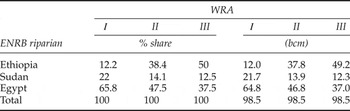
Economic theory requires that a precondition for any traded good is well-specified property right systems, and that property right systems be modified in the direction required to take account of economic effects created by trade (Demsetz, Reference Demsetz1967). Especially in a common-pool resource such as river water, clearly defined property rights play a vital role in addressing a number of issues, including sharing benefits (equity) and internalizing the externality (Schlager and Ostrom, Reference Schlager and Ostrom1992). Here, we propose three WRA (table 1) to initiate water trade, based on suggestions from Nile River experts, historical facts, and past and present hydro-politics in the basin.
Proposed WRA of the Nile River water among Eastern Nile Basin riparian countries

According to Whittington et al. (Reference Whittington, Waterbury, McClelland, Dinar and Loehman1995), a Nile basin institution will assign 12.2 per cent of Nile water to the upstream country, Ethiopia, and 87.8 per cent to downstream riparian countries, Sudan and Egypt (identified as WRA I). The United Nations Convention's Article 5, ‘equitable and reasonable utilization and participation’, is the basis for formulating WRA II (UN, 1997), but the formulation is based on per capita water use using the 1960 population in the basin. This is because the major dialogues behind Nile water allocation revolve around the 1959 bilateral allocation of Nile River water between Sudan and Egypt. Based on Beaumont (Reference Beaumont2000), 50 per cent of Nile water is allocated to Ethiopia because it is the source of the Nile River, and the remaining 50 per cent is assigned to downstream riparian countries based on their historic use (WRA III). Sudan and Egypt will share 25 and 75 per cent, respectively, of the combined downstream portion according to the 1959 water-sharing agreement for WRA I and WRA III.
5. Results
The setup of the optimization model is similar to the approach used in McKinney and Savitsky (Reference McKinney and Savitsky2006). The mean annual runoff of 98.5 bcm, calculated using the last 50 years of Nile River flow, is used as the main input for calibration and estimation of the various allocation scenarios (GRDC, 2010). The main choice variables are irrigation water released, land irrigated, hydropower water released, electricity generated and volume of water traded. Prices and values are expressed in 2010 US$ price level.
5.1. Baseline allocation
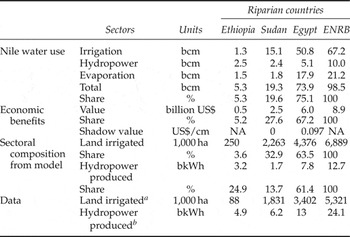
One of the main purposes of estimating the baseline allocation is to calibrate the situation on the ground along with the 1959 bilateral treaty between Egypt and Sudan, as specified in equation (10), and to assess its welfare level using the specified model. The data and model results are presented in table 2. The results confirm that Egypt uses the volume of water specified in the 1959 treaty, and that Sudan uses less water than the volume assigned in this treaty. Although the treaty did not explicitly allocate water to Ethiopia, it currently uses almost 5.3 bcm of water from the Nile River. The model estimates that there are more than two and four million ha of land under irrigation in Sudan and Egypt, respectively, and that the region produces around 13 bkWh of electricity from hydropower.Footnote 4

The economic benefit for the ENRB from the baseline allocation is US$8.9 bn. The shadow values indicate that allocating additional water to Egypt would result in increased economic benefit, ceteris paribus. The shadow value for additional water to Sudan is negligible. Since Ethiopia did not have an allocation through the 1959 treaty, its water use does not reflect its shadow value of using additional water. Wu and Whittington (Reference Wu and Whittington2006) estimated US$4 bn (2000 US$ price level), for the economic benefit of this allocation using a different model setting and pricing structure. Except for hydropower production in Sudan and irrigated land in Ethiopia, our calibrated results using the model and the actual data are relatively similar for most variables. Since the model optimizes the current situation based on the baseline allocation and capacity, it is reasonable to expect some variations between data and our model results.
5.2. Unilateral use arrangement
We assume that riparian countries will unilaterally decide to use the Nile River water for existing as well as planned projects along the Nile River. One of the most prominent projects in this regard is GERD, which will be in operation by 2017. Even though this project is intended to use the Nile River water for generating electricity from hydropower and is considered a non-consumptive water use sector, the sheer size of the reservoir, the potential loss to evaporation and the estimated capacity to generate up to 15 bkWh of electricity can affect water allocation in the ENRB.
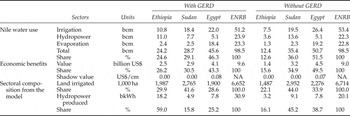
As shown in table 3, the welfare value for the ENRB from unilateral use with and without GERD could reach US$9.6 bn and US$9.0 bn, respectively. Both with GERD and without GERD scenarios could improve the economic benefit for the region compared with the baseline allocation. Unilateral use of Nile water among the three riparian countries with GERD would reduce the economic benefit of Sudan and Egypt as compared to without GERD allocation. This indicates that the enormous size and potential of GERD will change both the economic benefits and hydrological positions of riparian countries and it will give Ethiopia more of an advantage in using Nile water. This result is consistent with the finding in Kahsay et al. (Reference Kahsay, Kuik, Brouwer and van der Zaag2015), who modeled GERD's impact on the Blue Nile economies using a static CGE model.
Model results for unilateral use arrangement

As expected, Ethiopia could use a significant portion of Nile water, 24.6 per cent or 24.2 bcm, with GERD, compared to 12.6 per cent or 12.4 bcm without GERD. The economic benefit from unilateral use with GERD for Ethiopia is more than five times what the country is currently receiving from the Nile River. GERD alone will enable Ethiopia to irrigate around 500,000 ha of land and to produce 15 bkWh of electricity. On the other hand, unilateral use without GERD would increase the economic benefit of the Nile water to Sudan and Egypt. Part 2 of the online appendix provides additional information about interpreting Nile water allocation.
The shadow value of water reveals that Egypt is the only riparian country with a positive value, while Ethiopia and Sudan would have a zero shadow value for this allocation. This result is due to their geo-economic position; both countries could be able to meet their water demand through unilateral use arrangement, and more water would not provide an extra economic benefit for both riparian countries, ceteris paribus.Footnote 5 If Ethiopia and Sudan were to divert the Nile water away from the ENRB, their shadow values would be positive. Since this allocation does not take into account increasing the welfare of the ENRB, there would be no shadow value associated to the region as a whole.
5.3. Social planner's allocation
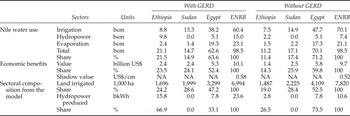
Based on maximizing ENRB's welfare, the social planner could assign 21.1 bcm of Nile water to the upstream riparian country, Ethiopia, and 77.4 bcm to the downstream riparian countries, Sudan and Egypt, with GERD, as shown in table 4. But the allocation without GERD would be 11.2 and 87.3 bcm to upstream and downstream countries, respectively. From the downstream portion of Nile water, around 80 and 20 per cent would be allocated to Egypt and Sudan, respectively. The social planner with GERD could allocate amounts of water to riparian countries similar to the suggestion by the experts working in the region (Whittington et al., Reference Whittington, Waterbury, McClelland, Dinar and Loehman1995).
Model results for social planner's allocation

For Egypt, the social planner's water allocation is higher than the unilateral-use arrangement. This is because Egypt uses Nile water more efficiently than the other riparian countries even though Ethiopia and Sudan get water ahead of Egypt due to their geographic location. The economies of scale, through accumulated experience and technological advancement, are the main sources of efficiency in Egypt. There are no economic benefits from generating hydropower in Sudan. Hence, allocating water to a sector or to a riparian country that could use the Nile water more efficiently increases the economic pie of the region. The optimization result confirms the efficiency condition of using water in a place where it could generate the highest welfare benefits for the region.
This allocation could improve the welfare of the region compared with the baseline and unilateral use. In addition to the highest welfare gain of US$10.1 bn with GERD and US$9.7 bn without GERD, the social planner's allocation results in the highest shadow value of water for the ENRB compared with other scenarios. Using optimal resource allocation, the region could cultivate around 7 million ha of land and produce around 24 bkWh of electricity with GERD. Without GERD, it is estimated to irrigate around 8 million ha of land and to produce around 11 bkWh of electricity. The social planner's economic benefits represent a significant improvement compared to the current economic values of US$8.9 bn from cultivating 6.9 million ha of land and producing 12.7 bkWh of electricity. GERD represents a comparative advantage in producing hydropower by Ethiopia. Wu and Whittington (Reference Wu and Whittington2006) estimated around US$8 bn (2000 US$ price level) economic return from optimum allocation using a game theory setup and assuming that Ethiopia would build four dams along the Blue Nile River. On top of using different pricing structures and proposed dams in Ethiopia, the reason for the difference between our model and the Wu and Whittington (Reference Wu and Whittington2006) results is that we maximize regional welfare by including the impact of GERD on changing the Nile River water utilization.
Since the social planner's allocation does not take into account separately increasing the welfare of an individual country, there would be no shadow value associated with additional water to each country. In addition to estimating the optimal economic value of Nile River water, the social planner's allocation can also be used as a yardstick to evaluate the performance of intrabasin water trade. As economic theory suggests, the market could bring about a desired economic value in allocating a resource among competing sectors and agents even though market failure and the externality may hamper its performance.
5.4. Allocation with property rights and trade
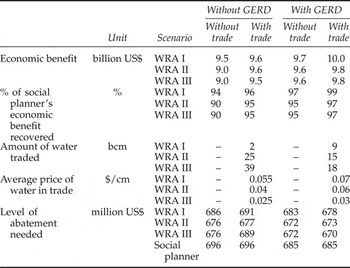
The basic notion of water trade is introduced based on the type of water rights established where a country with a higher shadow value of water can get more water from a riparian country with a lower shadow value. This could be facilitated through the existing regional institution such as the NBI. The results for the three different WRA with and without the situation of GERD for both without trade and with trade scenarios are shown in table 5. These results are also compared with the corresponding social planner's results. In the case of both the without GERD situation and the trade scenario, the region's economic benefit would reach US$9–9.5 bn depending on the WRA. This amount could recover up to 94 per cent of the social planner's economic benefit. But once trade is introduced, the region's welfare could reach more than US$9.5 bn, and trade could recover more than 95 per cent of the social planner's benefits.
GERD situation, trade scenario and internalizing externality results for different WRA

In the case of GERD but without trade, the region's economic benefit would reach up to US$9.7 bn, and up to 97 per cent of the social planner's economic benefit could be recovered. For both the GERD and the trade scenarios, the region's economic benefit could reach up to US$10 bn and this could recover up to 99 per cent of the social planner's results. This is the biggest amount of economic value among the GERD situation and trade scenarios, and the best possible recovery for the social planner's benefit. Hence, it is viable to claim that allocation of water under water trading also leads to a Pareto efficient outcome (with limited buyers) in additional to reaching 95–99 per cent of total benefits guaranteed by the social planner.
It is shown that the economic benefit of WRA without trade could be increased through introducing a regional intrabasin water trade. This is supported by the economic theory of managing common-pool resources. The results indicate that the region's economic benefit will be increased by up to US$500 m depending on WRA. Trade could also help recover a significant portion of the social planner's economic benefit. Even though the underlying economic theory suggests that trade could attain the optimal efficiency level, our model indicates that the time needed to transfer water from one district to the other and the evaporation loss in the reservoirs prevent the model from attaining 100 per cent of the social planner's economic benefit.Footnote 6
5.5. Internalizing the externality
On top of reducing the economic benefit for the ENRB, the formulation in equation (15) enables us to estimate the amount of abatement investment that each country could make for reducing or eliminating resource degradation. As shown in table 5, the social planner's solution could raise more than US$680 m in protecting the resource base, the highest amount compared to any of the other allocation schemes. For all WRA, trade could provide more abatement dollars than without trade scenarios. This result is consistent with the merit of trade in resource management where trade provides sufficient abatement based on incentive and marginal returns from resource use (Hanley et al., Reference Hanley, Shogren and White1997). This abatement could solve unsustainable agricultural practices and deforestation, which are the leading causes of soil erosion and siltation (Longin et al., Reference Longin, Saad, Eldaw, Naggar, Nindamutsa, Chane and Faudul2005).
Furthermore, we found that the externality cost of GERD and the level of investment needed for abatement is less than without GERD. This supports some of the claims presented by upstream countries for the benefit of regulating and managing the Nile River water at the source. Hence, on top of producing a very significant economic benefit, the model results indicate that GERD would help reduce some of the externality cost incurred by riparian countries. The region's efficiency as well as internalizing the externality would be facilitated by the construction of GERD.
From our result, it can be inferred that implementing resource conservation and protection activities by assigning WRA alone is an inefficient approach to managing a resource. Even though establishing water rights is a necessary condition for conserving and protecting resources, other mechanisms such as trade could supplement the sufficient condition of attaining economic efficiency. This result is consistent with the economic theory and management practice of common-pool resources in which property rights play a vital role (Schlager and Ostrom, Reference Schlager and Ostrom1992).
6. Discussion
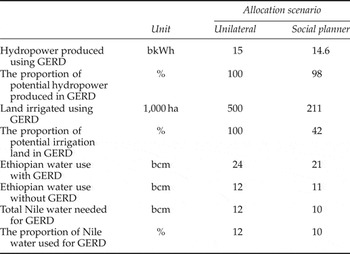
The landscape of the region as well as the Nile River flow have changed since GERD. As shown in different parts of the results, the Nile River water use and the participation of individual countries will be changed once GERD is fully operational. Most importantly, GERD will significantly increase Ethiopian non-consumptive water use from the current 5.3 to over 20 bcm and its economic benefit from the baseline value of US$0.5 bn to more than US$2.3 bn. As shown in table 6, Ethiopia may claim more than 10 bcm of additional Nile River water (more than 10 per cent of the Nile River water) for GERD depending on the various allocation scenarios. This is on top of more than 60 bcm of water that is intended to be stored in the reservoir.
Some significant changes as a result of GERD

GERD will enhance Ethiopian hydropower production capability. This also confirms the findings of most previous works and recommendations of experts that Ethiopia has a comparative advantage from using the Nile River water for hydropower production (Abate, Reference Abate1994; Wu and Whittington, Reference Wu and Whittington2006). For a country where power outages are rampant and more than 76 per cent of the population lacks access to electricity, this is a meaningful additional supply of electricity that could bring a significant change in Ethiopia's electricity grid (World Bank, 2014). In addition, Ethiopia has signed agreements with Kenya, South Sudan, Sudan and Djibouti to sell electricity and is currently selling electricity to Sudan and Djibouti (Davison, Reference Davison2014). It considers electricity export as an important source of its foreign exchange and as a new strategy to help its economic development process. The multiplier effect of producing cheap electricity will spur growth in other sectors of the economy and speed up economic development aside from the predominant agriculture. Hence, GERD will significantly change the Nile River water allocation among riparian countries and the economic benefit that they get from using the river resources.
Another interesting result concerning GERD is that it would be a viable project in the social planner's allocation, as shown in table 6. In general, GERD would increase the region's welfare and the shadow value of using the basin's water in an economic sector that would produce a higher return. The ecological benefit of regulating the basin's water and decreasing other externalities are also added benefits of GERD. Even though Ethiopia unilaterally decided to construct GERD, downstream countries could economically (for instance, through purchasing cheap electricity) and ecologically (for instance, through decreasing siltation and evaporation) benefit from the dam.
Since the change in government in Egypt after the Arab Spring and the secession of South Sudan from Sudan, the Nile River's asymmetry in political power has taken on a new dimension. Changes in the politics of these two downstream riparian countries and the involvement of China as a financer and a contractor of big projects (like GERD) give leverage to the upstream countries (such as Ethiopia) to undertake their own initiatives in implementing projects (Hatton, Reference Hatton2011). In the meantime, sticking to the old political power asymmetry and relying on the status quo for Nile River allocation could not result in stability in the region. Hence, with the reality of GERD taking shape, the basic concepts of water rights and intrabasin water trade will open a new window for future Nile River dialogue.
In a further discussion, electric power grid networks would appear to be incompatible in Africa (Sebitosi and Okou, Reference Sebitosi and Okou2010). Despite some recent progress, previous efforts regarding electricity trade in the region have faced a number of setbacks, such as lack of proper ownership, unclear and conflicting reform objectives and uncertainty of integration outcomes (Pineau, Reference Pineau2008). There is less experience in multinational trade in electricity in the east Nile region. Hence, before modeling electricity trade, we focus on modeling water trade that takes the natural flow and could be used to develop electricity by one nation and sold to other countries. By identifying the comparative advantages, our results can help incorporate many dimensional elements and issue linkages that help facilitate regional dialogue and strengthen cooperation among riparian countries.
7. Conclusion
The results indicate that baseline and unilateral use arrangements are suboptimal compared to the social planner, and Egypt could use Nile water more efficiently than the other countries. The social planner assigns the Nile River water for an economic sector and agent that generates the highest economic benefit to the region regardless of initial WRA. Its welfare gain is the ‘first-best’ economic solution, which is practically challenging to implement in the real world, but the gain helps evaluate the performance of other allocations.
As an alternative to the use and management, the proposed WRA with trade may be politically sensitive; they provide a plausible alternative to utilizing the Nile River water. It is estimated that intrabasin regional water trade could make better off those downstream riparian countries that hold a firm position on maintaining the baseline allocation. Trade could lead to an important step in the Nile dialogue that is stalled by the fear that any intervention could affect the economic benefit of the downstream riparian countries. If there is a regional or basin-wide consensus in the form of a treaty or formal negotiation among riparian countries, which adopts the prevailing realities of the region or basin, a water market will provide more cost-effective tools for resource protection than WRA alone. Such trade will compensate negatively affected countries and promote sustainable resource management practices.
The results suggest that Ethiopia could produce more electricity than its potential use once GERD is fully operational. This helps diversify its agriculture-based economy to a new frontier of selling electricity to its neighboring countries, and importing food commodities, which otherwise results in inefficient use of the region's resource.
GERD demonstrates the possibility of addressing the scarcity of food, water and energy in a developing region by exchanging water and energy, based on their marginal productivity across the basin states. This food–water–energy nexus as a package of considerations at the basin level demonstrates the likelihood for cooperation and trade (including water and electricity) in the region. It is among the feasible projects that satisfies both efficiency and sustainability conditions of the social planner's problem. Unilateral hydropower projects by upstream countries do not necessarily reduce the water available to downstream countries nor hurt their economic sectors since generating hydropower is a non-consumptive water use. Future work may address regional electricity trade and integrate issue linkages with comparative advantages to provide more insight for regional dialogue in resource management.
Finally, it is important to mention some of the limitations of the model. First, annual Nile River flow variation could change the results. Secondly, the model integrates an exogenous cost estimate for the externality and excludes the transaction cost of establishing the market for water and managing it. Finally, the model is a partial equilibrium model that includes only two economic sectors and three riparian countries of ENRB among the 11 countries which share the entire Nile River basin.
Supplementary materials and methods
The supplementary material referred to in this paper can be found online at journals.cambridge.org/EDE/.