Introduction
Evaluating the mode of construction and preservation of a trace fossil is an important step toward the determination of the possible producer and provides the opportunity to investigate behavioral evolution of organisms in the past. Proper functional and taxonomic interpretation of a trace and its maker first depends upon understanding the preservation process, which could impact ichnologic fidelity, trace visibility, and ultimately ichnotaxonomy (Savrda, Reference Savrda and Miller2007; Buatois and Mángano, Reference Buatois and Mángano2011, p. 12; Bromley, Reference Bromley1996, p. 155–158).
Paleosol ichnology has provided important insights on the evolution of dwelling strategies in terrestrial invertebrates. Trace fossils show that beginning in the Late Cretaceous, soil insects displayed a marked rise in both behavioral and taxonomic diversity with the use of constructed pelletal and fluidized linings to inscribe and stabilize the boundary walls of pupation chambers and cocoons (Genise, Reference Genise2016, p. 565). Similar adaptations have been also reported in trace fossils ascribed to crustaceans, which perfuse with thick linings the walls of burrows and breeding chambers constructed in soils (Genise et al., Reference Genise, Bedatou and Melchor2008; Bedatou et al., Reference Bedatou, Melchor, Bellosi and Genise2008). This Late Cretaceous revolution is testified by a richer record of trace fossils within paleosols worldwide and exemplified by the occurrence of the Celliforma ichnofacies, the first insect-dominated ichnofacies (Genise et al., Reference Genise, Bedatou, Bellosi, Sarzetti, Sánchez, Krause, Mángano and Buatois2016).
Over the last 10 years, several studies have reported an abundant collection of trace fossils preserved in paleosols from the Upper Cretaceous Two Medicine Formation. These trace fossils have increased importance given their occurrence in dinosaur nesting grounds where they could provide environmental constraints on dinosaur reproductive strategies (Martin and Varricchio, Reference Martin and Varricchio2011). So far, these studies have recognized an abundant insect trace-fossil assemblage ascribed to Fictovichnus sciuttoi Genise et al., Reference Genise, Melchor, Bellosi, González and Krause2007, Rebuffoichnus isp., Teisseirei isp., and Tombownichnus isp., interpreted, respectively, as hymenopterans pupation chambers, coleopterans brooding chambers, and perforation traces produced by parasitoid insects (Martin and Varricchio, Reference Martin and Varricchio2011; Freimuth and Varricchio, Reference Freimuth and Varricchio2019). Here we describe a novel enigmatic trace fossil from Two Medicine Formation deposits of the Egg Mountain locality—Feoichnus martini new ichnospecies—attributable to a possible insect trace maker. Even though the structure is very simple, we recognize several features, e.g., preferential orientation and presence of a thin discrete wall, which could suggest a mechanism of formation similar to that observed in other soil-preserved traces. This study: (1) provides a description of this new trace fossil, (2) discusses a possible mechanism of its formation and preservation, (3) analyzes it relative abundance with respect to other trace fossils from the same site, and (4) reviews its paleoenvironmental and paleoecological significance.
Geological setting
The Upper Cretaceous Two Medicine Formation crops out in northwestern Montana within the Rocky Mountain Disturbed Belt and is composed of siliciclastic sediments derived from the erosion of the uplifting Sevier Thrust Belt and igneous effusive rocks of the Elkhorn volcano (Lorenz and Gavin, Reference Lorenz, Gavin, McBane and Garrison1984). Two Medicine Formation sediments were deposited in fluviolacustrine settings extending between the thrust belt to the west and the Western Interior Seaway to the east (Rogers, Reference Rogers1990). Semiarid climate conditions influenced by monsoonal regimes are suggested for the Two Medicine Formation by evidence from the lines of arrested growth in conifer log fossils, the common occurrence of caliche nodules, and the scarcity of root traces in the succession (Lorenz and Gavin, Reference Lorenz, Gavin, McBane and Garrison1984; Retallack, Reference Retallack, Wolberg, Stump and Rosenberg1997; Falcon-Lang, Reference Falcon-Lang2003). The abundance of insect trace fossils ascribed to fossorial hymenopterans in paleosols corroborates this interpretation (Martin and Varricchio, Reference Martin and Varricchio2011; Freimuth and Varricchio, Reference Freimuth and Varricchio2019).
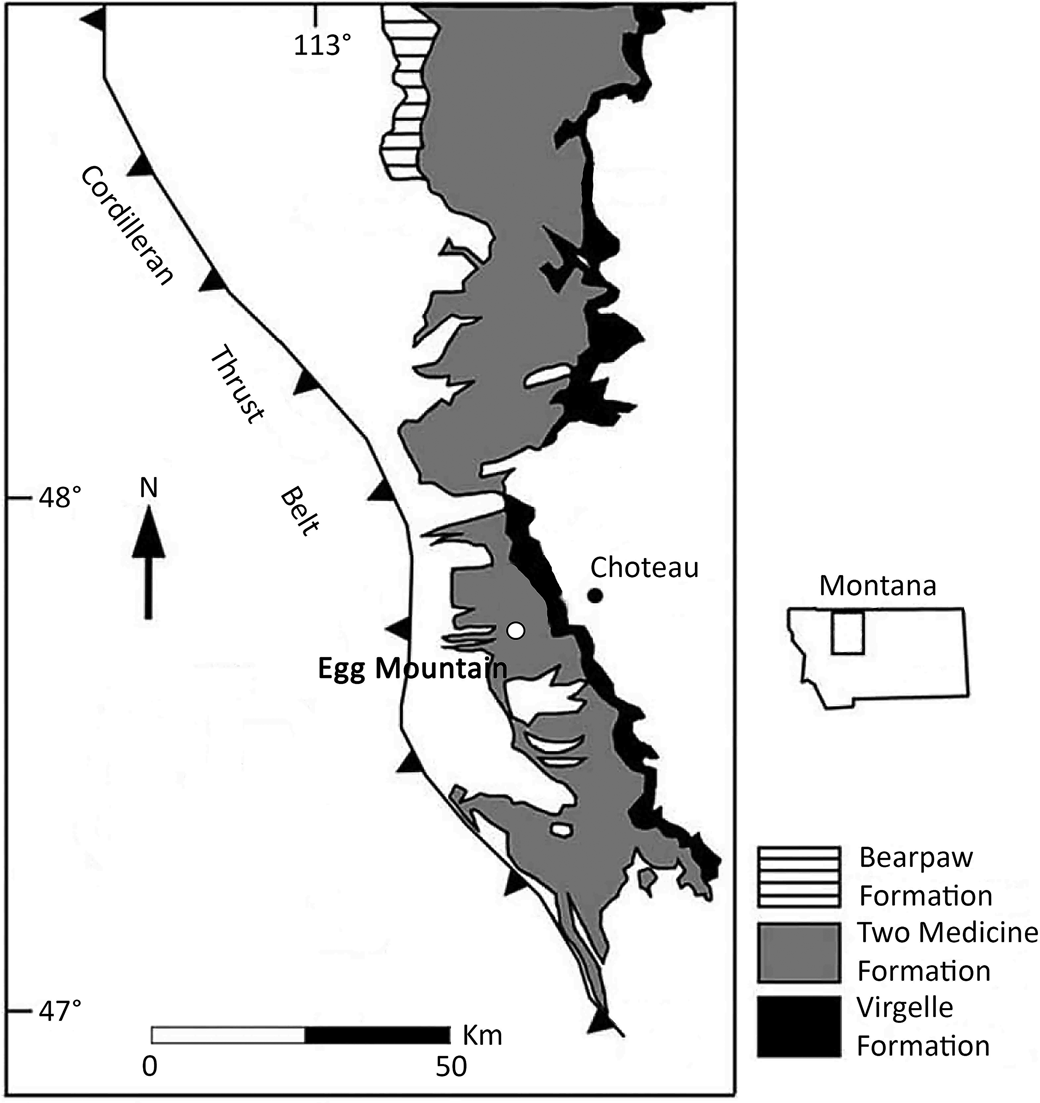
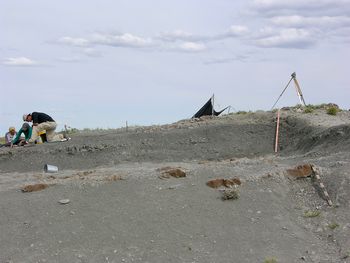
Egg Mountain is located 19 km west of Choteau, Montana and is part of the Willow Creek anticline (Fig. 1). The site is located ~1.5 km south of the Pupa Peninsula (PPP), where paleosols stratigraphically equivalent to Egg Mountain have revealed a notable invertebrate ichnoassemblage mainly composed of insect pupation chambers and cocoons (Martin and Varricchio, Reference Martin and Varricchio2011). Egg Mountain was first discovered by a research group from Princeton University in 1979 led by John R. Horner, with subsequent excavation campaigns beginning in 1982 when a quarry extending ~85 m2 was opened on the western slope of the site (Horner, Reference Horner1984, Reference Horner and Czerkas1987). The deposits extend for ~200 m2 on a small hill and consist of massive calcareous siltstones, associated with discontinuous carbonate layers gently dipping toward the northwest. The succession exposed is characterized by 3 m of siltstones alternating with a laterally discontinuous and well-indurated calcareous horizon 10–30 cm thick (Fig. 2). Although Lorenz and Gavin (Reference Lorenz, Gavin, McBane and Garrison1984) included the site within the lacustrine middle subfacies unit, these deposits have been interpreted as calcitic Inceptisols (Retallack, Reference Retallack, Wolberg, Stump and Rosenberg1997). Carbonate horizons and the scarcity of root traces argue for a prevalent well-drained soil (Retallack, Reference Retallack, Wolberg, Stump and Rosenberg1997; Freimuth and Varricchio, Reference Freimuth and Varricchio2019). These deposits have yielded a rich fossil collection throughout the succession, consisting of dinosaur remains, eggs, and teeth, lizards, and metatherian and multituberculate mammals, alongside extensive invertebrate bioturbation structures (Montellano, Reference Montellano1988; Horner, Reference Horner1989; Varricchio et al., Reference Varricchio, Jackson and Trueman1999; Montellano et al., Reference Montellano, Weil and Clemens2000; Freimuth and Varricchio, Reference Freimuth and Varricchio2019). Radiometric analyses place the age of these deposits in the middle Campanian, near 75.5 Ma (Rogers et al., Reference Rogers, Swisher and Horner1993; Varricchio et al., Reference Varricchio, Koeberl, Raven, Wolbach, Elsik and Miggins2010).
Schematic geological map of northwestern Montana showing the location of Egg Mountain (white dot) (modified from Rogers et al., Reference Rogers, Fricke, Addona, Canavan, Dwyer, Harwood, Koenig, Murray, Thole and Williams2010).

View of the quarry at the Egg Mountain locality showing paleosol deposits characterized by gray calcareous siltstones and prominent laterally discontinuous carbonaceous layers. The beds dip slightly to the north (at left).

Materials and methods
The material described here comes from the main quarry of Egg Mountain excavated between 2010 and 2016 extending ~100 m2, later expanded laterally to the east during the summer of 2015. Excavations exhumed the uppermost 1.5 m of the succession exposed at the top of Egg Mountain and consisted of first breaking up the indurated lithology with a hand-held 80-pound jack hammer in ~12.5 cm thick passes. The crew then picked through the generated rubble. The material was also collected in detritus, swept at the edges or floating on the ground surface of the quarry. In total, 95 specimens of the new trace have been collected. Given the absence of discrete strata in the succession, relative abundance of specimens was calculated for each of the 12 jack-hammer passes (JHP) representing artificial timelines across the main quarry. Specimens from the excavations involving the expansion of the main quarry were not included in the abundance analysis because the material could not be related confidently to jack-hammer passes of the main quarry. Only 36 specimens were suitable for measurements. In addition, a few representative specimens were prepared as petrographic thin sections for optical and chemical analyses. A JEOL JSM-6100 scanning electron microscope was used to obtain chemical characterization across the diagnostic area of the samples. Standard thin sections 30 μm in thickness were prepared and coated with gold using a sputter coater set with current and time, respectively, at 30 mA and 30 sec. X-ray spectra and relative element total weight percentages were collected using the software Winshell (Ingo H. de Boer, http://www.winshell.org) and visualized using the program WinTools (Godlike Developers, http://www.wintools.net/). The pulse throughput was set at 2.5 Kcps and the amplification at 20 eV per channel to collect from 0–20 kV. X-ray spectra were obtained at a death time of 20–30%. The working distance was maintained at 39 mm.
Repository and institutional abbreviation
Specimens examined in this study are deposited in the Museum of The Rockies (MOR), Bozeman, Montana, USA.
Systematic ichnology
Ichnofamily Pallichnidae Genise, Reference Genise2004
Ichnogenus Feoichnus Krause et al., Reference Krause, Bown, Bellosi and Genise2008
Type ichnospecies
Feoichnus challa Krause et al., Reference Krause, Bown, Bellosi and Genise2008 by original designation.
Diagnosis
A hemispherical, concave-up, pan-shaped structure, seldom conical in shape, with an irregular external morphology, and lacking an active filling. The internal surface is smooth and lined, sometimes bearing multiple stained layers. The internal surface can also display irregular ridges or a bumpy appearance. The external surface is irregular and can show a characteristic lateral smooth groove with longitudinal striations that is vertically or subhorizontally oriented (modified after Krause et al., Reference Krause, Bown, Bellosi and Genise2008).
Remarks
The ichnogenus Feoichnus has a global distribution, and a stratigraphic occurrence extending back to the Cretaceous. The fossil record of Feoichnus in North America ranges from the Upper Cretaceous to the Pliocene (Krause et al., Reference Krause, Bown, Bellosi and Genise2008). Specimens reported from Two Medicine Formation deposits can be easily distinguished from other co-occurring trace fossils by its unique hemispherical or hemiellipsoidal shape. Other hemispherical ichnogenera potentially comparable to Feoichnus might be Cellicalichnus Genise et al., Reference Genise, Bedatou and Melchor2008 and Dagnichnus Genise et al., Reference Genise, Bedatou and Melchor2008, but they differ from the first in displaying, respectively, single and multiple radiating, meniscated cells (Genise et al., Reference Genise, Bedatou and Melchor2008).
Feoichnus martini new ichnospecies
Figures 3, 4, 6–8
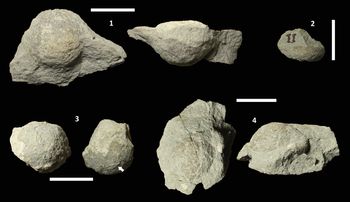
Feoichnus martini n. isp., from Two Medicine Formation deposits at Egg Mountain: (1) holotype MOR-IV-3010 B0.16-1, lower and lateral views; (2) paratype MOR-IV-3010 B0.10-2, lateral view showing distinct brown coloration on its lower half and truncation on the upper edge; (3) paratype MOR-IV-3010 B0.10-1 showing wavy root traces on the lower edge (white arrow); (4) paratype MOR-IV-3010 B24.16-2 partially embedded in host rock. Scale bars = 2 cm.

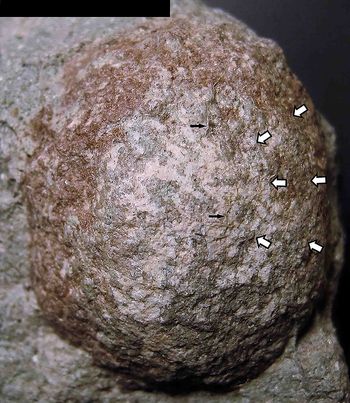
Feoichnus martini n. isp., paratype MOR-IV-3010 B28.12-1, showing thin, branching network of root traces on the surface (black arrows) and pattern of concentric rings on the surface (white arrows). Scale bar = 2 cm.

Type specimens
Holotype, MOR-IV-3010 B0.16-1, from Two Medicine Formation deposits, Egg Mountain locality (upper Campanian), west of Choteau, Montana, USA. Paratypes (5): MOR-IV-3010 B0.10-1, B0.10-2, B28.12-1, B24.16-2, and B9.13-2; same locality as holotype.
Diagnosis
Hemispherical to hemiellipsoidal structure with a simple, regular, rounded, lined lower edge, in places composed of a pattern of concentric rings.
Occurrence
Massive calcareous gray siltstone associated with micritic limestone interpreted as calcitic Inceptisols; Two Medicine Formation at Egg Mountain locality (Upper Campanian), west of Choteau, Montana, USA.
Description
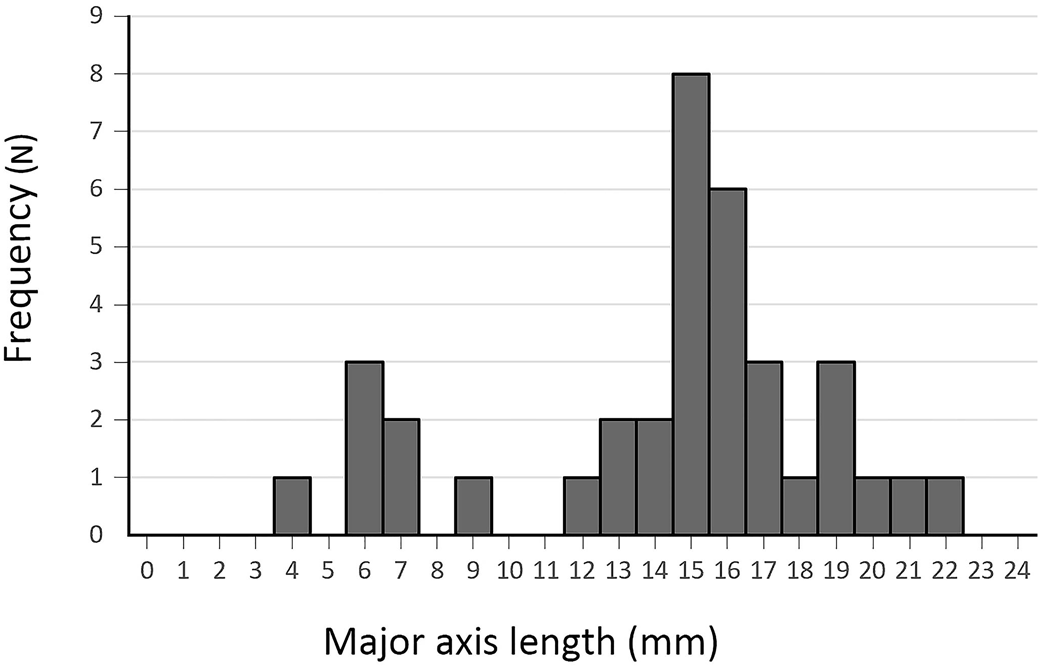
Specimens ascribed to Feoichnus martini n. isp. are preserved as hemispherical or hemiellipsoidal casts (Fig. 3). In several specimens, the counterpart of the cast is still present and preserved as a regular, rounded, concave mold. The lower border of the cast is rounded, characteristically brown, and can be finely ornamented by wavy, branching lineation, and associated with a pattern of concentric rings (Fig. 4). The brown coloration of the lower surface enhances the visibility of the specimens, making them easily recognizable in the field. In situ specimens are found with the rounded surface directed downward, and the upper edge attached or isolated from the host rock. Thus, the upper edge appears somewhat truncated. Equatorial diameter varies from 4.0–23.9 mm (N = 36) with most specimens measuring 15–18 mm (Fig. 5). Height is difficult to estimate unless the structure is completely detached from the host rock, but typically the equatorial diameter exceeds the height.
Frequency distribution of Feoichnus martini n. isp. from Egg Mountain, Two Medicine Formation, with respect to major axis length (N = 36).

Etymology
Feoichnus martini n. isp. is named after paleontologist Anthony J. Martin (Emory University, Atlanta, Georgia, USA) who has greatly contributed to the study and popularization of paleontology and ichnology.
Materials
In total, 95 specimens with catalog number MOR-IV-3010.
Remarks
We establish Feoichnus martini n. isp. on the basis of recurrent shape, size, and composition, and a preservation style that differs from any other trace fossil reported from the Campanian Two Medicine Formation paleosols, as well as on several important features that differentiate it from F. challa. Cicada feeding-chamber structures ascribed to F. challa are comparable to F. martini n. isp. in that they display a half-dome shaped form and a lined border. However, the internal structure, orientation, and morphology of F. challa indicate the involvement of more complex mechanisms of formation, e.g., readjustment and relative displacement of the chamber (Krause et al., Reference Krause, Bown, Bellosi and Genise2008) resulting in a more irregular and variable external trace morphology.
Results
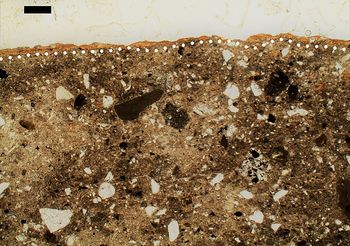
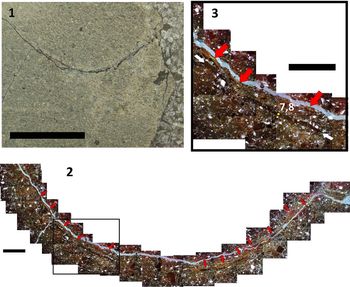
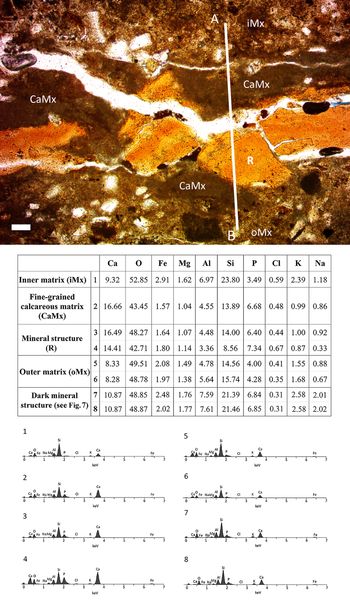
The filling of the natural casts mainly consists of calcareous siltstone associated with floating angular to subangular clasts of potassium plagioclase, K-felspar, quartz, amphiboles crystals, and lithics. The sediment fill is structureless and compositionally identical to the host rock. The brown coloration observed on the rounded surface appears to be part of a thin discrete mineral structure, which can be traced microscopically along the rounded lower edge. Specimens preserved as isolated casts distinctively display this mineral thin structure on the lower rounded edge, which ranges 50–300 μm in thickness (Fig. 6). In some specimens, the rind has a uniform appearance, but in others, portions are lacking or occupied by a gray, fine-grained, calcareous matrix. This is particularly evident when the specimen is preserved both as a cast and mold (Fig. 7). It is also evident that the mineral structure does not form a complete enclosing border, but rather abruptly terminates within the host rock, defining the detachment line of the half-dome shaped cast. In specimen MOR-IV-3010 B9.13-2, several portions of the rind also adhere to either the cast or the outer matrix. Moreover, a second thin mineral structure has been observed in the outer matrix of this specimen. The structure appears to be separated from the other mineral structure by a thin layer of sediment, is dark in color, always extinct both in normal and cross-polarized lights, and locally incorporates clasts and crystals. Chemical analyses reported total percentages of phosphorus and calcium higher in these two mineral structures with respect to the inner and outer matrix (Fig. 8), therefore defining two phosphorous-rich zones restricted to the lower rounded perimeter.
Feoichnus martini n. isp., no catalog number, thin section showing inner filling of a specimen preserved as an isolated cast. White dots emphasize the mineral structure covering the rounded edge of the cast. Scale bar = 0.5 mm.

Feoichnus martini n. isp., paratype MOR-IV-3010 B9.13-2, preserved as a cast and its relative impression on the external matrix: (1) polished thin section showing the rounded contact on the lower edge between the inner cast and the outer matrix; (2) composite photomicrographs of the external matrix with details of the mineral structure (red arrows); (3) close-up of the outlined area in (2) showing details of a second, parallel, dark mineral structure (white arrows); yellow dot refers to point 7, 8 where element total weight percentages of the dark mineral structure were measured (Fig. 8). Photomicrographs (2) and (3) in normal polarized light. Scale bars = 2 cm (1), 20 mm (2), 0.5 mm (3).

Element total weight percentages and relative X-ray spectra quantified along profile A-B across the cast and the outer matrix of paratype MOR-IV-3010 B9.13-2; photomicrograph in normal polarized light. Data in the table and spectra were attained, respectively, at one point of the cast (iMx), two points in the rind (R), and two points in the outer matrix (oMx). The dark area (CaMx) is composed of a fine-grained calcareous matrix, apparently representing an altered portion of the rind; points 7, 8 are samples of this dark mineral structure (see Fig. 7). Scale bar = 50 μm.

Discussion
Consistent size, shape, and orientation argue for a biogenic origin of Feoichnus martini n. isp. The wavy and branching lineations occasionally observed on the lower surface likely represent root traces. These together with the close association of Fictovichnus sciuttoi and undetermined burrows indicate that these structures were produced within soil.
As observed in other biogenic structures, the presence of a discrete lower border suggests that Feoichnus martini n. isp. might have been produced by a soil-dwelling organism, and therefore comparison with similar structures produced in soils would help explain its formation and preservation. In F. martini n. isp., at least two thin mineral structures are observed running parallel to the rounded border. These structures are not associated with aligned grains or pellets and tend to incorporate clasts and crystals, suggesting a passive mechanism of formation (i.e., impregnation) rather than mechanical interaction between the trace maker and the substratum (Genise, Reference Genise2016). Iron has been reported within these structures and oxidation could be responsible for the characteristic rusty color observed on the lower surface. Organic carbon preservation is typically connected with iron oxidation within soils (Kaiser and Guggemberger, Reference Kaiser and Guggenberger2000; Lalonde et al., Reference Lalonde, Mucci, Ouellet and Gélinas2012). In particular, oxidized horizons and mineral coatings are commonly associated with biogenic structures in which the perimeter is constructed or passively formed by trace makers using organic fluids that compact and stabilize the surrounding sediment (Hallam, Reference Hallam and Frey1975; Bromley, Reference Bromley1996; Krause et al., Reference Krause, Bown, Bellosi and Genise2008; Genise, Reference Genise2016). The darker color observed in the most external mineral structure is likely connected to a relatively greater abundance of iron. These mineral structures argue for the presence of organic matter accumulated along the lower rounded border and could be consistent with the presence of multiple stained layers (Genise, Reference Genise2016). The relatively higher abundance of phosphorous in these mineral structures could also be suggestive of the presence of localized organic matter accumulation. Although calcium carbonate minerals are abundant in Egg Mountain deposits, because they are derived from erosion, transport, and deposition of Paleozoic carbonate sediments (Varricchio et al., Reference Varricchio, Jackson and Trueman1999), the presence of phosphorus-rich coatings, e.g., collophane minerals, are mainly reported in association with organogenic structures (e.g., dinosaur eggs; Oser, Reference Oser2014). Thus, although circumstantial, the presence of phosphorus might also be supportive of mineral accumulation derived from an organic source (Retallack, Reference Retallack1984; Karkanas and Goldberg, Reference Karkanas, Goldberg, Stoops, Marcelino and Mees2018). The fine-grained calcareous matrix locally observed in close association with these mineral structures is in contrast amorphous, displays irregular contacts, but shows nearly the same phosphorous-rich composition, suggesting that it likely derives from alteration of these mineral structures.
All of the specimens assigned to Feoichnus martini n. isp. are half-dome shaped and lack mineral structure on the upper edge, thus they appear somewhat truncated. With compaction of a complete spherical or prolate morphology, one would still expect these structures to be present, even if deformed. The absence of a discrete upper border was possibly produced by collapse of an unstable sediment. In this scenario, the overall form of F. martini n. isp. can be explained if formation of the wall was mainly driven by a passive, gravitational component in which organic discharges concentrated and impregnated the underlying sediment, and hence, consolidated only the lower border (Krause et al., Reference Krause, Bown, Bellosi and Genise2008). The absence of oriented grains could support this passive constructional method because the border does not preserve signs of active trace maker-substratum interaction, e.g., oriented grain or fluidized linings. Consequently, this scenario assumes that the structure was initially provided with a roof, but because the discharge of organic fluids selectively consolidated only the bottom of the structure, the roof remained unconsolidated and more prone to collapse. Disruption of the roof eventually caused infilling of the hollow space.
An alternative hypothesis considers the trace maker as more directly the cause of the half-dome shaped structure. For instance, preservation of a half-dome shaped structure could be connected to the emergence of an adult insect from a pupation chamber. However, if this is true, signs of collapse or distortion of the sediment resulting from the emergence should be present, but this does not appear to be the case. Because the main function of an underground chamber is to preserve microclimatic conditions and protection during critical periods, it seems unlikely that construction would not include the presence of a roof (Genise, Reference Genise2004).
Preservation of Feoichnus martini n. isp. is similar to that reported for F. challa. The latter is characterized by a pan-shaped, passively filled structure with a lined internal surface that can consist of multiple stained layers. Additionally, the external morphology is characteristically irregular and can also present a lateral groove. These complementary features have been interpreted as feeding behavior of the trace maker. Specifically, Krause et al. (Reference Krause, Bown, Bellosi and Genise2008) reported the presence of the lateral groove in ~40% of the specimens described, making it a supportive character observed in this trace fossil. Root traces, represented by wavy or mesh-like lineation structures, are common on insect trace fossils from the Two Medicine Formation and are also reported in F. martini n. isp., but none of them are comparable to the lateral groove structure observed in F. challa. Furthermore, the overall shape observed in F. martini n. isp. is more regular and simpler than that reported in F. challa.
Based on consistent simple shape, size, and orientation, Feoichnus martini n. isp. is here interpreted as a trace constructed in soil. We favor an interpretation in which the mineral structures observed along the lower surface represent the vestigial accumulation of organic fluids released by the trace maker. This process is similar to that observed in soil-dwelling insects, e.g., cicada nymphs, and could be indicative of a lined border composed of multiple stained layers (Krause et al., Reference Krause, Bown, Bellosi and Genise2008; Genise, Reference Genise2016). Traces produced by soil-dwelling organisms, e.g., burrows and chambers used for feeding, nesting, hibernation, or aestivation purposes, typically display a discrete border (Retallack, Reference Retallack1984; Edwards et al., Reference Edwards, Jarzembowski, Pain and Daley1998; Downing, Reference Downing and Capinera2004; Betadou et al., Reference Bedatou, Melchor, Bellosi and Genise2008; Alonso-Zarza et al., Reference Alonso-Zarza, Genise and Verde2014; Genise and Harrison, Reference Genise and Harrison2018). Pupation and nesting structures, i.e., Pupichnia and Calichnia, resulting from insect activity are one of the most common structures encountered in paleosols, but their walls are generally too complex to be attributed to F. martini n. isp. The pattern of concentric rings sometimes observed on the lower edge of F. martini n. isp. might indicate that the trace maker excavated the structure within soil. Alternatively, the rings could have resulted from lithostatic compaction of a more truly spherical structure. Regardless, the characteristic regular, rounded external morphology suggests that the trace maker remained in a more or less static position. Moreover, because F. martini n. isp. does not display a lateral groove, possible assignment to a cicada feeding chamber remains tenuous to problematic. Ultimately, F. martini n. isp. could represent a structure produced by a soil-dwelling insect, but, given its simple morphology, no definitive identification can be confirmed about its function or specific trace maker.
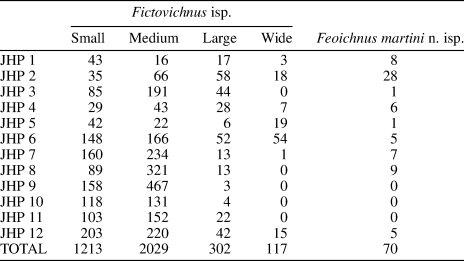
Egg Mountain deposits are notable for the peculiar impoverished Celliforma ichnofacies, characterized for the most part by Fictovichnus sciuttoi, an ichnotaxon interpreted as produced by fossorial wasps, which suggests both well-drained soil conditions for the majority of the year and a workable substratum ideal for soil-dwelling organisms (Genise et al., Reference Genise, Melchor, Bellosi and Verde2010; Genise, Reference Genise2016; Freimuth and Varricchio, Reference Freimuth and Varricchio2019). Feoichnus martini n. isp. is relatively more abundant in the uppermost 25 cm of the deposit where the greatest ichnodiversity has been reported (Table 1). Jack-hammer passes have yield three morphotypes ascribed to Fictovichnus sciuttoi, possible Fictovichnus isp., unidentified invertebrate burrows (Freimuth and Varricchio, Reference Freimuth and Varricchio2019), and a clutch-associated dinosaur nest (Varricchio et al., Reference Varricchio, Jackson and Trueman1999). Co-occurrence of dinosaur egg clutches, and vertebrate and invertebrate trace fossils suggests a complex trophic web in which organisms could have exploited a broad variety of potential food resources (Horner, Reference Horner1982, Reference Horner1984, Reference Horner1989; Chin and Gill, Reference Chin and Gill1996; Varricchio et al., Reference Varricchio, Jackson, Borkowski and Horner1997, Reference Varricchio, Jackson and Trueman1999; DeMar et al., Reference DeMar, Conrad, Head, Varricchio and Wilson2017).
Relative abundance of Fictovichnus isp. and Feoichnus martini n. isp. across jack-hammer passes (JHP) of the main quarry (modified after Freimuth and Varricchio, Reference Freimuth and Varricchio2019).

Krause et al. (Reference Krause, Bown, Bellosi and Genise2008) interpreted the wall of Feoichnus challa as a passively lined wall consisting of an inner lining and the portion of the soil surrounding the excavated chamber that was originally impregnated with organic fluids, a definition that is also applied here to Feoichnus martini n. isp. They further suggested that thinning of the wall observed in Feoichnus specimens from different stratigraphic horizons of the Sarmiento Formation could be in response to increasingly drier climates. The lined wall of F. martini n. isp. is markedly thin compared to the overall dimensions of the structure and could be consistent with the well-drained condition of the soil informed by the ichnoassemblage reported at Egg Mountain (Freimuth and Varricchio, Reference Freimuth and Varricchio2019).
So far, this report is the only occurrence of Feoichnus martini n. isp. from the Two Medicine Formation. The limited distribution could be connected to local ecological parameters, e.g., temperature and soil moisture, particularly suitable for the trace maker (Brockmann, Reference Brockmann1979; Lorenz and Gavin, Reference Lorenz, Gavin, McBane and Garrison1984; O'Neill, Reference O'Neill2001, p. 283; Genise et al., Reference Genise, Mángano, Buatois, Laza and Verde2000; Martin and Varricchio, Reference Martin and Varricchio2011), or it could reflect the extensive and focused collecting techniques applied at the site in search of small vertebrates (DeMar et al., Reference DeMar, Conrad, Head, Varricchio and Wilson2017). Paleosols stratigraphically equivalent to the Egg Mountain deposits are abundant in the Willow Creek Anticline area, but only a few have been studied in detail (Martin and Varricchio, Reference Martin and Varricchio2011; Freimuth and Varricchio, Reference Freimuth and Varricchio2019). Further field discoveries from new localities will be helpful to better understand the nature of this enigmatic trace fossil.
Conclusions
Feoichnus martini n. isp. consists of a hemispherical or hemiellipsoidal structure characterized by a regular, rounded lower border and a lined wall. The structure is recurrent throughout the Egg Mountain succession and is closely associated with extensive invertebrate bioturbation. The wall of F. martini n. isp. was likely produced by the release of organic fluids by the trace maker, resulting in multiple stained layers. Feoichnus martini n. isp. is here interpreted as a structure likely constructed by a soil-dwelling invertebrate, although its function and specific trace maker are still disputable. This trace fossil represents an important addition to the ichnoassemblages mainly composed of Pupichnia and extends the record of the ichnogenus Feoichnus to the Campanian deposits of Montana.
Acknowledgments
The authors would like to thank J.F. Genise and K. Chin whose advice and discussions were inspirational and stimulating for this study; W.J. Freimuth who reviewed and helped improve the manuscript, as well as A. Atwater and A. Moore-Nall. The authors are also grateful to the staff of the Imaging and Chemical Analysis Laboratory of Montana State University who provided the instruments for imaging and chemical analyses. A special mention is due to A.J. Martin, the enigmatic ichnologist who inspired the name of the enigmatic Feoichnus martini n. isp., and last but not least, all of the the field crews of Egg Mountain 2010–2016 (AKA the Egg Mountaineers and Rubble Pickers). We also thank Associate Editor G. Mángano and four anonymous reviewers who helped to improve the manuscript. In addition, the first author offers grateful acknowledgment to U. Nicosia for his support and for reviewing the first draft of the manuscript.