


Introduction
According to the National Comorbidity Survey, the lifetime prevalence of panic disorder (PD) is between 1% and 3.5% (Kessler et al., Reference Kessler, McGonagle, Zhao, Nelson, Hughes and Eshleman1994). Several studies suggest that the prevalence of PD in youth is between 0.6% – 1.6% in community samples (Von Korff, Eaton and Keyl, Reference Von Korff, Eaton and Keyl1985; Whitaker et al., Reference Whitaker, Johnson, Shaffer, Rapoport, Kalikow and Walsh1990; Wittchen, Reed and Kessler, Reference Wittchen, Reed and Kessler1998) and 2% – 10% in outpatient clinical samples (Diler et al., Reference Diler, Birmaher, Brent, Axelson, Firinciogullari and Chipetta2004; Last and Strauss, Reference Last and Strauss1989). PD can be an extremely impairing disorder, especially when accompanied by agoraphobia. This is particularly true for adolescents, who should be entering a stage of greater independence and increased peer interaction. PD can significantly impact an adolescent's developmental trajectory if it leads to avoidance of certain developmentally-appropriate activities and experiences.
There are several hypotheses about factors contributing to the development and maintenance of PD. Cognitive models propose that biased information processing plays an important role in the development and maintenance of the disorder (Beck and Clark, Reference Beck and Clark1997; Bouton, Mineka and Barlow, Reference Bouton, Mineka and Barlow2001). Research has established that anxious individuals, including those with PD, tend to pay selective attention to threatening stimuli (Lang and Sarmiento, Reference Lang and Sarmiento2004; Reinecke, Coopera, Favarona, Massey-Chase and Hermera, Reference Reinecke, Coopera, Favarona, Massey-Chase and Harmera2011). In addition to attentional bias, anxiety sensitivity is also thought to be a core feature of PD. Anxiety sensitivity (AS) refers to the perception that physiological cues related to anxiety – bodily sensations such as a racing heart or shortness of breath – are harmful or threatening (McNally, Reference McNally2002; Reiss, Peterson, Gursky and McNally, Reference Reiss, Peterson, Gursky and McNally1986; Westling and Ost, Reference Westling and Ost1995). Research indicates that, similar to adults, adolescents with PD are more likely to misinterpret internal physiological sensations in a catastrophic manner (Doerfler, Connor, Volungis and Toscano, Reference Doerfler, Connor, Volungis and Toscano2007; Masi, Favilla, Mucci and Millepiedi, Reference Masi, Favilla, Mucci and Millepiedi2000). Heightened AS is associated with increased risk of panic attacks (Hayward, Killen, Kraemer and Taylor, Reference Hayward, Killen, Kraemer and Taylor2000) and is commonly reported by both youth with PD and those at risk for developing the disorder (Ginsburg and Drake, Reference Ginsburg and Drake2002; Hale and Calamari, Reference Hale, Calamari and Velotis2006; Kearney, Albano, Eisen, Allan and Barlow, Reference Kearney, Albano, Eisen, Allan and Barlow1997).
Taken together, these findings suggest that both attentional bias and AS play a significant role in the etiology and maintenance of PD. Furthermore, research indicates that these two constructs are related to one another. In a recent study, Hunt, Keogh and French (Reference Hunt, Keogh and French2007) found that anxious children with heightened AS also exhibited greater attentional bias to anxiety-related stimuli. In PD, especially, these two constructs are thought to be related: individuals with PD pay excessive attention to internal physiological sensations and then catastrophically misinterpret these sensations (Lang and Sarmiento, Reference Lang and Sarmiento2004).
While it is well-established that anxious individuals selectively attend to threatening stimuli (Lang and Sarmiento, Reference Lang and Sarmiento2004), the specificity of this attentional bias has become a topic of interest in recent years. As opposed to a more general bias towards threatening information, the specificity hypothesis proposes that anxiety-disordered individuals show a greater bias mainly towards disorder-relevant stimuli. Maidenberg, Chen, Craske, Bohn and Bystritsky (Reference Maidenberg, Chen, Craske, Bohn and Bystritsky1996) utilized an emotional Stroop (ES) task to examine the specificity of attentional bias in anxious adults and found that a specific attentional bias was present in those with social phobia, but not with PD. The authors suggest that this may indicate a broader fear network in PD compared to social phobia. Other studies, however, have detected a specific attentional bias to disorder-relevant stimuli in adults with PD (Buckley, Blanchard and Hickling, Reference Buckley, Blanchard and Hickling2002; Lang and Sarmiento, Reference Lang and Sarmiento2004). Together, these results suggest that adults with PD may exhibit a greater attentional bias towards panic-relevant stimuli than to other threatening stimuli, but findings have been inconsistent.
While there is strong evidence supporting the role of attentional bias in PD, research suggests that this bias may diminish after completing a successful course of treatment. Westling and Ost (Reference Westling and Ost1995) administered the Bodily Sensations Interpretation Questionnaire (BSIQ; Clark et al., Reference Clark, Salkovkis, Gelder, Koehler, Martin, Anastasides, Hand and Wittchen1988) to a group of individuals with PD both before and after completing a full course of CBT. The BSIQ is a self-report measure that assesses cognitive bias by examining how individuals interpret ambiguous bodily sensations. Findings revealed that participants with PD were more likely to choose negative explanations for internal bodily sensations than were controls at pre-treatment, but this difference diminished after successful treatment. While the BSIQ does not directly measure attentional bias, it can detect cognitive biases in the way that individuals with PD interpret bodily sensations. Therefore, the findings from this study suggest that successful treatment of PD may have a significant impact on the cognitive processes that characterize and maintain the disorder.
Although a large body of literature exists in the area of PD and attentional bias in adults, this feature of PD is still not well understood in adolescents. The primary objective of the present study, therefore, was to investigate attentional bias among adolescents diagnosed with PD. Based on previous research with adults, it was hypothesized that adolescents would demonstrate an attentional bias to panic-relevant stimuli and that this bias would diminish after completing an intensive course of CBT.
To address these hypotheses, an ES task was utilized to assess whether (1) there was an attentional bias to panic-relevant words as indicated by slower reaction times when compared to other word types and (2) this attentional bias diminished after treatment completion. The third and final aim of the study was to examine the specificity of attentional bias in PD, a hypothesis spurred by mixed findings in the current body of literature. Therefore, the ES task was also utilized to detect whether (3) a specific attentional bias to disorder-relevant stimuli existed, as evidenced by slower reaction times to panic-relevant versus general-threat words. These panic-relevant words (e.g. dizzy, heart attack) specifically tapped into sensations that would be interpreted as threatening for individuals with high AS.
Method
Participants
The study included 25 adolescents, aged 12–17 years (M = 15.19, SD = 1.75) who sought treatment at a university-based anxiety clinic. The sample was comprised of 14 males (56%) and 11 females (44%) with a principal diagnosis of PD. Twenty-seven adolescents and their parents were offered participation in the study, but one family declined. Of the remaining 26 adolescents who agreed to participate, 1 participant dropped out of the treatment study prematurely and, therefore, his pre-treatment data were not included in the final data analysis. Among the sample, the majority of participants (92%) were Caucasian, which is consistent with the demographic characteristics of the US national population of youth seeking treatment for mental health problems (Merikangas et al., Reference Merikangas, He, Burstein, Swendson, Avenevoli and Case2011). The remaining participants (n = 2) did not report their ethnicity. The mean annual income for families participating in the study was $102,143, albeit highly variable (SD = $64,769).
Adolescents and their parents were administered the Anxiety Disorders Interview Schedule, Child and Parent Versions (ADIS-IV-TR/CP, Silverman and Albano, Reference Silverman and Albano1997) to determine study eligibility. Following the intake assessment, adolescents were offered participation in an 8-day intensive panic disorder treatment study if they were given a clinician-rated diagnosis of principal or co-principal PD. Each adolescent who enrolled in the 8-day intensive treatment study was also offered participation in the adjunct attentional bias study. Adolescents who agreed to participate in this project signed an assent form and parents of all eligible adolescents signed a separate study consent form. All participants and their caregivers were assured that study materials and results would be kept confidential.
Treatment protocol
Participants completed a manualized intensive CBT program designed for adolescents with PD, occurring over 8 consecutive days and delivered in an individual format (Pincus, Ehrenreich, Mattis, Craske and Barlow, Reference Pincus, Ehrenreich, Mattis, Craske and Barlow2008). During days 1–3 of the intensive treatment adolescents received education about the nature and physiology of anxiety and panic, and learned skills such as cognitive restructuring and interoceptive exposure exercises. Days 4–7 were spent conducting situational and interoceptive exposure exercises with the therapist or on their own and entering previously avoided situations. The final day included a review of skills and progress and a discussion about relapse prevention.
Measures
The measurement instruments included in the study are routinely utilized in the assessment of children with PD and other anxiety disorders. In all cases, the most theoretically appropriate, psychometrically sound, and empirically validated measures were chosen for use in the present study.
Measures of clinical status
The Anxiety Disorders Interview Schedule, Child and Parent Versions (ADIS-IV-C/P; Silverman and Nelles, Reference Silverman and Nelles1988) was administered to potential participants and their parents during the initial assessment. These interviews permit the diagnosis of all DSM-IV anxiety disorders, as well as other disorders (e.g. mood and externalizing disorders of childhood). Parents and children are asked to provide ratings, ranging from 0 to 8, of the child's fear and avoidance of various situations, as well as the level of interference the symptoms cause in the child's daily functioning. In addition to diagnostic information, the ADIS-IV-C/P provides a 0–8 clinical severity rating (ADIS-CSR), assigned by the interviewer, based on the degree of distress and functional interference that is reportedly caused by the disorder. To obtain a diagnosis on the ADIS-IV-C/P, reports are pooled across informants (parents/children). Research demonstrates that the ADIS-IV-C/P has good inter-rater (r = .98 for the ADIS-C; r = .93 for the ADIS-P) and test-retest reliability (k = .76 for ADIS-C; k = .67 for ADIS-P) (Silverman and Eisen, Reference Silverman and Eisen1992; Silverman and Nelles, Reference Silverman and Nelles1988). Rapee, Barrett and Dadds (Reference Rapee, Barrett and Dadds1994) and Silverman, Saavedra and Pina (Reference Silverman, Saavedra and Pina2001) report kappa coefficients for specific anxiety disorder diagnoses and a kappa of .75 has been reported for overall anxiety disorder using combined ADIS-C/ADIS-P information.
The Panic Disorder Severity Scale, Child Version (PDSS-C), an adaptation of the PDSS (Shear et al., Reference Shear, Brown, Barlow, Money, Sholomskas and Woods1997), is a 7-item scale that provides ratings of several core features of PD (panic frequency, distress during panic, anticipatory anxiety, panic-related avoidance of situations and sensations) and the degree of work and social impairment/interference due to the disorder. Adolescents are asked to rate their symptoms on a 0 (i.e. no panic or limited symptom episodes) to 4 (i.e. extreme episodes or symptoms) point scale over the past week. A total score ranging from 0 to 28 is derived by summing the severity ratings of the endorsed statements, with higher scores indicating greater symptom severity. The PDSS has become the “gold standard” for assessing outcome in PD (Barlow, Gorman, Shear and Woods, Reference Barlow, Gorman, Shear and Woods2000). The PDSS for adults has shown good interrater reliability; in a multicenter study that developed the scale, the interrater reliability for individual items ranges from .74 to .87 (Shear et al., Reference Shear, Brown, Barlow, Money, Sholomskas and Woods1997). The PDSS has also shown strong concurrent validity, correlating significantly with the Anxiety Disorders Interview Schedule (r = 0.55, N = 145, p < .001). The measure has also demonstrated modest internal consistency for the total score (α = .65) (Shear et al., Reference Shear, Brown, Barlow, Money, Sholomskas and Woods1997). It was used in the present study as a composite measure of PD severity at pre- and post-treatment.
The Childhood Anxiety Sensitivity Index (CASI; Silverman, Fleisig, Rabian and Peterson, Reference Silverman, Fleisig, Rabian and Peterson1991) is an 18-item scale modified from the Anxiety Sensitivity Index (Peterson and Reiss, Reference Peterson and Reiss1987), the most widely used instrument for measuring AS in adults. The CASI assesses AS in children and adolescents by asking them to state how aversively they view physiological anxiety symptoms by endorsing “none” (1), “some” (2), or “a lot” (3) in response to each item. The total anxiety sensitivity score is defined as the sum of the child's endorsements, and ranges from 18 to 54. The CASI has been reported to have sound psychometric properties, with adequate test-retest reliability of .79 in a clinical sample (Silverman et al., Reference Silverman, Fleisig, Rabian and Peterson1991). Silverman and colleagues (Reference Silverman, Fleisig, Rabian and Peterson1991) also reported that item-total correlations produced a standardized alpha of .87 for both a clinical and nonclinical sample, reflecting good inter-item reliability and implying that a single trait was being measured.
The Subjective Symptoms Scale, Child Version (SSS-C) is a modification of a scale introduced by Hafner and Marks (Reference Hafner and Marks1976), consisting of ratings of the extent to which anxiety symptoms interfere with five areas of daily functioning. These areas have been modified slightly to be developmentally appropriate for adolescents. They are: school, home management, private leisure, social leisure, and family relationships. Participants were asked to rate symptom interference in these five areas on a 0 (not at all) to 8 (severe) scale. A total score ranging from 0 to 40 was derived by summing the interference ratings, with higher scores indicating greater symptom interference.
Measure of attentional bias
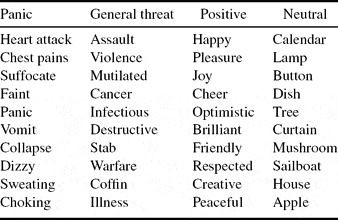
The emotional Stroop Task (ES; Clark et al. Reference Clark, Salkovkis, Gelder, Koehler, Martin, Anastasides, Hand and Wittchen1988; Gotlib and McCann, Reference Gotlib and McCann1984) assesses processing of emotion and attentional bias towards emotion-laden information (Eide, Kemp, Silberstein, Nathan and Stough, Reference Eide, Kemp, Silberstein, Nathan and Stough2002). Several studies have utilized this measure and found that adults with anxiety disorders, including PD, show slower reaction times to threatening words as compared to neutral words (Buckley et al., Reference Buckley, Blanchard and Hickling2002; Lang and Sarmiento, Reference Lang and Sarmiento2004; Maidenberg et al., Reference Maidenberg, Chen, Craske, Bohn and Bystritsky1996). For the purposes of this study, the ES contained four word categories: panic-relevant, neutral, positive, and general-threat words (see Table 1 for word lists). Each category was comprised of 10 words that were either generated specifically for this experiment or drawn from a previously used word list in a similar attentional bias study (Maidenberg et al., Reference Maidenberg, Chen, Craske, Bohn and Bystritsky1996). A list of all potential words was presented to a group of child and adolescent anxiety researchers for suitability and those with 80% agreement among the researchers were included in the final word lists. Research indicates that the retest reliability for reaction times on the ES over a one-week time period is very high (r ≥ .77, p < .01) (Eide et al., Reference Eide, Kemp, Silberstein, Nathan and Stough2002), implying that a significant difference in Stroop effect over the course of the week would reflect a change in attentional bias.
Words presented in the emotional Stroop task

Procedure
Participants completed a computerized version of the ES prior to beginning the intensive treatment and one week later at treatment completion. The experiment was programmed using E-prime software and administered on a Dell laptop. Words were presented four times throughout the experiment, once in each color for a total of 160 trials. Participants were given the instruction to ignore the meaning of the word and to name its color as quickly as possible by pressing the corresponding color-coded button. As soon as the button was pressed, the next word appeared. Words were presented randomly and appeared on the computer screen for a maximum duration of 10,000 ms. The experiment began after a training phase of 20 neutral words.
Results
Data analysis
Data were analyzed using SPSS 15.0 statistical software. Attentional bias was operationalized as slower reaction time to panic-relevant words versus words in the other categories. Paired sample t-tests were performed to detect differences in mean reaction time to panic-relevant versus other word types at pre- and post-treatment. To address the specificity hypothesis, a t-test was also performed to compare mean reaction time to panic-relevant versus general-threat words.
Analysis of clinical status
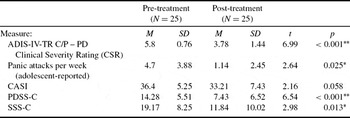
Based on measures of clinical status, participants experienced significant improvement in disorder symptoms, severity, and interference over the course of the intensive treatment (Pincus et al., Reference Pincus, Whitton, Angelosante, Buzzella, Cheron and Weiner2010). Mean scores for pre- and post-treatment self-report measures, clinical severity ratings of PD, and number of panic attacks experienced are presented in Table 2.
Means and standard deviations on measures of clinical status at pre- and post-treatment

Note: ADIS-IV-TR C/P = Anxiety Disorders Interview Schedule, Parent and Child Versions, CASI = Children's Anxiety; Sensitivity Index, PDSS-C = Panic Disorder Severity Scale, Child Version, SSS-C = Symptom Severity Scale, Child Version
* p < .05, ** p < .01
At pre-treatment, the ADIS-IV-C/P was utilized to assess PD symptomology and disorder severity. There was a significant decrease in mean clinical severity rating (CSR) from pre- to post-treatment; t(24) = 6.99, p < .001. At post-treatment, mean CSR rating fell within the clinically insignificant range (i.e. score under 4 on the 0–8 scale). Therefore, the change from pre- to post-treatment was clinically as well as statistically significant. Participants were also asked to report the frequency of panic attacks over the past week at pre- and post-treatment and a significant decrease was found; t(24) = 2.64, p < .05. Mean score on the PDSS significantly decreased from pre- to post-treatment; t(24) = 6.54, p < .001, as did mean score on the SSS; t(24) = 2.98, p < .01. Notably, mean score on the CASI, which is a self-report instrument designed to measure AS, did not decrease significantly from pre- to post-treatment; t(24) = 4.45, p = .058. However, the data trended toward significance and the non-significance of this finding is likely a reflection of the small sample size.
Analysis of attentional bias
The study's first aim was to evaluate whether adolescents with PD exhibit an attentional bias to panic-relevant stimuli, as evidenced by slower reaction time to panic-relevant words compared to other word categories. A t-test was performed to compare mean reaction time to panic-relevant words compared to words in all other categories at pre-treatment. Consistent with study hypotheses, mean reaction time to panic-relevant words (M = 755.32, SD = 117.26) was significantly slower than to other word types (M = 738.78, SD = 108.21), t(24) = 2.89, p < .01 (see Figure 1).
Pre- and post-treatment mean reaction times (ms) on the emotional Stroop task

Given the compelling clinical improvements that occurred over the treatment period, it was hypothesized that attentional bias would decrease significantly from pre- to post-treatment.
Therefore, the second aim of the study was to evaluate whether greater Stroop interference to panic-relevant words was still present after completing an intensive course of CBT. A t-test was performed to compare mean reaction time to panic-relevant words versus words in all other categories at post-treatment. As hypothesized, there was no longer a significant difference in mean reaction time panic-relevant words (M = 741.15, SD = 113.61) versus other word types (M = 728.66, SD = 108.30), t(24) = 1.62, ns (see Figure 1).
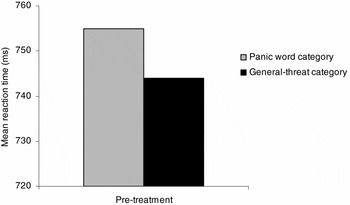
The final aim of the study was to examine whether adolescents with PD demonstrate an attentional bias towards all threatening stimuli or specifically to disorder-relevant stimuli (i.e. words describing physical symptoms that are perceived as threatening). To evaluate the specificity of attentional bias, a t-test was conducted to determine whether PD patients demonstrated a significantly slower mean reaction time to disorder-relevant stimuli compared to general-threat stimuli at pre-treatment. Analyses revealed that mean reaction time to panic-relevant words (M = 755.32, SD = 117.26) was not significantly slower than to general-threat words (M = 744.58, SD = 127.59), t(24) = 1.29, ns (see Figure 2). Therefore, results did not support the specificity hypothesis.
Pre-treatment mean reaction times (ms) to panic-relevant versus general threat words on the emotional Stroop task

Discussion
The present study examined attentional bias in a sample of adolescents with a principal diagnosis of PD. Findings from this study revealed that (1) adolescents with PD exhibited an attentional bias toward panic-relevant words as evidenced by slower color-naming response times, and (2) this difference diminished after an intensive course of CBT. This decrease in attentional bias, coupled with the dramatic clinical improvements in panic symptoms, supports the efficacy of an intensive CBT intervention. While all of the components of this intensive CBT intervention addressed AS to some degree, interoceptive exposure specifically targeted this feature of the disorder. During interoceptive exposure, adolescents were repeatedly exposed to feared bodily sensations, gradually habituating and learning that the sensations were not signs of actual danger. The significant decrease in attentional bias scores from pre- to post-treatment may reflect this decreased AS, as words describing the feared bodily sensations no longer elicited more attention than other stimuli.
The findings from this study do not, however, support a specificity effect for panic-relevant words compared to general-threat words; in this way, the current data diverge from some findings in the adult PD literature. In this study, mean reaction time to panic-relevant words was not significantly slower than that to general-threat words. This could reflect the small sample size, since mean reaction time to panic-relevant words was indeed slower than to general-threat words, but this difference did not reach significance. The lack of specificity may also reflect a true difference in the experience of PD for adolescents. Perhaps when PD first develops there is a more generalized fear response to threatening stimuli that narrows to internal bodily sensations as the disorder progresses. Thus, adolescents may be hypervigilant to a broader range of threat cues, both internal and external.
This study has several limitations that should be addressed. First, the research is limited by its small sample size. Second, all participants were Caucasian and had the time and financial resources to participate in a week-long intensive treatment program. Although the treatment itself was free, many families had to pay for travel and accommodation near the clinic since study recruitment was nationwide. These factors may limit the generalizability of the findings to other adolescents in the community. The present study is also limited in its lack of a control group. Including a control group comprised of either healthy controls or adolescents with other anxiety disorders could have elucidated whether attentional bias to panic-relevant stimuli is specific to adolescents with PD. Future research with more diverse samples, including a control group, is warranted.
Lastly, an ideal design would have been a prospective study, which would have allowed for the assessment of attentional bias before the onset of PD. The design of the present study does not answer the question of whether attentional bias is a risk factor for PD or develops after the onset of the disorder. A prospective study could also include words related to other anxiety disorders (e.g. social phobia) to help clarify the specific effect of panic-threat words.
Conclusions
This study presents evidence of an attentional bias toward panic-relevant stimuli in adolescents with PD that diminishes after completing an intensive course of CBT. Findings indicate a similar pattern of attentional bias in adolescents and adults with PD, thus supporting the use of similar treatment techniques for both age groups. Although the specificity hypothesis has been supported by some research in the adult PD literature, the data from this study do not support a specificity effect for adolescents. This finding may reflect limitations in study design or a true difference in the experience of PD among adolescents.
The findings from this study may also be clinically-relevant to practitioners treating youth with PD. Given the finding that attentional bias to panic-relevant stimuli diminishes with successful treatment, clinicians might include a measure of attentional bias in order to assess treatment response. Since most measures of treatment response rely on self-report, the inclusion of a more objective measure like the ES could be a valuable clinical tool.




Comments
No Comments have been published for this article.