In 1957, the Home Office issued a pamphlet, The Hydrogen Bomb, aimed at informing the public about what to do in the event of a nuclear attack on Britain. The pamphlet offered the following advice about how to deal with one of the key threats of hydrogen weapons, radioactive fallout:
Radioactive dust on the body could be washed off with soap and water, particular attention being given to the nails and hair … If a washing machine were used for clothes, some of the radioactive particles might stay inside the machine. A bucket or tub would be better. If a vacuum cleaner were used, radioactive material would collect in the bag and the whole machine would have to be put where the radiation could do no harm.Footnote 1
Two years earlier, however, a highly secret government report had given policymakers a somewhat different vision of Britain after a nuclear war:
Hydrogen bomb war would be total war in a sense not hitherto conceived. The entire nation would be in the front line … Failure to provide adequate protection against radio-activity from fall-out would be disastrous. To remain in the open during fall-out would be suicidal in an area of 1,000 square miles for each bomb … The public should be thoroughly instructed in peacetime on the effects of hydrogen bombing and on the precautions necessary to minimise casualties.Footnote 2
The apparent gulf between the nuclear devastation envisaged by government planners and the banal advice which they offered to the public during the 1950s and 1960s raises the question of how useful such advice would have been in the event of a nuclear attack, and how honest the government was being with its citizens in these pamphlets. Indeed, such advice has been widely mocked, both by contemporaries and by more recent commentators, for offering what appeared to be quite inadequate advice about nuclear war. For example, after the issue of a 1963 pamphlet, Advising the Householder on Protection against Nuclear Attack, the Daily Mirror commented sarcastically,
The Home Office pamphlet, in a superb and ineffable paragraph, advises the motorist to ‘park off the road if possible; otherwise alongside the kerb’ when a nuclear attack seems imminent. And don't forget to take the milk in, post your football coupons and mow the lawn – if you have time.Footnote 3
Reporting in the same year, the House of Commons Select Committee on Estimates highlighted the same extract from the pamphlet. They recommended that the pamphlet should be withdrawn ‘because it served no useful purpose’, commenting that the advice ‘would not give the average householder the impression that the Government's civil defence measures were of any value whatsoever’.Footnote 4 By 1974, the Guardian reported that the pamphlet was ‘virtually a collector's item’, adding, ‘Thanks to the attention of David Frost and other megaton range satirists, the pamphlet was buried in scorn … Following this public relations disaster, the Government has shown little inclination to upset an electorate which long ago learned to stop worrying and love the bomb.’Footnote 5
More recent commentators have taken a similar line on government civil defence advice. Duncan Campbell, in his classic 1983 critique of British civil defence plans, War Plan UK, mocked the ‘spirit of cheerful lunacy’ of the advice in the 1957 pamphlet quoted above.Footnote 6 He also noted the ‘various inanities and inadequacies’ in Advising the Householder, complaining that it ‘had no advice whatsoever to offer on protection against the blast effects of bombs’, and dismissed its advice on fallout protection as ‘an extremely rough and ready approach … potentially writing off many whose homes would provide insufficient radiation protection’.Footnote 7
Amid this general derision, what has not been recognized is that many months of detailed experiments and trials went into the production of the advice in these pamphlets. This research was carried out largely by the Home Office Scientific Advisers' Branch, the group of expert advisers enlisted by the state to provide the scientific and technical data which was to inform Britain's civil defence plans. Composed largely of career civil servants trained as scientists and engineers, the branch provided advice to policymakers on the scientific aspects of preparing the country to face a nuclear attack, and coordinated the scientific research which was necessary to produce this advice. Its members also used their knowledge to train a nationwide network of almost two thousand specialist civil defence volunteers in the scientific and technical problems of nuclear war.
Yet the Scientific Advisers' Branch remains virtually invisible within studies of British civil defence, which focus largely on high-level policy debates and mention scientific aspects of planning only in passing, if at all.Footnote 8 While expert advisers have featured in some studies of war planning in the United States, no parallel study of nuclear experts has yet emerged for the British case.Footnote 9 Furthermore, from the picture of the post-war British state which appears in most historical accounts, one would barely guess that this body of scientific experts existed, much less that they played an important role in British war planning for more than two decades. As David Edgerton argues convincingly in his book Warfare State, historians of science and of the British state during the twentieth century seem to have systematically overlooked the role of scientists within government, often while condemning policymakers for their underuse of experts.Footnote 10 Yet while Edgerton's work offers a powerful critique of existing histories, his lists of faceless experts give little insight into the world inhabited by government scientists or how their everyday activities helped shape post-war Britain.
In this paper, I take up Edgerton's invitation to put the expert back into the history of the British state by explaining the activities of the Scientific Advisers' Branch. My study will look at two areas of the branch's work. First, I will consider the branch's role as advisers to policymakers. I will examine the methods developed by its members to conceptualize and manage the almost inconceivable problems which Britain would face after a nuclear attack, and consider the often subtle ways in which their advice helped shape policymakers' thinking about civil defence, and therefore decisions about civil defence policy, during a crucial period in the mid-1950s. Second, I will explain the branch's role in formulating and coordinating the research programmes which provided the scientific and technical information about nuclear warfare needed for civil defence planning. In particular, I will consider how its research informed the much-mocked civil defence advice which the government issued to the public. Drawing on recently released archive material, the aim will be to build up a picture of the Scientific Advisers' Branch as a research community and to explain how its behind-the-scenes work informed Britain's war plans. My aim is to demonstrate the important role played by experts in a key aspect of post-war British policy, by showing how the two key aspects of the branch's work – policy advice and research – shaped civil defence policy and planning in the nuclear age.
The Scientific Advisers' Branch and the planning process
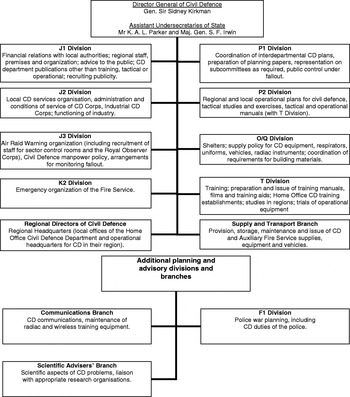
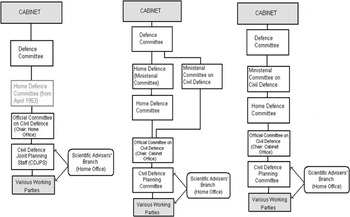
In 1948, against a background of increasing Cold War tensions, the British government passed a new Civil Defence Act and, only three years after standing down the wartime civil defence organization, began to make plans for the next war. The Home Office was the main civil defence planning department: it was given overall responsibility for coordinating civil defence plans, and was also in charge of planning in a range of specific areas, as shown in Figure 1. Other government departments were responsible for making civil defence preparations in areas which fell within their remit: for example, the Ministry of Health made plans for the provision of hospital beds, while the Ministry of Food considered food stockpiling requirements. To coordinate the planning process, an interdepartmental group, the Civil Defence Joint Planning Staff (CDJPS), was set up under the Home Office, and the Scientific Advisers' Branch was established, also under the Home Office, to provide planners with scientific and technical support.Footnote 11Figure 2 shows how the CDJPS (and its successor from September 1955, the Civil Defence Planning Committee or CDPCFootnote 12) and the Scientific Advisers' Branch fitted into the committee structure for civil defence policymaking, while the following list gives the names of some of the key members of the branch, the positions they held within the branch and the dates they held them, their educational background and their previous work.
• Sir Edward ParisFootnote 13 (1889–1985): chief scientific adviser 1948–54. Physics at Imperial College/UCL. First World War: Royal Artillery; scientific civil service.
• Dr Ronald PurcellFootnote 14 (1904–69): chief scientific adviser 1954–62. Physical chemistry at Imperial College and University of Amsterdam. 1920s–30s: lecturer in physical chemistry; 1940s: scientific civil service.
• Dr Henry SargeauntFootnote 15 (1907–97): chief scientific adviser 1962–7. University College Reading and Cambridge. Second World War: Army Operational Research Group (AORG); 1950s: government scientific advisory posts.
• Edward Leader-WilliamsFootnote 16 (1909–74): deputy chief scientific officer (shelter specialist) 1948–65. B.Sc. in Engineering at Bristol University; 1930s: worked under Prof. Sir John Baker (government and private practice); Second World War: R & E dept (Morrison shelter).
• Thomas MartinFootnote 17 (1893–1971): principal scientific officer (‘Civil Defence Ambassador’ to universities) 1951–64. M.Sc. in Engineering, UCL. First World War: Royal Artillery; Second World War: Ministry of Supply; general secretary of Royal Institution (1929–50); BSHS member and author on Faraday.
• Dr J. McAuley:Footnote 18 senior principal scientific officer 1956–73. Chemistry at Glasgow University; D.Sc. (Tech) in Zurich. 1926: DSIR, Patent Office, research chemist at ICI; 1936: scientific civil service.
• George R. StanburyFootnote 19 (d. 1973): senior principal scientific officer 1948–67. Physics at Imperial College. 1920s/1930s: industrial research; Second World War: R & E Dept; post-war: Ministry of Works.
• Frank H. Pavry:Footnote 20 (senior) principal scientific officer 1948–76. B.Sc. in civil engineering at Imperial College; 6 years' industrial work; 1939: R & E Dept; 1944: Air Ministry; 1945: MoW Scientific Advisers' Division.
The top post within the branch was that of chief scientific adviser to the Home Office, who presided over a deputy chief scientific adviser, one or two senior principal scientific officers, and between five and nine principal scientific officers, with the precise numbers at each grade varying over the two decades of their institutional existence according to responsibilities and workload. The higher grades were supported by several lower-grade scientific staff and some clerical staff.
Structure of the Home Office Civil Defence Department. Simplified version of diagram of Home Office Civil Defence Department, October 1959, TNA HO 322/272.

The Scientific Advisers' Branch and civil defence policymaking structures. Matthew Grant's Ph.D. thesis provides an excellent overview of civil defence planning structures during this period. See M. Grant, ‘Civil defence in Cold War Britain, 1945–68’, unpublished Ph.D. thesis, London, 2006.

The members of the branch were science graduates, usually with degrees in chemistry, physics or engineering – typically from universities other than Oxford or Cambridge – who had often done other scientific work for the government before joining the Home Office. Essentially they were civil servants, trained in science, whose various career paths – academic science, private practice or government work – had all led to them working for the branch. Many had had their first experience of government work during the Second World War, and most had some expertise in an area relevant to civil defence work.
To take an example, Edward Leader-Williams, grandson of the better-known Manchester Ship Canal engineer of the same name, had studied engineering at Bristol University. He spent most of the 1930s working under Dr J. F. Baker (later Professor Sir John (Fleetwood) Baker), first at the Department of Scientific and Industrial Research (DSIR) and then in a private practice. He worked during the Second World War at the Research and Experiments Department, in some ways the predecessor department of the Scientific Advisers' Branch, where he was closely involved in the design of the ‘Morrison’ indoor air-raid shelter.Footnote 21 He later advised the Air Ministry on the strategic bombing of enemy countries and worked on civil defence at the Ministry of Works, before joining the branch in 1948. His expertise in shelter design made him a key figure in the branch, and, as an affectionate retirement notice acknowledged in 1965, he was the unofficial ‘right-hand man’ to successive chief scientific advisers.Footnote 22
A relative who knew ‘Cousin Lea’ during the 1930s recalls being told that he was ‘jolly good at air-raid shelters’.Footnote 23 Many other members of the branch had similar experiences in their pre-branch careers: Frank Pavry, for example, had also worked at the Research and Experiments Department during the war and, as part of the British Mission to Japan in 1946, had witnessed the effects of atomic weapons first-hand.Footnote 24 George Stanbury, another long-serving branch member, had conducted research into incendiary bombs, also in the Research and Experiments Department.Footnote 25
There were two main routes by which the advice of the Scientific Advisers' Branch reached planners. Firstly, the branch produced dozens of reports on various aspects of civil defence, on subjects ranging from ‘Assessment of the damage and the number of casualties and homeless likely to result from an attack on Glasgow with an atomic bomb’Footnote 26 to ‘Research on blast effects in tunnels with special reference to use of London tubes as shelter’.Footnote 27 The reports would be circulated and used as a basis for planning at various levels. The main clients for the branch's reports seem to have been the various working parties set up under the CDJPS to consider specific aspects of civil defence, such as the Working Party on Dispersal and Shelter, or the Working Party on Shelter Policy. The advice would then be transmitted up the planning chain via the CDJPS (or CDPC) to the Official Committee on Civil Defence, and then to the higher-level ministerial committees whose task was to decide civil defence policy. There is little evidence that higher-level policymaking bodies received the reports of the branch directly; rather, the key points arising from discussions of its reports, and the conclusions reached by officials on the basis of these reports, were filtered upwards as the planning process progressed.
The second main route by which scientific advice influenced the planning process was through members of the branch attending planning meetings in person, either as permanent members or by specific invitation. For example, Leader-Williams regularly attended meetings of the Working Party on Shelter Policy, thus allowing him to interact directly with the planners.Footnote 28 Furthermore, personal contacts with planners sometimes allowed members of the branch to circumvent the formal planning structure. At a meeting of the branch in April 1954, one of its members, J. W. Martin, noted that branch members were often consulted ‘as individuals’ by civil defence planning branches within the Home Office ‘and sometimes without realising it were having an influence on policy in a wider field’.Footnote 29
Mechanisms were in place, then, for the Scientific Advisers' Branch to have an input into civil defence planning, via both formal and informal routes. Before explaining the important role played by the branch in shaping civil defence plans, I will first give an overview of civil defence policy at this time and explain how planners' views of the purpose of civil defence shifted as planning assumptions changed during the 1950s.
Civil defence policy from Hiroshima to the hydrogen bomb
During the early days of civil defence planning, British planners' conceptions of a future war were very much based on their experiences of the previous one. A 1948 paper outlining the basis for future civil defence planning predicted that ‘our enemy will be in possession of the atom bomb in limited numbers by 1957’, and envisioned a future attack in which atomic weapons would play only a minor role, alongside the high-explosive, incendiary and rocket bombs of the Second World War.Footnote 30 The early work of the branch reflected these assumptions: reports produced in 1948, for example, considered the occupancy of shelters during the V-1 attacks on London, assessed the economic and social impacts of German bombing raids, and imagined an attack on London with nerve gas.Footnote 31
Accordingly, civil defence plans during this period were largely inspired by the measures which had been relatively successful during the Second World War: there would be a voluntary civil defence organization to help with rescue, first aid and firefighting; shelters would be provided for the public; and plans would be made to evacuate people from target areas. Not only the form, but also the purpose of civil defence in the late 1940s and early 1950s was as it had been during the previous war: it was an ‘insurance policy’, designed to mitigate the consequences of an attack on the civilian population and allow Britain to be maintained as a war-fighting base for as long as possible.
In November 1952, however, the United States tested the world's first hydrogen bomb, or H-bomb.Footnote 32 This new type of weapon was not only hundreds of times more powerful than the atomic bomb, but also generated far greater quantities of radioactive dust – fallout – which was produced when an H-bomb was detonated at ground level, and which could spread radiation hundreds of miles from the site of the explosion. This new danger was brought to the attention of both policymakers and the public following the United States' widely publicized Bravo H-bomb test in the Pacific in March 1954, when radioactive fallout was spread across hundreds of square miles and the crew of a Japanese fishing boat, the Lucky Dragon, were struck down with radiation sickness.Footnote 33
In December 1954, the British government – which had secretly decided in July of that year to develop its own hydrogen weaponsFootnote 34 – commissioned a group of civil servants, headed by William Strath, to produce a secret report into the implications of these weapons for the country's defence policy. Imagining an attack on Britain with ten hydrogen bombs, each with a yield of ten megatons – around five hundred times more powerful than the twenty kiloton Nagasaki bomb, and about the same as the United States' first H-bomb test – the committee spent three months outlining in detail the effects of such an attack on Britain and considering the possible measures which could be taken to protect the country.
The Scientific Advisers' Branch had already begun to turn its attention to the hydrogen bomb during 1954, and Strath's committee drew on the work of the branch in preparing their report, including their estimates of casualties caused by an H-bomb attack.Footnote 35 Informal consultation with members of the branch also had an impact on the content of the report: at a meeting in January 1955, for example, it was noted that a member of the Strath committee, the director general of Civil Defence, Sir Sidney Kirkman, had ‘re-written a paper on evacuation following a conversation with Mr. Leader-Williams’.Footnote 36 The need for members of the branch to be frequently consulted on this informal basis seems to have been one of the main reasons for their relocation, in February 1955, from their South Kensington headquarters to the Home Office building at Horseferry House.Footnote 37
The Strath Report was issued to all Cabinet ministers in March 1955. Its detailed assessment of the effects of a thermonuclear attack left little doubt that the consequences of such an attack on Britain would be devastating, predicting twelve million deaths and four million casualties in a single night, with a further thirteen million people, many suffering from radiation sickness, pinned down in their houses by heavy fallout.Footnote 38
The thirty-two-page report also contained a series of detailed recommendations for mitigating these effects, including the advice that shelters against heat and blast should be provided on the outskirts of likely target areas and that fallout shelters should in principle be provided for the whole population.Footnote 39 With the Strath Report complete, a period of discussion and debate began within government over the future of civil defence.
The debate centred around two opposing views of the role of civil defence: civil defence as an ‘insurance policy’ to protect the civilian population in the event of an attack, serving much the same purpose as it had during the Second World War, and civil defence as part of the strategy of deterrence, a strategy upon which Britain had become increasingly reliant since deciding to build its own hydrogen weapons.Footnote 40 In the latter view, civil defence was a way of deterring attack by convincing the enemy that Britain was prepared to fight, and a method of maintaining public support for the deterrent by convincing the British people that nuclear war was survivable. It was this view which became increasingly dominant following the Strath Report, despite the insistence of the Home Office that the government had a duty to protect the civilian population. Because deterrence relied on maintaining confidence rather than on costly life-saving measures such as shelters, it was potentially much cheaper for the government. This was an important selling point for the Ministry of Defence, who feared that expensive ‘insurance’ measures such as public shelters would divert finances from ‘active’ defence measures such as nuclear weapons.Footnote 41 Added opposition to the ‘insurance’ view came from the Treasury, which was responsible for setting the civil defence budget, and which generally sided with the Ministry of Defence against the Home Office in trying to keep civil defence expenditure to a minimum.
Eventually, after months of debate, the deterrence view triumphed over the ‘insurance policy’ view. The civil defence measures recommended by the Strath Report failed to materialize: no public shelters were built, no materials were stockpiled to allow shelters to be built in an emergency, plans to incorporate reinforced basements into new buildings were shelved, and stockpiles of food and supplies remained below recommended minimum levels. Minister of Defence Selwyn Lloyd summed up the new philosophy of civil defence, which was to dominate thinking from the late 1950s onwards, in December 1955: ‘The objective should be to limit the level of expenditure on home defence to the minimum needed to maintain public confidence.’Footnote 42
While the debate within government over civil defence did not simply come to an end after 1955, and opposing views continued to be expressed over the next few years, no serious consideration was ever given to providing fallout shelters after this time.Footnote 43 Planners increasingly shifted their attention away from traditional ideas about civil defence and began to focus on how Britain would be governed after a nuclear war, while spending the minimum required to convince the British people that the government was ‘doing something’ to protect them. Instead of a nationwide shelter programme, as recommended by Strath, the government issued pamphlets giving people advice on how to improvise fallout protection in their own houses, using furniture and household items.
Civil defence policy in Britain can be divided into two main phases, then: the ‘atomic age’, during which civil defence played the more traditional role of reducing civilian casualties, and which lasted roughly until early 1954, when the implications of the H-bomb began to become apparent; and the ‘H-bomb era’, which began once the post-Strath debates had been more or less concluded at the end of 1955, and which focused on maintaining a façade of preparedness at as low a cost as possible. Between these two phases lies a transition period, during which the future of civil defence policy was not yet decided, and it is this period which is key in understanding how the Scientific Advisers' Branch was able to shape the course of the civil defence debate. In the next section I will analyse the role of the branch in shaping thinking about civil defence during this crucial period.
The Scientific Advisers' Branch as policy advisers
I have explained above the various routes by which the advice of the branch was able to reach policymakers. Here I intend to show how this advice helped shape civil defence planning and policy, by examining the concepts developed by the scientists to conceptualize nuclear war as a solvable problem, and considering some of the consequences of this for civil defence planning. I will show that behind the scenes of the high-level policy debates which have dominated historians' thinking about civil defence, the advice of the branch was shaping the political discourses surrounding civil defence in a number of subtle ways.
The official role of the Scientific Advisers' Branch was to provide scientific and technical background to inform civil defence planning, in order that those responsible for deciding on policy would have the necessary information to do so. Its role was not to provide explicit policy advice, and the scientists appear to have taken care to maintain this distinction. Their reports were modelled on scientific papers, usually beginning by setting out the problem to be solved; working through the method, often based on a mathematical approach; then summarizing the results and concluding by explaining the implications of these results for the original problem. Usually, the reports did not explicitly recommend any particular policy, although some did comment on the course of action suggested by the scientific and technical factors covered in the report. The scientists generally viewed the spheres of ‘policy’ and ‘science’ as quite separate – an attitude summed up by the reaction of then chief scientific adviser Dr Purcell in 1957, when he declined an invitation to attend a meeting of an advisory board on guided weapons on the grounds that ‘the problems posed … were mainly policy and not scientific’.Footnote 44
This distinction between ‘scientific advisers’ and ‘policymakers’, while clearly an artificial one, served a useful rhetorical purpose for the Scientific Advisers' Branch. In his analysis of the rhetoric of scientific papers, Alan G. Gross argues that ‘the objectivity of scientific prose is a carefully crafted rhetorical invention’, which acts as a powerful tool of persuasion by appealing to the ‘authority of reason’ while allowing the author to adopt a position of detached impartiality.Footnote 45 Such an appeal to ‘objectivity’ in the reports of the Scientific Advisers' Branch allowed their advice to be influential in ways that would have been much more difficult for overt policy advice. While planners would question explicit policy advice, they rarely questioned the assumptions lurking beneath the scientific and technical advice of these reports, hence allowing such assumptions to be absorbed into the political debate about civil defence. As the policy discussions progressed, the original underlying assumptions gradually became buried, and were unlikely to be revisited or reassessed in light of changes in the political, strategic or scientific situation. But some of these concepts clearly had important implications for the framing of civil defence problems.
One example of this process is provided by a report produced in 1953–4, ‘The safety–cost relationship for certain types of surface and trench shelter’. The report was clear about its purpose: it was intended as ‘a step towards a shelter policy which would enable a maximum of protection to be provided in areas considered liable to atomic attack as quickly as possible and at a minimum cost of labour and materials’.Footnote 46 The report began by defining two new terms: the ‘safety rating’ and the ‘safety–cost rating’ of a shelter. The ‘safety rating’ of a shelter was defined by estimating the percentage of extra lives that would be saved if the population were all in shelters of this safety rating, rather than in houses. If everyone was in a shelter with a safety rating of ninety, for example, this would mean that ninety per cent of those who would otherwise have been killed would be saved. The ‘safety–cost rating’ was simply the safety rating divided by the estimated cost per head of shelter. The adoption of this term – expressing questions of shelter design, lives saved and financial cost as a simple numerical value – was perfectly in keeping with the aims of the report. But the problem is that the safety–cost rating did not stay as a clearly and specifically defined term within the narrow context of this report, but quickly became adopted as a basic term to discuss shelter policy.
Once introduced, the term became standard in later reports. In January 1954, the branch produced a report on ‘The safety–cost relationship of certain basement shelters and a comparison with surface and trench shelters’, which aimed to bring basement shelters in line with the classifications of other types of shelter by assigning them safety–cost ratings.Footnote 47 A paper produced in October 1954 on ‘Shelters in central high risk areas’ also used the concept, explaining that ‘some basis for deciding whether shelters should provide protection at 1, 2 or 3 miles from a hydrogen bomb must clearly be found, and a “safety–cost” approach seems most likely to yield a solution’.Footnote 48
At a meeting later that month, the members of the Working Party on Shelter Policy agreed with that paper's conclusion that ‘deep trenches … were likely to provide the best ad hoc shelter which could be provided at a reasonable cost’, and went on to discuss the practicalities of such a scheme.Footnote 49 There is no evidence that the underlying assumption behind this conclusion – that the usefulness of a given shelter programme should be evaluated in terms of the safety–cost rating – was called into question by this or any other planning body. The safety–cost rating was further entrenched as the standard measure of a shelter's usefulness when it was used to define the ‘optimum’ shelter design:
Since the adoption of the shelter with the highest safety–cost rating yields the best return in terms of cost per life saved, and since there seems to be little prospect, in the time likely to be available for building shelters, of building shelters of a higher standard than this, this standard will be referred to subsequently as the ‘optimum’ standard or design.Footnote 50
Having moved from ‘safety–cost’ rating to defining the ‘optimum’ shelter, the branch immediately began to use this as a basis for policy recommendations, noting, ‘On the assumptions mentioned above, it can never pay to build shelters of less than the optimum strength or thickness.’Footnote 51
Of course, such reasoning by the members of the branch represented a pragmatic response to the economic and political realities of post-war Britain. But the important point for civil defence policy is not that concepts like safety–cost rating were particularly inappropriate ones when introduced, but that such concepts, once introduced into civil defence science, often became black-boxed.Footnote 52 Such terms were used outside the narrow context in which they originated, and the original assumptions which had led to their introduction usually went unquestioned. Similar principles applied to other aspects of the branch's work. Early decisions about how to conceptualize problems, which words to use to describe them, and which methods were developed for solving them, were all built into civil defence planning at an early stage, and, I argue, went on to shape later decisions.
The influence of early concepts and methods on later approaches to problem-solving has been highlighted by Lynn Eden, in her study of nuclear war planners in the US Air Force.Footnote 53 Eden's study seeks to explain why US nuclear planners, when predicting nuclear weapons effects for targeting purposes, failed to take into account fire damage, which, according to Eden and the experts she interviews, is a major and predictable effect of nuclear weapons. She answers this question using the concepts of ‘organizational frames’ and ‘knowledge-laden organizational routines’. Organizational frames are the approaches to problem-solving used in a particular organization (in her study, the US Air Force), including how problems are chosen and defined, how strategies are developed to solve them, and what form the answer can take. Once solutions to these problems are developed, they become established as knowledge-laden routines: mundane operations which an organization routinely applies to solve problems. Such routines, established in response to past problems, can then be applied to future problems, helping to solve these problems but also constraining the solutions.
Eden shows that, early in the Second World War, the US military possessed relatively few incendiary bombs in comparison to high-explosive bombs, and their aerial bombing strategy was initially dominated by the precision bombing of key economic targets, rather than the firebombing of cities which became more common later in the war. Civil engineers were enlisted by the US government to determine the effects of such bombs, and they developed a large amount of knowledge about blast effects, codifying this knowledge into methods for predicting blast damage, while research on fire effects was sidelined. Eden argues that this early exclusion of fire damage predictions also led to fire effects being systematically overlooked in Cold War-era planning, when the strategic situation itself had changed completely. As a result, she argues, the United States consistently overestimated the number of nuclear weapons required to inflict a given level of damage on an enemy.
I suggest that the Scientific Advisers' Branch did something similar: the ‘organizational frames’ developed by the branch during the early years of the Cold War to study civil defence continued to shape approaches to problem-solving even when the problems themselves may have changed. In particular, what changed during the mid-1950s was that the atomic bomb was superseded by the hydrogen bomb as the main concern of civil defence planning. By the time planners had begun to consider the implications of thermonuclear weapons for civil defence, the scientific advisers of the Home Office were just getting into their stride in terms of tackling the problems of civil defence: they had started to develop ways of conceptualizing the problems of the atomic age, introduced new terms to describe these problems, and begun to come up with solutions for some of them. Despite the Strath Report's warning that ‘fall-out, combined with the vast explosive power of the hydrogen bomb, presents problems of a revolutionary character for the defence of this country’,Footnote 54 the members of the branch reached for the old methods and concepts of atomic civil defence in seeking to solve these new problems. I argue that such thinking ultimately contributed to the key shift in civil defence policy which took place after the Strath Report, including planners' rejection of a nationwide shelter programme in favour of issuing advice to householders on improvised fallout protection.
The safety–cost rating is an example of how an organizational frame developed to talk about shelter against the atomic bomb was absorbed into civil defence discourse, and then used as the basis of judgements about shelter policy in the H-bomb era. The consequences of planners' reliance on concepts like the ‘optimum’ shelter began to become apparent as they searched for a shelter policy to counter the threat of hydrogen weapons in the period leading up to and following the Strath Report. Such thinking began to push planners away from the idea of providing shelters in target areas, and they began to think instead in terms of how to provide improvised protection in areas away from the explosion.
For example, following a discussion with Leader-Williams on shelter policy, one Home Office official, L. N. Blake Odgers, wrote a note summing up his understanding of the position regarding shelter policy:
The difficulty of providing shelter will be greatly reduced, if it is provided elsewhere than in the densely populated centres. Much of the shelter there provided would necessarily have been in the form of surface shelter … [and] the ‘optimum’ cost was found to be £15.5 per head … But outside these centres there will be much greater opportunities for digging improvised trenches … and the cost of providing the necessary timbers and corrugated roof sheets would be far below £15 per head.Footnote 55
In other words, based on safety–cost thinking, the idea of providing shelter in target areas was beginning to look increasingly unappealing. This view was reinforced by another argument, again based on the safety–cost rating, deployed by Leader-Williams in a report written in April 1954, which assessed the likely casualties caused by various sizes of bomb, assuming various standards of shelter were in use. After evaluating the different casualty figures, Leader-Williams commented that as
the bomb size increases, so does the proportion of all the shelter provided which is wasted since the occupants are killed whether they are in shelter or not. This raises the question as to whether, against very large bombs, it is worth while providing shelter in the area immediately round the probable aiming point.Footnote 56
Here we see that, even before the Strath Report, safety–cost thinking had begun to lead to the conclusion that the target areas should effectively be written off in the event of a nuclear attack. By the end of 1955, as we have seen, any serious thought of a nationwide shelter programme had been abandoned in favour of improvised protective measures for those away from target areas.
Evidence that this ‘atomic-age’ thinking persisted into the hydrogen bomb era is apparent throughout the reports of the branch. Two key examples are provided by the so-called ‘nominal bomb’, designated ‘N’, which was defined as a twenty-kiloton (or Nagasaki-sized) atomic weapon, and the ‘Grade A’ standard of shelter, defined as a shelter which ‘provides immunity from death … immediately underneath a bomb of the Nagasaki type and height of burst (3/8 mile)’.Footnote 57
Both Grade A and the nominal bomb were defined relative to the strategic situation in 1948, when the maximum threat was thought to be Nagasaki-type atomic weapons. But both quickly became standard terms in civil defence planning, and persisted well into the hydrogen bomb period. A report from 1952, for example, noted that current policy was based around the provision of Grade A shelters in areas where atomic attack was considered likely, and went on to investigate whether protection could be increased by ‘a trivial increase in cost’.Footnote 58 A 1953 report examined in detail the radiation likely to penetrate Grade A shelters and gave casualty estimates.Footnote 59 ‘Grade A’, by the early 1950s, had become a sort of shorthand in discussions of shelter policy: it no longer had to be explained each time it was used, and was used to explain other terms and concepts related to shelter. But although its origins were no longer explicit, this was a term defined in relation to problems of an earlier age, which continued to affect thinking after the strategic basis of planning had changed.
By 1954, when it had become clear that future planning must proceed on the basis of the H-bomb, civil defence control centres, which it had been decided in 1951 would be constructed to Grade A standard, were still under construction. A report in 1954 explained safety ratings for basement shelters by comparing them to shelters of Grade A standard.Footnote 60 Similarly, when planning began for civil defence against the hydrogen bomb around 1954, the ‘nominal bomb’ was simply scaled up, with scientists now talking about the one-hundred- or one-thousand-times nominal bomb (100N, 1,000N and so on). The implication was that the H-bomb was merely a bigger atomic bomb, and that the way to protect against it was to scale up atomic civil defence plans accordingly.
Yet, as the Strath Report emphasized, a war involving H-bombs would not be the same as an atomic war. Like Eden's nuclear experts, whose understandings of the effects of nuclear weapons were shaped by the methods and organizational structures of an earlier age, the branch's response to the H-bomb was constrained by the approaches they had developed in answer to the problems presented by the atomic bomb. The paradoxical result of this was that, in the face of the H-bomb, atomic-age measures such as shelters were dismissed as financially and technically impractical, and in the absence of any new alternatives to fill the gap, such protective measures were ultimately abandoned.
In this section, I have attempted to demonstrate that the Scientific Advisers' Branch played an important role in shaping civil defence policy during this key period in the mid-1950s. Despite adopting a stance of ‘objectivity’ in relation to policy debates, the members of the branch were not merely providers of scientific and technical background to key policy decisions, but were able to shape such decisions by influencing the way the problems of civil defence were understood at a fundamental level. In the next section, I will show that the members of the branch were able to shape another key aspect of civil defence during the 1950s and 1960s: the advice which the Home Office was issuing to the public on civil defence. This advice was largely informed by the experimental research conducted by the branch, which, alongside their role as policy advisers, formed a key part of their everyday activities. It is to this research work, and its central role in informing the much-derided civil defence pamphlets of the period, that I now turn.
The Scientific Advisers' Branch and civil defence research
In the early years of the Cold War, the branch's main priority was to gather as much information as possible about weapons effects in order to establish a basis for more detailed planning. Some of this information was drawn from experiences of conventional bombing during the Second World War, and from what was already known about the effects of atomic weapons from Japan and the Manhattan Project.Footnote 61 Between its members, as I have already mentioned, the branch had considerable experience of Second World War civil defence planning: Leader-Williams, Stanbury and Pavry had all been wartime members of the Research and Experiments Department of the Ministry of Home Security, and Pavry had accompanied the British Mission to Japan in 1946. After 1946, when the United States passed the McMahon Act banning the sharing of atomic information with other countries, British planners found it very difficult to obtain detailed information on weapons effects from the Americans. This difficulty persisted until 1958, when the two countries signed a treaty permitting exchanges of technical information about nuclear weapons.Footnote 62 However, unclassified information was available in a book, The Effects of Atomic Weapons, published in 1950 by the United States Atomic Energy Commission, and this did prove a useful reference manual for the branch.Footnote 63 Even allowing for an element of flattery, there was some truth in Pavry's description of the book, in a letter to the editor some years later, as ‘our Bible’.Footnote 64
To fill gaps in knowledge about weapons effects, and to obtain scientific information on particular problems related to civil defence, the branch also designed its own research programmes, conducting trials mainly at Ministry of Defence facilities around the country. In a note outlining the civil defence work of his branch, its first head, Edward Paris, explained this research role:
It is one of the responsibilities of the Chief Scientific Adviser to see that the researches necessary for the solution of [civil defence] problems are properly formulated and that arrangements are made for them to be put in hand by the Departments or organisations best equipped for dealing with them. The facilities required are usually to be found in one or other of the organisations under the Research Councils or in the research establishments of the Ministry of Supply.Footnote 65
Many of these research programmes were carried out by the Atomic Weapons Research Establishment (AWRE) at Aldermaston. An AWRE report on civil defence research for the years 1952 and 1953, for example, reveals an extensive programme of tests at a Ministry of Defence testing range at Shoeburyness to determine the effects of blast on buildings and other structures. This included subjecting one-eightieth-scale models of various structures to the blast from a conventional explosion, to simulate the effect of a roughly Nagasaki-sized atomic bomb on full-size structures. The AWRE research programme for that year also investigated the effects of shock waves in tunnels, made a mathematical study of the effects of blast on tall chimneys, and calculated the dose of initial gamma radiation likely to be received by someone sheltering in a slit trench.Footnote 66 This cooperation with the AWRE continued after 1954, when the formation of the new UK Atomic Energy Authority took atomic weapons, and hence the AWRE, outside the civil service.Footnote 67
Atomic trials were also an important way for the branch to gain information on the effects of nuclear weapons. From 1950, Paris represented the interests of civil defence research on a subcommittee of the Defence Research Policy Committee (DRPC), the body set up under Henry Tizard in 1947 to direct the post-war research and development effort on defence-related issues.Footnote 68 The subcommittee was mainly concerned with atomic trials, but was unsuccessful in its initial attempts to get facilities for experiments at trials in the United States. However, some civil defence experiments were later included in the British trials, starting in 1952 with Britain's first atomic test, Hurricane. The branch sent a civil defence study team to Australia, led by Stanbury and also including Pavry, to oversee the branch's experiments there, which focused mainly on blast effects.Footnote 69
However, civil defence always remained a low priority relative to the primary aim of weapons development. A 1953 report on the requirements of the Home Office and service departments for facilities at future tests noted that ‘the primary purpose of future trials should be to test and improve the nuclear performance of weapons and that the Service and Civil Departments requirements for information on effects should be of secondary importance’.Footnote 70 Furthermore, the requirements of the Home Office at atomic trials had to be coordinated with the needs of other departments with civil defence responsibilities: requirements drawn up in 1954, for example, show plans by the Ministry of Housing and Local Government to test contamination of local water supplies, a request by the Ministry of Fuel and Power to look at blast effects on oil containers, and proposals from the Ministry of Agriculture and Fisheries and the Ministry of Food to look at radiation effects on vegetation and soil, in addition to plans by the Home Office to test the effects of blast on different types of building and various designs of bomb shelter, and to collaborate with the AWRE to make gamma radiation measurements.Footnote 71 The branch therefore had to plan carefully what information needed to be obtained from the tests, and what could be obtained from research at government experimental facilities.
During this early period, research naturally focused on the effects of the atomic bomb, particularly blast and its effects on structures and the penetration of initial gamma radiation. However, by the late 1950s the new threat of fallout had become a major focus of the branch's research, and experiments on this aspect dominated throughout the late 1950s and the 1960s. To take just one example, in 1959 the branch organized a series of experiments with the Chemical Defence Experimental Establishment at Porton Down to determine whether washing down building roofs with water could reduce the fallout dust which would settle there following an H-bomb explosion.Footnote 72 In 1963, Porton carried out further experiments to determine fallout distribution on roofs in windy conditions, using the fine grit emitted from the chimney of an electricity generating station in Wimbledon to simulate the fallout from a nuclear explosion, and measuring the level of ‘fallout’ which remained on the power station roof compared to a sample in a shallow tray nearby.Footnote 73
It is this post-Strath period which is most important for understanding the origin of government civil defence advice to the public during the 1950s and 1960s. In the absence of any nationwide shelter provision, plans to protect the public during this period were based on the idea of an improvised ‘refuge room’ or ‘fallout room’, a concept which appears to have been recycled from advice issued by the government prior to the Second World War.Footnote 74 Just as the wartime version had instructed householders to prepare a sealed room or basement to protect against the gas attacks which were then expected to be widespread, the new plans to defend against the H-bomb relied on the idea of a ‘refuge room’ (renamed a ‘fallout room’ in the early 1960s) constructed inside the home from sandbags or household equipment, which was intended to provide as much shielding from the gamma radiation of fallout as possible. The 1963 pamphlet Advising the Householder gave basic instructions to the public on how to build a fallout room in a typical house: ‘Put sandbags or earth-filled containers outside the windows. If you cannot do this, block the windows from inside with bookcases, chests of drawers or other large furniture packed tightly with earth, books or other heavy material.’Footnote 75 Despite the mockery which such advice often faced on the grounds of its apparent inadequacy against the destructive force of the hydrogen bomb, in fact years of research lay behind the fallout room advice. In 1955, the branch's shelter specialist Leader-Williams was commissioned to produce a draft booklet explaining how to construct a refuge room in a typical house.Footnote 76 Leader-Williams produced a paper outlining possible designs for refuge rooms in May 1955, and in August the branch tested these designs experimentally at a specially constructed brick bungalow – charmingly named ‘Rose Cottage’ – in the grounds of the Civil Defence School in Falfield, Gloucestershire.
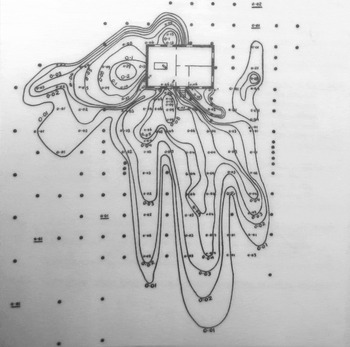
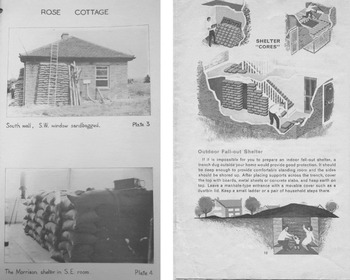
The Rose Cottage experiment used a radioactive point source, moved between different points on a grid pattern around the bungalow, to simulate a uniform radiation field from a layer of radioactive fallout on the ground outside. Measurements of the radiation dose were then taken from different positions inside the house, to simulate the dose from fallout which would be experienced by someone at various locations inside the house. Figure 3 shows a plot of the dose-rate contours obtained using this method, and illustrates the grid pattern used for the radiation source. The experiment tested the relative protection provided by different protective measures, including blocking one of the windows with sandbags and covering a Morrison shelter with a layer of sandbags (both shown in Figure 4, left), blocking one of the outside doors with a brick panel, and building an under-floor trench in one of the rooms. The experiment was qualitative rather than quantitative, and aimed to identify key weak points in the house through which radiation could penetrate, such as doors and windows, and to get more information about the usefulness of the different refuge room designs which the branch were then considering.Footnote 77 As highlighted in the comparison of the Rose Cottage tests and the 1963 pamphlet Advising the Householder, shown in Figure 4, the advice on building a fallout room using household items had its origins in the Rose Cottage experiments carried out by the Home Office scientists eight years earlier.Footnote 78
Radiation patterns at ‘Rose Cottage’, Falfield, 1955.

Experiments at Rose Cottage, 1955 (left), and instructions on building a fallout room in Advising the Householder, 1963 (right).

Particularly notable is the level of detail which went into the trials. When the Rose Cottage experiments identified doors and windows as a key weak point for fallout penetration, the branch initiated a series of investigations into methods of window-blocking. They were concerned not only with the level of fallout protection which could be achieved, but also with devising methods that ‘an ordinary householder could carry out, at short notice, with such material as he may have to hand and with no other assistance than could be provided by members of his household or friends’.Footnote 79 One of the methods proposed was using boxes of soil stabilized with cement to block windows, and to test the feasibility of this method the branch contacted the Falfield Civil Defence School to request some of their staff to carry out the instructions on blocking windows. A letter to the school explained: ‘The idea would be to see if [the staff member] succeeded in stabilising the soil from some simple directions we would give him and whether he could make a successful job of sealing the windows with the blocks.’Footnote 80 The tests satisfied the branch that ‘this method of window-blocking was practicable, and the work could be readily done by an ordinary able-bodied householder of average intelligence provided the instructions which he would need in the form of a pamphlet were carefully observed’.Footnote 81
Because the concept of the fallout room was based on people remaining under cover until radiation levels had dropped far enough for them to move to a safer location, the scientists also took an interest in the psychological aspects of occupying such a refuge for long periods of time. Although none of the scientists within the branch were trained as psychologists, they were extremely interested to learn of experiments which had been carried out to explore behaviour under such conditions. In one experiment in the United States, a family of five had spent two weeks living in a mock ‘fallout shelter’, and the Branch considered running a similar experiment of its own.Footnote 82 The archives also include several reports of British experiments, often run by organizations such as the Civil Defence Corps and the Royal Observer Corps (ROC) on their own initiative, including a test in which three ROC volunteers occupied an underground observation post for forty-eight hours.Footnote 83
Even after Advising the Householder had been published in 1963, the members of the branch continued their research. In 1964, they carried out an experiment to obtain more accurate quantitative data on the increase in fallout protection provided by constructing different designs of ‘core’ shelter, as recommended in the pamphlet. Their report explained,
Although it was self-evident that such cores would give an improvement in radiation protection, no quantitative data were available from which to determine the exact amount. A series of experiments were therefore planned to make direct measurements of the protective factor of a typical British brick house and of various types of core shelter constructed inside it.Footnote 84
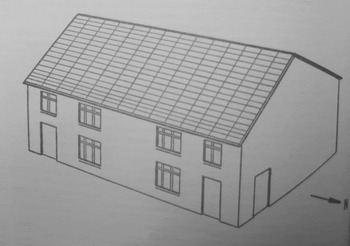
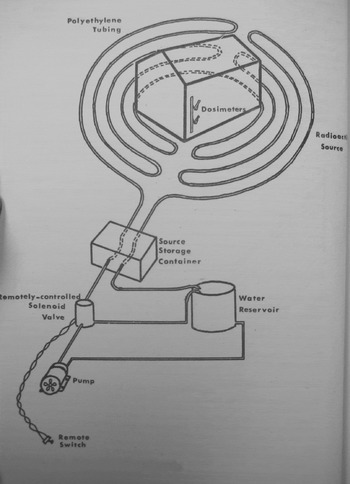
The experiments were again carried out at Falfield, this time in a semi-detached brick house built for civil defence training purposes. A diagram of the test house – which was one of ten semi-detached pairs built on both sides of a street – is shown in Figure 5. The report explained that the experiments would produce more accurate data than the original Rose Cottage trials, largely thanks to a new set of experimental equipment loaned to the branch by the US Office of Civil Defense, which would allow a stronger radiation source to be used without danger to the personnel carrying out the experiments. Rather than moving a point source around a grid, as at Rose Cottage, the tests simulated uniform ground contamination by pumping a sealed cobalt-60 source through a length of polythene tubing, as shown in Figure 6. The branch reported that the experiments confirmed the value of the protective measures recommended in Advising the Householder, concluding that ‘protective factors could be doubled, tripled or quadrupled by installation of a suitable core’.Footnote 85
Semi-detached brick house used in ‘protective factor’ experiments at Falfield, 1964.

Experimental equipment used at ‘protective factor’ experiments, Falfield, 1964.

Of course, the fact that these Home Office pamphlets were based on research does not mean that the many criticisms of government civil defence advice were groundless. Indeed, as we have seen, the government's philosophy of civil defence by the late 1950s was to spend as little as possible while maintaining public confidence. Furthermore, the members of the branch, and the Home Office officials whom they advised, were aware that the measures recommended in the pamphlets were often less than adequate. A 1957 memo summarizing the current situation regarding proposed advice to the public, for example, admitted that improvised methods of blocking windows such as
placing heavy furniture against the window or using books … could be said to be slightly better than nothing but not much better as only a very small minority of householders would have the quantity of books required: 27″ thickness of books is needed to give results equivalent to 9″ brick and this calls for a fair size library.Footnote 86
Such improvised methods for blocking windows were nevertheless recommended in Advising the Householder, without any mention of the rather important detail that most people would be unable to achieve a useful standard of protection in this way. The same memo also highlighted a fairly significant problem with the method of using sandbags to block windows: ‘If this were adopted as the standard method the number of standard sandbags required for the country as a whole would be of the order of at least 2,000 million as compared with our present stocks of about 30 million.’Footnote 87 Again, such practicalities were conveniently ignored in the advice which was eventually issued.
There was a certain tension, then, between the task allotted to the branch – to provide accurate and practical advice to help reduce casualties – and the government's view of civil defence during the late 1950s and the 1960s as mainly a means of maintaining public confidence. Looking at the role of the Scientific Advisers' Branch in compiling this advice shows that there was more to Home Office pamphlets than empty propaganda. But at the same time it demonstrates the role of these experts in helping construct the reassuring official picture of nuclear war which was presented to the public, a picture that, if not completely untrue, was far from completely honest.
Bureaucracy and nuclear war planning
How did the members of the branch reconcile these contradictions in their work? And, indeed, what was it like dealing with the reality of nuclear war, and making decisions which could affect the survival prospects of millions of people, on a daily basis? In the absence of any evidence regarding the personal feelings of the individual scientists, some insight is provided by looking at the scientific and bureaucratic community within which the branch existed, and which it helped to create.
Zygmunt Bauman, in his book Modernity and the Holocaust, considers the role of bureaucracy in the Holocaust, arguing that the Nazis' slaughter of millions of people was not an aberration in an otherwise ‘civilized’ society, but was in fact a product of a modern, scientific and bureaucratic society. He argues that bureaucratic systems allow people to be distanced from the consequences of their actions, both by separating people from the overall end result of a process, and by freeing actions from moral concerns in order that they can be judged on purely ‘rational’ grounds such as cost, efficiency or technical factors.Footnote 88
I suggest that the bureaucratic culture within which the branch worked helped its members to distance themselves from some of the more disturbing aspects of their subject matter. Indeed, one of the striking features of the meetings of the Scientific Advisers' Branch is their sheer mundanity: apart from the subject matter, they could be the meetings of virtually any organization. Discussions of the effects of H-bombs, radiation sickness and blast casualties sat alongside everyday office business. In the minutes of a 1958 meeting, for example, during which the scientists discussed a study on evacuating the heaviest fallout areas, permissible radiation doses and a study of fire effects caused by nuclear attack, the following note seems almost inappropriately ordinary: ‘Christmas Party: Party to take place on Tuesday 23rd at 11.30 a.m. on the same lines as last year.’Footnote 89
Similarly, in the months following the 1954 Bravo test, the pressing task of estimating the casualties caused by a thermonuclear attack on major British cities did not stop the scientists from enjoying departmental social activities as normal: ‘In order that officers may attend the Home Office Sports Day on 24th May the next weekly meeting will be held on 31st May at 4 p.m.’Footnote 90
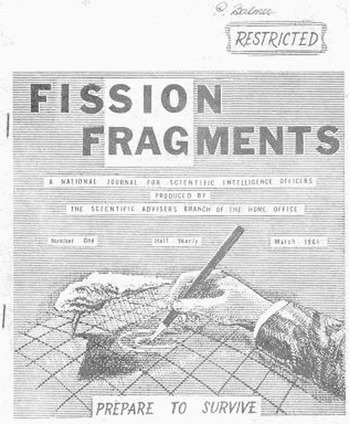
Another fascinating insight into the working culture of the branch, and how it perhaps allowed them to detach themselves from the reality of nuclear war, is provided by a national civil defence bulletin which its members produced from 1961, Fission Fragments. The bulletin, the front cover of which is pictured in Figure 7, was intended as a means of providing information about civil defence science to volunteer scientific specialists, known as scientific intelligence officers (SIOs), who were based in local Civil Defence Corps divisions in regions across the country. The branch initially formed this scientific network, whose numbers peaked at more than 1,600 in the early 1960s, in 1951. Civil Defence Corps volunteers who had some scientific background were trained as technical specialists, initially known as technical reconnaissance officers (TROs) but renamed SIOs in 1957. Their main role in wartime would be to provide local corps divisions with important technical information, such as bomb size and position, and to monitor radiation levels due to fallout.Footnote 91
Cover of Fission Fragments, Issue 1, March 1961.

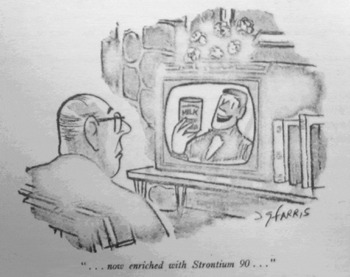
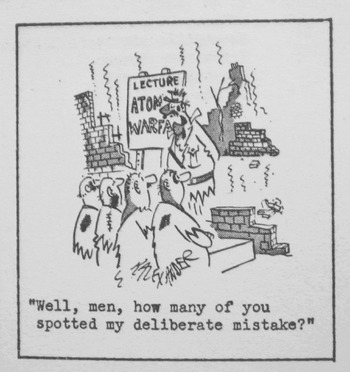
The Scientific Advisers' Branch was responsible for training the SIOs, and its members organized conferences and exercises, decided on training syllabuses and produced training materials. Fission Fragments, edited by members of the branch, was intended as a way of disseminating up-to-date civil defence information, but it was also intended as a way of strengthening the sense of community among SIOs spread across different regions of the country. The bulletin was somewhere between a research publication, a magazine and a newsletter: it included assessments of major exercises and regional civil defence news, as well as fairly technical reports on various aspects of civil defence science and updates on wartime operational procedure for SIOs. Readers were encouraged to contribute articles and use the correspondence pages to air their views or queries. As well as providing information on more technical matters, the bulletin aimed to entertain: cartoons and jokes sat alongside fallout-plotting exercises and details of bomb effects (see Figures 8 and 9), while a civil defence-themed crossword was a long-running feature (see Figure 10).Footnote 92
Cartoon from Fission Fragments, Issue 2, December 1961 (originally appeared in Punch magazine).

Cartoon from Fission Fragments, Issue 7, May 1965 (originally appeared in the Daily Mirror).

SIO crossword in Fission Fragments, Issue 1, March 1961.

Around two thousand copies of Fission Fragments were distributed roughly twice a year, and the journal was not intended for those outside the civil defence community; it was given the lowest security classification of ‘restricted’. Although in practice it would probably not have been difficult for the press or anti-nuclear groups to obtain a copy and publicize its contents, the fact that this apparently did not happen perhaps has something to do with the fairly specialist nature of its subject matter: instructions on plotting fallout patterns and reports of reconnaissance exercises in jeeps were hardly as sensational as the documents unearthed by the ‘Spies for Peace’ in 1963, which revealed previously secret plans for government officials to control the post-attack remains of the country from regional bunkers.Footnote 93 There is also the fact that – civil defence crosswords and poetry aside – there was very little in Fission Fragments which was not already available to the public, for example in Civil Defence Corps training pamphlets.Footnote 94 As Peter Balmer, a former SIO, reflected many years later, ‘I don't think we were told anything that was secret, because … we would leak like sieves probably, so therefore we didn't know to tell anyone.’Footnote 95
Fission Fragments provides something of an insight into the often bizarre world inhabited by civil defence planners, and suggests an answer to the question of how the members of the branch were able to reconcile what they knew about the horrors of nuclear war with the less-than-adequate measures they were advocating for the protection of the public. The bulletin was a way of strengthening the nationwide network of civil defenders and disseminating the branch's scientific methods for dealing with the problems of a nuclear attack, but it was also a way of separating the everyday business of civil defence from the almost unimaginable destruction of a nuclear war. Cartoons and crosswords, like Christmas parties and sports days, made nuclear war seem manageable and routine, allowing the members of the branch to distance themselves from the reality behind the casualty figures and radiation levels which they dealt with on a daily basis. To the members of the branch, civil defence planning was, in the end, a job, and one they tried to do to the best of their abilities given the political, economic and technical limitations of post-war Britain.
Conclusion
The aim of this study has been to put the Home Office Scientific Advisers' Branch into the history of British civil defence. The role of this community of expert advisers in civil defence planning has thus far tended to be overlooked or ignored by those seeking to understand British civil defence, yet including them provides a much more nuanced picture of civil defence planning during the early Cold War. Understanding the impact of scientific advice on civil defence policy helps not only in terms of the specific aim of this paper – that is, a better historical understanding of British civil defence – but also begins to fill in some of the details of the ‘expert state’ for which Edgerton has argued so persuasively. Here I have attempted to put some flesh on the bones of Edgerton's analysis by examining a concrete example of experts in the British state, and demonstrating in more detail their previously hidden role in shaping policy and planning decisions at several levels. In doing so, I hope I have pointed the way for future studies to continue this line of research, with the aim of providing a more complete picture of the role of experts in the British state during the twentieth century.
In the history of civil defence policy in post-war Britain, the influence of experts was felt in two main areas: firstly, in the advice about civil defence which the government offered to the public; and secondly, in policymakers' understandings of, and solutions to, the problems of civil defence during the 1950s. This study has shown that the work of the Home Office scientific advisers directly informed civil defence advice to the public, a finding which sheds new light on the conventional wisdom about the ‘absurdity’ of some of this advice. Yet at the same time, these scientific advisers were helping to construct the ‘official’ version of nuclear war – a version, aimed largely at reassuring the public, which contrasted sharply with the devastating assessments of nuclear war contained in secret government reports. Advice about using books and chests of drawers as protection against the deadly effects of fallout, which provided such an easy target for mockery by contemporaries, was simultaneously a genuine attempt by planners to provide people with what protection they could given very limited resources, and a tool for persuading the public of the usefulness of civil defence, and hence the legitimacy of British nuclear policy. Accounts which seek to understand civil defence as either a panacea for the effects of nuclear war or a cynical propaganda programme designed to dupe a gullible public fail to do justice to the complexities and contradictions which shaped the response of British civil defence planners to the hydrogen bomb.
I have also sought to demonstrate the role of the branch in determining the course of civil defence policy. The implicit assumption by historians that scientific advisers were providing mere technical background to civil defence decisions has led to their important role in civil defence policy being ignored. Yet while ministers and top officials were arguing about the future of civil defence, the scientific advisers were helping define the terms on which nuclear war and civil defence would be understood. Far from being merely a group of boffins, there to be tapped by policymakers for technical data as required, the advisers played an active role in deciding how civil defence would be framed and how its problems would be solved. Policymakers and politicians took the final decisions about civil defence policy, but fundamental decisions taken by the Home Office scientists helped determine their range of options.
Understanding these interactions is crucial in shedding light on the diverse ways in which science has been, and still is, used as a tool to shape policy.