Development and Psychopathology is celebrating 25 years of shaping the field of inquiry in developmental psychopathology, and the scholarship that fills the pages of this unique journal has impacted the field well beyond the borders of the developmental psychopathology vantage point. For example, one might only think of the concept of resilience and how this concept (a legacy of Norman Garmezy; Garmezy, Reference Garmezy, Matthysse, Levy, Kagan and Benes1996), which has been well represented in the pages of Development and Psychopathology, has become nearly universal in our thinking about psychological adjustment in the face of adversity (see Hanson & Gottesman, Reference Hanson and Gottesman2012; Masten, Reference Masten2011); or consider the powerful theoretical constructs of equifinality and multifinality (Cicchetti & Rogosch, Reference Cicchetti and Rogosch1996), which appeared first in these pages and are now adopted widely in any informed consideration of developmental psychopathology. Methodological approaches to data that are essential to unraveling pathways of pathogenesis have been described here in detail and adopted by many. Consider the explication of multilevel modeling by Willett, Singer, and Martin (Reference Willett, Singer and Martin1998) and the wide use this approach now enjoys. In short, this journal has consistently hosted the cutting-edge theoretical and methodological discussions, as well as data-driven empirical studies, in developmental psychopathology for a quarter of a century.
I can still recall looking through the inaugural issue of Development and Psychopathology in the reading room of the Department of Human Development at Cornell University in 1989. As I perused the first issue I remember thinking that this journal would be a unique place where rich discussion would occur on any number of developmental psychopathology topics. I imagined the journal as a forum in which the principles of developmental psychopathology as a vantage point could be imparted, debated, proposed, and refined. I think this potential has been more than realized, and the predictions Dante Cicchetti made in 1989 (Cicchetti, Reference Cicchetti1989) have come to be born out in what continues to be a vigorous scholarly venue. Professor Cicchetti is to be saluted by the community of psychopathology research scholars for his vision and energy in founding and sustaining Development and Psychopathology.
Orienting Remarks
This paper concerns the concepts of endophenotype, intermediate phenotype, and biomarker. Each of these terms is currently in active use in developmental psychopathology. For example, in this journal alone there have been 68 articles that mentioned endophenotype, 51 articles that mentioned biomarker, and 11 articles that mentioned intermediate phenotype. The 2012 Special Issue of this journal that focused entirely on the contributions of the genetic/genomic sciences to developmental psychopathology (Volume 24, Issue 4) contained many papers referring to one of more of these concepts. The papers in this special issue highlighted the centrality of genetic factors acting in concert with epigenetic factors, environmental factors, and other forces in the pathogenesis of psychopathology (Grigorenko & Cicchetti, Reference Grigorenko and Cicchetti2012), an assumption that embraces the concepts of endophenotype, intermediate phenotype, and biomarker. Moreover, Beauchaine, Neuhaus, Brenner, and Gatzke-Kopp (Reference Beauchaine, Neuhaus, Brenner and Gatzke-Kopp2008) outline an approach to research on prevention that incorporates concepts such as endophenotypes and biomarkers.
Over the past 20 years we have seen an increased focus on the process/systems approach to understanding the causes of psychopathology. Kagan (in Schwartz, Snidman, & Kagan, Reference Schwartz, Snidman and Kagan1999) described anxiety psychopathology emanating from deviations in the fear system. Recall that the core assessments of the children in Kagan's landmark studies were done in the laboratory when the children were 4 months old, thus tapping early indicators of behavioral inhibition. Davidson (Reference Davidson1998) described affective disorder, particularly depression, in terms of the approach (positive emotion) and the withdrawal (negative emotion) systems. This work was done largely in the context of psychophysiological assessments. Depue and Lenzenweger (Reference Depue, Lenzenweger, Lenzenweger and Clarkin2005) have proposed a model that describes personality disorders as emergent products of the agentic approach, affiliation, anxiety, fear, and constraint systems. Predictions from this model are currently being tested in the laboratory using both psychological and pharmacological probes. This general line of thinking, where deviations In basic processes are thought to underlie the development of signs and symptoms of psychopathology, has long been a methodological and theoretical mainstay in both experimental and developmental psychopathology. Inspired in part by such work, the National Institute of Mental Health has ventured a proposal that seeks to foster this line of investigation and further advance conceptualization from this perspective. The proposal is known as the Research Domain Criteria (RDoC) initiative, and it was developed to enhance classification through research on such underlying dimensional processes (e.g., negative emotion, positive emotion, social/affiliation, regulatory/control) in psychopathology (Sanislow et al., Reference Sanislow, Pine, Quinn, Kozak, Garvey and Heinssen2010). The RDoC proposal has homed in on particular processes that it targets for even more intense scrutiny in the coming years, with the hope that illuminating these basic processes will further illuminate our understanding of the development of psychopathology. Central to the study of the selected processes in the RDoC approach is the implicit assumption that research efforts will depart from a traditional focus on signs and symptoms of illness. A further implicit assumption is that an energetic, wholesale research effort focused on the processes of greatest interest in the RDoC framework will make ample use of the concepts of endophenotype, intermediate phenotype, and biomarker in the coming years.
The traditions of laboratory research in psychopathology (cf. Maher, Reference Maher1966; Lenzenweger & Hooley, Reference Lenzenweger and Hooley2003), the RDoC initiative, the forthcoming DSM-5, and an ever-changing array of genetic and epigenetic research strategies will all shape future psychopathology discourse. The concepts of endophenotype, intermediate phenotype, and biomarker have all played roles in discussions regarding gene–illness pathway models in contemporary experimental and developmental psychopathology research. The concepts of biomarker, intermediate phenotype, and endophenotype have been used increasingly to frame research questions, particularly those efforts seeking to identify RDoC-defined dimensions and the associated homogenous systems underlying those dimensions, and these concepts will continue to serve such a framing function. However, there are critical issues surrounding the use of these concepts that are largely ignored by those using the concepts without intellectual vigor. Whereas some investigators have used these concepts interchangeably (synonymously), the terms are actually not fungible. An understanding of their individual meanings and implications for psychopathology research is essential (on conceptual clarity, see Meehl, Reference Meehl1977). Although there is a dawning awareness that these concepts are not equivalent (see footnote 1 in Fornito & Bullmore, Reference Fornito and Bullmore2012), there has not been a comparative conceptual analysis of them. Given the prominence of these concepts in current discussions in developmental psychopathology, it seems the time is ripe for a critical examination of these ideas. Such an examination should focus on the points of convergence and divergence in meaning for these three concepts as well as on points of ambiguity and potential confusion. In short, a comparative analysis of these concepts in search of definitional clarity is in order (see also Miller & Rockstroh, in press).
Endophenotype: The Concept, Meanings, and Implications
The modern psychopathology research corpus supports the inference that most forms of mental illness possess an appreciable heritable substrate. This substrate contributes, in interaction with other genetic assets and liabilities as well as environmental and epigenetic inputs, to the overall liability for an illness. The final observable illness phenotype reflects the brain-based developmental unfolding of pathological processes, at times influenced by environmental inputs (e.g., trauma, social/interpersonal milieu). It is highly plausible to assume further that the underlying liability for an illness (or normal deviations in processes contributing to an illness) will manifest itself in some fashion before the emergence of its clinical signs and symptoms. In schizophrenia, taken as an exemple, this means the emergence of detectable pathological processes before the appearance of psychotic symptoms, even before prodromal features. One should be able to detect some internal manifestation of a genetic liability for schizophrenia, for example, within the at-risk person that (a) is not visible to common observation, (b) exists in situ (i.e., within the person), and (c) predates observable signs or symptoms of illness. These fundamental theoretical assumptions are embodied in the endophenotype concept (Gottesman & Gould, Reference Gottesman and Gould2003; Gottesman & Shields, Reference Gottesman and Shields1972; Shields & Gottesman, Reference Shields, Gottesman, Iversen and Rose1973).
The intellectual history undergirding the endophenotype concept
The endophenotype model has long characterized Irving Gottesman's thinking about the genetics of schizophrenia and of psychopathology more broadly. He and James Shields proposed the endophenotype concept in the early 1970s (Gottesman & Shields, Reference Gottesman and Shields1972; Shields & Gottesman, Reference Shields, Gottesman, Iversen and Rose1973, p. 172). The substantive background and meaning of the endophenotype was explicated in Gottesman and Gould (Reference Gottesman and Gould2003).
The endophenotype concept reflects the impact of two major intellectual currents in psychological science and genetics. One current, derived from the insect genetics literature, advocated the term endophenotype to denote a feature internal to an organism and visible upon microscopic examination of chromosomes (i.e., not an obvious, external feature; John & Lewis, Reference John and Lewis1966). The other current, derived from the theoretical and methodological psychological science work on hypothetical constructs, was inspired by the seminal substantive distinction between hypothetical constructs and intervening variables made by MacCorquodale and Meehl (Reference MacCorquodale and Meehl1948; see also Cronbach & Meehl, Reference Cronbach and Meehl1955; Maher & Gottesman, Reference Maher and Gottesman2005; Meehl, Reference Meehl, Gottesman and Shields1972). Well known to psychologists, but not to necessarily others, the hypothetical construct model advanced the core idea that a theoretical concept (e.g., anxiety, depression, pain, love, open-mindedness) could (a) exist at a theoretical level, (b) not be directly observable, but (c) be plausibly related via a nomological network to observable and measureable characteristics (e.g., signs/symptoms, test measurements, interview data). Using the example of schizophrenia, Gottesman and Shields argued that endophenotypes should be considered internal phenotypes that might someday be detectable in families of schizophrenics: “an endophenotype, either biological or behavioral (psychometric pattern), which will not only discriminate schizophrenics from other psychotics, but will also be found in all the identical co-twins of schizophrenics whether concordant or discordant” (Reference Gottesman and Shields1972, p. 336). Thus, by way of interim review, the endophenotype is conceptualized as internal to the individual, meaning existing “within” the person. In addition, the endophenotype represents an unobservable entity (not unlike a hypothetical entity) that cannot be directly observed with the unaided naked eye; rather, an appropriate technology would be needed to “see” the endophenotype. However, the endophenotype is not “hidden,” rather it can now be viewed with the appropriate 21st century tools.
The endophenotype concept in action
The endophenotype concept enjoys a rich intellectual history, and it has been in active use in psychopathology research for some time. For example, experimental and developmental psychopathology studies in schizophrenia research have long employed the endophenotype concept, where an emphasis on detecting disruptions in underlying processes has been a central focus for decades. For psychopathology research, this may reflect a close relationship with the methods of the experimental psychological science laboratory and associated emphases on precision in measurement and controlled conditions (Holzman, Proctor, & Hughes, Reference Holzman, Proctor and Hughes1973; Maher, Reference Maher1966; Shakow, Reference Shakow1977; cf. Lenzenweger & Hooley, Reference Lenzenweger and Hooley2003). Lenzenweger (Reference Lenzenweger1999) specifically argued for the use of endophenotypes to advance laboratory-based schizophrenia research. Developmental psychopathology studies of the origin and pathogenesis of mental illness, continuing with the example of schizophrenia, have long sought to study endophenotypic indicators (conceptualized as “resilience” or “competence” indicators protectively antecedent to clinical illness, e.g., Garmezy, Reference Garmezy, Matthysse, Levy, Kagan and Benes1996). Although articulated in 1972 and 1973, awareness of the endophenotype concept remained limited in the 1970s into the early 1980s. A marked sea change occurred in the mid- to late 1980s, when the endophenotype concept emerged clearly as a substantive methodological formulation, for example, embodied in high-risk research in schizophrenia (Erlenmeyer-Kimling et al., Reference Erlenmeyer-Kimling, Adamo, Rock, Roberts, Bassett and Squires-Wheeler1997) and schizotypy investigations (Lenzenweger & Loranger, Reference Lenzenweger and Loranger1989, p. 902). The theoretical basis and research intentions of the endophenotype concept were most prominently repositioned for psychiatry in Gottesman and Gould's seminal Reference Gottesman and Gould2003 essay.
Defining the endophenotype: A statement of explicit criteria for validity
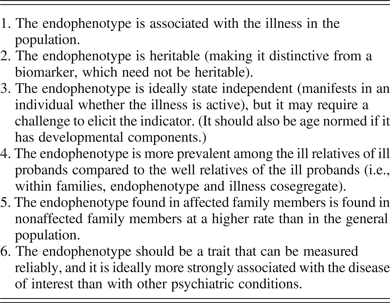
According to Gottesman and Gould (Reference Gottesman and Gould2003; Gould & Gottesman, Reference Gould and Gottesman2006), an endophenotype is a measurable component, unseen by the unaided naked eye, that lies along (i.e., within) the pathway between disease (i.e., observable phenotype) and distal genotype. An endophenotype is not a risk factor; rather, it is a manifestation of the underlying disease liability. Thus, an endophenotype is internal and not easily discerned without some technological assistance with appropriate sensitivity. An endophenotype may be neurophysiological, endocrinological, neuroanatomical, cognitive, or neuropsychological in nature, and it can include configured self-report (e.g., inventory) data. The utility of an endophenotype is that it represents, in principle, a relatively simpler clue to genetic underpinnings than does the disease syndrome (i.e., symptom constellations). Gottesman and colleagues (Chan & Gottesman, Reference Chan and Gottesman2008, p. 964; Gottesman & Gould, Reference Gottesman and Gould2003, p. 639; Gottesman & McGue, in press) proposed six explicit criteria that an endophenotype should meet (see Table 1).
Criteria for an endophenotype

Note: Adapted from Gottesman and Gould (Reference Gottesman and Gould2003, p. 639), Chan and Gottesman (Reference Chan and Gottesman2008, pp. 962–963), and Gottesman and McGue (in press).
One might reasonably ask what benefits accrue from the endophenotype concept and the identification and study of endophenotypes. A summary of what Gottesman and Gould (Reference Gottesman and Gould2003) described as the probable benefits of the endophenotype concept follows:
1. Physiological and more elementary-based endophenotypes may more directly reflect the activities of synaptic and other neuronal mechanisms than does the more complex illness itself, and therefore they are more likely to reflect genes with larger effect sizes.
2. Both the patients and their unaffected relatives may show a fairly extensive range of scores on the endophenotypes, making such measures ideal for quantitative trait linkage analysis. (The analysis of quantitative measurements related to the clinical phenotype will provide more statistical power to detect linkage compared with the smaller number of clinically defined [i.e., qualitative] psychiatric relatives/patients.)
3. To the extent that the biology of the endophenotype is understood or can be investigated via brain-imaging studies and infrahuman animal model research, candidate genes can be identified more systematically in the areas of linkage.
4. Endophenotypes (may) lend themselves directly to the use of animal models.
Biomarker: Definition and Usage
In biomedical research, a biomarker (occasionally termed bioindicator; Ritsner, Reference Ritsner2009) could be any measureable indicator of a disease. An elevated blood concentration of one or another substance in the blood that would be taken as indicative of the presence of illness is a biomarker. For example, high cholesterol is a biomarker of cardiovascular ill health. What Gershon and Goldin (Reference Gershon and Goldin1986) termed genetic vulnerability markers can be biomarkers in some cases. (In other cases, they are more like endophenotypes.) Gershon and Goldin (Reference Gershon and Goldin1986) define such markers as “a heritable trait, associated [italics added] with a pathophysiologic factor in an inherited disease” (p. 113). In this context, it is important to consider the word associated in this definition. As noted, Gershon and Goldin defined the genetic vulnerability markers as associated with a pathophysiologic factor. They did not specify that a putative vulnerability marker was necessarily in the causal pathway from gene to behavior. One could easily imagine a marker associated with a process or factor and this marker thus merely correlated with the presence of the pathophysiologic factor or process. Such a vulnerability marker may help one to find the pathophysiologic process, but the marker is not part and parcel of the process or factor. In other words, such a biomarker could be correlated with an aspect of the disease process but not necessarily fall within the genotype–phenotype pathway and therefore may not be specifically embedded in the causal chain for the disease. However, if a Gershon and Goldin genetic vulnerability marker lies within the gene to behavior pathway, then it could be designated an endophenotype (a term they did not use).
A biomarker could also reflect the impact of an outside agent upon the organism. From the standpoint of environmental inputs, the National Institute of Environmental Health Sciences defines biomarkers as “key molecular or cellular events that link a specific environmental exposure to a health outcome” (National Institute of Environmental Health Sciences, 2011). Blood or urine lead levels are examples of biomarkers of environmental lead exposure. Perhaps casting the broadest net in the biomarker dialogue, the Biomarkers Definitions Working Group (2001) defines biomarker as “a characteristic that is objectively measured and evaluated as an indicator of normal biological processes, pathogenic processes, or pharmacologic responses to a therapeutic intervention” (p. 91). In all of these descriptions, it is evident that a genetic basis for the biomarker is not a necessary criterion. In short, a biomarker may or may not be subject to genetic influences.
How does the biomarker definition compare with that of the endophenotype? An essential component of the endophenotye concept is that it is heritable, whereas biomarkers need not be heritable. The easiest way to remember the distinction between these terms (inspired by Irving Gottesman) is that all endophenotypes are biomarkers, but not all biomarkers are endophenotypes. (This is illustrated clearly in Figure 1, where endophenotypes represent a subset contained within the larger set defined by the term biomarker.) An endophenotype must meet the criteria presented in Table 1, whereas a biomarker need only reflect some measureable deviation in the organism that is reflective of either internal factors operating in health/illness or the impact of an external agent. A biomarker that is reflective of an environmental exposure will necessarily fail to satisfy those criteria of validity for an endophenotype that concern patterns of familial aggregation (e.g., elevated ammonia levels due to some forms of drug abuse). The single most important difference between the biomarker and the endophenotype is that a biomarker need not meet the heritability requirement of an endophenotype (see Figure 1). Thus, the term biomarker is not fungible with (or equivalent to) endophenotype.
(Color online) The hypothetical relations among biomarker, intermediate phenotype, and endophenotype concepts. This diagram reveals that all endophenotypes and intermediate phenotypes are subsets within a greater domain of biomarkers. However, not all biomarkers are necessarily either intermediate phenotypes or endophenotypes. Only a subset of intermediate phenotypes can be regarded as endophenotypes. Reprinted from Schizotypy and Schizophrenia: The View From Experimental Psychopathology, by M. F. Lenzenweger, Reference Lenzenweger2010. New York: Guilford Press. Copyright Reference Lenzenweger2010 by Mark F. Lenzenweger. Reprinted with permission of the author.
Intermediate Phenotype: History, Prior Usage in Genetics, and Intended Usage in Psychopathology
The term intermediate phenotype has been used in some discussions related to psychopathology liability, biomarkers, and endophenotypes in psychopathology research. However, like the term biomarker, the intermediate phenotype concept is not fungible with endophenotype (Figure 1). The principal shortcomings of the intermediate phenotype center around the ambiguity that attends the meaning of intermediate in relation to phenotype, as well as a conflict with an established, prior technical definition in genetics.
The term intermediate phenotype is preferred by Weinberger and colleagues (Meyer-Lindenberg & Weinberger, Reference Meyer-Lindenberg and Weinberger2006; Rasetti & Weinberger, Reference Rasetti and Weinberger2011) because they argue it “implies a biological trait that is in a predictable path from gene to behaviour and because the phenotypes are not secondary, but probably primary” (Meyer-Lindenberg & Weinberger, Reference Meyer-Lindenberg and Weinberger2006, p. 820). This definition suggests that the biological trait in question could be essentially a biomarker, as it leaves unclear the extent to which the intermediate phenotype concept requires heritability as a definitional criterion. However, Rasetti and Weinberger (Reference Rasetti and Weinberger2011) recently stated, “An intermediate phenotype related to mental illness is a heritable trait that is located in the path of pathogenesis from genetic predisposition to psychopathology” (p. 340), and in defining the intermediate phenotype they explicitly reference Gottesman and Gould's endophenotype (Reference Gottesman and Gould2003).
Meyer-Lindenberg and Weinberger prefer the term intermediate phenotype to endophenotype because they (a) see the term endophenotype as suggesting “hidden” phenomena (Meyer-Lindenberg & Weinberger, Reference Meyer-Lindenberg and Weinberger2006, p. 820) and (b) assert the use of intermediate phenotype is “analogous to its usage in other areas of complex medical genetics” (Meyer-Lindenberg & Weinberger, Reference Meyer-Lindenberg and Weinberger2006, p. 820). In what follows, the concept of intermediate phenotype is dissected and compared with the term endophenotype. It is argued that (a) as with biomarker, the term intermediate phenotype is not fungible with endophenotype and (b) usage of the term intermediate phenotype introduces a degree of imprecision into the ongoing discussion in psychopathology research and psychiatric genetics.
Preference for the term intermediate phenotype, based on the assertion that the term endophenotype refers to “hidden” phenomena (Meyer-Lindenberg & Weinberger, Reference Meyer-Lindenberg and Weinberger2006, p. 820), suggests an incorrect interpretation of endo. Endo is a Greek element used as a prefix to mean inside or within. The prefix does not imply hidden. Were one to speak of hidden phenotypes, one would need to make use of the Greek element crypto and speak of “cryptophenotypes.”
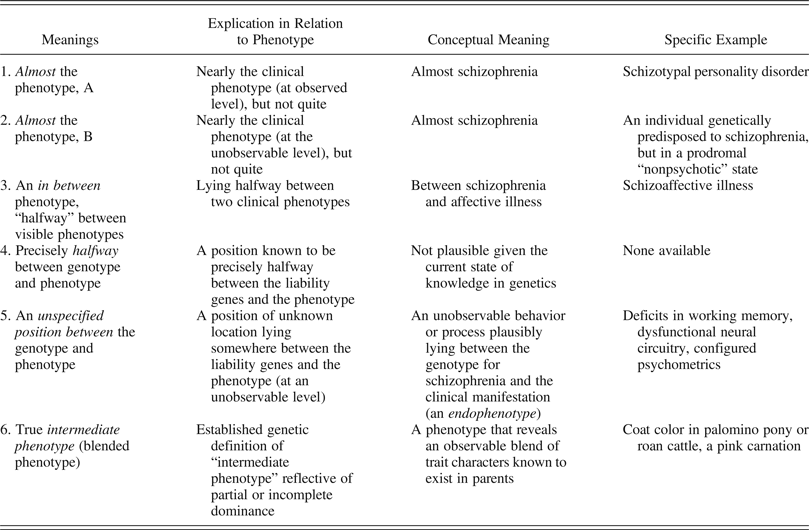
A critical analysis of the intermediate phenotype concept calls for careful understanding of the meanings of the word intermediate. The word intermediate can connote “in between.” However, one could just as plausibly understand the meaning of the word as typically used: “almost” or “not quite,” as well as the important “halfway.” Intermediate phenotype could plausibly refer to “almost a phenotype,” “halfway to a phenotype,” or “not quite a phenotype.” Since Johannsen (Reference Johannsen1909), a phenotype in genetic terminology refers to an established, visible manifestation of a genotype. Thus, it is unclear what a not quite or almost phenotype would look like. This concern is not trivial, as it cuts to the heart of the level of analysis implied in the term intermediate phenotype. The ambiguity that accompanies the meaning of intermediate easily translates to different substantive positions, which in turn define the differing methodological levels of analysis. The intention of the concept of intermediate phenotype hinges critically on the meaning chosen for intermediate as a modifier. This is not merely semantics or a philosophical exercise; rather, it determines the scientific level and unit of analysis. For example, does it imply analysis at the level of the person (e.g., individual differences/symptom constellations) or within the person (e.g., neural circuits/brain structure; see Kosslyn & Rosenberg, Reference Kosslyn, Rosenberg, Perlman, McCann and Buskist2005)? If intermediate means not quite or almost, then intermediate phenotype could plausibly mean an observable phenotype that falls short of the typically visibly discernible phenotype (e.g., subsyndromal symptom patterns). For example, consider schizotypal personality disorder, or prodromal schizophrenia, as opposed to clinical schizophrenia (see Table 2, entries 1 and 2).
Plausible meanings of “intermediate phenotype” with explication and examples
Another plausible meaning of the term intermediate raises other problems. The word intermediate derives from inter (between) and medius (in the middle) and is typically defined as “being or occurring at the middle place, stage, or degree” (Webster), “lying or occurring in a middle position or state” (Stedman's Medical Dictionary), or “holding the middle place or degree between two extremes” (Oxford English Dictionary). If the word intermediate is used to mean midway, middle, or halfway, then a certain level of precision is suggested in locating a concept in some sort of semantic or conceptual hyperspace, what Meehl termed the nomological network (Cronbach & Meehl, Reference Cronbach and Meehl1955; Meehl, Reference Meehl, Gottesman and Shields1972). Adoption of this meaning of the word intermediate suggests that an intermediate phenotype demarcates a location precisely halfway between X and Y, or in this instance, halfway between the genotype (X) and phenotype (Y). This degree of precision in specifying the underlying topography spanning the distance from genotype to phenotype is simply not possible and cannot be assumed (Table 2, entry 4). Remaining simply at the level of observable phenotypes, one might consider the condition “schizoaffective illness” as halfway between schizophrenia and affective illness, which is not likely (Table 2, entry 3).
Alternatively, the term intermediate phenotype could plausibly mean a measureable phenomenon of some sort within the person that characterizes the observable phenotype in some manner. Thus, a phenomenon that falls somewhere between the unobservable genotype and the observable phenotype and affects the final phenotype (Table 2, entry 5). This meaning seems to be a bit closer to that implied by Weinberger and colleagues. However, this usage remains problematic as well, because such a measureable phenomenon (e.g., working memory deficits) may bear no resemblance to the phenotype in question (i.e., schizophrenia). This particular interpretation of intermediate phenotype causes problems because the term phenotype becomes muddied, and one can easily argue that phenotype must retain its established meaning in genetics, namely, a visible manifestation of the genotype. If we consider working memory deficits, reward circuitry abnormalities, and emotion regulation deficits (that are assessed “within the person”) as intermediate phenotypes of schizophrenia, then these phenomena should bear some resemblance to the phenotype they are putatively targeting (e.g., schizophrenia). However, we know, for example, working memory deficits do not manifest themselves visibly nor do they resemble the signs or symptoms of schizophrenia. It is interesting that whereas this particular usage of the term intermediate phenotype poses conceptual problems, the term endophenotype as applied in this example actually does not. The endophenotype is internal by definition, and its characteristics are not required to “look like” the observable phenotype under consideration. Thus, one can speak of working memory deficit as an endophenotype for schizophrenia, and such deficits do not need to appear visibly similar to schizophrenia signs/symptoms.
Finally, Weinberger and colleagues note their preference for the term intermediate phenotype is because the term is used elsewhere in medical genetics, outside of psychiatry. However, their intended meaning of the term intermediate phenotype conflicts with the formal definition of intermediate phenotype used in the general field of genetics (King, Mulligan, & Stansfield, Reference King, Mulligan and Stansfield2012; Stern, Reference Stern1973). The term intermediate phenotype is related to the technical concept of “incomplete dominance” (also known as “partial dominance,” when known a priori that a true autosomal dominant gene is causal) or a form of intermediate genetic inheritance in which heterozygous alleles are both expressed to varying degrees, resulting in an intermediate phenotype that represents a combination of the parent phenotypes (Table 2, entry 6; see Stern, Reference Stern1973). The observable intermediate phenotype is a phenotype of an offspring expressing a mixture of the phenotypes of the parents. In this sense, the intermediate phenotype is a phenotype somewhere (but not exactly halfway) intermediate between the corresponding homozygote phenotypes. For example, in cross-pollination research, one could see a mating between a white flower and a red flower give rise to a pink flower. The palomino phenotype in horses (due to the incomplete dominance of a cream color gene for coat color) is an intermediate phenotype (with possible epigenetic inputs as well). In shorthorn cattle, coat color may be red, white, or roan (roan is an intermediate phenotype expressed as a mixture of red and white hairs). One form of familial hypercholesterolemia in humans represents an intermediate phenotype reflective of incomplete dominance. The low density lipoprotein receptor gene for hypercholesterolemia follows a pattern of autosomal dominance, such that heterozygous carriers express a certain degree of elevated cholesterol that is strangely predictive of early heart disease in later adulthood (in the early 40s and 50s). In contrast, carriers homozygous for the low density lipoprotein receptor gene mutation express severe hypercholesterolemia, typically emerging in childhood. Numerous examples of intermediate phenotypes in humans, using this technical definition of the term, can be found readily on the Online Mendelian Inheritance in Man website (http://www.ncbi.nlm.nih.gov/omim). Although this technical definition of intermediate phenotype appears not to be what is intended by those using the term in psychopathology genetics, this meaning of the term (i.e., intermediate phenotype) is established in genetics, predating the proposed use in psychopathology.
In sum, the meaning of the word intermediate (as a modifier of phenotype) serves to reduce the clarity of the concept intended in intermediate phenotype, both as proposed and likely used. Of all the foregoing interpretations (see Table 2) of the term intermediate phenotype, all of which are entirely plausible, only the fifth interpretation in Table 2 is what Weinberger and colleagues seem to advocate as their intended meaning for the term intermediate phenotype. They provide evidence of a dysfunctional neural circuitry of putative relevance to schizophrenia and use it as an illustrative intermediate phenotype. That such dysfunctional neurocircuitry may be taken as an expression of schizophrenia liability and that dysfunction emerges somewhere between the genotype for schizophrenia and the clinical phenotype is plausible. Ironically, the intended meaning of intermediate phenotype in relation to the dysfunctional neural circuit example (Table 2, entry 5) is the precise definition of an endophenotype. Finally, although Weinberger and colleagues appear to advocate the use of the term intermediate phenotype as essentially synonymous with endophenotype, one is beginning to see others in the field using the term intermediate phenotype differently. For example, Insel and Cuthbert (Reference Insel and Cuthbert2009) suggest that endophenotype is appropriate to situations where a specific process is studied (e.g., prepulse inhibition; Table 2, entry 5), whereas intermediate phenotype should be used for constructs such as “personality or clinical constellations” (Insel & Cuthbert, Reference Insel and Cuthbert2009, p. 988; Table 2, entries 1, 2, or 3). In this instance, Insel and Cuthbert recommended usage of intermediate phenotype is wholly different from that advocated by Weinberger and others, as well as different from the technical definition of the term in genetics. In short, this alternate interpretation of intermediate phenotype offered by Insel and Cuthbert (Reference Insel and Cuthbert2009) provides evidence of the kind of confusion that attends the term.
Matters of Cause, Matters of Effect, Matters of Development, and Matters of Risk
There are additional concerns that should be brought to bear upon the distinctions among biomarker, intermediate phenotype, and endophenotype as concepts. These concerns are best framed as questions. If we assume a candidate measurement or putative disease process is reflective of a biomarker, intermediate phenotype, or endophenotype, we must ask ourselves the following: is this candidate measurement/process likely to be in the causal chain from genotype to phenotype? Is this candidate measurement/process reflective of the origin of the illness or the effect of the illness (in other words might it be an artifact of the illness)? Does a deviation on the candidate measurement/process predate the onset of the illness, and can it be detected earlier in development, even in the fetus, well before the onset of clinical symptomatology and signs of illness (even subtle symptoms or signs, such as those found in prodromal schizophrenia states)? Is the candidate measurement/disease process merely a variable that speaks to elevated risk for a disorder but, as a process, lies outside of the core pathological process(es) in the disorder/condition? (In many ways, these questions alert one to the correlation vs. causation distinction.) The endophenotype concept makes clear assumptions regarding its nature in the causal sequence involved in the pathogenesis of a given disorder. The definition of the endophenotype offered by Gottesman and Gould (Reference Gottesman and Gould2003) clearly places the construct within the gene–behavior pathway. The endophenotype that is measured is therefore reflective of a developmental process that predates the onset of the disorder and is implicated in the cause of the condition or disorder. The endophenotype is not merely a risk indicator or suggestive of a gene that increases risk for an illness. It is not thought to be an indicator that is simply associated with an elevated risk for the presence of a disorder while being agnostic in cause, effect, and developmental status.
The situation for the intermediate phenotype concept is less clear with regard to these questions. Rasetti and Weinberger (Reference Rasetti and Weinberger2011) state, “To link a gene effect in brain [sic] to the gene effect on risk for the syndromal diagnosis, it is necessary to show that the brain effect is a biological substrate also linked to risk, a so-called intermediate phenotype” (p. 340). This formulation would be consistent with a biomarker, perhaps a heritable biomarker, that is associated with an increased likelihood (i.e., risk) for a disorder. However, a feature that can be measured and is associated with an increased likelihood for a disorder does not necessarily place the feature in the gene–behavior pathway for the disorder. Rasetti and Weinberger (2010) continue, “An intermediate phenotype related to mental illness is a heritable trait that is located in the path of pathogenesis from genetic predisposition to psychopathology” (p. 340; with citation to Gottesman & Gould, Reference Gottesman and Gould2003). Here it appears the definition of intermediate phenotype suggests that it is not so much a risk factor but, rather, the intermediate phenotype is defined as an endophenotype. The precise assumptions made in defining an intermediate phenotype in terms of the following remain to be articulated clearly: (a) placement in the causal chain from gene to behavior, (b) whether an intermediate phenotype might actually be an effect or artifact of clinical illness, and (c) whether an intermediate phenotype is simply best thought of as a feature that is associated with enhanced risk for an illness with no causal force. Finally, in this context it should be noted that it is possible that multiple genotype–phenotype pathways could be active in the determination of some forms of psychopathology, each of these pathways potentially harboring (or not harboring) separate endophenotypes (Kendler & Neale, Reference Kendler and Neale2010).
Excursus on Clarity, Precision in Language, and the Peril of Confusion
Is the focus on clarity and precision in language in this essay just an academic, intellectual exercise? A naive view of the issues here might view this as merely a textual analysis. Furthermore, this author has heard it said that the field of psychopathology research has matured to the point that an attempt to caution the field at imprecision in terminology is a didactic exercise (presumably read “unnecessary”). This strikes me as an overly optimistic reading of the level of discourse in modern psychiatry, clinical psychology, and allied mental health research disciplines. The slow progress of soft psychology and psychiatry remains unambiguous to this day (see Meehl, Reference Meehl1978). The value of clear thinking in psychopathology cannot be overstated, and the existence of clear thinking, as well as common sense, in all discussions cannot be assumed (see Waller, Yonce, Grove, Faust, & Lenzenweger, Reference Waller, Yonce, Grove, Faust and Lenzenweger2006). One might ask, is there any intellectual cost or peril if the language defining a scientific concept lacks precision or affords fuzzy multiple meanings? The answer to this question is axiomatic: yes. There is obvious peril in imprecision in language in science. Why not allow two or more somewhat similar concepts to coexist in the scientific forum? For example, can we simply not rely on the embedding text to help us figure out the meaning of a term such as intermediate phenotype? The answers to these questions are simple. Ambiguity interferes with communication and can muddy a unit of measurement. Greater precision in language confers greater precision in research formulation, increased clarity in common discourse, and enhanced shared understanding of research results.
One might counter this concern about clarity and precision by claiming that a word is defined by its use. One might even offer Wittgenstein's Reference Wittgenstein and Anscombe1953 position in support “for a large class of cases—though not for all—in which we employ the word meaning it can be defined thus: the meaning of a word is its use in the language.” However, Wittgenstein also noted, “Everything that can be thought at all can be thought clearly. Everything that can be put into words can be put clearly.” More than 2,000 years earlier Aristotle, in his Nicomachean Ethics (trans. Reference Ostwald1962), notes that it is the “mark of an educated man to seek precision in that class of things insofar as the class permits.” In science, we have an instance where we should insist on clarity in language and the meaning of words must be agreed upon; it is not a free for all. The challenge posed by a concept such as “intermediate phenotype” is that is it has been used in at least two different ways in scientific language: (a) as defined in the technical genetics literature (e.g., partial dominance) and (b) as implied by Weinberger and colleagues (i.e., as synonymous with endophenotype). Moreover, there are other plausible meanings for the term as well (see Table 2), and these plausible meanings are potentially contributing to confusion. This was illustrated by noting Insel and Cuthbert's recommendation that intermediate phenotype should refer to personality and symptom constellations. The Insel and Cuthbert (Reference Insel and Cuthbert2009) interpretation of intermediate phenotype would be consistent with meanings 1, 2, and/or 3 in Table 2, which could contribute to conceptual ambiguity for the term beyond (a) Weinberger's intended usage (entry 5 in Table 2) and (b) the technical usage in genetics (entry 6 in Table 2). As a concept, endophenotype does not have such definitional problems.
In short, communication, research strategies, and the scientific unit of analysis all hinge on the meaning attached to our research concepts. In science we must seek clarity and precision in language that defines our concepts and articulates the meaning space they are intended to occupy. Psychopathology as a science is no exception. Psychopathology research discourse continues to evolve in clarity and precision and the field continues to pull itself up by its bootstraps to achieve the precision one finds in the more mature sciences, such as chemistry or physics (see Meehl, Reference Meehl1978).
The occasional need for specialized terminology in science
Related to the issue of clarity in language are concerns about creative use of language and in some instances the need to develop new concepts to capture the essence of a particular scientific concept. The latter is not unusual in science. This is an issue in the current context, because some may think that endophenotype is an unusual term that is crafted for a special purpose. That impression would be broadly correct because such a term was needed 40 years ago. There are instances in science when concepts are defined by a unique moniker, and this is done to convey a particular meaning that will be perceived immediately. In physics, special terminology emerged when needed: consider the neutrino (“small neutral one”) or the hadron. In psychoanalysis, Kohut (1984) introduced the term selfobject (note no hyphen) to describe a unique psychological dimension of experience between a person and some external object. These terms were introduced to ensure clarity by demarcating the intended concept from previously defined concepts in these disciplines. Thus it was (is) with endophenotype; as a noun it captures the essence of a uniquely defined concept, and it does not run afoul of other, previously defined concepts in genetics.
Conclusion
The biomarker and intermediate phenotype concepts are not fungible with the endophenotype concept and should not be confused with the latter. In contrast, the concept/term endophenotype enjoys freedom from the terminological ambiguity necessarily associated with the term intermediate phenotype. The semantic and substantive considerations reviewed here favor endophenotype as a concept for psychiatric genetics and developmental psychopathology research (including RDoC efforts). However, the biomarker and intermediate phenotype concepts do have utility. The biomarker term captures the domain of any biologically influenced factor or deviation in relation to developmental psychopathology (including endophenotypes). It may be useful in distinguishing between biological factors that occur secondary to an illness but fall outside the realm of endophenotypes (e.g., state markers). Biomarker may have utility when discussing the biological impact of environmental or exogenous factors on the emergence of psychopathology. Intermediate phenotype may be best used to describe a subclinical variant of a form of major psychopathology, such as schizotypic psychopathology compared to schizophrenia; the phenotype is visible to the unaided (but informed) eye, and it bears some resemblance to the classic phenotype of interest. Intermediate phenotype, in this usage, describes a dilute form of an established phenotype (or unit of analysis). In more conservative terms, the intermediate phenotype might be best reserved for describing incomplete or partial dominance, as it has been used in Mendelian genetics for decades.
These observations have been offered to advance clarifying discourse in developmental psychopathology. Additional work could be done to further advance this dialogue. First, heritability studies of candidate indexes and/or processes should be either summarized or conducted to separate candidate (nonheritable) biomarkers from (heritable) endophenotypes. Second, studies demonstrating that putative endophenotypes do actually lie within the gene–behavior pathway in the causation of psychopathology are welcome. Such research would help to separate genuine endophenotypes from those indexes or processes that are merely statistically associated with illness occurrence (i.e., they are associated with elevated risk) but are not genuinely in the causal pathway (i.e., simple correlates, such as social class level). Endophenotypes for the main processes under consideration in the RDoCs seems like a good place to start. Third, in my view heterogeneity represents the Achilles' heel of all (experimental and developmental) psychopathology research. Going forward, endophenotypes (when carefully chosen and ranked; Glahn et al., Reference Glahn, Curran, Winkler, Carless, Kent and Charlesworth2012) can be put to use maximally in efforts to reduce heterogeneity (e.g., Lenzenweger, McLachlan, & Rubin, Reference Lenzenweger, McLachlan and Rubin2007) in laboratory data. Such heterogeneity reduction would advance efforts in psychiatric genetics. Endophenotypes could serve other important functions as well. Perhaps a battery of assessments directed at the detection of endophenotypes could eventually become an adjunctive tool for those seeking to develop biological tests in psychopathology (Karpur, Phillips, & Insel, Reference Karpur, Phillips and Insel2012). Furthermore, Beauchaine and colleagues (Reference Beauchaine, Neuhaus, Brenner and Gatzke-Kopp2008) present a compelling rationale for the use of endophenotypes in the expansion of tools useful in prevention efforts related to the potential development of psychopathology.
Coda
Several observations are offered to facilitate reliable distinctions among the terms endophenotype, biomarker, and intermediate phenotype (see Figure 1). The term endophenotype is not fungible with either biomarker or intermediate phenotype and vice versa. Although all endophenotypes can be subsumed under the greater umbrella of biomarker, not all biomarkers are endophenotypes. In similar fashion, all intermediate phenotypes can be thought of as biomarkers, but not all biomarkers are intermediate phenotypes. The intermediate phenotype is captured best by the pink carnation, which represents a genuine intermediate phenotype emerging from its white and red parents. Endophenotype and intermediate phenotype are not fungible concepts, because only one of several plausible definitions of intermediate phenotypes meets the criteria for an endophenotype.
In the spirit of advancing discourse on this topic and proposing empirical studies that will both further facilitate differentiation among these terms and allow a proper sorting of candidate research foci, two broad study approaches are proposed: first, heritability studies of candidate indexes and/or processes should be either summarized or conducted so as to allow a separation of candidate biomarkers from endophenotypes, keeping in mind that endophenotypes are heritable yet many biomarkers are not necessarily so. Second, additional empirical study should be undertaken to demonstrate that putative endophenotypes do actually lie within the gene–behavior pathway in the causation of psychopathology. Such study would help to separate genuine endophenotypes from those indexes or processes that are merely statistically associated with illness occurrence (i.e., they are associated with elevated risk), but they are not genuinely in the causal pathway.