Continuous perfusion of abdominal organs and the lower part of the body during arch reconstruction is not a new concept. Yasui et al Reference Yasui, Kado and Yonenaga1 defined a part of this technique in 1993 by suturing a tube graft to the descending aorta with left thoracotomy, and Imoto et al Reference Imoto, Kado and Shiokawa2 finalised the technique in 1999 by placing an additional arterial cannula in the descending aorta to ensure distal perfusion. Subsequently, the insertion of a second arterial cannula into the proximal descending aorta opened during arch reconstruction has been described, but not preferred due to the presence of a cannula in the surgical field. Reference Karavas, Deschner, Scott, Mettler and Bichell3 Another technique that is more preferred today is directly cannulating the descending aorta behind the pericardium or through the parietal pleura, which was defined by Hammel et al. Reference Hammel, Deptula, Karamlou, Wedemeyer, Abdullah and Duncan4
Some studies in recent years have suggested that end-organ damage, especially renal dysfunction, can be prevented with double aortic cannulation. Reference Kreuzer, Sames-Dolzer, Benedikt, Mair and Mair5 The aim of this study was to evaluate the effect of this technique on renal function by comparing the perioperative and postoperative results of patients who underwent arch reconstruction.
Materials and methods
Patients who underwent arch reconstruction in our clinic, between 2011 and 2019, were reviewed retrospectively. The patients were grouped according to their ventricular physiology and cannulation strategies in this study. Group 1 consisted of univentricle and Group 2 of biventricular patients. Group 2A non-double aortic cannulation and Group 2B double aortic cannulation-done were included. The effect of double aortic cannulation on renal function was investigated by examining the preoperative/postoperative lactate, urea, and creatinine values of the patients. Kidney Disease Improving Global Outcomes staging was used to standardise the renal insufficiency of the patients.
Kidney Disease Improving Global Outcomes staging

Surgical technique
Surgery was performed through standard median sternotomy in all patients. The innominate artery or distal part of the ascending aorta was directly cannulated in all of the patients. In patients who underwent double aortic cannulation, the beating heart was elevated to the right and outside of the pericardium using a malleable retractor during cardiopulmonary bypass. The descending aorta was reached by entering the left pleural cavity over the diaphragm and direct cannulation was applied. Both arterial lines were connected to the heart-lung pump separately.
Monitorisation
Arterial monitorisation was applied through the right radial artery and lower extremity. The efficiency of the perfusion was monitored by placing near-infrared spectroscopy monitorisation to both the cranial and renal region. When a significant difference was detected in the near-infrared spectroscopy value during cardiopulmonary bypass, the localisation of the innominate artery cannula within the arterial wall, the drainage of the superior caval vein venous cannula, the cardiopulmonary bypass flow, and the haematocrit value were investigated.
Statistical analysis
The Number Cruncher Statistical System 2007 (Kaysville, Utah, USA) programme was used for the statistical analysis. Descriptive statistical methods (mean, standard deviation, median, first quartile, third quartile, frequency, percentage, minimum, maximum) were used while evaluating the study data. The conformity of the quantitative data to normal distribution was tested using the Shapiro–Wilk test and graphical examinations. The independent group t-test was used for the comparison of the normally distributed quantitative variables between two groups, and the Mann–Whitney U-test was used for comparisons between two groups of non-normally distributed quantitative variables. Pearson’s correlation analysis and Spearman’s correlation analysis were used for the evaluation of relations between quantitative variables. Statistical significance was accepted as P < 0.05.
Results
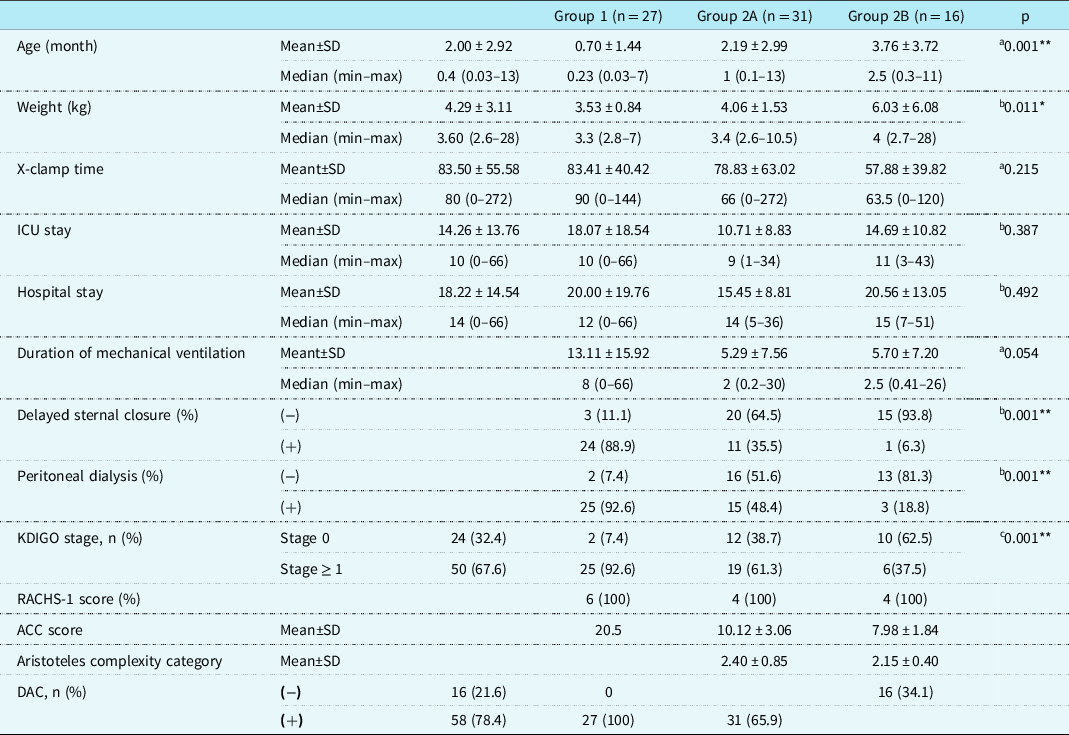
The demographic characteristics of patients in the univentricular and biventricular groups were compared (Table 1). Double aortic cannulation was performed in 78.4% (n = 58) of patients. While double aortic cannulation was performed in all patients in the Group 1, this rate was 65.9% (n = 31) in the Group 2. Group 2A double aortic cannulation-done and Group 2B non-double aortic cannulation were included. The age and weight of the patients in group 1 were found to be significantly lower than those in Group 2A and 2B. (respectively p = 0.01, p = 0.013; p < 0.05 and p = 0.011, p = 0.08; p < 0.01). There was no difference between groups in terms of the X-clamp time, duration of mechanical ventilation, or duration of ICU stay (p = 0.075, p = 0.184, p > 0.05). On the other hand, a delayed sternal closure and the need for peritoneal dialysis were more common in the Group 1 (p = 0.01, p < 0.01).
Demographic data

ACC: Aristotle’s comprehensive complexity; DAC: Double aortic cannulation; KDIGO: Kidney Disease Improving Global Outcomes.
a Kruskal Wallis Test.
b Mann–Whitney U-test.
c Chi-square test.
* p < 0.05.
** p < 0.01.
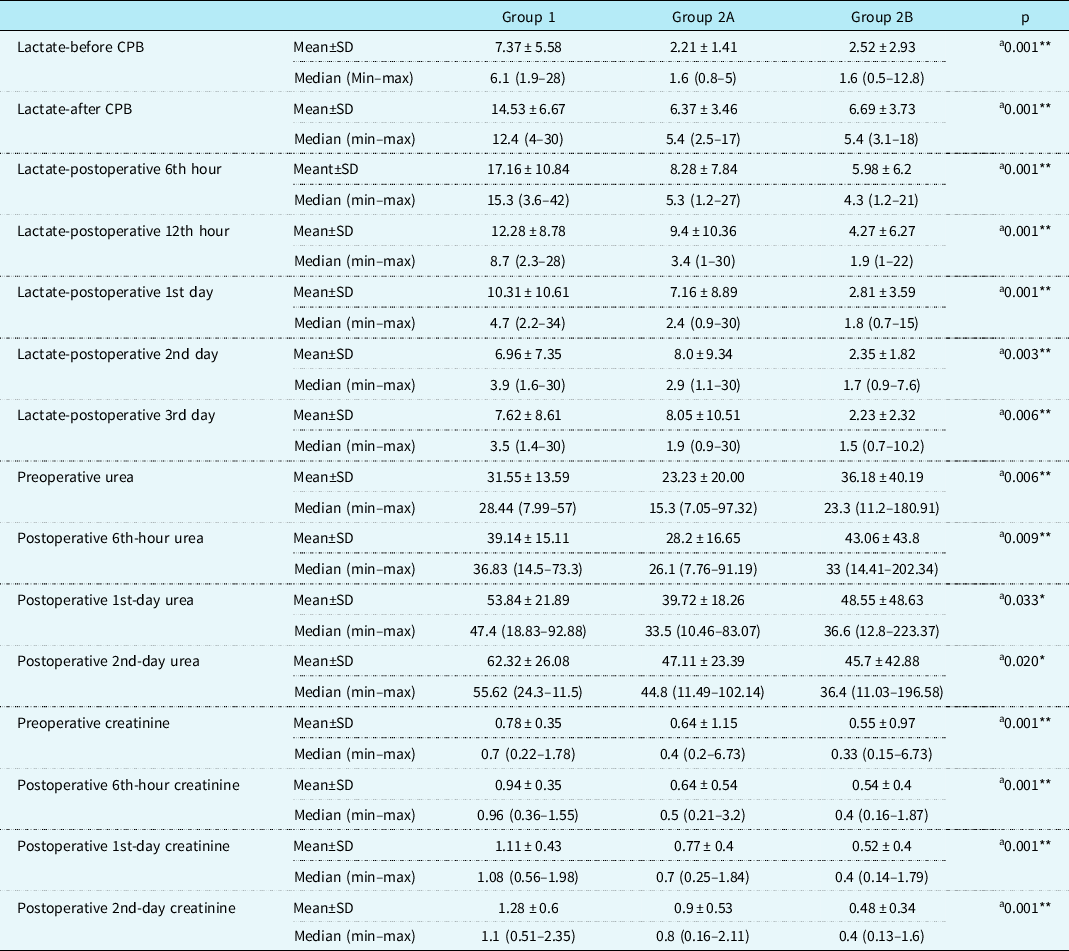
Preoperative and postoperative comparisons of the groups are summarised in Table 2. The preoperative and postoperative 6th- and 12th-hour, and 1st- and 2nd-day lactate values in the Group 1 were higher (p = 0.001, p = 0.001, p = 0.001, p = 0.001, p = 0.003, p = 0.006, p < 0.05) when compared with the same values in the Group 2A and 2B. Moreover, the preoperative and postoperative 1st- and 2nd-day urea (p = 0.006, p = 0.009, p = 0.033, p = 0.020, p < 0.05) and creatinine (p = 0.01, p = 0.01, p = 0.01, p = 0.01, p < 0.05) values were also high in the Group 1.
Comparison of preoperative and postoperative lactate, urea, and creatinine values by groups

CPB: Cardiopulmonary bypass.
a Kruskal Wallis Test.
* p < 0.05.
** p < 0.01.
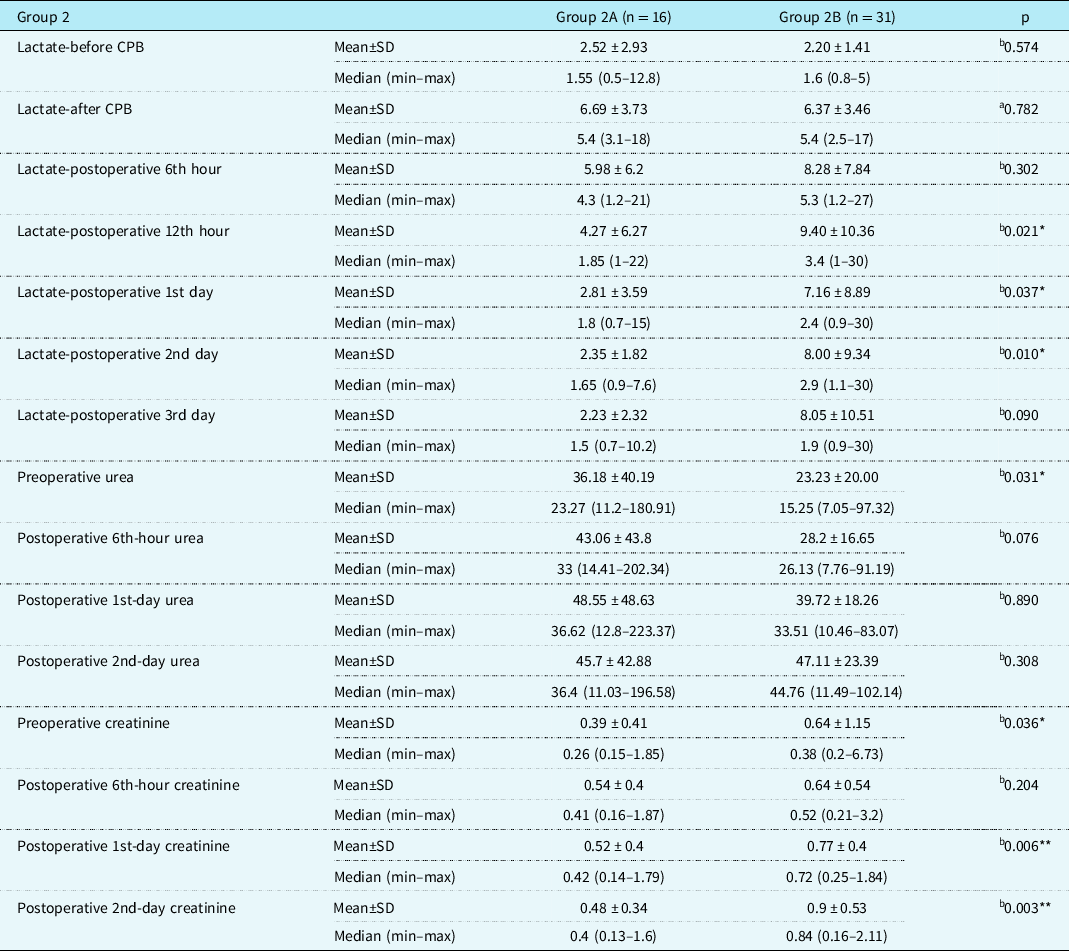
Patients in the Group 2 were evaluated separately according to cannulation strategies (Table 3). There was no significant difference in the preoperative, post-cardiopulmonary bypass, and 6-hour (p = 0.574, p = 0.782, p = 0.302, p > 0.05) lactate values of the patients who underwent double aortic cannulation, respectively. On the other hand, the postoperative 12th-hour, and 1st- and 2nd-day lactate values (p = 0.021, p = 0.037, p = 0.010, p < 0.05) were high. No difference was detected between the groups in terms of the urea values (p = 0.031, p = 0.076, p = 0.890, p = 0.308, p > 0.05). The preoperative and postoperative 1st- and 2nd-day creatinine values were significantly higher in the Group 2A (p = 0.036, p = 0.006, p = 0.003, p < 0.05).
Comparison of perioperative values with double aortic cannulation in the biventricular group

CPB: Cardiopulmonary bypass.
a Student t Test.
b Mann–Whitney U-test.
* p < 0.05.
** p < 0.01.
Discussion
Acute kidney injury is the most common major complication after cardiac surgery in children. Reference Gil-Ruiz Gil-Esparza, Alcaraz Romero and Romero Otero6–Reference Park, Hur and Kim8 The incidence of acute kidney injury in this populations has been reported as 30–52%, and the greatest risk group is newborns. Reference Blinder, Goldstein and Lee9–Reference Esch, Salvin, Thiagarajan, Del Nido and Rajagopal11 It has been reported that more than one-third of newborns develop acute kidney injury after CHD surgery. Reference Beken, Bulum-Akbulut and Albayrak12 It is impossible to determine the real incidence in neonatal group patients due to the immaturity of the renal tubules and changes in the glomerular filtration rate. Reference Welke, Dearani, Ghanayem, Beland, Shen and Ebels13,Reference Zappitelli, Parikh, Akcan-Arikan, Washburn, fett Mof- and Goldstein14 SooHoo et al Reference SooHoo, Patel, Jaggers, Fraubel and Gist15 suggested that the Norwood procedure is related to an increased incidence of acute kidney injury. In their study, it was also shown that the risk of acute kidney injury increased as the surgical complexity increased.
The exact mechanism of acute kidney injury that develops after cardiac surgery is not fully understood due to the complexity of its pathophysiology and its multifactorial nature. Reference Cavalcante, Cavalcante and Castello Branco16 Early diagnostic tools, such as urine and serum biomarkers, could not be determined and there is still no specific treatment for the prevention or cure of acute kidney injury. Although various criteria are used for the diagnosis of acute kidney injury, Kidney Disease Improving Global Outcomes staging has recently been used as a standard diagnostic tool. Reference Toda and Sugimoto17 Kidney Disease Improving Global Outcomes Stage II and III are defined as severe acute kidney injury. The incidence of acute kidney injury, according to the Kidney Disease Improving Global Outcomes criteria, after CHD surgery was reported as 29–86%. Reference Lex, Toth and Cserep7,Reference Park, Hur and Kim8,Reference Hazle, Gajarski and Aiyagari19
Acute kidney injury was also found to be associated with chronic renal failure, prolonged mechanical ventilation, and ICU stay, in addition to mortality. Reference Chiravuri, Riegger and Christensen20 Risk factors related to acute kidney injury include prolonged cardiopulmonary bypass duration, the complexity of surgical repair, degree of hypothermia, circulatory arrest, and postoperative low cardiac output syndromes. Reference Li, Krawczeski and Zappitelli10,Reference Esch, Salvin, Thiagarajan, Del Nido and Rajagopal11,Reference Chiravuri, Riegger and Christensen20
In another study, an age <1 was determined as a risk factor and in another study, a cardiopulmonary bypass duration >90 minutes was accepted as a risk factor. Reference Chan, Ip, Chiu and Cheung21–Reference Boldt, Brenner, Lehmann, Sutter, Kumle and Isgro25 While being under the age of 1 is considered to be the most important risk factor, preoperative mechanical ventilation and perioperative peritoneal dialysis have been shown as other risk factors. Reference Li, Niu, Huang, Sheng and Tian26–Reference Grams, Sang and Coresh29 A non-pulsatile flow, renal hypoperfusion, and hypothermia are also other causes of renal dysfunction. Reference Kron, Joob and Van Meter30,Reference Regragui, Izzat, Birdi, Lapsley, Bryan and Angelini31
Aortic arch reconstruction is the cornerstone of congenital heart surgery and can be an important part of complex surgical procedures, such as the Norwood procedure. Reference Karavas, Deschner, Scott, Mettler and Bichell3 The extent of body and distal organ damage during surgery is unclear. Systemic inflammatory response, as a result of ischaemia/reperfusion injury, may cause renal, hepatic, and intestinal dysfunction, which is associated with postoperative morbidity. Reference Kornilov, Sinelkinov and Soinov32 Moreover, patients who have undergone aortic arch construction are at high risk in terms of postoperative acute kidney injury because of systemic outflow obstruction. Reference Cooper, Charpie and Flores33,Reference Rajagopal, Emani, Roy, Westgate and Bacha34 Cannulation of the descending aorta, in addition to continuous low-flow body perfusion, was defined as an effective method for visceral protection. Reference Imoto, Kado and Shiokawa2 Only a few studies have had promising results in the last ten years with regard to the efficiency of double aortic cannulation. Reference SooHoo, Patel, Jaggers, Fraubel and Gist15,Reference Cesnjevar, Purbojo, Muench, Juengert and Rueffer35 Specifically, the Norwood procedure has been related to ensuring perfusion throughout the body with double aortic cannulation during surgery, avoiding deep hypothermia, reducing the duration of cardiopulmonary bypass and myocardium, and better postoperative hemodynamic results. It has also been found to be beneficial for postoperative kidney dysfunction and capillary leak. Reference Hammel36
Rajagopal et al Reference Rajagopal, Emani, Roy, Westgate and Bacha34 suggested a lower incidence of acute kidney injury during aortic arch repair in neonates when compared to their control group. In neonates who had aortic arch reconstruction, those who had only regional cerebral perfusion and those who had multisite perfusion were compared. Visceral perfusion was performed through the femoral or umbilical artery. In this study, while the incidence of acute kidney injury was 8% in patients who underwent multisite perfusion, it was found to be 50% in patients who underwent regional cerebral perfusion. Although this is a good outcome, the number of patients in the study was low. In the study of Hammel et al, Reference Hammel, Deptula, Karamlou, Wedemeyer, Abdullah and Duncan4 in 2013, it was reported that multisite arterial perfusion reduced the incidence of acute kidney injury and postoperative volume overload in neonates. In 2019, Kulyabin et al Reference Kulyabin, Gorbatykh, Soynov, Nickay, Zubritskiy and Bogachev-Prokophiev37 reported this technique was preferred to provide distal perfusion in the presence of ductus-dependent systemic circulation, especially in children with renal anomaly or dysfunction. In our study, there was no surgical complication due to descending cannulation. As a result, it is accepted as a reliable technique when applied by experienced people in accordance with the literature.
In our clinic, the standpoint of performing double aortic cannulation is dominant in patients in whom complex surgery is selected and the duration of cardiopulmonary bypass will be long. In this study, the Norwood Stage 1 procedure was applied to all of the patients in the univentricular group who had a diagnosis of hypoplastic left heart syndrome. On the other hand, patients in the biventricular group were operated on due to hypoplastic arch. Double aortic cannulation was not applied to those in Group 2B, since they did not have any intracardiac anomaly and were older than 1 year.
The number of Kidney Disease Improving Global Outcomes stage ≥1 patients who had delayed sternal closure was higher in the univentricular group. This was considered to be related with a patient age <1 month, the presence of complex surgery, and the patient profile.
Hyperlactatemia is accepted as a sensitive marker. Reference Munoz, Laussen, Palacio, Zienko, Piercey and Wessel38 Although not specific, an increase or change in the lactate level during cardiopulmonary bypass might be a marker of regional hypoperfusion or increased metabolic demand. Reference Jonas, Jonas and Elliott39,Reference Sicsic, Duranteau and Corbineau40 Although high lactate levels in the postoperative period are related with low cardiac output, Reference Boigner, Brannath and Hermon41 organs most likely to produce lactate in response to hypoperfusion or reduced oxygen extraction include the brain, gut, liver, kidneys, and skeletal muscle. Reference Jonas, Jonas and Elliott39,Reference Sicsic, Duranteau and Corbineau40
Munoz et al Reference Munoz, Laussen, Palacio, Zienko, Piercey and Wessel38 reported that an increase in the lactate level during cardiopulmonary bypass can be an early indicator for determining postoperative results and is related to surgical complexity. Although it was suggested to determine the predictive level of lactate using serial measurements, Reference Boigner, Brannath and Hermon41 Hatherill et al found that the presence of a lactate level >6 mg/dL in the postoperative initial blood gas measurement of patients was suggested to be a risk factor Reference Hatherill, Sajjanhar and Tibby42 Similarly, Shemie Reference Shemie43 and Duke et al Reference Duke, Butt, South and Karl44 determined that the level of lactate was an indicator of a complicated postoperative period.
The most commonly used parameter in the diagnosis of renal dysfunction is the serum creatinine level. However, it is a late indicator since it is thought that more than 50% of kidney function is lost when it starts to rise. Reference Devarajan45,Reference Parikh and Devarajan46 In addition, the serum creatinine level is a non-specific parameter, as it is related to age, gender, muscle mass, muscle metabolism, and hydration status. Reference Murray, Devarajan and Levey47 However, it was shown to be correlated with renal dysfunction. Reference Kist-van Holthe tot Echten, Goedvolk and Doornaar48 In newborns, preoperative residual maternal creatinine can be present. This creatinine decreases with the effect of cardiopulmonary bypass and may lead to the underestimation of postoperative renal dysfunction. In such cases, it has been suggested that the aprotinin level can be measured to demonstrate independent renal damage. Reference Wilder, Kavarana, Voepel-Lewis, Paugh, Lee and Ohye49 An increase in the serum creatinine value, at a rate of 10–24%, was found to be related with mortality. Reference Coca, Peixoto, Garg and Krumholz50 Haase et al Reference Haase, Devarajan and Haase-Fielitz51 reported that there was no relationship between postoperative creatinine elevation and adverse effects in patients with an acute kidney injury diagnosis.
In the study of Kreuzer et al Reference Kreuzer, Sames-Dolzer, Benedikt, Mair and Mair5 in 2018, the effect of the perfusion strategy was evaluated in patients with double aortic cannulation in addition to an evaluation of the patients in terms of their postoperative lactate levels and the need for peritoneal dialysis. In their study, the 6-hour postoperative lactate values were higher in the univentricular group, and no difference was determined in terms of the cross-clamp duration, age, and body weight. As the kidney is the most fragile organ against hypoperfusion, it has been suggested that perioperative and postoperative serum creatinine levels may be significant. Low body weight, advanced age, and univentricular physiology were found to be associated with the postoperative creatinine level, while cross-clamping, the cardiopulmonary bypass duration, and advanced age were not.
In the current study, the urea, creatinine, and lactate values of the patients were measured serially. The postoperative lactate, urea, and creatinine values in the univentricular group patients were significantly higher than in the Group 2A and 2B. This result was associated with the high preoperative values of the patients (Table 2). It was aimed to separately evaluate the patients in the Group 2 according to their perfusion strategies, but no difference in the postoperative lactate values was present in the patients that underwent double aortic cannulation when compared to those who did not. Preoperative urea creatinine elevation was found to be associated with the postoperative results in this patient group (Table 3). Consistent with the literature, high preoperative lactate, urea, and creatinine levels were found to be risk factors for postoperative renal dysfunction.
Renal replacement therapy is required in 1–17% of patients who develop acute kidney injury after congenital heart surgery. Reference Jander, Tkaczyk and Pagowska-Klimek52 Peritoneal dialysis is still preferred for acute renal replacement treatment in newborn and early childhood patients with renal dysfunction because it is simple and reliable. Cannulation of the large vessels and systemic anticoagulation is not necessary, which helps to avoid the ischaemic and embolic complications of extracorporeal techniques. Reference Flynn53,Reference Stromberg, Fraser, Sorof, Drescher and Feltes54 Indications for peritoneal dialysis after cardiac surgery include hypervolemia, positive volume balance, oliguria, anuria lasting longer than 4 hours and not responding to medical treatment, and hyperkalemia. Reference Boigner, Brannath and Hermon41
As there is no standard definition for acute kidney injury, no consensus is present for the timing of first renal replacement. In 2007, Palevsky Reference Palevsky55 used blood urea nitrogen levels to determine the time of renal replacement. In their study, better results were obtained if renal replacement therapy was started when the BUN level was <73 mg/dL. It was suggested in the literature that paediatric fluid overload can be an independent risk factor for morbidity and mortality instead of the BUN level. Reference Goldstein, Currier, Graf, Cosio, Brewer and Sachdeva56
Volume overload after heart surgery is frequent and multifactorial. Hazle et al Reference Hazle, Gajarski, Yu, Donohue and Blatt57 related volume overload with late sternal closure. Seguin et al Reference Seguin, Albright and Vertullo58 found it to be associated with long-term ventilation and high pressure requirement and infection in the early postoperative period. In another study, peritoneal dialysis was suggested in order to decrease pulmonary complications as the result of volume overload. Reference Werner, Wensley, Lirenman and LeBlanc59 On the other hand, Dittrich et al Reference Dittrich, Vogel, Dahnert, Haas, Alexi-Meskishvili and Lange60 suggested that starting early peritoneal dialysis decreases morbidity and mortality. For this reason, it is practised in many centres to insert the dialysis catheter in the operating room and start it on the 1st postoperative day. Because, especially in those with cardiopulmonary bypass time 150 minutes and more, early peritoneal dialysis positively affects the survival. Reference Namachivayam, Butt, Millar, Konstantinov, Nguyen and d’Udekem61
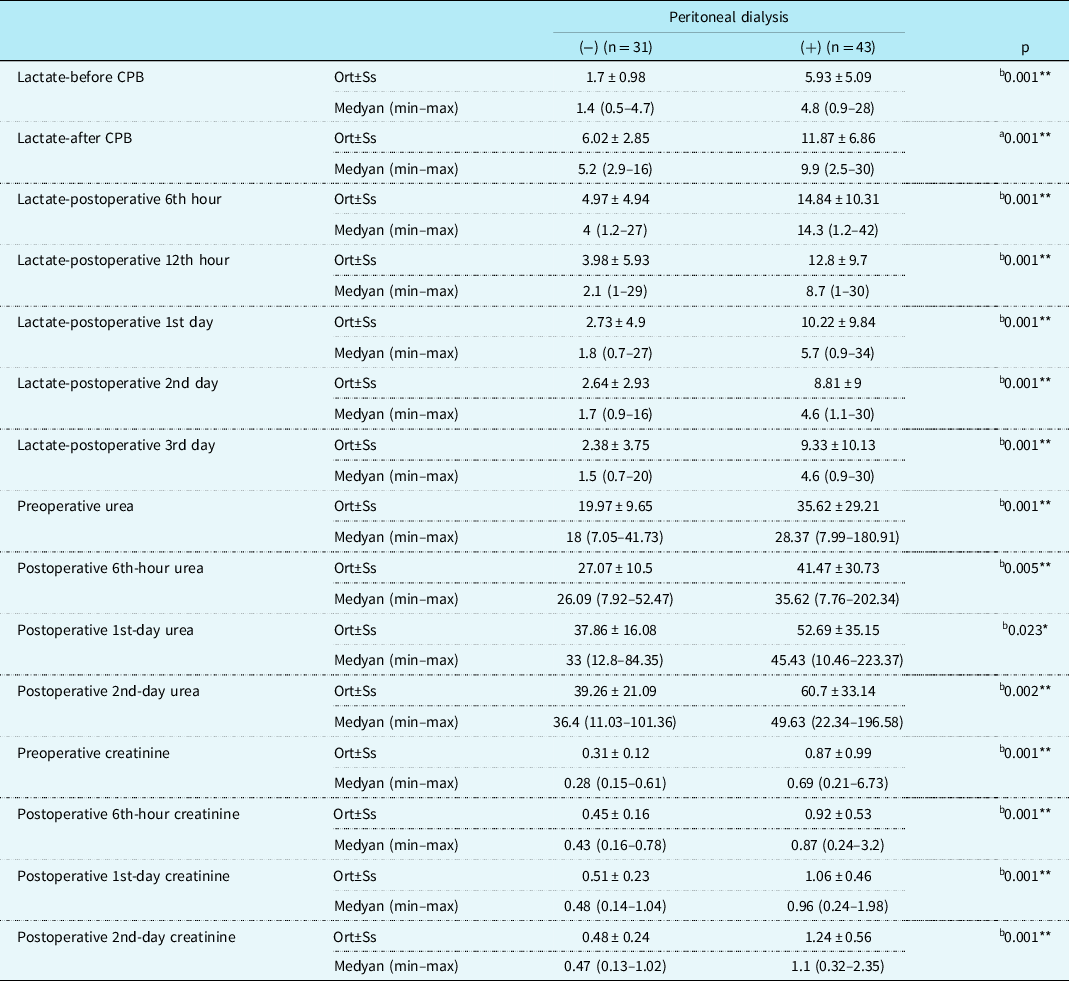
In our clinic, it is preferred to insert a peritoneal dialysis catheter on the operating table, because the duration of cardiopulmonary bypass is longer in patients with single ventricular physiology who are <1 month. In this group of patients, volume overload should be prevented before hemodynamic instability occurs. Peritoneal dialysis is also applied in patients with volume overload that do not respond to medical treatment and in the presence of oliguria and anuria, progressive urea, and increased creatinine values. The parameters of patients with postoperative peritoneal dialysis were also compared herein (Table 4). According to this, the elevation of the lactate, urea, and creatinine levels in the preoperative and postoperative periods is directly related to the need for peritoneal dialysis (p < 0.01).
Evaluation of lactate, urea, and creatinine levels by peritoneal dialysis

CPB: Cardiopulmonary bypass.
a Student’s t-test.
b Mann–Whitney U-test.
* p < 0.05.
** p < 0.01.
Conclusion
Double aortic cannulation is a safe technique when applied by an experienced team. Especially in the risk group for renal dysfunction, neonatal, single ventricular physiology, and its application during complex surgery are recommended in literature. It can be preferred in critical patients where the perfusion of the lower half of the body cannot be achieved through PDA. Although no statistically significant difference was found in the patients who underwent double aortic cannulation in our study, the same opinion prevails.
Acknowledgement
No funding was obtained for this study.
Financial support
This research received no specific grant from any funding agency, commercial, or not-for-profit sectors.
Conflicts of interest
None.