doll's house, n.
Also doll-house, dolls’ house.
A miniature toy house made for dolls; also transf. and fig., applied esp. to a diminutive dwelling-house.
Oxford English Dictionary (Oxford, 2015)dollhouse, n.
A small toy house that is used by children for playing with dolls
Merriam-Webster Dictionary (Springfield, MA, 2015)British and American spellings of the same word attest to cultural difference. For Americans, the doll simply provides an indication of the scale of the model in which it is lodged. The doll, like its house, is just another passive product in a commodity culture made for our own or our children's consumption. In contrast, for the British, the use of the possessive (doll's) indicates that the model house is possessed by the miniature figure who occupies it. By ascribing proprietary rights to the doll, the British tacitly acknowledge her agency. An investigation of the Stettheimer dollhouse/doll's house now in the Museum of the City of New York suggests that British English is, at least occasionally, more accurate than American English in its representation of the world.
Here I use the Stettheimer doll's house to argue that scale models (like other model types) have a life of their own: they are agents capable of acting independently of their human producers. Scientists and social scientists commonly accept the independence of their models. Margaret Morrison, a recognized master of economic models, argues compellingly that economic models are “autonomous agents” independent both of the world and of the particular theory or idea about the world that they are designed to demonstrate.Footnote 1 Although architects, designers, and humanists, like scientists and social scientists, use models extensively in their work, they have rarely investigated their properties with equal theoretical rigor.Footnote 2 No less then algorithms or pie charts, it seems to me that scale models act independently of both their archetypes and their originating ideas. I would add further that scale models, and indeed all other model-types, are, once complete, also independent of their makers and their consumers (as children are independent of their parents; or, perhaps better, as buildings are independent of their architects).
Despite an ever-growing body of literature on the agency of objects, humanists may still be skeptical of the claim that models are independent agents.Footnote 3 The agency that I am claiming for models in general and for the Stettheimer doll's house in particular is not the heavily freighted agency of philosophy and common discourse, which is embedded in complex concepts of human morality, personal intentionality, and liberal individualism. Rather it is more like the agency of chemistry. In chemistry, an agent is merely a substance, but it is a substance that has physical, chemical, or medicinal effects on proximate things. No intentions and no consciousness are ascribed to chemical agents. Model-agents, then, as in chemistry, are nonhuman entities – whether they are spatial objects like scale models, or abstract notations like algorithms – that have an effect on their physical or mental environments, without exhibiting any inkling of consciousness or intentionality. A model-agent differs from a chemical agent in so far as its effects on its setting are much less predictable. However its maker might intend a model to act, its actual performance can never be fully controlled. But act it will.
How effectively a model-agent works depends on its setting and its robustness. Model-agents, like all agents – human or chemical – can be strong or weak. Their weaknesses and strengths are at least in part defined through their relation to their referents. A strong model acts as a dominant subject that determines its weak object. An architect's model, for example, may be expected to work as an archetype for the building to be constructed. The market may change to conform to a rhetorically powerful economic model made of it. Joan Smalls, supermodel, makes clothes look fabulous, though she makes women feel ungainly. There are also weak model-agents. Weak models, like copies, are subordinate to their archetypes. A Barbie doll, as a copy of a supermodel, is weak. But model-agents exercise their agency in part by oscillating between their weak and strong potentials. A Barbie may, after all, contribute to the anorexic future of her possessor. The Stettheimer doll's house acted in the world in both expected and unexpected ways; it was both a weak and a strong model.
EXPECTED ACTS: REFLECTION (WEAK MODEL)
Carrie Stettheimer began working on the model in 1916 at the age of forty-six; she was still fashioning it when she died in 1944. Her doll's house was not a toy. Rather, as with many personal collections, it was a mirror in which the collector looks at herself in the absence of her own image. As in a mirror image, too, that portrait is miniaturized. Of course, all reflections involve flexions; they bend their contents.
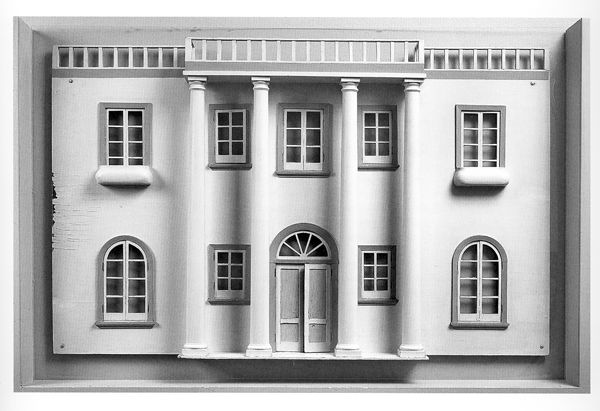
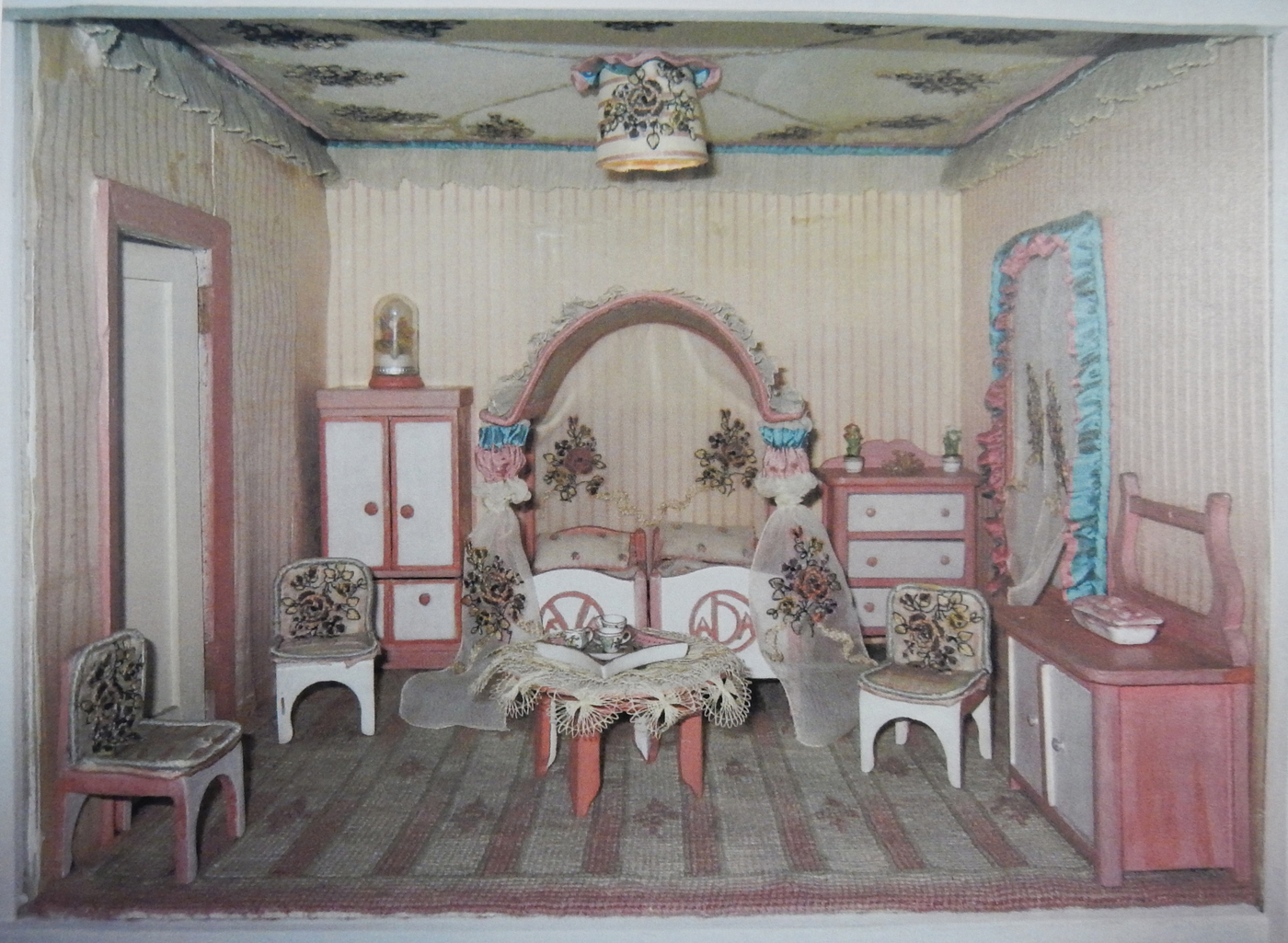
The doll's house acts as a weak model. Both the structure and its contents offer a diminutive version of Carrie's world. The house, fabricated by an unidentified cabinetmaker, had as its archetype André Brook in Tarrytown, the large and beloved house at which Carrie summered with her mother, Rosetta, and two younger sisters, Ettie, a philosopher and novelist, and Florine, a painter (Figure 1).Footnote 4 The model, like the central structure of its demolished referent, is white, bilaterally symmetrical and Georgian in form. The facade's focus is a monumental porch of four colossal columns. The exterior of Carrie's professionally constructed sixteen-room house is classically ordered; the wholly personally contrived interior is eclectically disordered.Footnote 5 The model's rooms present a pastiche of styles: French Empire, Chinese, Baroque, Gothic, over-the-top modern. The melange is not simply the result of multiple fashions, but also the effect of material opulence. Carrie added elaborate ceiling, floor, wall and window treatments to the model. She crafted the furniture or, if pieces were purchased, modified them with fabric, paint, and various materials. The Rose Bedroom is characteristic (Figure 2). Its pink-and-white striped wallpaper is trimmed at the top with gathered chiffon instead of crown molding. A needlepoint carpet and blue-and-pink ruffled window surrounds with embroidered toile curtains provide a busy setting for the room's fussy furnishings: a double bed canopied with flounces, scrunchies, and toile embroidered with over-scaled roses, white chairs with needlepoint flowered upholstery, a table with a lace cloth set for coffee, dressers staged with glass-domed flowers and other ornaments.
New York, Museum of the City of New York, Stettheimer Doll's House, front facade. Photograph published with the permission of the Museum of the City of New York.

New York, Museum of the City of New York, Stettheimer Doll's House, Rose Bedroom. Photograph published with the permission of the Museum of the City of New York.

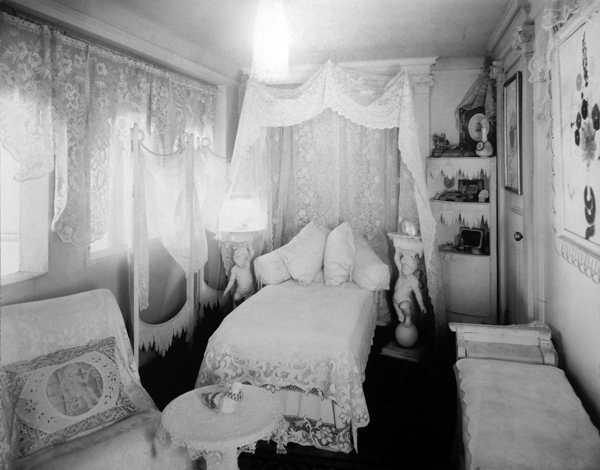
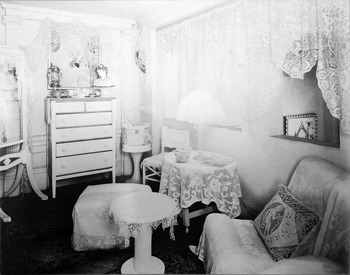
Later photographs of the Stettheimer sisters’ apartment in New York City and Florine's studio suggest that the model's interior, like its exterior, depended on Carrie's lived experience.Footnote 6 After returning from Europe the three unmarried Stettheimer sisters and their mother first took up residence at 102 West 76th Street. By 1926, they were living in a large apartment in Alwyn Court, at 182 West 58th Street, one of the most elaborately ornamented high-rises in Manhattan.Footnote 7 Though it has lost some of its original decoration, the building's terracotta-adorned facade is still lush. Florine also had a studio with living quarters in the Beaux Arts Building on Bryant Park, which she claimed as her address in the First Annual Exhibition of the Society of Independent Artists in 1917.Footnote 8 The sensory voluptuousness of the Rose Bedroom has a counterpart in Florine's bedroom at her studio (Figures 3 and 4). There is the same horror vacui: the bed and other pieces are slathered in lace, the mirrors are ornamented, the gaze is encumbered with needlepoint cushions, tables and shelves filled with bibelots. The same pieces of furniture – a pair of half-round white side cabinets designed by Florine – appear in images of the salon at Alwyn Court and in the dining room of the model. The photographs and the model are filled with things; both suggest that the spaces they represent were regarded as most eloquent without human bodies.
New York, Beaux Arts Building, Bryant Park, interior of Florine's bedroom. Photograph published with the permission of the Avery Archives, Columbia University.

New York, Beaux Arts Building, Bryant Park, interior of Florine's bedroom. Photograph published with the permission of the Avery Archives, Columbia University.

Carrie's house, by replicating the ambience of its maker, appears to be a weak model. Indeed, most conventional doll's houses are weak models. They reproduce on a small scale and in a simplified form the settings that their young possessors may inhabit, though do not yet control. The intention of the parents who present their daughters with a doll's house may well be didactic: the child should learn to organize a household properly. One father in nineteenth-century England, Thomas Alsager, even drafted a doll's house lease for his eight-year-old daughter, Margaret:
This indenture made the first day of January 1837 between Thomas Massa Alsager of Queen Square in the County of Middlesex, Esquire, of the one part and Margaret Alsager of the same place, spinster, of the other part witnesseth that for and in consideration of the rent and covenants herein after received and contained the said Thomas Massa Alsager doth demise and base unto the said Margaret Alsager all that messuage or dwelling house, commonly known by the name of the “Doll's House” now situate and being in the back drawing room of No. 26 Queen Square aforesaid with all the appurtenances thereof to have and hold to the said Margaret Alsager for the full term of four years, the said Margaret Alsager yielding and paying therefore every month the sum of one shilling lawful money of Great Britain … And also that she will insure the same from accidental fire by agreeing to pay to the said Thomas Massa Alsager a fine of twenty shillings every time she the said Margaret Alsager shall introduce into the said dwelling house a real lighted candle or light any real fire in the stoves. Provided always and it is hereby agreed that this covenant shall not exclude the introduction of any candle the flame whereof shall be made of red foil red worsted red glass or any other incombustible, nor the filling any of the stoves with coals the same not being in an Ignited state …Footnote 9
Whatever the intentions of the adult who provides a child with a doll's house, it is the object's ludic promise that makes the gift a pleasure to its recipient. Though a doll's house may provide a site for practicing potential dominion, it is engaging only in so far as it offers future authority as fantasy.
Carrie's model was not made for a child; it never had a didactic function. Like the famous doll's houses owned by adult women in the early modern Low Countries, Carrie's model was not intended to teach her the domestic chores with which she was already all too familiar.Footnote 10 The historian Susan Broomhall suggests that the Dutch “patrician dollhouses were no more than a sumptuous extension of girls’ pastimes of household role-playing.”Footnote 11 I'm sure she is wrong. They were, rather, as others have argued, a means of exhibiting their owner's social status, leisure, and artistic sensibility.Footnote 12 In a Protestant cultural setting still fraught with anxieties about wealth and its display, those extravagant models, which might cost as much as a full-scale house, may well have been considered recusant.Footnote 13 The apparent weakness of these lavish doll's houses was a principal source of their cultural force: their association with children's playthings masked their potential to raise suspicions about the established social order. Here an oscillation of the model between strength and weakness begins.
Carrie's doll's house was also a bit mutinous, and, like its Dutch predecessors, its edginess depended on its apparent docility. In the modern example, however, the model's social subversiveness is of an aesthetic rather than a religious variety.Footnote 14 The Stettheimer doll's house elevates the commonplace to a spectacle of feminine excess. David Levinthal, the well-known artist/photographer who documented Carrie's doll's house for a retrospective of her sister Florine's work at the Whitney Museum in 1995, identifies it as installation art, an expression of an art form before its invention.Footnote 15 But in its own time, it was Camp. Camp describes a sensibility, a taste of an artistically inclined, leisured elite in the early twentieth century that embraced the artificial, the out-of-date, the popular, and the outrageously effeminate. It flourished on the margins of urban high culture, delighting in experimentation with homosexuality, interraciality, and object overload. Susan Sontag's characterization of Camp in fifty-six notes for Oscar Wilde remains authoritative.Footnote 16 She observes, “Camp taste has an affinity for certain arts rather than others. Clothes, furniture, all the elements of visual décor, for instance, make up a large part of Camp. For Camp art is often decorative art, emphasizing texture, sensuous surface, and style at the expense of content.”Footnote 17 She also characterizes the objects privileged by Camp as “old-fashioned, out-of-date, démodé,” exhibiting a “sensibility of failed seriousness, of the theatricalization of experience.”Footnote 18 Sontag insists that Camp is not about politics. “To emphasize style is to slight content, or to introduce an attitude which is neutral with respect to content. It goes without saying that the Camp sensibility is disengaged, depoliticized – or at least apolitical.”Footnote 19 If, however, “politics” can be used to describe the construction of an alternative elite with the object of contesting the status quo, Camp certainly had a politics. Camp challenged a number of the dyads that ordered culture at the time – black–white, male–female, elite–popular. In doing so it offered an in-your-face challenge to bourgeois convention. Camp, having done its job, has withered away.Footnote 20
Of course, for Carrie's doll's house to be Camp, it had to be seen in a campy way by campy observers. And seen it was. The Stettheimers attracted an exceptional group of acquaintances. Arthur Danto, philosopher and art critic, named the clique the “American Bloomsbury.”Footnote 21 Androgyny, excess, racial mixing, and theatricality, along with an appreciation of the new (particularly the new of a slightly perverse nature), flourished in the Stettheimer milieu. The Stettheimers were involved in many of New York's happenings, including the Harlem Renaissance and the innovative stage productions of Gertrude Stein. Their parties were attended by artists, photographers, writers, and designers – Charles Demuth, Robert Locher, Jo Davidson, Marcel Duchamp, Marsden Hartley, Gaston Lachaise, Elie Nadelman, Georgia O'Keeffe, Francis Picabia, Joseph Hergesheimer, Avery Hopwood, Edna Kenton, Henry McBride, Leo Stein, Carl Van Vechten, Arnold Genthe, Alfred Stieglitz, Edward Streichen, Elsie de Wolfe, Baron Adolph de Meyer.
That Carrie's doll's house fully participated in this remarkable setting is indisputable. A number of the Stettheimers’ friends gave Carrie gifts for her model. Several presented her with miniature artworks, most of which were nudes: Alexander Archipenko, Gaston Lachaise, Carl Sprinchorn, Albert Gleizes, Paul Thévenaz, Marguerite Zorach, William Zorach, Claggett Wilson, and, most famously, Marcel Duchamp.Footnote 22 Duchamp was the sisters’ French tutor as well as their friend. Ettie describes him as “a queer but charming French boy, who painted ‘the Nude descending the Stairs’ and other cubistic creations.”Footnote 23 Nude Descending a Staircase was the painting that caused such a commotion at the Armory Show in 1913; Duchamp made a diminutive version of the work for Carrie's doll's house. Of the many small artworks given to her by her famous friends, Carrie seems to have only installed two faux eighteenth-century pastorals by Albert Sterner. Like the Stettheimers’ New York apartments, the model displayed few images other than the sisters’ own. Some of these painting-gifts were later hung in the doll's house, but only after Carrie was dead.
UNEXPECTED ACTS: AFFECT (STRONG MODEL)
Affect is like aura: it is felt rather than thought. It works on the viscera of those who encounter it – through bodily sensation and intuition rather than through cognition and intellect.Footnote 24 Affect is an attribute of strong models, not weak ones. It allows them to act in unexpected ways. Carrie Stettheimer's model was a strong model in so far as it had a marked effect on art made in its vicinity. Most obviously, Carrie's doll's house exerted an attraction that generated contributions. It effected production that its own scale controlled – the miniature gifts made by the Stettheimers’ friends. More profoundly, the model also changed the artistic production of those who experienced its affect. Duchamp's gift of a diminutive Nude Descending a Staircase has been identified as the inspiration for the artist's later experiments in miniaturization, the Boîte-en-valise series. It has also been understood as a precursor to Duchamp's found objects.Footnote 25 Carrie's doll's house may have provoked Duchamp to think about commoditization and collection, occasioning experimental forms. I believe that it also changed the artistic production of Carrie's siblings. Comparisons of their works before and after Carrie began decorating the doll's house reveal parallel shifts in both Florine and Ettie's expressions of space.
Before the doll's house
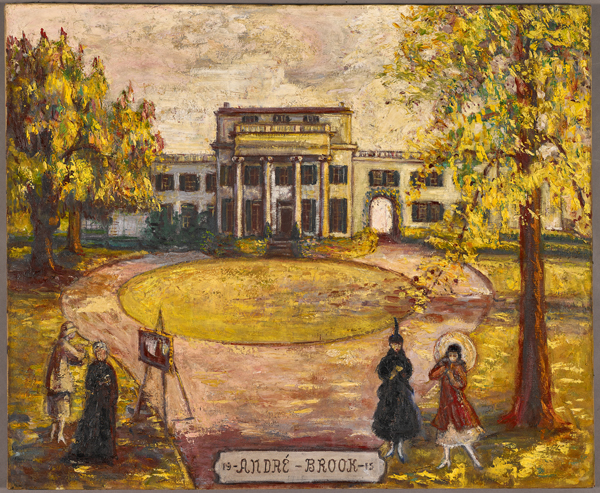
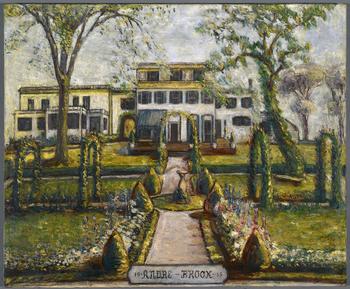
Florine and Ettie worked in more conventional media than that of their sister – painting and literature. But the three sisters’ work in their respective forms shared one significant element – its subject matter. All three featured the self and the self's immediate surroundings in their production. Carrie's doll's house was, as I have argued, a mirror. In 1915, the year before Carrie began her doll's house, Florine had already depicted the family's summer home, André Brook. Indeed, this beloved place is more accessible through Florine's two portraits of the property – its front and rear facades – than in its re-creation as a doll's house. The view of the entrance facade may have the brushwork of an impressionist painting, but the somber cast of its pastels, the inattentive handing of recession, and the symmetrical ordering of the subject matter reveal an unimpressionistic indifference to natural appearances (Figures 5 and 6). The monumental entrance porch with Ionic (not Doric) columns of a colossal order contributes to the building's dominance within the picture. The house structures its landscape setting and its human occupants. Paired members of the family inhabit the lower corners of the painting of the front facade. On the right are the painter's sisters, Carrie and Ettie, and on the left the artist and her mother, Rosetta. Florine's easel, like Ettie's parasol, is a mere attribute. The miniature canvas on display is not the one that we contemplate. The characters are diminutive. Their location suggests a foreground, but their scale denies that the painting has any foreground at all, an effect reinforced by the plaque painted on the canvas naming the house. By their ordered subordination to the controlling axis, their smallness, their generic treatment, and their utter lack of interaction with one another, the figures are made into the house's accessories. They are its dolls.
Florine Stettheimer, André Brook (Tarrytown, New York, front facade), 1915, 28″ x 34″. Courtesy of the Avery Archives, Columbia University, and the permission of Alan Solomon.

Florine Stettheimer, André Brook (Tarrytown, New York, rear facade), 1915, 28″ × 34″. Courtesy of the Avery Archives, Columbia University, and the permission of Alan Solomon.

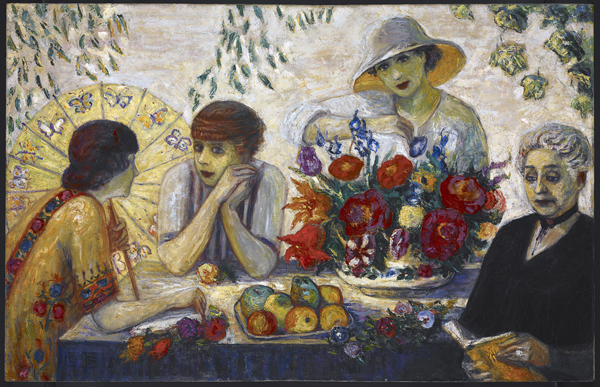
In the same summer and with the same palette, Florine painted another portrait of the family (Figure 7). Instead of having no real foreground, this image is exclusively foreground. Half-length versions of the same four figures are packed into a narrow stage space around a table laden not by a meal, but by two still lifes. Despite the restrictive space and the lack of any practical reason for the gathering, these figures, like those in the architecture-scape, are oddly unsocial: Rosetta reads a book, Florine arranges flowers, Carrie and Ettie are posed for conversation but do not engage in it. From the 1890s to Rosetta's death in 1935, this was the Stettheimer family. Rosetta's husband, Joseph Stettheimer, left the family in the later 1870s; he died at the age of forty-seven in 1889.Footnote 26 Rosetta and her children lived and traveled in Europe. In 1890, they returned for a time to New York, perhaps to put family affairs in order; they settled permanently in New York City only in 1914.
Florine Stettheimer, Family Portrait I, 1915, 40″ × 62·25″. Courtesy of the Avery Archives, Columbia University, and the permission of Alan Solomon.

Florine's two canvases define her family in the summer of 1915: apparently rich, vaguely unconventional, and subtly awkward. The same can be said for the paintings themselves. The palette pretends to be gay, but its effect is acerbic. Space is perspectival, but the distribution of elements within it is unnatural. The large figures are consistently modeled, but not convincingly solid or cogently structured. As her plausible nudes from art school suggest that she knew how to render an anatomy, the rubberyness of the Stettheimer bodies must have been deliberate. Florine's two portraits of André Brook, along with ten of her other paintings, were included in Florine's only public, one-person exhibition of her work during her lifetime. That small show was held in the well-known Knoedler Gallery in Manhattan in October 1916.Footnote 27 It was a failure. Comments in her diary give a sense of Florine's dissatisfaction. On 14 October 1915 she notes, “My pictures are hanging at Knoedlers – I am unhappy – and I don't think I deserve to be. I thought I might feel happiness after dinner, but I have had dinner.” On 24 October, two days before the end of the show, she notes, “Sold nothing.”Footnote 28
Ettie Stettheimer wrote the way her sister Florine painted. Her first novel, Philosophy: An Autobiographical Fragment, which was drafted before Carrie had made much progress on her doll's house, appeared under the pen name Henrie Waste (HENRIEtta WAlter STEttheimer).Footnote 29 Like the paintings in her sister's exhibition, it is made up of portraits and flowered landscapes, ordered with an avoidable awkwardness. The principal portrait drawn in the novel is her own: a pure intellect encumbered by an extraordinarily beautiful and sensitive body. Early on in the novel she says to herself, “Feel as little as possible, and think as much as possible.”Footnote 30 The other protagonist of the book is Henrie's male alter ego, Taddeo, a wealthy, conveniently orphaned Italian Jew, whose melancholy beauty is lavishly described, then mirrored as Henrie's own. They call each other “brother” and “sister.” But while Henrie is a philosopher, working on her PhD on William James's phenomenology, Taddeo investigates thought as corporal, as part of the body rather than elevated above it. He paints. There is no narrative or plot to the novel. The settings, whether the university town of Freiburg, where Ettie did, in fact, 1earn her PhD in philosophy, or the rooms that she lets, are generically described, serving as a blank stage space for the protagonists. There is only the author's own character development: from one-dimensionally intellectual to two-dimensionally emotional. Any third dimension is missing. Part I narratively describes her education and her platonic relationship with Taddeo. Part II is written as a series of letters devoted to her consciousness, ostensively written to Taddeo, without his replies. It ends in Henrie's recognition that she needs the physical and well as the mental: she begs Taddeo to return to her as a lover as well as a brother.
Ettie exposes her own self-absorption in response to her protagonist. Taddeo objects when Henrie describes herself as insensitive to others:
“You are exaggerating, little sister.”
“Negligibly, little brother.”
“Because you are thinking in a careless hurry, little sister.”
“I am not, little brother; about myself, as you hardly can have failed to observe, I think often and with affectionate persistency.”Footnote 31
Or again, when Henrie describes one of the differences between herself and Taddeo:
When you think of others, you think of them and not of yourself along with them, and when you love, you love the object of your love and not your own act of loving. – But to me it at least seems to be true that myself is the final objective of all that goes from me.Footnote 32
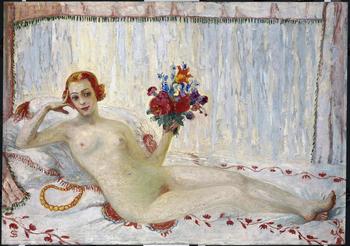
Ettie's unveiling of herself has an arresting analog in the nude self-portrait that her sister painted at the same time that the novel was being formulated (Figure 8).Footnote 33 Here a slender, small-breasted young woman with brilliant red hair reclines on a bed covered with a white spread embroidered with a red flowering vine scroll and curtained on the back and sides by fringed draperies. Like Florine's other figures, this one is spongy: her finger bends unnaturally and her thigh is boneless. Ettie and Florine both obsess about themselves in their artistic production. Although both were in their early forties, they equally idealize their appearances as beautiful, modern young women. Even some of the details in their self-representations are similar. In both the novel and the paintings, portraits of flowers are at least as pervasive as those of people. More fundamentally, they oddly describe themselves as attentively inattentive to their bodies as they appear in a similar stage space: natural but shallow.
Florine Stettheimer, Nude Self-Portrait, c.1915, 48·25″ × 68·25″. Courtesy of the Avery Archives, Columbia University, and the permission of Alan Solomon.

After the doll's house
The subject matter of both artists’ work remains much in place through their subsequent careers: obsessively focussed on themselves and those others whose existences complement their own. In her only other novel, Love Days [Susanna Moore's], the female protagonist again evolves from a wealthy, self-absorbed, aloof, and independent woman to a wealthy, self-absorbed, aloof woman who discovers her need for love only when it cannot be realized. Florine continues to paint herself, flowers, and those in her immediate, very private environment. But after 1916, the year that Carrie began work on her doll's house, certain formal aspects of the production of both artists shift in a remarkably parallel manner. In the later novel and in the later paintings, settings are rooms or room-like yards and those spaces become, themselves, characters in the drama depicted. In Love Days, Susanna, having returned from Europe, establishes herself in a New York apartment:
She looked about her leisurely, and she felt that she was shedding affection over all her property around her. Decidedly – she agreed with herself – this room was a pleasant place … Not, indeed, as different as new friends always expected it to be, but nevertheless pleasant … She continued to glance about her, smiling, and her room smiled back at her, a restrained, a subtle, quiet, sunny smile. In a general way this room made the impression of a mass of books on a billowing faced sea-green sea. French and Spanish notes, eighteenth century and modern, masculine and feminine melted together into a caressing, gay sobriety. The walls were covered with old brocade picked up in Spain, the curtains were full French taffeta affairs dyed to match, a refectory table, with drawers built in, served as desk; a Spanish escritoire and cabinets filled with porcelains of animals added their note of mellow color. The right hand wall was completely taken up by Susanna's extensive library, the shelves of which were set into the wall, and in whose center a black and gold grilled enclosure harbored the most precious volumes, which Susanna had arranged in imitation of the fashion of Spanish cloisters, face inward, golden leaves outward, so that the blaze of gold shone through the grill. Opposite a large and luxurious sofa, a bergère, and various chairs of creams and greens surrounded the fireplace: greens of faded meadows, of swamps, and sea greens, and the green of sun-glows on sultry summer evenings. – All of the objects in this room had been selected and collected by Susanna herself, and she adored them with the combined loves of discovery, of irresponsible ownership and of beauty.Footnote 34
The room takes Taddeo's place as the heroine's alter ego. The room is Susanna's familiar, androgynous companion, who smiles back at her in the morning. Her friends expect something different, presumably something more modern. But the room frustrates expectations and seems a source of pleasure rather than of anxiety. It displays her collections of things, her love of the density of high-cholesterol color and texture, her excess.
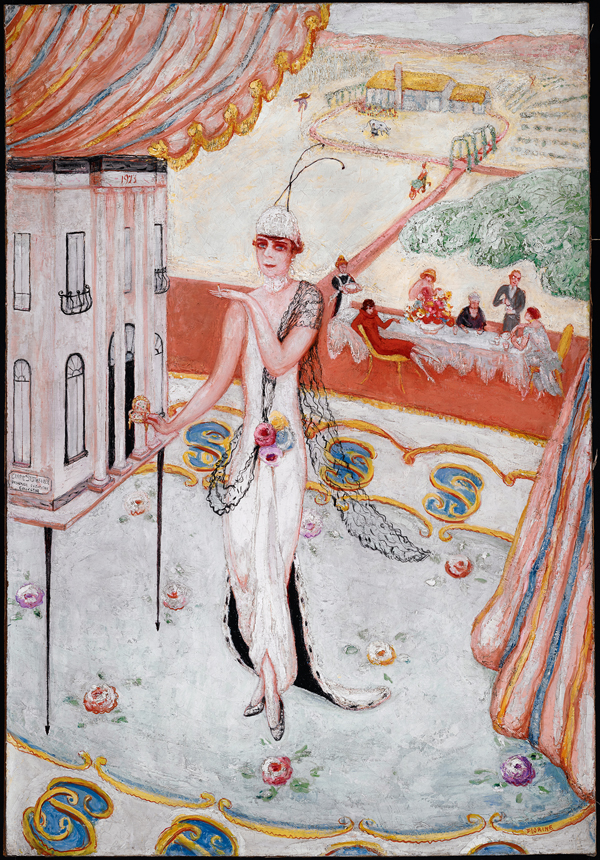
Carrie's doll's house appears to have impressed Florine even more directly. In 1923 Florine executed a triptych of herself and her two sisters. In the canvases of herself and Ettie, reclining figures float promiscuously in the day and the night skies respectively. In Carrie's portrait, the doll's house is represented as a full-scale participant in the image: Carrie introduces it to the observer (Figure 9). Carrie is an elaborately dressed creature of the sort identified by Sontag as Camp: exaggeratedly sinuous, thin, timeless, androgynous.Footnote 35 The model is treated as her alter ego. Both Carrie and the model are dressed in white with pink shading. The doll's house is as elegantly posed as its maker, set on a simple table balanced on unlikely arrow-like legs. Its rooms and the miniatures contained in them are hidden behind its facade. And the model is even identified as Carrie with a plaque on its side, reading “Carrie Stettheimer Designer Decorator Collector.” Carrie gestures towards the model with her left hand (which holds a cigarette) while demonstrating its contents by holding a tiny gilt armchair in front of its entrance. The foreground space occupied by Carrie and her model is carefully delimited. The ground plane, determined by a large oval carpet (bordered with Carrie's monograph), inclines towards the viewer. Curtains suggest the closure of both sides of the picture. Depicted behind Carrie and the model is the ambiguous space of a dream, representing the Stettheimer family in the back garden of André Brook.
Florine Stettheimer, Portrait of My Sister Carrie W. Stettheimer, 1923, 37·84″ × 26″. Courtesy of the Avery Archives, Columbia University, and the permission of Alan Solomon.

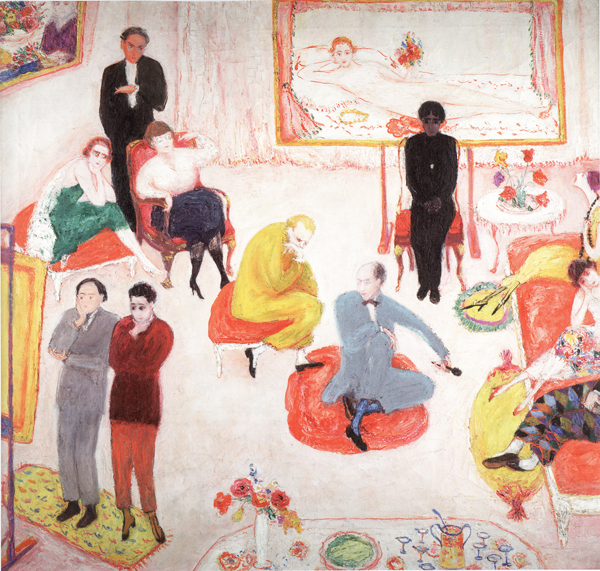
The new pleasure that Ettie takes in rooms adds ornamentally to her writing, but doesn't make it any better.Footnote 36 In contrast, a remarkably similar new concern with discrete, highly personalized sites transformatively improves Florine's painting after 1916.Footnote 37 The Studio Party (Soirée), of 1917–19, exemplifies this shift (Figure 10). Here are distributed, in unrelated patches of color, Florine's family members, friends, paintings, and possessions. Well-known artists and writers – Albert and Juliette Gleizes, Gaston Lachaise, Maurice Stern, Avery Hopwood, Leo Stein, and the Indian poet Sankar – are decoratively distributed around the canvas.Footnote 38 Ettie attends the gathering. Rosetta is included in the corner of the painting in the upper left (Figure 7). Florine appears twice looking at the viewer: from the couch and from the canvas (Figure 8). Represented is a wonderfully incoherent situation in which no one talks to anyone else. Everyone looks absent; no one is eating or drinking; objects and people suffer in isolation. The dreaded ennui of a cocktail party is rendered as a visually, but not a socially, titillating melange. The image seems a perfect illustration of a poem, “Our Parties,” written by Florine at about the same time:
The ground that the party occupies is tilted towards the viewer, voyeuristically revealing a room from which the front wall has been removed. The figures are slender plastic things folded into different postures. They look and act like dolls of doll's houses. Dolls also make a brief appearance in Ettie's Love Days. Susanna pretends to be asleep, resolutely frustrating her husband's passion. He tries to move her body next to his. “How much she unconsciously contributed to the success of these operations, Susanna did not ask herself, but she acted up to the general situation with good will and a skill derived from experience in impersonating dolls and dead bodies.”Footnote 40
Florine Stettheimer, Studio Party (Soirée), 1917–19, 32″ × 33·5″. Courtesy of the Beinecke Rare Book and Manuscript Library, Yale University.

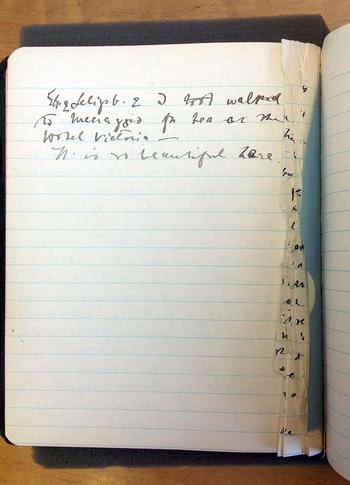
Though dolls appear in Ettie and Florine's work where they might not be expected, dolls aren't found in Carrie's model where they could be presumed. As its name suggests, a doll's house implies diminutive inhabitants. The child's fantasy is, for the most part, played out with the help of the dolls’ who occupy the house.Footnote 41 But the absence of dolls in the Stettheimer doll's house was naturalized by two circumstances: it was always under construction and it shared the space of Carrie and her sisters, its obvious inhabitants-to-be. Certainly miniature occupants were imagined. In a diary entry of 19 August 1921, Florine notes, “I made a sketch for the doll portraits for Carrie's dollhouse picture gallery.”Footnote 42 Portraits of figures who don't exist can apparently be painted. But a resistance to self-reproduction also contributed to the absence of dolls for the doll's house. During their lifetimes, the Stettheimers notoriously avoided having portraits made by outsiders. The anxiety about revealing themselves was expressed by Florine's wish to have her paintings destroyed when she died as well as by the violence of Ettie's editing of Florine's diaries before they were archived (Figure 11). Carrie literally conceives the non-presence of dolls in the model. In a letter written in 1931 to Gaston Lachaise, she writes enigmatically, “I am now hoping [the dolls] will never be born, so that I can keep them forever in custody, and enjoy them myself, while awaiting their arrival.”Footnote 43
Florine Stettheimer, diary eviscerated by Ettie Stettheimer. Author's photograph published with the permission of the Beinecke Rare Book and Manuscript Library, Yale University.

CANNY AND UNCANNY ACTS/STRONG AND WEAK MODELS
A model's strength or weakness is conditioned by its context. Carrie's doll's house was an effective agent while it was in her possession; it might even have been identified as a canny thing. “Canny” names the exposure of the ways things work; it implies a manifestation of mechanisms or actions that, in normal conditions, are hidden or obscure. For its maker the model worked as a mirror and even as an incubator – the means by which her progeny might sometime be generated. For at least some of Carrie's intimates it also acted as a catalyst for re-seeing the familiar. As so perfectly depicted in Florine's painting of 1923, Carrie's construction was a canny thing as well as a Camp object; it operated as her companion, as an affective work of art and as a strong model (Figure 9).
Carrie Stettheimer and her sister Florine both died in 1944. Ettie gifted Florine's paintings to various collections and Carrie's doll's house to the Museum of the City of New York. There, the doll's house's acquisition and exhibition were celebrated with a commemorative party for its maker in 1945. In its Stettheimer setting it was a canny interlocutor, but in its quotidian life in the Museum of the City of New York the model is mute. It is no longer an artwork, only a curious plaything: a doll's house missing its occupants. Ettie was never happy with its installation. After a visit to the museum with a friend in 1952, she wrote a complaint to the museum:
The only side the spotlight illumined was that consisting of the unfinished dining room, servant's quarters and back stairs.
I have felt heart-sick ever since. When the House was on the ground floor I complained repeatedly to Miss Pinny and I think on occasion to Mr. Sholle of the inadequate lighting, although compared with its present state it was almost brilliant.
Do you not think you owe it to the house itself to render it visible; and also to me, who besides presenting it, supplied and employed all the helpers involved in the rapid completion insisted upon by the Museum, with the exception of Miss Pinny's valuable aid. Also the cost of the catalogue was defrayed by me. I think you do.Footnote 44
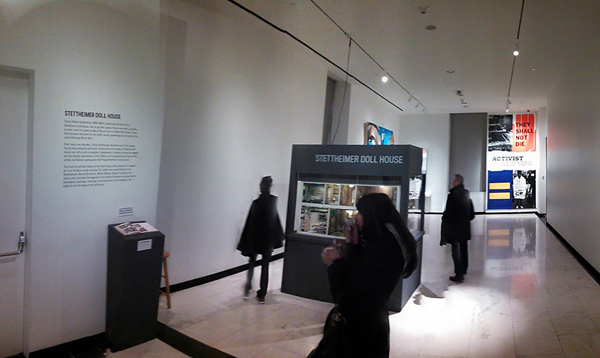
Now set at the badly lit end of the second-floor hallway, the doll's house is presented as a glass-encaged set of rooms (Figure 12). Stripped of its facade, it becomes a vitrine prison. Most observers understand the object as a wealthy child's toy; those who read the narrative labels perceive it as a small-scale repository of the life of an eccentric woman who never really grew up. Kaitlin Vaughan, a conceptual artist ensnared by the object, interviewed museum visitors:
One of the surprisingly large number of guests who described the house as creepy (curiously enough, mostly men), said it reminded him of Charlotte Perkins Gilman's The Yellow Wallpaper. Another said it reminded him of the movie “Psycho,” “Ya know,” he went on, “all the lights are on, but nobody's home.” The horror film comparison was brought up more than once. One patron confessed that he couldn't stop thinking about Lester Freamon, a detective on the TV show “The Wire,” who crafted miniatures in his spare time.Footnote 45
New York, Museum of the City of New York, view of the south end of the second-floor corridor with the Stettheimer doll's house. Photograph © flickr user Casey and Sonja; used under Creative Commons License CC BY-SA 2·0.

The Stettheimer doll's house is now uncanny. Both canny and uncanny imply a special relation to perception, a particular ability to either unmask (canny) or mask (uncanny). If canniness suggests insight into how things work, uncanniness signifies the frustration of understanding.Footnote 46 Uncanniness is associated with conditions that resist rational conceptualization and, consequently, feel dangerous. The uncanny is an affect of latent violence. The uncanny lurks in all kinds of places. For Sigmund Freud, it was the red-light quarter of a small Italian town which he attempted to escape, but to which he repeatedly returned:
Strolling through the empty and to me unfamiliar streets of a small Italian town, I found myself in a district about whose character I could not long remain in doubt. Only heavily made-up women were to be seen at the windows of the little houses, and I hastily left the narrow street at the next turning.Footnote 47
For Lila Crane (Vera Miles) in Hitchcock's Psycho and for Jonathan Harker in Bram Stoker's Dracula, it was a mirror.Footnote 48 If the uncanny comes as a surprise in urban mazes, mirrors, and multiple other sites, it habitually breeds in two things in particular: dolls and dwellings.
Dolls (china infants, plastic Barbies, stuffed animals) are, from childhood, associated with quotidian comfort and even occasional consolation. They are not instruments of passion, but rather objects of habitual and reliable satisfaction. Usually they are fully under our control, obedient extensions of ourselves into the alien world. When they are animated, their liveliness is a familiar expression of our own vitality. These objects are habitually active as partners in their possessor's imaginative adventures. Children's books and films abound with lovable anthropomorphized companion things. Hoffmann's Nutcracker, preparing to fight the Mouse King, chooses to wear as his favor Maria's simple ribbon rather than glamorous Clara's glittering wrap, reciprocating the little girl's love for him.Footnote 49 A. A. Milne's Christopher Robin assumes that the gentle adventures of his beloved stuffed animals told by his father are perfectly true.Footnote 50 Carlo Collodi's Pinocchio finally matures into his maker's son.Footnote 51
Precisely because of their dependable familiarity, dolls that act in unexpected ways are scary. When their habitual submission to their keepers morphs into mutiny, dolls become stock purveyors of the uncanny.Footnote 52 By breaching the safe, conventional boundaries separating the animal, human, machine, these aberrant dolls reveal themselves as unnatural. Whatever the malevolent source of their power, they become compelling representatives of the revolt of animals and machines against their human enslavers. Dolls can induce trauma simply by their absence. If a doll is not where it is expected to be, it might well cause hysteria – as in the all-too-familiar case of a child traveler forgetting to pack her transitional object. When, in an ordinary domestic setting and without explication, a doll goes missing, it may well elicit an anxiety about the doll's abduction by a malicious force. Perhaps, like Hans Bellmer's hideously dismembered and sutured mannequins, the beloved doll is the object of abuse.Footnote 53 Truancy might evoke the even greater fear that the doll has hidden itself with evil intent, as was the case with the demonic clown in one of the most frightening scenes of Steven Spielberg's Poltergeist. That dolls have apparently gone missing from the Stettheimer doll's house makes it uncanny. The house's emptiness offers a threat.
Dwellings, like the cherished doll, are typically sources of comfort and assurance. Most of us love our homes. I say goodbye to my house when I leave in the morning; it maintains a good-natured silence. But in Ettie Stettheimer's Love Days, when the protagonist Susanna smiled at the room that was so much her own, “her room smiled back at her.”Footnote 54 We are prepared for the dangers from the outside; we are unprepared for a threat from the beloved familiar. Unanticipated bad acts by dwellings, like those of dolls, are unsettling. When those acts bear intimations of death, they are uncanny. Haunted houses are a trope. Bodies, living or dead, ill-handled in the past, cling to the sites of their suffering, troubling their current occupants no matter how innocent they might be. What did Carol-Anne, the child abducted by the dead in Poltergeist, do to deserve what happened to her?Footnote 55 One of the objectives of the specters of Poltergeist, like that of the apparitions in most haunted properties, is to empty a space of its living occupants.
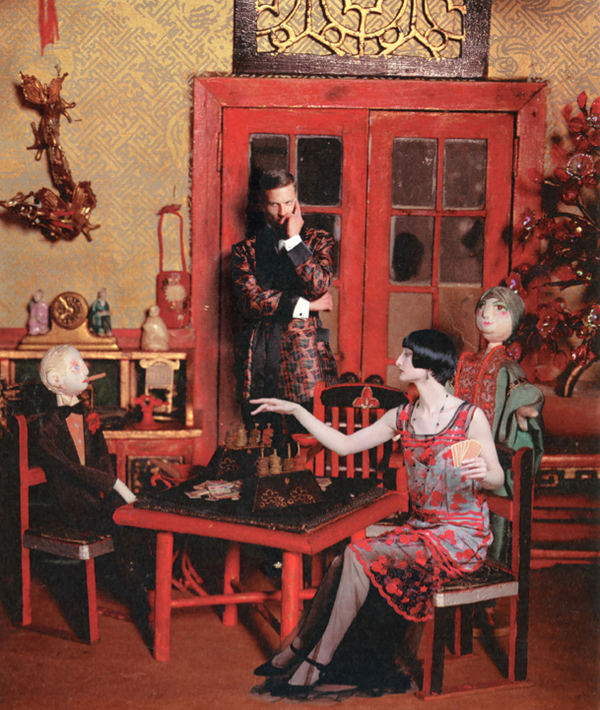
That the uncanniness of the Stettheimer doll's house arises from its doll-lessness is demonstrated by curatorial attempts to populate it. For the museum's curator of toys, John Noble, doll's houses required dolls. In the 1970s he made dolls for the house in the guise of Carrie Stettheimer with her family and friends (Figure 13).Footnote 56 Noble imposed not only posthumous portraits on the sisters, but also a moment that would assimilate them into a broader public: a Christmas party thrown by this secular Jewish family.Footnote 57 The Stettheimers were made to stage their festivity not just for their intimate friends, but for everyone: an invitation to attend the event was published in the New York Times.Footnote 58 In 1995, even fashion models crashed the party (Figure 14). The Stettheimers were Democrats, but not democrats. Ettie commented on the company that they had to keep on one of their transatlantic sailings: “And we have our usual bad-luck – we are at table with the most under bred people aboard.”Footnote 59 The guest list for a Stettheimer party was always carefully constructed and consciously exclusive.
David Levinthal, Polaroid photograph of Carrie Stettheimer doll's house, photographed for the Whitney retrospective of Florine Stettheimer, 1995. Published with the artist's permission.

New York Times magazine, 16 July 1995, fashion photograph by Barbara Bordnick, dollhouse photograph by David Levinthal, computer composite by Oliver Wasow, styled by Barbara Turk.

Noble's dolls, despite their imitation of Florine's painted figures, look out of place. Of course, even where they do belong, the dolls resident in doll's houses are never quite natural. Like the figures occupying John Martin's paintings, the “human” robots of video games, and the clip-art images populating the digital models of architects, they tend to undo the illusion of their settings. The respected New Zealand writer Katherine Mansfield captures something of the oddity of a doll's house. In a short story written at the same time as Carrie was constructing her model, Mansfield recognizes that dolls undo the deception of a miniature reality, rather than contribute to it. In contrast, its objects can be utterly immersive:
What Kezia liked more than anything, what she liked frightfully, was the lamp. It stood in the middle of the dining-room table, an exquisite little amber lamp with a white globe. It was even filled all ready for lighting, though of course you couldn't light it. But there was something inside that looked like oil and that moved when you shook it.
The father and mother dolls, who sprawled very stiff as though they had fainted in the drawing-room, and their two little children asleep upstairs, were really too big for the doll's house. They didn't look as though they belonged. But the lamp was perfect. It seemed to smile at Kezia, to say, “I live here.” The lamp was real.Footnote 60
Noble's oddly effervescent figures were certainly not compelling proxies for their missing human analogs. Even David Levinthal, who has animated toys so effectively in projects from Hitler Moves East to History, was unable to mask their alienness in the photographs that he produced for Florine's Whitney retrospective (Figure 14).Footnote 61 Those dolls, and the Christmas decorations with which Noble hoped to expunge the structure's uncanniness, are now gone.Footnote 62
The doll's house is once more uninhabited. While Carrie was its proprietor, the model had no dolls but didn't seem to miss them. In its former life, the doll's house was a mirror of Carrie's family and an artwork for her Campy friends. It was a strong model, provoking a change in Carrie's sisters’ artistic production. Now it is an ornamentally elaborate miniature house uncannily emptied of the tiny occupants expected by its observers. The doll's house no longer offers resistance to conventional bourgeois modes of commodity consumption, but appears to promote them. When it works at all, it works only as a weak model, passively subordinate to some lost referent. This model, once a doll's house, is now a dollhouse. A museum can have that effect.Footnote 63 Tracing the life of Carrie Stettheimer's doll's house suggests something of the way other models – social-scientific and scientific models as well as nonscientific ones – also work. Models’ strength and weakness are often derived from their referents’ status. But whether a model is strong or weak also depends on the conditions of its own history. A model that at its maturity has a powerful impact might, in its old age, be sadly impotent.