INTRODUCTION
The order Mysida contains 1128 species arranged in two families: Mysidae and Petalophthalmidae (cf. Mees & Meland, Reference Mees and Meland2013). Members of the order Mysida are known as mysids or opossum shrimps, the latter because mature females have a ventral brood pouch (marsupium). Most mysid species occur in the marine environment (>90%), from subpolar to tropical estuarine, neritic and oceanic waters (Mauchline, Reference Mauchline1980). They have a diverse diet, which may include algae, detritus and small invertebrates (Zagursky & Feller, Reference Zagursky and Feller1985; Takahashi & Kawaguchi, Reference Takahashi and Kawaguchi1998; Lehtiniemi & Nordström, Reference Lehtiniemi and Nordström2008). Thus, mysids play an important link as intermediate consumers in marine food webs, serving as food for invertebrates, fish, birds and mammals (Mauchline, Reference Mauchline1980). Mysids also have a major role in the benthic–pelagic coupling, a consequence of their hyperbenthic habit and strong vertical migratory behaviour (Calliari et al., Reference Calliari, Cervetto, Bastreri and Gómez2001; Taylor et al., Reference Taylor, Shellito, Abello and Jumars2005; Jumars, Reference Jumars2007).
Most available knowledge about mysids is derived from studies carried out in temperate regions of the northern hemisphere. In the south-west Atlantic, studies on mysids started with descriptions of new species collected sporadically in Brazilian coastal waters during international oceanographic expeditions (Dana, Reference Dana1852; Ortmann, Reference Ortmann and Hensen1893; Tattersall, Reference Tattersall1923; Coifmann, Reference Coifmann1937). Later, studies by local and foreign scientists broadened the knowledge about regional mysid species richness with the description of new species from Brazilian (Băcescu, Reference Băcescu1968a, Reference Băcescub, Reference Băcescuc, Reference Băcescu1969, Reference Băcescu1984, Reference Băcescu1986; Silva, Reference Silva1970a, Reference Silvab, Reference Silva1971a, Reference Silvab, Reference Silva1972, Reference Silva1974, Reference Silva1979a; Reis & Silva, Reference Reis and Silva1987; Bond-Buckup & Tavares, Reference Bond-Buckup and Tavares1992) and Argentine waters (Hoffmeyer, Reference Hoffmeyer1993; Carcedo et al., Reference Carcedo, Fiori and Hoffmeyer2013). To date, a limited amount of investigations concerning their biology (Loureiro Fernandes & Gama, Reference Loureiro Fernandes and Gama1996; Rörig et al., Reference Rörig, Resgalla, Pezzuto, Alves and Morelli1997; Gama & Zamboni, Reference Gama and Zamboni1999; Gama et al., Reference Gama, Montú and Gusmão2002, Reference Gama, Montú and D'Incao2006, Reference Gama, Calazans and Fontoura2011), distribution and/or population structure (Costa, Reference Costa1964; Almeida Prado, Reference Almeida Prado1973, Reference Almeida Prado1974; González, Reference González1974; Silva, Reference Silva1979b; Hoffmeyer, Reference Hoffmeyer1990; Tavares & Bond-Buckup, Reference Tavares and Bond-Buckup1990 (1992); Tararam et al., Reference Tararam, Wakabara and Flynn1996; Bond-Buckup & Tavares, Reference Bond-Buckup, Tavares and Young1998; Fries, Reference Fries1999; Calliari et al., Reference Calliari, Cervetto, Bastreri and Gómez2001, Reference Calliari, Cervetto, Castiglioni and Rodríguez2007; Schiariti et al., Reference Schiariti, Mianzan and Ramírez2004, Reference Schiariti, Berasategui, Giberto, Guerrero, Acha and Mianzan2006; Viñas et al., Reference Viñas, Ramírez and Mianzan2005; Cardelli et al., Reference Cardelli, Cervellini and Piccolo2006; Borzone et al., Reference Borzone, Lorenzi and Calil2007; Gama et al., Reference Gama, Cardozo and Fontoura2007; Calil & Borzone, Reference Calil and Borzone2008; Gama, Reference Gama2008) have been completed in the south-west Atlantic. In the late 1990s, Murano (Reference Murano and Boltovskoy1999) performed the most comprehensive review available to date of the mysidacean fauna (orders Mysida and Lophogastrida) of the South Atlantic Ocean, considering marine coastal and deep waters, including geographical and vertical distribution, detailed descriptions and illustrations of each species, and a taxonomic key for species identification. Since then, important results on regional mysids biodiversity have been gathered.
This paper revisits the mysid biodiversity in the south-west Atlantic with the goal of complementing and updating previous contributions, and identifying venues for future research. In particular, we add new species described or cited for the South Atlantic since Murano's (Reference Murano and Boltovskoy1999) review and update known species distribution based on recent evidences. Synonymies, body length and temperature–salinity range of occurrence of each species are also provided.
MATERIALS AND METHODS
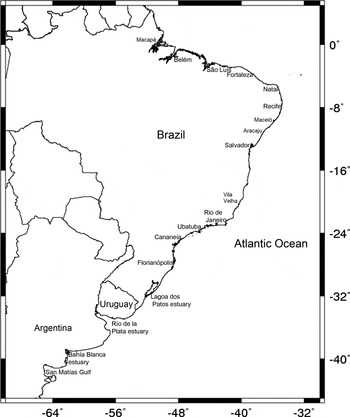
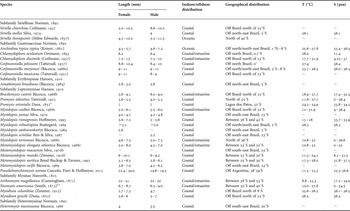
Information was primarily obtained from published studies or reviews, and academic theses. Grey literature was also taken into consideration, because important information on regional biodiversity is often only present in journals of very restricted circulation. Search for information employed tools such as Google Scholar and Web of Knowledge using terms [mysid*], [Brazil], [Uruguay], [Argentina], [Southwest Atlantic] as keywords. Search and identification of source information also relied on expert knowledge by authors. For the present study we considered species that occur in estuarine, coastal and oceanic waters between 0° (northern Brazil) and 40°S (Argentina) off South America (Figure 1). A list of all recorded species was compiled and is presented in Table 1 along with details of geographical distribution, body length, and temperature–salinity range of occurrence for each species. Species depth range of occurrence was not provided because this information was usually not available.
Map of south-west Atlantic.

List of species recorded in the south-west Atlantic with information on their body length, inshore/offshore and geographical distribution, and temperature (T) and salinity (S) range of occurrence.

*, alien species; **, cryptogenic species (potentially alien, not confirmed).
RESULTS
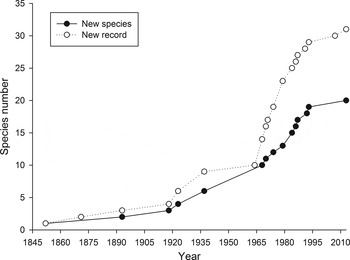
Available information indicated that in the south-west Atlantic the order Mysida is represented by 31 species, distributed in 14 genera, 6 subfamilies and one family (Table 1). Species originally described from specimens collected in the south-west Atlantic sum up to 20 (Figure 2). Most of these species have been described between 1968 and 1993, mainly by Băcescu (Reference Băcescu1968a, Reference Băcescub, Reference Băcescuc, Reference Băcescu1969, Reference Băcescu1984, Reference Băcescu1986) and Silva (Reference Silva1970b, Reference Silva1974, Reference Silva1979a). After 1993, only one new mysid species (Carcedo et al., Reference Carcedo, Fiori and Hoffmeyer2013) has been described in the south-west Atlantic.
Cumulative number of currently valid species described (solid circle) and recorded (open circle) along the years in the south-west Atlantic.

SYSTEMATICS
Order MYSIDA Haworth, Reference Haworth1825
Family MYSIDAE Haworth, Reference Haworth1825
Subfamily SIRIELLINAE Norman, Reference Norman1892
Genus Siriella Dana, Reference Dana1850
GENERAL REMARKS
Of 80 Siriella species currently described (Mees & Meland, Reference Mees and Meland2013) only three were recorded in the south-west Atlantic, with S. melloi Silva, Reference Silva1974 being exclusive to Brazilian waters. Identification uncertainties of Siriella species may arise as a result of the fact that organisms belonging to this genus usually continue growing after sexual maturity, thus showing some morphological variation compared with available descriptions (Tattersall, Reference Tattersall1955). Species identification depends on the analysis of the male, as females of congeneric species are very similar and may not be distinguished from one another (Ii, Reference Ii1964). The three Siriella species that were recorded in the south-west Atlantic can be distinguished from each other by the analysis of the male third and fourth pleopods.
Siriella species usually perform diel vertical migration, staying at deeper waters during daytime and closer to the surface at night (Tattersall, Reference Tattersall1955).
Siriella chierchiae Coifmann, Reference Coifmann1937
Siriella occidentalis Tattersall, Reference Tattersall1937: 6, figures 3, 4.
Siriella chierchiae Coifmann, Reference Coifmann1937: 3, figure 1; Tattersall, Reference Tattersall1951: 66, figures 15, 16; Costa, Reference Costa1964: 3, figure 57; Brattegard, Reference Brattegard1970a: 2, figure 1; Brattegard, Reference Brattegard1970b: 116, figure 2; Escobar-Briones & Soto, Reference Escobar-Briones and Soto1989: 33, figure 3; Price et al., Reference Price, Heard, Harris and McCoy2002: 40, figures 3B, 4C; Price & Heard, Reference Price and Heard2004: 149, figure 3A.
GENERAL REMARKS
Siriella chierchiae is abundant in the western tropical Atlantic, mainly in coastal waters (Tattersall, Reference Tattersall1951).
DISTRIBUTION
South-west Atlantic
Brazil: Rio Grande do Norte, mouth of Potengy River (Băcescu, Reference Băcescu1984); Bahia (Coifmann, Reference Coifmann1937); and Rio de Janeiro, Urca (Costa, Reference Costa1964).
Others
Caribbean Sea (Tattersall, Reference Tattersall1951; Brattegard, Reference Brattegard1970a, Reference Brattegardb, Reference Brattegard1973, Reference Brattegard1974a, Reference Brattegardb, Reference Brattegard1975; Băcescu & Ortiz, Reference Băcescu and Ortiz1984; Modlin, Reference Modlin1987); Gulf of Mexico (Modlin, Reference Modlin1984; Escobar-Briones & Soto, Reference Escobar-Briones and Soto1988, Reference Escobar-Briones and Soto1989, Reference Escobar-Briones and Soto1991); and Key West, Florida (Tattersall, Reference Tattersall1951).
Siriella melloi Silva, Reference Silva1974
Siriella melloi Silva, Reference Silva1974: 1, figures 1–7.
DISTRIBUTION
North-east Brazil (Silva, Reference Silva1974, Reference Silva1979b).
Siriella thompsonii (Milne Edwards, Reference Milne Edwards1837)
Cynthia thompsoni Milne Edwards, Reference Milne Edwards1837: 462.
Siriella thompsonii: Sars, Reference Sars1885: 205, plate 36, figures 1–24; Ii, Reference Ii1964: 62, figures 14–15; Pillai, Reference Pillai1965: 1693, figure 19; Stuck et al., Reference Stuck, Perry and Heard1979a: 234, figures 2F–5F; Heard et al., Reference Heard, Price, Knott, King and Allen2006: 25, figure 22.
DISTRIBUTION
South-west Atlantic
Off Brazil (Coifmann, Reference Coifmann1937; W.M. Tattersall, Reference Tattersall1951; O.S. Tattersall, Reference Tattersall1955; authors' own unpublished data).
Others
Worldwide between 40°N and 40°S (W.M. Tattersall, Reference Tattersall1923, Reference Tattersall1951; O.S. Tattersall, Reference Tattersall1955, Reference Tattersall1962; Ii, Reference Ii1964; Stuck et al., Reference Stuck, Perry and Heard1979b; Price et al., Reference Price, McAllister, Towsley and DelRe1986).
Subfamily GASTROSACCINAE Norman, Reference Norman1892
Genus Anchialina Norman & Scott, Reference Norman and Scott1906
GENERAL REMARKS
There are 17 described species of Anchialina (cf. Mees & Meland, Reference Mees and Meland2013), but only one has been registered in the south-west Atlantic.
Anchialina typica typica (Krøyer, Reference Krøyer1861)
Anchialus typicus Krøyer, Reference Krøyer1861: 53, plate 2, figure 7A–L.
Anchialina typica: Brattegard, Reference Brattegard1970a: 24, figure 6; Nouvel, Reference Nouvel1943: 70, plate 4, figures 109–110; Stuck et al., Reference Stuck, Perry and Heard1979a: 227, figures 2a–5a; Băcescu & Ortiz, Reference Băcescu and Ortiz1984: 16, figure 1B; Price et al., Reference Price, Heard, Harris and McCoy2002: 41, figure 4E; Price & Heard, Reference Price and Heard2004: 149, figure 3D; Heard et al., Reference Heard, Price, Knott, King and Allen2006: 25, figure 6.
Anchialina typica typica: Nouvel, Reference Nouvel1971: 327, figure 1.
GENERAL REMARKS
Nouvel (Reference Nouvel1971) separated Anchialina typica (Krøyer, Reference Krøyer1861) in two subspecies: Anchialina typica typica from Atlantic waters and Anchialina typica orientalis Nouvel, Reference Nouvel1971 from the Indo-Pacific.
DISTRIBUTION
South-west Atlantic
Brazil: off north and north-east coasts (Silva, Reference Silva1979b); and Rio de Janeiro (Tattersall, Reference Tattersall1923).
Others
Caribbean Sea (Brattegard, Reference Brattegard1973, Reference Brattegard1974a, Reference Brattegard1975; Băcescu & Ortiz, Reference Băcescu and Ortiz1984; Price et al., Reference Price, Heard, Harris and McCoy2002; Price & Heard, Reference Price and Heard2004); Gulf of Mexico (Stuck et al., Reference Stuck, Perry and Heard1979b; Price et al., Reference Price, McAllister, Towsley and DelRe1986; Escobar-Briones & Soto, Reference Escobar-Briones and Soto1991); Bahamas and Florida (Brattegard, Reference Brattegard1970a); and USA Atlantic coast (Wigley & Burns, Reference Wigley and Burns1971).
Genus Chlamydopleon Ortmann, Reference Ortmann and Hensen1893
GENERAL REMARKS
Wittmann (Reference Wittmann2009) re-described the type material of Chlamydopleon aculeatum Ortmann, Reference Ortmann and Hensen1893, as the original description made by Ortmann (Reference Ortmann and Hensen1893) was considered inadequate (Tattersall, Reference Tattersall1951). Thus, Wittmann (Reference Wittmann2009) revalidated the genus Chlamydopleon, and consequently invalidated the junior synonym Bowmaniella Heard & Price, Reference Heard and Price2006. He also provided a taxonomic key to identify the three species of Chlamydopleon (cf. Wittmann, Reference Wittmann2009). This genus can be distinguished from Coifmanniella Heard & Price, Reference Heard and Price2006 by the presence of the articulated dorsal process on the fifth abdominal segment (Heard & Price, Reference Heard and Price2006).
Chlamydopleon aculeatum Ortmann, Reference Ortmann and Hensen1893
Chlamydopleon aculeatum Ortmann, Reference Ortmann and Hensen1893: 25, plate 2, figure 1; Wittmann, Reference Wittmann2009: 23, figure 1A–H.
DISTRIBUTION
Brazil: Pará, Tocantis River mouth (Ortmann, Reference Ortmann and Hensen1893).
Chlamydopleon dissimile (Coifmann, Reference Coifmann1937)
Gastrosaccus dissimilis Coifmann, Reference Coifmann1937: 5, figures 2–3; Tattersall, Reference Tattersall1951: 97, figure 29; Costa, Reference Costa1964: 4, plate 1, figures 1–4.
Bowmaniella (Coifmanniella) dissimilis: Băcescu, Reference Băcescu1968a: 363, figure 4.
Bowmaniella dissimilis: Brattegard, Reference Brattegard1970a: 11, figure 2; Heard & Price, Reference Heard and Price2006: 7, figures 1, 2C–D, 4A, 5A, 6A–B, 8F; Heard et al., Reference Heard, Price, Knott, King and Allen2006: 26, figure 8.
Bowmaniella (Coifmanniella) brasiliensis Băcescu, Reference Băcescu1968a: 363, figures 5–6; Almeida Prado, Reference Almeida Prado1974: 49, figures 2–4.
Bowmaniella brasiliensis: Stuck et al., Reference Stuck, Perry and Heard1979a: 233, figures 2D, 3D, 4C, 5D, 7; Price, Reference Price1982: 13, figure 4.
Bowmaniella floridana Holmquist, Reference Holmquist1975: 68; Stuck et al., Reference Stuck, Perry and Heard1979a: 227, figures 2C, 3C, 4D, 5C, 6; Price, Reference Price1982: 14, figures 2–3. Escobar-Briones & Soto, Reference Escobar-Briones and Soto1989: 34, figure 4.
Chlamydopleon dissimile: Wittmann, Reference Wittmann2009: 24, figure 1J–L.
GENERAL REMARKS
This burrowing species is one of the most common and abundant Gastrosaccinae in the south-west Atlantic.
DISTRIBUTION
South-west Atlantic
Brazil: Rio Grande do Norte, mouth of Potengy River (Băcescu, Reference Băcescu1984); Bahia (Coifmann, Reference Coifmann1937); Rio de Janeiro, Mangaratiba Bay (Costa, Reference Costa1964; Băcescu, Reference Băcescu1968a), and Sepetiba Bay (Băcescu, Reference Băcescu1968a); São Paulo, Cananeia estuary (Almeida Prado, Reference Almeida Prado1973, Reference Almeida Prado1974; Tararam et al., Reference Tararam, Wakabara and Flynn1996; authors' own unpublished data); Paraná, Atami and Mansa beaches (Borzone et al., Reference Borzone, Lorenzi and Calil2007); and Rio Grande do Sul, Lagoa dos Patos estuary (Gama, Reference Gama2008).
Others
Caribbean Sea (Brattegard, Reference Brattegard1973, Reference Brattegard1974a, Reference Brattegardb); Gulf of Mexico (Băcescu, Reference Băcescu1968a; Stuck et al., Reference Stuck, Perry and Heard1979b; Escobar-Briones & Soto, Reference Escobar-Briones and Soto1988, Reference Escobar-Briones and Soto1989, Reference Escobar-Briones and Soto1991); Florida (Brattegard, Reference Brattegard1970a); and USA Atlantic coast (Hopkins, Reference Hopkins1965; Heard et al., Reference Heard, Price, Knott, King and Allen2006 and references therein).
Genus Coifmanniella Heard & Price, Reference Heard and Price2006
GENERAL REMARKS
This genus differs from Chlamydopleon by the absence of the articulated process in the posterodorsal margin of the abdominal segment 5 (Heard & Price, Reference Heard and Price2006).
Coifmanniella johnsoni (Tattersall, Reference Tattersall1937)
Gastrosaccus johnsoni Tattersall, Reference Tattersall1937: 9, figures 5–7; Tattersall, Reference Tattersall1951: 93, figures 26–28.
Bowmaniella (Bowmaniella) johnsoni: Băcescu, Reference Băcescu1968a: 356, figures 2F, 3C; Price et al., Reference Price, Heard, Harris and McCoy2002: 41, figure 4F; Price & Heard, Reference Price and Heard2004: 150, figure 3E.
Bowmaniella bacescui Brattegard, Reference Brattegard1970a: 20, figure 5; Silva, Reference Silva1979b: 4, figure 3.
Coifmanniella johnsoni: Heard & Price, Reference Heard and Price2006: 15, figures 2A, B, 3A–D, 4C, 5C.
DISTRIBUTION
South-west Atlantic
North Brazil (Silva, Reference Silva1979b).
Others
Caribbean Sea (Tattersall, Reference Tattersall1937; Brattegard, Reference Brattegard1974b, Reference Brattegard1975; Price et al., Reference Price, Heard, Harris and McCoy2002; Price & Heard, Reference Price and Heard2004); Gulf of Mexico (Modlin, Reference Modlin1984; Escobar-Briones & Soto, Reference Escobar-Briones and Soto1991); and Bahamas (Brattegard, Reference Brattegard1970a).
Coifmanniella merjonesi (Băcescu, Reference Băcescu1968a)
Bowmaniella (Coifmanniella) merjonesi Băcescu, Reference Băcescu1968a: 356, figures 7–9.
Bowmaniella recifensis Silva, Reference Silva1971b: 185, figures 1–2.
Bowmaniella inarticulata Silva, Reference Silva1972: 161, figure 1.
Coifmanniella merjonesi: Heard & Price, Reference Heard and Price2006: 21, figures 3 G, H, 4E, 5E.
DISTRIBUTION
South-west Atlantic
North-east Brazil (Silva, Reference Silva1971b, Reference Silva1972, Reference Silva1979b).
Others
Caribbean Sea (Băcescu, Reference Băcescu1968a; Heard & Price, Reference Heard and Price2006).
Coifmanniella mexicana (Tattersall, Reference Tattersall1951)
Gastrosaccus mexicanus Tattersall, Reference Tattersall1951: 98, figure 30.
Bowmaniella (Coifmanniella) mexicana: Băcescu, Reference Băcescu1968a: 356.
Bowmaniella mexicana: Brattegard, Reference Brattegard1970a: 9, tables 7–8; Heard et al., Reference Heard, Price, Knott, King and Allen2006: 27, figure 9.
Bowmaniella (Bowmaniella) atlantica Silva, Reference Silva1971a: 159 (=Gastrosaccus brasiliensis sensu Silva, Reference Silva1970a: 35, figure 1).
Bowmaniella portoricensis Băcescu, Reference Băcescu1968a: 357, figures 1, 2A–E, 3A–B; Brattegard, Reference Brattegard1970a: 9, tables 7–8; Stuck et al., Reference Stuck, Perry and Heard1979a: 227, figures 2B–5B.
Bowmaniella gutzui Ortiz, Reference Ortiz1988: 4, figure 1.
Coifmanniella mexicana: Heard & Price, Reference Heard and Price2006: 18, figures 3E, F, 4D, 5D.
DISTRIBUTION
South-west Atlantic
Brazil: Rio de Janeiro, Sepetiba Bay (Silva, Reference Silva1970a, Reference Silva1971a).
Others
Gulf of Mexico (Tattersall, Reference Tattersall1951; Stuck et al., Reference Stuck, Perry and Heard1979b); Cuba (Ortiz, Reference Ortiz1988); USA Atlantic coast (Băcescu, Reference Băcescu1968a; Wigley & Burns, Reference Wigley and Burns1971; Heard et al., Reference Heard, Price, Knott, King and Allen2006); and Pacific coast of Panama (Tattersall, Reference Tattersall1951).
Subfamily ERYTHROPINAE Hansen, Reference Hansen1910
Genus Amathimysis Brattegard, Reference Brattegard1969
GENERAL REMARKS
Amathimysis was considered a subgenus of Katerythops Holt & Tattersall, Reference Holt and Tattersall1905, but was elevated to a valid genus (Murano & Chess, Reference Murano and Chess1987).
Amathimysis brasiliana (Băcescu, Reference Băcescu1984)
Katerythops (Amathimysis) brasiliana Băcescu, Reference Băcescu1984: 3, figure 1.
DISTRIBUTION
Brazil: Rio Grande do Norte, mouth of Potengy River (Băcescu, Reference Băcescu1984).
Subfamily LEPTOMYSINAE Hansen, Reference Hansen1910
Genus Brasilomysis Băcescu, Reference Băcescu1968b
GENERAL REMARKS
There are two species of Brasilomysis: B. castroi Băcescu, Reference Băcescu1968b and B. inermis (Coifmann, Reference Coifmann1937). The latter occurs on the Pacific coast of South America (Coifmann, Reference Coifmann1937), whereas B. castroi is limited to Atlantic waters (Murano, Reference Murano and Boltovskoy1999).
Brasilomysis castroi Băcescu, Reference Băcescu1968b
Brasilomysis castroi Băcescu, Reference Băcescu1968b: 81, figures 3–4; Brattegard, Reference Brattegard1969: 61, figure 18; Almeida Prado, Reference Almeida Prado1974: 50, figures 5–7; Stuck et al., Reference Stuck, Perry and Heard1979a: 236, figures 2N, 3N, 4N, 5O; Price, Reference Price1982: 16, figures 13–14; Escobar-Briones & Soto, Reference Escobar-Briones and Soto1989: 34, figure 5; Heard et al., Reference Heard, Price, Knott, King and Allen2006: 30, figure 24.
DISTRIBUTION
South-west Atlantic
Brazil: Rio de Janeiro, Sepetiba Bay (Băcescu, Reference Băcescu1968b); São Paulo, Ubatuba (Băcescu, Reference Băcescu1968b), and Cananeia estuary (Almeida Prado, Reference Almeida Prado1973, Reference Almeida Prado1974; Tararam et al., Reference Tararam, Wakabara and Flynn1996; authors' own unpublished data); Paraná, Atami and Mansa beaches (Borzone et al., Reference Borzone, Lorenzi and Calil2007).
Others
Caribbean Sea (Brattegard, Reference Brattegard1973, Reference Brattegard1974a, Reference Brattegardb); Gulf of Mexico (Stuck et al., Reference Stuck, Perry and Heard1979b; Price et al., Reference Price, McAllister, Towsley and DelRe1986); Florida (Brattegard, Reference Brattegard1969); and USA Atlantic coast (Heard et al., Reference Heard, Price, Knott, King and Allen2006).
Genus Promysis Dana, Reference Dana1850
GENERAL REMARKS
The two valid Promysis species, P. atlantica Tattersall, Reference Tattersall1923 and P. orientalis Dana, Reference Dana1852, were recorded in the south-west Atlantic. However, P. orientalis is an alien species (see Discussion).
Promysis atlantica Tattersall, Reference Tattersall1923
Promysis atlantica Tattersall, Reference Tattersall1923: 286, plate 1, figures 5–6; Tattersall, Reference Tattersall1951: 245, figure 56; Clarke, Reference Clarke1956: 1, figures 1–6; Costa, Reference Costa1964: 8, plate 2, figures 1–2; Brattegard, Reference Brattegard1973: 44, figure 18; Almeida Prado, Reference Almeida Prado1974: 52, figures 15–17; Silva, Reference Silva1979b: 8, figure 4; Stuck et al., Reference Stuck, Perry and Heard1979a: 234, figures 2G–5G; Price, Reference Price1982: 15, figures 5–6; Tavares & Bond-Buckup, Reference Tavares and Bond-Buckup1990 (1992): 55, figures 24–28; Heard et al., Reference Heard, Price, Knott, King and Allen2006: 31, figure 12.
DISTRIBUTION
South-west Atlantic
Brazil: Ceará (Silva, Reference Silva1979b); Espírito Santo, Vitória Bay (Sterza & Loureiro Fernandes, Reference Sterza and Loureiro Fernandes2006); Rio de Janeiro, six miles off Rio de Janeiro Harbour (Tattersall, Reference Tattersall1923), and Guanabara Bay (Costa, Reference Costa1964); São Paulo, Ubatuba (Băcescu, Reference Băcescu1968c), Santos (authors' own unpublished data), and Cananeia estuary (Almeida Prado, Reference Almeida Prado1973, Reference Almeida Prado1974); Paraná, Atami Beach (Borzone et al., Reference Borzone, Lorenzi and Calil2007); Santa Catarina (Resgalla, Reference Resgalla2011); and Rio Grande do Sul, Tramandaí (Tavares & Bond-Buckup, Reference Tavares and Bond-Buckup1990 (1992)), and Lagoa dos Patos estuary (Gama, Reference Gama2008). Uruguay: Río de la Plata estuary (authors' own unpublished data).
Others
Caribbean Sea (Brattegard, Reference Brattegard1973, Reference Brattegard1974a); Gulf of Mexico (Stuck et al., Reference Stuck, Perry and Heard1979b; Price et al., Reference Price, McAllister, Towsley and DelRe1986); and USA Atlantic coast (Clarke, Reference Clarke1956; Williams, Reference Williams1972; Heard et al., Reference Heard, Price, Knott, King and Allen2006).
Promysis orientalis Dana, Reference Dana1852
Promysis orientalis Dana, Reference Dana1852: 651; Dana, Reference Dana1855: plate 43, figure 4A–C; Ii, Reference Ii1964: 392, figure 99; Pillai, Reference Pillai1965: 1713, figure 71; Pillai, Reference Pillai1973: 98, figure 53.
Uromysis armata Hansen, Reference Hansen1910: 72, plate 11, figure 2A–N.
DISTRIBUTION
South-west Atlantic
Brazil: Rio Grande do Sul, Lagoa dos Patos estuary (Gama et al., Reference Gama, Cardozo and Fontoura2007; Gama, Reference Gama2008).
Others
Indo-Pacific (Hansen, Reference Hansen1910; Tattersall, Reference Tattersall1951; Ii, Reference Ii1964; Pillai, Reference Pillai1965, Reference Pillai1973).
Genus Mysidopsis Sars, Reference Sars1864
GENERAL REMARKS
Mysidopsis is the most speciose genus in the south-west Atlantic, with 7 registered species. However, most of these species were recorded only once. A taxonomic key to identify Mysidopsis species from warm waters of the western Atlantic was provided by Brattegard (Reference Brattegard1969).
Mysidopsis coelhoi Băcescu, Reference Băcescu1968c
Mysidopsis coelhoi Băcescu, Reference Băcescu1968c: 245, figure 5; Almeida Prado, Reference Almeida Prado1974: 51, figures 10–12.
DISTRIBUTION
Brazil: north-east Brazil (Silva, Reference Silva1979b); São Paulo, Ubatuba (Băcescu, Reference Băcescu1968c) and Cananeia estuary (Almeida Prado, Reference Almeida Prado1973, Reference Almeida Prado1974; Tararam et al., Reference Tararam, Wakabara and Flynn1996; authors' own unpublished data); Paraná, Atami and Mansa beaches (Borzone et al., Reference Borzone, Lorenzi and Calil2007); Rio Grande do Sul, Lagoa dos Patos estuary (Gama, Reference Gama2008).
Mysidopsis juniae Silva, Reference Silva1979
Mysidopsis juniae Silva, Reference Silva1979a: 1, figure 1.
GENERAL REMARKS
In Brazil, this species is frequently used in toxicity tests (e.g. Nipper et al., Reference Nipper, Badaró-Pedroso, José and Melo1993; Lopes et al., Reference Lopes, Milanelli, Prosperi, Zanardi and Truzzi1997).
DISTRIBUTION
Brazil: São Paulo, São Sebastião (Silva, Reference Silva1979a; Fries, Reference Fries1999) and Cananeia estuary (authors' own unpublished data).
Mysidopsis rionegrensis Hoffmeyer, Reference Hoffmeyer1993
Mysidopsis rionegrensis Hoffmeyer, Reference Hoffmeyer1993: 15, figure 1–2; Schiariti et al., Reference Schiariti, Mianzan and Ramírez2004: 890, figure 2B.
DISTRIBUTION
Uruguay: Río de la Plata estuary (authors' own unpublished data). Argentina: Buenos Aires coastal waters (Schiariti et al., Reference Schiariti, Mianzan and Ramírez2004); San Matías Gulf (Hoffmeyer, Reference Hoffmeyer1993); and Nuevo Gulf (Menéndez et al., Reference Menéndez, Biancalana, Berasategui, Fernández Severini, Hoffmeyer and Esteves2011).
Mysidopsis robustispina Brattegard, Reference Brattegard1969
Mysidopsis robustispina Brattegard, Reference Brattegard1969: 56, figures 16–17; Brattegard, Reference Brattegard1973: 26, figure 9.
DISTRIBUTION
South-west Atlantic
North-east Brazil (Silva, Reference Silva1979b).
Others
Bahamas (Brattegard, Reference Brattegard1969).
Mysidopsis sankarankuttyi Băcescu, Reference Băcescu1984
Mysidopsis sankarankuttyi Băcescu, Reference Băcescu1984: 6, figure 2.
DISTRIBUTION
Brazil: Rio Grande do Norte, mouth of Potengi River (Băcescu, Reference Băcescu1984).
Mysidopsis scintilae Reis & Silva, Reference Reis and Silva1987
Mysidopsis scintilae Reis & Silva, Reference Reis and Silva1987: 5, plates 1, 5.
DISTRIBUTION
Brazil: Rio de Janeiro (Reis & Silva, Reference Reis and Silva1987).
Mysidopsis tortonesei Băcescu, Reference Băcescu1968c
Mysidopsis tortonesei Băcescu, Reference Băcescu1968c: 242, figure 4; Tavares & Bond-Buckup, Reference Tavares and Bond-Buckup1990 (1992): 55, figures 10–23; Schiariti et al., Reference Schiariti, Mianzan and Ramírez2004: 888, figure 2A.
Mysidopsis tortonesi: Brattegard, Reference Brattegard1973: 27, figure 10; Almeida Prado, Reference Almeida Prado1974: 52, figures 13–14.
DISTRIBUTION
South-west Atlantic
Brazil: Paraíba (Silva, Reference Silva1979b); São Paulo, Ubatuba (Băcescu, Reference Băcescu1968c), and Cananeia estuary (Almeida Prado, Reference Almeida Prado1973, Reference Almeida Prado1974; Tararam et al., Reference Tararam, Wakabara and Flynn1996); Paraná, Atami Beach (Borzone et al., Reference Borzone, Lorenzi and Calil2007); Rio Grande do Sul, Tramandaí (Tavares & Bond-Buckup, Reference Tavares and Bond-Buckup1990 (1992)) and Lagoa dos Patos estuary (Gama, Reference Gama2008). Uruguay: Río de la Plata estuary (Calliari et al., Reference Calliari, Cervetto, Castiglioni and Rodríguez2007). Argentina: Río de la Plata estuary (Schiariti et al., Reference Schiariti, Mianzan and Ramírez2004).
Others
Caribbean coast of Colombia (Brattegard, Reference Brattegard1973, Reference Brattegard1974a).
Genus Metamysidopsis Tattersall, Reference Tattersall1951
GENERAL REMARKS
Four species and one subspecies of Metamysidopsis were recorded in the south-west Atlantic. A taxonomic key to identify the Metamysidopsis species can be found in Băcescu (Reference Băcescu1969) and Brattegard (Reference Brattegard1970b).
Metamysidopsis elongata atlantica Băcescu, Reference Băcescu1968c
Metamysidopsis elongata atlantica Băcescu, Reference Băcescu1968c: 237, figure 2; Almeida Prado, Reference Almeida Prado1974: 51, figures 8–9.
GENERAL REMARKS
Băcescu (Reference Băcescu1968c) described M. e. atlantica to separate it from the Pacific subspecies M. e. elongata (Holmes, Reference Holmes1900). Metamysidopsis e. atlantica usually is the most abundant and common species in coastal and estuarine waters of the south/south-east Brazilian coast (Bersano, Reference Bersano1994; Tararam et al., Reference Tararam, Wakabara and Flynn1996; authors' own unpublished data), consequently it is the most studied species in this region. Studies relating to rearing techniques, feeding rates, moulting cycle, growth and response to gradients of temperature and salinity were carried out under laboratory conditions (Rörig et al., Reference Rörig, Resgalla, Pezzuto, Alves and Morelli1997; Gama & Zamboni, Reference Gama and Zamboni1999; Gama et al., Reference Gama, Montú and Gusmão2002, Reference Gama, Montú and D'Incao2006, Reference Gama, Calazans and Fontoura2011).
DISTRIBUTION
Brazil: São Paulo, Ubatuba (Băcescu, Reference Băcescu1968c), São Sebastião (Fries, Reference Fries1999), Una do Prelado River (Lansac Tôha & Lima, Reference Lansac Tôha and Lima1993) and Cananeia estuary (Almeida Prado, Reference Almeida Prado1973, Reference Almeida Prado1974; Tararam et al., Reference Tararam, Wakabara and Flynn1996); Santa Catarina (Rörig et al., Reference Rörig, Resgalla, Pezzuto, Alves and Morelli1997; Resgalla, Reference Resgalla2011); Rio Grande do Sul, Tramandaí Beach (Avila et al., Reference Avila, Pedrozo and Bersano2009), Lagoa dos Patos estuary (Gama, Reference Gama2008; Avila et al., Reference Avila, Machado and Bianchini2011) and Cassino Beach (Bersano, Reference Bersano1994; Avila et al., Reference Avila, Machado and Bianchini2011).
Metamysidopsis macaensis Silva, Reference Silva1970b
Metamysidopsis macaensis Silva, Reference Silva1970b: 199, figures 1–4.
DISTRIBUTION
Brazil: Rio de Janeiro and São Paulo (Silva, Reference Silva1970b).
Metamysidopsis munda (Zimmer, Reference Zimmer1918)
Mysidopsis munda Zimmer, Reference Zimmer1918: 17, figures 8–15.
Metamysidopsis munda: Băcescu, Reference Băcescu1969: 352, figure 2A–J; Tavares & Bond-Buckup, Reference Tavares and Bond-Buckup1990 (1992): 49, figures 1–7.
GENERAL REMARKS
Loureiro Fernandes & Gama (Reference Loureiro Fernandes and Gama1996) studied the moulting cycle of M. munda under laboratory conditions.
DISTRIBUTION
Brazil: Rio de Janeiro, Armação dos Búzios (Zimmer, Reference Zimmer1918); Rio Grande do Sul, Tramandaí (Tavares & Bond-Buckup, Reference Tavares and Bond-Buckup1990 (1992)) and Lagoa dos Patos estuary (Gama, Reference Gama2008).
Metamysidopsis neritica Bond-Buckup & Tavares, Reference Bond-Buckup and Tavares1992
Metamysidopsis neritica Tavares & Bond-Buckup, Reference Tavares and Bond-Buckup1990 (1992): 49, figures 8–15; Bond-Buckup & Tavares, Reference Bond-Buckup and Tavares1992: 66, figures 1–2.
GENERAL REMARKS
This species usually is the dominant mysid in littoral waters of the State of Paraná, south Brazil (Borzone et al., Reference Borzone, Lorenzi and Calil2007).
DISTRIBUTION
Brazil: Paraná, Atami and Mansa beaches (Borzone et al., Reference Borzone, Lorenzi and Calil2007; Calil & Borzone, Reference Calil and Borzone2008); and Rio Grande do Sul, Tramandaí (Tavares & Bond-Buckup, Reference Tavares and Bond-Buckup1990 (1992); Bond-Buckup & Tavares, Reference Bond-Buckup and Tavares1992).
Metamysidopsis swifti Băcescu, Reference Băcescu1969
Metamysidopsis munda: Costa, Reference Costa1964: 8, plate 2, figures 3–4.
Metamysidopsis swifti Băcescu, Reference Băcescu1969: 350, figure 1; Brattegard, Reference Brattegard1970a: 30, figure 8; Brattegard, Reference Brattegard1973: 21, figure 7; Stuck et al., Reference Stuck, Perry and Heard1979a: 234, figures 2h–5h; Price, Reference Price1982: 16, figures 15–16; Heard et al., Reference Heard, Price, Knott, King and Allen2006: 30, figure 28.
DISTRIBUTION
South-west Atlantic
Brazil: Rio de Janeiro, Sepetiba Bay (Costa, Reference Costa1964).
Others
Caribbean Sea (Brattegard, Reference Brattegard1974a, Reference Brattegardb); Gulf of Mexico (Băcescu, Reference Băcescu1969; Stuck et al., Reference Stuck, Perry and Heard1979b); Florida, Cape Haze (Brattegard, Reference Brattegard1970a); and USA Atlantic coast (Heard et al., Reference Heard, Price, Knott, King and Allen2006).
Genus Pseudobranchiomysis Carcedo, Fiori & Hoffmeyer, Reference Carcedo, Fiori and Hoffmeyer2013
Pseudobranchiomysis arenae Carcedo et al., Reference Carcedo, Fiori and Hoffmeyer2013: 480, figures 1–6.
GENERAL REMARKS
This gregarious species is the only member of the genus Pseudobranchiomysis.
DISTRIBUTION
Argentina: surf zone (0–1 m) of Monte Hermoso and Pehuen Có sandy beaches (Carcedo et al., Reference Carcedo, Fiori and Hoffmeyer2013).
Subfamily MYSINAE Haworth, Reference Haworth1825
Genus Arthromysis Colosi, Reference Colosi1924
GENERAL REMARKS
This genus is monospecific, containing only Arthromysis magellanica (Cunningham, Reference Cunningham1871). Details regarding taxonomic classification can be found elsewhere (W.M. Tattersall, Reference Tattersall1951; O.S. Tattersall, Reference Tattersall1955).
Arthromysis magellanica (Cunningham, Reference Cunningham1871)
Macromysis magellanica Cunningham, Reference Cunningham1871: 497.
Arthromysis chierchiae Colosi, Reference Colosi1924: 4, figures 1–3.
Arthromysis magellanica: Tattersall, Reference Tattersall1955: 179, figures 45A–O, 46A–P.
DISTRIBUTION
Argentina: Bahía Blanca estuary (Hoffmeyer, Reference Hoffmeyer2004; Cardelli et al., Reference Cardelli, Cervellini and Piccolo2006; Fernández Severini et al., Reference Fernández Severini, Botté, Hoffmeyer and Marcovecchio2011); Strait of Magellan (Cunningham, Reference Cunningham1871; Colosi, Reference Colosi1924; Tattersall, Reference Tattersall1955); and Patagonian Shelf (Tattersall, Reference Tattersall1955).
Genus Neomysis Czerniavsky, Reference Czerniavsky1882
GENERAL REMARKS
This genus comprises 17 valid species (Mees & Meland, Reference Mees and Meland2013).
Neomysis americana (Smith, Reference Smith1873)
Mysis americana Smith, Reference Smith1873: 552.
Neomysis americana: Williams et al., Reference Williams, Bowman and Damkaer1974: 838, figures 4–5; Hoffmeyer, Reference Hoffmeyer1990: 186, figures 2–3; Tavares & Bond-Buckup, Reference Tavares and Bond-Buckup1990 (1992): 55, figures 29–33; Heard et al., Reference Heard, Price, Knott, King and Allen2006: 32, figure 26; Wittmann et al., Reference Wittmann, Vanagt, Faasse and Mees2012: 62, figures 1B, 1E, 1H.
DISTRIBUTION
South-west Atlantic
Brazil: Rio Grande do Sul, Tramandaí (Tavares & Bond-Buckup, Reference Tavares and Bond-Buckup1990 (1992)), and Lagoa dos Patos estuary (Gama, Reference Gama2008). Uruguay: Laguna de Rocha estuary (Rodriguez-Graña et al., Reference Rodríguez-Graña, Calliari, Conde, Sellanes and Urrutia2008); Solis Grande estuary (Calliari et al., Reference Calliari, Cervetto, Bastreri and Gómez2001); and Río de la Plata estuary (González, Reference González1974; Calliari et al., Reference Calliari, Cervetto, Castiglioni and Rodríguez2007). Argentina: Río de la Plata estuary (Schiariti et al., Reference Schiariti, Mianzan and Ramírez2004, Reference Schiariti, Berasategui, Giberto, Guerrero, Acha and Mianzan2006; Viñas et al., Reference Viñas, Ramírez and Mianzan2005); and Bahía Blanca estuary (Hoffmeyer, Reference Hoffmeyer1990, Reference Hoffmeyer2004; Cardelli et al., Reference Cardelli, Cervellini and Piccolo2006; Fernández Severini et al., Reference Fernández Severini, Botté, Hoffmeyer and Marcovecchio2011; Menéndez et al., Reference Menéndez, Dutto, Piccolo and Hoffmeyer2012).
Others
North American Atlantic coast (Hulburt, Reference Hulburt1957; Herman, Reference Herman1963; Wigley & Burns, Reference Wigley and Burns1971; Williams, Reference Williams1972; Williams et al., Reference Williams, Bowman and Damkaer1974; Zagursky & Feller, Reference Zagursky and Feller1985; Prouse, Reference Prouse1986; Brown et al., Reference Brown, Bollens, Madin and Horgan2005; Taylor et al., Reference Taylor, Shellito, Abello and Jumars2005; Heard et al., Reference Heard, Price, Knott, King and Allen2006 and references therein; authors' own unpublished data); and Holland (Wittmann et al., Reference Wittmann, Vanagt, Faasse and Mees2012).
Genus Mysidium Dana, Reference Dana1852
GENERAL REMARKS
Two of the six valid species of Mysidium were recorded in the south-west Atlantic.
Mysidium columbiae (Zimmer, Reference Zimmer1915)
Diamysis columbiae Zimmer, Reference Zimmer1915: 172, figures 23–29.
Mysidium columbiae: Brattegard, Reference Brattegard1969: 86, figure 27; Silva, Reference Silva1979b: 11, figure 6; Băcescu & Ortiz, Reference Băcescu and Ortiz1984: 22, figure 2L; Price et al., Reference Price, Heard, Harris and McCoy2002: 44, figure 4G; Price & Heard, Reference Price and Heard2004: 154, figure 3I.
DISTRIBUTION
South-west Atlantic
Brazil: Paraíba and Pernambuco (Silva, Reference Silva1979b).
Others
Caribbean Sea (Zimmer, Reference Zimmer1915; Tattersall, Reference Tattersall1951; Steven, Reference Steven1961; Goodbody, Reference Goodbody1965; Brattegard, Reference Brattegard1970b, Reference Brattegard1973, Reference Brattegard1974a, Reference Brattegardb, Reference Brattegard1975; Băcescu & Ortiz, Reference Băcescu and Ortiz1984; Modlin, Reference Modlin1987); Bahamas and Florida (Brattegard, Reference Brattegard1969, Reference Brattegard1970b).
Mysidium gracile (Dana, Reference Dana1852)
Macromysis gracilis Dana, Reference Dana1852: 653; Dana, Reference Dana1855: plate 43, figure 5A–M.
Mysidia gracilis: Zimmer, Reference Zimmer1918: 24, figures 33–44.
Mysidium gracile: Costa, Reference Costa1964: 8, plate 2, figures 5–6; Brattegard, Reference Brattegard1969: 80, figure 25; Silva, Reference Silva1979b: 10, figure 5; Price et al., Reference Price, Heard, Harris and McCoy2002: 45, figure 4I; Price & Heard, Reference Price and Heard2004: 155, figure 3K.
DISTRIBUTION
South-west Atlantic
Brazil: Paraíba and Pernambuco (Silva, Reference Silva1979b); Espírito Santo (Cividanes da Hora & Joyeux, Reference Cividanes da Hora and Joyeux2009); Rio de Janeiro (Dana, Reference Dana1852; Zimmer, Reference Zimmer1918; Costa, Reference Costa1964); and São Paulo, São Sebastião (Fries, Reference Fries1999).
Others
Caribbean Sea (Tattersall, Reference Tattersall1951; Brattegard, Reference Brattegard1970b, Reference Brattegard1974a, Reference Brattegardb); and Florida (Brattegard, Reference Brattegard1969).
Subfamily HETEROMYSINAE Norman, Reference Norman1892
Genus Heteromysis Smith, Reference Smith1873
GENERAL REMARKS
Despite the high number of Heteromysis species described (82: Mees & Meland, Reference Mees and Meland2013) only Heteromysis mureseanui Băcescu, Reference Băcescu1986 was recorded in the south-west Atlantic.
Heteromysis mureseanui Băcescu, Reference Băcescu1986
Heteromysis mureseanui Băcescu, Reference Băcescu1986: 93, figure 1.
DISTRIBUTION
Brazil: at 29 m depth, 12 km off the coast of the State of Espírito Santo (Băcescu, Reference Băcescu1986).
DISCUSSION
In relation to the previous review (Murano, Reference Murano and Boltovskoy1999), this contribution adds 8 species to the mysids species list in the South Atlantic, and updates the geographical distribution range or the temperature and salinity ranges of occurrence of 13 species.
Out of 1128 currently known mysid species worldwide (Mees & Meland, Reference Mees and Meland2013), only 31 have been recorded in this region, i.e. ~2.7%. These figures are extremely low considering the extension of the geographical area covered. This situation contrasts to that of other marine taxa, e.g. planktonic copepods, for which the same area hosts 15% of the world's marine planktonic copepod species (Razouls et al., Reference Razouls, de Bovée, Kouwenberg and Desreumaux2005–2012). It is likely that the low mysid species richness in the south-west Atlantic is an artefact resulting from limited research effort and knowledge, rather than a real pattern. Despite their ecological importance, few works focused on these organisms in the south-west Atlantic (Murano, Reference Murano and Boltovskoy1999).
One major problem limiting research on mysids is related to sampling difficulties, as either classical plankton or benthos samplers are ineffective to collect these evasive organisms (Jumars, Reference Jumars2007). Moreover, their strong migratory (vertical and horizontal) and schooling behaviour (patchy distribution) make them difficult to locate and quantify. The most indicated sampling gear to collect hyperbenthic mysids is an epibenthic sledge, whereas pelagic species or vertical migrating individuals can be sampled with large plankton nets, but usually only during night hours (Mauchline, Reference Mauchline1980).
Current results strongly suggest that several further mysid species should be found in the south-west Atlantic if a stronger research effort and specific sampling designs and methods were applied to target this group. Likewise, under that scenario new mysid species would be expected to be described in this region. Two subfamilies are acutely underrepresented in this region: the Erythropinae and Heteromysinae. There are currently 243 and 123 species described worldwide in each subfamily (Mees & Meland, Reference Mees and Meland2013), respectively, but only one species of each has been recorded in the south-west Atlantic (Băcescu, Reference Băcescu1984, Reference Băcescu1986). The former is represented mainly by deep-sea species, where studies are rare, whereas species of Heteromysinae are usually symbionts of benthic invertebrates (e.g. Wittmann, Reference Wittmann2008), which makes this taxon even more complicated to sample.
Because of mysids' omnivorous diet and voracious predatory behaviour, the introduction of an alien mysid species may result in deleterious ecological consequences (e.g. Ketelaars et al., Reference Ketelaars, Lambregts-van de Clundert, Carpentier, Wagenvoort and Hoogenboezem1999; Ellis et al., Reference Ellis, Stanford, Goodman, Stafford, Gustafson, Beauchamp, Chess, Craft, Deleray and Hansen2011). The species list here presented (Table 1) includes two cases of potentially alien and invasive mysids: P. orientalis and N. americana. Promysis orientalis is endemic from the Indo-Pacific (Hansen, Reference Hansen1910; Tattersall, Reference Tattersall1951; Ii, Reference Ii1964; Pillai, Reference Pillai1973), but was found in the South Atlantic, in the Lagoa dos Patos estuary (~32°S), south Brazil, probably transported by ballast water (Gama et al., Reference Gama, Cardozo and Fontoura2007; Gama, Reference Gama2008). However, there are no data regarding if this alien species is already established in Brazilian waters, i.e. if there is a self-sustaining, reproducing population. Neomysis americana occurs in the North Atlantic from ~46°N along Canadian and USA coastal waters (Hulburt, Reference Hulburt1957; Herman, Reference Herman1963; Williams, Reference Williams1972; Williams et al., Reference Williams, Bowman and Damkaer1974; Prouse, Reference Prouse1986; Brown et al., Reference Brown, Bollens, Madin and Horgan2005), but it is not reported for Central America or northern South American waters. It was first cited for South America in Montevideo Harbour, Uruguay (35°S: González, Reference González1974), and since then it has been found in other Uruguayan sites (Calliari et al., Reference Calliari, Cervetto, Bastreri and Gómez2001, Reference Calliari, Cervetto, Castiglioni and Rodríguez2007; Rodriguez-Graña et al., Reference Rodríguez-Graña, Calliari, Conde, Sellanes and Urrutia2008), in southern Brazil (Tramandaí and Lagoa dos Patos, ~30°–32°S: Tavares & Bond-Buckup, Reference Tavares and Bond-Buckup1990 (1992); Gama, Reference Gama2008) and Argentina (36°–40°S, Hoffmeyer, Reference Hoffmeyer1990; Viñas et al., Reference Viñas, Ramírez and Mianzan2005). In these localities, N. americana is usually the dominant or single mysid species present. Neomysis americana is probably an invasive species in South America, but its alien character has not been clarified yet; it is thus considered cryptogenic (Orensanz et al., Reference Orensanz, Schwindt, Pastorino, Bortolus, Casas, Darrigran, Elías, López Gappa, Obenat, Pascual, Penchaszadeh, Piriz, Scarabino, Spivak and Vallarino2002) and further research is needed to fill that gap in knowledge. Interestingly, N. americana has been recently found in the eastern North Atlantic (Holland: Wittmann et al., Reference Wittmann, Vanagt, Faasse and Mees2012).
In summary, few works concerning mysids have been carried out in the south-west Atlantic. Taxonomically, more effort should be made to sample symbiotic and deep-sea species. In addition, for a better understanding of mysids' role in the marine food webs, experimental works should be conducted to complement studies of composition and spatial distribution.
ACKNOWLEDGEMENTS
We thank three anonymous referees for comments that improved the manuscript. L.K.M. was supported by the National Council for Scientific and Technological Development (CNPq, grants #142203/2010-6, #142050/2012-1, and #245466/2012-6). D.C. was partially supported by CSIC-UdelaR Grupos I + D programme.