INTRODUCTION
During their first year of vegetative growth, biennial sugar-beet plants (Beta vulgaris L.) produce storage roots that are commercially harvested in the autumn for the sugar they contain. Because a period of cold conditioning (vernalization) is needed to induce the apical meristem to change from the vegetative to a floral state, plants normally only flower when left in the ground to continue their growth through the winter. The flowering stem elongates (i.e. bolts) as days lengthen in the following summer. A proportion of the plants in a crop may, however, flower and bolt during their first year of growth if the seed has previously been vernalized by being exposed to cool conditions while still attached to the mother plant (Wood et al. Reference Wood, Scott, Longden and Hebblethwaite1980), or seedlings and young plants are exposed to cold temperatures after they emerge (Wood & Scott Reference Wood and Scott1975). The presence of many bolters in a crop causes difficulties at harvest, decreases yield and beet quality and creates weed-beet problems in following crops if they are not removed before their seeds are shed (Longden et al. Reference Longden, Scott and Tydesley1975; Hornsey & Arnold Reference Hornsey and Arnold1979). The removal of bolters from the crop can cost up to £50/ha.
UK sugar-beet growers are encouraged to sow early because lengthening the growing season by advancing the sowing date from mid-April to earlier in March typically increases yield (Scott et al. Reference Scott, English, Wood and Unsworth1973; Jaggard et al. Reference Jaggard, Wickens, Webb and Scott1983). As a consequence, over half of the UK sugar-beet acreage is now drilled in mid to late March, rather than in the first 2 weeks of April as was the situation in the late 1970s (Jaggard et al. Reference Jaggard, Qi and Semenov2007). Even so, many progressive growers – especially those with large sugar beet areas who wish to complete their drilling within the optimum sowing window – aim to drill their crops towards the beginning of March, considering the risk of increased numbers of bolters worthwhile when balanced against the timeliness of operations and the extra yield. Models that predict the likelihood of bolting in these situations would help assess the risk.
Studies on the model plant Arabidopsis thaliana have greatly improved understanding of the molecular basis of the vernalization and photoperiodic processes involved in the induction of flowering (Sheldon et al. Reference Sheldon, Finnegan, Rouse, Tadege, Bagnall, Helliwell, Peacock and Dennis2000; Simpson & Dean Reference Simpson and Dean2002; Sung & Amasino Reference Sung and Amasino2005). Mathematical models have also been developed to predict the flowering responses to vernalization in a range of crops, e.g. winter wheat (Wang & Engel Reference Wang and Engel1998; Streck et al. Reference Streck, Weiss and Baezinger2003), carrot (Yan & Hunt Reference Yan and Hunt1999), calabrese (Wurr et al. Reference Wurr, Fellows, Phelps and Reader1995), onion (Streck Reference Streck2003) and lily (Streck & Schuh Reference Streck and Schuh2005). These models are largely concerned with situations in which all plants within the crop become fully vernalized and hence focus primarily on predicting the time of flowering. In contrast, under normal circumstances, only a few of the plants in spring-sown sugar-beet crops become sufficiently vernalized for them to flower. It is therefore of more interest, in this crop, to predict the proportion of plants that flower than the time at which they do so.
The proportions of plants bolting in UK sugar-beet crops is currently predicted using a ‘cool-day’ model developed by Jaggard et al. (Reference Jaggard, Wickens, Webb and Scott1983), which relates the probit of the percentage of bolters to the number of days in which the maximum air temperature is less than 12°C. The model predicts that significant numbers of bolters only occur after the crops have experienced between 30 and 40 such cool days since sowing – the actual number depending on variety (Longden et al. Reference Longden, Clarke and Thomas1995). The model does not take into account the fact that temperatures between 0 and 12°C may quantitatively differ in their effects on vernalization or that temperatures may, on occasions, only be within the vernalizing range for part of the 24 h diurnal cycle. The current paper presents a new sugar-beet bolting model that relates the proportion of bolted plants to the intensity and duration of vernalization. When suitably parameterized, the model allows the patterns of bolting to be predicted for given varieties drilled on particular sowing dates at specific locations.
DEVELOPMENT OF THE MODEL
Bolting and temperature data
The vernalization-intensity bolting model was developed and evaluated using historic bolting data from a series of 390 variety-assessment trials done under the auspices of the British Beet Research Organization (BBRO) at a wide range of locations in the main UK sugar-beet growing areas between 1973 and 2006. The trials were drilled between mid March and mid April and the number of bolters recorded in June, July and August. The study was restricted to selected groups of varieties whose commercial lifespans and years in trial were long enough to provide the required wide range of vernalizing conditions and levels of bolting. Three groups of varieties were chosen, representing those grown in the 1970s (Monotri, Amono and Bush Mono G), the 1980s (Salohill, Regina and Amethyst) and the 1990s (Celt, Roberta and Triumph).
The intensity of vernalization experienced in each trial was calculated from daily minimum and maximum air temperatures recorded at nearby meteorological stations – these being retrieved from the Biological and Biotechnological Sciences Research Council's ARCMET database. Diurnal hourly temperatures were estimated from these two temperatures using the sinusoidal equation:

where T is the hourly temperature, h is the hour of the day, T m is the mean daily temperature (i.e. (T max+T min)/2), T a is the amplitude of the daily temperature (i.e. (T max−T min)/2) and hx is the hour at which T max occurs (i.e. 14·00 h in the UK).
Additional data for a few recently introduced varieties were obtained from 27 early sown bolter-assessment trials done at locations in Yorkshire, Lincolnshire and Norfolk between 2000 and 2008 (also funded by the BBRO). These trials were sown during the last week of February or early in March and the number of bolters counted in June, July and August. Temperatures in these trials were recorded on site, at hourly intervals. The regression and curve-fitting procedures of the GENSTAT statistical program (Lane & Payne Reference Lane and Payne1996) were used to analyse the data.
The vernalization-intensity bolting model
Vernalization weightings
The model relates the proportion of bolted plants to the intensity and duration of vernalization calculated as the accumulated number of hours between sowing and the end of June that temperatures were between 0 and 13°C, with each temperature within this range being differentially weighted for its vernalizing effect.
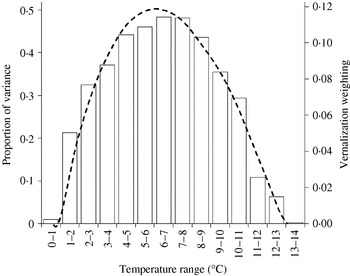
Bell (Reference Bell1946), Stout (Reference Stout1946), Campbell & Russell (Reference Campbell and Russell1965) and Bosemark (Reference Bosemark, Cooke and Scott1993) all quote a vernalizing temperature range of 0–12°C for sugar beet, with an optimum temperature of 6–8°C. However, these values are not based on any extensive or definitive series of controlled-temperature studies. A weighting curve that more explicitly describes the relationship between the cardinal minimum, optimum and maximum vernalization temperatures was developed for the present study (Fig. 1). It was derived, indirectly, from bolting and temperature data from a subset of 60 variety-assessment trials done between 1973 and 1983. These data were used to calculate the proportion of the bolting variance that could be accounted for by separate linear regressions on the number of hours that the crops were exposed to temperatures of 0–1, 1–2, 2–3, etc. up to 13–14°C. The columns in Fig. 1 indicate the proportions of the bolting variance that were accounted for by each of these temperatures. A vernalization weighting was then calculated for each temperature as the proportion of variance that that particular temperature contributed to the total sum of variance for the whole 0–14°C range. The critical exponential regression

was fitted to the resulting curve and used to calculate the vernalization weighting (y) associated with a particular hourly temperature (x). The dashed line in Fig. 1 indicates the form of the weighting curve. The seasonal intensity of vernalization (VI) was calculated as the number of vernalization-weighted hours (hereafter referred to as vernalizing hours) accumulated between sowing and the end of June. This vernalization interval is justified later.
The proportion of variance in the proportion of bolted plants accounted for by linear regressions on individual temperatures between 0 and 14°C (columns) and the fitted vernalization weighting curve (dashed line). Data relate to the 1973–83 variety-assessment trials.

Vernalization may be partly or completely reversed if the periods of vernalization are immediately followed by much warmer conditions (Fauchère et al. Reference Fauchère, Richard-Molard, Souverain, Prats, Pérarnaud and Decquiedt2003). The actual temperatures at which devernalization occurs in sugar beet have not been quantified precisely, but temperatures above 23°C are usually regarded as having the greatest effect (Longden et al. Reference Longden, Clarke and Thomas1995; Fauchère et al. Reference Fauchère, Richard-Molard, Souverain, Prats, Pérarnaud and Decquiedt2003). An attempt was made in the present study to define the devernalizing temperatures more closely by calculating how much extra variance in the observed number of bolters could be accounted for when the intensities of vernalization accumulated on days when such high maximum air temperatures occurred were not included in the seasonal sum. This was done successively for maximum daily air temperatures that were incremented at intervals of 1°C between 15 and 28°C. Doing this only accounted for extra variance when the daily maximum air temperatures were above 23°C. The vernalization-intensity model was therefore adjusted to take account of devernalization by not adding the vernalization of such days to the seasonal sum. In practice, these adjustments were generally small and infrequent because relatively few potentially devernalizing days occur prior to the end of June in the UK.
The vernalization interval
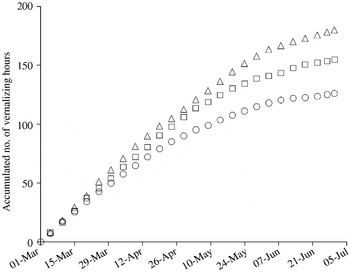
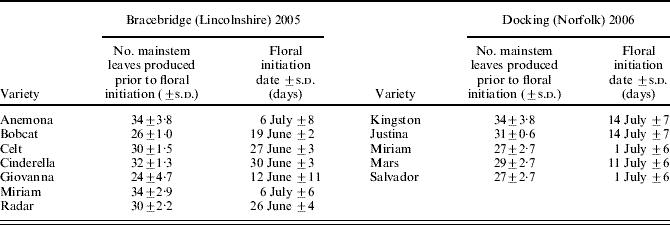
Sugar-beet plants do not appear to have to undergo an obligatory juvenile period before they become capable of being vernalized. It has been shown, for instance, that developing seeds on the mother plant, freshly imbibed seed and young seedlings can all be vernalized (Lexander Reference Lexander1969; Wood & Scott Reference Wood and Scott1975; Wood et al. Reference Wood, Scott, Longden and Hebblethwaite1980; Jaggard et al. Reference Jaggard, Wickens, Webb and Scott1983), but it is not known at what stage in the plant's subsequent development vernalization becomes ineffective. Working with winter-sown lupins, Milford et al. (Reference Milford, Shield, Siddons, Jones and Huyghe1996) showed that the date at which plants became sufficiently vernalized for the apical meristem to switch from the vegetative to the floral state can be estimated from the number of leaves that the plant was able to produce before this happened and the thermal rate at which the leaves are produced. The same approach was used in the present study by counting the total number of living and dead leaves and leaf scars on bolted plants of several of the varieties grown in the BBRO's 2005/06 early sown bolter trials. Milford et al. (Reference Milford, Pocock and Riley1985) calculated the thermal interval for sugar-beet leaf production – which does not seem to vary greatly between varieties – to be 30°C days above a base temperature of 3°C. Bolted plants taken from early sown bolter trials in the present study had usually produced a total of c. 30 leaves before the mainstem inflorescence developed (Table 1). The number of leaves was multiplied by the above thermal rate of leaf production to estimate the thermal interval between sowing and the completion of vernalization for each variety, and the daily temperature records for each site were used to convert these thermal intervals to calendar dates. The analysis indicated that the majority of the bolted plants had become fully vernalized by the beginning of July (Table 1). The period between sowing and the end of June was therefore chosen as the interval over which the seasonal intensities of vernalization were summed in the final model. Long-term temperature records from Broom's Barn Research Station, Suffolk, show that very little vernalization occurs after the end of June in either the coolest or warmest growing seasons (Fig. 2).
Seasonal progression in the mean accumulated intensities of vernalization in the five coolest (▵), average (□) and warmest (○) sugar-beet growing seasons since 1970 at Broom's Barn Research Station, Suffolk.

Estimation of the vernalization interval from the number of leaves produced by bolting sugar-beet plants before the onset of flowering in 2005–2006 early sown bolting trials

Vernalization intensities and bolting
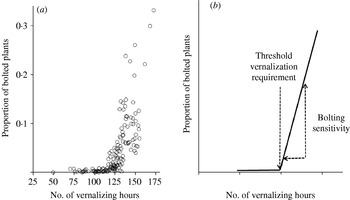
Figure 3 a shows an example of the relationship between the seasonal intensity of vernalization and the proportion of bolted plants produced by the variety Monotri in the 1973–83 series of variety-assessment trials. Very few bolters were produced by crops that experienced fewer than 120 vernalizing hours prior to the end of June, but increasingly greater numbers of bolters occurred with above-threshold intensities of vernalization. The threshold number of vernalizing hours required to induce a variety to bolt is termed its vernalization requirement (VR), and the rate of the above-threshold increase in bolting its bolting sensitivity (BS). As shown diagrammatically in Fig. 3 b, these two parameters could be estimated from a biphasic linear regression fitted to an individual variety's pattern of bolting.
(a) Relationship between the proportion of bolted plants and the seasonal intensities of vernalization for the variety Monotri in 1973–83 variety-assessment trials and (b) a diagrammatic illustration of the use of biphasic linear regressions to estimate varietal threshold VRs and bolting sensitivities.

The vernalization-intensity model therefore predicts the proportion of bolted plants (y) as:

and

in which VI (the vernalization intensity) is the accumulated number of weighted vernalizing hours between sowing and the end of June, VR is the threshold number of vernalizing hours, and BS is expressed as the proportional increase in bolters with each 10-h increase in above-threshold vernalization. As stated above, the seasonal intensity of vernalization was adjusted for devernalization by not including the hourly vernalization sums for days in which maximum air temperatures were 23°C or above.
MODEL PARAMETERIZATION AND VALIDATION
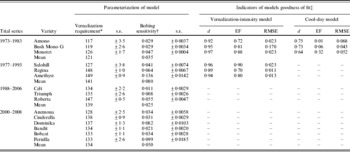
Relatively few UK datasets exist with sufficient ranges of bolting to allow the VRs and bolting sensitivities of individual varieties to be estimated accurately. In the present study, two such groups of varieties were identified whose commercial lifespans were long enough for them to be included in sufficient variety-assessment trials to provide the wide range of bolting needed to parameterize and validate the vernalization-intensity bolting model. These two groups of varieties were Monotri, Amono and Bush Mono G from trials of the 1970s, and Salohill, Regina and Amethyst from trials done in the 1980s. Data were available for each variety from a total of 150–160 variety-assessment trials, and these were divided into two sub-sets, equally balanced for seasons and sites. One sub-set was used to parameterize the vernalization-intensity model by estimating the VR and BS of each variety from biphasic linear regressions as indicated in Fig. 3 b. The other sub-set of trials was used to validate the model by predicting the proportion of bolters likely to be produced by each variety in each of the trials from intensities of vernalization derived from temperatures recorded at nearby meteorological stations. Three indicators of the ‘goodness-of-fit’ of the model's predictions were calculated. These were:
(a) the index of agreement (d) proposed by Willmott (Reference Willmott1981), which measures the degree to which the model's predictions are error free;
(b) the efficiency of the model (efficiency factor (EF)) which measures the proportion of variance in the observed values accounted for by the model's predictions (Launay & Guerif Reference Launay and Guerif2003); and
(c) the root mean squared error (RMSE) that indicates the degree to which the model's predictions are error prone – it has the same dimensions as the observed and predicted data, and the smaller its value the better the model predictions (Janssen & Heuberger Reference Janssen and Heuberger1995).
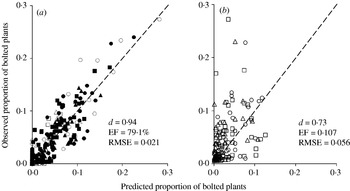
Table 2 gives the bolting parameters used for each variety in the vernalization-intensity model. Both the overall relationship between the predicted and observed numbers of bolters (Fig. 4 a) and the model performance statistics for the individual varieties (Table 2) indicate that the model's predictions were good. For instance, the overall index of agreement (d) for individual varieties were consistently greater than 0·9, and the EFs consistently above 0·70.
Relationships between observed proportion of bolted plants and the proportion predicted by (a) the vernalization-intensity and (b) the ‘cool-day’ bolting models in the varieties Monotri (•), Amono (▪) and Bush Mono G (▴) in 1973–83 variety-assessment trials, and Salohill (○), Regina (□) and Amethyst (▵) in 1977–93 variety-assessment trials.

Parameterization and validation of the sugar-beet vernalization-intensity bolting model and a comparison with the ‘cool-day’ model. The analysis is for successive commercial generations of varieties from UK variety-assessment and early-sown bolter trials done between 1973 and 2008

* No. vernalizing hours from sowing.
† Increase in the proportion of bolted plants for each 10 vernalizing-hour increment above the threshold requirement.
‡ d, the index of agreement; EF, the efficiency of the model; RMSE, root mean squared error.
The ‘cool-day’ model proposed by Jaggard et al. (Reference Jaggard, Wickens, Webb and Scott1983) originated from a 5-year study of four varieties at two locations in East Anglia, which showed a strong correlation between the probit of the percentage bolters and the number of cool days from sowing. Three of these varieties, Monotri, Amono and Bush Mono G were common to the present study, with their bolting behaviour being evaluated over a much wider range of sites and seasons in the 1973–83 series of variety-assessment trials. This sub-set of trials was therefore used to compare the performance of the two models, with the ‘cool-day’ model being parameterized for each variety using the regressions published by Jaggard et al. (Reference Jaggard, Wickens, Webb and Scott1983). The relationships between the predicted and observed levels of bolting (Fig. 4 b) and the indicators of model performance (Table 2) both show the vernalization-intensity model to be a more robust and discriminating predictor of bolting than the ‘cool-day’ model.
At present, no sufficiently good data exist to allow the vernalization-intensity model to be parameterized and evaluated for the varieties that are currently being grown commercially. Table 2 provides the parameters for a few of the varieties introduced since 2000, but these are given merely to illustrate how varietal performance might have changed in recent years. Because they depend strongly on the exceptionally large proportion of bolters seen in a few early sown trials done in 2008, they should be treated with caution.
INTERPRETIVE AND PREDICTIVE USES OF THE MODEL
The vernalization-intensity bolting model for sugar-beet presented in the present paper quantifies the intensity of vernalization by means of a curvilinear function that differentially weights the vernalizing effect of each temperature within the vernalizing range. In this respect, the sugar-beet model is similar to the vernalization models developed for other crop species – it differs in accumulating intensities of vernalization on an hourly rather than a daily basis. The sugar-beet vernalization-weighting curve was derived not from controlled-temperature studies but indirectly from field trial data. Streck & Schuh (Reference Streck and Schuh2005) advocated the use of a generalized sigmoid function to describe flowering responses to vernalization but this is best suited to species in which the whole population of plants in a crop becomes vernalized and flowers. It is not suitable for spring-sown sugar beet, in which only a small proportion of plants – the most vernalization-sensitive, bolting-susceptible ones – actually flower and bolt. For this reason, biphasic linear regressions were used in the present study to describe the restricted patterns of bolting seen in field-grown sugar beet. They had the advantage of allowing two potentially useful varietal bolting attributes to be calculated – a threshold VR and a BS. When parameterized for these varietal attributes, the vernalization-intensity model proved to be a more discriminating tool for predicting bolting in commercial sugar-beet crops than the ‘cool-day’ model currently used in the UK. Some examples of how the vernalization-intensity model might be used in practice are considered below.
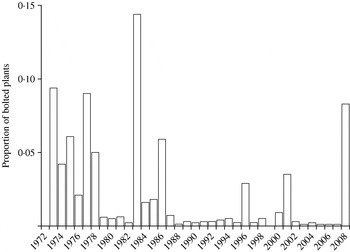
The pattern of bolting in UK sugar-beet variety trials has changed progressively over the past three decades (Fig. 5). Prior to the mid-1980s, large numbers of bolters frequently appeared in variety-assessment trials despite these being generally sown in the 3rd or 4th weeks of March. Considerably fewer bolters have occurred in trials done since then, except for trials done in 1996 and 2001 – which contained moderate numbers of bolters – and trials done in 2008 in which many appeared, as they also did in many of the commercial crops grown that year. The vernalization-intensity model helps interpret how far these patterns can be attributed to the greater bolting resistance of varieties now being grown, or to spring temperatures becoming increasingly milder in recent years. Table 2 indicates there has been a small but progressive increase in the threshold VR from c. 120 vernalizing hours in the older varieties to 140 h in more recent ones, which would be reflected in improved bolting resistance. Bolting sensitivities, on the other hand, do not appear to have changed greatly; they seem to be as variable now as in the past.
The proportion of bolted plants in variety-assessment and early sown bolter trials done between 1973 and 2008. (Values are the overall means for all commercially listed varieties in the trials).

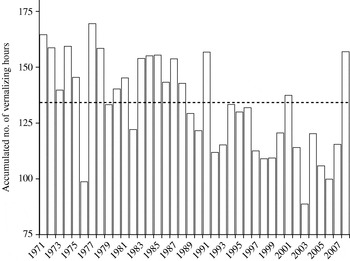
Although such varietal improvements in bolting resistance will, almost certainly, have contributed to the smaller proportion of bolters seen in recent years, the major over-riding factor has undoubtedly been that spring temperatures have become progressively warmer and obviated much of the bolting risk in recent years. Calculations based on the meteorological records of Broom's Barn Research Station in Suffolk show that, prior to 1995, sugar-beet crops sown in mid March would have experienced sufficient intensities of above-threshold vernalization (i.e. >135 vernalizing hours) to have caused large proportions of plants to bolt in two seasons out of three. These intensities of vernalization have, however, occurred in only two of the last 15 years – in 2001 and 2008 (Fig. 6). The occurrence of many bolters in commercial crops in 2008, in particular, led growers to ask whether they were due to the choice of variety, to early drilling, or to the unexpectedly cold March and April weather of that year. The exceptionally warm weather and favourable soil conditions at the start to the 2008 sugar-beet growing season encouraged many growers to sow early and, as a result, just over one-sixth of the national acreage was drilled by the end of the first week in March (Jaggard et al. Reference Jaggard, Qi and Inskip2009). Atypically cold weather later in March and in early April exposed many of these early sown crops to above-threshold intensities of vernalization, causing many plants to bolt. As a rider to this, it is worth commenting that many current commercial varieties have only been present in recommended-list trials since the late 1990s so their bolting behaviour has predominantly been assessed predominantly under the relatively mild vernalizing spring temperatures of the present century. The more intensive vernalizing conditions that occurred in the spring of 2008 probably provided a better test of their true bolting behaviour.
Accumulated number of vernalizing hours estimated to have been experienced by sugar-beet crops sown in East Anglia in mid March between 1971 and 2008 (based on temperature records from Broom's Barn Research Station, Suffolk).

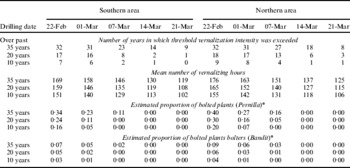
The onset of spring is more gradual in the UK than on the continent, allowing sugar beet to be sown early and providing the long growing season needed to produce maximum yields (Hull & Webb Reference Hull and Webb1970; Scott et al. Reference Scott, English, Wood and Unsworth1973; Jaggard et al. Reference Jaggard, Wickens, Webb and Scott1983). Early sowing, however, increases the risk of crops experiencing long periods of cold vernalizing temperatures. The vernalization-intensity model allows this risk to be quantified – provided the threshold VRs and bolting sensitivities of the varieties are known, and temperature records needed to calculate the intensities of vernalization for a given sowing date at a particular location are available. This is illustrated by a simulation of the proportion of bolted plants likely to have occurred in the past 35 years in bolting-sensitive (Pernilla) or bolting-resistant (Bandit) varieties sown at progressively earlier dates in the northern and southern sugar-beet growing regions of the UK. The simulation used the bolting parameters of these two varieties shown in Table 2, and long-term temperature records from Askham Bryan in Yorkshire and Broom's Barn in Suffolk. The bolting risk was quantified in terms of the number of years in which a threshold requirement of 135 vernalizing hours was exceeded, and the resulting proportions of bolted plants (Table 3). The exercise illustrates: (i) the increased risk, both in the frequency and number of bolters, associated with progressive weekly advances in drilling date prior to the third week of March; (ii) the dependence of the risk on locality and the BS of the variety being grown; and (iii) the diminished risk of bolting as spring temperatures have become progressively warmer in recent years.
Historical analysis of the potential effects of advancing the drilling date of bolting-sensitive (Pernilla) and bolting-resistant (Bandit) varieties in southern and northern sugar-beet growing areas of the UK

* Assumes a mean threshold number of vernalizing hours of 135 and bolting sensitivities of a 0·099 increase in the proportion of bolted plants for each 10 vernalizing hours above threshold for Pernilla and 0·022 for Bandit (Table 2).
The vernalization-intensity model should help growers match their choice of variety to their desired drilling dates and allow growers or their advisors to track the likely final number of bolters in their crops as the season progresses and in time for arrangements to be made for their removal to prevent seed being shed and infestations of weed-beet in the field to increase. Before this can become practice, however, the model has to be parameterized for varieties that are already on the current recommended list and for future varieties coming through the trialling system. The short lifespan of most current varieties is an obstacle to doing this within the present system of variety-assessment trials because this does not, in the short term, provide the required range of vernalization and bolting. A more effective way of parameterizing the model would be to make a series of fortnightly sowings extending from early February to mid April, which, as the simulations in Table 3 show, should provide a sufficient range of intensities of vernalization in most years to produce the required range of bolting.
The authors thank the British Sugar's field staff for their experimental help and the National Institute of Agricultural Botany for providing historic variety-assessment trial data. The project was funded by the BBRO.