


Introduction
During the 1950s and1960s, global medical research increasingly converged on the conclusion that cigarette smoking was the primary cause of lung cancer. Landmark contemporary publications provided compelling epidemiological evidence linking cigarette smoking to high mortality rates,Footnote 1 before the American Surgeon General’s 1964 report “solidified the existing scientific medical consensus about smoking and health and ended many lingering doubts about the harmfulness of smoking.”Footnote 2 This triggered a wave of international public health advocacy and anti-tobacco institutional mobilization. Yet, the reception of this medical consensus varied widely across different political, economic, and cultural contexts. One of the most striking examples of this divergence occurred in Southern Rhodesia (now Zimbabwe), a settler-colonial polity whose economy and political identity were profoundly intertwined with commercial tobacco farming.Footnote 3 The crop had acquired more than economic value as it became a cornerstone of the settler-colonial project, reinforcing claims to land, political authority, and racial privilege. Unsurprisingly, its economic and ideological centrality meant that any “obstacle”—whether moral, political, or scientific—carried significant implications for the stability of the settler state and would therefore be resisted.
Yet the epidemiological link between cigarette smoking and lung cancer, firmly established by 1950, coincided with the ascendancy of tobacco as Southern Rhodesia’s premier export crop. Following decades of economic volatility after the 1890 occupation of the land between the Zambezi River to the north and the Limpopo River to the south, the tobacco sector recovered spectacularly in the 1940s, largely due to the post-war global shortage of raw materials and Britain’s dollar crisis.Footnote 4 Beginning in the early 1950s, local newspapers reported on the accumulating medical evidence linking cigarette smoking to lung cancer. However, the way these reports were presented was far from neutral. Rather than straightforwardly conveying scientific findings, newspapers engaged in a complex process of reinterpretation, reframing, and selective emphasis. In doing so, they highlighted dissenting opinions, stressed uncertainties, questioned statistical methods, and foregrounded the potential economic repercussions of anti-smoking campaigns. Scientific evidence appeared alongside counterclaims by tobacco industry spokespersons, government officials, and medical professionals skeptical of epidemiological approaches. This culminated in a fragmented media landscape in which doubt and reassurance competed with an emerging medical alarm.
The global rise of anti-tobacco activism has attracted considerable scholarly attention.Footnote 5 However, much of this scholarship focuses on the political responses to the smoking-cancer connection in Europe and North America. What has not been given sufficient attention is the imperial-colonial dimension of the intersection of smoking, cancer, and tobacco capital. For instance, as noted by Andrekos Varnava, “the prevalence of smoking and the antismoking messages in the newspapers … has also not been the subject of any sustained research … in a broader colonial context …”Footnote 6 He, in a subsequent study with Thomas J. Kehoe and Elizabeth Greenhalgh, bemoans how scholars and policymakers tended to “overlook the socio-political complexities of tobacco control in a context where the tobacco business is deeply connected to colonial history.”Footnote 7 Using the case of Sri Lanka and Cyprus, they show “how the entwinement of tobacco with imperialism in the past has vested additional powers in tobacco corporations.”Footnote 8
The analysis of the imperial legacy of the prevalence of cigarette consumption has now been extended to Australia by Yianni Cartledge and Varnava, who show how migrants from Cyprus, Greece, and southern Europe in general exported their cigarette consumption habits into Australia.Footnote 9 This article inserts the case of Southern Rhodesia in the ongoing conversations on the intersection of imperialism, tobacco and prospects of tobacco control. In doing so, it converges with Varnava, Kehoe, Varnava and Greenhalgh, and more recently, Cartledge and Varnava.Footnote 10 However, that is as far as the convergence goes. Unlike the other works whose focus is on how imperialism influenced the prevalence of cigarette consumption with implications for current tobacco control efforts, I shift attention to how imperialism inserted a settler colony into the global tobacco trade as a producer and exporter of tobacco leaf. Although Southern Rhodesia manufactured cigarettes, it remained a minor consumer of tobacco products, with leaf exports reaching as high as 98 percent of the entire crop.Footnote 11
The export-orientation of the Southern Rhodesian tobacco industry should not completely overshadow the activities of the British American Tobacco (BAT) company and Rothmans in the manufacturing of cigarettes. However, in the case of Southern Rhodesia, the emphasis on export of tobacco leaf remained evident. While BAT established cigarette manufacturing operations in South Africa, in Southern Rhodesia it set up a leaf handling and packing factory at Msasa in 1928. Under the direction of the mother company’s Leaf Department, this organization was responsible for the purchasing, packing and shipping of the company’s leaf requirements from Southern Rhodesia.Footnote 12 Despite venturing into cigarette manufacturing later, Southern Rhodesia therefore enters the global smoking-cancer debate as predominantly a producer of leaf for British corporations, while other cases emphasize the promotion of the consumption of cigarettes manufactured by the same British multinational corporations.
Extant literature on Southern Rhodesia’s tobacco industry has mainly focused on the development of White settler agriculture, the political economy of the tobacco growing industry, settler agrarian capital, and the authoritarian logic of the settler-colonial state, or, more recently, on tobacco farming after Zimbabwe’s land reform program of 2000.Footnote 13 Such studies—except for a chapter by Elijah Doro– have paid far less attention to the intersection of media, science, and tobacco politics in the context of the global smoking-cancer debate of the 1950s and 1950s.Footnote 14 As Doro notes, unlike in the USA and the Global North where “the anti-smoking movement was galvanising support and dominating the conversations on public health and tobacco consumption …. in Southern Rhodesia the conversations on the social controversies of tobacco and public health were dominated by the tobacco interests’ groups.”Footnote 15 The article relies on newspaper articles to analyze the framing of the smoking-cancer connection in Southern Rhodesia during the 1950s and 1960s. In doing so, it casts light on how local economic priorities, settler-colonial ideology, and postwar imperial designs shaped global scientific debates in the context of a tobacco-dependent settler colony.
Methodology and Theoretical Framework
The article takes an archive-centered approach by analyzing relevant articles from the main Southern Rhodesian newspapers held at the National Archives of Zimbabwe, the Zimbabwe Papers Archives, and the Tobacco Research Board repository at Kutsaga, outside Harare. Materials examined include news reports, editorials, opinion columns, letters to the editor, and health-related features (Table 1).
Article types and frames

Table 3. Long description
The table consists of four columns and five data rows.
Column headers from left to right are: Article type, Frequency, Primary frame, and Characteristics.
Row 1: News; Frequency is High; Primary frame is Uncertainty; Characteristics are Short reports.
Row 2: Editorials; Frequency is Medium; Primary frame is Economic; Characteristics are Defensive tone.
Row 3: Letters; Frequency is High; Primary frame is Statistical; Characteristics are Personal views.
Row 4: Features; Frequency is Medium; Primary frame is Mixed; Characteristics are Long-form analysis.
Row 5: Industry; Frequency is Low; Primary frame is Economic; Characteristics are Lobby influence.
Compiled by the author from analysis of newspaper articles.
Although I consulted other archives, most of the articles analyzed in this study were collected from the library of the Tobacco Research Board (TRB) at their Head Office outside Zimbabwe’s capital city of Harare. I collected the materials in 2017 and 2018. Fortunately, the TRB library has a well-organized section containing cuttings of all tobacco-related stories and adverts carried by Southern Rhodesian newspapers from the 1940s to the 1980s. I took pictures of the relevant newspaper cuttings, which I later converted to PDF and Microsoft Word documents for easy manipulation. Working within the documents, I identified relevant articles through keyword searches—such as smoking, lung cancer, tobacco, tar, and epidemiology—enabling me to trace shifts in representations of smoking and health covering my study period of the 1950s and 1960s.
The analysis is guided by two complementary approaches from media studies—framing theory and agenda-setting theory. On the one hand, framing theory focuses on how media construct meaning by emphasizing particular aspects of an issue while downplaying or excluding others, thereby shaping understandings of causality, responsibility, and risk. On the other hand, agenda-setting theory addresses how media influence public priorities by determining which issues receive sustained attention and which are marginalized.Footnote 16 While both theories originated in studies of liberal-democratic media systems, their core insights can be productively adapted to a settler-colonial context in which the press operated within a tightly circumscribed political sphere and was closely aligned with state and industry interests.Footnote 17
In Southern Rhodesia, agenda-setting was reinforced by the institutional structure of the press. Newspapers depended heavily on advertising revenue from tobacco-linked enterprises—merchants, packing houses, cigarette manufacturers, and agricultural suppliers—creating strong incentives to avoid sustained or critical coverage of smoking-related health risks.Footnote 18 Editorial leadership was overwhelmingly drawn from networks sympathetic to White agricultural interests, embedding settler priorities within routine journalistic practice.Footnote 19 These conditions encouraged a public agenda that foregrounded tobacco’s economic centrality while relegating cancer risks to the margins.
In terms of framing, newspapers employed recurrent interpretive strategies that supported the political economy of tobacco. Scientific uncertainty was foregrounded by emphasizing disagreement among researchers rather than emerging epidemiological consensus. Statistical contestation was highlighted to cast doubt on population-level methods and to suggest multiple alternative causes of cancer unrelated to smoking. Economic-threat frames recast global anti-smoking research as an external danger to colonial prosperity rather than a domestic public health concern. These frames were not passive reflections of scientific ambiguity but active strategies that shaped public understanding while maintaining the appearance of balanced reporting. Framing theory thus reveals how selective emphasis, rhetorical qualification, and strategic omission enabled newspapers to mediate between global medical discourse and local economic imperatives.
Historical and Political Economy Context
In Southern Rhodesia, tobacco was far more than an agricultural commodity; it shaped class formation, state policy, land distribution, and the ideological self-fashioning of the settler population. By the 1950s, it constituted the backbone of the settler economy and was deeply entangled with Britain’s postwar economic needs and the shifting political landscape of the Central African Federation.Footnote 20 This section briefly outlines how tobacco became the economic engine of the settler state and examines the political power of tobacco farmers in Southern Rhodesia, as represented by the Rhodesia Tobacco Association (RTA). By highlighting the postwar Anglo-Rhodesian tobacco relations, the section unpacks the imperial contexts that framed Southern Rhodesia’s encounter with the global smoking-cancer debate (Table 2).
Temporal shifts in framing

Table 2. Long description
The table consists of five columns: Period, Dominant frame, Characteristics, Global context, and Local response. It contains three rows of data:
* Row 1: Period 1950 to 1955. Dominant frame is Uncertainty. Characteristics are Science inconclusive. Global context mentions Doll and Hill. Local response is Debate emphasis.
* Row 2: Period 1956 to 1963. Dominant frame is Economic threat. Characteristics are Defensive framing. Global context mentions U K debates. Local response is Economic focus.
* Row 3: Period 1964 to 1970. Dominant frame is Medical alarm. Characteristics are Risk acknowledged. Global context mentions U S / U K reports. Local response is Mitigation strategies.
The table is noted as being compiled by the author from analysis of various newspaper articles.
Compiled by the author from analysis of various newspaper articles.
By the end of the World War II era, Southern Rhodesia had developed into one of the world’s most important producers of Virginia flue-cured tobacco.Footnote 21 The reasons for this have been amply explained in extant literature and therefore need no repetition here.Footnote 22 Suffice it to say that despite the central role that agriculture was later to play in Southern Rhodesia, what drove Cecil John Rhodes’ British South Africa Company (BSAC) to occupy the territory was the search for gold. Only after it turned out that gold was not present in anticipated quantities for commercial exploitation did the BSAC administration expand its focus to agriculture, leading to the adoption of the White Agricultural Policy in 1908.Footnote 23 As Machingaidze aptly demonstrates, the BSAC administration, which administered the territory from 1890 to 1922, and the Responsible Government of settlers that took over in 1923, invested heavily in supporting agriculture in general and the tobacco sector in particular.Footnote 24
The question of how tobacco fitted into the colonial scheme of things has been adequately tackled in extant literature. Scholars have shown that tobacco emerged as a key crop during the early colonial period for two key reasons. The first reason, which was entwined with the very logic of settler colonialism, was that tobacco offered quick returns on capital invested, which lured the much-needed immigrants necessary to turn Southern Rhodesia into a colony of White settlement. The second, and more important reason for the British South Africa Company (BSAC) was that tobacco was “best grown in the previously neglected sandy soils so that the Company could … be able to sell many farms that had hitherto attracted few buyers.”Footnote 25 For these reasons, the settler colonial state laid the institutional and infrastructural foundations for the tobacco sector’s future growth: agricultural research stations experimented with seed varieties and curing technologies, marketing boards regulated prices, and the state granted generous credit schemes that encouraged settler landowners to shift into tobacco production.Footnote 26
However, marketing constraints dimmed the prospects of Southern Rhodesia’s tobacco sector. Britain, the then most lucrative tobacco leaf market, imported most of its leaf from the United States.Footnote 27 It was not until the outbreak of World War II and the disruptions it triggered that Southern Rhodesia gained a foothold in the British market.Footnote 28 Wartime disruptions presented Southern Rhodesian tobacco growers with “the first real opportunity to increase their share of the British and world markets.”Footnote 29 As British manufacturers began to import more and more from Southern Rhodesia, this raised the colony’s tobacco profits considerably and elevated the socio-economic and political status of tobacco growers. Tobacco outpaced gold as the colony’s largest foreign currency earner, thereby placing tobacco farming at the center of Southern Rhodesia’s economy. Thus, tobacco became not only a commercial success but a central symbol of settler identity, with tobacco farms becoming markers of both economic success and cultural legitimacy. Modernized White agriculture was viewed as the civilizing force that justified the political and territorial privileges of the settler population. This elevated tobacco to a vital pillar of the settler-colonial order.
Even the inception of the Central African Federation, which lasted between 1953 and 1963, did not alter the centrality of tobacco. Tobacco quickly emerged as one of the Federation’s most important commodities, accounting for a substantial portion of foreign exchange earnings. During the 1950s and early 1960s, it consistently ranked as the second most valuable export after copper (from Northern Rhodesia, now Zambia) and represented a substantial share of total export earnings—rising from 16–18 percent in 1956–57 to 21 percent by 1961. More so, tobacco prices were more stable than those of copper, making it a relatively more reliable federal economic base. By 1960, tobacco accounted for nearly half of the country’s agricultural production by value.Footnote 30 This made the RTA one of the most influential lobby groups in Southern Rhodesia. Its leadership consisted of wealthy planters who possessed longstanding ties to political elites, financial institutions, and the senior bureaucracy.Footnote 31 Sir Roy Welensky, the Federation Prime Minister, had full life patronage of the Tobacco Institute, an organization founded by the tobacco industry to refute scientific evidence of the cigarette smoking-lung cancer connection.Footnote 32 This overlap between economic and political leadership blurred the boundaries between state and industry, producing what would today be described as a form of proto-state capture.
The political muscle of the RTA enabled it to exercise decisive influence over agricultural policy, research, marketing arrangements, land settlement schemes, and negotiations with Britain and international buyers.Footnote 33 Unsurprisingly, when the smoking-cancer debate emerged, the RTA took a stand to defend the tobacco industry. According to Evan Campbell, the RTA President in the 1950s: “From its earliest days the use of tobacco has been blamed for most of the ills that afflict the human body. As with the latest scare, no definite proof of these allegations has been forthcoming.”Footnote 34 Ten years later, Campbell carried this attitude to the International Tobacco Trade Congress (ITTC), held in Salisbury, the capital city of Southern Rhodesia, from March 06 to 16, 1963, which he presided over. He argued that “the Congress was not competent to deal with scientific causation,” and that “[the] possibility of a tobacco element causing lung cancer was not proven”; he deleted the lung-cancer debate from the ITTC official record.Footnote 35
A reading of Southern Rhodesian newspaper articles shows that the RTA drew on transnational networks of industry-funded research designed to cast doubt on epidemiological findings. The RTA’s political strength derived not only from tobacco’s economic importance but also from the ideological alignment between tobacco farmers and the settler state. Firstly, both saw their identity and legitimacy as rooted in successful White agriculture partly because the attraction of fresh immigrants—necessary to cure the White settler demographic deficit—depended on the prosperity of agriculture. Secondly, both feared external interference, whether from international health bodies, metropolitan reformers, or African nationalist movements. Both framed critiques of tobacco as indirect attacks on the settler project itself. This alignment meant that the RTA did not need to exercise overt coercion to shape media narratives; its priorities were deeply embedded in the political consciousness of the White population. It is within this structural context that the framing of the smoking-cancer debate discussed in what follows should be viewed.
Framing the Smoking-Cancer Debate
An analysis of press reports for the period 1950s to 1960s reveals that Southern Rhodesian newspapers did not simply relay the emerging global consensus on the health risks of cigarette smoking. Instead, they curated a complex, internally contradictory discursive field that simultaneously acknowledged and neutralized medical warning. This was achieved by carefully deploying five recurrent frames that structured public interpretation of the smoking-cancer connection: scientific uncertainty and manufactured doubt; statistical confusion and counter-interpretation; economic catastrophe and industry defense; cultural normalization of smoking; and rising medical alarm and epidemiological evidence.
The cumulative effect of these frames was to delay the social uptake of risk, to preserve the legitimacy of the tobacco economy, and to reassure readers that local practices needed not change. In what follows, the discussion turns to the specific ways in which these frames manifested in press reports.
Firstly, press reports on the causal link between smoking and cancer foregrounded scientific uncertainty to “manufacture” doubt in the minds of the public. This was achieved partly through the deployment of qualified causal language such as “possible link,” “no final proof,” “researchers divided.” By so doing, articles presented the science as unresolved. The rhetorical strategy was subtle: while acknowledging that “some” studies showed “associations,” journalists presented these as provisional and counterbalanced them with authoritative voices who urged caution. The effect was to convert a growing epidemiological consensus into a perpetual scientific “debate” that was yet to be conclusively settled. In fact, the Rhodesia Herald had a headline, “Cancer theory refuted,”Footnote 36 reducing the smoking-cancer link to a theory.
A recurring feature of this frame was the selective elevation of expert skepticism. Statements by prominent surgeons or public figures—especially those associated with the British medical establishment—were used to suggest that smoking did not cause cancer or that lung cancer could be attributed to other causes such as environmental pollutants, wartime conditions, or urban stress rather than cigarettes. Sir Clement Price-Thomas, a British chest specialist, was directly quoted as having boldly declared that “Smoking does not cause lung cancer,” citing inconclusive evidence.Footnote 37 Similarly, Sir Ronald A Fisher, a Cambridge University statistician and geneticist, was also quoted as suggesting that “dirty air” could be a major cause of lung cancer and not smoking.Footnote 38 Such opinions were given prominence as evidenced by the following Rhodesia Herald headlines: “Doctors say diesel fumes, not tobacco may be cancer cause”Footnote 39; “Air pollution has main cancer danger”Footnote 40; “Cigarettes not direct cause of lung cancer where air is clean”Footnote 41; and “Lung cancer: Nickel now blamed.”Footnote 42
Related to expert skepticism were implicit appeals to professional hierarchy as a way of sowing doubt and creating uncertainty about the smoking-cancer link. A case in point was a story reproduced by the Rhodesia Herald in which Dr Morton Levin, a high-ranking US State Health Department official, was used to counter a study conducted by anonymized “researchers” from the State Hospital at Buffalo in the United States, which had shown that the relative incidence of lung cancer in people who smoked twenty or more cigarettes a day was ten times higher than that of non-smokers. Dr Levin’s opinion was summoned to counterbalance and outweigh the researchers at the State Health Hospital at Buffalo. He was quoted as having stressed that “the evidence did not indicate that smoking was ‘the sole causative factor or even that it is operative in the absence of other factors’ such as “air pollution from smoke or dust.”Footnote 43 His exhortation to avoid “alarmism” was designed to outweigh the anonymized “researchers” whose statistical findings were cited in brief. By doing this, the media created an asymmetry in which clinical prestige trumped population-level epidemiology, which resonated with audiences accustomed to equating scientific authority with bedside medicine.
Scientific uncertainty was also cultivated through tactical temporal deferral in framing the smoking-cancer connection. In terms of this strategy, reports regularly promised that “more research was underway” in Britain or the United States and that definitive answers were “expected soon.” The Rhodesia Herald carried reports about Britain conducting a nationwide investigation among 40,000 doctors into whether smoking killed.Footnote 44 Subsequent reports continued to portray research as underway with results expected soon. Other reports included ongoing Leeds University smoking machine experiments in which smoke condensate was tested on rats for seven months, with no tumors yet.Footnote 45 In effect, experimental ambiguity was privileged over population-level regularity whenever it could be marshalled to sustain doubt. There were also reports of British and US doctors re-examining mortality statistics as part of ongoing analytical and statistical investigations into cancer causation. The future tense deployed in such reports served as a device for postponing judgment, subtly instructing readers that it would be premature to alter habits or policy based on incomplete information.
If the uncertainty frame questioned whether science was settled, the statistical frame challenged how it was known. Articles and letters to the editor cast aspersions on epidemiological reasoning by problematizing sampling, causality, and the interpretation of ratios and risks. The aim was not to provide a coherent alternative causal theory but to sow methodological skepticism sufficient to blunt policy implications. Aware that the media environment privileged common-sense reasoning over statistical literacy, newspapers deployed fallacies to cultivate methodological skepticism. One such convenient fallacy was the “base-rate” objection, the prior probability of an event or something before considering new evidence. The base rate fallacy thus “is the result of pitting what seem to be merely coincidental, therefore low-relevance, base rates against more specific, or causal, information.”Footnote 46 In what follows, I look at how this fallacy was deployed in media coverage of the smoking-lung cancer debate in Southern Rhodesia during the period under consideration.
Media reports suggested that if a large portion of the population smoked, then most people who developed lung cancer would naturally be smokers. In that case, the smoking-lung cancer association lacked probative value. The Northern News newspaper of July 22, 1954, for instance, quoted medical doctors who suggested that cancer rates were higher in cities not necessarily due to smoking. Instead, they argued, since smokers outnumbered non-smokers, more cancer cases among smokers “proved nothing,” claiming that statistics could “prove” even absurd correlations. This not only showed widespread skepticism but also made insinuations of statistical loopholes and misinterpretation. Such arguments confused absolute counts with risk proportions, ignoring that epidemiological studies compared rates among smokers and non-smokers, controlled for age, and demonstrated dose–response relationships.
To further push the narrative that early anti-smoking statistics contained flaws and oversimplifications,Footnote 47 sections of the media resorted to the use of cross-national data to undermine causal interpretations of smoking statistics. A case in point was the story of British physicist Sidney Russ, who was reported as having argued that U.S. cigarette consumption was far higher than in Europe, yet lung cancer rates were no higher.Footnote 48 This was interpreted as contradicting the statistical argument that smoking “must” cause lung cancer. In some cases, media reports introduced the “third-factor” hypothesis to challenge statistical accuracy. Reports blamed occupational hazards such as dust and fumes or urban lifestyles such as crowded housing and increased motor traffic as leading to smoking and thereby independently increasing cancer risk. In that case, cigarettes became epiphenomenal. They were a secondary phenomenon that accompanied a primary process but had no causal influence or effect on it.Footnote 49 Such reporting projected epidemiological statistics linking cigarette smoking to cancer as ignoring confounding variables like urban pollution. This is the context within which chest specialist Sir Clement Price-Thomas’ claims that cancer was mainly a “townsman’s disease” due to pollution, not smoking, should be understood.Footnote 50
Sometimes newspapers combined the “third factor” hypothesis with statistical tu quoque, a logical fallacy and rhetorical device that attempts to discredit an opponent’s position by accusing them of hypocrisy or failing to act consistently in accordance with their own argument, or is directed at revealing an inconsistency in the positions that the opponent has adopted on various occasions.Footnote 51 The premise was that if modern medicine had not eliminated other cancers, why single out smoking? The implication was that epidemiology overreached by isolating one cause within a complex web of modern ills. Such counternarratives reassured readers that causality remained murky, and that prudence required resisting precipitous conclusions. Taken together, these tactics were deployed by the media to question statistics, offer alternative interpretations, and explicitly highlight confusion and contradictions in data in the context of a media environment that privileged common-sense reasoning over statistical literacy.
In framing the smoking-cancer debate, Southern Rhodesian newspapers often emphasized the specter of economic catastrophe. Instead of framing the smoking-cancer issue as a question of health, newspapers cast it as one of livelihood, national solvency, and the moral economy of settler farming, the mainstay of Southern Rhodesian finance. This is the context within which the Rhodesia Herald’s coverage of the editor of Forensic Medicine, Dr H. A. Shapiro’s speech in South Africa should be understood. Speaking at the congress of the South African Medical Association in Port Elizabeth on June 23, 1954, Dr Shapiro was quoted as bemoaning that “an unresolved medical problem, which may in the end be found to represent an allegation that is without substance, has achieved such wide lay publicity all over the world that the economic structure of an important industry has been rocked to its very foundations” [Emphasis is mine].Footnote 52 The quotation achieved two things: firstly, it underscored the economic centrality of tobacco, and secondly, it cast doubt on the smoking-cancer connection. In the context of Southern Rhodesia, this should be read together with a reassuring prominent picture of the colony’s Governor-General, Lord Llewellin, inspecting tobacco on the opening day of the auction sales floors in Salisbury on March 23, 1954.Footnote 53
In addition, reports highlighted dire economic warnings for tobacco-producing countries, as “hysterical” or “sensational” reporting could damage export markets, depress auction prices, and jeopardize farm incomes. For instance, the Rhodesia Herald of June 22, 1954, reported that “tobacco shares on the New York Stock Exchange plunged on new medical reports of a link between smoking and cancer.”Footnote 54 More reports reiterated the same point. On 14 March 1962, the Rhodesia Herald carried reports of falling share values on the London Stock Exchange and ten days later, on March 24, 1962, there were reports of tobacco shares dropping US$25m in a day following Lord Hailsham’s hard-hitting attack on smoking.Footnote 55 The message was clear: words had material consequences, and imprudence in public health discourse could trigger economic harm far exceeding “speculative” medical benefit.
The specter of economic catastrophe frame frequently blurred the line between news reporting and lobbying. Statements by the RTA were reproduced with minimal editorial distance, often as authoritative commentary on national welfare. Government officials and cabinet ministers lent additional gravitas by urging “responsible” journalism and emphasizing tobacco’s contribution to tax revenue, employment, and foreign exchange. This was deployed alongside a developmentalist defense in terms of which tobacco underwrote investments in rural infrastructure, schools, and hospitals. In terms of this logic, causality was inverted: the very institutions tasked with responding to cancer were rhetorically positioned as beneficiaries of tobacco’s prosperity. For instance, rather than tobacco threatening health, health was portrayed as dependent on tobacco: amplifying the smoking-cancer, the argument goes, would paradoxically harm public health by shrinking the fiscal base. The cumulative effect was not only to elevate tobacco from a commodity to an economic commons but also to frame criticism as a kind of free-riding on the sacrifices of farmers and exporters. In this moral economy, smoking mutated from a private habit to become a patriotic act that sustained the “national” project.
If economic defense operated at the level of national interest, cultural normalization worked at the level of everyday life. Newspapers portrayed smoking as a legitimate, even stylish practice embedded in social rituals. For instance, reports highlighted that a group of doctors attending the American Medical Association Convention in San Francisco on June 23, 1954 “were puffing at the normal rate” despite the American Cancer Society’s report indicating a link between smoking, cancer, and heart disease. The implicit lesson was that something so widespread and ordinary could not simultaneously be aberrant or dangerously deviant. The reports went on to cite Dr Walter B. Martin, the American Medical Association president, suggesting that “whether a person wanted to stop smoking as a result of the report was an individual decision.”Footnote 56 There were even suggestions that “smoking behaviour appears to be in part a reflection of the biological or genetic make-up of the individual”Footnote 57 and that contrary “to the belief that smoke can cause lung cancer in any person …. it may be hereditary factors that make some people prone to the disease.”Footnote 58
Another component of cultural normalization was humor and masculine bravado. Letters and columns occasionally ridiculed “nannying” doctors or “faddish” health scares, invoking a stoic ideal of the Rhodesian man who faced risk with equanimity. The Rhodesia Herald of March 16, 1962, in a story headlined, “Smoke and be happy is the motto here,” described Bulawayo (Southern Rhodesia’s second largest city) smokers’ attitude as “Smoke and at least die happy.”Footnote 59 Two letters to the editor are worthy of quoting at length. In one long letter, prominently placed, one Nigel Philip played down the smoking-cancer connection by arguing that “To attribute lung cancer to smoking seems just as foolish as stating that eating and drinking are the cause of digestive troubles.” Instead, he contended, “emphasis surely is on excessive smoking and drinking and over-eating.”Footnote 60 Not to be outdone, after stating that he had been “a heavy smoker for more than 50 years,” one Theydon wrote:
Admittedly nicotine is a poison, but so is alcohol. But alcohol modified with the essence of the grape, as in wines and brandies, or with the essence of malted barley, as in beers and whiskies, is not deleterious, rather otherwise. Similarly, nicotine combined with the other chemicals contained in properly cured tobacco leaf … gives a product which has a soothing effect on the nerves.Footnote 61
Theydon added that “this, among other benefits, enables students, writers, and other thinkers to carry on without undue strain.” The core message remained consistent: smoking was a manageable, civilized habit compatible with respectable life. In short, cultural normalization did the ideological work of making risk ordinary.
The foregoing frames might suggest that medical evidence disappeared from public view. On the contrary, newspapers intermittently carried strikingly direct reports of epidemiological findings: elevated mortality among heavy smokers; clear dose-response relationships; longitudinal studies that tracked cohorts across decades; and chemical analyses identifying carcinogenic compounds in smoke.Footnote 62 Such reportage often arrived via wire services, British medical bulletins, or summaries of major conferences. At moments of international significance, the press even adopted a tone of measured gravity, conceding that the evidence was increasingly difficult to ignore.
Yet even as the medical alarm surfaced, it was frequently sequestered. Health items were positioned away from front pages devoted to commodity prices, political speeches, and agricultural fairs. Medical stories were compressed into column-length summaries that lacked explanatory context, technical definitions, or local relevance. The rhetorical structure tended to present the new finding and then immediately juxtapose it with a dampening counterpoint—an industry response, a call for caution from a senior clinician, or a reminder that “more research is needed.” This oscillation produced flashes of alarm punctuated by reassurance, never sustained long enough to consolidate into public urgency.
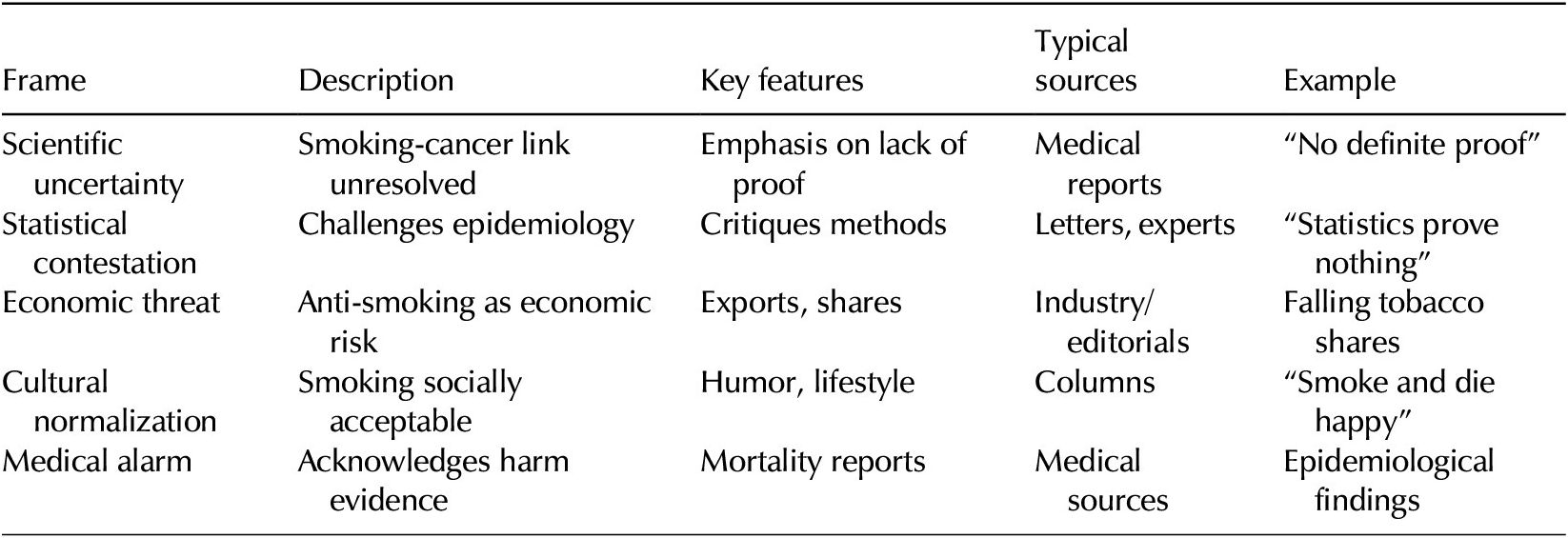
When longer features appeared, they sometimes acknowledged the epidemiological logic more fully and the accumulation of evidence across independent studies. Even here, however, the articles frequently concluded with an emphasis on individual responsibility, sometimes urging smokers to “take a few quick puffs on their cigarette soon after lighting”Footnote 63 or to know their bodies.Footnote 64 This had the effect of translating population-level hazard into private prudence. By individualizing risk, newspapers avoided raising questions about regulation, advertising restrictions, or the structure of the tobacco economy. The medical frame thus coexisted with, and was absorbed into, the broader discursive ecology that kept political implications at bay (Table 3).
Dominant media frames (1950s–1960s)

Table 1. Long description
The table consists of five columns and five rows of data.
* Row 1: Scientific uncertainty frame. Description: Smoking-cancer link unresolved. Key features: Emphasis on lack of proof. Typical sources: Medical reports. Example: No definite proof.
* Row 2: Statistical contestation frame. Description: Challenges epidemiology. Key features: Critiques methods. Typical sources: Letters or experts. Example: Statistics prove nothing.
* Row 3: Economic threat frame. Description: Anti-smoking as economic risk. Key features: Exports or shares. Typical sources: Industry or editorials. Example: Falling tobacco shares.
* Row 4: Cultural normalization frame. Description: Smoking socially acceptable. Key features: Humor or lifestyle. Typical sources: Columns. Example: Smoke and die happy.
* Row 5: Medical alarm frame. Description: Acknowledges harm evidence. Key features: Mortality reports. Typical sources: Medical sources. Example: Epidemiological findings.
Compiled by author from analysis of various newspaper articles.
Importantly, the medical alarm intensified over time. By the late 1960s and early 1970s, as international consensus hardened and as more robust chemical and pathological evidence accumulated, newspapers found it harder to sustain earlier degrees of skepticism. The tone shifted subtly: articles became less willing to claim outright uncertainty and more inclined to acknowledge danger while recommending personal mitigation strategies. Filter technology and brand differentiation grew more salient in coverage, with headlines such as “Filter tips save dogs from cancer” and concluding that “the filtered kind are less damaging to lung tissues.”Footnote 65 The emphasis shifted to the invention of safe tobacco hope by scientists based on claims that scientists were not only close to identifying and eliminating cancer-causing components of tobacco but also to identify the type of man who was likely to get lung cancer and warn him off cigarettes.Footnote 66 This indicated that industry adaptation—rather than abandonment—had become the newspapers’ preferred resolution of the tension between evidence and habit. The strategy, used by the tobacco industry globally to avoid the public health backlash, revolved around “deflecting the risk of tobacco into a factor that could be managed through technology and scientific research.”Footnote 67
Colonial Media, Science, and Economic Power
The media framings analyzed in the previous section cannot be understood simply as the outcome of editorial preference, journalistic style, or scientific ambiguity. Instead, they reveal a deeper structural relationship between knowledge production, economic power, and the ideological imperatives of a settler-colonial society. Newspapers acted as key intermediaries in translating global debates into local meaning, but in Southern Rhodesia they did so from within a political economy dominated by an export crop whose fortunes were inseparable from the prosperity and political stability of the White settler community. In what follows, I draw these threads together, showing how the press functioned both as a mirror of settler anxieties and as an active agent in shaping public understanding of scientific risk.
At the heart of the Southern Rhodesian media’s treatment of the smoking-cancer debate was tension between scientific modernity and economic dependency. On the one hand, the settler state prided itself on being a technologically advanced agricultural society, boasting modern research stations, high yields, and robust connections to British scientific networks. On the other hand, the very product that underpinned this identity—flue-cured tobacco—was increasingly implicated in a global public health crisis. Reconciling these contradictory positions required well-crafted narrative work. Newspapers resolved the tension by adopting frames that preserved a sense of scientific seriousness while resisting the political implications of emerging epidemiological findings.
This narrative work was facilitated by the structural proximity of newspapers to the White settler project, and by extension to the tobacco economy. Editors and journalists inhabited the same social world as farmers, traders, agronomists, and state officials. They themselves were White settlers who considered tobacco essential not only to the colony’s economy but also to its cultural coherence and political survival. One such journalist was Frank Clements, who, in 1962, teamed up with a former president and a long-serving councilor of the RTA, Edward Harben, to come up with one of the most laudatory books on tobacco in Southern Rhodesia.Footnote 68
In that RTA commissioned book, the journalist and the tobacco farmer argued that “It would be a foolish man who planned the future of Rhodesia, and who felt he could leave … above all the European tobacco farmer … out of his calculations,”Footnote 69 adding that “tobacco created contemporary Rhodesia.” They described it as “the chief impulse to the flood of immigration [and] to the opening up of vast new areas of unsurveyed bush.”Footnote 70 However, the so-called bushes were not empty as claimed. Africans were removed to pave the way for potential tobacco farmers.Footnote 71 Clements and Harben’s views on the place of tobacco in Southern Rhodesia found academic validation from Steven Rubert, who argued that not only was tobacco “Southern Rhodesia’s most important export commodity” but was also “the linchpin of the colonial government’s European settler policy.”Footnote 72 Within this context, criticism of tobacco carried the weight of a broader critique of settler legitimacy.
Because of the socio-economic and political centrality of tobacco in Southern Rhodesia, newspapers often treated the smoking-cancer debate less as a medical issue than as a political one. It was viewed as pausing potential threat to the settler project and therefore needed careful management. The intertwined effects of framing and agenda-setting reveal how this management operated. By emphasizing scientific uncertainty, newspapers avoided the need to confront the ethical question of whether an economy so deeply reliant on tobacco was sustainable in the long term. Scientific findings were portrayed as provisional, localized, or contested, thereby creating discursive space for the continued valorization of tobacco farming. The statistical confusion frame further bolstered this space by casting doubt on epidemiological reasoning itself. Since lung cancer remained relatively rare in the colony and was not yet documented in large African population studies, it was easy for newspapers to claim that the issue was either irrelevant to local conditions or insufficiently understood to warrant alarm.
Yet the reluctance to acknowledge risk did not take the form of outright denial. Instead, the press employed a soft-containment strategy, allowing limited acknowledgement of harm while controlling its interpretive direction. Medical alarm could occasionally surface, but it was carefully hedged by reassurance and countervailing commentary. This dynamic produced a discursive environment where readers became accustomed to encountering mixed messages but lacked the interpretive tools to make sense of them. The coexistence of alarm and reassurance did not produce confusion so much as controlled ambiguity, a condition in which no single narrative became dominant enough to prompt collective action or policy change.
Underlying this controlled ambiguity was the press’s role in defending the economic nationalism of the White settler state. Unlike in metropolitan Britain, where anti-smoking campaigns emerged alongside a modest diversification of the economy, Southern Rhodesia remained acutely vulnerable to shifts in global demand for tobacco. Newspapers thus adopted a protective posture toward the industry, presenting anti-tobacco activism as a threat not only to farmers but to the colony’s financial stability and development aspirations. This defensive stance had the effect of naturalizing the tobacco economy: smoking was framed as an ordinary habit, tobacco farming as a patriotic endeavor, and public health concerns as exaggerated or foreign. This approach gained further impetus after 1965, when the colony was slapped with sanctions following Ian Smith, the then Rhodesian premier’s Unilateral Declaration of Independence (UDI) on 11 November of that year.
Within this ideological architecture, responsibility was individualized. Even when newspapers conceded that smoking posed health risks, they framed the matter as a question of personal choice rather than structural harm. Readers were encouraged to smoke “in moderation,” choose filtered brands, or consult their physicians. Such actions would shift responsibility from industry and state to individual bodies. This individualization aligned neatly with the broader ideological commitments of the settler state, which emphasized personal discipline, self-reliance, and the moral correctness of entrepreneurial White agriculture. By translating a structural public health problem into private consumer choice, newspapers helped preserve the political economy without appearing to suppress information.
The broader implications of this media environment are significant. First, it demonstrates how colonial media systems mediated global scientific debates in ways that protected local power structures. The scientific consensus on smoking and lung cancer did not simply travel across borders; it was translated, reframed, and sometimes diluted according to local interests. Second, it highlights the role of the press as an ideological institution in settler societies. While often presented as independent observers, newspapers in Southern Rhodesia functioned as extensions of the political and economic elites whose worldviews they shared. Third, the case of Southern Rhodesian illustrates how public health knowledge can be weaponized—either to defend or to challenge political economies—depending on the narrative framework through which it is communicated.
The contradictions inherent in the smoking-cancer debate also reveal deeper tensions within the settler-colonial project. The desire to present Southern Rhodesia as a modern, scientifically advanced society clashed with the need to defend a monocrop economy that was increasingly at odds with global public health. This contradiction produced a paradoxical media discourse: scientifically literate yet selectively skeptical, modern yet defensive, international in outlook yet provincial in interpretation. The Southern Rhodesian press managed these contradictions not by resolving them but by reinforcing a discursive equilibrium in which both science and tobacco could coexist without fundamentally disrupting the social order.
In sum, the media’s handling of the smoking-cancer debate illustrates the political work of ambiguity in a colonial context. Ambiguity allowed the settler state to appear aligned with global scientific modernity while simultaneously preserving the economic foundations of its authority. It enabled newspapers to acknowledge emerging evidence without confronting its implications. Further, it allowed readers to recognize risk without feeling compelled to change their behavior. This management of knowledge, which was careful, deliberate, and structurally embedded, helps explain why the debate on the causal connection between cigarette smoking and lung cancer developed as it did, and why public health reforms remained limited despite mounting scientific evidence in Southern Rhodesia.
Conclusion
The Southern Rhodesian cigarette smoking–cancer debate presented in this article illustrates how scientific knowledge is filtered through political–economic structures rather than translated directly into public understanding. Despite mounting global epidemiological evidence linking smoking to lung cancer, newspaper coverage did not produce a linear expansion of risk awareness. Instead, it sustained a managed discourse in which acknowledgement was carefully balanced with containment. Recurrent frames of scientific uncertainty, statistical dispute, economic threat, and cultural normalization worked together to blunt the disruptive implications of medical evidence.
The effects of the different frames lay not in isolation but in their interaction. Uncertainty established science as unsettled; statistical contestation encouraged skepticism toward epidemiology; economic alarm reframed public health reporting as a danger to national welfare; and cultural normalization rendered smoking a manageable, ordinary practice. Even moments of medical alarm failed to puncture this discursive order. Evidence entered public debate only to be neutralized by surrounding frames, producing an enduring ambiguity in which risk could be acknowledged without demanding structural change.
Ambiguity was deeply rooted in Southern Rhodesia’s settler colonial political economy. Tobacco exports underpinned foreign exchange earnings, fiscal stability, and White agrarian identity, tying scientific interpretation to material survival. Within this context, the Rhodesian Tobacco Association and allied state actors functioned as key nodes in a broader apparatus of persuasion that shaped editorial priorities and journalistic routines. Newspapers were not external observers, but participants embedded socially, financially, and ideologically within these structures. Their agenda-setting practices constrained the visibility of medical evidence, while their framing strategies transformed epidemiological consensus into a perpetually contestable claim.
The smoking-cancer debate carries wider implications for the history of public health and the media. It demonstrates the path-dependent nature of scientific uptake in commodity-dependent economies, where interpretive repertoires often evolve to protect economic legitimacy amid accumulating evidence of harm. It also highlights the analytical value of combining agenda-setting and framing approaches in colonial contexts, revealing how visibility and meaning are jointly structured by elite interests. Finally, it invites comparative inquiry across other settler societies and export-oriented colonies where public health controversies—from pesticides to asbestos to alcohol—were similarly mediated through protective discursive frameworks.
By the 1970s, the press in Southern Rhodesia could no longer credibly deny the link between cigarette smoking and lung cancer. Yet the prolonged period of managed ambiguity had already reshaped the terms of debate: it delayed consolidated risk perception, shifted responsibility from structural conditions to individual behavior, and insulated the tobacco economy during a period of intensifying global scrutiny. In tracing how this outcome was produced, this article underscores the political labor of media in settler colonial states and reminds us that evidence becomes actionable only after traversing fields of power—fields that can, under conditions of dependency and ideological investment, constrain translation from knowledge to action.



 Open access

