Botulinum neurotoxins (BoNTs) are produced by Clostridia sp. anaerobic gram-positive bacilli and are among the most lethal toxins known to exist. Intoxication with BoNT can result in a neuroparalytic disease. In the absence of medical intervention, mortality rates as high as 50% to 60% have occurred with BoNT intoxication.Reference Nishiura1, Reference Shapiro, Hatheway and Swerdlow2 BoNT is at least 5000 times more lethal than sarin and 1800 times more lethal than VX nerve agent.Reference White3
BOTULINUM TOXIN AS A BIOLOGICAL WEAPON
BoNT was among the first biological agents to be considered as a potential weapon, and has been developed as a biological weapon (BW) by state-sponsored programs in Germany, Iraq, Japan, Russia, and the United States. The toxin was first used as a weapon in the early 1930s by the Japanese when General Shiro Ishii, the military medical commander of Unit 731 in Occupied Manchuria, directed that prisoners be fed lethal cultures of C botulinum.Reference Hill4
The United States initiated a BW program in 1943. Allied intelligence in early 1944 indicated that Germany was planning to use a BoNT weapon against an invasion force.5 Because of this perceived threat from the German war effort, BW research was initiated on BoNT. At that time, neither the composition of the toxin formed by C botulinum nor its mechanism of action was completely understood. Initial BoNT research efforts were to isolate and purify the toxin and to determine its mechanism of pathogenicity. BoNT was given the US code name “agent X,” and its potential as an offensive biological weapon was examined during this time. Reference Bernstein6–Reference Franz, Parrott and Takafuji8 All stockpiles of BoNT produced during the BW program, along with all other BW agent stores, were destroyed once the US BW program ended in 1969 by executive order of President Richard M. Nixon.
In 1972 the Soviet Union signed the Biological and Toxin Weapons Convention (BTWC), and subsequently ratified this agreement in 1975, agreeing to stop all offensive BW development and destroy existing BW stockpiles.9 However, the Soviet Union continued and significantly expanded their offensive BW program. BoNT research, weapons development, and production were included in the former Soviet Union BW program.10, Reference Bozheyeva, Kunakbayev and Yeleukenov11 The Soviets reportedly tested BoNT-filled weapons at the Soviet site Aralsk-7 on Vozrozhdeniye (Renaissance) Island in the Aral Sea,Reference Bozheyeva, Kunakbayev and Yeleukenov11, 12 and attempted to use genetic engineering to transfer BoNT genes into other bacteria.Reference Alibek and Handleman13 In April 1992 Russian President Boris Yeltsin confirmed that his country had continued a covert offensive BW program, which included a BoNT weapon. Also in 1992, Soviet Colonel Kanatjan Alibekov (known in the United States as Ken Alibek), the former deputy chief of the biological weapons agency Biopreparat, defected to the United States. Alibek later provided detailed descriptions of the Soviet BW program.14
By 1985 Iraq’s offensive BW program had significantly increased since the country had signed the BTWC 20 years earlier. In 1995 Iraq disclosed to the United Nations Special Commission (UNSCOM) inspection team that between 1989 and 1990, they had formulated 4900 gal of concentrated BoNT for use in modified missiles, bombs, and tank sprayers.10, 15 The Iraqis used 2600 gal of BoNT to fill 13 Al Hussein SCUD missiles (having a firing range of 600 km), and also one hundred 400-lb (R-400) bombs (each bomb held 22 gal of BoNT). Conversely, biological agents were never used by Iraq during the Gulf wars. Iraq has asserted that its biological weapon stockpiles were entirely destroyed.Reference Blix16 The potency of Iraq’s weaponized BoNT was never established.
Is it possible for a terrorist with the proper expertise and resources to obtain a toxin-producing strain of C botulinum? Clostridial spore germination and subsequent growth of BoNT-producing bacteria may innately occur with the improper preservation of foodsReference Van Ermengen17, Reference Sobel, Tucker, Sulka, McLaughlin and Maslanka18 and decaying animal carcasses and vegetable matter. Reference Smart, Jones, Clegg and McMurray19–Reference McLaughlin, Sobel, Lynn, Funk and Middaugh21 Various scientific journals, texts, and Internet Web sites provide information on how to isolate and culture anaerobic bacteria and, specifically, how to produce BoNT.
The Aum Shirinkyo, a Japanese cult formed in 1987 by a charismatic guru known as Shoko Asahara, tried to develop BW after their political party (the Supreme Truth, or Shinrito Party) was defeated in the Japanese Diet elections of 1990. With 50,000 followers worldwide and an estimated US$1 billion in financial resources, this cult had the intent and ability to develop BW.Reference Sugishima22 Aum Shinrikyo members obtained soil samples in an attempt to isolate C botulinum bacteria. Although their membership included microbiologists, physicians, and others with scientific expertise, the cult lacked specific proficiency in the development of BW. In the early 1990s, 3 briefcases containing devices that produced water vapor were discovered in a subway station. At Asahara’s trial in 1996 for the 1995 sarin gas attack in the Tokyo subway system, the perpetrator stated his belief that those briefcases contained BoNT, although toxin was not detected upon subsequent analysis. Aum scientists had difficulty isolating and cultivating C botulinum, and were likely never successful in this effort.Reference Sugishima22, Reference Leitenberg23
American extremist groups have also tried to obtain BoNT. Larry Wayne Harris was a member of the right-wing white supremacist group Aryan Nations with training in microbiology. He was arrested in 1995 after purchasing C botulinum bacterial cultures acquired from the American Type Culture Collection in Maryland. Harris was later convicted, and then was rearrested in 1998 after he had ordered bacterial cultures of Bacillus anthracis (the bacteria that causes anthrax).24
A mass casualty attack with BoNT would likely overwhelm the health care system and significantly affect the medical response to victims of the attack. The medical intervention required for patients with botulism includes mechanical ventilation as well as urgent attendant medical care. One can imagine what could have occurred if, for example, the Rajneeshee cult had in 1984 used a BoNT solution in lieu of Salmonella typhimurium in salad bars throughout the community of The Dalles, Oregon. Reference Torok, Tauxe and Wise25–Reference Miller, Engelberg and Broad27 It would have been highly probable that many of the 751 people who contracted Salmonella gastroenteritis would have contracted botulism instead of gastroenteritis. Community medical resources would rapidly have become overwhelmed by the neurological sequelae of hundreds of patients having BoNT intoxication.Reference Smith28
The possibility of spreading BoNT via a liquid medium, if it is in a sufficient toxin concentration, represents a chilling mass casualty disaster. Contamination of the milk supply elicits a primal fear of bioterrorism in our society because there would be many pediatric victims of such an event. Salmonellosis resulting from exposures to milk and milk products contaminated with naturally occurring S typhimurium and affecting more than 200,000 people in a single outbreak has in fact occurred in the United States and demonstrates potential vulnerabilities within our national milk supply distribution system.Reference Hennessy, Hedberg and Slutsker29, Reference Ryan, Nickels and Hargrett-Bean30
In 2005 two Stanford University scientists described a method by which a bioterrorism attack could be launched against the milk supply in California with BoNT.Reference Wein and Liu31 Their mathematical model considers milk distribution from cows-to-consumer in a 9-stage supply chain, representing California’s dairy industry at that time. The dispersal of BoNT in liquid form in an recreational water venue as an act of terrorism has also been considered,Reference Alberts32, Reference Dembek33 based on a naturally occurring outbreak of gastroenteritis in a recreational water fountain in Florida in 1999.34
CLOSTRIDIA MICROBIOLOGY AND C BOTULINUM TOXIN
Clostridium sp. bacteria are sporulating, obligate anaerobic, gram-positive bacilli. C botulinum spores are ubiquitous, and are distributed worldwide in soil and marine sediments. Not surprisingly, they are frequently present in the intestinal tract of domestic grazing animals.Reference Ward, Carroll, Garrett and Reese35, Reference Smith36 Provided the appropriate environmental or laboratory conditions (pH near 7.0, optimal growth at 35°C, and anaerobic conditions), C botulinum spores may germinate into bacilli that can produce toxin.Reference Shone and Tranter37
Botulism is a considerable public health concern, both from the perspective of the capacity to cause death in untreated cases and the need to rapidly identify the source of the toxin to limit further exposures. The acidic and anaerobic conditions encountered with food preservation and canning may promote germination of C botulinum spores and result in BoNT production. Many botulism cases today are associated with the improper canning or preserving of foods at home or in restaurants, particularly vegetables such as beans, garlic, peppers, carrots, and corn that are pH >4.6.Reference Shapiro, Hatheway and Swerdlow2, Reference Arnon, Schechter and Inglesby38C botulinum spores are hardy, so to ensure their destruction and inability to germinate and produce BoNT, special sterilization techniques are required. Fortunately, modern commercial food preparation procedures have nearly eliminated food poisoning via BoNT.
There are 7 antigenic types of neurotoxins produced by Clostridium botulinum; they are designated by the letters A through G (BoNT/A–BoNT/G). All 7 BoNTs are structurally similar (∼150 kDa), but they are immunologically distinct.Reference Hatheway39 Nevertheless, some serum cross-reactivity exists among the clostridial serotypes because they share some structural homology and with tetanus toxin.Reference Halpern, Smith, Seamon, Groover and Habig40 The unique strain C baratii produces only BoNT/F41 and C butyricum generates only BoNT/E.Reference Aureli, Fenicia, Pasolini, Gianfranceschi, McCroskey and Hatheway42
Human botulism is caused primarily by BoNT/A, BoNT/B, and BoNT/E,Reference Arnon, Schechter and Inglesby38 and rarely by BoNT/F.Reference Barash, Tang and Arnon43C argentinense produces BoNT/G, which has been associated with sudden death but not neuroparalytic illness in a few patients in Switzerland.Reference Sonnabend, Sonnabend, Heinzle, Sigrist, Dirnhofer and Krech44 Botulism resulting from BoNT/C and BoNT/D intoxication has been reported in animals but has not yet been found in humans. It is important to note that all 7 toxins can cause inhalational botulism in primatesReference Middlebrook and Franz45 and therefore have the potential to cause human botulism, provided a significant enough exposure. Clostridial C2 cytotoxin is an enterototoxin and distinct from the BoNTs because it is not a neurotoxin. C2 cytotoxin elicits cellular damage from its action on actin polymerization in the cellular cytoskeleton, which affects vascular permeability in multiple organs. C2 cytotoxin has been implicated in a fatal enteric disease of waterfowl.Reference Aktories and Barth46, Reference Barth, Aktories, Popoff and Stiles47
The estimated human dose (assuming 70 kg weight) of BoNT/A lethal to 50% of a population that is exposed (LD50) based on animal studies is approximately 0.09 to 0.15 μg by intravenous administration, 0.7 to 0.9 μg by inhalation, and 70 μg by oral administration.Reference Ohishi48–Reference Woodruff, Griffin and McCroskey51 The precise human toxicities for the remaining BoNTs are unknown at this time.
TOXIN STRUCTURE AND CELLULAR PATHOGENESIS
All BoNTs are synthesized as a single-chain polypeptide with a molecular weight of 150 kDa. Subsequent enzymatic cleavage produces a 50 kDa light chain (LC) polypeptide and a 100 kDa heavy chain (HC) polypeptide that are linked via a single disulfide bond.Reference Swaminathan and Eswaramoorthy52 The LC functions as a zinc-dependent endopeptidase, and the HC contains 2 functional 50 kDa domains: a C-terminal ganglioside-binding domain,Reference Lamanna53 and an N-terminal translocation domain.Reference Fu, Lomneth and Cai54
As a consequence of their mechanism of action, each of the 7 BoNT serotypes have different specific toxicities Reference De Paiva, Meunier, Molgo, Aoki and Dolly48,55,56 and durations of persistence within nerve cells.Reference Foran, Mohammed and Lisk57, Reference Aoki and Guyer58 Although all BoNT serotypes inhibit acetylcholine release, their mechanism of action is via different intracellular protein targets (there are 3 protein targets, with 7 different cleavage sites within the 3 protein targets).Reference Simpson59
BoNT can enter the body via the pulmonary route (inhalation botulism), the gastrointestinal system (food-borne and infant botulism), or absorption into the circulation from infected wounds (wound botulism). Once absorbed into the body, the circulatory system transports BoNT to peripheral and cranial nervous system cholinergic synapses, where it primarily affects neuromuscular junctions.60, Reference Habermann61 The toxin binds to high-affinity presynaptic receptors. It is then transported into the nerve cell through a receptor-mediated endocytosis process common with di-chain toxins. Through a mechanism that is not completely understood, the N-terminal HC domain enables the catalytic domain (LC) to translocate across the endosomal membrane into the cytosol of the peripheral cholinergic nerve cell. Once inside the cytosol, the LC endoproteases selectively target and cleave 3 different components of a synaptic fusion complex. The soluble N-ethylmaleimide-sensitive factor and their sensitivity to BoNT are synaptosomal-associated protein of 25 kDa (SNAP-25; cleaved by BoNT/A, BoNT/C, BoNT/EReference Rossetto, deBernard and Pellizzari62); syntaxin (cleaved by BoNT/C); and synaptobrevin (also known as vesicle-associated membrane protein [VAMP], cleaved by BoNT/B, BoNT/D, BoNT/F, BoNT/G).60 Inactivation of soluble N-ethylmaleimide–sensitive factor attachment protein receptors, also known as SNARE proteins, by BoNT proteolysis leads to a blockade of neurotransmitter (acetylcholine) release and neuromuscular paralysis.Reference Rossetto, deBernard and Pellizzari62
CLINICAL PRESENTATION
Most botulism cases are expected to result from ingestion of contaminated food or beverages, whether from a naturally occurring source or a bioterrorist event. Symptoms from food-borne botulism appear several hours to within a few days (range 2 hours–8 days) after consumption of contaminated food.Reference Arnon, Schechter and Inglesby38 Most cases have onset of symptoms occurring within 12 to 72 hours postexposure, with a median time to onset of symptoms of 1 day.Reference Varma, Katstadze and Moiscrafishvili67 The rapidity of symptom onset and severity of illness may be dependent on both the toxin serotype and the amount of toxin absorbed.Reference Arnon, Schechter and Inglesby38, Reference Woodruff, Griffin and McCroskey51 The median time for the onset of symptoms from BoNT/E in 1 study was observed to be shorter (range 0–2 days) compared to BoNT/A (range 0–7 days) and BoNT/B (range 0–5 days), with most individuals with BoNT/E experiencing symptoms within 24 hours of ingestion.Reference Woodruff, Griffin and McCroskey51 Symptoms from food-borne botulism caused by BoNT/A are usually more severe than from BoNT/B and BoNT/E.Reference Woodruff, Griffin and McCroskey51 Early diagnosis is important because antitoxin therapy is most effective when administered early.
Botulism is a neuroparalytic illness and characteristically presents as an acute, symmetrical, descending flaccid paralysis. Early symptoms can be nonspecific and may be difficult to associate with BoNT intoxication. Food-borne botulism cases often present initially with gastrointestinal symptoms, including nausea, vomiting, abdominal cramps, and diarrhea. Initial neurological symptoms usually involve the cranial nerves, with symptoms of blurred vision, diplopia, ptosis, and photophobia, followed by indications of bulbar nerve dysfunction such as dysarthria, dysphonia, and dysphagia. Onset of muscle weakness commonly develops in the following order: muscles involving head control, muscles of the upper extremities, respiratory muscles, and muscles of the lower extremities. Weakness of the extremities generally occurs in a proximal-to-distal pattern and is usually symmetric.Reference Shapiro, Hatheway and Swerdlow2 However, 1 review reported asymmetric extremity weakness in 9 of 55 botulism cases.Reference Hughes, Blumenthal, Merson, Lombard, Dowell and Gangarosa64 Botulism is not associated with sensory nerve deficits, although 8 of 55 individuals with botulinum intoxication caused by BoNT/A or BoNT/B described symptoms of paresthesias.Reference Hughes, Blumenthal, Merson, Lombard, Dowell and Gangarosa64 Autonomic problems associated with botulism include gastrointestinal dysfunction (intestinal ileus), urinary retention, dilated and fixed pupils, internal ophthalmoplegia, hypothermia, loss of responsiveness to postural changes or decreases in blood pressure, and alterations in the resting heart rate. Symptoms commonly reported include fatigue, sore throat, dry mouth, constipation, and dizziness.Reference Hughes, Blumenthal, Merson, Lombard, Dowell and Gangarosa64
Respiratory muscle weakness can result in respiratory failure, which may have an abrupt onset. In 1 study the median time between the onset of intoxication symptoms and intubation was 1 day.Reference Woodruff, Griffin and McCroskey51 Death is usually the result of respiratory failure or from secondary infection associated with prolonged mechanical ventilation. Intoxication with BoNT/A generally results in more severe disease and is more likely to present with bulbar and skeletal muscle impairment, thereby requiring mechanical ventilation. Reference Hughes, Blumenthal, Merson, Lombard, Dowell and Gangarosa51,63,64 Intoxication with BoNT/B or BoNT/E is more readily associated with symptoms of autonomic dysfunction.
Paralysis from botulism can be long lasting, and is toxin dose dependent. Mechanical ventilation may be required for 2 to 8 weeks or longer with food-borne botulism, and paralysis may continue for as long as 7 months.Reference Hughes, Blumenthal, Merson, Lombard, Dowell and Gangarosa64 Symptoms of cranial nerve dysfunction and mild autonomic dysfunction may persist for more than 1 year.Reference Maroon65, Reference Mann, Martin, Hoffman and Marrazzo66
An acute, symmetric, descending flaccid paralysis with prominent bulbar palsies, in an afebrile patient, and with a normal sensorium should suggest a clinical diagnosis of botulism. The “4 D’s” is an eponym for the bulbar palsies of botulism: diplopia, dysarthria, dysphonia, and dysphagia. A classic pentad for botulism has also been used for diagnosis: nausea and vomiting, dysphagia, diplopia, dry mouth, and fixed dilated pupilsReference Hughes, Blumenthal, Merson, Lombard, Dowell and Gangarosa64; however, individuals may not exhibit all 5 symptoms. A review of botulism cases in the Republic of Georgia noted that only 2% (13/481) of cases presented with all 5 criteria of the pentad.Reference Varma, Katstadze and Moiscrafishvili67
Botulism acquired on the battlefield or in a laboratory may occur via inhalation of BoNT. This is obviously a non-natural exposure route. The incubation period for inhalational botulism is similar to that from ingestion of BoNT, with incubation periods generally ranging from 24 to 36 hours to several days postexposure.Reference Woodruff, Griffin and McCroskey51, Reference Varma, Katstadze and Moiscrafishvili67 Clinical symptoms resulting from inhalational intoxication are similar to botulism acquired from ingestion of the toxin, except for the absence of gastrointestinal symptoms (eg, nausea, vomiting, abdominal cramps, diarrhea).
The sole reported human inhalation-acquired botulism cases occurred in a German research laboratory in 1962.Reference Holzer68 Three laboratory workers experienced botulinum intoxication symptoms after conducting a postmortem examination of laboratory animals that were exposed to BoNT/A. Three days following their exposure, the workers were hospitalized with symptoms including a mucous plug in the throat, difficulty in swallowing solid food, and the beginning of the common cold without fever. By the fourth day, all complained of mental numbness and extreme weakness. Speech became indistinct and gait uncertain due to weakness. Physical examination findings included retarded extraocular motions, moderately dilated pupils, and slight rotary nystagmus. The patients were given antibotulinum serum on the fourth and fifth days postexposure. Between the sixth and tenth days after exposure, the patients experienced improvements in visual disturbances, numbness, and difficulties in swallowing. They were discharged from the hospital <2 weeks after their exposure, with a mild general weakness as their only remaining symptom.Reference Holzer68
BoNT may also occur from absorption of toxin into the circulation from infected wounds (wound botulism), and has recently been associated most commonly with injection drug use, particularly that of black tar heroin.Reference Werner, Passaro, McGee, Schechter and Vugia69 Symptoms are similar to intoxication from food-borne botulism, with the exception of the presence of a grossly infected wound in approximately 80 of 94 cases (85%) in intravenous drug users and in 12 of 17 cases (71%) in wound botulism not associated with intravenous drug use. Some wound infections did not initially appear to be grossly infected and were identified only after close examination of the intravenous injection site. Identification and treatment of the infected wound are important because toxin production from the wound site may continue until the infection is eliminated. Treatment may require extensive surgical debridement and irrigation of the wound and administration of antibiotics.
DIAGNOSIS
Initial Diagnosis
The initial diagnosis of botulism is based on clinical history, physical examination, epidemiological history (including food consumption), and electromyography results, because laboratory confirmation of botulism generally requires days before results are known and treatment with botulinum antitoxins is thought to be most effective when given early in the illness. Epidemiological histories such as black tar heroin injection (wound botulism), laboratory work with botulinum toxins, or receiving non-FDA–approved botulinum neurotoxin preparations for therapeutic use (ie, cervical dystonia, certain cosmetic purposes) are risk factors that may support the diagnosis of botulism.Reference Werner, Passaro, McGee, Schechter and Vugia69 Any occurrence of botulism requires immediate notification of public health authorities and an epidemiological investigation. This is due to the fatal nature of the disease, the need to rapidly discover the source of the toxin, and to identify additional undiagnosed cases.
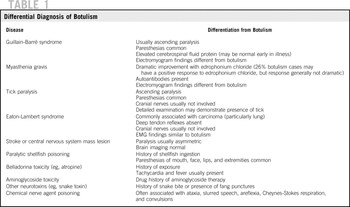
As previously described, the clinical presentation of an afebrile patient with an acute, symmetric, descending flaccid paralysis (without sensory deficits) with a normal sensorium suggests a diagnosis of botulism. Other causes of paralytic illnesses must be excluded (see Table 1). Electrophysiological studies are useful in distinguishing botulism from other causes of acute flaccid paralysis and support a presumptive diagnosis of botulism. Reference Maselli and Bakshi70–Reference Padua, Aprile and Monaco72 An electromyogram with repetitive nerve stimulation at 20 to 50 Hz showing facilitation (an incremental response to repetitive stimulation), which usually occurs only at 50 Hz, may be helpful in distinguishing botulism from Guillain-Barré syndrome or myasthenia gravis, but not from Eaton-Lambert syndrome.Reference Shapiro, Hatheway and Swerdlow2 Electrophysiological testing in botulism may also demonstrate a small evoked muscle action potential response to a single supramaximal nerve stimulus, with normal sensory nerve function and nerve conduction velocity test results. However, electrophysiological tests may exhibit normal results in botulism. In 1 study, 15% of botulism patients lacked abnormal muscle action potential amplitudes, and 38% of patients did not exhibit facilitation of muscle-action potential after tetanic stimulation or during rapid repetitive stimulation at rates of ≥20/second.Reference Hughes, Blumenthal, Merson, Lombard, Dowell and Gangarosa64
Differential Diagnosis of Botulism

Cerebrospinal fluid findings are usually normal in botulism, and abnormal findings suggest an alternate diagnosis. However, mild elevation of cerebrospinal fluid protein (cerebrospinal fluid protein between 50 and 60 mg/dL) was reported in 3 of 14 patients (17%) who underwent spinal fluid analysis.Reference Hughes, Blumenthal, Merson, Lombard, Dowell and Gangarosa64 Laboratory tests, such as the complete blood count, blood chemistries, liver and renal function tests, and electrocardiogram are normal in botulism, unless a complication (ie, secondary infection, respiratory failure) occurs.
Confirmatory Clinical Laboratory Tests
In food-borne botulism, a confirmatory diagnosis can be made by demonstrating the presence of toxin in patient specimens, including serum, stool, gastric aspirate, or vomitus, and by using mouse bioassays. Mouse bioassays are performed by the intraperitoneal injection of mice with the specimen sample suspected to contain toxin (with and without antitoxin). If toxin is present in the specimen, then mice injected with the specimen alone (without antitoxin) will usually die from botulism within 6 to 96 hours, but mice injected with the specimen treated with antitoxin will survive. Specimens for mouse bioassays may be sent to the Centers for Disease Control and Prevention (CDC) or other designated state or municipal public health laboratories.
Botulism diagnosis can also be achieved by anaerobic culture and isolation of Clostridium sp. toxigenic strains from clinical specimens, including fecal specimens, gastric aspirates, vomitus, or infected wounds. The organism or toxin can also be isolated from the suspect food, to help support the diagnosis.
Toxin Assays and Cultures
Toxin assays of various clinical specimens from cases of food-borne botulism during 1975–1988 showed the presence of toxin as follows: sera 37% (126/240), stool 23% (65/288), and gastric aspirate 5% (3/63).Reference Woodruff, Griffin and McCroskey51 Specimens were more likely to be positive if obtained soon after toxin ingestion. Toxin assays of sera were positive in >60% specimens obtained within 2 days after toxin ingestion, in 44% within 3 days of toxin ingestion, but in only 23% of specimens obtained by day 4 or later.Reference Woodruff, Griffin and McCroskey51 Toxin assays of sera were more likely to be positive from intoxications due to BoNT/A than from those caused by BoNT/ B and BoNT/E. Toxin assays of the stool were positive in 50% of stool specimens obtained within 1 day following toxin ingestion, in 39% within 3 days of ingestion, but in <20% of specimens obtained at 5 days or later.Reference Woodruff, Griffin and McCroskey51
Stool and gastric aspirate cultures for C botulinum in clinical specimens from cases of food-borne botulism (1975–1988) have resulted in a higher yield of diagnosis than toxin assays.Reference Woodruff, Griffin and McCroskey51 Gastric aspirates were positive in 45% (35/78) specimens, and almost 80% of stool cultures were positive at the second day following toxin ingestion, with about 40% of specimens remaining positive 7 to 9 days from toxin ingestion. However, laboratory confirmation of food-borne botulism by either toxin assay or culture could not be obtained in 32% of cases.Reference Woodruff, Griffin and McCroskey51 This may be due to the insensitivity of diagnostic testing, especially when specimens are obtained >3 days after toxin ingestion.
In a California study of wound botulism, toxin assays of the sera resulted in confirmation of botulism in most cases. Toxin was detected in the sera of 95% (99/104) intravenous drug users and 83% (15/18) of individuals lacking a history of intravenous drug usage with a clinical diagnosis of botulism.Reference Werner, Passaro, McGee, Schechter and Vugia69C botulinum was isolated from culture of the wound in 41 of 63 patients (65%), with cultures positive in 30 of 49 (61%) wounds from intravenous drug users and 11 of 14 (79%) wounds from individuals without a history of intravenous drug use.Reference Werner, Passaro, McGee, Schechter and Vugia69
Laboratory confirmation of botulism acquired by inhalation may be difficult because toxin acquired through inhalational exposure is not generally identifiable in the serum or stool as with food-borne botulism.Reference Franz, Jahrling and Friedlander73, Reference Heymann74 Antibody titers have limited use in the diagnosis of botulism because individuals may not develop an antibody response due to the small quantity of toxin protein required to cause botulism symptoms. If individuals inhale only toxin (no C botulinum spores), then bacterial cultures of the organism cannot be grown. Toxin may be detectable in the nares for up to 24 hours postexposure. An enzyme-linked immunosorbent assay or polymerase chain reaction of a nasal mucosal swab may be considered a diagnostic tool for inhalational exposure to botulinum toxin (detects contaminating bacterial DNA), but these tests have not been validated. Reference Heymann74–Reference Akbulut, Grant and McLauchlin76
TREATMENT
Standard treatment for botulism includes antitoxin therapy (regardless of route of acquisition of the toxin) and supportive care, which may require mechanical ventilation. The duration of mechanical ventilation may vary, but may be decreased with early initiation of antitoxinReference Kongsaengdao, Samintarapanya and Rusmeechan77; however, ventilatory support may be long term (usually ranging from 2 to 6 weeks’ duration, but may be longer). The mean duration of ventilatory support in 1 study was 58 days for botulism due to BoNT/A and 26 days for BoNT/B.Reference Hughes, Blumenthal, Merson, Lombard, Dowell and Gangarosa64 Because respiratory failure onset may occur suddenly, individuals with suspected botulism should be closely monitored, with frequent assessment of vital capacity and maximal inspiratory force.Reference Marks78 Intubation is recommended before the onset of hypercarbia or hypoxia, with the decision to intubate based on assessment of compromise of the upper airway or changes in vital capacity (in general, a vital capacity <12 mL/kg is an indication for intubation).Reference Black79 If recent ingestion of an implicated food has occurred, cathartic agents or enemas may be used to accelerate the removal of unabsorbed toxins, provided ileus is absent. Treatment in wound botulism includes surgical debridement with irrigation, preferably after administration of antitoxin (if possible), and antibiotic therapy (toxin production from the wound site may continue until the infection is eliminated).
Supportive care may require specialty consultations (intensivists, pulmonologists, neurologists, infectious disease specialists) and supportive staff (critical care nurses, respiratory care professionals, pharmacists, nutritionists) to manage these long-term patients in an intensive care unit. Complications occurring in patients with botulism in the intensive care unit were most commonly infections, mainly aspiration pneumonia and urinary tract infections, and less commonly acute pulmonary edema and acute respiratory distress syndrome.Reference Kongsaengdao, Samintarapanya and Rusmeechan77, Reference Marks78 Long-term physical medicine and rehabilitation may be required for residual weakness (most improvement in muscle strength occurs within the first 3 months of recovery, but continued improvement may be seen during the year following disease).Reference Hughes, Blumenthal, Merson, Lombard, Dowell and Gangarosa64 Mental health intervention may be required for long-term emotional sequelae.Reference Gottlieb, Kretsinger and Tarkhashvili80 Details on the supportive critical and chronic care management required for patients with botulism is beyond the scope of this article.
Antitoxin Therapy
Before 1950, the rate of mortality from botulism was approximately 60%.Reference Shapiro, Hatheway and Swerdlow2 Therapy with equine antitoxins did not become available until the early 1970s. The clinical evidence for the efficacy of botulinum antitoxin use in humans is based on retrospective analyses of small numbers of patients and from animal studies. In 1 study botulism caused by BoNT/A was associated with a mortality rate in humans of 46% without antitoxin therapy versus 10% with antitoxin therapy.Reference Tacket, Shandera and Mann63 Another study demonstrated a fatality rate of 29% from botulism caused by BoNT/E without antitoxin therapy versus 3.5% with antitoxin therapy.Reference Iida81 Although the evidence is limited, it is believed that early treatment, especially within 24 hours, is most effective in preventing paralysis progression. Antitoxin cannot neutralize toxin once it has bonded to the nerve receptors. Therefore, the antitoxin does not reverse paralysis, but only prevents progression of the paralysis. Symptoms may often progress for up to 12 hours after antitoxin administration before an effect is observed. With adequate ventilatory assistance, tracheostomy, and improved intensive care support, botulism fatality rates are generally less than 10%.
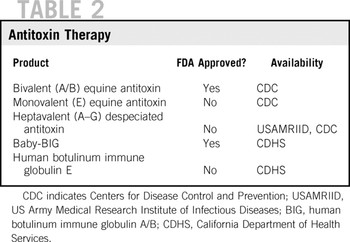
Individuals suspected to have been exposed to botulinum toxin must be monitored closely for evidence of botulism. Botulinum antitoxin should be administered as soon as possible once individuals develop symptoms of botulism. Table 2 is a summary of these antitoxin therapy products and availability.
Antitoxin Therapy

Equine Botulinum Antitoxin Products
Bivalent botulinum equine antitoxin (for BoNT/A and BoNT/B) is the sole FDA-approved antitoxin preparation available for adults (available from CDC). Trivalent equine botulinum antitoxin (for BoNT/A, BoNT/B, and BoNT/E) is no longer available from the CDC because of its declining antitoxin titers to BoNT/E. The CDC also has an investigational equine antitoxin product for BoNT/E. Because these antitoxin preparations are equine products, a risk of hypersensitivity reactions exists. Skin testing must therefore be performed before administering these antitoxins.
Human Botulism Immune Globulin Products
Human botulism immune globulin (Baby-BIG) is an FDA-approved drug for use in infants, which is available from the California Department of Health Services. Baby-BIG is obtained from the pooled plasma of adults immunized with pentavalent botulinum toxoid, having subsequent development of high titers of neutralizing antibodies against BoNT/A and BoNT/B. Because Baby-BIG is of human origin, it does not have the high risk for anaphylaxis that is inherent with products derived from equine sources, nor does Baby-BIG demonstrate a risk for possible lifelong hypersensitivity to equine antigens. Infantile botulism occurs primarily in newborns <1 year old, due to toxin production resulting from the intestinal colonization and growth of C botulinum. There are approximately 100 cases of infantile botulism diagnosed each year in the United States.82 Use of Baby-BIG has been estimated to save $70,000 per case in hospital costs.Reference Fox, Keet and Strober83, Reference Arnon84 An investigational human botulinum immune globulin against BoNT/E is also available from the California Department of Health Services.
Despeciated Equine Antitoxin Products
In addition, 2 equine antitoxin preparations (investigational products) against all 7 BoNT serotypes have been developed by USAMRIID for treating botulism: botulism antitoxin, heptavalent, equine types A, B, C, D, E, F, and G (HE-BAT), and botulism antitoxin F(ab′)2 heptavalent, equine toxin neutralizing activity types A, B, C, D, E, F, and G (Hfab-BAT). These products are “despeciated” equine antitoxin preparations, made by cleaving the Fc fragments from the horse immunoglobulin G molecules. This leaves only the F(ab′)2 fragments, which may potentially reduce the risk for serum sickness and hypersensitivity reactions. Although the species-specific antigens have been removed, hypersensitivity reactions remain a risk because approximately 4% of the horse antigen molecule remains in the preparation. The HE-BAT heptavalent product, when administered to an individual as a single vial of 10 mL, was formulated to provide >4000 IU of serotypes A, B, C, E, and F, and >500 IU of serotypes D and G antitoxin. One international unit of antitoxin is the amount of antitoxin that will neutralize 10,000 LD50 of BoNT serotypes A, B, C, D, F, and G and 1000 LD50 of BoNT/E. Both investigational products would be considered for treating botulism, particularly in the event of biowarfare or a bioterrorism event, which may potentially involve the use of any of the 7 BoNT serotypes.
Both heptavalent antitoxin products have been shown to be protective in mice and nonhuman primates. The heptavalent antitoxin products were demonstrated to neutralize all 7 BoNT serotypes in vitro. Mice injected with a mixture of heptavalent antitoxin with a specific toxin serotype did not develop symptoms of botulism.
Heptavalent product F(ab′)2 was protective when given to asymptomatic mice within a few hours after aerosol challenge with approximately 10 LD50 of BoNT/A, even with doses as low as one tenth of one human dose (associated with low antitoxin titers, ranging from 0.02 IU/mL or lower).Reference Franz, Pitt, Clayton, Hanes and Rose50 The Hfab-BAT product was also protective in nonhuman primates against aerosol challenge to toxin serotype A at a dose of approximately 2000 mouse intraperitoneal LD50/kg (MIPLD50), when given immediately before exposure (protection in 5 of 5 animals) and when given 48 hours after inhalational exposure (protective in 3 of 5 monkeys). However, if the heptavalent product was given at the onset of respiratory failure, then the F(ab′)2 heptavalent antitoxin was not protective in mice against aerosol exposure or intraperitoneal exposure, even with a 3-fold greater dose than the recommended human equivalent amount. Postexposure respiratory failure in mice occurred within 1 to 3 hours and death within 3 to 11 hours. This was much earlier than observed in humans and nonhuman primates, in which death generally did not occur until 2 to 3 days postexposure. The ineffectiveness of antitoxin administration at the onset of symptoms in the mouse model may be due to most of the toxin being no longer present in the circulation at the onset of symptoms (ie, it is already bound to the nerve terminals).
CLINICALLY RELEVANT SIGNS OF BOTULINUM TOXIN ATTACK
The first evidence that there has been a bioterrorist attack using BoNT would likely consist of victims having symptoms of botulism arriving at hospitals and urgent care medical facilities. Antitoxin therapy must be given early (based on clinical diagnosis of botulism) to have a beneficial effect, with subsequent confirmation of the diagnosis by laboratory findings. This may be difficult to accomplish because early symptoms of botulinum intoxication can be vague and difficult to diagnose effectively. Because severe cases may progress and develop respiratory failure, hospital bioterrorism plans should include contingency measures for additional ventilatory and intensive care unit support for mass intoxication.
The initial cases of early botulism illness may present with nonspecific gastrointestinal symptoms, and initial cranial nerve involvement may be minimal. Clinical observations from the ongoing wound botulism epidemic in California have provided important guidelines for botulism case identification and treatment. All 20 of the patients treated at the University of California, Davis had bulbar palsies, and all of the had a lateral rectus palsy upon initial presentation, along with double vision and difficulty speaking and swallowing. Some of these patients had respiratory failure, and all had good mental status.85 These patients required long-term care, including a percutaneous endoscopic gastrostomy (PEG) tube and tracheostomy.85 Difficulties caused by lack of muscle tonicity were encountered with the use of the PEG tube during medical treatment of a patient injected with high levels of BoNT/A.86 An esophageal gastroduodenoscopy revealed that the gastroesophageal junction and pylorus were fully open and no peristalsis was observed, even after stimulation of the mucosal wall. An attempt to position the patient so that PEG feedings could move from the stomach and into the duodenum via gravity failed. Eventually a jejunostomy tube was placed through the PEG tube for nutrition, although difficulties were encountered anchoring the jejunostomy tube in place because the mucosa would not contract around the ligating suture.86
The 2004 outbreak of iatrogenic botulism epitomizes public health concerns regarding readily accessible bulk BoNT not intended for human use. Four cases of botulism occurred as a result of improper use of laboratory research grade BoNT/A for cosmetic purposes. A vial of raw bulk botulinum toxin (a non-FDA approved formulation) containing as much as 10 million units of botulinum toxin (compared to a vial of FDA-approved Botox containing 100 units of toxin) was used by an unlicensed physician for cosmetic injections into 3 patients as well as himself.87, 88 Analysis of serum samples indicated circulating levels of toxin as high as 43 times the estimated human lethal injection dose.Reference Chertow, Tan and Maslanka89 All 4 individuals were subsequently admitted to medical facilities with symptoms of botulism and experienced a long-term recovery from the effects of the unapproved toxin formulation.Reference Chertow, Tan and Maslanka89 The most severely affected individual was a 34-year-old woman who spent 104 days in a hospital and received ventilator support for 171 days.Reference Chertow, Tan and Maslanka89 This index patient initially demonstrated bilateral ptosis, bilateral dilated pupils that were nonreactive to light, and flaccid quadriplegia upon hospital admission.Reference Souyah, Karim, Kamin, McArdle and Marcus90
The single largest botulism outbreak requiring mass casualty response occurred in Thailand in March 2006,Reference Kongsaengdao, Samintarapanya and Rusmeechan77,91–Reference Ungchusak, Chunsuttiwat and Braden93 and is a useful case study for bioterrorism preparedness. The outbreak was caused by food-borne botulism from home-canned bamboo shoots and affected 209 villagers who consumed a common meal.91 Of those affected, 43 developed respiratory failure and 86% of the initial 163 patients were hospitalized.Reference Kongsaengdao, Samintarapanya and Rusmeechan77,91–Reference Ungchusak, Chunsuttiwat and Braden93 Thirty-nine patients required mechanical ventilation by the sixth day of the outbreak, and all 13 of the patients required endotracheal intubation and mechanical ventilation.Reference Kongsaengdao, Samintarapanya and Rusmeechan77, Reference Wongtanate, Sucharitchan and Tantisiriwit92 Ninety-three vials of antitoxin donated to Thailand by various international health organizations were administered to patients with the most severe symptoms.Reference Kongsaengdao, Samintarapanya and Rusmeechan77, Reference Siegel97 The median duration of hospital admission was 6 days for patients without mechanical ventilation and 25 days for patients with mechanical ventilation. The fact that no patients died is attributed to the massive public health response undertaken by the Thai health care system. Aside from the need for adequate ventilators and health care support, successful treatment of such large numbers of severely affected patients required intervention from neurologists, pulmonologists, intensivists, cardiologists, infectious disease specialists, and rehabilitation and referral services.Reference Kongsaengdao, Samintarapanya and Rusmeechan77 Other supportive personnel required for a mass casualty botulism event include pharmacists, respiratory care officials, and psychological services.
PRE- AND POSTEXPOSURE PROPHYLAXIS
Pentavalent Botulinum Toxoid
No FDA-approved vaccine is available to prevent botulism. However, an investigational product, the pentavalent botulinum toxoid (PBT) against BoNT/A-E, has been in use since 1959 for people who are at risk for botulism (eg, research laboratory workers). 94–Reference Rusnak, Kortepeter, Hawley, Anderson, Boudreau and Eitzen96 It is available as an investigational product on protocol through the CDC. The PBT is a toxoid (inactivated toxin) derived from formalin-inactivated, partially purified BoNT/A-E. The PBT was developed by the US Department of Defense at Fort Detrick, and originally manufactured by the Parke-Davis Company in 1958.Reference Siegel97 Formulation of the final product is based on concentrations that induce protective immunity in guinea pigs against a lethal challenge of 105 mouse intraperitoneal LD50 doses of each respective BoNT serotype. The Michigan Department of Community Health produced the current lots of PBT, which were formulated in the 1990s using monovalent products produced in the 1970s.
The PBT has been found to be protective in animal models against percutaneous challenge with BoNT/A–E and against aerosol challenge to toxin serotype A.98, 99 At-risk laboratory workers in the former US offensive biological warfare program at Fort Detrick were initially immunized in 1945 with a bivalent botulinum toxoid (serotypes A and B), and thereafter with the PBT, beginning in 1959.Reference Rusnak, Kortepeter, Hawley, Anderson, Boudreau and Eitzen96 Although there have been 50 accidental exposures to botulinum toxins reported from 1945 to 1969 (24 percutaneous, 22 aerosol, 4 ingestion), no cases of laboratory-acquired botulism have occurred, possibly due to protection from the botulinum toxoids.
The PBT dosing schedule has been modified since its introduction. It had been administered as a primary series of 3 subcutaneous injections (0.5 mL at 0, 2, and 12 weeks), a booster dose at 12 months, and additional doses as required for declining antitoxin titers. 98,100,101 In 2004 the dosing schedule for PBT was changed based on a recent decline in the yearly PBT potency testing, data supporting the requirement for a 6-month dose of PBT, and a demonstrated decline in immunogenicity to BoNT/E following immunization with the primary series or subsequent to a booster dose.98,101–104 The current PBT protocol requires a primary series of 4 injections (0.5 mL at 0, 2, 12, and 24 weeks), followed by a booster dose at 12 months, and booster doses annually thereafter.98 Given the recent decline in immunogenicity and potency, the CDC’s current recommendation for at-risk individuals who receive the PBT is to consider personal protective measures as the sole source of protection against all of the botulinum serotypes.98
The PBT has been administered to more than 20,000 at-risk individuals, mainly to at-risk laboratory workers and also to approximately 8000 members of the US armed forces deployed to the Persian Gulf War between January 23 and February 28, 1991.105 Clinical experience has indicated the toxoid to be safe, with the main adverse event of local reactions, which are generally mild and self-limiting. Adverse events on passive reporting to the CDC for more than 20,000 vaccinations (1970–2002) consisted of 7% of vaccinees with moderate local reactions (edema or induration between 30 to 120 mm), and <1% with severe local reactions (reaction size >120 mm, marked limitation of arm movement, or marked axillary node tenderness).98
The PBT is not recommended for postexposure prophylaxis because measurable antitoxin titers do not usually occur until 1 month after the third dose of the vaccine (4 months after the first vaccine dose).Reference Siegel97,98,Reference Fiock, Cardella and Gearinger100,103,105 However, the PBT may be considered for preexposure prophylaxis in at-risk individuals (laboratory workers or military personnel at high risk for exposure). Preexposure vaccination in the general population is not recommended because the risk of botulinum intoxication is rare. In addition, the requirement of multiple doses to maintain titers, the Investigational New Drug Application status of the vaccine, and the limited supply of the vaccine makes this product difficult to use in large numbers of people in an emergency setting. Nearly all of the stocks of these products are held either by the US Army or CDC for the pharmaceutical Strategic National Stockpile (CDC maintains large amounts of medicine and medical supplies to protect the public in the event of a public health emergency the severity of which would cause local supplies to run out).
Passive Immunoprophylaxis
Passive antitoxin prophylaxis has been effective in protecting laboratory animals from toxin exposureReference Gelzleichter, Myers, Menton, Niemuth, Matthews and Langford106; however, the limited availability and short-lived protection of antitoxin preparations makes their use for pre- or postexposure prophylaxis impractical for large numbers of people.Reference Franz, Jahrling and Friedlander73 Equine antitoxin is not recommended for preexposure prophylaxis because of the risk for anaphylaxis from foreign equine proteins, particularly with repeated doses. These products are also not generally recommended for use in asymptomatic individuals. Botulinum immune globulin is most effective when administered within 24 hours of a high-dose aerosol exposure to botulinum toxin. Making the decision to administer antitoxin to an individual with a known high-dose aerosol exposure to BoNT before the onset of symptoms from botulism (versus observation with administration of antitoxin at the onset of symptoms) involves weighing the risk for anaphylaxis from the equine antitoxin against the expected morbidity and mortality from the exposure to the botulinum toxin.
NEW BOTULISM VACCINE RESEARCH
Botulism vaccine candidates include formalin inactivated toxoids made nearly identical to the formalin-inactivated PBT, designed for subsequent FDA approval.Reference Edelman, Wasserman, Bodison, Perry, O’Donnoghue and DeTolla107, Reference Torii, Tokumaru and Kawaguchi108 The major concerns with the formalin-inactivated toxoids have been the occurrence of local reactions and the need for multiple injections to achieve and sustain protective titers.
The use of pure concentrated antigen in recombinant vaccines could offer advantages of increased immunogenicity and a decrease in reactogenicity (local reactions at the injection site) over formalin-inactivated toxoids.Reference Holley, Elmore, Mauchline, Minton and Titball109 Recombinant techniques use a toxin segment that is in itself immunogenic, but lacks the capability to block cholinergic neurotransmitters. Both Escherichia coli and yeast expression systems have been used in the production of recombinant fragments, mainly the carboxy-terminal fragment (Hc) of the HC of the toxin. Vaccine candidates using recombinant fragments of botulinum toxins against BoNT/A–C, along with BoNT/E–F have been protective in mice.Reference Byrne, Smith, Montgomery and Smith110–Reference Smith, Jensen, Montgomery, Brown, Ahmed and Smith116 A vaccine recombinant candidate for BoNT/A was protective in mice against intraperitoneal challenge and produced levels of immunity similar to that attained with the PBT, but with an increase in safety and a decrease in cost per dose.Reference Middlebrook117 Recombinant vaccines given by inhalational route are also being investigated.Reference Park and Simpson118, Reference Park and Simpson119 Work at USAMRIID led to the development of a bivalent recombinant botulinum vaccine (BoNT/A and BoNT/B) undergoing human phase I trials.98, Reference Byrne and Smith120 This vaccine is administered in 2 doses (0 and 6 weeks).
SUMMARY
The neurotoxins produced by Clostridia sp. are among the most potent toxins known. BoNT has been examined and developed as a BW by many countries and should be considered to be a bioterrorism threat agent. A mass casualty event from BoNT has the potential to cause widespread societal harm, and has been depicted via mathematical models. Botulism is a neuroparalytic disease most commonly caused by food-borne ingestion of neurotoxin types A, B, and E, and is often fatal if untreated. Clinicians should be able to recognize the classic symptoms of botulinum intoxication. Various laboratory assays for botulinum toxin are available for clinical specimens, but patient treatment is initiated in the absence of laboratory confirmation, given an index of suspicion for botulism. Antitoxin therapy and supportive care are important for treating botulism patients. Bivalent botulinum equine antitoxin is the sole FDA-approved antitoxin for adults. Human botulism immune globulin was approved recently by the FDA and is available for the treatment of infantile botulism. Two heptavalent (A–G) despeciated equine antitoxin preparations developed by USAMRIID are available as investigational drugs for treating botulism. PBT has been used for more than 45 years as an investigational product in at-risk laboratory workers for potential protection against botulinum toxin. Future vaccine research could lead to a new class of recombinant vaccines to protect against botulism.