This paper aims to expose the ‘double life’ currently enjoyed by a gold seal ring in the Victoria and Albert Museum, London.Footnote 1 In England the ring is generally believed to be ninth-century Anglo-Saxon and to be connected with King Alfred and the so-called ‘Rome Hoard no. 6’, a hoard of Anglo-Saxon coins said to have been found with the ring in Rome; by contrast, Italian and German scholars know it as a Lombard seal ring of early seventh-century date. What follows is a brief history of the discovery of the ring, of its early records, as documented in Italian antiquarian sources and reappraised in recent scholarly discussion, and of its re-emergence in England in the middle of the nineteenth century in the collection of Edmund Waterton, FSA, along with a discussion of the numismatic connection to King Alfred.
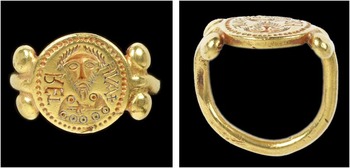
First, a brief description of the object itself (fig 1). This is a large seal ring of gold that weighs 16.2g and is 24mm wide, 23mm in depth and 16mm in height. It is in very good condition, apart from some slight damage to the bezel at 12 o'clock and to the frame of pellets at 6 o'clock. There are traces of red wax in the recesses. On each side of the hoop, two large flattened globules join it to the circular bezel, a typical setting seen on seal rings among many Germanic peoples.Footnote 2 On the bezel, within a frame of pellets, is engraved the frontal bust of a man with hair parted in the middle and a long beard and moustache. The eyes are large and oval, with dots forming tiny pupils, and the lips full; the recessed brow and the long thin nose are joined in a T-shape. The half-bust is decorated by seven roundels with a central dot: two are on the shoulders and five form the lower border of the bust. Between the two rows of roundels is incised what would be the man's right arm in an imprint of the seal. All five fingers are portrayed, with the index and medium fingers extended in a gesture of speech or majesty,Footnote 3 typical of Lombard iconography.Footnote 4 To either side of the bust is arranged the retrograde inscription +
 VF RET.Footnote 5
The Aufret ring. Photograph: © The Victoria and Albert Museum

The elegant capital letters of the inscription are well proportioned and serifed. The most noteworthy character is the display square capital A with a forked cross-bar (
 ), a variant form of Greek origin, commonly found over a very extensive geographical area in early Christian inscriptions from the third century onwards.Footnote 6 Because the form was canonical in Christian Greek, it was found from the fourth century associated with omega in the Chrismon.Footnote 7 As Morison states, the ‘Greek inscriptional forked alpha became not only Phrygian and Roman, but Insular,Footnote 8 early medieval and modern vernacular Gaelic’.Footnote 9 It is a form also commonly used in Lombard inscriptions.Footnote 10
The discovery of the ring and its early movements can be mapped in well-documented works by Italian and German historians,Footnote 11 and they form an interesting chapter in the world of eighteenth-century antiquarian markets. The ring was found in 1726 in Civita di Bagnoregio (fig 2),Footnote 12 now in the province of Viterbo, in central Italy. Once a centre of some importance, a large part of the town was destroyed by an earthquake and a massive landslide in 1695, which affected in particular its medieval quarter, Civita, where the cathedral and the bishop's residence were situated. Near the cathedral was the church of St Peter, which belonged to the Brotherhood of St Peter: it too was destroyed in the earthquake and by the collapse of a tower. According to his own declaration, the treasurer of the Brotherhood came across the gold ring some thirty years later, on 5 September 1726, while sifting through the ruins of the church in the process of reclaiming bricks. According to his account, the ring was found below the floor to the left of the altar within the presbytery.Footnote 13 Another local witness claimed that some iron fragments were also found with the ring, believed at the time to be parts of an iron crown but more probably the remains of weapons – though such iron artefacts are likely to have deteriorated beyond recognition in the three decades that had passed since the tomb was breached by the events of 1695.
Civita di Bagnoregio. Photograph: © Comune di Civita di Bagnoregio

In spite of the treasurer's protestations, and the pleas of the Brotherhood, the ring was confiscated by a canon and a priest and eventually passed to the local bishop, Onofrio Pini (1721–54). Subsequently, through negotiations with the bishop's brother, it was acquired in 1727 by an enthusiastic Roman collector and bibliophile, the Marquis Alessandro Gregorio Capponi (1683–1746).Footnote 14 From 1726, having become involved in some catacomb excavations, Capponi's interests, which had been concentrated on books and paintings, extended to the acquisition of archaeological finds, and he assembled a large and noted collection.
Capponi's manuscript diary of his acquisitions of the Aufret seal ring survives in the Vatican Library.Footnote 15 Soon after this acquisition, in March 1727, Capponi corresponded with Ludovico Antonio Muratori (1672–1750), the leading Italian historian and antiquary of the day, sending him a reproduction of the ring, which he thought might be Lombard on account of the name, and asking about possible parallels. Muratori expressed interest in the Aufret ring and in another similar seal ring (now lost) that also belonged to Capponi,Footnote 16 and he dedicated a lengthy discussion to both in his Antiquitates italicae medii aevi.Footnote 17 He was particularly interested in the style of the hair and moustaches,Footnote 18 identifying them as representing Goths or Lombards, or even Franks, but certainly northerners and noble. He also re-published part of his text (omitting the discussion of the name Aufret, and the illustrations) in the second volume of his Dissertazioni sopra le antichita Italiane.Footnote 19
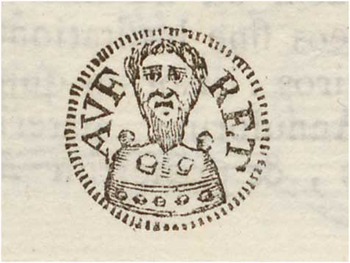
Muratori's illustration of the ring (fig 3) must have been made from either a wax imprint of the seal or a drawing of it, because the inscription AVFRET is clearly legible from left to right. However, compared to the original, the illustration presents several discrepancies. The cross that precedes the legend is omitted and the schematic right arm and outstretched hand are misunderstood and replaced by a double border of two parallel lines that frame the five dot-in-ring decorations of the vestments.Footnote 20 The two uppermost dot-in-ring patterns, originally on the shoulders, are duplicated: two are placed on the breast and an additional pair, possibly understood as a pair of round brooches, is positioned on top of the shoulders. The features of the man appear less stylized than on the original, though they retain the severity of the long thin face, accentuated by the triangular beard. The length and neat central parting of the hair are not too well understood, even though these are discussed at length by Muratori as elements characteristic of Lombard iconography.
The Aufret ring as published by L A Muratori in Antiquitates italicae, iii, col. 113. Photograph: © The University of Cambridge

Despite these minor differences, the inscription and the iconography of the bust leave no doubt that Muratori's illustration represents the ring now in the Victoria and Albert Museum. Hayo Vierck, who first realized this in the early 1980s, signalled his discovery in an informal communication to Otto von Hessen,Footnote 21 who had been particularly interested in Lombard seal rings and their iconography since the discovery of an impressive specimen with the name RODCHIS at Trezzo sull'Adda in 1976.Footnote 22 In a paper discussing the corpus of all known Lombard seal rings,Footnote 23 he welcomed Vierck's re-discovery of the Aufret ring, which had been presumed lost. Von Hessen's paper said that the ring was classified by the Victoria and Albert Museum as ‘the ring of King Alfred’ and as an Anglo-Saxon antiquity,Footnote 24 and he quoted Okasha's publication of its inscription.Footnote 25 He does not, however, appear to have alerted the museum or ‘Insular’ scholars to the ring's misattribution.Footnote 26
In addition to re-attributing the ring to a Lombard context, some scholars have been tempted to trace the historical figure of Aufret. Kurze wanted to recognize in him the person named in the letter that Gregory the Great sent in June ad 600 to Bishop Ecclesius of Chiusi.Footnote 27 Gregory there states that the gloriosus filius noster Ansfrid (or possibly Ausfrid)Footnote 28 has let him know of the election of the deacon John as bishop of Balneum Regis with the consensus of the local people and now requests of Gregory his ordination and consecration. Ecclesius is asked to conduct checks on John's status so that he can be properly ordained or deposed. Other scholars have been more cautious with this attribution:Footnote 29 not only was Bagnoregio under Byzantine rule in ad 599/600, but the ‘royally inspired’ style of burial and the iconography of the ring would, for Lusuardi Siena, fit more readily in the 630s or 640s.Footnote 30 Perhaps all that can be said, then, is that Aufret must have been a Lombard leader of some importance to have owned such a ring and to have been afforded burial in a position of honour in the church of St Peter, Bagnoregio.
How did the ring end up in England? We know its later story only in part. In 1730, the Marquis Alessandro Gregorio Capponi, already a renowned collector, became Cameriere Segreto (Privy Chamberlain) to Pope Clemens xii and Forerius Major (literally ‘Great Furrier’, an ancient post with responsibility for the papal palaces), and in 1733 he was charged with the reorganization of the Capitoline Museums. On his death in 1746, Capponi bequeathed his own antiquarian collection to Fr Contuccio Contucci (1688–1768), to be incorporated into the Museo Kircheriano in Rome (now part of Rome's Museo Nazionale delle Terme).Footnote 31 Contucci was Prefectus of the museum from 1741 and Fr Filippo Buonanni (1638–1722) was Director. Both were Jesuits and the collection was neglected during the period between the suppression of the Order in 1773 and the return of the Jesuits in 1825. During this period, the Vatican Museum, exercising papal privilege,Footnote 32 took various items from the numismatic and antiquarian collections, possibly including the ring. So while the whereabouts of the ring after Capponi's death in 1746 remains uncertain,Footnote 33 we can assume that it was deposited at the Museo Kircheriano from whence it found its way to the Vatican collection.
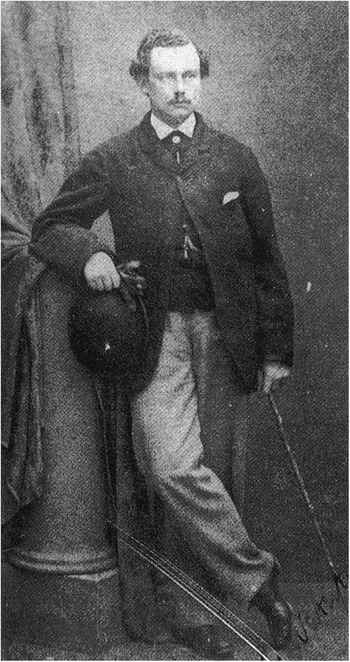
By working backwards from its attested provenance in England, we can glean something of the ring's subsequent history. As already stated, the ring was acquired by the Victoria and Albert Museum in 1871 as part of the extensive Waterton Collection.Footnote 34 Edmund Waterton (1830–87), FSA (fig 4), was the only son of Charles Waterton of Walton Hall, near Wakefield, West Yorkshire, a devout Catholic of ancient stock and a renowned traveller and naturalist.Footnote 35 Edmund, however, far preferred archaeology, as well as pomp, ceremony and a luxurious lifestyle. After his education at Stonyhurst, the Jesuit school in Lancashire, Edmund went to Rome in 1850. Thanks to his father's connections with the Jesuits, he became a member of the papal household as Cameriere Segreto di Spada e Cappa Soprannumerario (Supernumerary Privy Chamberlain of the Sword and Cape) to Pope Pius ix. On 6 March 1858, he was made a Knight of the Supreme Order of Christ.Footnote 36 As a lover of the fine things in life and an avid collector of rings and other antiquities, he accumulated a fine collection – as well as spiralling debts.Footnote 37 In a vivid first-hand account of Edmund, back at Walton Hall in 1861, Mrs W Pitt Byrne contrasted the asceticism of his father with the comfortable life style that the son enjoyed.Footnote 38 His much-admired collection of ‘antique and curious rings’Footnote 39 was deposited on loan at the South Kensington Museum, where they were ‘handy for purchase when his time of embarrassment came’ in 1871.Footnote 40
Edmund Waterton in the 1860s. Photograph: © The English Convent, Bruges

Edmund Waterton had been elected a Fellow of the Society of Antiquaries on 19 June 1851 at the young age of twenty-one. His obituary in the Proceedings of the Society of Antiquaries lauds him as ‘a great collector of rings, medieval jewellery, swords, etc’ and praises him for often exhibiting his choicest pieces to the Society.Footnote 41 The Aufret ring – one of Edmund's prized possessions – had been given to him in Rome in 1857 ‘by a dear friend, now no more’,Footnote 42 and he exhibited the ring at meetings of the Society of Antiquaries on 7 January 1859Footnote 43 and on 8 March and 20 December 1860,Footnote 44 as well as at Ironmongers’ Hall in London in May 1861.Footnote 45 The ring was also selected for publication in the Illustrated London News in January 1863.Footnote 46
Waterton's statement dating the presentation of the ring to him to 1857 is as far back as we can securely document the provenance of the Aufret ring, which still leaves a gap of about a hundred years in its history from its alleged bequest to the Museo Kircheriano after the death of Marquis Capponi in 1746. Although we can only speculate how the ring came to be in Edmund Waterton's possession, it is clear that ‘all roads lead to Rome’: his strong connections with the Jesuits and the Roman Curia, and the fact that both Edmund and the Marquis Capponi had held the post of Cameriere Segreto, suggest associations that make this change of ownership quite plausible. We can only speculate whether Waterton was aware that the gift to him was perhaps improper: it was his practice to record the provenance and/or source of other acquisitions in detail – over this ring, however, he was far more reticent.
When the Aufret ring reached England, it gradually took on a new life, and a new identity, potentially far more important than the one it had enjoyed as the seal ring of a long-forgotten Lombard duke in central Italy. The entries that accompanied the various notifications of its exhibition, and indeed other descriptions in publications of the ring, all added some detail, the sum of which slowly, but inexorably, built up to a misleading connection to King Alfred the Great.
Waterton's note published in the Proceedings of the Antiquaries’ meeting of 7 January 1859 stated that the ring was found ‘with a considerable number of coins of Alfred’.Footnote 47 The entries for 8 March and 20 December 1860 noted ‘a massive signet ring of gold on which is engraved a full-faced bust and the inscription +AVFRET. The ring appears to be 8th–9th century and was obtained in Rome’ and is ‘a fine signet ring which has all the characteristics of Anglo-Saxon manufacture – is this a form of the name Alfred?’Footnote 48 In his manuscript ‘Essay on rings’ of 1860, Waterton was at pains to justify the discrepancies between the inscription and the king's name.Footnote 49 G R French, who compiled a catalogue of the Ironmongers’ Hall exhibition of 1861, reported: ‘a massive gold signet ring; the bezel circular, representing the bust of a man, inscribed with the name, +AVFRET, or ALFRET. It was presented in 1857 to Mr Waterton, who says – “May this be a form of ALFRED?” ’Footnote 50
In his article of 1931, Oman wrote: ‘said to have been found in the Roman Forum with coins of Alfred the Great’,Footnote 51 and whilst in his 1930 entry in the catalogue of the rings in the Victoria and Albert Museum he had perceptively linked its iconography to that of the Lombard rings inscribed MAVRICI, now in the Ashmolean Museum, Oxford,Footnote 52 and FAOLFVS,Footnote 53 now in the Bargello Museum, Florence,Footnote 54 both in this and in subsequent publications he considered the Aufret ring to be of Anglo-Saxon manufacture, ‘made for someone of importance who was literate and he might have been Alfred’.Footnote 55 Jessup's discussion of the ring in the 1950s is also enmeshed in historical rationalizations: he linked the ring, and justified the circumstances of its find place, to a passage in the Anglo-Saxon Chronicle E, sub anno 883, which records the gift of a portion of the True Cross from the pope to Alfred.Footnote 56 More recently, Wilson's assessment of Anglo-Saxon ornamental metalwork and Okasha's studies of the ring's inscription both built on its previous bibliography; hence ‘Aufret’ was included in the corpus of Anglo-Saxon artefacts and inscriptions.Footnote 57
David Hinton, in his discussion of the Alfred Jewel and its inscription in 1974, was one of the first to cast a critical eye on the ring. Whilst accepting the possibility that AVFRET might have been a variant of Alfred's name, Hinton stated that ‘the ring in other ways appears to be Merovingian’.Footnote 58 Others began to be more sceptical of the received history of the ring,Footnote 59 highlighting the problems of identification of an object without reliable details concerning its discovery, and questioning the existence of the coin hoard, which was by now firmly connected to the ring. The ring was tentatively considered to be Byzantine,Footnote 60 but agreed to be ninth-century, as was then universally accepted in England. Shirley Bury, former Keeper of the Department of Metalwork in the Victoria and Albert Museum, described the ring in 1984 as ‘?9th century. Previously thought to be Anglo-Saxon, it is now thought to be Byzantine’.Footnote 61 At the time of writing, the entry on the Victoria and Albert Museum website states that the ring,
previously described as Anglo Saxon, was said to have been found in Rome with a hoard of coins of Alfred the Great (849–901). The story has recently been challenged, and the inscription cannot therefore be taken definitively to refer to King Alfred. The Anglo-Saxon attribution which partly depended on the association with Alfred has to be balanced against the general resemblance of the ring to Byzantine examples, which in turn derived from a Roman type.Footnote 62
It is hoped that the evidence presented here will serve to put the record straight with regard to its Lombard origins and seventh-century date.
The association of a hoard of Anglo-Saxon coins with the ring ‘found in Rome’ had naturally also excited the curiosity of numismatists. In 1986 Christopher Blunt published an article specifically on coins found in Italy, where he included this ‘find’.Footnote 63 His ‘Hoard no. 6, near Rome before 1859’ comprises the ‘considerable number of Anglo-Saxon coins’ found with the Aufret ring. Whilst he admitted that the coins had not been traced, he suggested the possibility that these were the coins referred to by H V Morton in his book A Traveller in Rome.Footnote 64 In a description of a visit to the Borgo and to the Ospedale Santo Spirito in Sassia, on the site or near where the Schola Saxonum, the old Anglo-Saxon quarter, was situated,Footnote 65 Morton wrote that the secretary of that institution had shown him ‘a few corroded Anglo-Saxon coins, too defaced to identify, all that could be seen and felt of England's long association with this part of Rome. He had every Saxon visitor at his finger ends, and how odd it was to hear someone refer to “Alfredo Magno”!’Footnote 66 Christopher Blunt asked his brother Anthony, the art historian, to check this vague reference by visiting the Santo Spirito hospital. This he duly did in November 1980, but he was told that, while they had indeed had some coins, these had subsequently been sold. Blunt acknowledged that the reference to Alfred was tenuous, as the coins were reportedly too corroded to be identified; he left the question open, however, resolvable only should a numismatist have seen and made a note of the coins kept in the hospital. Because of early links between the hospital and Anglo-Saxon pilgrims, it is quite possible that these coins may have been Anglo-Saxon – but there clearly cannot have been any link to the Lombard ring. The notion of an association between this hoard and the ring should now be abandoned by scholarship.Footnote 67
The Aufret ring has thus led a double life until now: in continental scholarship, there is no doubt about its provenance and secure attribution to a well-attested class of Lombard artefacts.Footnote 68 We are fortunate to be able to follow the ring, after its recovery from the ruins of Bagnoregio in 1726, in the correspondence between two antiquaries, Antonio Muratori and the Marquis Capponi, who owned it until his death in 1746. We can then trace it in the collection of Edmund Waterton from 1857 until its acquisition by the Victoria and Albert Museum in 1871. In Britain, the ‘red herring’ of the coins, and the similarity of the name Aufret to that of Alfred, have proved fatally attractive, and have consequently derailed much subsequent scholarship. It is now time to bring the two stories together, to remove the phantom ‘Rome Hoard no. 6’ from the list of Italian finds of coins of Alfred, and the name +AVFRET from the list of Anglo-Saxon inscriptions, and to re-label the seal ring appropriately, ascribing it to Aufret the Lombard.
ABBREVIATIONS AND BIBLIOGRAPHY
- Abbreviations
- BAV
-
Biblioteca Apostolica Vaticana, Vatican City
- TCL
-
Trinity College Library, Dublin
Acknowledgements
My thanks are due to Professor Lusuardi Siena, of the Catholic University of Milan, who sparked my interest in the Aufret ring with an invitation to contribute to the seminar to launch I Signori degli Anelli (‘Lords of the Rings’) in 2004.Footnote 69 I would also like to express my gratitude to Rachel Church, Curator of Metalwork at the Victoria and Albert Museum, for generously allowing me access to the ring and for much useful discussion; to Marian Campbell, FSA, Carol Farr, FSA, Rosalind Love, the late John Higgitt, Elisabeth Okasha, FSA, Lucia Travaini and Leslie Webster, FSA, for their generous comments and contributions; to Adrian James, P Robinson and John Sargent for help with references and to Myke Clifford and Cambridge University Library for help with the figures.