


INTRODUCTION
The rights and status of women have been on the agenda of intergovernmental organizations at least since the early 20th century,Footnote 1 but it was the establishment of the United Nations (UN) in 1945 that marked a significant turning point. Expressing “faith in fundamental human rights, in the dignity of human person, in the equal rights of men and women and of Nations large and small” in the preamble of its Charter (emphasis mine), the UN has been addressing women's status as an issue of discrimination in relation to human rights since its inception.
The UN's approach to human rights, as articulated in the Universal Declaration of Human Rights (UDHR 1948) and the subsequent human rights declaration and treaties, is significantly different from what is promoted in earlier “liberal,” “natural right,” or “social contract” philosophies and documents that centered on men, focused on property rights, and served the already privileged (e.g., the Magna Carta, and the French Declaration of the Rights of Man and of the Citizen) (Arat Reference Arat2006a, Chap. 1). In addition to including a broader scope of rights, the UN declarations and treaties are more explicit on universalist and egalitarian principles (Arat Reference Arat2008, Reference Arat2006b). They call for the protection of human rights, because “human beings are born free and equal in dignity and rights” (UDHR, Art. 1, emphasis added), and promote the enjoyment of human rights by all without discrimination based on “race, colour, sex, language, religion, political or other opinion, national or social origin, property, birth or other status” (e.g., UDHR, Art. 2). The emphasis on equality in dignity, in a world of unequals, and promoting human rights for all to enjoy regardless of their status, tacitly treat all rights as positive rights that require positive action to remove obstacles and provide protection.Footnote 2 This approach brings those who are currently lacking rights to the forefront as the primary subjects of rights. In fact, what makes human rights appealing to the disadvantaged is precisely this trust in equality in dignity (Arat Reference Arat2008).
The UN has advanced women's rights in at least two ways: (1) by introducing a new, emancipatory human rights discourse, and (2) by offering a venue for interaction, exchange, and cooperation among women with different life experiences and from different parts of the world, thus supporting transnational women's activism. Women's rights activists, in turn, used opportunities created by the UN to push its agenda and discourse further (Jain Reference Jain2005; Merry Reference Merry2006; Winslow Reference Winslow1995), often by introducing different feminist theoretical frameworks.
In this article I offer a critical examination of the interaction of feminist theories and the international human rights discourses as articulated at the UN forums and in its documents. Different from other critics of the UN, who tend to focus on lack of political will or implementation, provide data on lack of progress, and problematize its defects as global governance, I draw attention to the gap between theory and praxis.
In the last fifty years, feminist theorizing has become increasingly sophisticated and a range of feminisms have emerged and elucidated the diversity of women's experiences and complexities of oppression. These theories have informed the transnational advocacy of women's rights and compelled the UN to address women's concerns, which could not be explained or redressed by simplistic notions of gender oppression. However, I contend that despite the incorporation of some of these feminist concerns into the documents that offer plans for action, the overall women's rights approach of the UN is still informed by the demands and expectations of liberal feminism, which seeks integrating women into male dominant domains and structures, without contesting the foundation and function of those structures.Footnote 3 This liberal feminist bias is particularly evident in the aggregate indicators (e.g., the share of women's seats in the parliament) that are employed to assess the “empowerment of women,” which is one of the UN Millennium Development Goals set in 2000. Thus, the key argument of this article centers on the problems with the use of such indicators. These aggregate measures are based on a notion that equates individuals’ access to some sources of power with their empowerment. Treating power as a property possessed by individuals, and thus deployed at will, this approach ignores the relational aspect of power and structures that sustain power differentials. Moreover, it assumes that as some members of a marginalized group gain access to some sources of power, the entire group is empowered. I contend that following policies that result in improvements on such indicators may help some women, thus help close the gender gap, but they would fall short of empowering the majority of women, because policies that simply seek gender equality by “integrating women” into existing institutions ignore the diversity of women and structural foundations of subordination, such as capitalism, race and class systems, and international power differentials. Combining a review of the interaction between the UN discourse and feminist theories with theoretical arguments about power relations, I claim that women's rights are advanced in theory (new feminisms and human rights discourse) and rhetoric (the UN documents), but with little hope for change in practice for the majority of women.
The first section summarizes the proliferation of feminist theories and shows how diverse and increasingly sophisticated feminist approaches to women's issues have been gradually integrated into the UN rhetoric. In addition to this responsiveness to alternative feminist discourses, I document the preeminence of the liberal framework and explain why liberal feminism has trumped other more complex feminist theories. Then, turning to the assessment of progress and empowerment, I discuss the limitations of the commonly used “liberal” indicators of women's empowerment. The discussion of the complex relationship between the sources of power and power relations points to the importance of addressing structural causes of subordination. Thus, I conclude by stressing the need to develop strategies and specific courses of action, which should be informed by feminist theories that call for changes beyond integrating women into the prevalent power structures.
FROM LIBERAL FEMINISM TO INTERSECTIONALITY: THEORETICAL ADVANCEMENTS AND RHETORICAL ACCOMODATIONS AT THE UN
Feminism can be broadly defined as a theory that problematizes the subordination of women, but feminisms vary in terms of what they see as the cause of women's subordination, their alternatives to patriarchal systems, and strategies for change. Here, I focus on some feminist theories that have been influential in shaping the UN rhetoric and debates. In an effort to show the parallel developments in theory and rhetoric, I treat the progress of theories in an almost linear fashion, following their visibility in public debates, although theories co-exist, constantly interact, and often overlap. Moreover, what I offer is necessarily a brief depiction of some theories. I inevitably oversimplify arguments, overlook differences within a theoretical category, and leave out some important theorists, as well as some distinct theoretical clusters (e.g., care feminism, psychoanalytical/French feminism, African feminism, Muslim feminism, postmodern feminism, ecofeminism). Poststructuralist/postmodernist feminist theories, which are largely informed by Foucauldian notions of power, are left out, because their rejection of general explanations, valorization of differences, and perception of nonlocal proposals domineering render a global feminist politics impossible or problematic. However, I touch upon the influence of these theories in the last section, where I discuss the limitations of feminisms that emerged as alternatives to liberal feminism.Footnote 4
The UN agency that focuses on women's rights is the Commission on the Status of Women (CSW).Footnote 5 The principles that guided the CSW are established at its first session, held in February 1947: (a) freedom and equality are essential to human development, and therefore women as human beings are entitled to share in them with men; (b) the well-being and progress of society depend on the extent to which both men and women have a definite role to play in the building of their society; and (c) women must take an active part in the fight for peace, the prevention of aggression, and the elimination of fascist ideology (E/281/Rev.1 (1947), 11–2). These principles were later articulated as the three goals of the first UN conference on women, held in Mexico in 1975, and subsequently became the three themes of the UN Decade for Women (1976–1985): equality, development, and peace. Beyond these principles, however, there was little agreement on priorities and strategies, since the political commitments and ideological dispositions of the member states varied.
Liberal versus Marxist Feminisms: Competing Visions in Cold War Politics
The Cold War divisions and rivalries shaped the CSW debates and polices, especially in the earlier decades, when liberal and Marxist feminisms constituted the main competing visions. Liberal feminism is informed by classical liberal philosophy, which emphasizes man's ability to reason, right to participate in governance, and freedom from the state control, especially in regard to managing his property: but it turns some of the key premises of classical liberalism upside down to argue for the equality of sexes. It opposes biological reductionism that defines woman by her reproductive role. Instead, it asserts that women, too, are rational beings, they can be intellectually on a par with men if given the same opportunities, and thus they should enjoy the same rights as men (Mill and Mill, 1869/Reference Mill and Mill1970). Demanding equal opportunities for women's education, electoral rights, economic participation, equal access to the public domain, and integration into all male institutions, liberal feminism seeks gradual change through legislative reform and antidiscrimination laws; it considers the state an apparatus that can be used to create equal opportunities for women and to establish gender equality.
Marxism emerged in the 19th century as both a critique of capitalism and the main rival of liberalism. Rejecting all notions that essentialize human nature and employing a materialist approach, Marxist feminism attributes the subordination of women, along with other forms of subordination (e.g., class, race, ethnicity), to the private ownership of the means of production (Engels 1884/Reference Engels1990). It holds that women constituted the first group to be subjugated by men who seized the means of production, and they have been separated from production to concentrate on propagating the human species and serving the needs of men in the family. While bourgeois women remain in the domestic sphere, working class women are treated as a “reserve army” of laborers to maintain the wages low. Treating the state as an instrument of the ruling/property-owning class, Marxism sees the emancipation of women as possible only through the emancipation of the working class by a proletarian revolution that would eliminate private ownership of the means of production, bring women to the production process as the equals of men, and treat childrearing as a social/collective responsibility.
Subscribing largely to liberal feminism, the first CSW delegates from Western Bloc countries prioritized problems affecting women because of their sex and promoted equal citizenship rights. Their approach prevailed in the CSW until the 1960s, and resulted in a few treaties,Footnote 6 as well as criticisms of certain customs and practices (e.g., female circumcision, polygyny, and bride price) deemed harmful to women.
The process of decolonization, peaking in the 1950s and 1960s, increased the UN membership and shifted attention to issues of development. With the support of some nonaligned (Third World) countries, the Eastern Bloc members emphasized integrating women into the development process. An integrative approach that sought creating educational and training opportunities for women was aligned with liberal feminist demands and gained support in the West, as well. As powerful western states started to create “women in development” offices in their international development and aid agencies, “Women in Development (WID)” appeared as a development paradigm (Chowdhry Reference Chowdhry, Marchand and Parpat1995; Rathgeber Reference Rathgeber1990). However, the WID approach is criticized for following modernization theory, which treats the Western experience as the model to be emulated, and for emphasizing women's reproductive roles, focusing on traditional economic activities and promoting capitalist modernization (Chowdhry Reference Chowdhry, Marchand and Parpat1995; Kabeer Reference Kabeer1994; Staudt Reference Staudt1985). Later, “The juxtaposition of the neo-liberal agenda of market-led efficiency with the WID emphasis on women as economic agents. . .within the market solution” led WID to be “described as liberal feminism writ global” (Kabeer Reference Kabeer1994, 26–7).
Again, with a concern over development and economic issues, the Eastern Bloc countries sponsored The Declaration on the Elimination of Discrimination against Women (1967). Reaffirming the equality norms and addressing issues related to economic and social rights, maternity protection, and exploitation through prostitution, the Declaration informed the content of The Convention on the Elimination of All Forms of Discrimination against Women (CEDAW). Adopted in 1979, CEDAW constituted an important effort to redress the male bias in the UN-led human rights regime (Charlesworth Reference Charlesworth, Peters and Wolper1995; Thornton Reference Thornton and Thornton2010).
In addition to a range of rights, CEDAW offers a comprehensive definition of discrimination (Art. 1) and repeatedly obliges state parties to take measures to eliminate all legislation and customary practices that discriminate against women; but it has certain limitations. Although sponsored by the Soviet delegation, its main provisions are imbued with a liberal feminist perspective. By requiring the States Parties to ensure that women have “the same rights [as men's]” and enjoy those rights “on equal terms with men,” or “on a basis of equality of men and women,” the Convention employs a language that treats man as the measure, the norm. Although it recognizes certain conditions specific to women (e.g., pregnancy and lactating) or more likely to be experienced by women (e.g., trafficking and prostitution), it fails to address a number of concerns such as gender-based violence, reproductive rights, sexuality, and sexual freedoms. Moreover, except for its reference to rural women, it treats women as a homogenous entity.
Differences in Women's Experiences and Gender Analysis
Some limitations of CEDAW were later redressed thanks to the emergence of new feminist discourses. First, the second-wave of feminism emerged in some Western countries in the late1960s. Although liberal feminism still dominated the public discourse, radical and socialist feminists entered the debate to draw attention to women's subordination not only in the public but also in the private domain and to redefine the scope of the “political.”Footnote 7 Assigning primacy to the male domination over women, radical feminists problematize male control over female sexuality and the body and offer a range of proposals, including separatism (Firestone Reference Firestone1970), matriarchy (Wittig Reference Wittig1981), embracing lesbianism as a political strategy (Bunch Reference Bunch, Myron and Bunch1975), and disallowing prostitution and pornography (MacKinnon Reference MacKinnon1989).
Socialist feminism criticizes liberal and radical feminisms for their exclusive focus on gender oppression and Marxist feminism for treating gender oppression as a derivative of class oppression. It claims that gender equality can be achieved only by addressing simultaneously the causes of subordination in interlocking structures of production, reproduction, sexuality, and socialization of children (Millett 1969/Reference Millett2000; Mitchell Reference Mitchell1966). Defining patriarchy “as a set of social relations which has a material base and in which there are hierarchal relations between men and solidarity among them which enable them in turn to dominate women” (Hartmann 1975/Reference Hartmann and Sargent1981, 18), socialist feminists list the crucial current expressions of patriarchy: “heterosexual marriage (and consequent homophobia), female childbearing and housework, women's economic dependence on men (enforced by arrangements in the labor market), the state and numerous institutions based on social relations among men—clubs, sports, unions, professions, universities, churches, corporations, and armies” (18–9).
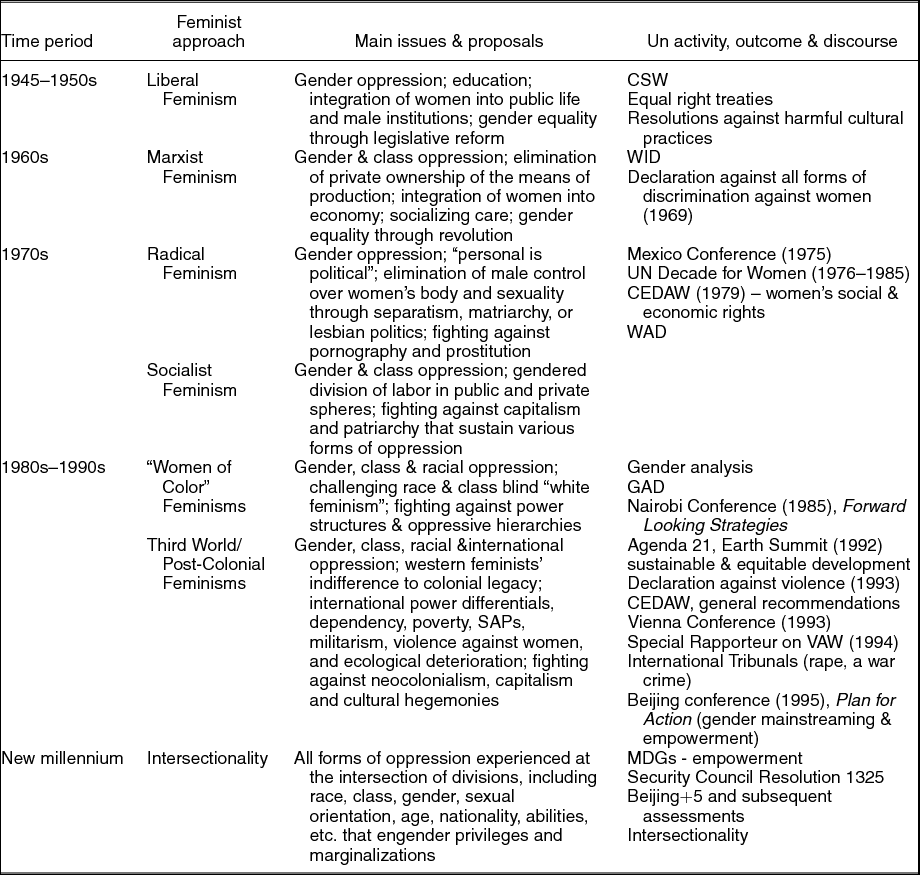
The publication of the Danish economist Ester Boserup's now famous book Women's Role in Economic Development in 1970 also raised questions about the “gender neutral” approach of aid agencies and development policies. Drawing attention to the gendered character of labor provided by men and women, both in the market as paid laborers and in the domestic sphere as unpaid laborers, and to the significant contribution of the latter to national economies, the study inspired many. It informed the UN Decade for women and stimulated the conceptualization of alternative development paradigms, known as “Women and Development (WAD)” and “Gender and Development (GAD),” in the late 1970s and1980s, respectively. Both approaches were more holistic than WID. While WAD followed neo-Marxist dependency theory and stressed the inequalities reproduced by neocolonial policies and the value of women's reproductive and unpaid labor, GAD emphasized the link between gendered roles in public and private domains and promoted “bottom up” strategies by grass-roots organizations as alternatives to the “top down” development designs imposed upon the people of developing countries.Footnote 8 These new feminist theories and approaches have been accommodated in the UN system, albeit with a time lag, as summarized in Table 1.
An Overview of Feminist Theoretical Developments Informing the UN Work by Decade (Highlights)

Second-wave feminism, however, has been criticized by “women of color” in the West, as well as by Third World feminists, for responding only to the needs of “white women” who continue to enjoy privileges produced by systems of racial and international oppression. Stressing the multidimensionality of their experience of oppression, a range of arguments is introduced by black feminist theorists (Beale Reference Beale and Cade1969/Reference Beale and Cade1979; Hooks Reference hooks1981), Chicana/Latina feminists (Moraga and Anzaldúa Reference Moraga and Anzaldúa1981), and Asian-American feminists (Making Waves 1989). Third World feminists problematize racism in connection to international power differentials and also criticize the patronizing attitude of western feminists (el Saadawi, Mernissi, and Vajrathon 1978/Reference el Saadawi, Mernissi and Vajrathon1997).Footnote 9 They highlight the homogenizing and marginalizing impacts of capitalism, which were experienced by the Third World “subjects” first through direct and indirect forms of imperialism and are now sustained by various intergovernmental agencies in the name of integrating markets and globalization. They point to the legacy of colonialism, including lack of development (Sen and Grown Reference Sen and Grown1987), economic dependency on the West, structural adjustment policies imposed by the West (Arat Reference Arat and Dorraj1995), militarism, racism, and ecological degradation (Narayan Reference Narayan1997; Shiva 1988/Reference Shiva2010). The critical engagement in these issues by Third World academics living in western societies has reintroduced the Third World feminist agenda as “postcolonial feminism” (Grewal and Kaplan Reference Grewal and Kaplan1994; Mohanty, Russo, and Torres Reference Mohanty, Russo and Torres1991).Footnote 10
The tension caused by these assertions of difference among women's experiences and understanding of oppression was addressed to some degree at the third UN Conference on Women, held in Nairobi in 1985. The strong presence of women from non-Western regions allowed Third World feminists to bring to the fore demands for structural transformation of societies, from the household to the global system, leading the outcome document of the conference, Forward-Looking Strategies for the Advancement of Women, to underline issues of neocolonialism, racism, and militarism as obstacles both to the elimination of discrimination against women and to meeting the Decade's goals of equality, development, and peace. Stressing structural economic problems, policies imposed on developing countries, and degradation of the environment, the document calls for agrarian reform. It addresses the problems faced by “women in areas affected by armed conflict, intervention, and threats to peace,” in a separate section. In addition to recognizing the diversity of women (e.g., young, elder, disabled, minority, refugee), it introduces “gender” as a tool of analysis. Although it fails to mention class oppression, capitalism, sexual orientation, or reproductive rights, the document requires improvements in women's engagement in family planning. Defining “development” as more than economic growth, and “peace” as not just absence of war, it criticizes the prevalent development policies and problematizes violence against women, including domestic violence and rape, as an “obstacle to the achievement of peace.”
Violence against women became the focus of the UN-based advocacy in the 1990s. Adopted in 1993, Declaration on the Elimination of Violence against Women suggests that women experience certain human rights violations that are unique to their gender or distinct from the way they affect men. The expert committee that oversees the implementation of the CEDAW had already defined violence against women, whether committed by public or private actors, as a form of discrimination. Rape was recognized as a war crime in international tribunals. In March 1994, the UN Commission on Human Rights adopted a resolution to appoint a Special Rapporteur on violence against women. Following the motto “women's rights are human rights,” the World Conference on Human Rights, held in Vienna in June 1993, affirmed that “the human rights of women and of the girl child are an inalienable, integral and indivisible part of universal human rights” (A/CONF.157/23, paragraph 18).
Attentive to Third World feminists’ concern about environmental deterioration, the transnational women's movement emphasized the link between women's interests, environmental protection and sustainable and equitable development. Their intense lobbying efforts enabled “Women's Agenda 21” to revise the original draft of “Agenda 21,” the outcome document of the Earth Summit held in Rio in 1992, to include multiple references to women's needs, as well as an entire chapter on women's role and advancement (A/CONF.151/4).Footnote 11
The fourth UN Conference on Women, held in Beijing in 1995 and attended by many more women's groups, created an opportunity to expand the agenda. Thus, the outcome document, The Beijing Declaration and Platform for Action, sets “an agenda for women's empowerment” and calls for “removing all the obstacles to women's active participation in all spheres of public and private life through a full and equal share in economic, social, cultural and political decision-making” and states that a “transformed partnership based on equality between women and men is a condition for people-centered sustainable development” (emphasis mine). In addition to identifying 12 “critical areas of concern” that require strategic intervention on behalf of women and girls, the document moves beyond the liberal feminist discourse to stress the problems of poverty, economic inequalities, and militarism; it openly criticizes the negative impacts of structural adjustment policies (SAPs) and affirms the need to address the “structural causes of poverty.” Seeking “fundamental change,” it calls for “gender mainstreaming” in designing, monitoring, and evaluating policies and programs by all relevant actors.
The New Millennium, Intersectionality, and Persistence of Liberal Feminism
In September 2000, at its Millennium Summit meeting, the UN adopted the Millennium Declaration, which identifies eight Millennium Development Goals (MDGs), with specific benchmarks to be achieved by 2015 or earlier: (1) eradicate extreme poverty and hunger; (2) achieve universal primary education; (3) promote gender equality and empower women; (4) reduce child mortality; (5) improve maternal health; (6) combat HIV/AIDS, malaria and other diseases; (7) ensure environmental sustainability; and (8) develop a global partnership for development (A/RES/55/2). Yet for indicators of progress toward achieving the goal of “gender equality and empowerment” the UN reverted to the liberal feminist framework and adopted “integrative” measures (which I will discuss later).
On October 31, 2000, the UN Security Council adopted a resolution on women and peace and security (S/RES/1325), which requires the incorporation of a gender perspective in all UN peace and security efforts. Resolution 1325 calls on all members to increase the participation of women in peace negotiations, peace building, peacekeeping, humanitarian response and in postconflict reconstruction. It also urges all parties to a conflict to take special measures to protect women and girls from all forms of gender-based violence.
The UN has shown its responsiveness to the theoretical advancements in feminist discourse also by adopting the feminist concept, “intersectionality.” Intersectionality has its roots in various feminist theories that criticize treating “women” as a homogenous category and ignoring how women may experience subordination and privilege at the same time—as their gender puts them in disadvantage, some women may enjoy the benefits of their race, class or other advantages. Stressing multiple dimensions of inequality and oppression, “intersectionality” is typically defined as “an analytical tool for studying, understanding and responding to the ways in which gender intersects with other identities and how these intersections contribute to unique experiences of oppression and privilege” (Symington Reference Symington2004, 1).Footnote 12
In preparation for the UN World Conference against Racism, held in September 2001, Kimberlé Crenshaw, a significant contributor to the development of intersectionality approach (Crenshaw Reference Crenshaw1989), was invited to the UN headquarters in Geneva to discuss intersectionality (Yuval-Davis Reference Yuval-Davis2006, 193). Subsequently, the term started to appear in UN documents, including one issued by the UN Commission of Human Rights:
OHCHR also organized a workshop on the intersectional discrimination on the basis of gender and race. The intersectionality concept, which refers to the multiple forms of discrimination an individual can face, had been raised at several regional and expert meetings and it was felt that the clarification of the concept would be valuable in the context of the World Conference. Indeed, the concept of intersectional discrimination can be of use to frame the complexity of problems such as violence or trafficking (E/CN.4/2002/81).
Adopting the intersectionality approach may promise a significant shift, but the shift seems to be limited to rhetoric, as has been the case with the conference documents that accommodate Third World feminists’ concerns. As already noted and will be discussed further, the progress reports issued by the UN still employ liberal empowerment indicators.
Why did the liberal feminist approach prevail, even in CEDAW and in development debates that were initiated by Eastern Bloc countries that subscribed to Marxist feminism? Why does liberal feminism continue to inform the UN, despite the proliferation of feminist theories, the demands and language of which have been acknowledged in various documents? We can find the answer partially in the UN mode of operation that tries to establish a consensus and is highly contingent upon a negotiation process that requires and results in compromises (Merry Reference Merry2006 ). Liberal feminism, which is relatively less challenging, may be seen as the minimum common denominator. Liberal feminism's trust in the state is also more in sync with the UN-led human rights regime. Feminist analyses of the state have been complex and inconclusive about the state role in advancing gender equality. While liberal feminism treats the state as neutral and as having the potential to be an ally of women and function as a tool of change, other feminisms tend to see the state as an oppressive and masculine institution; but they have not been able to devise a strategy that would not require engaging the state. The same dualistic position on the state is embedded in the international human rights law and regime as well: while the state is recognized as the main (potential) violator to be monitored (and mainly by other states), it is also trusted with the responsibility for promoting and protecting human rights. This state-centric approach of the international human rights regime (Arat Reference Arat2008) and its ultimate reliance on the state to protect and fulfill human rights creates an environment that is more conducive to liberal feminism. The prevalence of the liberal feminist approach can also be attributed to the fact that the feminist framework employed by the state-socialist regimes was a diluted version of Marxist feminism, one that did not pay much attention to the reproductive labor, or oppression of women within the family, but only aimed to bring women into the public domain as workers and citizens. This particular interpretation of Marxist feminism, despite differing from liberal feminism for seeking the elimination of the private ownership of the means of production, had accepted reliance on the [socialist] state to take measures necessary to “emancipate” women. Finally, the integrative approach of liberal feminism, which focuses on gender parity and demands equal opportunities and representation for women, makes it a better match for the data-driven epistemology of the UN apparatus, which seeks benchmarks and relatively easy measures needed to demonstrate achievements and set the next targets.
ASSESSING THE PROGRESS
There is no doubt the progress at the normative level has been impressive. In addition to a proliferation of declarations, treaties and resolutions that address women's rights, the documents employ an increasingly sophisticated language. Instead of simply stressing equality of men and women, both the differences between men and women and the differences in women's experiences are acknowledged. Recognizing that gender oppression is not unidimensional but complicated by racism, poverty, international power differentials, and other structural factors, intersectionality is embraced as an analytical tool.
These theoretical and rhetorical advancements, however, have not led to significant improvements in the living conditions or status of women. Some analysts highlight the increasing use of electoral quotas and consequent increases in women's representation in parliaments, the increase in women's economic participation, the reduction in poverty levels during the decades preceding the 2008 global recession, and the wide use of microcredit programs that support microenterprises owned by women as positive indicators of progress toward closing the gender gap and, thus, as tools or evidence of women's empowerment (Howard-Hassmann Reference Howard-Hassmann2011; Inglehart and Norris Reference Inglehart and Norris2003; Kristof and Wudunn Reference Kristof and Wudunn2009; Paxton, Hughes, and Green Reference Paxton, Hughes and Green2006). Others note negative implications and consequences. In addition to the persistence of violence against women, they point to increases in income inequalities, child labor, trafficking of girls and women, sweatshops, religious and market fundamentalisms, militarism, and armed conflicts since the 1990s (Bales Reference Bales2004; Peterson and Runyan Reference Peterson and Sisson2010; Razavi Reference Razavi2001; Sadasivam Reference Sadasivam1997; True Reference True2012). Once heralded as the best hope of poor women in developing countries, even by socialist and Third World feminists such as Kabeer (Reference Kabeer1994) and Chowdhry (Reference Chowdhry, Marchand and Parpat1995), microcredits are criticized for enabling the accumulation of capital through women's labor, forcing them to exploit their children, hampering girls’ schooling, inflicting a culture of competition as opposed to cooperation, contributing to domestic violence, and actually doing very little to alleviate poverty (Ahmed Reference Ahmed2008; Brenner Reference Brenner2003; Garikipati Reference Garikipati2013; Karim Reference Karim2011; Keating, Rasmussen, and Rishi Reference Keating, Rasmussen and Rishi2010). Despite Security Council Resolution 1325 on Women, Peace and Security, transitional justice and reparation procedures remain male centered, inadequate, and insensitive to the violations experienced by women (Rubio-Marin Reference Rubio-Marin2006). Although optimism tends to be more common in intergovernmental organizations, lack of progress in meeting the MDGs, including gender equality and women's empowerment, has been noted by several UN agencies.Footnote 13
Common explanations for the lack of progress tend to include the strength of patriarchal resistance, lack of political will, ineffective implementation of progressive laws, backlash, and the subversion of the progressive agenda. Pointing to an unfortunate coincidence, some analysts note that “the rise of neoliberalism dramatically changed the terrain on which the second wave Feminism has operated” (Fraser Reference Fraser2009, 108), and led to blending the transformative feminist agenda into identity politics. Others highlight the confusion about the meaning of some key concepts.
The Beijing Declaration and Platform for Action, for example, introduces and stresses the concepts of “empowerment” and “gender mainstreaming” but fails to define either term. It took until 1997 to offer a working definition of gender mainstreaming to guide action by the UN system as a whole:
Mainstreaming a gender perspective is the process of assessing the implications for women and men of any planned action, including legislation, policies or programs, in all areas and at all levels. It is a strategy for making women's as well as men's concerns and experiences an integral dimension of the design, implementation, monitoring, and evaluation of policies and programs in all political, economic, and societal spheres so that women and men benefit equally and inequality is not perpetuated. The ultimate goal is to achieve gender equality.Footnote 14
Although many UN agencies, states, and intergovernmental organizations have incorporated “gender mainstreaming” into their discourse and programs, its actual meaning remains elusive. Thus, the confusion about the meaning of “gender mainstreaming,” and of “gender” itself, leads to no change in policy processes beyond the rhetoric, and the diffusion not only weakens the women-focused specialized offices but also causes difficulties in monitoring and lobbying multiple agencies (Gaer Reference Gaer and Agosín2002; Hafner-Burton and Pollack Reference Hafner-Burton and Pollack2002; Lang Reference Lang2009; Porter and Sweetman Reference Porter and Sweetman2005; Prügl and Lustgarten Reference Prügl, Lustgarten, Jaquette and Summerfield2006; Verloo Reference Verloo2005).
Moreover, the confusion about the terminology is not limited to the UN, or governmental agencies, but prevails in feminist academia, as well. For example, Adam Jones, who salutes feminist scholars for introducing the variable of “gender” to the field of international relations, also criticizes them for “equating gender primarily with females/femininity,” keeping “The plight of embodied women” at the front and center, and giving “to the male/masculine realm. . .little more than lip-service” (Reference Jones1996, 420–21).
Similarly, Nira Yuval-Davis offers an account of misunderstandings surrounding the term “intersectionality” in the UN context (2006), and other intersectionality analysts repeatedly complain about feminists’ tendency to treat different forms of oppression faced by women as “added” rather than caused by interactive factors (Berger and Guidroz Reference Berger and Guidroz2009; Grzanka Reference Grzanka2014). Among the buzzwords, “empowerment” appears to be particularly popular.
DEFINING EMPOWERMENT AND PROBLEMS WITH THE CURRENT INDICATORS
Empowerment is repeatedly mentioned in The Beijing Declaration and Platform for Action but without a clear definition. What comes close to a definition is paragraph 12, which reaffirms member states’ commitment to “The empowerment and advancement of women, including the right to freedom of thought, conscience, religion and belief, thus contributing to the moral, ethical, spiritual and intellectual needs of women and men, individually or in community with others and thereby guaranteeing them the possibility of realising their full potential in society and shaping their lives in accordance with their own aspirations” (emphasis mine).
The World Bank offers a definition of empowerment mainly in relation to poverty reduction. Indicating “Empowerment refers broadly to the expansion of freedom of choice and action,” a sourcebook issued in 2002 adds that poor people's “freedom is severely curtailed by their voicelessness and powerlessness in relation particularly to the state and markets,” and “powerlessness is embedded in the nature of institutional relations” (World Bank 2002, v). Thus, adopting “an institutional definition of empowerment in the context of poverty reduction” (p. v, emphasis mine), it defines empowerment as “the expansion of assets and capabilities of poor people to participate in, negotiate with, influence, control, and hold accountable institutions that affect their lives” (p. vi). Then, it specifies the institutional barriers that should be targeted:
Empowering poor men and women requires the removal of formal and informal institutional barriers that prevent them from taking action to improve their wellbeing—individually or collectively—and limit their choices. The key formal institutions include the state, markets, civil society, and international agencies; informal institutions include norms of social exclusion, exploitative relations, and corruption (p. vi).
Although it does not elaborate on the hierarchal character of these institutions, this multidimensional approach that recognizes flaws in markets, the state, and society could mean endorsing substantial and transformative reforms. However, the indicators employed by the Bank to assess women's empowerment are limited to sex ratios in school enrolments, women's share of nonagricultural work force, percentage of seats in parliament held by women, contraceptive prevalence rate, adolescent fertility rate, proportion of females among professionals and technical workers, ratio of female to male labor force participation rates, number of weeks of maternity leave, and maternal leave benefits as percentage of wages in covered period (World Bank, GenderStats, n.d.)
The UN employs an even narrower approach. The Millennium Summit Declaration, which sets gender equality and women's empowerment as a goal, fails to provide a conceptual definition. But the progress reports on the MDGs operationalizes “empowerment” by employing three indicators: (1) male-female enrollment ratios in primary, secondary, and tertiary education, (2) women's share in nonagricultural wage employment, and (3) the percentage of seats held by women in national parliament.
Problems with the Indicators
Limited to aggregate measures of women's access and integration, the UN indicators of empowerment reveal a tacit subscription to the narrow framework of liberal feminism, which recognizes gender oppression only and seeks gender equality through the integration of women to the present institutions and structures.Footnote 15 But what are the stories behind these aggregate figures? Are we making progress in fulfilling all women's human rights or only those of some already privileged women at the expense of others? Are there any casualties of “progress”? In order to illustrate the problem, I will focus on one of the indicators of empowerment employed by the UN—women's share in nonagricultural wage employment—by addressing issues surrounding employment in general. (The other two indicators are indirectly addressed in the subsequent section on sources of power.)
The right to work is a human right, and those who are prevented from seeking work or unemployed are denied this right. But, would a decline in unemployment statistics, or an increase in women's economic participation, indicate getting closer to realizing the right to work? Do women who join the workforce enjoy this right and feel empowered? The answers to these questions would depend on the stories behind those numbers, which would raise another set of questions: What kind of jobs are they getting? Do they settle for part-time jobs or full-time jobs with meager wages, unhealthy work conditions, and no benefits? Are they paid livable wages? When a woman enters the labor market, does she do so willingly or is she forced into it? Even if it is her voluntary decision, is it a step toward fulfilling her capacity, or because her family needs the additional income? Does she have to compensate for the income loss caused by the unemployment of her husband, and/or does she need to make up for reduced public subsidies or privatized social services? Is anyone assuming her reproductive responsibilities at home, or is she overburdened by working a double or triple shift? In short, does her workforce participation represent fulfillment of a right or burden/exploitation that comes at the expense of her right to rest and leisure?
Increases in women's economic participation rates (now in nonagricultural sectors), however, are typically treated as progress not only for signaling women's penetration into the male/public domain (integration) and fulfilling their right to work, but also for empowering women. Gainful employment, income, and social networking broadened by work outside the home are treated as markers of women's autonomy and empowerment. Indeed, the theoretical propositions and some empirical studies establish positive relationships among different dimensions or forms of power. Hence, a woman's increased access to income (financial power) or interacting with others outside the home (social power) may enhance her decision-making power. However, the terms under which she enters the workforce may in fact curtail the gains on each power dimension. Moreover, the issue of autonomy raises further questions: Does she control her own income? Is she freer or subject to more control due to the stigma attached to working outside the home? Are there additional hardships (e.g., sexual harassment), elements of stress, and new exposure to various forms of violence? What do we make of nonagricultural home-based work? Does it accommodate women's needs, or is it a neoliberal innovation that allows employers to circumvent labor laws/regulations and weaken unions (Prügl Reference Prügl, Meyer and Prügl1999)?
The assumed empowering effect of women's participation in the workforce lacks empirical support, since survey data fail to provide consistent evidence. While some studies find that educated and working women as more likely to leave an abusive relationship or to have a say in matters regarding their children and other family affairs (Kabeer Reference Kabeer1994; Nussbaum Reference Nussbaum2011; O'Campo et al. Reference O'Campo, McDonnell, Gielen, Burke and Chen2002; Strube and Barbour Reference Strube and Barbour1984), other studies note that women (especially those from working class, rural, or low income families) tend to hand in their earnings to their father/husband, use their income to support their husband's education or business, tend to negotiate for lower hours/leaves instead of higher pay/promotion, and would prefer to stay home and be “the mistress of their house,” if their husbands’ income were sufficient to support the family (Tekeli Reference Tekeli1982; The World's Women 2010, Chap. 8). A union organizer in the United States notes that many working women whom she tried to recruit as union members would say, “I need to ask my husband first,” while no man ever felt the urge to check with his wife before signing a union card (Vargas-Cooper Reference Vargas-Cooper2011).
In fact, if employment and earning income were to empower women, shouldn't lower class women who have been working for generations be considered empowered and ranked as more powerful than upper-class women who have “stayed home” and lacked “independent income”? Yet, even if they do not acknowledge the omnipresence of power related to class, upper-class liberal feminists, aware of the fact that they are more powerful than women of poor classes and countries, have been trying to emancipate their less fortunate sisters but usually by focusing on cultural practices.Footnote 16 Again, the same unspoken awareness of power differentials leads us to treat an educated upper-class woman's decision to leave her professional career to take care of her children as an autonomous choice but view poor women who are staying home and taking care of their children as oppressed. Instead of addressing the root causes of her oppression, however, their emancipation and empowerment are sought by pushing them into the labor market.Footnote 17
Liberal feminism and human rights advocacy that focus mainly on “nondiscrimination” tend to devote attention to the extent to which policies and institutions discriminate against particular segments of society, in this case women. The effort is geared toward eliminating discrimination in recruitment, promotion, and career development so as to make existing institutions more inclusive. The adverse function and hierarchical structures of these institutions are not questioned. Yet an “integrative” progress that does not alter the structural obstacles to equality can only benefit some while continuing to sustain violations of others’ human rights. I have tried to address elsewhere these less visible consequences of what is often seen as progress:
According to a certain feminist approach, we can interpret women's ability to penetrate into some androcentric institutions and increase women's representation in these institutions as a favorable development, as an indicator of progress. For example, women's recruitment to the military in the United States of America and their participation in combat can be viewed as an achievement of the women's movement. But, for a woman living in Iraq or Afghanistan, would it matter that the bombs falling on her head, destroying her home, and killing her children are dropped by a plane steered by a female pilot, instead of a male one? Or, most of us desire women to break the glass ceiling and reach top management, to positions where important decisions are made. But, for a woman—let's say in Mexico—who leaves her younger children to the care of her slightly older 12-year-old daughter and sweats at a job for 14 hours a day to earn hardly livable wages, is it important that the company for which she works is run by a woman (Arat Reference Arat2011, 463)?
While these “integration” examples indirectly address the issue of representation, increases in political representation of women as measured by the share of women's seats in parliament (another UN indicator of empowerment) pose more direct questions about its meaning for women at large. Does “descriptive” representation result in “substantive representation” of women's interests and formulating policies that address women's issues?Footnote 18 What are women's interests and issues?Footnote 19 The latter question, in particular, takes us to the importance of acknowledging the diversity among women.
POWER, EMPOWERMENT, AND SOURCES OF POWER
All of these indicators, employed to measure empowerment, actually use power and sources of power interchangeably. Power is usually defined as the ability to influence the behavior of others (Lukes 1974/Reference Lukes2005). Seen as conflict oriented, this “power over” notion is rejected by critical and ethical theories of power, including some feminist ones (Squires Reference Squires1999). Redefining power not in terms of restrictions of others but as self-development, they introduce a counter and positive notion of power: one's capability to do things. This capability, or “power to,” approach is linked to the discourse of empowerment.Footnote 20 As power is defined in nonconflict terms, empowerment of women would then mean not taking away someone else's power but the development of their own capabilities (Hartsock Reference Hartsock, Hirschmann and Di Stefano1996; Nussbaum Reference Nussbaum2011). Articulating women's demands in development/capabilities terms, instead of domination/conflict terms, empowerment discourse rejects the notion that power is a zero-sum game. When the empowerment of one person is seen as not conditional on the disempowerment of another, empowerment becomes an open-ended development process in which all might partake, and the empowerment discourse becomes more palatable than a discourse of power struggle. But by undermining the relational aspect of power, this empowerment discourse poses the danger of depoliticizing women's struggle.
Moreover, “the ability to influence others’ behavior” can be seen as the other side of “the capability to choose and do what one desires.” Treating these as two sides of the same coin would bring us back to treating empowerment as a power struggle and power as zero sum, which means the empowerment of the currently marginalized has to come at the expense of those who are already powerful. In other words, if one acquires the capability of asserting control over her own body and life—i.e., she is empowered—then those who once had power over her would lose it.Footnote 21
Sources of power are many, including economic, political, physical (both muscles and weapons), institutional, traditional/customary (e.g., motherhood, seniority, age), psychological, collective/organizational, knowledge/experience, formal education, physical/erotic attractiveness, etc. These sources may overlap and reinforce each other, and people possess them in varying degrees. While some sources are finite, or near finite (e.g., money, seats in the parliament), some other sources can be acquired by a person without necessarily subtracting it from other people (e.g., knowledge).
Conflating power and sources of power and using them interchangeably involve three problematic assumptions. First, defining power narrowly as a quality possessed by individuals; this approach treats gaining access to a source of power as an increase in the power held. Second, again at the microlevel, it assumes that “gained power” will lead to the exercise of power and thus change power relations between individuals (e.g., husband and wife). Third, it posits that targeting gender equality by providing access to some sources of power to some women will have a redistribute effect at the aggregate, macro level and will result in empowering all women.
On the first two assumptions: having access to some sources of power does not necessarily mean that one holds power and uses those sources to exercise power either over others or to claim autonomy. In addition to “voluntary” delegation of power, a woman may choose not to use certain sources of power she has at a given time out of fear of triggering action by other parties who may exercise their power in undesirable ways—a situation that is less tolerable than the status quo. An eternal question about battered women who are trapped in an abusive relationship—“Why can't she leave him?”—can serve as an example of the disempowering quality of fear, which is sustained by a web of power relations and cannot be easily eliminated by gaining access to one or two sources or power. Moreover, an important aspect of “exercising power” is engendering norms, values, and institutions that determine the choices and domain of decision making (Bachrach and Baratz Reference Bachrach and Baratz1962; Lukes 1974/Reference Lukes2005) and limit people's options as well as demands (Cohen and Rogers Reference Cohen and Rogers1983, Chap. 3). Liberal feminism's integrative approach, or capabilities approach to women's empowerment, undermines not only the relational aspect of power but also the constraints and controls imposed by systematic biases.
Even if we consider power as an attribute that can be possessed, it must be more than the sum of the power sources that one holds. The ability to transform sources into control (over self and others) depends on the sources held by others, as well as the meanings attached to each source. The complexity of social interactions, which involve power relations and value systems that enforce current power structures, confound the relationship between access to power sources and empowerment and make the conversion of a particular source into a tool of influence or autonomy less than automatic. Our tendency to assume an automatic relationship, however, leads to measuring women's empowerment by their access to some sources of power, instead of seeing the cumulative effect of the distribution of a broad array of power sources and their meaning and reinforcement in social relations. We first make some unstated assumptions about the impact of access at the individual level and then measure the progress in aggregates. Thus, as evident in the UN indicators of women's empowerment, we look for the closure of gaps in school enrollments, increases in percentages of parliamentary seats occupied by women, or the percentage of women who become “economically active” by taking (nonagricultural) jobs outside the home. By generalizing from certain experiences and then inferring backwards from the general to the particular, we exhibit a series of fallacies.
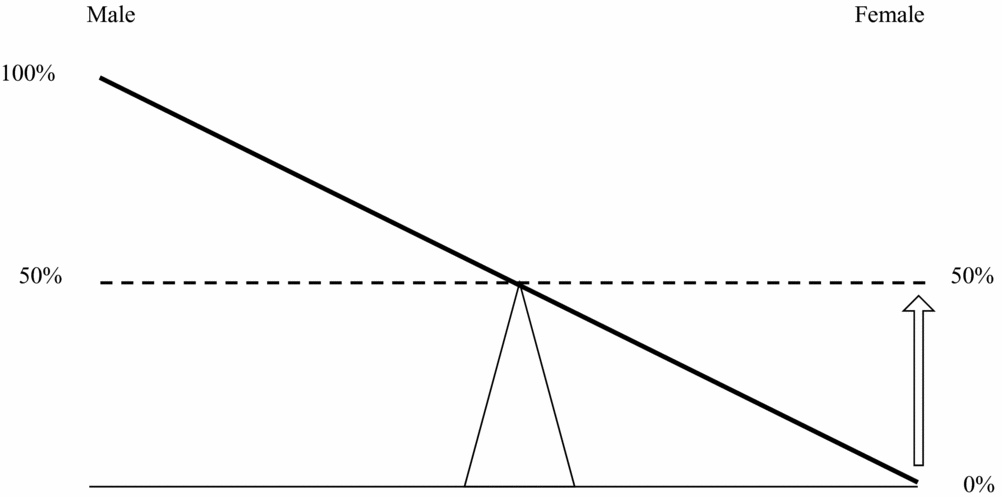
If we imagine the gender gap in access to power sources as analogous to an old-fashioned measuring scale, the closing of a gender gap in the case of a finite source (e.g., number of seats in parliament) would look like the illustration in Figure 1. Assuming we start with an all-male institution (the dark line), as the number of women in parliament increases, the share of the seats held by men would decline, and the equilibrium (equality) would be established at 50 percent for each sex (dashed line). This would entail the redistribution of an institutional source of power.
Balancing the access to a finite power source (redistributive, e. g., income; seats in parliament)

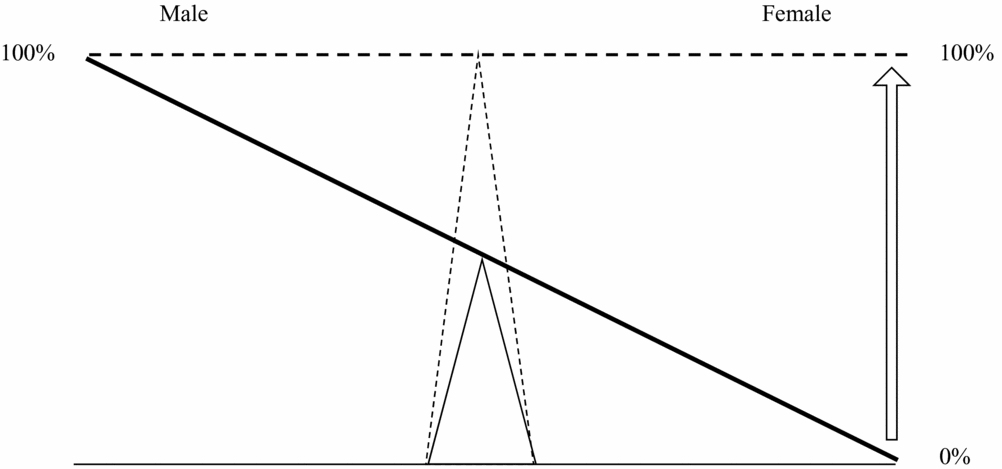
In the case of an infinite or relatively more expandable source (e.g., knowledge, an extension of the right to vote, or school enrollments), the goal and equality may not necessarily require reducing males’ access but providing more access for females. In this case, improvement for females would require the elevation of the base of the scale (see Figure 2), which may mean investing more sources.
Balancing the access to an infinite power source (distributive, e.g., vote, knowledge)

However, since the resources needed for creating these opportunities are likely to be limited, the expansion of opportunities for one group may require a reduction for the other, in quality, if not in quantity. For example, if education funding must be held constant, schooling of girls may result in less schooling opportunities for boys or overcrowded and poorly financed schools both for boys and girls. The elevation of the base of the scale for a power source would require resetting social priorities so as to allow redistribution of collective resources (e.g., tax revenues) from one area to another.
Most important, any distribution or redistribution of sources of power between sexes within the existing structures—without removing hierarchies and addressing a range of inequalities that go beyond sex discrimination—may result in mathematical gender equality (on that particular source), but will likely create a different equilibrium for each stratum, where stratification may be based on class, race, ethnicity, nationality, etc. For example, the income of men and women in each social stratum (of classes, ethnic groups, etc.) can be equalized, without eliminating the income gaps among various strata. Women in the lowest stratum may be earning as much as men in the same stratum but would still be struggling to meet their basic needs. Yet, if gender equality were established for each stratum, gender equality in income would be established for the entire society. In other words, theoretically, gender equality can be achieved at the aggregate level, but without empowering or emancipating some women. Yet, this is precisely what is promoted by the capabilities approach (Nussbaum Reference Nussbaum2011), or empowerment via microcredits (Chowdhry Reference Chowdhry, Marchand and Parpat1995; Kabeer Reference Kabeer1994), which can be defined as liberalism accommodating social and economic rights by providing the bare minimum (Molyneux and Razavi Reference Molyneux and Razavi2003).
HUMAN RIGHTS AND FEMINISM FOR A TRANSFORMATIVE CHANGE
The limitations of the “integrative” approach and treating women as a monolithic category have been raised by critics of liberal feminism, who stress the diversity of women's experiences and demand structural change. Yet, we seem to cling to indicators that measure progress by “integration.” Moreover, many feminists, including some who subscribe to alternative theoretical frameworks, endorse and applaud efforts to integrate women into various institutions (e.g., the military, corporations), without questioning the function and impact of these institutions.
If we have already noted power differentials among individuals, including among women, as well as between peoples/nations/states, and identified the state and capitalism as structural mechanisms that sustain and reproduce both privilege and marginalization, then why do we celebrate women who climb these power structures? Do we place too much confidence in the critical mass theory, which holds that as the number of women in legislative bodies or corporate executive boards increases they will be more effective in promoting and producing pro-women polices? Is a significant presence of women enough to change the culture and role of these institutions? The theory trusts that women will conquer them from within and transform their functions; but achieving success in these institutions may necessitate assimilation and co-optation, which would leave them essentially unchanged. While the empirical studies testing the theory are inconclusive about women's ability to produce “pro-women policies” (Beckwith and Cowell-Meyers Reference Beckwith and Cowell-Meyers2007; Childs and Krook Reference Childs and Krook2008), it is important to note that even where the evidence is supportive, pro-women policies adopted tend to “assist women” within the prevailing structures rather than making, or even seeking, a transformative impact (Wängnerud Reference Wängnerud2009). Similarly, while the increase in feminist bureaucratic cadres (sometimes called femocrats) allows them to serve as advocates for women and to influence policy outcomes under certain circumstances (McBride and Mazur Reference McBride and Mazur2010), such pro-women policies do not challenge power differentials, especially when the state's role is shifted from “market-steering” to “market-supporting” (Levy Reference Levy2006).
In reference to the new common ground held by some feminists from different parts of the world, Mohanty redefines her position:
While my earlier focus was on the distinction between Western and “Third World” feminist practices, and while I downplayed the commonalities between these two positions, my focus now, . . . is on what I have chosen to call an anticapitalist transnational feminist practice—and on the possibilities, indeed on the necessities, of cross-national feminist solidarity and organizing against capitalism (Reference Mohanty2003, 230).
But, as illustrated in the earlier section, while many Third World/transnational feminist concerns are articulated in UN outcome documents, these documents have been silent on class oppression and fail to mention capitalism by name as a contributor to the hardship faced by many women. Other observers also note that international human rights treaties require women to take a pro-state position in order to be effective or to press for the implementation of treaties such as CEDAW. In the process, women move away from protest movements and try to engage the state through lobbying or providing expertise (Craske and Molyneux Reference Craske and Molyneux2002; Ecevit Reference Ecevit and Kabasakal Arat2007). The depoliticizing impact of the “professionalization” of human rights advocacy work, as well as the “bureaucratization” and co-optation of NGOs by funding agencies and foundations (which are often extensions of capitalists enterprises), are already noted by some alarmed observers (Andreopoulos and Arat Reference Andreopoulos, Arat, Andreopoulos and Kabasakal Arat2014; Guilhot Reference Guilhot2005; The Revolution will not be Funded 2007).
Perhaps the reliance on the integrative approach demarcates the emergence of a “capitalist bargain,” in which women seek improvements within capitalism, without challenging its structures. This may appear as a viable option, especially since capitalist enterprises have been willing to enter into a “feminist bargain” and accommodate the relatively unthreatening demands of liberal feminism, by being willing (and sometimes eager) to hire women or extend them credits, as long as the essence of the system—profit maximization and power structures—is not endangered.Footnote 22 While this may help some women in the short term, it contributes to the normalization of capitalism (now euphemistically referred to as market economy or economic globalization). Various intergovernmental organizations have been reinforcing the normalization of not only capitalism but also its aggressive neoliberal version (e.g., the IMF, WTO), and the UN is a part of this system. However, human rights obligations also push the UN to counterbalance the neoliberal tend and have its own capitalist bargains (e.g., Global Compact on corporate responsibility). With its tripartite structure that includes governments, unions, and employer organizations, the International Labour Organisation, the main international agency of labor advocacy, has been an instrument of capitalist bargain since its inception.
While the institutional support for capitalism has been firm, both at national and international levels, and has increased since the end of the Cold War, feminist struggles against it remain weak, partially due to the shortcomings of feminist theories that emerged as alternatives to liberal feminism. They identify the structural causes of oppression but suggest no viable alternative course of action beyond being attentive to each other's concerns, experiences, and positions. An inspirational writer, Gloria Anzaldúa calls for empathy for the ones “on the other bank” and claims “The possibilities are numerous once we decide to act and not react” (Anzaldúa 1987/Reference Anzaldúa2012, 100). But what are those possibilities? How will women's empathy for others translate into political action for transformative change? The diversity of women's experiences, conjoined with the transformative agenda that attempts to change structures that sustain and reproduce marginalizations of sorts, complicates efforts to develop radical policies that would address women's needs in light of their diversity.
While the destabilization of category “women” was complicating enough, poststructural/postmodern theories, which reject totalizing mega narratives, elevated the development of emancipatory strategies from difficult to unworkable. Particularly influential has been Foucault's theory of power. Claiming that power is everywhere and circulates not through an apparatus but a network in which one is not only a target but also a transmitter of power, Foucault recognizes the agency of the marginalized. However, by referring to power as “coextensive with the social body” and “there are no spaces of primal liberty between the meshes of its network” (Foucault Reference Foucault1980, 142), he closes the door on the possibility of liberation. Delving into the relationship between knowledge and power, he also stresses the importance of discourse in the production of identities and construction of truths. This notion of “power as discourse” and discourse analysis as effective tools of deconstruction have resonated in feminist circles but swayed postmodern feminist theorists. Postmodern feminists reject all standpoint theories and solutions for being partial, repressive, and producing new marginalizations, focus on discourse rather than the material causes of oppression, overlook hierarchies, and thus flatten social structures. Since the critics of postmodernism and postmodern feminism have been many and prolific, here I will suffice to note that the overall impact of their discourse is seen as depoliticizing and demobilizing, if not paralyzing.Footnote 23 Nevertheless, regardless of the influence of postmodern feminism, other feminist theories critical of liberal feminism have been stronger in analysis than strategies. Transnational collaboration and transversal politics are promoted but without further guidelines.
How can two feminist women, the employer and the worker, who are informed by the intersectionality approach, negotiate and resolve their class conflict? Can they handle it locally, without being engaged in a global power struggle against global capitalism? What is needed may be akin to demanding women in privileged positions to lead a revolution from within and thus “commit suicide as class,” as African socialist Amilcar Cabral once suggested for the petty bourgeoisie in the colonies.Footnote 24 But it requires the privileged to set the moral compass in a new direction and sail truly uncharted waters Footnote 25
The multidimensional and transformative struggle against oppressions face at least two major challenges. The first challenge is figuring out how to work and negotiate within hierarchal structures when the goal is eliminating or significantly modifying those structures. The second challenge concerns balancing the strategic goals (eliminating hierarchal structures) that would take a long time to achieve with the practical issues/interests (enabling women to get a job and feed the children, to leave an oppressive relationship, etc.), which must be addressed immediately.Footnote 26 There may be ways to pursue these competing goals simultaneously, and identifying such strategies and policy proposals should be at the top of the feminist agenda. Feminist theorists can start with the evaluation of certain proposals offered in other contexts, including working toward cooperative production systems that serve both men and women,Footnote 27 instead of encouraging competitive private enterprises (e.g., microfinance); participatory programs that work toward workplace democracy (Bachrach and Botwinick Reference Bachrach and Botwinick1992); and taking economic and social rights seriously and pressing for their fulfillment (Arat Reference Arat2008).
In this article, I point to the hegemony of liberal feminism and the pitfalls of allowing it to dictate policy formulations and the measurement of progress. While recognizing the theoretical advances of alternative feminisms, I also present a critical view of these feminisms, stressing that theory should not only bring women and other oppressed groups together but should also lead them to political action and practical change. By drawing attention to the praxis, my ultimate goal is to start a conversation on strategies that are informed by advanced theories that can result in actions fulfilling their emancipatory promise.



Comments
No Comments have been published for this article.