The Republican and Democratic Parties in the last three decades have increasingly directed their policy discourse away from issues of material need and poverty. Whereas Republicans in the late 1970s and 1980s previously committed 7 to 8 percent of their platforms to discuss issues of poverty, by the 2000s that percentage had fallen to under 2 percent; similarly, in the heyday of their Great Society agenda, Democrats addressed poverty issues in 8 to 9 percent of their platforms, but by 2012 that percentage too fell to 2.5 percent. Since 2004 the levels at which both parties now discuss poverty in their platforms are thus at historic lows, similar only to the period before the Great Depression. What explains the diminishing salience of poverty within the parties’ policy agendas? To account for this, this article highlights a concurrent development: the parties’ references to family within poverty planks increased dramatically just as partisan attention to poverty ebbed. Through analysis of party platforms from 1900 to 2012, I will suggest that the current diminished salience of poverty is but the latest phase in an ongoing relationship between poverty and family in American party politics. Late-century antipoverty policy development is the result of an ideational reconfiguration of poverty engendered by a coincident ascendance and transformation of family, as a political ideal.Footnote 1
The relationship between family and poverty has also long been an object of study for sociologists and other scholars interested in race, gender, and welfare policy. Initially a part of the controversial “culture of poverty” thesis, family structure and its impact on generating norms, behaviors, and cultural values among the poor has been revived in recent sociological studies.Footnote 2 Unlike this article, these works focus more on the empirical dynamics of family and poverty and are less concerned with unpacking normative ideals or political discourse. Feminist and other critical inquiries that evaluate welfare policies as “regulating” family and sexual behavior do pay greater attention to political ideals.Footnote 3 For example, several highlight positive and negative family ideals protected or repudiated by welfare policies, such as the white widow family or the black welfare mother family, respectively. However, these too do not attempt to construct an interpretative account of family-centered welfare policy change or fit this policy history into partisan ideological development as I do here.
In political science and history, an emerging literature now acknowledges the centrality of changing family ideals to public policy and political development.Footnote 4 Literature focused on morality, culture, and social issues in American politics points to the persisting significance of the family to American political development.Footnote 5 In her book All in the Family, political scientist Patricia Strach demonstrates the ongoing ways by which family assumptions shape policy inasmuch as policymakers “hold and incorporate into policy very real and concrete assumptions about what constitutes a family, what roles members of families may be expected to perform, and what families can expect from the state.”Footnote 6 Whereas the use of family as a normative ideal is one of three ways by which Strach illustrates the influence of family in policy, this is more central to works by Robert Self, George Lakoff, Rebecca Edwards, and my previous work. Collectively, the authors demonstrate that family ideals shape partisan ideology and policy outcomes through a variety of mechanisms: (a) they serve as underlying assumptions or cognitive frames consciously or unconsciously invoked by parties and policymakers when crafting policy; (b) as rhetorical tools/ justifications purposively used to gain support for policy positions; or else, (c) as “political projects” or policy objects actively pursued by dominant political coalitions.Footnote 7 Lakoff and Self also point to the late-century emergence of a moral family ideal in American politics, alluding to its wide-ranging policy implications.
I will argue that the kinds of antipoverty policies pursued by the Democratic and Republican Parties in different periods can be explained by the kinds of family ideals the parties hold and pursue; and that policy change in welfare can be tied to the parties’ shifting family ideals. For much of the twentieth century, the parties normatively conceived of family as an economic unit and their welfare policies, described as “protecting the family,” aimed at preserving its material welfare by enhancing its economic capacity to provide for its dependents. In contrast, since the 1970s, when the parties began to assume a family’s essential role to be moral, social welfare policies still seeking the “protection of the family” now began to focus on preserving its moral or affective welfare and only secondarily considered, if at all, family material welfare. Material assistance moved off the parties’ agendas and became more of a “private” familial obligation with the parties’ policy attention now increasingly directed instead at generating positive affect through families, such as feelings of “self-reliance,” “strength of character,” and “responsibility,” previously subterranean to American party politics. Thus not only did the transformation of the parties’ family ideals reconfigure welfare policy, leading to the decreased attention to material poverty, but it also redrew the national boundaries between “public” and “private,” restructuring state and society obligations.
Why did the parties’ family ideals change in the first place? In this article, I suggest that changes in party politics and in social behavior, such as the unraveling of the nuclear family, emergence of new party activists, and new issue-contexts in the late twentieth century, contributed to the displacement of the parties’ existing family ideals. Strach offers a similar social-change model of policy development, revealing how large-scale changes in American families challenge family ideals embedded in public policies, creating “policy gaps” that form, she says, “when the social practice is at odds with values or assumptions of public policy.”Footnote 8 In turn, she shows how these policy gaps allow for policy change to occur, configured around newly emergent family ideals. This article adds to this model by expanding the historical arc and tracing path-dependence in the development of poverty and family policy ideas; demonstrating how late-century welfare policy concerns are layered onto the parties’ previous ideological positions, the moral family ideal resonating more loudly among Republicans, who had long championed the importance of affect, values, and morality in opposition to the materialist New Deal state. Thus this account demonstrates how partisan ideological legacies and contexts also structure the parties’ response and accommodation of the new family ideals into their welfare agendas.
By paying attention to the “family” and its shifting, enhanced, role in late-century partisan poverty discourse, this article thus provides an alternative interpretation of welfare policy development, one that contributes to works on “family/marriage and poverty” in sociology, political theory, and public policy and also complements the growing political science acknowledgment of family as a vital, inextricable part of American politics. By placing “family and poverty” into the fold of American party development, I will bring two mostly disparate sets of literature, on “family and welfare policy” and “family in American politics,” in closer conversation with each other and, in so doing, help to explain the long arc of party politics in the United States. This moves family out of its conventional niche area and places it at the heart of American politics.
Following a section on methodology and sources, the first section documents the late-century turn in the parties’ poverty agendas, away from material welfare and toward affective values and concerns. It also shows the coincident, increasing turn to family within the parties’ poverty discourse. The second and third sections chronologically assemble the underlying family ideals within poverty discourse through the twentieth and twenty-first centuries, placing the welfare policy developments within the larger context of coalitional and social change. These sections illuminate the dynamic relationship between poverty and family, revealing what has remained the same and what has changed over time, and demonstrating the ways by which the “family” has come to impel the late-century move toward “affective welfare” within poverty discourse. The conclusion summarizes my findings and discusses implications for future scholarship on welfare, family, and American political development.
Methodology and Research Design
The central aim of this article is to unpack partisan poverty discourse, analyzing the logic that has guided the parties’ antipoverty policy agendas and the role of family within it; thus the method of analysis is first qualitative “close reading,” supplemented by quantitative “content analysis.” In order to investigate how poverty discourse has changed over time, I analyze Republican and Democratic platforms from 1900 to 2012, yielding fifty-eight primary documents in all, consisting of 17,489 paragraphs. The party platform is an umbrella-like statement of abstract principles, beliefs, and policy positions (planks) of the party as a collective.Footnote 9 Platforms serve as the standard discourse of the party, demonstrating the party’s public ideology, described by political scientist John Gerring as “the words and (proposed) actions by which leaders represent their party before the general electorate.”Footnote 10 Platforms are thus valuable sources for analyzing the discursive and ideological content of each political party and how they have viewed and understood policy issues over time.Footnote 11 Platforms are less helpful, however, in analyzing the parties’ “private” and “behind the scenes” ideologies and considerations. These can only be “seen” indirectly or through secondary sources, as I do here. However, despite these limitations, platforms remain valuable as critical texts that represent the themes, issues, and frames of the parties’ electoral efforts in presidential elections. Moreover, the project of analyzing change in the parties’ “official” discourse, its “public ideology” and logic, is a very worthwhile one.Footnote 12
I read all platforms closely from start to finish, analyzing their overall themes, frames, and contexts but then selecting and focusing on the “poverty paragraph” as my unit of analysis. “Poverty,” for purposes of the article, is understood as a systemic and/or individual state of being “poor,” that is, “lacking the means to procure the comforts and necessities of life.”Footnote 13 This definition goes beyond merely individuals in abject poverty and includes other groups also defined by limited means, such as the “needy” and “low income,” as is the accepted practice in the literature on party development.Footnote 14 To qualify as a “poverty paragraph,” each paragraph must contain one or more of the following search terms: poor / poverty / welfare / assistance / needy / aid / deprived / deprivation / depressed/ ghetto / blight / slum; and only those were selected that meaningfully addressed the “poor” or “needy” or “low-income.” Thus paragraphs that mention the “welfare of the American nation,” for example, were excluded despite containing the term “welfare” as it was used in a general rhetorical sense and not pertaining to the poor. Paragraphs were delimited by a hard return and could thus be of varying lengths: extending from a couple or few sentences to many sentences, a poverty paragraph took many forms, including: direct policy pledges, critiques of opposition party’s policies, and enumeration of general principles in relation to antipoverty and assistance programs. Paragraphs that merely reported statistics or empirical data on the state of the poor or the needy were excluded. I thus selected 585 such “poverty paragraphs” from 1900 to 2012 for close analysis.
Through close reading and inductive analysis, the article developed and utilized two master frames to analyze antipoverty policy development: affective and material welfare. According to scholars of framing, “master frames,” such as “rights frames” or “equality frames,” must be sufficiently “broad in interpretive scope, inclusivity, flexibility, and cultural resonance.”Footnote 15 In this article, “affective welfare” and “material welfare” are such broad frames of poverty discourse that include alternative meanings about the poor and the experience of poverty (disparate diagnosis) and offer their own unique solutions (distinct prognosis).Footnote 16 Within the “affective frame,” poverty is constructed as the lack of affective welfare, that is, the primary diagnosis of poverty as a social problem is found in the lack of positive affect in the poor and the policy solution offered is to enhance their positive affect: their feelings, attitudes, values, and behavioral norms. In contrast, within the “material frame,” poverty is understood as a lack of material welfare and the policy solution suggested is to increase the poor’s material resources: their income, housing, food, health care, etc. Within my narrative I also allude to the presence of the two frames more broadly in other parts of the parties’ platforms as well, beyond those directed at the poor, insofar as these broader developments impact poverty discourse, its logic and presentation.
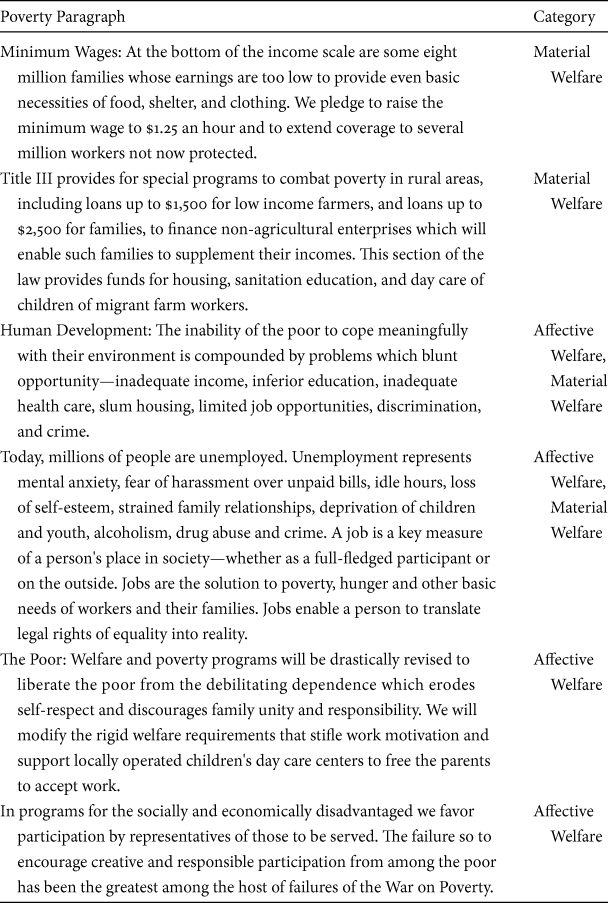
In their scope and definition, the two frames broadly resonate with similar heuristics found in two sets of related literature: first, as loosely approximating the “economic” and “cultural” dimensions emphasized in party ideology and polarization literature;Footnote 17 and, second, as categories of “resilience resources” found in an emerging literature on family and “vulnerability” in legal scholarship. Martha Fineman, the leading vulnerability scholar, classifies five types of assets that structure human vulnerability or resilience in the face of misfortune such as poverty: physical, human, social, ecological or environmental, and existential assets.Footnote 18 The above resources may be differentiated into two broad categories: external/material, on the one hand, and internal/affective or psychological, on the other. I use the term “affective” rather than “cultural” here to underscore the internal quality of these “resilience” resources that may structure how individuals are able to respond to limited material assets. The term “resilience” has gained wide recognition within cultural, political, and literary studies.Footnote 19 Echoing Fineman, all partisan policy promises framed at providing external assistance or bolstering material resources are classified here as part of the “materialist” frame and those directed internally, at enhancing the stock of affective resources—whether feelings, attitudes, values, or character traits—are treated within the “affective” frame. Poverty paragraphs are coded for whether they illustrate the material welfare frame or the affective. The two are not assumed to be separate; a significant part of the analysis is also to examine the interrelationship between the two in addition to identifying each frame’s own constitutive elements. Although sometimes overlapping (as the data reveal), paragraphs often focus on a central frame and policy issue. Examples of poverty paragraphs and the frame/s they illustrate can be found in Table I in the Appendix.
I also analyze the family conceptions (implied or expressed) in the platforms and in each poverty paragraph, also relying on other primary sources, such as presidential speeches and congressional hearings, and on secondary sources, to assist my analysis. Here too, my analysis is directed at how conceptions of the family link with poverty frames. I find two recurrent ideals of family: one economic, viewing family as an economic unit, and the other a moral ideal, imagining family as a moral unit. The two family ideals themselves resonate with work done by Robert Self, which acknowledges a similar alternating focus on families’ economic and/or moral qualities. I will then analyze how and when the two family ideals impinge on and intersect with the material and affective welfare frames of poverty within partisan discourse across the twentieth and twenty-first centuries.
The Evolution of Poverty and Family in Partisan Discourse
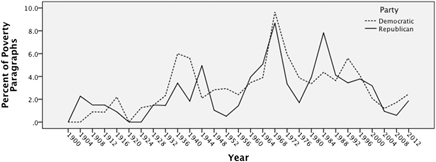
Attention to poverty has waxed and waned across the twentieth century. Figure 1 charts the proportion of Democratic and Republican platform paragraphs that address poverty since the beginning of the twentieth century. It shows the trend of partisan realignment over poverty in the national policy debate: attention to poverty (in the form of welfare reform) galvanized the Republican policy agenda from the late 1970s to 1990s much in the same proportion as it had previously galvanized the Democrats in the 1960s, when Lyndon Johnson declared a “war on poverty” in State of the Union address in 1964. Figure 1 also reveals the overall diminishing salience of poverty in party platforms after watershed welfare reform legislation in 1996, the two parties’ address of poverty now falling to historic lows, unmatched since before the Great Depression.
Poverty Paragraphs as Percentage of Democratic & Republican Platforms, 1900–2012.

Party platforms thus highlight the 1970s as the period marking a long-term turn in both the salience and partisanship of poverty as a national policy issue. This follows the widespread acknowledgment in welfare literature of the significance of that era, whose political turbulence engendered an enduring, critical turn in the substance of policies affecting the poor—away from entitlement and toward the institution of obligations.Footnote 20 The Republican surge through the 1980s, seen in Figure 1, coincides with this new approach to poverty, illustrating the point at which the party formulated an effective response to repudiate Democratic poverty discourse, then displayed it prominently in its 1984 platform, only to drop it on its successful capture of the poverty agenda through the passage of the 1996 Personal Responsibility and Work Opportunity Act.
Indeed, the timing of change in partisanship and salience of poverty discourse seen in Figure 1 suggests a possible link between the changing meaning (ideation) of poverty and its shifting salience. Party platforms in the 1970s mark the onset of a new imagining of poverty: instead of being addressed predominantly as a state of material deprivation, the platforms begin to make reference to the internal conditions associated with poverty—the negative or pathological affect associated with poverty, such as diminishing responsibility, aberrant sexuality, and psychological dependence.
To be sure, affect and values had long been intertwined with material welfare in the parties’ address of poverty in their platforms. Parties invoked values of “fairness” and “justice” in their pledges to address inequities and also celebrated feelings such as “self-worth” and “dignity” arising from “jobs” and from “bringing a paycheck home.”Footnote 21 In such cases, parties attach affect to the “material welfare” of the disadvantaged, in which enhancing their material circumstances is the primary policy goal and the affective benefits are seen as secondary. In contrast, more recent platforms emphasize feelings, values, and attitudes as the primary policy “ends” or goals of welfare policy in themselves. They insist, for example, that “poverty cannot be defined by income statistics alone but by an individual’s true situation and prospects” and pledge “to a welfare policy that is truly reflective of our people’s true sense of compassion and charity as well as an appreciation of every individual’s need for dignity and self-respect.”Footnote 22 Within this framework, economic programs such as work requirements, “workfare,” and “educational and vocational incentives” are designed “to allow recipients to become self-supporting,” “to build self-sufficiency,” “so that families, particularly young families, can establish their economic independence.”Footnote 23 In these more recent cases, material welfare is the means to achieve “affective” welfare, not the end itself. Thus, although intertwined, the parties’ primary antipoverty policy goals can also be delineated as belonging to one or the other category: material or affective welfare of the needy, where one can take precedence and be layered over the other.
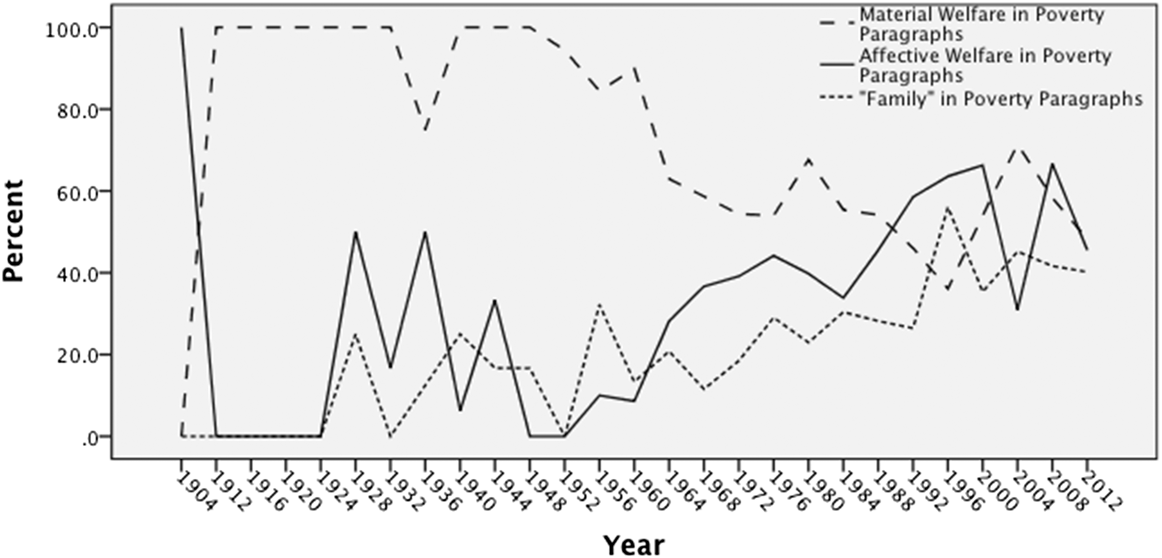
As Figure 2 shows, 1964 marked the beginning of an upward trend in the central focus on affective welfare in poverty paragraphs while also initiating a downward trend in the proportion of poverty paragraphs directed primarily at material welfare. This inverse dynamic, with affect on the rise and materiality in decline, gained much ground in the 1970s and reached its apex in the 1990s, when, for the first time, the focus on affective welfare overshadowed material welfare. The emphasis on generating positive feelings among the poor, such as “self reliance” and “personal responsibility,” for example, eclipsed references to material needs. Since 1996 there has been a slight rebound in the focus on material welfare, which appears, as of the 2000s, to be now comparably balanced with more affective goals. The growing emphasis on affect, values, and attitudes within partisan poverty discourse starting in the 1960s and 1970s is thus unmistakable as seen here.
Material Welfare, Affective Welfare, and Family - as Percentage of Poverty Paragraphs in Party Platforms, 1900–2012.

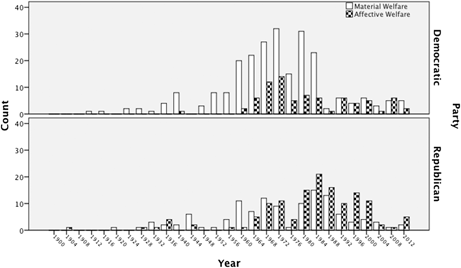
Figure 2 also reveals the enhanced, close relationship between affective welfare and family in poverty discourse starting in the 1970s: the uptick in the proportion of poverty paragraphs invoking affective welfare occurred alongside a simultaneous increase in mention of family in these paragraphs. The heightened significance of family in the late-century revisioning of poverty discourse is further revealed when we analyze partisanship patterns: affective welfare and the turn to “family” are more clearly illustrated in Republican platforms than in Democratic ones. As seen in Figure 3, for much of the twentieth century the Democratic Party consistently focused on material poverty, focusing on material need in a majority of their welfare pledges; Republicans too, until 1968, referred to material welfare of the poor more than affective welfare goals.
Number of Poverty Paragraphs addressing Material and Affective Welfare in Democratic and Republican Party Platforms, 1900–2012.

However, since 1964 and the candidacy of Barry Goldwater, Republicans began to adopt affective welfare goals more. In the 1970s and 1980s and through the 2000 election, their poverty discourse shifted decisively to this focus on affect. At this time Democrats too abandoned their emphasis on material welfare, also becoming increasingly silent on the issue of poverty itself. Thus, on the initiative of the Republican Party, in the last two decades of the twentieth century, both parties have shifted their poverty discourse from a material to a more affective focus; also poverty has moved from being central to the Democratic Party agenda to being invoked more prominently instead by the Republican Party. By the twenty-first century, poverty has mostly moved off both parties’ agendas; in its diminished state, it is framed by the two parties as a concern over both the material and affective welfare of the poor.
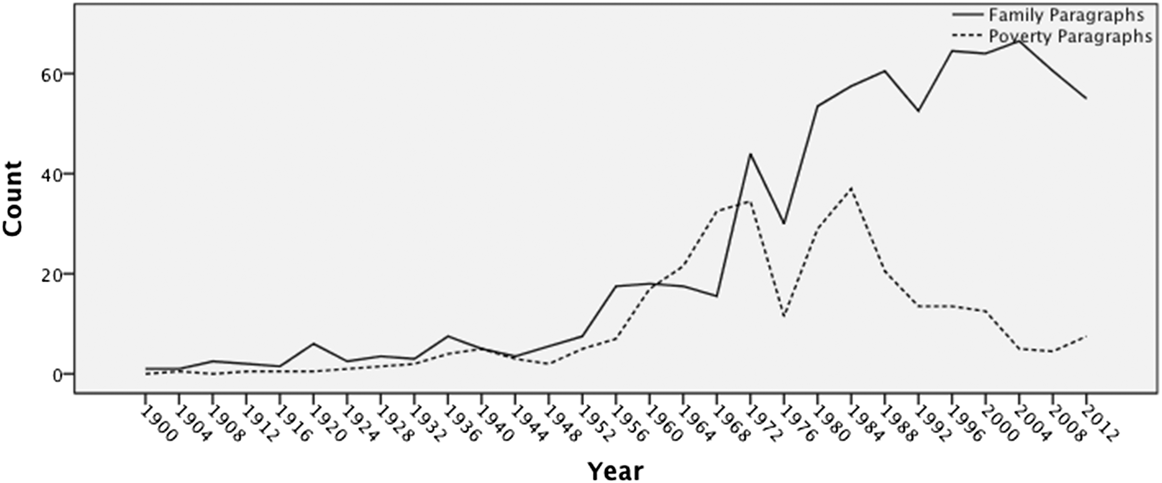
The declining attention to poverty closely coincides with the emergence of “family” as a central policy focus for both parties in the late twentieth century. This is suggested when we plot all platform paragraphs that invoke the family against those that address poverty from the start of the last century: we find that as the parties devoted fewer paragraphs to address poverty in the late century both began to sharply increase their invocation of families throughout their platforms; on an average since 1980, almost five times as many platform paragraphs are devoted to the “family” in comparison to “poverty” paragraphs. The rising salience of family as a policy issue coincides with the turn to affective welfare and the subsequent decline in the salience of poverty itself. Poverty and family bear a statistically significant, inverse, relationship to each other in terms of their mention in party platforms.Footnote 24 The more the parties began to invoke the family in their late-century platforms, the less they addressed poverty.
Count of Family and Poverty Paragraphs in Party Platforms, 1900–2012.

Why and how did this come to be? In the next two sections, I address this puzzle by analyzing the rhetoric and discourse found in each party’s platforms, centrally arguing that “family” is a crucial, hitherto missed, piece in the puzzle of poverty policy development. I offer a family-centered account of welfare policy development, demonstrating the heightened impact of “family,” specifically the new “moral family ideal,” on the parties’ late-century imagining of poverty and thus in the construction of their welfare agenda, its form and salience.
The Intertwined Roots of Family and Poverty in Partisan Discourse, 1900–1968
Throughout the twentieth century and into the twentieth-first, family has been the assumed unit of American society, playing an enduring role in the formulation, administration, and ideology of public policy. The platform data analyzed in the following sections show that partisan policy discourse responds to family social change, its family ideals shifting over time and, in turn, altering antipoverty policies in different eras. Whereas for much of the twentieth century, both parties assumed an economic (“male-breadwinner”) family ideal in their poverty discourse, expanding and instantiating this ideal in their responses to social conditions through much of the last century; family morality and affect remained more subterranean, advocated only by social interest groups and minor factions within the parties.
During the first two decades of the twentieth century, social-progressive reformers responded to the massive industrialization under way in the nation by crafting an agenda for social reform.Footnote 25 In their proposals to mitigate urban and industrial poverty, they relied on a nativist family ideal: the (white) male-breadwinner family. They suggested income support, called “mother’s aid” or “mother’s pensions,” for families that had lost their breadwinner, in order to counter the need of poor mothers to work outside the home; they promoted domestic motherhood through programs for maternal and infant care, seeking to educate poor, often immigrant mothers on Americanized methods of health care, food preparation, and nutrition; and they advocated regulation of child labor and compulsory schooling over the authority of poor parents as further means to halt familial cycles of poverty and to force “loafing” fathers to become responsible and perform their breadwinning roles.Footnote 26 Thus social-progressive initiatives to mitigate the harmful effects of poverty harnessed a male-breadwinner family ideal that was at once both material and affective in scope.
In support of progressive policies, the parties’ platforms placed antipoverty initiatives within a broader theme of “conservation” of human resources; in so doing they focused their policies on material welfare more than on affective. Conservation of natural resources had featured prominently through early Progressive Era platforms. The parties repeatedly pledged to make land improvements, protect forests and minerals, and develop waterways, irrigation, and land reclamation as part of this theme, essential to the growing nation. In a similar vein, the parties emphasized the need to conserve the “life, health, and strength” of the American people, particularly the poor laboring classes, now seen as vital to the good and collective security of the nation. For example, in their plank on “Social Progress,” Republicans in their 1920 platform asserted that “the supreme duty of the nation is the conservation of human resources through an enlightened measure of social and industrial justice.”Footnote 27
The platforms’ emphasis on human resource conservation thus focused attention on the physical well-being of mostly male workers and the impoverished material conditions in which they and their families lived and labored, also embedding distinct familial claims over the bodies of female workers. As existing or potential “mothers” entrusted with the task of reproducing the “race,” the platforms called for protective labor legislation for women described as, “provisions for decency, comfort and health in the employment of women as should be accorded the mothers of the race.”Footnote 28 In so doing, the platforms echoed prevailing maternalist ideas that considered women to be first and foremost mothers, not workers, thus valuing their physical health primarily for their reproductive capacities.Footnote 29
In this way partisan discourse emphasized the material, corporeal, welfare of the male-breadwinner/domestic-mother family. In other pledges the parties’ similarly committed to the material welfare of poor families, there too invoking a male breadwinner family ideal, for example, in their support for state-based mother’s aid and in promises for pensions and employment assistance to poor widows and orphans of veterans, described as part of a “debt of profound gratitude” owed by the Nation “to (male) soldiers and sailors who have fought its battles.”Footnote 30
In this early period, however, issues of poverty were relatively obscure in national partisan discourse given the context of prevailing constitutional boundaries. Direct assistance to the poor, called “poor relief,” was an exclusive prerogative of local private and public agencies, and issues of child labor and other labor regulations were often seen as unconstitutional intrusions of the state into local matters. Thus it is unsurprising that poverty-related paragraphs at most formed a low 1 percent (approximately) of the parties’ platforms during the first three decades of the twentieth century. With the exception of two paragraphs, all poverty paragraphs focused primarily on material welfare. It would take a future critical event to expand the constitutional reach of the national government allowing far greater partisan attention to issues of poverty, further instantiating, as it turns out, the focus on material welfare.
The Great Depression was just such a transformative event; not only did it serve to vastly expand the constitutional reach of the national government, but it also “democratized” poverty by making material deprivation a widespread condition experienced by all ranks.Footnote 31 In the face of the sheer flood of human suffering, the immediate necessity of providing material relief to the needy in the form of food, shelter, and clothing overshadowed previous concerns with cultural or affective reform of the poor.Footnote 32 Once again, material welfare was front and center of the parties’ poverty discourse. During the 1930s and 1940s, in their references to poverty, Democratic platforms invoked the material-welfare frame exclusively over affective welfare (in a ratio of 4:0), and whereas Republicans platforms were slightly more attentive to the feelings of the needy, directing some pledges to restoring “hope” and “self-sufficiency,” they made three times as many references to the goal of their material well-being, such as addressing economic “need” and extending relief to depleted state and local agencies.Footnote 33
Family was front and center in subsequent New Deal assistance and social insurance programs designed to target “those who are faced with the hazards of unemployment and old age [and] the orphaned, the crippled, and the blind.”Footnote 34 In their 1936 platform, Democrats presented their immense agenda for economic security as the “Protection of the family and the home,” which they now asserted was a “self-evident” and “inescapable obligation of government in a modern civilization.”Footnote 35 Democrats pledged several new policies such as protection of savings and investment, old age and social security programs, consumer protection, health programs, and housing assistance as part of this newfound national responsibility to provide family material welfare more broadly.Footnote 36
In so doing, New Deal programs relied on and further embedded the economic (“male-breadwinner”) family ideal. As Suzanne Mettler has shown, the Social Security Act de facto bifurcated programmatic benefits by gender.Footnote 37 On the one hand, the system of Unemployment and Old Age insurance targeted long-term, full-time employees, entitling the “male-breadwinner” or male worker to nonstigmatized income support in the event of job loss or old age, universally administered by the national government. On the other hand, an alternative system of assistance programs, administered differentially by often capricious state governments, upheld the ideal of domestic motherhood (inherited from “mother’s aid” programs) for poor widowed, deserted, or divorced mothers with dependent children. By so doing, New Deal policies preserved the “male breadwinner/domestic mother” model as the economic family unit, privileging the rights of full-time, mostly male, workers over the needs of poor, dependent mothers and their children.Footnote 38 Despite its unevenness, as family historians Mintz and Kellogg recognize, “the New Deal was a critical watershed in the history of the American family, because for the first time the federal government became a major guarantor of (material) family welfare.”Footnote 39
Like Democrats, who imagined family at the center of their relief and economic security programs, Republicans similarly invoked families in their pledges to provide for the material welfare of the poor, pledging to strengthen “federal-State programs for maternal and child health, dependent children, and assistance to the blind.”Footnote 40 However, since 1928 the Republican Party also made a significant turn to oppose central planning and to adopt an antistatist, neoliberal ideology that prevails to this day.Footnote 41 Individuals, not families, were central to this emerging ideology. As Herbert Hoover remarked in 1932, “We must build up men and women in their own homes, on their own farms, where they may find their own security and express their own individuality.”Footnote 42 As part of their new neoliberalism, Republicans began to focus on preserving individualist feelings, such as self-reliance and initiative, to oppose the emerging materialist welfare state. In the 1930s and 1940s, although Republican platforms generally acquiesced to federal programmatic intervention, their pledges were far more circumspect.Footnote 43 Whereas Republicans endorsed “federal grants-in-aid to the States while the need exists,” they also stressed that “hope must be restored pending recovery.”Footnote 44 They began to emphasize the importance of values of liberty but also feelings of opportunity and free character, proclaiming: “America is in peril. The welfare of American men and women and the future of our youth are at stake. We dedicate ourselves to the preservation of their political liberty, their individual opportunity and their character as free citizens, which today for the first time are threatened by Government itself.”Footnote 45
For Republicans, material welfare of the poor would always be tied to the goal of enhancing private affect, freedom, and opportunity. For example, in their 1944 platform, when Republicans claimed that “our goal is to prevent hardship and poverty in America,” they asserted that “that goal is attainable by reason of the productive ability of free American labor, industry and agriculture, if supplemented by a system of social security on sound principles.”Footnote 46
Thus in the wake of the Depression, both parties committed to a new overarching focus on economic security and material welfare that continued to assume, at its core, the single-earner, male-breadwinner family. Poverty too was part of this enlarged vision, as well focusing on the material welfare of poor families, engaging national parties systematically for the first time. However, at this time Republicans made a significant turn to neoliberalism, asserting private affect and internal qualities to oppose the emerging welfare state—a strategy that would mature only roughly five decades later. In the meantime, as the country entered into and emerged from World War II, the concern with family material welfare would continue to prevail and expand within partisan discourse laying the groundwork for a more deliberative focus on poverty as a systemic material condition.
In the economic boom that followed World War II, from 1948 to 1960, partisan discourse in general morphed from its previous focus on relief to a prosperity focus, still structured on the male-breadwinner family as the assumed economic unit. Republicans, for example, summarized their postwar agenda thus: “to establish and maintain peace, to build a country in which every citizen can earn a good living with the promise of real progress for himself and his family.”Footnote 47 In the context of the prevailing Cold War, historian Elaine Tyler May points to the enormous political value of this postwar focus on family material prosperity. She writes that the postwar American dream of rising family incomes and increasing family possessions was understood by policymakers and people alike to illustrate the superiority of American free enterprise over Soviet communism, stating, “American superiority in the cold war rested not (only) on weapons, but on the secure, abundant family life of modern suburban homes.”Footnote 48 As postwar Americans became increasingly “homeward bound,” with uniformly high marriage and fertility rates and low divorce rates, political actors extolled this “domestic consensus” and the material success underpinning it, celebrating successful breadwinners supporting attractive homemakers in affluent suburban homes. In his famous “kitchen debate” with Soviet Premier Nikita Khrushchev in 1959, Richard Nixon and other American politicians, for example, contrasted the comfortable good life of American housewives against that of Soviet women employed in “the drudgery of industry.”Footnote 49 The material success of the breadwinner family was thus central to postwar policy and politics.
In their postwar platforms, the two parties embraced the goal of family material success with unmatched fervor, making numerous references to increasing families’ income and standard of living.Footnote 50 Using strong rights-based language, postwar Democratic platforms enumerated a list of rights to ensure the material well-being of all families, including: “the right to a useful and remunerative job,” the right to earn a minimum wage sufficient for families’ basic needs (clothing, shelter, recreation), the right of every farmer to a return on his produce in order to “give him and his family a decent living,” and the “right of every family to a decent home.”Footnote 51These rights and their continued centrality in Democratic policy pledges emphasized the party’s ongoing embrace of family material welfare and its economic success.Footnote 52
The postwar Democratic expansion of social security programs to include more poor and marginalized populations was part of this larger political commitment to family material life, pledging more and more public responsibility to “help . . . less fortunate citizens meet the needs of daily living.”Footnote 53 Prevailing electoral conditions in favor of the Democratic Party and its welfare policies facilitated this expansion, as The Saturday Evening Post observed in 1949: “Who’s against welfare?: Nobody . . . fighting an election by opposing welfare is on par with taunting an opponent for having been born in a log cabin.”Footnote 54 Alongside proposals to extend the benefits of old age and survivors insurance to more people and to expand unemployment insurance “to include dependents,” Democrats pledged “further improvements in public assistance programs for the blind, the disabled, the aged and children,” also promising to increase aid “for needy persons who are not adequately protected by our contributory insurance programs.”Footnote 55 Deriding the “Republican brand of prosperity” as a “deceptive” “tall tale” focused on the economic elite,Footnote 56 postwar Democrats claimed to articulate a more inclusionary vision of family material success, which soon came to include the eradication of poverty.
In their 1956 platform, among a long list of pledges entitled “Democratic principles of Full Prosperity for all,” Democrats promised for the first time “to work toward the reduction and elimination of poverty in America.”Footnote 57 This Democratic pledge, which prevailed through the 1960s, to “eradicate” poverty, was part of an expansive “Economic Bill of Rights,” said to “point the way to a better life for every family in America.”Footnote 58 It encompassed extended assistance to the poor in housing, city revitalization and slum clearance, public assistance, community programs, consumer protection, legal counsel, and education assistance.
The expanding Democratic obligation to family material welfare and, relatedly, to the eradication of poverty was not without its detractors, albeit still marginalized within the Republican Party. On the one hand, in the 1950s through the 1960s, Republican platforms continued to support government-sponsored material welfare for low-income families,Footnote 59 pledging support for special education programs for poor preschool children,Footnote 60 “help” to low-income farm families,Footnote 61 and low-income housing programs.Footnote 62 They also addressed poverty as a scourge in need of concerted policy action, making references to “our crusade against poverty” and committing to “conquering disease, poverty and grinding physical demands.”Footnote 63
However, a faction of congressional Republicans continued to champion a neoliberal, laissez-faire conservatism that remained antistatist and focused on private (individual) affect.Footnote 64 Affective well-being began to find increasing mention in Republican postwar platforms. In an extensive plank devoted to “Human Welfare and Advancement,” the GOP in 1956 declared that “the Republican Party believes that the physical, mental, and spiritual well-being of the people is as important as their economic health.”Footnote 65 Presidential hopeful Senator Robert Taft (R-Ohio) cautioned that “the productive capacity of this country is so great that it can afford to see that we abolish hardship and poverty in the United States. . . . You have to be careful . . . that you do not begin to support people to a point at which they will not work, themselves, as hard as they should.”Footnote 66 In the 1960s, as Republican platforms began to mount a consistent attack against the Democratic postwar order,Footnote 67 they stressed more the creation of positive affect, particularly individual self-reliance, as a central policy goal. Pledges to assist the needy were framed as promises to increase opportunities for individuals to “become self-supporting,” asserting that “government’s primary role is to help provide the environment within which the individual can seek his own goals.”Footnote 68 Although affective welfare continued to be directed at individuals at this time, emerging anxieties over family and its impact on generating negative affect also began to permeate Republican poverty discourse, first seen in pledges to combat juvenile delinquency.
In 1956 in the first-ever plank on “Juvenile Delinquency,” Republicans pledged increased federal programmatic attention to “strengthen family life in welfare programs,” declaring that “the Federal Government can and should help state and local communities combat juvenile delinquency by inaugurating a grant program for research, demonstration, and training projects and by placing greater emphasis on strengthening family life in all welfare programs for which it shares responsibility.”Footnote 69
In response to a 30 percent increase in youth crimes following World War II, juvenile delinquency through the 1950s had received widespread media and congressional attention.Footnote 70 Coming before Congress, postwar child-development experts pointed to family breakdown and “delinquent parents”: deserting fathers who shirked their breadwinning responsibility, and, more often, uncaring working mothers.Footnote 71 The widespread entry of married women into the workforce that first began during the war engendered a marked anxiety in the 1950s over the stability of the family and possible changes in people’s internal morality and values.Footnote 72 Testifying before a congressional committee, social observers such as Dr. Grace Sloan Overton (a nationally known youth counselor) cautioned that “if we are not careful in America . . . within 3 generations, possibly 2, the homelife as we know it will not exist any more. The idea of family will be over and done with.”Footnote 73 Following World War II, anxieties over changing morals and affective degeneration thus began to be directly connected to family, eliciting a new moral ideal of family as a political project, one that soon would be harnessed as a leading focus of the Republican welfare reform agenda of the late century.
The Transformation in Late-Century Poverty and Family Partisan Discourse, 1968–2012
Beginning in the late 1960s as political ferment roiled the country, social behavior also underwent much transformation, unraveling the male-breadwinner nuclear family as the dominant family arrangement. Whereas in 1960 over 70 percent of all American households were made up of a breadwinning father, a homemaker mother, and their biological children,Footnote 74 three decades later, with the explosion of women’s workforce participation, divorce, and extramarital births, such families accounted for less than 25 percent of the nation’s households.Footnote 75 As Stephanie Coontz, a leading family historian writes, “Marriage and family thus changed more in the last thirty years (of the twentieth century) than in the last five thousand.”Footnote 76 Policy assumptions of family long centered on the model of the male-breadwinner nuclear family began to be deeply challenged; no longer could policymakers, and the political parties to which they belonged, assume the form, structure, and ideals of American families. The ensuing “culture wars” of the 1970s, 80s and 90s, resulted in a new late-century political consensus centered on family as an affective and moral ideal, not an economic one. In his book All in the Family, historian Robert Self describes this transformation:
In the middle decades of the twentieth century, the heterosexual nuclear family was a liberal political project. From the New Deal to the Great Society, social welfare liberals created a social safety net, supported labor unions, subsidized vast suburban housing tracts, and created government programs to fight poverty either entirely or in large part to strengthen male-breadwinner nuclear families or to compensate for their temporary instability. . . . They hoped to assist families economically. . . . By 2004, the nuclear family was a conservative emblem . . . and instead of crafting policies to extend opportunity to new segments of society, conservatives endeavored to defend families from moral threats . . . conservatives won back the power to define the mythological American family, and in the process the Great Society pledge to assist families became the New Right pledge to protect them.”Footnote 77
The shift in political family ideals occurred in conjunction with a turn in partisan politics toward greater recognition of “post-material” values and affect among key liberal and conservative factions.Footnote 78 As already seen, since the New Deal a small neoliberal faction of the Republican Party had resisted the welfare state by emphasizing individual, private, affect in the form of self-reliance, freedom, and initiative. In the late 1960s, in response to high-profile Supreme Court rulings legalizing abortion and banning school prayer, and the prevailing civil rights, feminist, and emerging gay rights movements, the neoliberal faction discovered new allies: religious groups and cultural traditionalists. Cultural traditionalists were alarmed by these developments and also concerned with affect, moral, and religious in their case.Footnote 79 On the Democratic side, an influx of a new college-educated set of countercultural activists into the Democratic Party upended its staunch (social conservative) blue-collar base and its unidimensional focus on material welfare, now adding their liberal affective claims and “values” interests to the Democratic agenda.Footnote 80
The New Left and Right thus introduced a new affect-based issue context into partisan politics, pitting cultural liberals and traditionalists against each other.Footnote 81 Whereas the individual was at the center of the New Left’s concern with affect, emphasizing individual rights and personal freedoms,Footnote 82 the “family” was now at the core of the new Right. Widely lamenting the breakdown of the male-breadwinner (heterosexual, married, white) nuclear family and the social order that it had come to symbolize, “family” became the rallying cry for newly mobilized cultural conservatives. Republicans now claimed in their platforms, “The family is the foundation of our social order. Its daily lessons—cooperation, tolerance, mutual concern, responsibility, industry—are fundamental to the order and progress of our Republic. . . . We insist that all domestic policies, from child care and schooling to social security and the tax code must be formulated with the family in mind.”Footnote 83 As seen in Figure 4, starting in the 1970s, party platforms exponentially increased their mention of family within their pledges. As Robert Self notes, “family had quite suddenly and powerfully joined communism and civil rights as the battlegrounds on which conservatives would wage war on liberalism.”Footnote 84
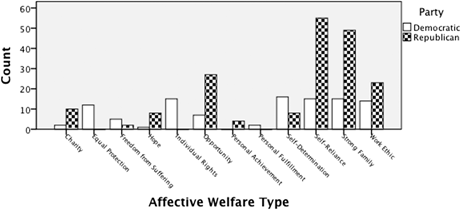
No other policy issue spotlights the crusade and success of the new Right to reinstall family as a moral ideal as clearly as welfare. In the late-century Republican battle for welfare reform, the moral family ideal energized the party’s long-standing assault against the New Deal welfare state. Beginning in 1968 and again in 1972, the Republican and Democratic platforms invoked the affective welfare frame in their poverty planks far more than ever before, and this trend continued strongly in Republican platforms after 1980 (Fig. 3). However, the parties differed significantly in the kinds of affect they valued and pursued, reflecting the differences between the newly mobilized political groups: cultural progressives, on the one hand, and traditionalists, on the other (Fig. 5). Whereas both parties stressed the need to encourage a strong “work ethic” among the poor; other kinds of positive affect, particularly family commitment/stability (“strong family”) and “self-reliance,” are starkly partisan. On their part, Democrats stressed the creation of feelings of empowerment in the poor such as: “individual rights,” “self-determination,” and “equal protection.” In contrast, Republicans highlighted the two central affective welfare goals of neoliberals and cultural conservatives: “self-reliance” and “strong families,” respectively, along with the cultivation of other more community-based feelings, such as charity, hope and opportunity.
Kinds of Affective Welfare Objectives in Poverty Paragraphs, Democratic and Republican Platforms, 1900–2012.

From the 1970s on, Republican poverty discourse emphasized the affective welfare frame more than ever, centered on a strong (moral) family ideal. Family stability and the capacity of families to perpetuate positive or negative affect and morals were strongly asserted in Republican platforms, which claimed that
families—not government programs—are the best way to make sure our children are properly nurtured, our elderly are cared for, our cultural and spiritual heritages are perpetuated, our laws are observed and our values are preserved. If families fail in these vitally important tasks, there is little the government, no matter how well-intentioned, can do to remedy the results. . . . The values of hard work and responsibility start with the family. . . . It is imperative that our government’s programs, actions, officials and social welfare institutions never be allowed to jeopardize the family. We fear the government may be powerful enough to destroy our families; we know that it is not powerful enough to replace them.Footnote 85
Republican welfare planks challenged Democratic programs for undermining poor families’ own positive affect, “erod[ing] self-respect and discourag[ing] family unity and responsibility,”Footnote 86 “penaliz[ing] the poor” and “kill[ing] any incentive its victims might have to work their way out of the morass.”Footnote 87 Any deviation from the male-breadwinner family among the poor was now seen to have moral, not only economic, meaning; the absence of fathers in poor families was seen to perpetuate not merely cycles of material hardship but, more fundamentally, that of degenerative family morals. In 1972, Republicans lamented, “[welfare] continues to break up poor families, since a father’s presence makes his family ineligible for benefits in many States. Its dehumanizing lifestyle thus threatens to envelop yet another ‘welfare generation.’”Footnote 88
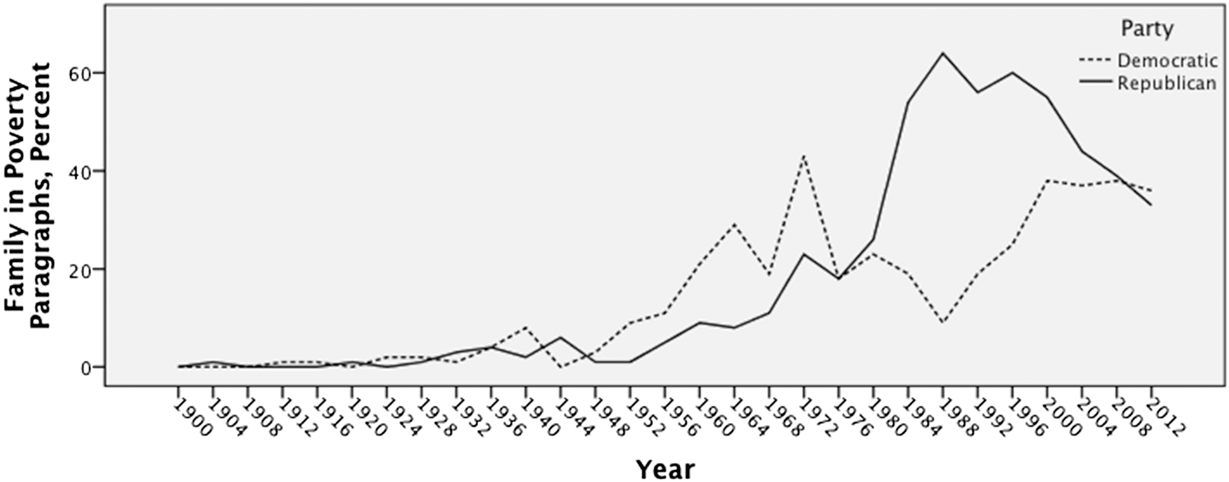
Republican platforms repeatedly pushed for a reimagining of poverty, claiming that “poverty used to be an economic problem, now it is a social pathology,”Footnote 89 also recasting that the goal of “remedying poverty” in affective terms: “requir[ing] that we . . . hold families together, get government’s hand out of their pocketbooks, and restore the work ethic.”Footnote 90 The new focus on the family thus galvanized the Republican welfare reform agenda, successfully capturing partisan poverty discourse. After Republican platforms sharply increase their invocation of the family in their poverty planks, a similar jump occurs in Democratic platforms after the 1990s, illustrating the success of this approach (Fig. 6).
Percent of Poverty Paragraphs that Refer to Families, Democratic & Republican Platforms, 1900–2012.

The moral family ideal championed by the new Right and enlisted in the Republican push for welfare reform reasserted the “traditional” married-family structure centered on an authoritative father/male breadwinner, now valued as much for his moral role rather than his economic one. Republican platforms not only attacked Democratic welfare policies for “shattering family cohesion both by providing economic incentives to set up maternal households and by usurping the breadwinner’s economic role in intact families” but also stressed the father’s central moral role.Footnote 91 As David Blankenhorn, founder of the Institute for American Values and author of the influential book, Fatherless America: Confronting our Most Urgent Social Problem, writes: “More than providing for their material needs . . . paternal sponsorship means cultural transmission—endowing children with competence and character by showing them how to live a certain kind of life . . . teaching children right from wrong . . . passing on a way of life.”Footnote 92
Through the 1980s and 1990s, Republican platforms repeatedly stressed the centrality of fathers in providing moral stewardship to children within married homes, cultivating positive affect such as responsibility and character in generations to come. Even after the passage of the 1996 welfare reform law, Republican platforms continued to stress the moral family ideal in “Promot[ing] Marriage and Responsible Fatherhood” as an antipoverty strategy, emphatically stating:
We support the President's welfare reform proposals that promote child wellbeing and stronger marriages. We recognize the importance of having in the home a father and a mother who are married. The two-parent family still provides the best environment of stability, discipline, responsibility, and character. We recognize that fathers play a critical role in providing stability for their children. . . . Promoting responsible fatherhood will have long-lasting benefits for families and for communities. We support President Bush's initiatives to reaffirm the important role fathers play in their children's lives and to help men meet the responsibilities of fatherhood.Footnote 93
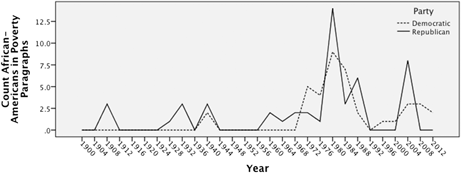
The moral family ideal contained in the conservative conception of the nuclear male-breadwinner family was also a racial ideal, privileging white family practices. Seen as anomalous to the white American male-centered married family, the poor African American single-mother family had been the centerpiece of welfare reform since Daniel Patrick Moynihan’s “The Negro Family.”Footnote 94 Upon postwar expansion and the increasing inclusion of previously excluded black families within assistance programs, the black “welfare queen” had begun to replace the white “worthy widow” within the public imagination of welfare.Footnote 95 Whereas the parties’ platforms made references to race in discussing the disproportionate impact of poverty on minorities, women, and on “black Americans,” they did not directly refer to black families or to the values and morals associated with them. However, the underlying centrality of race to the late-century moral family ideal in poverty discourse can be seen indirectly in the coincident timing and frequency with which the parties’ begin to refer to African Americans and families in their poverty planks. As seen in Figure 7, African Americans were not mentioned in the parties’ poverty paragraphs for most of the twentieth century, yet beginning in the last few decades (and particularly in the 1980s) the parties’ sharply increased their mention when referencing the agenda for welfare reform. During the same late-century period (1970s on), the parties also greatly increased their mention of families and their use of the affective welfare frame in their poverty planks (see Fig. 2). Late-century partisan welfare discourse thus indicates the racial context of the Republican-led moral family ideal even as it was being proffered as an antidote to the identity politics of the New Left.
Word Count of African-Americans in Poverty Paragraphs, Democratic & Republican Platforms, 1900–2012.

For the New Left, the changing social order and the collapse of the nuclear family were not negative developments. It signaled to them the possibility of a new, more-inclusive, social and affective order, in which personal fulfillment, self-expression, and rights could trump long-standing hierarchical obligations, constraints, and inequalities.Footnote 96 Yet divisions within the New Left, particularly among factions in the feminist and gay rights movements, prevented them for rallying around a unified liberal family moral ideal that could then consolidate the liberal affective values that were emerging during this period.Footnote 97 As such, Democratic platforms continued to rely on an economic family ideal, now promising assistance to diverse family structures, such as dual-earner families, in addition to the postwar male-breadwinner family.Footnote 98
However, the conservative ideal of the moral family also found its way into Democratic discourse, particularly into their poverty planks. By the 1990s, Democrats too began to stress affective welfare and the central role of the family in promoting it, and in 1996 they proclaimed: “Today’s Democratic Party knows there is no greater gap between mainstream American values and modern American government than our failed welfare system. When Bill Clinton became President, the welfare system undermined the very values—work, family, and personal responsibility—that it should promote. The welfare system should reflect those values: we want to help people who want to help themselves and their children.”
Like Republicans, Democrats also embraced the married family ideal, proposing to reinstate missing fathers and to promote marriage as private means to combat poverty, promising to “send the strongest possible signal to young people that it is wrong to get pregnant or father a child until they are married and ready to support that child and raise that child.”Footnote 99 In 2000 the Democratic platform went further, proclaiming, “Promoting responsible fatherhood is the critical next phase of welfare reform and one of the most important things we can do to reduce child poverty.”Footnote 100 For poor families the morality of the male-breadwinner family attached, in large part, to the father’s role as a self-reliant, material provider: poor fathers were required to exhibit their morality, their “responsibility” as it were, by independently providing material support to dependents; as the Democratic plank on child support stated, “If you owe child support, paying it fully and promptly is just the first step in living up to your responsibility as a parent.”Footnote 101 The male-breadwinner two-parent married-family ideal was no longer solely a liberal economic family ideal, used to expand state intervention; it was now, more critically, also a conservative moral one, used to enhance private, independent family responsibility and to limit the state.
A similar turn to greater affective welfare in Democratic welfare planks can be seen in the party platforms’ growing preoccupation with family responsibility among the poor. Starting in 1992, Democratic poverty discourse began to make increased reference to “work” and “responsibility” as moral family traits, circumscribing the eligibility of poor families to receive public assistance to those who could demonstrate these traits.Footnote 102 Thus “working” families replaced poor “needy” families, as the centerpiece of late-century Democratic welfare discourse.
From 1960 to 1988, Democratic platforms on an average devoted about four paragraphs, referencing policies specifically directed at “poor families” and made almost no mention of “working families” (mean of 0.25 paragraphs in this period). However, starting in 1992, the number of paragraphs that made reference to poor families fell to half (two paragraphs), and those devoted to “working families” increased six times (on an average now, six paragraphs per platform). Thus even for Democrats, working (and hence moral) families became prominent in their poverty discourse, the party now promising programmatic assistance to only those families who fell/fall behind despite “playing by the rules” and “working as hard as they can,”Footnote 103 directing systemic reform not only at material welfare but also at character, at “(those) people who want to help themselves and their children.”Footnote 104 As shown in Figure 3, Democratic poverty planks invoked “self-reliance” as a central (private) affective goal, even more than “individual rights” or increasing “self-determination” among the poor, the latter requiring more public intervention.
In the context of the prevailing economic recession, however, the Democratic Party in its two most recent platforms (2008 and 2012) appears to somewhat resurrect its previous liberal economic family ideal, also recommitting to the “eradicati[on of] poverty” as part of its policy agenda.Footnote 105 Directing attention at marginalized families, such as those headed by women and racial minorities, “who are the most likely to be poor,” Democrats are also emphasizing again the importance of material welfare and assistance, asserting that “it is no good to be able to ride the bus when you can’t afford the bus fare.”Footnote 106 In this respect the party has pledged to the Fair Pay Act and expansion of Earned Income Tax Credit and other policies described as “fair pay and support for mothers.”Footnote 107 In other ways, however, Democratic welfare planks continue to rely on the conservative moral family ideal, still characterizing a majority of their pledges to low-income and poor families as “helping parents and children . . . lift themselves out of poverty” and devoting large sections to promoting “responsible fatherhood.”Footnote 108
So far in this century, Republicans continue to stress only the conservative moral family ideal in their abiding focus on the affective welfare of the poor.Footnote 109 In its 2012 platform, the party again pledged to “Renew American Values to Build Healthy Families” and celebrated the “daily lessons” of the “American Family”: “cooperation, patience, mutual respect, responsibility and self-reliance,” as “fundamental to the order and progress of our Republic.”Footnote 110 In 2012, the party promised to “Creat[e] a Culture of Hope: Raising Families Beyond Poverty” and committed to various policies to further limit the state, generating, they said, “hope” and “self-reliance.” The party promised even stricter work requirements and food-stamp disbursement to underscore its commitment to family responsibility and self-reliance, “so that low-income parents and individuals should strive to support themselves.”Footnote 111 Family-based affect, its “daily (moral) lessons,” as opposed to its material welfare, continues to frame Republican poverty discourse, still tying the party’s long-standing antistatist, neoliberalism to its late-century embrace of religion and morality.
Conclusion
In this article, I have attempted to do two things: first, I have demonstrated how “family” has long influenced the development of “poverty” or “welfare” policy discourse. However, since the 1970s the “family” as a moral ideal has risen to policy attention as never before, becoming the means by which Republicans and Democrats have transformed their welfare policy agendas. Second, I have highlighted the partisan dynamics of these policy developments, in particular how and why the two parties have now come to be preoccupied with internal, affective concerns in addition to material, distributional ones in their address of poverty as a policy issue. Both of these aspects have broader implications.
First, in thinking about the influence of the family on welfare policy development, it is important to highlight the role of family in reconfiguring the boundaries between “public and private.” On the one hand, the redirection of welfare policy to focus on hitherto private internal/psychological feelings, sensibilities, or choices redirects the “public” gaze toward affect, a domain previously beyond the reach of policy. At the same time, this has meant a declining focus on material need, reconfiguring material poverty to the “private” domain, replacing state responsibility with individual familial obligations. This reconfiguration is deeply tied to the late-century transformation of “family” as a political ideal, as its moral role in generating positive affect has now become more “public” and central to the organization of welfare and other social policies, while its economic function of providing for material necessities has receded more into the “private” domain, refocusing welfare policy attention away from material need and deprivation. Thus far from being outside of policymaking, in the last four decades the family has become the very policy subject through which the boundaries between state and society are established, negotiated, and reconfigured, contributing to how we think about public policymaking as well as the role of family in American political development.
Second, the account of partisan dynamics in the development of poverty discourse throughout the twentieth century has implications for American politics. To begin with, it illustrates the prominence of two—not one—cross-cutting issues dimensions: material and affective welfare within the partisan poverty debate, a feature of contemporary politics that some say marks a more fundamental transformation “in the central substance of American politics”: from “distributional concerns” over the “distribution of material goods, around economics and social welfare” to “valuational” concerns “involving the proper behavioral norms within which social life should proceed.”Footnote 112 This article has not only demonstrated the presence of these two frames within poverty discourse but has gone further by demonstrating how the two frames are imbricated and interwoven together. It is by paying attention to “family” as a normative ideal, underpinning and structuring welfare policy, that we are able to do this, for “family” is both an affective unit as well as a material one, and so meshes material and affective frames of poverty discourse together, layering one over the other. In the Progressive Era, “mother’s aid” layered material welfare, providing income support for families lacking male breadwinners, on affective concerns, to encourage domesticity and nurturing among women. And in more contemporary times, “responsible fatherhood” imbricates affective welfare concerns, that is, encouraging responsibility and self-reliance, with material welfare goals, namely, providing income and economic support to dependents. The dynamic interwoven relationship between the material and affective dimensions of poverty can thus be clearly seen when we focus on the family and its role in structuring welfare policy development over time.
Furthermore, like previous literature on party ideology (Gerring), the analysis of party platforms reveals a “path-dependence” in how parties’ formulate and develop their policy ideals from one political regime to the next. In periods of political realignment, such as in the 1970s, the resurgent party does not merely add a wholly new frame (such as affective welfare) to an existing configuration but, rather, develops and draws on its previous policy ideologies to reformulate its new policy vision. Thus the embrace of affective welfare policy goals by the Republican party in the 1970s had deep antecedents in the party’s opposition to the New Deal, as “self-reliance” and “personal responsibility” had been long cherished by the antistatist, neoliberal faction within the party. Similarly, contemporary Democratic platforms since 2008 reveal a lasting focus on distributional/material welfare combined with its new, affective welfare concerns with “responsible fathers” and “work ethic” of marginalized groups. The late-century emergence of affective welfare, alongside or in lieu of material welfare of the poor, is thus likely to survive in some shape or form within partisan politics for a long time to come.
APPENDIX
Samples of Coding of Poverty Paragraphs