Introduction
Posttraumatic stress disorder (PTSD) is a disabling clinical syndrome that threatens social and vocational functioning (Kessler et al., Reference Kessler, Berglund, Demler, Jin, Merikangas and Walters2005). PTSD affects 6.8% of American adults (Kessler et al., Reference Kessler, Berglund, Demler, Jin, Merikangas and Walters2005) and is even more prevalent after military deployment [13.8% of Operation Enduring Freedom/Operation Iraqi Freedom (OEF/OIF) Veterans, Tanielian and Jaycox, Reference Tanielian and Jaycox2008]. Studies suggest that poor outcomes associated with symptoms of PTSD are partially attributable to cognitive dysfunction (Geuze, Vermetten, de Kloet, Hijman, & Westenberg, Reference Geuze, Vermetten, de Kloet, Hijman and Westenberg2009). Most cognitive research on PTSD symptomatology has focused on learning and memory dysfunctions (Moore, Reference Moore2009; see Rubin, Berntsen, & Bohni, Reference Rubin, Berntsen and Bohni2008, for a review). However, there is emerging evidence that symptoms of PTSD are also associated with poorer performance on executive function tasks (e.g., Esterman et al., Reference Esterman, DeGutis, Mercado, Rosenblatt, Vasterling, Milberg and McGlinchey2013a; Polak, Witteveen, Reitsma, & Olff, Reference Polak, Witteveen, Reitsma and Olff2012; Schuitevoerder et al., Reference Schuitevoerder, Rosen, Twamley, Ayers, Sones, Lohr and Thorp2013; Swick, Honzel, Larsen, Ashley, & Justus, Reference Swick, Honzel, Larsen, Ashley and Justus2012). Executive functions include task switching, working memory, and inhibitory control that enable complex goal-directed behaviors (Alvarez & Emory, Reference Alvarez and Emory2006; Miyake, et al., Reference Miyake, Friedman, Emerson, Witzki, Howerter and Wager2000). Executive functions may be particularly relevant to PTSD symptoms because they are associated with diminished functional status and may compromise PTSD treatments (e.g., emotion regulation strategies during trauma-focused therapies, Mohlman & Gorman, Reference Mohlman and Gorman2005; Polak, et al., Reference Polak, Witteveen, Reitsma and Olff2012; Vasterling & Verfaellie, Reference Vasterling and Verfaellie2009). The current study addresses whether PTSD symptoms are related to general executive dysfunction or are more related to certain executive function subdomains.
Two recent reviews examined the link between PTSD and executive dysfunction. Polak et al. (Reference Polak, Witteveen, Reitsma and Olff2012) performed a meta-analysis, examining the results of classic executive functioning tests (e.g., Stroop, Trails B, Digit Span, Wisconsin Card Sorting Test) in PTSD compared to trauma-exposed and healthy controls. Supporting a link between PTSD and general executive dysfunction, Polak and colleagues found that patients with PTSD demonstrated significantly poorer performance on Trails B, the Wisconsin Card Sorting Test, and Digit Span than did trauma-exposed controls. Another review (Qureshi et al., Reference Qureshi, Long, Bradshaw, Pyne, Magruder, Kimbrell and Kunik2011) examined a much broader array of cognitive tasks, performed qualitative analyses rather than pooling effect sizes, and found more mixed results. Of the 16 executive function studies reviewed, only 9 found significant deficits in executive function related to PTSD (predominantly on Trails B or Symbol Digit Modalities Test). Contrary to the findings of Polak et al. (Reference Polak, Witteveen, Reitsma and Olff2012), Qureshi et al. (Reference Qureshi, Long, Bradshaw, Pyne, Magruder, Kimbrell and Kunik2011) did not find a PTSD-related impairment on the Wisconsin Card Sorting Test, likely because these effects were modest and are only significant when using a meta-analytic approach.
One explanation for these mixed findings is that individuals with PTSD have impairments within specific executive functioning subdomains and that measures assessing multiple executive function subdomains simultaneously fail to consistently capture these deficits. In line with this explanation, another review proposed that executive dysfunction associated with symptoms of PTSD is more specific to the subdomain of inhibitory control (Aupperle, Melrose, Stein, & Paulus, Reference Aupperle, Melrose, Stein and Paulus2012). Inhibitory control involves executive functions related to stopping or changing automatic response patterns (e.g., response inhibition) or control of selective attention (e.g., distractor suppression). Aupperle and colleagues suggest two possible mechanisms relating impaired inhibitory control and PTSD: (1) the re-experiencing and hyperarousal symptoms associated with PTSD interfere with inhibitory control by creating more distractors during daily life; or (2) preexisting inhibitory control dysfunction impairs one’s ability to inhibit attending to and disengaging from trauma-related triggers and emotional memories, increasing the likelihood of developing PTSD. Support for the association between inhibitory control and PTSD symptoms comes from studies showing PTSD-related deficits in distractor suppression (Esterman et al., Reference Esterman, DeGutis, Mercado, Rosenblatt, Vasterling, Milberg and McGlinchey2013a; Leskin & White, Reference Leskin and White2007) and response inhibition (Swick et al., Reference Swick, Honzel, Larsen, Ashley and Justus2012; Wu et al., Reference Wu, Ge, Shi, Duan, Wang, Sun and Zhang2010). While these studies suggest a prominent relationship between inhibitory control impairments and PTSD symptoms, due to the limited battery of executive function assessments used in these studies, they cannot conclusively determine whether these PTSD-related associations are greater than associations of PTSD with other executive functions.
To better clarify the generality of executive dysfunction in those with PTSD symptoms and test the hypothesis that PTSD symptoms are specifically related to inhibitory control dysfunction, we administered a comprehensive executive functioning battery to a group of OEF/OIF Veterans with varying levels of PTSD symptoms. We included sensitive measures covering the three executive functioning subdomains advocated by Miyake and colleagues (Reference Miyake, Friedman, Emerson, Witzki, Howerter and Wager2000)—inhibitory control (go/no-go, visual distraction task, Color Word Interference Test-Stroop), working memory (Digit Span, Auditory Consonant Trigrams), and task switching (Intra-Extra Dimensional Set Shift-IED). We also included measures that combined multiple subdomains such as Verbal Fluency (FAS category and letter fluency) and Trails Number Letter Sequencing (Trails NL, analogous to Trails B) from the Delis-Kaplan Executive Function System (DKEFS). Giving such a comprehensive battery to the same group of participants allowed us to test whether participants with greater PTSD symptoms exhibit specifically poorer performance in inhibitory control or more generally poorer performance across all executive functions.
Methods
Participants
Participants were drawn from a pool of 250 OEF/OIF Veterans recruited into the Traumatic Brain Injury (TBI) Center of Excellence at the Boston VA—the Translational Research Center for TBI and Stress Disorders (TRACTS, for a more in-depth description of recruitment and characteristics of this sample, see Amick et al., Reference Amick, Clark, Fortier, Esterman, Rasmusson, Kenna and McGlinchey2013; Fortier et al., Reference Fortier, Amick, Grande, McGlynn, Kenna, Morra and McGlinchey2013). All participants recruited to TRACTS undergo a comprehensive neuropsychological assessment including standardized tests of executive function, memory, and attention. The final sample of 37 for the present study includes those that were contacted following their TRACTS session to participate in a second session that involved more in-depth assessment of executive functions. [Of the 37 participants in the current study, 17 were previously reported in the study of the Attentional Capture Task by Esterman and colleagues (Reference Esterman, DeGutis, Mercado, Rosenblatt, Vasterling, Milberg and McGlinchey2013a).] The average time between the TRACTS session and the subsequent executive function session was 5.6 months (SD=4.6). In the TRACTS session, all participants received the Clinician Administered PTSD Scale (Blake et al., Reference Blake, Weathers, Nagy, Kaloupek, Gusman, Charney and Keane1995) and all had experienced at least one Criterion A traumatic event but only 18 of the 37 had a PTSD diagnosis. As part of the Center’s exclusionary criteria, participants did not have a history of neurological/physical impairments, although eight reported mild traumatic brain injury (mTBI). Psychiatric exclusionary criteria included psychotic disorders, bipolar disorder, and suicidal/homicidal ideation requiring intervention. This study was approved by the VA Boston IRB, written consent was obtained from all participants, and research was conducted according to the Declaration of Helsinki.
Paradigms/Procedures
Clinical measures
During the TRACTS session, severity of PTSD symptoms was assessed with the PTSD Checklist-Civilian (PCL-C, Weathers, Litz, Herman, Huska, & Keane, Reference Weathers, Litz, Herman, Huska and Keane1994) and the Traumatic Life Experiences Questionnaire (Kubany et al., Reference Kubany, Haynes, Leisen, Owens, Kaplan, Watson and Burns2000). The PCL-C is a self-report measure corresponding to the DSM-IV symptoms for PTSD with excellent reliability (full scale, Cronbach’s α=.96). Depressive symptoms were assessed with the Depression Anxiety Stress Scales, Depression subscale (DASS; Lovibond & Lovibond, Reference Lovibond and Lovibond1995; Cronbach’s α=.82). To assess trauma exposure and common comorbidities of deployment-related PTSD symptoms, participants completed self-report questionnaires including the Deployment Risk and Resilience Inventory-2 combat experiences portion (DRRI; Vogt, Proctor, King, King, & Vasterling, Reference Vogt, Proctor, King, King and Vasterling2008), Lifetime Drinking History questionnaire (LDH, average number of drinks on a drinking day and LDH total corrected for body weight; Skinner & Sheu, Reference Skinner and Sheu1982), Short Michigan Alcohol Screening Test (SMAST, total score; Selzer, Vinokur, & Rooijen, Reference Selzer, Vinokur and Rooijen1975), and the Boston Assessment of Traumatic Brain Injury-Lifetime (BAT-L; Fortier et al., Reference Fortier, Amick, Grande, McGlynn, Kenna, Morra and McGlinchey2013). During the second testing session, participants again completed the PCL-C (first and second session PCL-C correlated r=.92) and were administered the Beck Depression Inventory-II (BDI-II), which reliably measures depression symptomatology (Cronbach’s α=.92) and correlates highly with the DASS-depression (r=.74; Lovibond & Lovibond, Reference Lovibond and Lovibond1995).
Cognitive measures
Assessment of executive functions included the following well-validated, reliable measures (see Table 1 for the session during which each measure was given, and see Supplementary Materials for further descriptions).
Measures administered during the first and second testing sessions

Task Switching
Participants completed the Intra-Extra Dimensional Set Shift (IED) from the Cambridge Automated Neuropsychological Test Battery (CANTAB, Cambridge, England, 2002), a computer-based analogue to the Wisconsin Card Sorting Test. Dependent measures of interest were the total errors (adjusted score) and the total completed stage trials.
Working Memory
Participants completed the Auditory Consonant Trigrams (ACT) and the Digit Span from the Wechsler Adult Intelligence Scale, Fourth Edition (Wechsler, Reference Wechsler1997). The dependent measures were the total number of correct responses for ACT and for Digit span, the sum of the Digit Span Forward, Backward, and Sequencing scores.
Inhibitory Control
We measured three aspects of inhibitory control: response inhibition, interference control, and distractor suppression. For response inhibition, we used the percent of presses to infrequent no-go stimuli (commission error rate) from a go/no-go continuous performance task, called the gradCPT (gradual onset continuous performance task, Esterman et al., Reference Esterman, Noonan, Rosenberg and Degutis2014; Rosenberg, Noonan, DeGutis, & Esterman et al., Reference Rosenberg, Noonan, DeGutis and Esterman2013a; Esterman et al., Reference Rosenberg, Noonan, DeGutis and Esterman2013b). We included the Color Word Interference Test (i.e., Stroop Test) as a measure of inhibition known as “interference control” (Stuss, Floden, Alexander, Levine, & Katz, Reference Stuss, Floden, Alexander, Levine and Katz2001). We chose the dependent measure to be interference trial total time instead of difference scores (e.g., the difference between interference trials and color naming or word reading trials) because difference scores are typically less reliable (Peter, Churchill, & Brown, Reference Peter, Churchill and Brown1993) and we had no reason to believe that subjects would differ on either color naming or word reading trials. Difference scores were highly correlated with interference trial time (ρ’s>.92) and all main results replicated when using differences scores. For distractor suppression, participants performed a version of the irrelevant singleton visual search paradigm (i.e., Capture Task, Theeuwes & Burger, Reference Theeuwes and Burger1998; Esterman et al., Reference Esterman, DeGutis, Mercado, Rosenblatt, Vasterling, Milberg and McGlinchey2013a). The dependent measure was the mean reaction time of distractor present trials minus distractor absent trials.
Multiple Executive Subdomains
To examine multiple sub-domains of executive function within single measures, participants also completed the Category and Letter Fluency conditions of the Verbal Fluency Test and the Trail Making Number Letter Sequencing Test (Trails NL, analogous to Trails B) from the Delis-Kaplan Executive Function System (DKEFS, www.pearsonclinical.com, Delis, Kaplan, & Kramer, 2001). We consider Trails NL to measure “multiple executive subdomains” because studies suggest it engages both working memory and switching (e.g., Sanchez-Cubillo et al., Reference Sanchez-Cubillo, Perianez, Adrover-Roig, Rodriguez-Sanchez, Rios-Lago, Tirapu and Barcelo2009). Additionally, we classify FAS as “multiple executive subdomains” because it requires working memory, inhibition (suppression of irrelevant responses, Burgess & Shallice, Reference Burgess and Shallice1996), and engages set shifting mechanisms (Rende, Ramsberger, & Miyake, Reference Rende, Ramsberger and Miyake2002). The dependent measure for Trails NL was time to complete whereas the dependent measures for Category and Letter Fluency was total score.
Results
Participant Characteristics
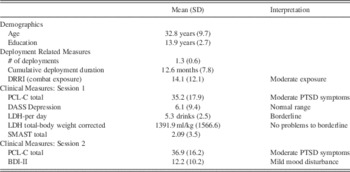
Characterization of the 37 participants is shown in Table 2.
Characterization of the current OEF/OIF Veteran sample

Note. DRRI=Deployment Risk and Resilience Inventory; PCL-C=Posttraumatic Stress Disorder Checklist-Civilian version; DASS=Depression Anxiety Stress Scale; LDH=Life-time Drinking History; SMAST=Short Michigan Alcohol Screening Test; BDI-II=Beck Depression Inventory II.
All were male and 1 participant was African American, 4 were Hispanic, 30 were Caucasian, and 2 participants did not report ethnicity. At the TRACTS baseline assessment 18 of the 37 participants had a PTSD diagnosis based on the Clinician Administered PTSD Scale and endorsed an average of 5.61±3.08 lifetime traumatic events on the Traumatic Life Experiences Questionnaire (Kubany et al., Reference Kubany, Haynes, Leisen, Owens, Kaplan, Watson and Burns2000), with 30 participants reporting trauma that was deployment-related. Of these, seven participants exclusively had military trauma. Only three participants had major depressive disorder according to the structured clinical interview for DSM-IV (SCID). According to the BAT-L, eight participants reported an mTBI during deployment, with all reporting altered mental status. Three participants with a deployment-related mTBI reported loss of consciousness of 0.5, 4, and 7.5 min, suggesting relatively mild mTBIs. Drinking behavior is reported in Table 2 and according to the SCID, no participants reported current use of other substances. However, four reported previous dependence on opioids, six reported previous cannabis dependence, two reported previous cocaine dependence, one reported previous methamphetamine dependence, one reported previous polysubstance dependence, and one reported previous dependence on other substances. In terms of prescription medications, 4 reported taking anti-hypertensives, 1 reported taking diabetes medication, 3 reported taking anti-depressants, 3 reported taking sedative/hypnotics, and 10 reported taking pain medication.
Correlations between Measures of Executive Functioning
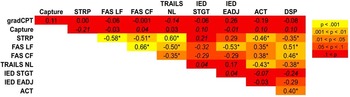
We first assessed how executive function measures correlated with each other. We performed Spearman’s ρ correlations rather than Pearson correlations, as some variables were not normally distributed, although all critical results replicate using Pearson correlations. As seen in Figure 1, Trails NL and Verbal Fluency (tasks simultaneously measuring multiple subdomains of executive functioning) were significantly correlated with Digit Span and ACT (tasks specifically measuring working memory), IED errors adjusted (switching), and Stroop, although they were not correlated with the other measures of inhibitory control (gradCPT, Capture Task). Although working memory tasks were correlated with each other, inhibitory control tasks were not correlated with one another. Because in this population the Stroop task significantly correlated with tasks measuring multiple subdomains of executive functioning as well as with working memory tasks, for the regressions below we group Stroop with the “other” executive functions rather than inhibitory control tasks. Note that all key results replicate when grouping Stroop with the inhibitory control tasks (see Supplementary Materials).
Spearman correlations between measures of executive functioning. Color indicates strength of correlation. Asterisk indicates p<.05. Correlations in the paradoxical direction (enhanced performance on one task correlating with decreased on another) are italicized. As can be seen, measures of response inhibition (gradCPT) and distractor suppression (Capture Task) do not correlate with other executive function tasks or with each other. In contrast, other executive function measures generally correlated with each other and within their subdomains. gradCPT=gradual onset continuous performance task; Capture=Capture Task; STRP=Stroop task; FAS LF=Letter fluency; FAS CF=Category Fluency; Trails NL=Number Letter sequencing; IED STGT=Intra/Extra Dimensional Shift Task stages completed; IED EADJ=Intra/Extra Dimensional Shift Task errors adjusted; ACT=auditory consonant trigrams; DSP=Digit Span.

Is Inhibitory Control More Strongly Associated with PTSD Symptoms Than Other Executive Functions?
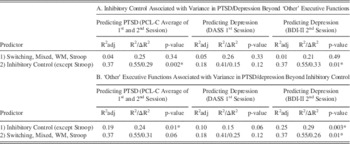
To test our main hypothesis that PTSD symptoms have a unique association with inhibitory control above and beyond the rest of executive functions, we ran hierarchical regressions comparing inhibitory control measures (gradCPT, Capture Task) to the other executive function measures (FAS LF/CF, Trails NL, IED Stages/Errors, ACT, Digit Span, Stroop) (see Table 3). Since PTSD symptoms measured in the two sessions were very similar and highly correlated, for simplicity we averaged the PCL-C scores from the two sessions to create a composite PCL-C. Results showed only subtle differences when using either the first or second session PCL-C score (see supplementary materials).
Hierarchical regression models predicting PTSD/Depression symptoms from measures of inhibitory control and ‘other’ executive functions. Significant models are indicated by *.

We began by entering all executive functions except inhibitory control measures into the model with the composite PCL-C total as the dependent variable. We then entered inhibitory control measures as predictors. The results demonstrate that executive functions without inhibitory control were not associated with a significant amount of variance in PCL-C (R2=.253, adjusted R2=.039; p=.343). Adding inhibitory control measures explained a significant amount of the remaining variance in PCL-C that was not explained by the other executive functions (R2=.546, adjusted R2=.372, R2 change=.293; p=.002). These results demonstrate that inhibitory control measures explain significant variance in PTSD symptoms above and beyond the other executive function measures, while other executive measures alone do not explain significant variance in PTSD severity.
We next ran the reverse analyses to determine whether the “other” executive functions are associated with variance in PTSD symptoms above and beyond inhibitory control measures. When inputting inhibitory control measures first and the rest of the executive function measures second, inhibitory control explained significant variance in the composite PCL-C score (R2=.235, adjusted R2=.190; p=.01). Adding the additional executive functions only showed a trend toward explaining a significant amount of the variance in the PCL-C that was not explained by the inhibitory control measures (R2=.546, adjusted R2=.372, R2 change=.311; p=.058). This demonstrates that the “other” executive functions do not significantly explain unique variance in PTSD above and beyond inhibitory control. Rerunning these analyses after removing individuals with mTBI showed nearly identical results. We also repeated these analyses on the separate PCL-C subscales and found very similar results, most likely because the subscales were so highly correlated to each other and the overall PCL-C score (all Spearman’s ρ’s>.71).
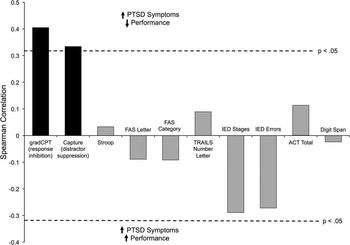
Next, to better characterize the relationship between PTSD symptoms and individual measures, we ran exploratory Spearman correlations (see Figure 2). Only gradCPT and the Capture Task showed an appreciable relationship with PTSD symptoms. It is notable that Stroop interference, although a classic measure of inhibitory control, failed to show a robust relationship with PTSD symptoms. No other executive measures significantly correlated with PCL-C scores. Of interest, the directionality of the correlations between PTSD and task switching (IED completed stage trials and adjusted errors) was not in the predicted direction—those who had fewer errors and completed more stages had more severe PTSD symptoms.
Spearman correlations between performance on executive functioning tasks and PTSD symptoms (PCL-C). The region above the x-axis indicates the expected direction of the correlation and the dotted lines indicate a significance of p<.05 uncorrected for multiple comparisons. Black columns indicate significant correlations. gradCPT=gradual onset continuous performance task; ACT=auditory consonant trigrams. IED = Intra/extradimensional shift task.

Do the Capture Task and GradCPT Independently Explain Variance in PTSD?
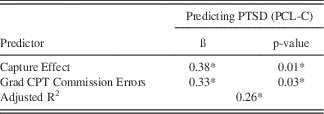
We next ran exploratory regression analyses to examine whether the Capture Task and gradCPT, the two measures that demonstrated strong associations with PTSD symptoms, are associated with unique variance in PTSD symptoms from each other. We expected that because they were not significantly correlated each, they would be associated with independent variance in PTSD symptoms. As seen in Table 4, the linear regression model showed that the Capture Task and gradCPT explained 26% of the variance in PTSD symptoms (using the PCL-C given during the second session rather than composite PCL-C), confidence interval [.03, .49]. Notably, the Capture Task and gradCPT were independently associated with variance in PTSD symptoms, suggesting that these tasks explain unique variance in PTSD.
Multiple regression predicting PTSD from measures of inhibitory control

Note. ß=standardized beta. *p<.05.
Exploratory Associations between Depression and Executive Functions
To better understand the nature of the inhibitory control/PTSD association, we performed exploratory correlations between executive functions and symptoms of depression. Measures of depression performed similarly to PTSD measures (these measures are highly correlated: DASS/first session PCL-C, ρ=.88; BDI/second session PCL-C, ρ=.55), with depression strongly correlating with the Capture Task (ρ=.44; p<.05) and trending significance with gradCPT (ρ=.32; p=.05). Also, there were no significant correlations between depression and Stroop, Digit Span, ACT, Category Fluency, Letter Fluency, or Trails (all p’s >.22). For IED measures, depression showed a trend toward negatively correlating with IED errors (ρ=−.29; p=.09) but not with stages completed (ρ=.12; p=.49). Performing hierarchical regressions with depression symptoms showed similar results to PTSD symptoms, particularly when examining the second session BDI scores, with inhibitory control explaining variance above and beyond “other” executive functions (see Table 3). Also paralleling the results with PTSD symptoms, in a linear regression model explaining depression from both the Capture Task and gradCPT, the Capture Task explained independent variance in depression (standardized ß=.40; p<.01) whereas the gradCPT commission errors showed a trend toward this result (standardized ß=.30; p=.05). Together, gradCPT and Capture Task explained 25% of the variance in depressive symptoms (as compared to 26% in PTSD symptoms).
Exploratory Associations between Mild TBI/Drinking/Medications and Executive Functions
We also explored the relationship between mTBI, drinking, medications and executive functions in this population. In contrast to the results with depression, we found no significant relationship between the presence/absence of a deployment TBI and any of the executive function measures (all p’s >.18). This is similar to recent studies of executive function performance in OEF/OIF Veterans by Swick et al. (Reference Swick, Honzel, Larsen, Ashley and Justus2012) and Esterman et al. (Reference Esterman, DeGutis, Mercado, Rosenblatt, Vasterling, Milberg and McGlinchey2013a).
For the drinking variables, we examined LDH total (corrected for body weight), LDH average drinks on a drinking day, and SMAST total. We used these variables instead of current drinking measures because drinking measures were only given during the first testing session and LDH total, LDH average drinks, and SMAST total are more stable over time than variables such as current drinking amount, making them more valid for both testing sessions. Out of these drinking variables, we did find that greater LDH total significantly correlated with the Capture Task (ρ=.41; p=.01) and trended toward a significant association with Digit Span (ρ=.29; p=.08) while the other measures were not significant (all p’s >.10). Importantly, when LDH total and Capture Task were put into a regression predicting PCL-C, both LDH total (standardized ß=.33; p=.03) and the Capture Task (standardized ß=.60; p=.001) explained independent variance, thus LDH total could not account for the observed PTSD/Capture Task relationship. Furthermore, including LDH total as an initial predictor in the hierarchical regression analyses (predicting PCL-C composite from inhibitory control and other executive functions) did not significantly affect the results for either model.
For prescription medications, only pain medications had a sufficient number of subjects to perform statistical analyses (10 taking pain medication, 27 not). Independent t tests demonstrated that those on pain medications showed a trend toward performing worse on IED stages (t(35)=1.88; p=.07), IED errors (t(35)=1.80; p=.08), and having higher PCL-C scores (t(35)=1.90; p=.07). Despite these trends, including pain medication as an initial predictor in the hierarchical regression analyses (predicting PCL-C composite from inhibitory control and other executive functions) did not significantly affect the results for either model.
Discussion
The current results demonstrate that, in a cohort of trauma exposed OEF/OIF Veterans, posttraumatic psychological symptoms are uniquely related to inhibitory control dysfunction rather than general executive dysfunction. Moreover, we found that distinct components of inhibitory control—response inhibition and distractor suppression—were independently associated with stress-related symptoms and together explain 26% of variance in PTSD and 25% of variance in depressive symptoms. This re-affirms that trauma-related psychological symptoms are associated with worse cognitive performance in non-emotional contexts and adds to the growing literature suggesting that inhibitory control is an important mechanism in the development and maintenance of posttraumatic symptomatology.
The present findings challenge the view that increased symptoms of PTSD are associated with generally poorer executive function performance. As seen in Figure 2, none of the executive function tasks beyond the gradCPT and Capture Task demonstrated a negative correlation between performance and PTSD symptom severity. In fact, performance on the IED task showed the opposite trend. As these measures are well validated and have previously demonstrated sufficient sensitivity to executive function deficits, these very low or contradictory correlations are not due to poor psychometrics. These results contrast a recent meta-analysis suggesting that those with a PTSD diagnosis demonstrate poorer performance on Trails B, Digit Span, and the Wisconsin Card Sorting Test (Polak et al., Reference Polak, Witteveen, Reitsma and Olff2012). It could be that one needs to have a clear diagnosis of PTSD rather than simply greater PTSD symptoms (as in the current study) to experience executive dysfunction. Although a possibility, the review by Qureshi and colleagues (Reference Qureshi, Long, Bradshaw, Pyne, Magruder, Kimbrell and Kunik2011) studied patients with PTSD diagnoses using a broader array of tasks than Polak and colleagues and found that the majority of executive function studies (9/16) failed to demonstrate significant differences between those with PTSD diagnoses and trauma-exposed controls. This review, combined with the current results, suggests caution is warranted when claiming that PTSD and greater PTSD symptoms are associated with general executive dysfunction. One likely possibility is that the effect size of PTSD-related deficits in general executive functioning is quite small and variable across studies and may only manifest when taking a meta-analytic approach.
Rather than general executive dysfunction, the current results emphasize the specific association of inhibitory control dysfunction with posttraumatic psychological symptoms (PTSD and depression). The very similar pattern of results for symptoms of PTSD and depression suggest that the inhibitory control associations reflect common posttraumatic psychological distress rather than symptoms unique to PTSD (e.g., re-experiencing) or depression, and may have common underlying neural substrates. Our distractor-suppression results are consistent with other studies showing that individuals with PTSD have difficulties filtering out both threat-related distractors (e.g., Fani et al., Reference Fani, Kitayama, Ashraf, Reed, Afzal, Jawed and Bremner2009; Pineles, Shipherd, Welch, & Yovel, Reference Pineles, Shipherd, Welch and Yovel2007) as well as non-emotional distractors (e.g., Leskin & White, Reference Leskin and White2007). Similarly, they are consistent with a study showing increased attentional capture of non-emotional stimuli in depression (Bredemeier et al., Reference Bredemeier, Berenbaum, Brockmole, Boot, Simons and Most2012). These results suggest that, in those with post-traumatic psychological symptoms, attentional failures in the context of threat-related stimuli may represent an exacerbation of a more general deficit in distractor suppression. Our response inhibition results are also consistent with studies showing that PTSD is associated with failure to inhibit pre-potent responses during not-X CPTs (Vasterling & Verfaellie, Reference Vasterling and Verfaellie2009) and go/no-go tasks (Swick et al., Reference Swick, Honzel, Larsen, Ashley and Justus2012) as well as with studies showing impaired inhibition during CPT performance in depression (e.g., Porter, Gallagher, Thompson, & Young, Reference Porter, Gallagher, Thompson and Young2003). One potential explanation is that inhibiting excessive arousal-related subcortical/limbic activity associated with posttraumatic psychological symptoms may deplete inhibitory control resources, not allowing for them to be engaged as efficiently for other cognitive operations. This is consistent with results showing that those with more severe PTSD symptoms fail to efficiently engage right-lateralized inhibitory control brain regions in the dorsal and ventral attention networks (Falconer et al., Reference Falconer, Bryant, Felmingham, Kemp, Gordon, Peduto and Williams2008; Jovanovic et al., Reference Jovanovic, Ely, Fani, Glover, Gutman, Tone and Ressler2013; Morey, Petty, Cooper, LaBar, & McCarthy, Reference Morey, Petty, Cooper, LaBar and McCarthy2008; Pannu Hayes, LaBar, Petty, McCarthy, & Morey, Reference Pannu Hayes, LaBar, Petty, McCarthy and Morey2009). Together, these results support the theory that deficits in inhibitory control are a core aspect of post-traumatic psychological symptoms (Aupperle et al., Reference Aupperle, Melrose, Stein and Paulus2012). By having less of an ability to stop pre-potent impulses, those with greater symptoms of PTSD and depression may both have difficulty establishing control over the focus of their attention and difficulty disengaging from either salient or trauma-related stimuli.
The current study also suggests that distractor suppression and response inhibition may be dissociable in this population and significantly explain independent aspects of posttraumatic symptomatology. Although studies of healthy controls typically find significant associations between distractor suppression and response inhibition (e.g., Friedman & Miyake, Reference Friedman and Miyake2004, albeit using slightly different tasks), we found a weak, non-significant correlation between these measures in the current population. Although it is unclear why, one possibility is that the Capture Task predominantly measures inhibitory control over external distractors while the gradCPT predominantly measures inhibitory control over internal distractors (that may interfere more with response control settings) and that these mechanisms are dissociable in the current population. Supporting this idea, the Capture Task has been shown to be relatively more stimulus-driven and less influenced by one’s internal goals (Theeuwes, Reference Theeuwes2010). Furthermore, studies using gradCPT and other go/no-go tasks have found that response control errors are associated with mind wandering and increased activity in the default mode network, a network thought to reflect internal mentation and task-unrelated thoughts (e.g., Christoff, Gordon, Smallwood, Smith, & Schooler, Reference Christoff, Gordon, Smallwood, Smith and Schooler2009; Esterman, Noonan, et al. Reference Esterman, Rosenberg and Noonan2013b). Thus, in the current study gradCPT failures may reflect dysfunction of endogenous, or goal-directed attention (mindless responding), while exaggerated attentional capture may reflect dysfunction of exogenous (stimulus-driven) attentional control. This may manifest as the Capture Task and gradCPT reflecting mechanisms specific to particular posttraumatic psychological symptoms. For example, gradCPT dysfunction could be more related to posttraumatic dissociative symptoms, since dissociative symptoms have been linked to mind-wandering, lapses of attention, and failure to maintain goal-directed endogenous attentional control (Bruce, Ray, & Carlson, Reference Bruce, Ray and Carlson2007). On the other hand, attentional capture could be related to hypervigilance, which has been linked to failures to ignore any salient stimuli in the environment, and thus represents dysregulation of exogenous attentional control (Esterman et al., Reference Esterman, DeGutis, Mercado, Rosenblatt, Vasterling, Milberg and McGlinchey2013a). Future studies are necessary to tease apart the unique contribution of distractor suppression and response inhibition to posttraumatic symptomatology.
The association between inhibitory control and post-traumatic psychological symptoms could either be due to pre-trauma factors such as genetic/temperamental vulnerabilities or may be due to posttrauma factors. It may be that compromised inhibitory control pre-trauma makes it more difficult to inhibit intrusive thoughts or flexibly engage with trauma-related stimuli, leading to more severe posttraumatic stress and depressive symptoms. This risk factor perspective is consistent with findings of Gilbertson and colleagues (Reference Gilbertson, Paulus, Williston, Gurvits, Lasko, Pitman and Orr2006) who compared cognitive functioning between twins with and without PTSD and found very similar profiles across a variety of cognitive tasks (see also Parslow & Jorm, Reference Parslow and Jorm2007). Alternatively, PTSD and depressive symptoms may cause inhibitory control deficits. This may be because exposure to trauma could create salient external distractors (trauma-related stimuli) as well as internal distractors (ruminations, trauma-related thoughts), which overwhelm or preoccupy inhibitory control systems. This is consistent with other theories of generalized anxiety disorders, in which inhibitory control deficits are thought to reflect worry preoccupying cognitive processing associated with inhibitory control (Attentional Control Theory; Eysenck, Derakshan, Santos, & Calvo, Reference Eysenck, Derakshan, Santos and Calvo2007).
Although the results of the current study are promising, they have limitations. First, our sample was relatively small which may have limited our power to detect significant associations between PTSD symptoms and executive functioning measures. In addition, we did not use an exhaustive battery of executive functions and did not include higher-level executive measures of reasoning, planning, and abstraction (e.g., Tower of London, Raven’s Progressive Matrices). Another limitation is that we included only combat-exposed, male Veterans and these Veterans may not be representative of the entire deployed Veteran population. Replicating these results in a civilian population with PTSD symptoms, as well as in females, would test the generality of the current findings. Additionally, because of the high correlation between PTSD and depressive symptoms, we could not determine whether the relationship between inhibitory control and PTSD symptoms is independent of depression. Some studies suggest that depression may be related to impaired inhibitory control (Quinn, Harris, & Kemp, Reference Quinn, Harris and Kemp2012) and have found impairments on CPT tasks (Porter et al., Reference Porter, Gallagher, Thompson and Young2003) and attentional capture tasks (Bredemeier et al., Reference Bredemeier, Berenbaum, Brockmole, Boot, Simons and Most2012). In fact, some studies have found no effect of PTSD after controlling for depression (Johnsen, Kanagaratnam, & Asbjørnsen, Reference Johnsen, Kanagaratnam and Asbjørnsen2008). However, other studies that have covaried the effects of depression find that PTSD-related cognitive impairments are preserved (e.g., Brandes et al., Reference Brandes, Ben-Schachar, Gilboa, Bonne, Freedman and Shalev2002). Future studies with larger samples would be useful to determine whether the observed inhibitory control association is specific to PTSD or instead share common mechanisms with depression. A final limitation of the current study is that it lacks a clearly defined group with PTSD diagnosis, which limits generalizability to clinical settings.
The current study examined multiple aspects of executive functioning in a group of trauma-exposed individuals and revealed that inhibitory control, both of visual distractors and prepotent responses, uniquely predicts posttraumatic psychological symptoms. These findings add support to a recent model asserting the importance inhibitory control in the development and maintenance of trauma-related symptoms (Aupperle et al., Reference Aupperle, Melrose, Stein and Paulus2012). These findings help lay the groundwork for further investigations of the mechanisms of cognitive dysfunction in those with posttraumatic psychological symptoms and may help to develop more effective cognitive treatments (e.g., Kuckertz et al., Reference Kuckertz, Amir, Boffa, Warren, Rindt, Norman and McLay2014).
Acknowledgments
This research was supported by the Translational Research Center for TBI and Stress Disorders (TRACTS), a VA Rehabilitation Research and Development Traumatic Brain Injury Center of Excellence (B9254-C) and by Veterans Affairs Career Development Award II’s given to J.D. and M.E. (VA Clinical Science R&D Career Development Award to M.E. 1IK2CX000706-01A2).
CONFLICTS OF INTEREST
None of the authors have conflicts of interest.
Author Contributions
J.D. developed the study concept. J.D., M.E., W.M., and R.M. contributed to the study design. Testing and data collection were performed by A.R. B.M. performed the data analysis and interpretation under the supervision of J.D. J.D. drafted the paper with contributions from B.M. and M.E. W.M., R.M., and A.R. provided critical revisions.
Supplementary Material
To view supplementary material for this article, please visit http://dx.doi.org/10.1017/S1355617715000235