Since its first description in 1976,Reference King, Thompson, Steiner and Mills 1 percutaneous atrial septal defect occlusion has emerged to the preferred treatment option for patients with an atrium secundum defect in many centres.Reference Fischer, Stieh, Uebing, Hoffmann, Morf and Kramer 2 – Reference Masura, Gavora and Podnar 4 Although occluders with different designs had been successfully used in the past,Reference Eicken, Witsenburg and Sebening 5 the most widely used occluders at present are the meshed nitinol double-umbrella devices. In the rare case of occluder embolisation, which occurs in about 0.55–1.5% of the cases, device retrieval by catheter interventional means is usually successful.Reference Levi and Moore 6 – Reference Haas, Soetemann and Ates 9 If an Amplatzer Septal Occluder (St. Jude Medical Inc., St. Paul, Minnesota, United States of America) embolises, the most widely used technique for retrieval is to catch the right atrial pin with a snare and thus retrieve the device into a large long sheath (12 or 14 F). Indeed, results from a study dedicated to the retrieval of this device indicate that this is a very useful and successful technique to avoid cardiac surgery.Reference Levi and Moore 6 However, our clinical experience and a recent publicationReference Shebani, Rehman and Taliotis 10 showed that retrieval of an Occlutech Figulla Flex device (Occlutech International AB, Helsingborg, Sweden) with a snare may be very difficult, cumbersome, or even impossible. In this study, we reviewed our experience with embolised atrial septal defect devices focussing on cases with the Occlutech umbrella. Furthermore, in benchside tests and in animal experiments, we developed and tested a strategy for retrieving atrial septal defect occluders.
Materials and methods
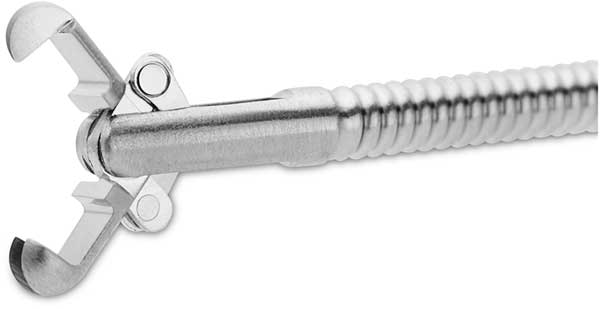
We identified all patients with embolised atrial septal defect devices at our centre since the beginning of interventional atrial septal defect occlusion in 1996. The type and size of the occluders and the methods and techniques for retrieval were assessed. The cases in which Occlutech occluders embolised were reviewed in detail with focus on the attempted techniques for removal of the device. This led to the hypothesis that, in contrast to embolised Amplatzer septal occluder, large Occlutech occluders (>16 mm) cannot be withdrawn into a large sheath (12 or 14 F) using a snare. This was tested on the benchside, and alternative techniques for interventional retrieval using a commercially available biopsy forceps – Maslanka® (H.+H. Maslanka, Tutlingen, Germany) (Fig 1) – were developed.
Maslanka biopsy forceps.

Animal model
The animal experiments were performed after approval of the university animal care committee and the federal authorities for animal research in Munich, Germany, and in accordance with the guidelines of the German and European societies of laboratory animal sciences.
Two male pigs of the German Landrace, both weighing 40 kg, were sedated with continuous intravenous Propofol infusion using an ear venous access. In addition, analgesia was provided with bolus doses of Fentanyl. The animals were intubated and put on positive pressure ventilation during the procedure.
Vascular access was obtained using surgical preparation of the right femoral vein and artery, puncture of the vessels under direct vision, and insertion of 16-F sheaths. After performing a right ventricular angiography to visualise the cardiac anatomy, atrial septal defect occlusion devices of different sizes were embolised purposefully into the right atrium. Subsequently, attempts to retrieve the occluders using different methods were made – first with a goose-neck snare technique (10 mm snare, Fisherman; Med-Zenith, Beijing, China) and then using the Maslanka biopsy forceps or a combination of both methods. After performing the tests, the animals were euthanised.
Interventional atrial septal defect closure
Interventional atrial septal defect closure was performed under general anaesthesia or conscious sedation, under transoesophageal echocardiographic guidance in all patients. After venous access in the groin was achieved, the defect was balloon sized with an adequate 24 or 34-mm Amplatzer sizing balloon (AGA Medical Co, Plymouth, Minnesota, United States of America) using the “stop-flow technique”.Reference Ewert, Berger, Daehnert, Krings, Dittrich and Lange 11 An adequate atrial septal defect occlusion device was chosen equalling the balloon occlusion diameter assessed by transoesophageal echocardiography. After mechanical stability was tested, the devices were released. Before discharge on the following day, transthoracic echocardiography was performed to document correct position of the atrial septal defect occluder.
Results
In the period between 01.1996 and 05.2017, 1449 interventional atrial septal defect closures were performed at our centre. The procedure was complicated by device embolisation in 11 patients, which accounts for an embolisation ratio of 0.8%. The embolisation ratio of the Amplatzer septal occluders was 0.6% – five embolised out of 787 implanted occluders – and the embolisation ratio of the Occlutech devices was 2.7% – four embolised out of 150 implanted occluders. In one patient, interventional retrieval was not attempted because an Amplatzer septal occluder embolised into the left ventricular outflow tract and immediate surgical removal of the device was performed. In all other patients, interventional removal of the embolised devices was scheduled. Details about the device types, sizes, and retrieval techniques/retrieval success are presented in the Table 1.
Cases with embolised Occlutech devices
Case 1
In an 18-year-old patient, weighing 78 kg, an atrial septal defect with a native diameter of 14 mm and a balloon occlusion diameter of 15 mm was closed with a 15-mm Occlutech Figulla flex II device. The routine echocardiographic examination on the next day revealed that the occluder had embolised into the transverse aortic arch. The patient was asymptomatic. Through a femoral arterial access, the right atrial pin of the occluder was snared with a 10-mm snare (PFM Medical, Nonnweiler, Germany) and retrieved into a 12-F sheath. The defect was then uneventfully closed with an 18-mm Figulla flex device.
Case 2
An 8-year-old girl weighing 38 kg underwent catheterisation for interventional closure of an atrial septal defect with an insufficient aortic rim and a balloon occlusion diameter of 10 mm. Immediately after release, the 10-mm Figulla flex II device embolised into the aorta. The femoral artery was cannulated and the device was snared with a 10-mm snare at the right atrial pin and removed through a 10-F sheath. The patient was scheduled for surgical closure of the defect.
Case 3
A 25-year-old woman weighing 59 kg was diagnosed with a native atrial septal defect diameter of 27 mm on transoesophageal echocardiography, a balloon occlusion diameter of 29 mm, and sufficient rims for interventional closure. Implantation of a 28-mm Occlutech device was attempted. However, immediately after release, the occluder dislocated and embolised into the left atrium. The right atrial pin was snared succesfully with a 10-mm snare, but the device could not be withdrawn into the 12-F delivery sheath neither in this position nor in the right atrium to which it moved easily after being snared. During the attempts to withdraw the occluder into the sheath, it embolised again and migrated to the pulmonary artery. Then, an 18-F sheath (Cook Inc., Bloomingdon, Indiana, United States of America) was introduced into the groin through the femoral vein. Through this sheath, the proximal pin of the occluder was snared with a 10-mm PFM snare in the pulmonary artery, and it was possible to remove the occluder from the pulmonary artery into the inferior caval vein. However, once retrieval into the 18-F sheath was intended, and this was done repeatedly, the snare slipped off the proximal pin of the Occlutech device. The patient underwent surgical removal of the device and patch closure of the atrial septal defect and recovered uneventfully.
Case 4
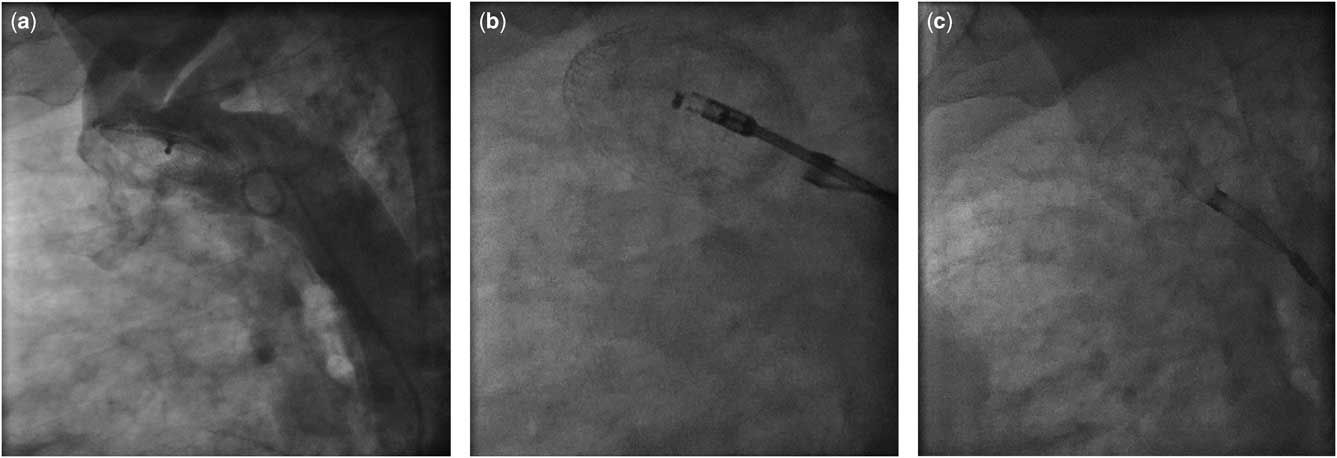
A 67-year-old man weighing 94 kg had a native atrial septal defect of 22 mm with a balloon occlusion diameter of 25 mm. He underwent interventional closure with a 24-mm Occlutech device. The routine echocardiographic examination of the asymptomatic patient the day after implantation showed device embolisation into the aortic arch. In a benchside test, immediately before repeated catheterisation for interventional retrieval, attempts to withdraw a 24-mm Occlutech device into an 18-F sheath with different-sized snares (PFM and Fischerman 5–20 mm) was unsuccessful. Regardless of the diameter of the snare loop, it always slipped off the “right atrial” pin of the occluder, once retrieval into the sheath was intended. Consequently, this removal technique was not used. The embolised device was situated in the transverse aortic arch in a way that the “right atrial pin” pointed downwards to the descending aorta. After femoral arterial access was achieved, an angulated long 12-F sheath (Cook Inc.) was advanced into the proximity of the embolised occluder. The stiff end of a 0.035 ‘Amplatzer Super Stiff guide’ (SJM Inc., St. Paul, Minnesota, United States of America) wire was bent in a way to help guide the sheath closely to the right atrial pin of the Occlutech umbrella. The pin of the occluder could then be caught with the original delivery forceps of an Occlutech occluder and the device was safely and easily withdrawn into the sheath (Fig 2). The defect was then closed with a 30-mm Amplatzer septal occluder.
A 24 mm Occlutech device embolised into the transverse aortic arch (a). After bending the stiff end of a wire to direct the long sheath to the device, it was possible to catch the pin with the original delivery forceps (b) and retrieve the occluder (c).

Benchside tests
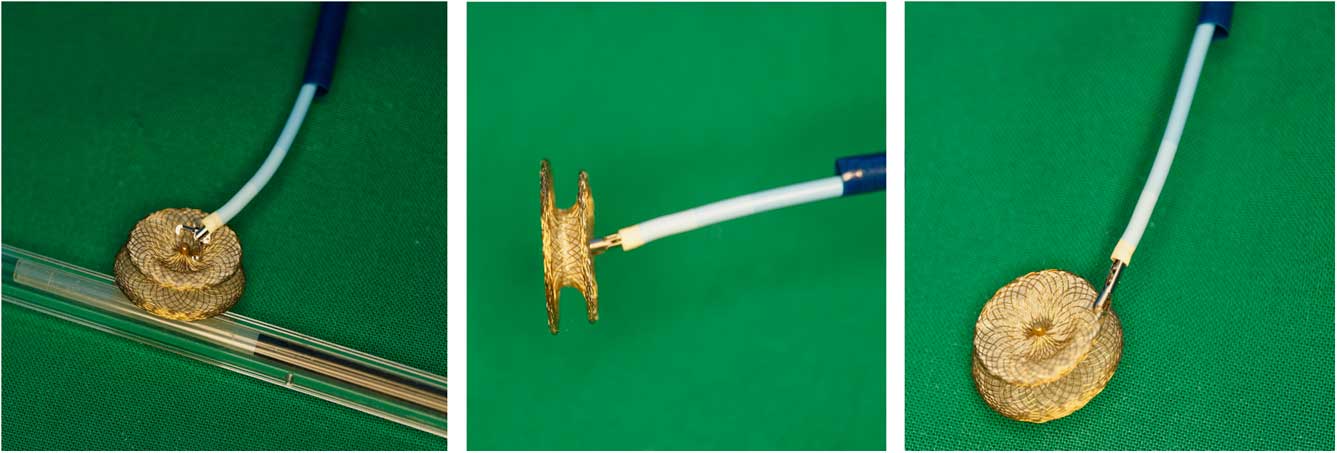
The feasibility of retrieval of different Occlutech and Ceraflex occuders (Lifetech Scientific Co, Shenzhen, China) using snare techniques was tested on the benchside. Using a 12-F sheath (Fisherman) through the 16-F sheath in the groin of the animal and a 10-mm snare (Fishermann), this was possible in Occlutech and Ceraflex umbrellas without significant problems in devices up to 16 mm. Devices larger than 16 mm could not be withdrawn into large sheaths using snare techniques on the benchside, even when using an 18-F sheath. The occluders could be snared at the “right atrial pin” without problems; however, the grip of the snare was not strong enough to pull the device into the sheath and slipped off the right atrial pin. With the Maslanka forceps, catching the devices at or near the right atrial pin and withdrawing them into large sheaths was successful (Fig 3).
Catching atrial septal defect devices with the Maslanka forceps in benchside tests. Retrieval into a 12-F sheath was possible even if the device was not caught centrally at the right atrial pin.

Animal experiments
Four purposeful device embolisations, followed by different retrieval attempts, were performed.
A 10-mm Ceraflex device, which was released into the left atrium, embolised into the aorta. The right atrial pin of the occluder was snared with a 10-mm Fisherman snare catheter and withdrawn without difficulties into a 10-F sheath. After this, the device was again embolised, this time into the right atrium from where it migrated to the pulmonary artery. Retrieval with the above-mentioned snare was not successful. Using the Maslanka biopsy forceps, introduced through a 7-F guiding catheter, it was possible to catch the device at the lateral edge and retrieve it into a 10-F short sheath in the groin of the animal. In a patient, it would have been more adequate to position a 10-F long sheath in the pulmonary artery before retrieval, to avoid possible damage to the pulmonary and tricuspid valves.
A 16-mm Ceraflex device was embolised into the right atrium. The right atrial pin was snared with a 10-mm snare and the device was then retrieved without problems into a 12-F sheath.
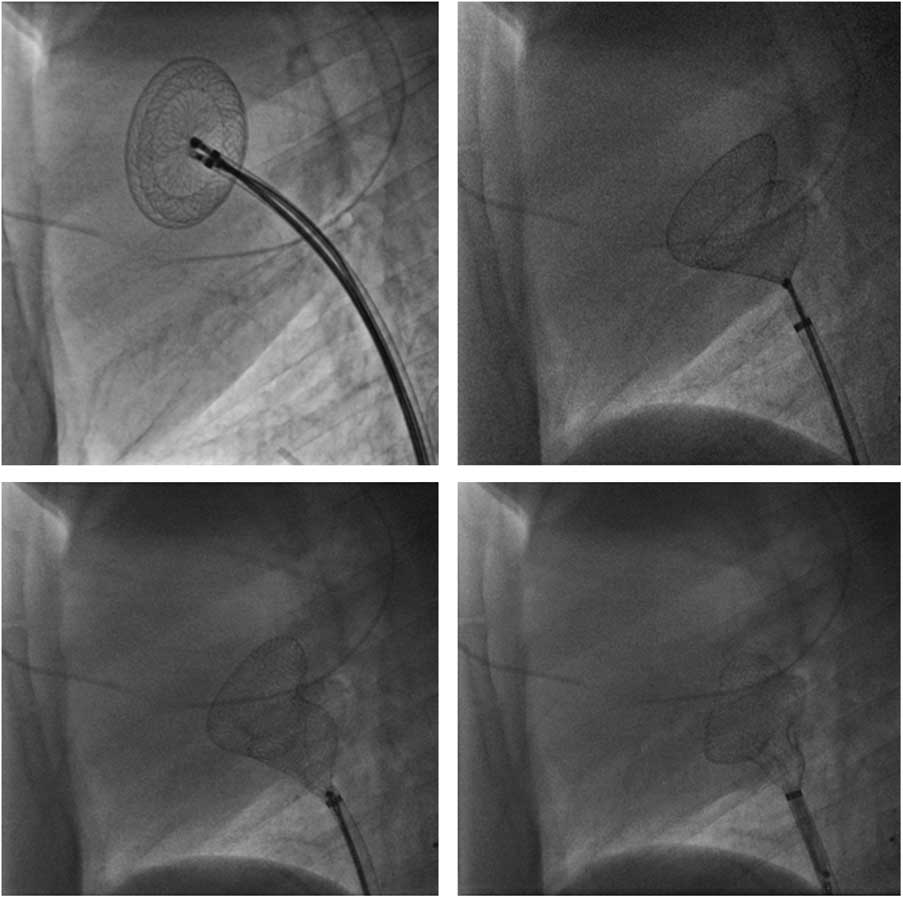
A 30-mm Ceraflex device was embolised into the right ventricle. In this position, all attempts to withdraw the occluder with a snare or with the Maslanka forceps into a 12-F sheath were unsuccessful. The device was then grasped with a 5.5-F myocardial biopsy forceps (Cordis Corp., Miami Lakes, Florida, United States of America), which had been advanced through a 7-F right coronary guiding catheter and was then pulled into the right atrium. Stabilising it that way, it was possible to catch it with the Maslanka biopsy forceps near the right atrial pin stable enough to retrieve it into a 12-F sheath (Fig 4).
Retrieval of a 30 mm Ceraflex occluder from the right atrium using the Maslanka forceps. The device is first stabilised by a standard biopsy forceps introduced through the same long sheath. This made catching the occluder tightly with the Maslanka forceps and thus retrieved into a 12-F sheath.

A 40-mm Occlutech device was embolised into the right ventricle. Again, using the Maslanka forceps only, it was not possible to catch the device firmly enough. Using the same technique, as described above with the 30-mm occluder, the device could be retrieved in the same way.
Discussion
This study confirms the difficulties encountered during retrieval of embolised Occlutech atrial septal defect occluders using a snare technique, which is an established procedure to remove an embolised Amplatzer septal occluder. It presents a new technique for retrieval of such devices, which proved to be effective on the benchside and in animal tests.
Interventional closure of secundum atrial septal defects has proven to be safe and effective and currently is one of the most frequently performed catheter interventions in children and adults with CHD.Reference Majunke, Bialkowski and Wilson 7 Complications of this treatment are rare and include infections, arrhythmia, thromboembolic events, nickel allergy, erosion, and, last not least, device embolisation.Reference DiBardino, McElhinney, Aditya and Mayer 8 , Reference Chessa, Carminati and Butera 12 , Reference Moore, Hegde and El-Said 13 In case of embolisation, the first task is to bring the device into a position where it does not acutely harm the patient and then to retrieve it out of the body with interventional techniques if possible. A study from 2004Reference Levi and Moore 6 and numerous case reports focussed on atrial septal defect device embolisationsReference Goel, Kapoor, Batra and Khanna 14 – Reference Katta, Gautam and Webel 17 describe cases with the Amplatzer septal occluder. The most common and recommended technique is to catch the right atrial pin with a snare and thus withdraw the device into a large sheath. Our experience confirms that this is a feasible strategy in the majority of patients with embolised Amplatzer septal occuder. All embolised Amplatzer devices, in which retrieval was attempted in our experience, could successfully be removed with this technique without harming the patients. In one case the occluder had embolised into the left ventricular outflow tract, and as the patient was haemodynamically stable we chose not to manipulate the device and referred him directly to surgery on the same day. There is one report of a successful interventional removal of an embolised atrial septal defect occluder from the left ventricular outflow tract.Reference Loh, Satler and Slack 15
In the past years, alternative double-umbrella nitinol devices have been developed – the Occlutech Figulla flex II and the Ceraflex device. Until recently, reports about interventional retrieval of these occluders were lacking or were limited to case reports.Reference Sadiq, Ur Rehman and Mehmood 18 , Reference Pac, Polat, Cetin, Oflaz and Balli 19 In our clinical experience, retrieval of an Occlutech device with a snare was only possible in smaller occluders (<16 mm). In the other two patients with larger occluders, this technique could not be used successfully, because the snare did not have enough grip to hold the device during withdrawal into the sheath. Snares with different loop sizes slipped off the right atrial pin, even if 18-F sheaths were used. The benchside tests, which we performed with different sizes of devices, only confirmed this issue: retrieval of devices larger than 16 mm with a snare was not possible. According to the literature, the use of a biopsy forceps for the retrieval of atrial septal defect occluders was limited to pulling devices into the inferior caval vein and assisting stable snaring. Bioptomes were not effective for retrieval of devices when used alone.Reference Levi and Moore 6 We chose the Maslanka biopsy forceps because of the massive jaws with strong grasping force. Indeed, on the benchside, it was possible to withdraw also larger devices into a 12-F sheath when using this bioptome. Interestingly, it was enough to grasp the device near the pin and not necessarily on it. This concept proved to be successful in the animal tests. Retrieval of Occlutech and Ceraflex atrial septal defect occluders with a snare was feasible only if they were smaller than 16 mm. The interventional removal of 30 and 40-mm atrial septal defect occluders was achieved with the new technique using the bioptome. Stabilising the embolised device with another bioptome through the same long sheath proved to be useful for grasping these large devices. A study reporting the experience on 12 patients from six centres with 13 embolised Occlutech devices was recently published.Reference Shebani, Rehman and Taliotis 10 The authors described similar difficulties in snaring the right atrial pin firmly enough to be able to retrieve the device.
Another successful option to remove an embolised Occlutech device described in this series is to reconnect the occluder to the original delivery forceps. We used this technique in one of our patients. However, it may be extremely cumbersome to align the device exactly in a way to be able to catch the right atrial pin, as steering possibilities of the original forceps are very limited. An alternative strategy for retrieval of such devices could be the use of a strong bioptome, which proved to be effective in benchside and animal tests in our study. Using a bent stiff end of a wire for forming the long sheath, a technique we used in case 4, or alternatively a steerable sheath, could be helpful for guiding the bioptome towards the embolised device.
The main and, in our opinion, most important difference of the Occlutech and Ceraflex devices, compared with the Amplatzer septal occluder, is the flexible connection between the delivery cable and the device. This makes deployment easier, potentially safer, and possibly more complex atrial septal defects may be amenable for interventional closure with these umbrellas.Reference Haas, Happel and Soetemann 20 Good results with both devices on large groups of patients have been published.Reference Haas, Soetemann and Ates 9 , Reference Astarcioglu, Kalcik and Sen 21 Difficulties or even inability to retrieve them in case of embolisation may be an important drawback for their clinical application. Our study adds information on how to deal with this complication.
We observed a device embolisation rate of 0.8% of the cases in a relatively large number of patients after interventional atrial septal defect occusion. The reported embolisation rate in other studies is comparable – 0.55–1.5%.Reference Levi and Moore 6 – Reference Haas, Soetemann and Ates 9 This confirms that atrial septal defect closure is a safe procedure, at least regarding one of the possible complications – device embolisation. We observed higher embolisation rates with the Occlutech occluders compared with the Amplatzer septal occluders. A possible explanation could be that because of the design of the newly developed occluders with the flexible connection between the delivery cable and the device, we tend to use these devices in anatomically more complex atrial septal defects. The largest series published until now with the Occlutech occludersReference Haas, Soetemann and Ates 9 reports 20 embolisations out of 1315 implanted devices (embolisation ratio of 1.5%) and recommend using balloon sizing for the prevention of this complication.
Limitations
This study has some limitations. As device embolisation is a rare event, the conclusions about the feasibility of device retrieval were based on observations in only a few patients. Our strategy for device retrieval was tested on the benchside and in vivo in animal experiments; however, so far we have not retrieved an atrial septal defect device in humans with the Maslanka bioptome. However, we successfully retrieved an Amplatzer duct occluder I through the femoral vein from a 5-kg patient with this technique recently.
Conclusions
Device embolisation after interventional atrial septal defect closure is rare, and most embolised devices can be retrieved by snaring. Occlutech and Ceraflex devices larger than 16 mm cannot be withdrawn into a large sheath with a snare in patients and on the benchside. Retrieval of Occlutech devices with the original delivery forceps may be possible, but this is technically challenging. Retrieval of Occlutech and Ceraflex devices of all sizes was possible on the benchside and in animal experiments with the use of the Maslanka biopsy forceps.
Financial Support
This research received no specific grant from any funding agency, commercial, or not-for-profit sectors.
Conflicts of Interest
A.E. is proctor for the Melody Valve and P.E. is proctor for the Melody and the Sapien XT valve. The other authors have no potential conflicts of interest.
Ethical Standards
The animal experiments were performed after approval of the university animal care committee and the federal authorities for animal research in Munich, Germany, and in accordance with the guidelines of the German and European societies of laboratory animal sciences.
Acknowledgement
None.