

1. Introduction
“An investment in knowledge pays the best interest”
Benjamin Franklin, US author and politician (1706–1790)
1.1 The origins of this paper began with the establishment of a working party to give an investment perspective on the pros and cons of portfolios utilising derivative instruments alongside cash-based instruments (i.e. traditional physical investments in equity and bond markets). As this work progressed it became clear that such a discussion would be given better context by exploring the general rationale behind using derivatives in a multi-assetFootnote 1 investment strategy.
1.2 Investment diversification, its benefits and the challenges in finding strategies that can provide such attributes, is in itself a topic that one paper could barely do justice to. The Global Financial Crisis in 2008 highlighted the volatile nature of inter asset correlation with conventional multi-asset portfolios displaying significantly less diversification benefits than had been expected or modelled. In this paper we describe a quantitative methodology in the form of principal components analysis that seeks to provide an objective assessment of the diversification potential of any asset class or portfolio. This statistical work focuses on understanding ‘true’ diversification within any one portfolio with a natural linkage thereafter to systemic risk within the financial markets. I believe that the actuarial profession, with a growing reputation in risk management, has the potential to add much in this important field of study.
1.3 The use of investment derivatives in pension schemes, life and general insurance has increased markedly in recent years. This has been most evident to the actuarial profession in issues such as
– asset-liability risk management, LDI for pension schemes in particular
– pooled investment products with guarantees and/or policy options that use both physical and derivative-based strategies
1.4 Such increased usage has led to more work on understanding the risks of using derivatives instruments. This is especially understandable in times where the widespread use of derivatives is seen by some as a prime cause of recent financial crises. Indeed many potential pension scheme investors (and some of their advisors) are openly hostile to using any strategies encompassing derivatives since that makes the investment proposition ‘too risky’.
1.5 Therefore the aim for of this paper is to present a more balanced view for the active use of mainstream derivative contracts within multi-asset portfolios, a core feature of which is the need to build portfolios with significantly more diversification benefits than traditional multi-asset portfolios. The background of the author (and of the working group) is as a market practitioner so the paper will be of most benefit to those who already have some knowledge of the main derivative instruments used in the market.
1.6 We assume that most actuaries will be primarily familiar with derivative instruments in relation to asset-liability issues. Without loss of generality it can be stated that from a fund management perspective the core investment challenge is to construct a well diversified portfolio of investment strategies to provide a positive (e.g. Cash + x%) return on a portfolio for a given level of investment risk (as measured by volatility, VAR or other quantitative risk measure). Use of instruments such as interest and inflation swaps can then transform the investment return (Cash + x%) to one more relevant to any given liability set (liabilities + x%)Footnote 2.
1.7 The paper focuses on the management of general market exposures rather than investments in specific securities or issuers. For multi-asset investment strategies, this is where the majority of investment risk lies for the investorFootnote 3. In managing these market exposures we compare and contrast a variety of ways for implementing a specific investment decision, say ‘reduce my equity exposure’. While the range of investment derivatives permits the development of very sophisticated and complex investment strategies, we will concentrate on the mainstream use of the core investment derivatives that we would expect any major institutional investor would consider in managing market exposures for the longer term.
1.8 Risk management techniques appropriate to cover portfolios containing both physical and derivative instruments can and do fill several books. This paper focuses on the quantitative investment risks inherent in such strategies (with appendices giving an overview of the broader risk management framework that is necessary for the industrial usage of derivative instruments in day-to-day investment management).
1.9 We discuss a methodology of assessing the portfolio risk of assets that are both physical and derivative-based - stand alone investment risk. This approach has the advantage of it being able to compare traditional asset allocation models with more modern multi-asset investment approaches.
1.10 We conclude by looking at the necessity to build a comprehensive quantitative risk palette to address the deficiencies that any one risk model will exhibit, no matter how sophisticated.
2. Investment diversification – measurement and potential sources
“If you can't measure it, you can't manage it”
Peter Drucker, management consultant, educator and author
2.1 The breadth of derivative technology has increased markedly in recent years. Products such as Exchange Traded Funds have broadened investors’ access to asset classes (such as commodities) historically only available to the select few. Such a wave of ‘new’ monies has affected the behaviour of asset classes as well. For example, in the equity bear market (also known as ‘the Tech wreck’) at the start of the 21st century commodity investment acted as a good diversifier to equities. However, in the equity market falls of 2008 and subsequent behaviour, commodities have performed more in line with traditional risk markets. The increased correlation of risky asset classes to global equities since 2008 is shown in Figure 1.
Average correlation of asset classes to global equities pre and post the Global Financial Crisis
Source: IPD UK Monthly Property Index, All Property; Federal Reserve Trade-Weighted Exchange Value of US Dollar vs 6 Countries; Dow Jones UBS – Commodity Index; Barclays Capital Global Corporate Index, Excess Returns; Barclays Capital Emerging Markets Index, Excess Returns; Barclays Capital US High Yield Index, Excess Returns; Standard Life Investments, 31 December 2011

2.2 Post the financial crisis there has been a growing level of work being done on developing measures that seek to highlight the level of systemic risk in the financial framework. “Principal components as a measure of systemic risk” by Kritzman et al. (Reference Kritzman, Li, Page and Rigobon2010) gives an excellent overview of different approaches already in use.
2.3 Work to date has looked at:
– assessing conditional (stress) correlations
– diversification dynamics in ‘good’ and ‘bad’ markets
– using principal components analysis to derive metrics (such as the Absorption Ratio) to assess how much market variation can be explained by a set number of factors
2.4 We provide a summary of work done by Kritzman et al. (Reference Kritzman, Li, Page and Rigobon2010) regarding principal component analysis before introducing some analysis based on ‘effective number of assets’ (or effective factors) work done by Fleming & Kroeske (Reference Fleming and Kroeske2011). A paper detailing this effective factor analysis should be published in 2013 for the interested reader (This paper is now available at http://papers.ssrn.com/sol3/papers.cfm?abstract_id=2260410. “An Information-Theoretic Approach to Dimension Reduction of Financial Data”). Use of Kritzman's Absorption Ratio for the analysis that follows, given the same input criteria, yields similar results and the intention for the basis of this paper is to highlight diversification deficiencies in traditional multi-asset designs rather than actively promote the effective factors’ methodology. That said, the actuary's skill set in marrying mathematical output to real world applications should place the profession in an ideal place to do further work on this field of study should it desire.
Principal components analysis
2.5 Principal components analysis (PCA) is a procedure to generate a set of linearly uncorrelated factors (eigenvectors) that represent a set of observations of possibly correlated variables (e.g. stocks in an equity index or asset classes in a multi-asset portfolio). Each eigenvector has an associated eigenvalue that demonstrates the relative importance of each eigenvector. PCA always produces as many eigenvalues as there are time series. However, the magnitude of the eigenvalues (when ordered from large to small) decays quickly. In some cases it is possible to associate these eigenvectors with observable measures such as equity and bond markets for a multi-asset portfolio.
2.6 The goal of principal component analysis is to better understand the structure and sophistication of correlations within the underlying data. There are several ways of measuring the concentration of eigenvalues available in published literature. These include:
(a) Absorption Ratio
(b) Herfindahl-Hirschman index (HHI)
(c) Gini coefficient
2.7 Kritzman's Absorption Ratio is defined as the fraction of the total variance of a set of assets explained or absorbed by a finite set of eigenvectors. A high value simply means that most of the variance of the data can be explained by the set number of eigenvectors. A high value for the absorption ratio corresponds to a high level of systemic risk, because it implies the sources of risk are more unified. A low absorption ratio indicates less systemic risk, because it implies the sources of risk are more disparate. Kritzman's paper then demonstrates the ability of this measure to capture market fragility.
2.8 The Absorption Ratio statistic is dependent upon the (somewhat arbitrary) selection of the number of eigenvectors to use for the analysis. Fleming & Kroeske (Reference Fleming and Kroeske2011) have further developed this work and have utilised entropy-related methodologies (used widely in physics, information theory, signal processing) to produce mathematically-robust measures that establish what can be broadly interpreted as the number of independent risk factors required to capture the risks of the underlying asset positions without losing information.
2.9 The effective number of assets is a measure that helps understand the diversification within a particular investment portfolio with which we are most familiar. The Diversification Potential highlights the maximum amount of effective assets that any given portfolio universe could have and is independent of any weightings.
2.10 Clearly the two are not the same: investment judgement, expected returns and client preferences will restrict any investment portfolio relative to an unconstrained universe. There is also a natural link between diversification potential and the measurement of systemic risk. While there is no universal measure of systemic risk, it is axiomatic that during periods of significant systemic risk there is a loss of diversification potential across markets.
2.11 We apply this measure to the FTSE 100 stock index and also a typical balanced portfolio to see how the diversification potential varied through the recent financial crisis. We compute the effective number of assets and the diversification potential based on a covariance matrix that is computed using a rolling 1 year window. Moreover, we use exponential weighting with a half life of 56 days. For stocks we compute the effective number of stocks in a capitalisation weighted and equally weighted portfolio. We compute the diversification potential using a rolling optimisation.
2.12 Let us begin by examining the FTSE 100 index. When we think of highly correlated stocks during a crisis we often consider there to be little diversification opportunity between them. The universe of stocks behaves as a single stock. In contrast to this we believe there is greater dispersion in stock returns during times of relative calm i.e. the number of stocks exhibiting different behaviour is higher.
2.13 The effective number of stocks in the FTSE 100 must therefore lie between one and one hundred. In Figure 2 we show the effective number of stocks in the current market capitalization-weighted FTSE 100 over time.
The effective number of stocks in the FTSE 100 index based on current constituents and fixed current market capitalisation weightings Source: Standard Life Investments, Datastream, 31st December 2012
2.14 We can see that the number of effective stocks has varied between four and fourteen. It is interesting to observe a persistent decline in diversification from 2005 to its low in 2011. Also worth noting is that even while stocks have rebounded strongly from 2009 to end 2012 and market volatility has decreased significantly, the diversification has remained persistently lower. This may be an indication of persistent systemic risk. Further work is required to analyse its effectiveness as a ‘sell’ or ‘buy’ indicator.
2.15 Furthermore, the relative importance of the stocks in the analysis does not have to be market capitalization weighted. It is intuitive that an equally-weighted index of stocks is better balanced. We present the results of an equally-weighted index in Figure 3.
Effective number of stocks using equally weighted index and diversification potential Source: Standard Life Investments, Datastream, 31st December 2012
2.16 While we can see that the overall trend is similar to the market-cap weighted results, the effective number of stocks is significantly higher in general with a correspondingly dramatic fall from around thirty five in 2006 to eleven in 2008. We then simply denote the diversification potential as the maximum achievable effective number of stocks for the index on a particular day. We observe an effective number of stocks that is typically around eight greater than the equally weighted index. In practice we have found that this maximum can also almost be achieved by an index which is equally weighted in terms of the risk contribution from each stock.
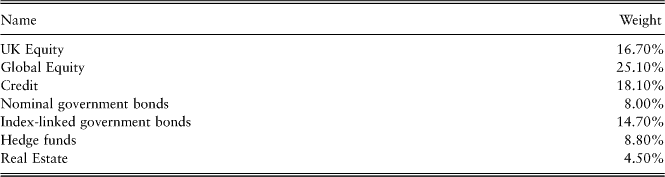
2.17 Finally we examine the diversification in a traditional multi-asset balanced portfolio where the asset allocation is shown in Table 1. If we term each line an asset class then, excluding cash, we have a total of seven asset classes.
Typical asset allocation of a UK pension scheme4

Source: The Purple Book 2011 - DB Pensions Universe Risk Profile 2011
However, we know they are not perfectly uncorrelated so we examine the effective number of asset classes. This is shown in Figure 4.
Effective number of assets and diversification of a UK pension portfolio Source: Standard Life Investments, Bloomberg, 31st December 2012
2.18 We see that from a high of around two and a half the effective number of asset classes declined to around one and a half at the height of the crisis, which is significantly lower than the maximum possible seven. The diversification potential is also plotted taking its highest value of around five and a half at the start of the chosen time period. Similar to the FTSE results, delivering this diversification potential requires a better balance of risk contributions from the various asset classes. The effective number of asset classes in a typical balanced portfolio is low due to the high correlation between the heavily weighted risky asset classes. This means there are limited benefits from diversification. However, addressing this by simply reducing exposure to risky assets (and investing more in lower returning bond assets) impacts long-term expected returns.
2.19 Therefore the investment problem can be summarised as follows:
“How can I build a better diversified investment portfolio but without impacting long term return expectations?”
Using the above analytical framework two key lessons become apparent:
– allow a broader global investment universe with greater granularity to increase the diversification potential. So this can be achieved by allowing managers to exploit views on, for example, currencies, asset classes, sectors, and yield curves across different geographies. A number of these strategies (such as specific currency pairs) will necessitate the use of derivative contracts.
– allow unconstrained dynamic asset allocation which offers access to the full diversification potential of the chosen investment universe
2.20 For those constructing portfolios to meet investment objectives, they must select the investment universe, set investment restrictions and portfolio management freedom, all of which will limit how much of the diversification potential their portfolio will be capable of. The achievable diversification will always be less than the potential of the universe. Understanding the impact of constraints on the ability of a portfolio manager to deliver robust performance and maintain a diversified portfolio during different market regimes should be a key consideration.
Increasing diversification potential for a multi-asset portfolio
2.21 There are numerous investment strategies that can make money over a given time period – however as discussed above many of the traditional strategies used for multi-asset investment exhibit high correlation and therefore have limited diversification benefits. Ideally a portfolio constructor seeks strategies that can not only make money but also offer significant diversification potential within the context of a multi-asset portfolio. Consider the following example as illustrated in Figure 5.
Correlation of a range of investment strategies to global equities Source: Standard Life Investments, APT, July 20125
2.22 Figure 5 shows a range of investment strategies that the fund manager believes can make money over their chosen time horizon of 3 years. The first three strategies; UK equity, high yield credit and Russian equity have high positive correlations to global equity and have little to offer from a diversification perspective. Investments in bond strategies whether emerging market, inflation-linked or corporate bond in nature have much more to offer from a diversification perspective. However the three most diversifying strategies are;
(a) a strategy that makes money if the European interest rate curve steepens
(b) a strategy that makes money if the Dollar strengthens versus the Euro
(c) a strategy that makes money if US large cap equities (as measured by the S&P 500 index) outperforms US smaller cap equities (as measured by the Russell 2000 index)
2.23 Should the fund manager have the necessary investment freedom, investing in these three strategies would provide more diversification potential for a multi-asset portfolio than the first three risky asset strategies and the second three physical bond strategies. To implement these investment strategies necessitates the use of mainstream derivative instruments.
2.24 Therefore to construct a well diversified multi-asset strategy the ability to use derivatives is a prerequisite to both increase the range of money making opportunities available and to find such strategies that exhibit exceptional diversification potential.
2.25 Figure 6 demonstrates how the use of a more unconstrained approach can produce a portfolio that has many more ‘moving parts’ (at worst 7) contributing to its risk positions than a traditional multi-asset portfolio (typically around 2). This is not to say that this portfolio will produce better absolute returns over any time period, but it will in all likelihood provide more consistent return outcomes, and more robustness to unforeseen investment shocks, since its investment risk is more diversely deployed.
Effective number of assets for an unconstrained multi-asset portfolio Source: Standard Life Investments, Bloomberg, 31st December 2012
It is within this framework that it appears investors can achieve a more diversified portfolio which does not compromise on return.
Potential uses of diversification analysis
2.26 The diversification potential of a particular investment universe can be used to estimate, in a statistical way, the maximum number of independent opportunities that are available. It is a more complete and intuitive measure than monitoring, for example, average correlation. For risk and portfolio managers alike such measures offer;
– a way of observing in real time how diversification potential could be deteriorating even when returns and volatility could be moving in a favourable direction
– a way of justifying to what extent you want to use active management within a given asset class.
2.27 In general for all investors it may be an efficient way to track diversification as an indicator of systemic risk. Research into related measures indicates the possibility that such measures could offer profitable trading signals for investment managers.
3. Derivative instruments and market risk management
“Derivatives are nothing more than a set of tools. And just as a saw can build your house, it can cut off your arm if it isn't used properly”
Walter D. Hops, Treasurer, Ciba-Geigy (1994)
3.1 It is not the intention of this paper to go over material on the mechanics of using derivatives and their pricing. This is well covered by J.C. Reference HullHull in “Options, Futures and Other Derivatives”. Likewise the paper does not discuss the issue (though an important topic in itself) of the likely changing collateral treatment of some Over the Counter (OTC) instruments – Appendix 1 provides more information on the core differences between OTC and Exchange Traded Derivatives (ETD).
3.2 This section gives a high level overview of a number of the most liquid and mainstream investment derivative contracts in the market, with the following section then illustrating how these instruments can be used to implement investment views that the fund manager may want in their portfolio.
3.3 Equity index futures
Stock market index futures are futures contracts used to replicate the performance of an underlying stock market index. They can be used for hedging against an existing equity position, or speculating on future movements of the index. Indices for futures include well-established indices such as S&P, FTSE, Eurostoxx and other major country indices.
3.4 Equity index call and put options
Equity options provide the right, but not the obligation, to buy (call) or sell (put) a given market index, at a set price (strike price), within a certain period of time (prior to the expiration date). These allow the implementation of a wider range of investment strategies with a plethora of colourful names and extra dynamics for the investor to use. Such approaches include:
– Collar
– Straddle
– Strangle
– Covered call
– Protective put
– Risk reversal
Whilst the details of each of these approaches is outwith the scope of this paper, the core point is that there is an increased number of ways for the investor to make money in equity markets than being dependent upon the outright direction (long or short).
3.5 Equity index variance swaps
An equity index variance swap is an over-the-counter financial derivative that allows one to manage risks associated with the volatility of some underlying equity index.
One leg of the swap will pay an amount based upon the realised variance (volatility squared) whilst the other leg of the swap will pay a fixed amount, which is the strike, quoted at the deal's inception. Thus the net payoff to the counterparties will be the difference between these two and will be settled in cash at the expiration of the deal, though some cash payments will likely be made along the way by one or the other counterparty to maintain agreed upon margin.
Similar to options above, there is a multitude of literature detailing how these instruments can be used by traders to manage their investment risk of relatively short time horizons. For longer term investors, they can play a useful role in managing volatility in a multi-asset portfolio.
3.6 Gilt futures and total return swaps
A gilt future is an exchange traded derivative that provides a gain or loss equal to the return on specific gilt over a period of up to 12 months, after which the future must be rolled if continued exposure is desired. Being exchange traded has advantages in liquidity, low cost and excellent transparency, but their use for long-term investors is limited by the fact that:
– the longest maturity currently available is 13 years
– no futures exist on index-linked gilts
– only cash collateral is acceptable.
A gilt total return swap is an OTC equivalent to a gilt future, and is available on pretty much any conventional or index-linked gilt. Being over-the-counter, bonds as well as cash are acceptable collateral. As with gilt futures, exposure must be rolled regularly, typically every 12 months (though longer terms are available, at a cost).
3.7 Gilt repo
Gilt repurchase agreements, or “repo”, are an alternative to gilt total return swaps. They provide the same exposure, the return on specific gilt, but within a different legal framework. As with total return swaps they must be rolled regularly to maintain exposure, typically every 3 months or so.
Legally a repo is a simultaneous agreement to sell a gilt and to repurchase it at an agreed price; economically this is effectively just a loan secured against the gilt, with the difference between the sale price and repurchase price representing the interest on the loan. By using repo, an investor can borrow against existing gilt holding to buy additional gilts, and hence leverage their exposure. It is even possible to simultaneously buy a gilt and repo that same gilt, providing exactly the same market exposure as a gilt future or total return swap. Alternatively, existing gilts could be repo'd and the proceeds used to purchase other assets, e.g. equities, thereby providing a leveraged equity exposure.
Repos are not generally traded under an ISDAFootnote 6, but rather under a Global Master Repurchase Agreement (GMRA). Collateralisation provisions are similar, except that typically repo of longer-dated gilts is traded with a “haircut” which means an over-collateralisation in favour of the lender of up to 3% of the amount lent. This haircut protects the lender and hence helps keep interest rates low – indeed, gilt repo is the lowest cost way to fund a leveraged position with sterling repo rates generally close to Bank of England base rates.
3.8 Interest rate and inflation swaps including forward starting and swaptions
An interest rate swap is an over-the-counter derivative involving the exchange of floating rate interest for fixed rate interest, on a given notional sum. The two main types used by long-term investors are par swaps, where fixed and floating interest payments are exchanged regularly over the term of the swap (e.g. 6-monthly for up to 50 years), and zero-coupon where the interest is compounded and a single exchange is made at maturity. An investor receiving fixed will benefit when long-term interest rates fall, and will lose out when long-term interest rates rise.
3.9 An inflation swap is an OTC derivative involving the exchange of a single fixed payment at a given maturity date where one party pays the compounded fixed rate and the other the actual inflation rate (e.g. RPI) for the term (note that more frequent payment contracts exist). More exotic variants such as CPI inflation swaps or LPI swap (linked to a capped RPI) exist, but are rare and costly. An investor holding a pay-fixed inflation swap will benefit when long-term inflation expectations rise, and will lose out when they fall.
3.10 A forward starting swap is a swap agreement created through the synthesis of two swaps differing in duration for the purpose of fulfilling the specific time-frame needs of an investor. For example if an investor wants to buy 2 year interest rates at the level the market expects them to be in 2 years’ time, he can enter into both a 4-year and 2-year swap now to construct that strategy
3.11 A swaption is an option to enter into a swap at a specified date. The exercise date is typically up to 5 years out, with a swap maturity of up to 50 years. Swaptions can be used to provide downside protection against unfavourable interest rate exposure. More generally, multiple swaptions can be combined to provide a customised profile of interest rate exposure, in ways similar to the ways that combinations of equity options can be used.
3.12 Credit Default Swaps and Indices
A credit default swap (CDS) is an agreement whereby one party buys credit protection from the other, on a particular entity on a certain face amount. The protection buyer pays a fixed periodic coupon (premium) for the specified life of the agreement. The protection seller makes no payments unless a specified credit event occurs. The market trades on 2003 ISDA definitions and its many supplements, especially the 2009 Supplement (Big/Small Bang Protocol). This covers such points such as the definition of the credit event to trigger payment.
Credit protection typically applies for 1–10 years with premium paid on a quarterly basis. Premium is often quoted in basis points (0.01%) per annum. If a credit event occurs, the trade terminates and the protection seller buys deliverable obligation at par (or pays cash settlement).
3.13 Compared with holding credit risk in the cash equivalent instrument of corporate bonds, then the following relationships follow:
– buying credit protection via CDS is selling the credit risk to another party, so is similar to selling your corporate bond
– selling credit protection via CDS is buying credit risk of an entity from another party, so is similar to buying the corporate bond of the name involved
3.14 It is no surprise then that the level of credit spread offered by a corporate bond is compared with the level of premium on an equivalent dated CDS contract as a way of deciding how best to implement an investment decision. It is also worth noting that the behaviour of ‘synthetic credit’ versus physical corporate bonds can diverge materially, as was seen in the global financial crisis of 2008.
3.15 A Credit Index default swap is a default swap on an index of 125 names. This is like buying a 125 equally weighted default swaps each on one name and using one confirmation agreement. In order to promote liquidity, index CDS trades at a standard default swap premium (“spread”) and maturity.
For example, buying $10 million notional protection on an index (with 125 names)
– Is like buying $80,000 protection on each of the 125 names
– Pay one premium (calculated on $10 million notional)
– In the event of a default, cash settle the defaulted name ($80,000 notional)
– The protection on the remaining 124 names continues, premium paid on remaining notional ($9,920,000)
The CDS indices typically roll every six months. Names that no longer qualify (ratings changes, lack of liquidity, dealer poll) are excluded while new names are added with liquidity polls for iTraxx (European credit index CDS contracts) and dealer polls for CDX (US credit index CDS contracts).
3.16 FX forwards
A FX forward is an agreement to purchase or sell a set amount of a foreign currency at a specified price for settlement at a predetermined future date, or within a predetermined window of time.
Closed forwards must be settled on a specified date. Open forwards set a window of time during which any portion of the contract can be settled, as long as the entire contract is settled by the end date.
FX forwards are quoted in forward points, or the amount that you would add or subtract to the spot rate to get the forward rate for that period.
FX forwards are determined by “Interest Rate Parity”. An investor cannot earn a return in a foreign currency greater than the interest rate in the domestic currency without accepting exchange rate risk.
Cash flows from FX forwards can be significant. Large cash inflows must be invested while large cash outflows must be funded. Forwards have a termination date and position must be periodically re-established. Being OTC in nature there are counterparty credit risks to be considered as well.
4. Practical implementations for longer term investors
“Derivatives don't kill people, people kill people.”
Clifford W. Smith, Jr., Professor, University of Rochester
4.1 We consider the end investor here to be one that is long a range of market risks with a view of generating a positive return either to cash (charities, endowments) or some pre-defined liabilities (pension schemes and insurance).
Reduce equity exposure
4.2 Here we assume that a portfolio has a long equity exposure but has taken the decision to reduce equity exposure in its belief that returns may not be acceptable for the next couple of years. However, the investor has a strong belief that an increase in equity exposure is likely over the same time period if a market opportunity presents itself.
4.3 A sample of investment options for reflecting the investor's view could be:
4.3.1 Sell physical equities - the most straightforward approach, the market exposure is removed with the investor incurring the transaction costs of selling individual lines of stock. Depending on the market size of the transaction and the liquidity of the stocks there may also be some market impact costs to account for, especially if the speed of the transaction is of greatest importance. This sale generates physical cash which can then be invested elsewhere. Should the investor subsequently decide to reinvest monies in equity, these costs have to be incurred again plus any local taxes (e.g. stamp duty for UK equities). Overall, simple but inefficient.
4.3.2 Sell equity index futures - here equity market exposure can be reduced very quickly for a fraction of the cost of selling physical stock and again this exposure can be rapidly reintroduced. Due to the size of the equity futures markets, the price impact of the transaction is more robust of size of the deal. However, equity index futures may be a poor proxy for the shape of the actual equities you own. Also, there is no physical cash raised to spend elsewhere since you have effectively opened a profit and loss account with this position. Should equity markets rise, your short equity futures position will start losing money with cash having to be made available to make margin payments. Overall, more efficient in immediate management of market exposure but introducing new risks to be managed.
4.3.3 Buy equity index put options – here a premium is paid to only sell the market index should it hit a prescribed level (or strike) over a predefined time period. This is a classic ‘downside protection’ approach where the investor is still long their equity position but protected from sharp market falls through the ability to sell equity index exposure at a given level. This introduces more dynamics for the investor to think through since the day to day option price move will typically not be one-to-one with market movements (due to strike price and the lifetime of the option). Also for the longer term investor, who is only interested in the protection over the option's lifetime, the cost of these options typically increases markedly with equity market uncertainty. Overall, simple and straightforward to implement although benefits may not outweigh costs and pricing dynamics of the option will require additional monitoring.
4.3.4 Sell equity index call options – taking account of the above dynamic in option put pricing, the investor may well decide to sell an equity index call option. In this scenario, the investor receives a premium (being the seller of an option) with an agreement to sell equity market exposure at a given price level above the current price level. Again this strategy has different risk/rewards to consider. In this scenario the investor receives money up front which will offset equity market falls (but only to the degree of the premium received) – however the investor is still long equity exposure up to which point where the market rises above the strike price. In essence the investor is rewarded for the market moving sideways with some downside protection but upside of the long equity exposure capped. Overall, a more complex range of dynamics to consider, albeit one that may be more suitable to the investor's requirement.
4.3.5 Buy equity index variance swaps – the simple rationale for this implementation is that when equity markets fall, the markets’ measurement of risk, implied volatility, tends to rise. In such a situation, a holder of long variance (volatility squared) benefits from this increase and will compensate for losses on equity dependent upon how large a position has been implemented. There are additional degrees of sophistication for the investor to understand and again day-to-day pricing behaviour of the swap needs to be understood. Overall, a strategy that works well in volatility spikes in the market but would not compensate for a gradual decline in equity prices.
4.4 With the wealth of liquid derivative contracts available, there is the ability for the investor to be much more prescriptive in how they want their longer term market exposures managed. Overall, in a world where the investor considers the use of first order vanilla derivative contracts, there is a much richer range of strategies that can be considered for management of equity exposure. With these additional options comes more complexity that requires active investment risk management and monitoring.
Manage credit exposure
4.5 Credit derivatives can provide flexibility in managing credit exposure which are not possible via direct buying and selling the physical credit securities.
4.6 For credit protection buyers who wish to reduce their credit exposure, credit derivatives can be used to:
4.6.1 Hedge credit exposure without transferring assets. This can be accomplished by buying an index credit default swap on a credit market in which the investor invests. This has the advantage of retaining the physical holding of the bonds while also allowing the investor to implement short term hedging strategy without selling the underlying credit.
4.6.2 Short the credit market. This can be accomplished by buying an index credit default swap without holding the underlying bonds. This is typically used to implement the investor's view on, say, a credit downturn.
4.7 For credit protection sellers who wish to gain credit exposure, credit derivatives can be used to:
4.7.1 Take credit exposure to names and maturities that may not be available in the physical market. This is particularly relevant for large scale transactions where there is insufficient supply in the market.
4.7.2 Credit diversification. Addition of credit exposure to specific sectors or issuers can be added to the portfolio by selling credit default swaps.
4.7.3 Leveraged investment. Credit derivatives in an unfunded form allow investor to get credit exposure without providing a full upfront payment. So for example, by holding index credit default swaps over long-dated gilts you get credit exposure for return but also the longer duration that you need to manage the credit risk in your liabilities.
4.7.4 Advantageous pricing. In certain instances, credit derivatives may offer a more beneficial pricing to the investors. However the investor should be aware of the ‘basis risk’ (the difference in credit spreads between the credit derivatives and the underlying holdings) and how this may change over time.
Interest rates and inflation management
4.8 Pension schemes and insurers typically have liabilities that can extend decades into the future and are (for given assumptions on demographics or claims experience) either fixed pound amounts, or know amounts linked to inflation. The present value of these liabilities will therefore increase when long-term interest rates fall or long-term inflation expectations rise, and vice versa.
4.9 If an investor wishes to hedge these risks, and hence reduce his net exposure to interest rates and inflation, he must hold assets that have a similar interest rate and inflation sensitivity to that of the liabilities. In order to hedge accurately, he will wish to take account of the fact that interest rates and inflation expectations may evolve differently at different terms (i.e. the yield curve is not flat, and may change shape).
4.10 If sufficient capital is available, such hedging can be done simply by purchasing gilts in the appropriate proportions. However, even then there are limitations as there is only a finite universe of gilts available, the longest gilt is generally around 50 years, and gilt coupons may in some cases provide more short-dated exposure than is desired. These weaknesses can be addressed to a large extent by using interest rate and inflation swaps to refine the profile of interest rate and inflation exposures. With gilt yields so low, using solely physical bonds will use up significant amounts of capital.
4.11 If sufficient capital is not available, then leverage is required in order to use the available capital as a collateral base and extend exposure to a greater notional. This can be done with gilt futures or total return swaps, gilt repo, interest rate swaps, inflation swaps, etc. The amount of leverage available will depend on duration of the exposure, and the ease or otherwise with which the investor would be able to top up the collateral base if the derivatives move against him and collateral begins to run out.
Currency exposures
4.12 Currency forwards help investors manage the risk inherent in currency markets by predetermining the rate and date on which they will purchase or sell a given amount of foreign exchange.
4.13 To a portfolio constructor, using currency forwards allows the currency decision to be split from the underlying asset decision. So for example, a sterling investor may want to invest in European equities but not want the resulting Euro currency exposure. Using a simple currency forward hedging strategy, this effect can be achieved.
4.14 Additionally given the depth and liquidity of the currency forward markets, there are numerous currency strategies (currency pairs for example) that can be reviewed for their attraction and diversification potential within an unconstrained multi-asset portfolio.
5. Quantitative portfolio risk management
“Uncertainty is the only certainty there is, and knowing how to live with insecurity is the only security”
J. A. Poulos, Professor of Mathematics, Temple University USA
5.1 Investment risk management is a very broad topic when considering an unconstrained multi-asset portfolio that uses derivatives to a significant degree covering not only quantitative risk analysis but much broader issues on counterparty selection, collateral management, regulatory demands etc. Appendix 2 gives more detail on the more practical challenges of managing unconstrained multi-asset portfolios.
5.2 This section of the paper looks at the more quantitative aspects of an asset portfolio that helps give the portfolio constructor some insight into the levels of investment risk that should be in play in searching for investment returns. Although this analysis looks at returns in an absolute context, as discussed in the Introduction, the approach is equally applicable when considering an asset portfolio versus liabilities. The author recognises that this is a very asset-centric perspective of risk and does not look at the risks in respect of liabilities, sponsor's covenant etc.
Risk systems and output interpretation
5.3 Investment risk teams will have access to one or more industry risk systems to ensure a consistent approach can be taken across similar portfolios and that ‘best in class’ systems are be used for specific asset classes. Many risk systems build their return and covariance histories of assets and investment strategies from historic relationships, with different providers offering varying degrees of sophistication in the period of data used and exponentially weighted factors. Suffice to say, irrespective of the elegance of historic analysis, it is still based on history and any output as to ‘future risk’ should be cognisant of this basic truth.
Risk based investing v traditional asset allocation
5.4 In a portfolio that utilises a wide range of investment strategies, devising a risk measurement framework that can be broad enough to capture all investment strategies, whether they are physically invested or implemented via derivatives, is fraught with numerous challenges.
5.5 A traditional way to assess portfolio risk was to assess the asset allocation breakdown of a fund;- whilst this is useful for demonstrating to the investor where monies have been placed, in itself it not a particularly insightful approach in understanding the risk dynamics of the portfolio. Equities have traditionally experienced higher volatility than traditional bond market indices so a ‘balanced’ 50/50 equity/bond portfolio could look from a risk perspective as equity heavy (say 80/20 in terms of risk bias).
5.6 In addition, investment strategies implemented using derivative contracts typically need only a marginal amount of money (initial margin, premium) up front or none at all as currently the case for swaps and currency forwards. So the monies invested hold little information in terms of what the fund is exposed to through the implementation of these contracts. Measuring the economic exposures of all investment strategies gives some additional information as to the overall exposure of the fund, but again little insight from a risk perspective given the likely different risk characteristics of investment strategies in a fund.
5.7 However, by assessing strategies and the overall portfolio from a risk perspective, a more measured and consistent way of understanding risks within a portfolio can be formed irrespective of whether investment strategies are implemented physically or by derivative instruments.
5.8 To demonstrate the robustness of this approach we will illustrate its use with an unconstrained multi-strategy portfolio that uses both traditional physical investments as well as a range of longer term investment strategies implemented by derivative contracts. The multi-asset strategy includes the following range of investment strategies/market exposures:
(a) traditional equity market allocations
(b) corporate bond market investments
(c) an allocation to the global inflation-linked bond markets
(d) a range of specific interest rate strategies
(e) some currency strategies
(f) relative value strategies between specific equity and corporate bond sectors
(g) volatility-based strategies
Ex-ante and ex-post volatility
5.9 The first order of risk for a portfolio of multiple market exposures is its volatility. There are two measures of volatility. Expected volatility, or ex-ante risk, is calculated from current positions and historical data of the strategies in the portfolio (return and co-variance information). Realised volatility, or ex-post-risk, is calculated from the actual fund returns. At best, expected volatility will be a good approximation of future realised volatility. It is good practice to track both measures.
5.10 While it is important to monitor the volatility being realised to check that the diversification benefit assumed by the risk system is actually being realised, it is the ex-ante risk which is more useful in constructing a portfolio. Rather than being reviewed ‘after the event’, it is calculated as part of the portfolio–construction process ahead of new investment strategies being entered into.
5.11 To understand the composition of the overall volatility, we look for ways of decomposing it.
We choose to do this decomposition in terms of the views or strategies that are held in the portfolio at any given time. We start with the expression for the volatility of the fund as a function of these strategies:
 $${{\sigma }_p}\, = \,\sqrt {{\mathop{\sum }\limits_{{i,j}}^{n}} {{w}_i}{{w}_j}{{\sigma }_{ij}}} $$
where n is the number of strategies, ω i is the exposure of strategy i, and σij is the covariance between strategies i and j. For convenience of notation we chose to work in variances, the square of volatility:
 $$\sigma _{p}^{2} \, = \,{\mathop{\sum }\limits_{{i,j}}^{n}} {{w}_i}{{w}_j}{{\sigma }_{ij}}$$
Expanding this expression gives a straightforward, albeit lengthy, summation of terms which are laid out here in a grid: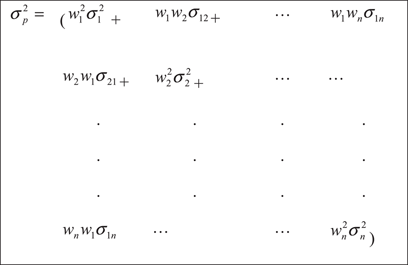 $$$$
For a fund holding 25 investment strategies, there will be 625 terms which sum to the total fund variance. The following sections look at ways of dissecting the grid in order to better understand the risk structure of the fund.
Standalone Risk
5.12 The simplest risk measure is the risk of each strategy in isolation; - the ‘standalone-risk’. It is the risk to the fund if it were to hold this strategy alone, in its current size, with the remainder in cash. So if a 10% UK equity position were held, with the holdings exactly replicating the FTSE All Share, then if the index volatility is 20%, the standalone risk would be 10%*20% = 2%.
In terms of the volatility expression, the standalone risks correspond to the (square root of the) terms down the diagonal of grid: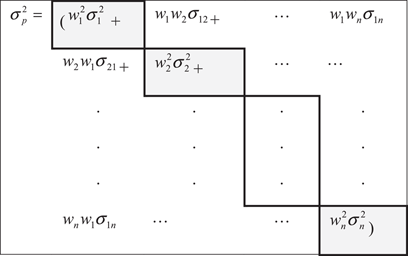 $$$$
i.e. the standalone-risk of strategy i is given by
 $${{S}_i}\, = \,{{w}_i}{{\sigma }_i}$$
We can now apply this measurement metric to the multi-asset portfolio. As a matter of context it should be noted that the unconstrained multi-asset fund has two investments objectives: these are a return and a risk objective. The first objective is to put sufficient investment risk in play to meet an investment return equating the risk free rate +5% per year (this being a reasonable proxy for the equity risk premium). The second objective is to meet the return objective whilst keeping the ex-ante portfolio risk within a 4% to 8% volatility band (or less than half of the volatility of an equity portfolio).
5.13 So for our unconstrained multi-asset portfolio, Figure 7 shows the standalone risk of each strategy as a waterfall chart in order of descending risk.
Standalone risk analysis of an unconstrained multi-asset fund Source: Standard Life Investments, APT system, March 2012
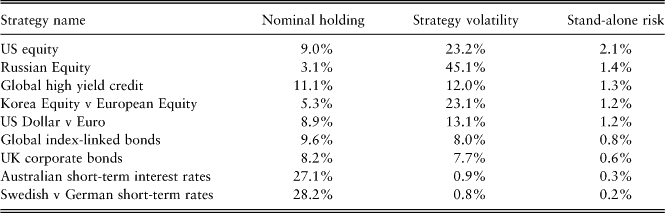
5.14 The first two strategies demonstrate the usefulness of this approach, as you read along the x axis of this chart. Like for like, Russian equity is a lot more volatile than US equity. However the holding size is one third of that of the US equity holdings so that when the size and the risk of these investments are combined it results in the US equity position being the ‘riskier’ position in the fund. The risk calculation is consistent across different asset classes (interest rates and currencies for example) and whether the investment strategy is a physical or derivative holding, as demonstrated in the Table 2 which shows a sample of the strategies used in this portfolio.
Stand-alone risk statistics of a sample of strategies from an unconstrained multi-asset portfolio

Source: Standard Life Investments, APT system, March 2012
5.15 What Table 2 also illustrates is that, when dealing with portfolios consisting of physical and derivative positions, summing up nominal holding sizes to produce an overall ‘total nominal exposures’ number is not providing much insight into the risks of the portfolio. It is far more beneficial to investigate how much investment risk in aggregate has been deployed by the investment manager.
Total standalone risk (correlated risk categories)
5.16 The strategy standalone risks are ‘sub-additive’, that is, the total volatility of the fund will always be less than or equal to the sum of the standalones. They would only equal the total volatility if all the strategies were perfectly correlated. Aggregating the standalone risks ignores the benefits of diversification, that is, from all the other terms in the volatility grid. We term this quantity the total standalone or ‘undiversified risk’.
5.17 It can also be considered a correlation stress – in a world where all strategies became perfectly correlated, this would be the risk of the fund. In the example, the undiversified risk is 22.4%. For comparison purposes, equivalent global equity volatility is 20.2%. If the investment strategy is targeting a level of return similar to the Equity Risk Premium then this expected level of volatility would not be surprising. We note that this level of volatility should be an extreme correlation stress for the multi-asset portfolio especially when taking an investment perspective on how the strategies might behave in stress scenarios (as in the investment manager would expect certain strategy pairs to move to a −1 correlation than +1). In reality the limit should be a dynamic function of a detailed correlation stress on the changing strategies, however, in terms of independent risk monitoring, this simple test should provide good guidance as to gauging size of any fat-tail events.
Further risk analysis - percentage of total standalone
5.18 The standalone risk of each strategy can be calculated as a percentage of total standalone risk – so in this example US equity (2.1%) share of total risk (22.4%) is just 9.3%. With around 30 strategies in play a sensible question might be why strategies are not equally weighted. The investment manager will explain that final risk weighting will be a factor of the return conviction of the position and its expected diversification benefits within the investment portfolio. However it would seem sensible for a ‘share of risk’ limit for any one single investment strategy in the fund to ensure that the success/failure of the investment strategy is not overly reliant on a couple of factors.
5.19 Also given that strategies in any one asset class, say equities, tend to behave in a similar manner (especially in stress scenarios) another straightforward risk limit to put on the multi-asset strategy would be a ‘share of risk’ limit at the asset class level. This restriction has the benefit of forcing the investment manager to diversify investment holdings into other asset classes in the portfolio no matter how strong their conviction may be for any one asset class.
Uncorrelated risk analysis
5.20 One can also calculate the risk of the fund under the assumption that all strategies are uncorrelated. In this case, the standalone risks are added in quadrature (i.e. their variances summed), which gives an uncorrelated risk of 4.9%. It is interesting to compare this to the forecast fund volatility (6.5%); however it is not a lower bound on the risk as it does not account for the possibility of negative correlations.
Diversification benefit
5.21 A simple measure is to compare the sum of the stand-alone risks of the fund with the forecast fund volatility. The difference between the two is the risk reduction due to diversification benefits which for this range of investment strategies looks substantial at 15.9%.
Leverage, nominal holdings and portfolio risk
5.22 So for this portfolio of physical and derivative-based investment strategies we have a portfolio which from a risk-basis looks well diversified. Although we have demonstrated that nominal exposures in themselves provide little information about risk, the fact that the sum of nominal exposures will exceed 100% (220% in the unconstrained multi-asset portfolio above) leads to understandable concerns of ‘leverage’ and linked worries of additional risks that the numbers are not explaining.
5.23 Leveraged strategies are traditionally associated with the running of a single investment strategy (say long equity or credit say) but, either through explicit borrowing or through using derivatives, deliberately seek to take on more risk through having more than 100% nominal exposure; some of these strategies have suffered significantly in times of market stress and hence ‘leverage’ and ‘derivatives’ in the same sentence usually raises a yellow (or sometimes red) flag for cautious investors. Using a risk-based approach to investing can ably demonstrate how much volatility can be expected from these types of approaches. Table 3 shows how leverage is directly linked to the portfolio risk calculation.
Expected risk of 3 investment funds

5.24 An initial view taken on Table 3 is that, if you have a positive view of Australian short term interest rates, then buying a 10 times leveraged portfolio (1000% exposure) is less than half of the risk of a normal equity portfolio.
5.25 What has to be remembered here though is that this is just ONE investment strategy, and what history has taught us is that the mathematics of risk calculation does not capture extreme market events; “once in a 100 year” events seem to happen almost every second year. So leverage in the context of one single risk can be considered ‘bad’ since the outcomes are wholly driven by the behaviour (or not as may be the case) of that single factor. It is not surprising therefore that leveraged credit funds, a favourite strategy of many in the last decade (promoted on the rationale of stable credit spreads and strong corporate balance sheets) came to grief as credit spreads skyrocketed during the global financial crisis.
5.26 A portfolio of 25 to 30 investment strategies (or highly different investment risks), properly constructed, can mitigate extreme tail risks by simply having strategies that should plausibly behave in opposite directions during market stresses. This is an area of work where we believe actuaries can use their broad risk skills to add valuable input to a portfolio discussion.
5.27 We have shown above the high level benefits of a risk-based investment approach. Clearly there is a range of additional analysis that can be done, looking at the impact of individual strategies on the risk dynamics of the portfolio (correlation and position removal risk metrics for example). Additionally such high level analysis may not take into account the asymmetrical dynamics of strategies implemented via options and a broader modelling set is required to support the output of the risk model. This is discussed in the next section.
Modelling limitations
5.28 When building any multi-asset investment strategy the worst thing you can do is to not have a risk system. The second worst thing you can do is to have a risk system and blindly trust its output. Modelling risk has to be seen for what it is – a model – reality provides outcomes which the risk modeller will describe as any of the following;
(a) Large standard deviation events
(b) Non-normality
(c) Outliers
(d) Fat tails
5.29 The Global Financial Crisis highlighted the inherent dangers of building ever more complex risk models that ultimately gave false levels of comfort to investment risks that a more holistic approach may have flagged earlier. One investment banker commented “We were seeing things that were 25-standard deviation moves, several days in a row”Footnote 7 once the crisis began to kick in. To put matters into context the mathematical likelihood of a 25 standard deviation event equates to even less likely than one day in the entire history of the universe.
5.30 So what can be done? Applying a range of broader range of analyses and exploring new fields of risk modelling are being done but actuarial judgement can be applied to understand the dynamics and limitations of any modelling approach. So for example, when markets become more volatile, the portfolio manager should be aware that typically risk modelling output will be underestimating the volatility of numerous investment strategies whilst overestimating their diversification benefits – in 2008, a number of investment products came to grief since there was insufficient appreciation in the portfolio risk construction process of the old maxim “The only thing that rises in a bear market is correlation”.
6. A broader quantitative risk management set
“Essentially, all models are wrong, but some are useful”
Professor George E. P. Box - Professor Emeritus of Statistics at the University of Wisconsin
Scenario stress tests
6.1 As discussed at the end of the previous section, risk models should not be used in isolation given their limitations and a broader risk palette is required to assess portfolio behaviour in stressed market situations. Scenario stress tests are a useful toolset and these can be both historic and future looking.
Historical stress tests
6.2 A primary advantage of historical scenario testing is its economic plausibility i.e. the events actually happened, and so we know that theoretically they could happen again. What we don't know however is the likelihood of the event re-occurring. Unlike the Value-at-Risk measure, we are only provided with the expected loss as a result, not the confidence level. Also although we can choose what we believe to be the most extreme set of historical scenarios, there can be no expectation that any of them will generate the worst case scenario of potential loss within the analysed portfolio.
6.3 Risk models for this type of exercise typically use a series of risk ‘factors’ to explain movements in securities. The main risk factor types tend to be Equity factors, Foreign Exchange factors, Commodity factors and Interest Rate factors. By modelling the historical or predicted behaviour of these risk factors, we can simulate the impact on the performance of a portfolio. Having selected a historical period spanning a financial crisis we can then use the relative change of the risk factors over that period as the stress scenarios. We apply these historical risk factor returns to the current level of the risk factors and then fully revalue the portfolio. We can therefore then determine the current portfolio's simulated profit/loss should this historical event re-occur.
Historical Outputs
6.4 Figure 8 is an example of an output from historical stress test of the simulated performance of a portfolio in a number of events. By choosing a wide range of market stresses, the portfolio manager can check whether their portfolio has any unintended concentrations of risk based on past shocks to the financial system. As highlighted area, none of these outcomes may be incidences where a multi-asset portfolio suffers higher losses and hence a more forward looking approach to the problem is required.
Unconstrained multi-asset portfolio historic stress test Source: Riskmetrics September 2012
Future Scenario analysis
6.5 In seeking to discover unintended concentrations of investment risk in a multi-asset portfolio there is a need to devise a methodology that can combine the ‘crystal ball’ scenarios of fund managers with a coherent mathematical framework. Potentially unlikely but plausible futures (as at the end of 2012) could be any of the following;-
• Quantitative Easing asset bubble
• Quantitative Easing asset collapse
• Germany leaves the Euro
• Shale gas revolution leads to collapsing energy prices
6.6 Whilst the fund manager may be able to provide some inputs on key variables (e.g., equity markets fall 20%, bond yields rise 1%) there is still then a challenge for the risk manager to model a conditional co-variance matrix and establish a framework for producing a range of future performance outcomes. Whilst a deterministic approach (defining all impacts on factor risks) may generate the ‘best estimate’, a stochastic approach may again help identify performance tail risks in the portfolio.
6.7 It is in this world of future uncertainty where actuarial skills could potentially be utilised, linked perhaps to a range of diversification measures for a portfolio. I would welcome debate on this subject.
Ex-post risk measurement
6.8 Measurement of the unconstrained multi-asset portfolio in practice demands a comprehensive set of measures that the investment management industry already produces; volatility, VaR. Sharpe ratios, Investment drawdown etc. In addition some relatively simple analysis can help the fund manager understand if the portfolio is behaving in line with expectations – Figure 9 shows the distribution of weekly returns of an unconstrained multi-asset fund and compares that to equivalent equity returns where we already know of the existence of ‘fat tails’. Here the chart shows that the multi-asset portfolio is less exposed to tail events than equities alone.
Distribution of weekly portfolio returns of an unconstrained multi-asset portfolio Source: Standard Life Investments, net performance from 12/06/2006 to 30/11/2012 Portfolio performance is based on the £, institutional pooled pension portfolio Source: Thomson Datastream, MSCI World (£) (net of tracker fund fee)
6.9 From the above, it is then a relatively straightforward process to do normality distribution tests and to estimate the risks within the tail of the distribution.
6.10 Market stresses in recent years continue to remind the investment management industry of the need to continue to look for new ways of looking at risk and modelling potential future asset behaviour. This growing area of study is potentially where actuarial skills could provide additional insight? The author would again welcome thoughts.
7. Conclusions
“He that will not apply new remedies must expect new evils. For time is the greatest innovator.”
Francis Bacon, Essays, 24, of Innovations
7.1 Investment markets continue to evolve and the investment management industry has a wide range of investment tools (derivatives) available to help build portfolios that provide reliable investment outcomes for investors, no matter what the economic conditions are.
7.2 The world of unconstrained multi-asset investment is growing. However the integrated use of derivatives in multi-asset management has not to date been adopted by the mainstream investment management industry, no doubt strongly influenced by client and advisor aversion to the use of derivatives - ”Derivatives - that's the 11-letter four-letter word”Footnote 8
7.3 The ongoing quest to discover investment diversification remains an ongoing challenge for investors in an increasing joined-up global network of investors – measurement of diversification is a growing industry (business) post the global financial crisis and this is a subject that the actuarial profession can make substantial contributions to as it develops its credentials in risk management.
7.4 An integrated unconstrained multi-asset portfolio of physical and derivative instruments can offer significantly more diversification than traditional approaches and the paper illustrates a range of approaches for risk measurement and ongoing risk monitoring that are appropriate for the expected time horizon that the strategies within the portfolio are employed. The author would welcome further ideas and suggestions for other approaches.
Acknowledgements
I am grateful to my fellow actuary, Euan Munro (Head of Multi-Asset Investing and Fixed Income at Standard Life Investments), for allowing me to share more widely some of the thinking that went into the justification of the design of Standard Life Investments’ Global Absolute Return Strategies (GARS) multi-asset investment product.
I would like to give specific thanks to Dr Brian Fleming and Dr Jens Kroeske for allowing me to use their proprietary methodology for measuring diversification effects. In addition, Dr Anne Friel and John Page provided much of the source material for the sections on quantitative risk portfolio measurement and on historic scenario analysis.
Many also thanks for the reviewers (both external and internal) that have helped reshape the original Working Party paper into this format. Also, I would like to thank my investment specialist colleague and actuary, Chris Nichols, who provided numerous improvements to the original drafting.
Finally, thanks to my Working Group colleagues, Jeff Neate and Clara Yan not only for their written contributions but also for the wider discussions we have had on the content of the original working party paper.
Malcolm Jones
January 2013
APPENDIX 1 – Exchange Traded Derivatives versus Over the Counter instruments
The different contract types are broken down into two different types, Exchanged Traded Derivatives (ETD) and Over The Counter (OTC). It is therefore useful to compare the features of these types.
Exchange traded instruments v OTC instruments
ETD – equities, options and futures markets
The fact that an exchange stands on the other side of all trades in exchange traded markets is one of their key advantages as this removes counterparty risk, or the chance that the party who you are trading with will default on their obligations relating to the trade. A second key advantage of exchange traded markets is that as all trades flow through one central place, the price that is quoted for a particular instrument is always the same. Lastly, because all firms that offer exchange traded products must be members and register with the exchange, there is greater regulatory oversight which can make exchange traded markets a much safer place to trade.
The most often downside cited about exchange traded markets is cost. As the firms who offer exchange traded products must meet high regulatory requirements to do so, this makes it more costly for them to offer these products, a cost that is inevitably passed along to the end user. Secondly, as all trades in exchange traded products must flow through the exchange this gives these entities immense power when setting things such as exchange fees which can also increase transaction costs for the end user.
OTC – swaps, currency, debt and options
Here there is no centralised place where trades are made; instead the market is made up of all the participants in the market trading among themselves. An over-the-counter contract is a bilateral contract in which two parties agree on how a particular trade or agreement is to be settled in the future. As there is no centralised exchange the firms that make prices in the instrument that is trading over the counter can make whatever price they want, and the quality of execution varies from firm to firm for the same instrument. While this is less of a problem in liquid markets such as FX and interest rate swaps where there are multiple price reference sources, it can be a problem in less highly traded instruments.
For derivatives, OTC agreements are usually governed by an International Swaps and Derivatives Association (ISDA) agreement. A Credit Support Annex, or CSA, is a legal document that regulates credit support (collateral) for derivative transactions. It is one of the four parts that make up an ISDA Master Agreement but is not mandatory. It is possible to have an ISDA agreement without a CSA but normally not a CSA without an ISDA.
OTC derivatives are significant part of the world of global finance. The OTC derivatives markets are large and have grown exponentially over the last two decades. Interest rate products, foreign exchange instruments and credit default swaps have driven the expansion. The notional outstanding of OTC derivatives markets rose throughout the period and totalled approximately US$601 trillion at December 31, 2010.
The key advantage for the over the counter markets is that transaction costs are normally lower when compared to similar products that trade on an exchange. This is due to there being no central exchange and relatively light regulation in the marketplace. Indeed, this lack of regulation is now being addressed with industry initiatives to have highly traded OTC derivative instruments clear through an Exchange-traded model;- this is a slow and complex process involving numerous trading jurisdictions. What is fair to say that whatever model evolves the increased cost will be reflected in end transaction costs to the investor.
APPENDIX 2 Derivatives and investment risk management
Investment risk management policy needs to be cognisant of specific risks of using any one derivative instrument, but that it should be integrated into the overall risk management policy of a company rather than being seen as a separate function.
In terms of assessing any one investment strategy, these risks can therefore be broken down as follows:
a) Market Risk
Market risk represents the risk of adverse movements in markets (including asset prices, volatility, changes in interest rates, or other market variables).
b) Liquidity Risk
Liquidity risk is defined as the risk that the underlying assets of a portfolio are not sufficiently liquid to meet potential subscription and redemption demands. When assessing liquidity, the potential impact on the fund valuation of buying and selling less liquid holdings must also be considered. The liquidity profile will vary across portfolios, reflecting different client/fund requirements.
For funds which utilise derivatives there is an additional liquidity requirement for the investment risk manager. This is to maintain an appropriate level of liquid assets (cash or other eligible assets) for the purpose of meeting margin/collateral calls. There need to be processes in place to monitor movements in derivatives to ensure potential margin/collateral calls can be met and manage the levels of liquidity cover in portfolios. Where appropriate, stress testing is performed on funds or specific instruments.
The portfolio manager does not want to be in a position of ‘forced’ asset sales to raise cash to meet derivative cash calls, especially if the portfolio has significant allocations to less liquid asset classes, such as real estate.
‘Standard’ tests (such as 1 month 99% VAR) calculations can show the manager how much cash would be needed to cover Exchange traded and OTC potential losses, but it makes sense to hold a large ‘buffer’ in excess of this in regard to the reality that these numbers are only estimates and markets are uncertain by nature.
c) Counterparty (Credit) Risk
Counterparty credit risk is the risk of exposure to potential loss should a counterparty fail to perform its financial obligations, including failure to perform them in a timely manner.
With respect to derivatives, investment management firms will have policies in place for:
– Counterparty selection
– What derivative instruments can be traded with each respective counterparty?
– Exposure limits to any one counterparty
– Collateral agreement details with each counterparty including collection triggers and range of allowable collateral (typically cash and highly credit rated government bonds)
d) Operational Risk
Operational risk is the risk that deficiencies in the effectiveness and accuracy of information systems or internal controls will result in material loss.
Where derivative usage is a significant part of daily investment management activity, there will be tightly monitored and controlled risk processes to deal with this ‘business as usual’ activity, to ensure there are always mitigating actions to deal with non-standard events.
It is worthwhile noting that even during the worst trading conditions modern markets have known in the aftermath of Lehman Bank's default in 2008, the OTC markets continued to operate and trade whereas other more traditional markets such as corporate bonds and money markets were to all intents and purposes closed. Since then, standards on acceptable collateral for OTC derivatives have improved along with even more focus on mitigating counterparty and operational risks.
Sophisticated and Non-sophisticated funds
In an investment management organisation, the Investment Risk function will measure and monitor the contribution of investment positions to the overall risk profile of the portfolio and apply a range of techniques to help evaluate the impact of any abnormal market movements where applicable.
The risk methodology adopted will be dependent on whether there is sophisticated or non-sophisticated use of derivatives. Where appropriate, portfolio managers and the risk function stress test portfolios, where derivative positions have the potential to alter portfolio values significantly more than the movement in the related physical securities.
Sophisticated Funds
Factors to consider when assessing funds individually:
• The use of derivatives forms a fundamental part of the fund's investment objective and would be expected to be used in all market conditions.
• The performance of the derivative is non linear in relation to the underlying assets or the performance is based on a reasonably complex mathematical formula.
• The use of cover for the derivative position, which is different from the underlying derivative. This assesses cover for absolute risk.
• The complexity of the strategies.
• Whether the fund is highly leveraged, interpreted as containing high absolute risk that would require stress testing.
• Is the use of derivatives necessary to meet the fund objectives exceeds the limit allowed on a commitment approach basis.
The list above is indicative and the points should be considered cumulatively rather than any one point indicating that a fund is sophisticated in nature.
Non-sophisticated Funds
• Strategies are used for efficient portfolio management (EPM) purposes.
The Investment risk function will advise on whether a fund is sophisticated or non-sophisticated.
The key point here is that an investment management organisation will put in place a risk monitoring framework that is appropriate for the sophistication of the investment product.