Since the inception of mitral commissurotomy by Cutler and Levine in 1923, the surgery for rheumatic heart disease has evolved tremendously to the current thought that up to 70% of the rheumatic mitral valve is repairable with a good outcome.Reference Cutler and Lewine1,Reference Gammie, Sheng and Griffith2 Although the decision to repair or replace rheumatic mitral valvulitis is highly controversial and the choice is mainly dictated by factors such as the surgeon’s experience and the degree of valvar and subvalvular apparatus lesions,Reference Duran, Gometza and Saad3 mitral valve repair has excellent operative mortality [0.7%]. But according to Yau et al, the operative mortality for mitral valve repair for rheumatic aetiology was found to be around 4.2%.Reference Thourani, Suri and Gunter4 The operative outcome is even worse for multiple valve surgeries done at a time with a perioperative mortality rate ranging from 10 to 50% and a stroke hazard of 10%.Reference Sanfelippo, Giuliani, Danielson, Wallace, Pluth and McGoon5
Rheumatic heart disease is a major public health problem in developing countries. Although the poor socio-economic condition is to be blamed for the rampancy of the disease,Reference Karthikeyan and Guilherme6 the lack of advanced open heart surgery to treat rheumatic heart disease patients in developing countries played a pivotal role for the significant mortality and morbidity due to the disease.
Evidence is scarce regarding surgical outcome of rheumatic heart disease patients in resource-limited settings, and the current study aimed to describe the immediate surgical outcome of patients with rheumatic valvular heart disease who were operated by the local cardiac surgical team at two centres in Addis Ababa, Ethiopia.
Materials and methods
Study setting, study population, and data collection technique
The current study was conducted at two centres found in Addis Ababa, Ethiopia: The Cardiac Center of Ethiopia and The El-Ouzier Cardiac Center. The Cardiac Center of Ethiopia was established in 2009 and since then hundreds of open heart surgeries were performed in the centre by “fly-in” missionaries from different countries. However, over the past 3 years, open heart surgery was being done in the centre by the team of local experts who had been trained abroad. The same team of local cardiac surgical team was performing cardiac surgery in El-Ouzier Cardiac Center which started conducting open heart surgery a year back.
Included in the current study were all patients who were diagnosed to have rheumatic valvular heart disease and who underwent open heart surgery for the same disease by the local cardiac surgical team in the mentioned two centres. In both centres, echocardiographic evaluation was done by a certified and registered cardiologist. The day before the surgery, the cardiac team holds a routine discussion on each patient and settles the diagnosis before the surgery. Diagnosis of rheumatic valvular heart disease and its severity grading was done by using American College of Cardiology diagnostic criteria. Rheumatic valvular heart disease was diagnosed based on the World Health Federation criteria,Reference Reményi, Wilson and Steer7 American College of Cardiology definitionReference Nishimura, Otto and Bonow8 and as per the echocardiographic findings. Pulmonary arterial hypertension was classified as mild between 25 and 39 mmHG, moderate between 40 and 59 mmHG and severe ≥60 mmHg as determined by the peak systolic gradient across the tricuspid valve regurgitation.
It is the protocol of the centres to operate only symptomatic patients due to severe rheumatic valvular stenotic or regurgitant lesions. Patients who had rheumatic valvular heart disease but who underwent cardiac surgery for some other cardiac diseases were excluded from the study.
Data were abstracted from the patient files by using a structured questionnaire. Demographic (age and sex), and pre-operative clinical, characteristics such as body mass index, presence of co-morbid medical illness, previous history of valve intervention, left ventricular ejection fraction, nature of valve lesion, use of anticoagulant, NYHA class, pulmonary artery pressure, cardiac rhythm and pre-operative haemoglobin level were abstracted from the chart. Additionally, the first 30 days of post-operative patient profiles such as post-operative hospital stay, post-operative ICU stay, duration of post-operative mechanical ventilation, post-operative complication (surgical wound infection, para-valvar leak, thromboembolic events, and prosthetic valve endocarditis), anticoagulant-related complications, and the patient outcome were collected.
Surgical technique protocol
A standard midline approach with ascending aorta cannulation and two-stage single right atrium cannulation was done for isolated aortic valve surgery, and Bi-Caval cannulation was done for the remaining type of valve surgeries. Cooling was done to 32 °C. and St Thomas cold blood cardioplegia solution was administered every 20–30 minutes during the surgery. Antegrade cardioplegia was administered for mitral and tricuspid valve surgeries, whereas direct coronary ostial administration of cardioplegia was done for multiple valve surgeries involving aortic surgery.
All mitral valve surgeries were approached via sondergaar groove, and aortic valve surgery was approached using a J incision into the non-coronary cusp of the aortic valve. Tricuspid valve surgery was approached via incision across the right atrium parallel to the atrioventricular groove.
Patients with moderate rheumatic mitral valve stenosis and who underwent aortic valve replacement therapy were treated with open mitral valvotomy. In such patients, bilateral commissurotomy along with chordae and papillary muscle mobilisation was done.
Young ladies whose mitral valve was not repairable and who planned pregnancy were offered the option of receiving tissue valve replacement therapy. Otherwise, mechanical valve replacement therapy was done for the remaining patients with rheumatic mitral valve and aortic valve diseases. All the mechanical valves used were bi-leaflet valves. An interrupted suture technique was used to mount all the prosthetic valves.
Mitral valve repair was done by applying annuloplasty ring, by augmenting the posterior mitral valve leaflet, and by doing chordal release.
Tricuspid valve repair was done on a beating heart either by using Edwards Lifescience® MC3 ring, or by using an autologous pericardial remodelling annuloplasty ring. Because MC3 Edawrd Life Science® is expensive and not widely available in our setting, the team preferred to use untreated autologous pericardium band for annuloplasty of the tricuspid valve. Such technique had been reported to have comparable outcome with the use of MC3 Edawrd Life Science®.Reference Jiang, Long, Li, Zhong, He and Lin9 We did not use the De Vega repair technique in our patient population.
The left modified maze procedure was done for patients who had chronic atrial fibrillation and giant left atrium (70–75 mm diameter). The technique used was based on the original cut and sew technique and the procedure composed of isolating the four pulmonary veins, left atrial appendage excision, left atrium reduction and a cut and sew line connecting to the mitral valve annulus.
For those patients who underwent redo surgery, all the redo surgeries were entered through the previous midline incisions and cannulation were central. The indications for the redo surgeries were previous tissue valve undergoing degenerative changes and stuck valve for mechanical valve.
Upon completion of the surgical procedure and before coming off bypass, trans oesophageal echocardiography was routinely done to see if the gradient across mitral valve was reduced and to check if any leakage across the mitral valve.
Follow-up
Following the cardiac surgery, all patients were admitted to the cardiac ICU. The occurrence of any of the major complications (death, re-operation, stroke and complete heart block), in the post-operative period within 30 days of the index surgery, was assessed.
After discharge, patients have a frequent follow-up visit schedules by the surgeon in the first 30 days of the index surgery. The primary outcome of the surgery was death, re-operation, stroke and complete heart block in the 30 days of the index surgery.
All patients who underwent valve replacement therapy were started warfarin and bridging unfractionated heparin infusion therapy the next day following surgery. Warfarin was titrated in such a way to keep the target international normalised ratio for a single-valve replacement surgery between 2 and 3, and for double-valve replacement surgery between 2.5 and 3.5.
Patients who developed a significant amount of pericardial effusion were treated with prednisolone, frusemide, and Asprin. Those who developed tamponade physiology despite the above treatment measures were intervened either surgically or by putting drainage tube in the catheterisation laboratory.
Statistical analysis
Data were analysed by using Statistical Package for Social Sciences version 20.0 for windows. Findings were presented in text form and frequency tables. The median value with its interquartile range and percentage values were determined for continuous and categorical variables, respectively.
The current study was approved by the Institutional Review Board of St Paul’s Hospital Millennium Medical College.
Result
Pre-operative demographic and clinical characteristics
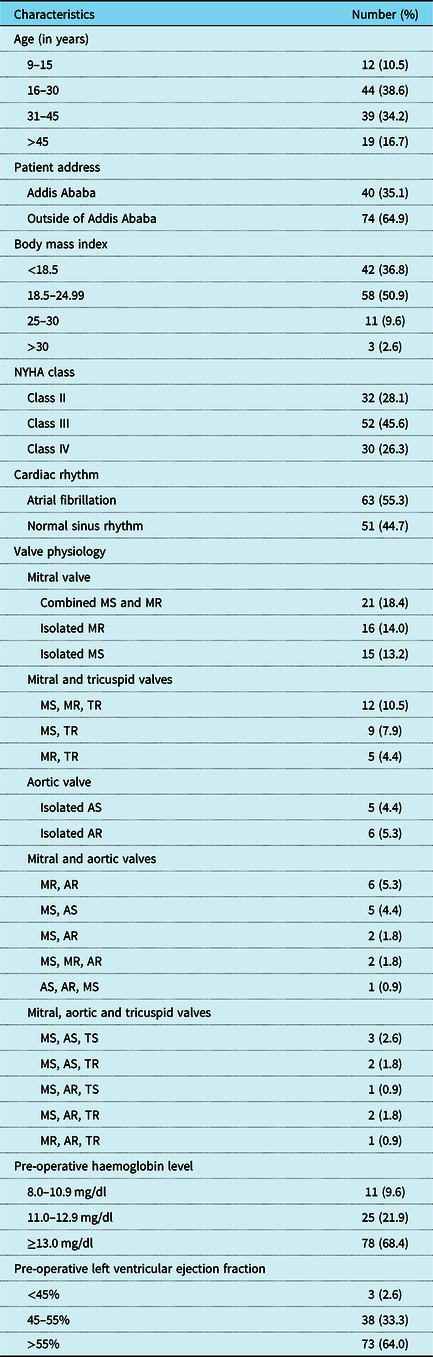
As shown in Table 1, altogether 114 patients (median age 31 years, interquartile range: 23–40) were included in the study and 62 (54.4%) of them were female. The youngest and oldest patients were 9 and 75 years old, respectively. Forty (35.1%) patients lived in Addis Ababa and all the remaining came from other parts of the country.
Pre-operatively, only about half of the study population 58 (50.9%) had body mass index between 18.5 and 24.99 and the majority of the study population 82 (71.9%) had either class III or IV NYHA heart failure symptoms.
Just before the surgery, 77 (67.5%) patients had moderate-to-severe pulmonary hypertension. Atrial fibrillation was documented in 63 (55.3%) patients. Ten (8.8%) patients had known non-cardiac co-morbid illness (chronic kidney disease two patients, human immune deficiency virus infection two patients, diabetes two patients, asthma one patient, stroke one patient, coagulopathy one patient and congenital leukocytosis one patient) at the time of the surgery. Thirty-six (31.5%) patients had a haemoglobin level of less than 13 mg/dl pre-operatively.
The pre-operative peak pulmonary artery pressure of the study population was 37 (32.5%) patients had between 17 and 39 mmHG, 30 (26,3%) patients had between 40 and 59 mmHG and 47 (41.2%) patients had greater than or equal to 60 mmHG. About one-third of the study population 41 (35.9%) had pre-operative left ventricular ejection fraction less than or equal to 55% (Table 1).
Demographic and pre-operative clinical characteristics of the study population, Addis Ababa, 2020

AR=aortic regurgitation; AS=aortic stenosis; MR=mitral regurgitation; MS=mitral stenosis; TR=tricuspid regurgitation; TS=tricuspid stenosis
Of the total 114 studied patients, most of them 103 (90.4%) had rheumatic mitral valve disease. Combined mitral and aortic valves lesion was seen in 16 (14.0%) patients. Only 11 (9.5%) patients had isolated rheumatic aortic valve disease. Four (3.5%) patients had rheumatic tricuspid valve stenosis in combination with other valve lesions (Table 1).
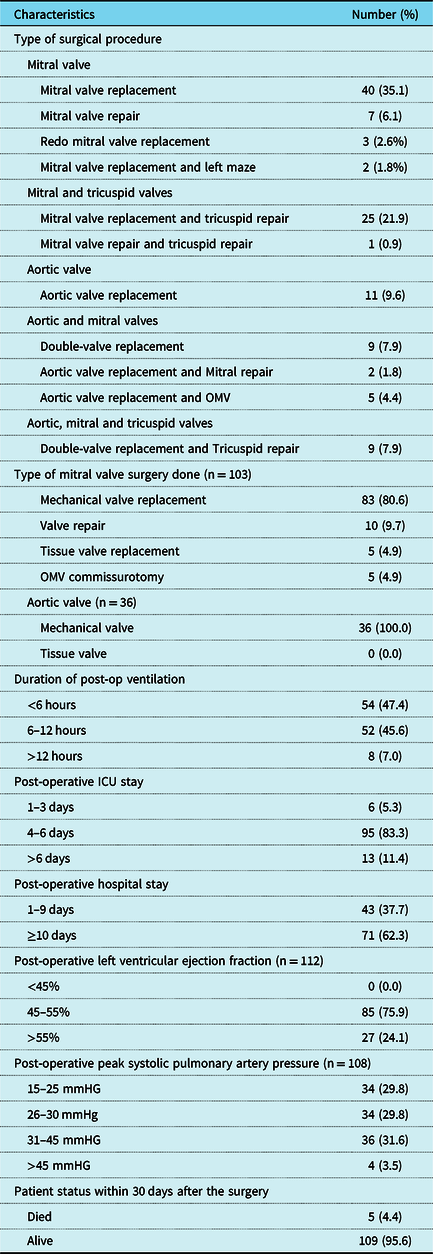
Table 2 depicts the intra-operative and post-operative clinical characteristics of the study population. As shown in the table, the surgical procedures done were triple-valve surgery 9 (7.9%) patients, mitral and tricuspid valves 26 (22.8%) patients, double-valve surgery 16 (14.0% patients, single-valve surgery 50.9% (11 aortic and 47 mitral valves) of patients, redo mitral valve surgery 3 (2.6%) patients and left maze with mitral valve surgery 2 (1.8%) patients. Of the total, 90.4% (15 repairs and 88 replacement) of them had mitral valve surgery (either isolated or in combination with other valve surgery), whereas 36 (31.6%) patients had aortic valve surgery. Of the 88 (85.4%) patients who underwent mitral valve replacement surgery, 83 (94.3%) patients had mechanical valve replacement and 5 (5.7%) patients had tissue valve replacement. Open mitral valve commissurotomy procedure was done for five (4.9%) patients. All the five patients who underwent open mitral valvotomy commissurotomy procedure also had aortic valve replacement therapy. Post-operatively, the mean inflow gradient across the mitral valve for all the patients who underwent mitral valve surgery was below 5 mmHG.
Intra-operative and post-operative clinical profile of the study population, Addis Ababa, 2020

OMV=open mitral valve commissurotomy
Out of the total 114 patients, 36 (31.6%) of them had aortic rheumatic valve disease and all of them were treated with aortic valve replacement therapy. Of them, only 11 (30.6%) patients underwent isolated aortic valve replacement therapy. The mean and peak post-operative trans-aortic valve gradient for all the patients were found to be less than 20 and 30 mmHG, respectively.
Of the total 114 patients, 3 (2.6%) patients had a previous history of cardiac surgery for rheumatic heart disease. Of these three patients, two of them were 31 and 34 years old, both of whom had previous tissue valve replacement surgery of the mitral valve that was done 5 years back. Both patients had degenerative changes of the tissue valve and mandated mechanical valve replacement. The third was a 54-year-old female patient who previously had mechanical mitral valve replacement therapy that was done 10 years back. All three patients received mechanical valve replacement therapy during the current surgery. One more female patient had previous percutaneous balloon mitral valve commissurotomy that was done 5 years back and this time she underwent surgical repair of the same valve.
The median bypass and cross-clamp time of the surgery for the study population were 110 (interquartile range, 89.8–142) minutes and 69.5 (interquartile range, 55.8–89.3) minutes, respectively. Left maze procedure (surgical treatment of atrial fibrillation) was done on two patients, and it was successful only on one of the patients. Post-operatively, almost half 54 (47.4%) of the patients required mechanical ventilation for less than 6 hours and only 8 (7.0%) patients were ventilated for more than 12 hours (Table 2).
Patient outcome
Of the total 114 patients, 5 (4.4%) patients died within 30 days following the index surgery (Table 3). Nineteen (16.7%) patients developed at least one form of post-operative complication. Eight (7.0%) patients developed cardiac tamponade due to massive pericardial effusion and sub-xiphoid surgical drainage was done for all. Four (3.5%) patients had bleeding and required re-exploration surgery. Two (1.8%) patients developed third-degree complete heart block and one of them required permanent pacemaker implantation. Another two patients had a stroke and one of them died due to the stroke. Additional two patients developed surgical site infection and wound exploration was done. One more patient who was a case of mitral valve disease and who underwent valve repair during the current surgery but ended up with failed initial repair and successful re-repair of the valve was done on the fifth day of the first operation.
Profile of patients who died following the surgery, Addis Ababa, 2020

MVR = mitral valve repair
Discussion
The current study aimed to describe the experience of the local cardiac surgical team regarding the immediate surgical outcome of patients who underwent open heart surgery for rheumatic valvular heart disease in a resource-limited setting. We found that 86.7% of the study subjects received at least one valve replacement therapy. Of the total 114 patients, 90.4% of them had mitral valve surgery and 31.6% of them had aortic valve surgery (all of them were mechanical valve replacement). Of the total 114 patients, only five (4.4%) patients died within 30 days following the index surgery.
In the current study, we found out that only a small proportion of patients underwent valve repair surgery. There are decisive factors why valve repair is not widely practiced by the surgeons in our setting. In our setting, we observe that cardiac patients seek medical attention late in the course of the disease after the cardiac valves are excessively calcified which makes valve repair less appealing. The durability issue of repaired valve in a resource-limited setting is also another important factor that dictates valve repair.
The operative mortality rate reported by the current study was 4.4% (5/114). Previous studies reported mortality rate ranging from 1 to 15%.Reference Ambler, Omar, Royston, Kinsman and Keogh10–Reference Kuduvalli, Grayson and Au13 depending on the underlying aetiology and the surgical technique that was used. In the current study, all the patients who died had chronic atrial fibrillation pre-operatively and three of them had also severe pulmonary hypertension. Also, among the deaths, three died in the immediate post-operative day and the remaining two died in the second and third weeks following their surgery. Of the three patients who died in the immediate post-operative day, one of them was a patient who underwent mitral valve replacement and left atrial appendage closure for a combined severe mitral valve stenosis and mitral regurgitation lesion. Following the surgery, the patient developed excessive bleeding and required re-exploration. However, the patient succumbed a few hours after re-exploration due to continued bleeding. The other two patients who died in the immediate post-operative period were patients who underwent double valve replacement and both of them died due to low cardiac output state despite receiving a cocktail of high-dose inotropic drug support.
The local cardiac surgical team believes that the mortality rate can even be further reduced down because of two reasons. One of the most important reasons is that three of our deaths happened in the early phase of launching the open heart surgery by the local team. That was the moment the team had to learn how to deal with such complex surgery. However, gradually the team got the chance to improve its learning curve and sought ways to improve patient outcomes. One approach followed by the team was the valve-sparing technique, at least for the posterior mitral valve leaflet, when operating on the mitral valve. The other reason was that two of the deaths happened due to excessive bleeding and haemorrhagic complications that could have been averted by better preparation for the surgery and strict international normalised ratio monitoring.
In the current study, there was no death among the patients who underwent isolated mitral valve repair; however, two patients had post-operative complications (one of the patients required re-operation for failed initial mitral valve repair and the other developed sternal wound infection). The benefit of isolated mitral valve repair whenever it is feasible especially in paediatric age patients is a proven fact with the best early and late mortality.Reference Akins, Hilgenberg and Buckley14,Reference Yau, El-Ghoneimi, Armstrong, Ivanov and David15 The fact that these patients do not require oral anticoagulants makes it attractive for those patients who do not have access to it. However, in this group of patients, the re-operation rate is higher. This makes the choice for such type of surgery to be less attractive in resource-limited settings due to very limited access for a redo surgery. That is why in the current series only 13.2% (15/114) of the patients underwent mitral valve repair.
Following open heart surgery, the incidence of significant pericardial effusion may range from 4.7 to 85%, but the magnitude of patients who require surgical intervention for the same problem may range from 0 to 8.8%.Reference Talwar, Rajesh, Subramanian, Saxena and Kumar16 In addition, the incidence of the need for re-exploration for bleeding for patients undergoing open heart surgery is in the range of 2–7%.Reference Malouf, Alam, Gharzeddine and Stefadouros17 In the current study, 12.3% (14/114) of the patients underwent re-operation due to four reasons; 8/114 (7.0%) patients developed tamponade physiology due to pericardial fluid accumulation and mandated drainage (for seven of them sub-xiphoid surgical drainage was done and for one patient tube drainage was done inside the catheterisation laboratory guided by flouroscopy). In the current study, all the seven patients who had tampnade were those patients who underwent valve replacement surgery and required anticoagulant post-operatively. The fact that they were taking anticoagulant post-operatively might have increased their risk of developing tamponade as compared to those who were not taking anticoagulant in the valve repair group. Additional 4/114 (3.5%) patients were re-explored due to bleeding. One patient developed complete heart block and required permanent pace maker implantation at the 14th-day post-surgery. One more patient underwent re-operation after failed initial mitral valve repair. For this patient, the team decided to repair the mitral valve rather than replace it even during the re-operation time since the patient was a 9-year-old female patient who came from a remote area of the country. Valve replacement is not the first option for young female patients who live in remote areas since they may opt to be pregnant in the future and then anticoagulant use will become a challenge.
One more patient developed third-degree complete heart block following aortic valve replacement therapy and permanent pace maker was not done since the patient was haemodynamically stable. The magnitude of third-degree complete heart block among the current study population was comparable with the incidence reported by other studies where it ranges from 1 to 3%.Reference Biancari, Mikkola, Heikkinen, Lahtinen, Airaksinen and Juvonen18–Reference Meimoun, Zeghdi and D’Attelis20
The perioperative risk of stroke for mitral valve and isolated aortic valve surgeries ranges from 1 to 8Reference Berdajs, Schurr, Wagner, Seifert, Turina and Genoni21 and 1.5%Reference Bucerius, Gummert and Borger22, respectively. The incidence of perioperative stroke in the current study was 1.7% (2 patients) which was in sharp contrast to findings reported by previous studies.
Despite the expected high mortality and morbidity of redo valve surgeries which can reach as high as 10.6%,Reference O’Brien, Shahian and Filardo23 all the three redo surgeries in the current study had uneventful and smooth post-operative course.
In the current study, left maze procedure (using the cut and sew technique) that was done for two young ladies to treat Atrial Fibrillation surgically is worth mentioning. The procedure was successful in one of the patients who also underwent mitral valve repair using tissue valve where the patient had normal sinus rhythm following the surgery. Although maze procedure is effective to treat atrial fibrillation surgicallyReference Jones, O’Kane and Gladstone24 especially in those undergoing concomitant mitral valve surgery, the local cardiac surgical team did not do the procedure liberally for different reasons. The main reason being the long cross-clamp time is that it takes due to the need to repair multiple valves in most of the patients and the difficulty that could arise to attain haemostasis as a result of limited availability of material and human resources in our setting. The lack of alternative energy sources was the main reason for not doing the left maze procedure frequently though most of the patients were having atrial fibrillation.
Among the study subjects, there were five patients who had rheumatic tricuspid valve stenosis. All of them underwent triple valve surgery with double-valve replacement and tricuspid valve repair. Repair of the tricuspid valve than replacement was the preferred procedure by the team in order to avoid the attending morbidity and mortality related to tricuspid valve replacement.
Limitations of the current study include: our study assessed patient outcome following open heart valve surgery within 30 days of the index surgery. Therefore, our study did not address long-term patient outcomes which can also be affected by the index surgery. The relatively small sample size of the current study also precluded us to assess determinant factors of patient outcome.
Conclusion
In conclusion, our study showed that there was excellent immediate patient outcome following open heart surgery done by local cardiac surgical team for rheumatic valvular disease in resource-limited setting. Since surgery is one of the best treatment modality for rheumatic valvular disease, the experience reported in this article will serve as a lesson to build surgical capacity in resource-limited settings, where the disease is most prevalent.
Acknowledgements
None.
Financial Support
This research received no specific grant from any funding agency, commercial or not-for-profit sectors.
Conflicts of Interest
None.
Ethical Standards
Ethical clearance was obtained after it was approved by the institutional review board of (IRB) of Saint Paul millennium medical college.