There are countless examples, spanning the globe, of Hobsbawm and Ranger's well-known concept of the ‘invented tradition’ (Reference Hobsbawm and Ranger1983); examples relating to music, dance, material culture, language, ritual and other practices. The notions of ‘tradition’ and ‘invented tradition’ have often intersected with understandings and discourses around age. For example, the demise of traditions has been allied to fears of practices, genres and practitioners becoming ‘old’ and ‘dying out’. In this article, I consider a popular music-dance form which bears many of the characteristics of an invented tradition and that is predominantly performed by people aged between 50 and 80-plus.Footnote 1 Far from dying out, however, the popular Cuban music-dance form danzón is flourishing, particularly in Mexico. Drawing from ethnographic data, I explore why local culture industries in the Port of Veracruz (Mexico) frame danzón as an ‘older’ people's music-dance form and to what ends.Footnote 2 My focus here is predominantly danzón dancers, the main consumers of this music, who gather for an hour most evenings in Veracruz's principal square (or nearby plazas) to dance to the Municipal Band or local danzoneras (danzón music ensembles).Footnote 3 I suggest that the older age of many danzón practitioners is used by Veracruz's culture industries to ‘authenticate’ this practice as a local ‘tradition’, to justify its ‘rescue’ and its promotion to younger generations. However this creates a tension since many of these older performers are new to danzón: they form the new generations of this partly invented tradition, disturbing notions of older people assuring the continuity of the past into the present. In the final section of the paper, I consider why the majority of danzón practitioners (as opposed to the local culture industries) insist that danzón is not an age-specific phenomenon. Let me begin however by introducing danzón, its trajectory in Mexico, and the people who perform it in Veracruz.
Danzón, a precursor of the mambo and the cha-cha-chá, emerged in Cuba in the 19th century and, like other fashionable genres, was soon performed in Mexico and beyond (as I discuss more extensively elsewhere, Malcomson Reference Malcomson2011). Danzón was particularly popular in Mexico's Gulf coast Port of Veracruz and in the capital. Mexico City's dance halls were renowned for their danzón (as depicted in 1940s films such as Julio Bracho's Distinto Amanacer, Reference Bracho1943; Emilio El Indio Fernández's Salón México, Reference Fernández1948; and Alberto Gout's Aventurera, Reference Gout1949). Meanwhile, Veracruz was considered the ‘adoptive’ parent of danzón due to its Afro-Caribbean ‘heritage’ and close ties with Cuba (after centuries of sea traffic between the ports of Havana and Veracruz). Both Veracruz and Mexico City were famed for their danzoneras and their dancers. A few dancers (mostly men, despite this being a couple dance) acquired ‘symbolic capital’ (Bourdieu Reference Bourdieu1993, p. 75) through their ability to (lead in the) dance, accumulating prestige by winning competitions, which gave them legitimacy to teach and judge others. The ‘field’ (Bourdieu Reference Bourdieu1993) in which they operated was fairly local, limited to Mexico City and Veracruz with little competitive interaction between the two. However, in the 1960s and 1970s the popularity of danzón waned somewhat, and by the 1980s the field in which dancers acted was transformed. A form of revival movement (Livingston Reference Livingston1999) began to emerge. People talked about ‘rescuing’ danzón (from its imminent downfall), formalising its transmission and choreography, and ritualising its performance in spectacles. New pedagogies emerged and the dance became more stylised, more codified, more disciplined. The emphasis on individual champions shifted to dance groups, legitimated as civil associations and directed by group leaders who created performances (‘exhibitions’) of groups dancing choreographed steps in unison (‘routines’). Meanwhile, the Mexican government was decentralising cultural institutions: local cultural centres burgeoned, such as Veracruz's Culture Institute (IVEC) which opened in 1987. A very few individuals created institutionally backed danzón empires in Mexico City and Veracruz, such as Miguel Zamudio. Based at Veracruz's IVEC, Zamudio is leader of the nationally renowned younger dancers' group Tres Generaciones (‘Three Generations’), promotes an annual danzón festival, a ‘national’ competition and a network of groups. Further spurred by the release of María Novaro's hugely successful film Danzón in Reference Novaro1991, the popularity of danzón spread throughout Mexico, particularly among older people. By the beginning of the 21st century, a new generation of danzón dancers had emerged who were predominantly over 50 years old. However, danzón remained relatively non-commercial compared to other popular music-dance forms.
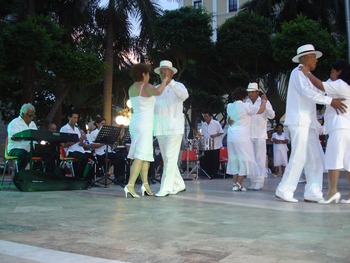
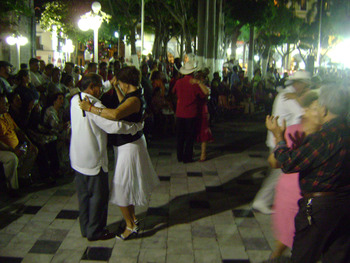
The increased popularity of danzón since the 1980s has reinforced the idea that danzón is something Veracruzano, despite (and because of) its Cuban ‘origins’ (see Malcomson Reference Malcomson and Cunin2010b). This concept of local identity has not only been significant in attracting people to danzón, but also in securing institutional support for performances predicated on notions of rescuing a local tradition. Veracruz, Mexico's largest port, is a cheaper holiday destination than Cancún or Acapulco. Local people told me that Veracruz mostly attracts lower-class tourists from Mexico City and Puebla, but also the odd middle-class and foreign tourist, as well as sailors who disembark in search of the city's pleasures. Veracruz is renowned for its festive atmosphere, its music, its dancing, and its annual pre-Lenten carnival attracts over two million visitors. From the 1980s, danzón increasingly became a resource for cultural tourism in Veracruz (although usually an added value for tourists, rather an incentive to visit the city, Piedras Feria Reference Piedras Feria, García Canclini and Piedras Feria2006, p. 63). The local government programmed and funded more danzón events in the main square (Figures 1 and 2): they hired the Danzonera Alma de Veracruz musicians as permanent employees in 1991, in addition to the Municipal Band, and provided space for danzón dance groups to rehearse and perform. While dancers choose to perform danzón as a leisure activity, danzón musicians are paid to perform, rarely seeking out danzón as a genre to play beyond a form of employment. In return for paying the danzonera musicians' salaries and providing chairs and space, the authorities get a ready-made tourist spectacle, with dancers avid to perform.
Danzonera Alma de Veracruz and members of Veracruz's Grupo Oficial dance group performing danzón on the stage of the Port's main square, 28 April 2007.

Rosa María Cruz Herrera and Jorge Enríquez Pérez dancing danzón in the corner of the main square, Port of Veracruz, Mexico, 20 November 2010.

While the (predominantly male) musicians in the Municipal Band were employed full-time by the local government in the 2000s, the (all-male) Danzonera Alma de Veracruz musicians were employed part-time (and members of other danzoneras work on an ad hoc basis). Most of the Danzonera Alma de Veracruz musicians had other jobs – an instrument repairer, electrician, primary school teacher – or were retired from working as builders, factory workers and shipbuilders. Their ages ranged from mid-thirties to mid-eighties, with the majority over 60. Of the dancers who regularly frequented Veracruz's danzón events, the majority of the male dancers were retired, having worked in the docks, the railways, the TAMSA Steel Tubes of Mexico factory, in other manual trades or in small businesses. While many of these men were still married, the majority of female danzoneras were widowed, divorced or separated. Married couples were scarce and most women danced in public settings before and after (but not during) their married lives. Some of the regular female dancers had widows' pensions inherited from their deceased husbands, or were supported by their children; others worked as secretaries, seamstresses, cooks, teachers. Many newcomers to danzón were in their early fifties and still worked, but there was also a sprinkling of younger dancers (many of whom were in, or had passed through Tres Generaciones, formed in 1987, or Veracruz's first large group, Hoy y Siempre (‘Today and Always’), established in 1982). Some younger dancers were more educated and self-identified as slightly higher class than the older dancers (and their parents' generation).
Motivations for performing the dance varied slightly according to age. Some older people suggested that they danced danzón precisely because the music is slow enough to dance with ease. One 74-year-old man (born in 1933) commented that he enjoyed danzón as he was no longer nimble enough to dance the mambo as he had in his twenties. That said, many older dancers recounted how their favourite part of danzones was the slightly faster final montuno section (taken from the Cuban son).Footnote 4 Other older dancers expressed a desire to get out of the house, especially women: the evening music-dance events in Veracruz's plazas (mostly danzón and Cuban son, sometimes son jarocho)Footnote 5 provide an opportunity for female regulars to go out alone (in the knowledge they will meet people they know) and sit in these public squares, a more male prerogative during the daytime. Still others told me that danzón was their therapy, both mental and physical (as Sevilla Reference Sevilla2003, explores in relation to Mexico City's dance halls). Meanwhile, several younger dancers in Tres Generaciones (aged between 15 and 25) were surprised that they had become interested in danzón, given its associations with older people, and joked about having to explain themselves to their peers at school and university. However, their motivations for performing danzón overlapped with those of older people: a desire to dance and learn choreographies, a love of the music, an opportunity to meet new friends and enjoy the conviviality of a group, to find romantic partners, to dance in staged performances with others, wear ‘elegant’ clothes, and perform a music-dance form that is considered characteristic of Veracruz.
Danzón, age and ‘cultural rescue’
Prior to the 1980s, ‘rescue’ rhetoric had been largely absent in Veracruz, distinct from the nostalgic laments that were being voiced by, among others, the local poet and chronicler, Francisco Rivera Ávila Paco Píldora (1908–1994). There is still much nostalgia in evidence for Veracruz's past, particularly from the 1920s until the 1980s when there was a major shift in economic and political power to (and from) the unionised dockers. This began with the 1920s post-revolutionary labour struggles and the re-creation of carnival in 1925 (see Wood Reference Wood2001, Reference Wood2003), and peaked in the 1970s towards the end of Mexico's economic ‘miracle’. The (male) dockers, together with the tram- and railway-men, became renowned as the heart and soul of this festive town, creating carnival comparsas (dressing up, playing instruments and dancing in carnival parades), hosting parties in the patios of the tenement blocks where many of them lived, and dancing to danzoneras, big bands, son cubano ensembles and local celebrities such as Toña La Negra (1912–1982) and Agustín Lara (1897–1970). However, this period was dramatically brought to a close with the 1980s debt crisis, culminating in the disempowerment of the dockers' unions and President Salinas de Gortari's requisition of the port in 1991. Veracruz is still described and represented as a city where music, dancing and carnival never stops, yet the privatisation of the port marked a juncture which is often evoked with nostalgia, separating a glorious past from a more commercialised, impersonal present. There is a nostalgia that during this ‘golden age’ Veracruz's musicians were at their finest, as were its danzón dancers who, I was told, were ‘renowned both nationally and internationally’. Yet these renowned dancers are long dead (such as El Charecua, Inés La Rompecuero, La Babuca, Pepe Castro, Miguel Díaz Andrade El Venado, and Sigfrido Alcántara who was interviewed in Trejo Reference Trejo1992).
The emergence of rescue rhetoric in relation to danzón (in both Mexico and Cuba) was possibly spurred by the 1979 centenary of the ‘first’ official performance of a danzón (Las Alturas de Simpson, composed by the Cuban, Miguel Faílde Pérez). The reasons given for the need to rescue danzón included the ageing of both danzón dancers and musicians, the lack of interest from younger people and the reduction in the number of Mexico City's dance halls. However, I would suggest that the timing of this urge for revival was partly due to broader socio-economic changes, whereby culture became a resource to be rescued. As Yúdice (Reference Yúdice2003) has argued, with the (multinational) neoliberal (market-oriented socio-economic) turn of the 1980s, the concept of culture as a resource emerged (a resource that could now not only promote wellbeing, but also ‘solve’ social problems). Moreover, culture became something to be ‘managed’ by administrators, whether for the purposes of tourism or social amelioration. From the 1980s, rescue rhetoric was evoked in Veracruz and Mexico City as a justification for danzón dancers to form officially legitimated dance groups, as well as to fund the promotion and dissemination of danzón to new generations of younger people. Danzón schools and groups were set up for young people and children, who were considered the hopes for the future of danzón, as well as for older people. However, many of these younger danzón dancers stopped dancing in their twenties, leaving the groups to marry, study and work. Yet, far from dying out, danzón continued to proliferate throughout Mexico and groups multiplied.
Younger people are seen and promoted by Veracruz's culture industries as the next danzón generation, rather than the 50-plus-year-olds who actually form these new generations. Older people are considered by Veracruzanos as pertaining to the past and the detail that many are new to the dance is rarely acknowledged. People do not always do the same things throughout their lives, contrary to stereotypes that deny older people temporality and possibility. Although there are a few older people who danced danzón along with other genres in dance halls when they were young, most (re)joined the dance once they were retired, widowed, separated or divorced and once their children were adults. Danzón is something that these newly recruited older people now do, and sometimes did when they were young (especially those aged above 70), rather than the frequently heard myth that it is something people have done all their lives. For example, one 74-year-old female danzonera (born in 1932) was just 10 years old when she started dancing with her parents at Villa del Mar, a renowned local dance hall; she stopped dancing when she married and moved away from the city, but resumed upon separating from her husband and returning to Veracruz in the 1980s. The dancing lifespan of older people often outstretches that of the young; for example, someone joining the dance as early as five years old may dance for 20 years, leaving the dance aged 25 to marry, while a 50-year-old newcomer may dance for 30-plus years, surpassing the younger dancer by a decade. In the 2000s, there were no children who danced danzón in Veracruz and very few young people. Meanwhile, 50-plus-year-olds continued to join the ranks of danzón dancers, particularly danzón groups, far outnumbering other age groups. ‘Older’ dancers create opportunities to evoke rescue rhetoric. By being older, they (appear to) create a continuity to the past (which may or may not be imagined), thereby ‘authenticating’ this local ‘tradition’ and contributing to nostalgic renditions of Veracruz as a town where local people party throughout their lives, a town with a long heritage of alegría (‘happiness’).
When a rhetoric of rescue is invoked in Veracruz – in justification for funding and to legitimise or critique the formation of music and dance groups – it relates more to continuity into the future than to the conservation of the past, or of the past in the present. As I introduced above, from the 1980s danzón took on many of the characteristics of what Hobsbawm and Ranger coined an ‘invented tradition’ (Reference Hobsbawm and Ranger1983), an idea well-worn within scholarship. Usually linked to an historic past, an invented tradition is a practice, governed by rules, that ‘is essentially a process of formalization and ritualization’ (Hobsbawm Reference Hobsbawm, Hobsbawm and Ranger1983, p. 4). Danzón dancing in particular has been formalised in terms of transmission (in schools and groups) and practice (a more codified dance), and ritualised in terms of the creation of spectacle. Yet, the choreographic transformations that occurred are not ‘characterized by reference to the past’ (Hobsbawm Reference Hobsbawm, Hobsbawm and Ranger1983, p. 4), as are Hobsbawm and Ranger's invented traditions. Nor is there a search for authoritative past forms of dancing or playing danzón as are often found in music revivals (see Livingston Reference Livingston1999). It is insightful here to compare danzón with son jarocho, a music-dance form also considered Veracruzano (and associated with the State as well as the Port of Veracruz).
At the end of the 1970s, son jarocho was marginal in the south of the State of Veracruz, and generational continuity had all but ceased. There existed, however, what Ávila Landa (Reference Ávila Landa2008) describes as urbanised, ‘folkloric’ son (epitomised by Lino Chávez) and ‘commercial’ son performed by folkloric ballets and by ambulant musicians donning stereotypical jarocho clothing, often for tourists. However, around 1979, a son jarocho revival movement emerged (epitomised by the group Mono Blanco) which, like danzón, saw the formation of civil associations, institutional support for groups, workshops, festivals and the emergence of a very few professional cultural entrepreneurs. There are, however, striking differences between the danzón and son jarocho scenes, despite their co-existence in Veracruz. These go beyond the distinction that son jarocho is perceived as being ‘born’ in (the State of) Veracruz, while danzón was merely ‘adopted’ by Veracruzanos (particularly in the Port). For example, son jarocho aficionados tend to be much younger than danzoneros, often attracted to performing the music as much as the dance. Moreover, notions of authenticity play a lesser part in danzón discourse and practice than they do in son jarocho. ‘Authentic’ renditions of danzón music or dance are rarely sought out, and older performers are seldom consulted as sources of a more authentic past to be emulated in the present. The older age of several members of the (music ensemble) Danzonera Alma de Veracruz provided a form of authentication for this music, and most older musicians and dancers who perform well are respected for their abilities and knowledge (particularly those who have done so for many decades), but they are not considered repositories of ‘traditional’ knowledge. Some dancers recalled nostalgically how their parents and grandparents had performed danzón, but there was no sense that they were attempting to create a continuity to that past in terms of performance practice.
In Veracruz, a distinction is made between two styles of dancing danzón: the more codified académico (‘technical’) style which emerged in the 1980s and is transmitted in groups, and the older lírico (‘free style’) danzón which, I was told, involves ‘just following the music’. Yet the difference between the two is not always clear, and often relates to whether people dance in groups (académico) or not (lírico). The older lírico style is not considered ‘heritage’ or more ‘authentic’ than the newer académico style. Where authenticity is evoked is in relation to closed and open style dancing. The closed style (where dancers remain in closed embrace) is considered characteristic of Veracruz, whereas the open-position style (with dancers usually holding one hand and often turning) is common in Mexico City. Although tensions arose in the 1980s when dancers began to incorporate turns in danzón dancing in Veracruz, by the 2010s most dancers in both lírico and académico styles opened out and turned during the final montuno section. Académico dancers did this much more frequently, however. From the 1980s, many dancers who at first danced lírico turned to the académico style so that they could participate in groups and because they considered the académico style more elegant. In the 2000s, I would estimate that around three-quarters of the dancers who frequented Veracruz's plazas performed some kind of académico danzón. People who learned to dance danzón after the 1980s tended to perform in the académico style, whatever their age. Of those dancing in the older lírico style, some had always danced lírico, while others had returned to it, having spent time in groups dancing académico and later leaving to dance independently (with or without regular dance partners). By the beginning of the 21st century, most of the oldest dancers were not in groups, although many had passed through them. So how do these dancing styles, music and age relate?
Dance style, music and age
Danzón is often described as a ‘difficult’ dance, for danzón performance requires both choreographic knowledge and musical awareness. Danzones are in rondo form (e.g. AABAACAAD) and the A sections are considered ‘non-danceable’ (the descansos or rests): in Cuba couples walk and greet each other, while in Mexico they stand holding hands (usually for the first iteration of each A section). While connoisseurs can hear when these non-danceable descansos occur, novices continue dancing alone. These non-danceable moments make dancers' choreo-musical knowledge particularly visible, especially in the newer, codified académico style where a dancers' feet should come together on the final beat of (step and) section endings.Footnote 6 Another reason danzón is characterised as difficult is that there are hundreds of steps which can be learned, especially in the académico style where steps are combined (and sometimes ‘invented’) by groups to create dance ‘routines’. In these routines, steps must both be physically achieved and large numbers remembered, sometimes in sequences of 28-plus per track (dance routine).
The codification of the dance, formation of dance groups and increased popularity of danzón from the 1980s had several impacts on the music. Firstly, the number of danzoneras (music ensembles) grew to fill the surge in demand. Secondly, some extant danzoneras, such as Danzonera La Playa, changed their performance practice in response to the codification of the dance. They clearly articulate the beginnings of phrases and sections so that académico-style dancers do not get lost. Académico dancers often prefer danzones that their four-bar steps ‘fit’ neatly into, danzones with eight-, 16- and 32-bar patterns which are uninterupted by bridge passages (that, if unaccounted for, may de-synchronise the dancers' steps from the music). Other extant danzoneras, such as the Danzonera Acerina, however, carried on performing in the same way that they had for decades. Danzonera La Playa also released several recordings which were very similar to their live performances so that if dancers practised to these recordings, they would not be confounded when dancing to La Playa playing live.Footnote 7
Thirdly, the majority of new and extant danzoneras continued to play a core repertoire (at least into the 2010s) that has changed little since the 1950s.Footnote 8 This is partly due to demand – dancers in groups becoming the main customers of danzoneras, and requesting a particular canon of danzones which are easier to perform and that are used for group dance routines. However, another reason for the stasis in the repertoire was that danzonera directors are now rarely composers (as they were until the 1950s), and instead anyone, with the resources to contract musicians and acquire an archive of scores (not an easy feat as these are generally unavailable in shops and must be obtained from other musicians or transcribed from recordings), a pair of timbales (small timpani), sound equipment, transport, and (ideally) a promotional recording, can set up a group and try to obtain gigs. Several dancers have done this, including Miguel Zamudio in Veracruz (with his Danzonera Tres Generaciones founded in 1999 to play with his younger dancers' group and at his annual festival) and Pablo Tapia who formed the Danzonera Yucatán in Mexico City in 2000. The stasis of the repertoire frustrates some musicians who seek breadth and innovation. The director of one danzonera complained to me that it was ‘boring’ playing the same pieces all the time, especially when he had a large repertoire to draw from. Many older danzoneras have repertoires penned by former directors (or frequently commissioned composers), but there is neither an urge to update these with new compositions and arrangements, nor a sense that certain compositions and arrangements are particularly valued for being ‘old’ or ‘authentic’. Only occasionally are new danzones created, but these rarely update earlier compositional practices and sometimes even take older pieces as their theme (such as Aguilar Alcántara's recent arrangement of Lennon and McCartney's Yesterday). While danzoneras endeavour to create a musical identity for themselves as ensembles in terms of performance practice, and may re-arrange pieces in order to do this, temporality and notions of modernity are not factors in this process. However, if the repertoire played by danzoneras has changed little in the last few decades, the codification of danzón dancing has shifted the dynamics between danzón and age considerably.
There is tension between the demands of the newer, more codified académico style of dancing danzón and the older bodies of the majority of newcomers to the dance. Many people told me that it was easier for younger people to learn danzón and dance routines as they are ‘young sponges’, unlike older people. The notion of the body as a sponge, as something that can absorb and be manipulated chimes with the late 18th-century European notion of the soldier's body described by Foucault: while in the early 17th century, a soldier was expected to already have an appropriate ‘bodily rhetoric of honour’, by the late 18th century, the soldier's body became something that could be disciplined ‘out of a formless clay’, something ‘docile’ that could become skilful and technically equipped for any demand (Foucault Reference Foucault1977, p. 135). In Veracruz, younger danzón dancers' bodies were described as potentially malleable, capable of easily absorbing the technical demands of académico danzón. There was a sense that older bodies no longer had sponge-like capacities. However, there was no notion that older people were unable to dance danzón, or necessarily danced ‘worse’, as there is for example in professional ballet (see Wainwright and Turner Reference Wainwright and Turner2006).
Age does not in itself (theoretically) determine whether danzón dancers are (considered) better or worse, but in Veracruz the exemplars of académico danzón are Miguel Zamudio's group of younger dancers, Tres Generaciones. It is generally easier for younger people to dance in the more codified, disciplined académico style, and members of Tres Generaciones usually achieve a collective standard of performance considered extremely ‘elegant’ (an important marker of ‘good’ dancing). The excellence of this group is key to maintaining Miguel Zamudio's reputation (both in the IVEC and in the national danzón scene). That said, Tres Generaciones rarely frequented local danzón events and merely represented Veracruz at Zamudio's annual danzón festival, in his national competition and on occasional trips away. However Tres Generaciones were both the exemplars and the exception, due to their younger age, their highly codified style of danzón performance, their institutional grounding and their national profile. In Veracruz, a theoretically level playing field is set up for dancers of all ages in which an aesthetic of disciplined académico danzón has become increasingly valued, and in which younger people are emerging as ‘better’ dancers. In Mexico City, there are still a few older dancers who are considered excellent, such as Arturo Sánchez Rivera El Capullo, Miguel Ángel Cisneros El Lagañoso and Roberto Salazar El Chale, but these dancers have to some extent been superseded by a new generation of younger institutionally backed dancers such as Fredy Salazar and Maru Mosqueda. But what makes a dancer ‘good’?
The admired aesthetic in both the lírico and académico styles of danzón-dancing is ‘elegance’ and well-accented, ‘musical’ dancing. Musicality is often allied to cadencia (cadence/rhythmic movement). Cadencia involves the movement of the hips, a movement particularly associated with the circum-Caribbean. I was told (by danzón practitioners in Veracruz) that Veracruzanos had cadencia, where other Mexicans did not (a contestable point), because Veracruz and its people were ‘Caribbean’ (a notion which has been particularly promoted by Veracruz's cultural institutions since the 1980s). Women from Veracruz were referred to in terms of racialised ‘decency’, reaping the benefits of being ‘a bit hot’, purportedly due to having some ‘black blood’ (as I explore elsewhere, Malcomson Reference Malcomson and Cunin2010b). A certain amount of sensuality is valued in danzón performance and, in addition to a model of the body as a sponge, there is (to a lesser extent) an ideal of embodied experience being brought to the dance. If Tres Generaciones' younger, more disciplined académico style is one representation of Veracruz and its danzón (to the national danzón scene in particular), then the image of older people dancing provides another. It is the predominantly older people who dance in the main square, in the académico and lírico styles, and who are the focus of Veracruz's tourist gaze.
‘An old people's dance’?
Beyond Veracruz's culture industries, danzón is envisioned as an older people's dance in the broader Mexican popular imaginary. This imaginary is sustained by the large number of older dancers, but it is not a view shared by performers. Some younger dancers asserted that danzón was un baile de viejitos (‘an old people's dance’), before promptly denying it and pointing to the number of younger practitioners. Danzón is and has been performed by people of various ages throughout its history, despite the preponderance of older practitioners in the last few decades. As we have seen, in Veracruz (and in Mexico City and beyond), younger people perform danzón and there are a few danzón groups dedicated to young people (and occasionally infants). Besides these groups, however, younger danzón dancers tend to be few and far between.
A second explanation as to why performers do not portray danzón as an age-related phenomenon is that danzón has never been a genre marketed solely towards particular age groups or youth cultures. Danzón was popular before the notion of ‘youth cultures’ gathered global momentum in the second half of the 20th century. Rather than being determined by biological age, ‘youth’ is a culturally specific and relational category, often allied to generation (and thus something that can be prolonged into mid-life and beyond). Literature on youth cultures (such as Ross and Rose Reference Ross and Rose1994), and particularly subcultures (e.g. Hebdige Reference Hebdige1979), provide ample illustrations of how music genres have acted as markers separating generations. Unlike the UK and the USA, where mid-century youth cultures tended to be associated with the lower classes, Zolov demonstrates how in Mexico it was the middle classes who initially took on the often defiant mores associated with youth. For example, rock ‘n’ roll (youth music par excellence in the USA) was merely another dance genre consumed by lower- and middle-class adults in Mexico City's dance halls, initially at least, only later becoming associated with urban youth (Zolov Reference Zolov1997, p. 201). One reason why Veracruz's practitioners are unwilling to categorise danzón by age, I suggest, is that danzón has no history of being a genre ranked in a hierarchy of generations. In Veracruz (as elsewhere), music-dance forms were separated to some extent by age in the 2000s: beyond family parties, reggaeton, for example, was associated with younger people, while danzón was linked to an older public. These age-related associations were often mapped onto venues (younger people tended to go clubbing, while older people danced in public open spaces), times of day (danzón events occurred early evening, while younger clubbers went out much later) and, more broadly, to understandings of younger (see Aguirre Aguilar Reference Aguirre Aguilar2008) and older people's amorous lives (see Malcomson Reference Malcomson2010a).
Additionally, understandings of ‘oldness’ contributed to danzón not being considered an older person's music-dance form by habitués. We have here people aged between 50 and 80-plus being grouped together under the banner of ‘old’. Age is contextual and relative, as is whether people deny or embrace ‘oldness’ (Kaufman Reference Kaufman1986, p. 7; Thompson et al. Reference Thompson, Itzin and Abendstern1990, p. 127). Few of the dancers I spoke to aspired to or relished becoming (or being) ‘old’. The notion of being ‘of the third age’ circulated in Veracruz (as it does beyond), and some older dancers used this terminology. The idea that ‘aging equals decline’ (Gullette Reference Gullette2004, p. 7) (as opposed to progress) was hegemonic in Veracruz (as it is in the UK, the USA and beyond). Younger dancers sometimes joked about the ‘old’ age of most danzón dancers, a joke shared with and told by older people. In addition to intergenerational ageism, in intragenerational settings, as Degnen (Reference Degnen2007) found in the UK, older danzón dancers ascribed ‘oldness’ to others, either in jest, or where someone's social comportment and mental acuity were open to question. Rather than being biologically determined, or applied to the self, oldness was predominantly a (social) quality ascribed to others.
The older age of participants is used to justify the promotion of danzón to the young, and danzón events in Veracruz are not aimed at older people. Instead, these events provide a space for people of all ages to meet, dance, listen and watch a phenomenon associated with the city. Danzón is linked to cultural identity and tourism rather than older age or health care in Veracruz (both institutionally and in terms of aficionados' discourse). The wellbeing of even the oldest dancers is rarely mentioned in official discourses as a rationale for danzón events (either in terms of danzón being a form of sport or therapy). Nor is danzón included in municipal events targeted at older people. INAPAM, the National Institute of Senior Citizens, supports danzón events in towns throughout Mexico. INAPAM's predecessor, the INSEN (National Institute of Older Age), promoted a danzón group in the Port of Veracruz in the 1990s, but this was short lived. In the 2000s, the Port of Veracruz's INAPAM hosted many activities for older people, including dance workshops, but danzón was conspicuously absent. When older people dance danzón in Veracruz, they do so in plazas in front of tourists' cameras, rather than at the INAPAM. While some danzón habitués participate in other activities at the INAPAM, particularly women, other older danzón regulars steer clear of ‘older people's’ events, preferring events (such as danzón) which are not age specific.
Conclusion
Understandings and discourses about age have tended to be instrumental to popular music in terms of production, promotion and consumption, and many studies of popular music have taken younger people, and especially youth cultures (past and present), as their centre of gravity. While some scholars (such as Zolov Reference Zolov1997) have analysed the relationships between age groups and emergent youth cultures, insufficient attention has been paid to music produced and consumed by older people in the present. Where the voices of older people have been considered, the focus has often been retrospective, that is on older people's experiences when young or their attitudes to contemporary youth cultures, rather than relationships between the temporal dimension of the life course and music. As the case of danzón in Veracruz illustrates, stereotypes that older people are resistant to novelty, change, creativity and possibility are ill-founded. Moreover, where age is used to justify rescuing ‘cultural traditions’, caution may be called for and analysis required to assess what lies behind such claims and why. As we have seen, the older age of the majority of Veracruz's danzón performers is evoked to ‘authenticate’ this ‘tradition’ and justify its ‘rescue’ and promotion by local culture industries. Yet, older people are not considered repositories of ‘tradition’ or sought out as ‘authentic’ practitioners. Instead, many older performers are new to danzón, often spending several decades dancing after they begin in mid-life. Older people form the new generations and their age does not make this a fragile or dying practice.
Acknowledgements
My thanks go to Mónica Moreno Figueroa, Henry Stobart, Cathrine Degnen, David Lehmann, Ciro Carlos Mizuno Gúzman, Margarita Castro Olvera, Dora Herrera de Cinta, Jan Fairley and the anonymous reviewers. Funding was kindly provided by the Arts & Humanities Research Council.