INTRODUCTION
Plunkett and Strömqvist (Reference Plunkett, Strömqvist and Slobin1992: 540) cite a personal communication from Melissa Bowerman, who described two approaches to cross-linguistic research. The first approach compares languages that differ greatly from one another. Bowerman claimed that this approach can ‘refute gross overgeneralizations of universalist claims’, but cannot reveal details of the acquisition process ‘precisely because of the fine-grained nature of the differences between the linguistic systems under investigation’. The second approach compares languages ‘that differ only marginally across broad and detailed dimension’ [sic]. As Bowerman noted: ‘Given that two closely related languages share many properties within a given linguistic domain but differ on just one or two dimensions, the causes and ramifications of these differences can be more carefully explored.’
We label the two approaches that Bowerman described the method of gross comparison and the method of fine comparison. Most cross-linguistic research conducted to date employs the method of gross comparison regardless of theoretical perspective, e.g., Brown (Reference Brown1973), Slobin (Reference Slobin and Slobin1985), Hyams (Reference Hyams1986), Bittner, Dressler and Kilani-Schoch (Reference Bittner, Dressler and Kilani-Schoch2003), Lust (Reference Lust2006), and O'Grady (Reference O'Grady, Chan, Jacob and Kapia2008) . Research on the acquisition of genetically related languages is typically the result of accident or availability rather than design, e.g., Jakobson (1941/Reference Jakobson1968), Clark (Reference Clark and Slobin1985), Plunkett and Strömqvist (Reference Plunkett, Strömqvist and Slobin1992), Hoekstra and Hyams (Reference Hoekstra and Hyams1998), and Hamann (Reference Hamann2002) . The method of gross comparison as well as the method of fine comparison lack explicit controls for the effect of cross-linguistic differences in contexts of use. In this article, we present a version of fine comparison that addresses the challenges of cross-linguistic comparison.
Despite the profound importance of cross-linguistic research, little attention has been paid to developing a systematic method for cross-linguistic comparison. Cross-linguistic research currently attempts to compare ‘structurally similar’ entities in different languages. This approach begins by selecting a grammatical entity in one language, typically English, and then identifies forms in other languages which represent similar target entities. Such methods lack an objective standard for demonstrating the degree of linguistic similarity between the target entities across languages. They assume that the equivalence of the target entities can be isolated from their formal realizations. However, such an assumption is unwarranted to the extent that morphology and syntax interact with phonology and discourse structure. Languages are not simple physical systems that map forms directly onto identical entities with equivalent contexts of use.
Grammatical entities such as tense, aspect, and agreement take many forms to represent different combinations of functions within each language. Languages often have two or more forms to represent grammatical entities, and use each form to represent multiple entities. The acquisition of grammatical entities cannot be compared across languages without abstracting away from their phonetic realizations in each language as well as the differences in the use of each form. Any attempt to explain how children acquire a grammatical entity in different languages must inevitably separate the grammatical entity from its language-specific forms and contexts of use.
The analysis of different forms realizing the same grammatical entities in different languages also introduces a methodological error. To the extent that a grammatical entity is realized by a different form in different languages, children acquiring the languages are likely to produce different realizations of the adult target forms. The investigators in each language must then decide which child forms count as realizations of the adult target and which do not. Cross-linguistic investigations lack a systematic procedure to control which child productions count, and therefore introduce a degree of methodological error into cross-linguistic comparisons that is not present in single-language studies.
The limitation to ‘structurally similar’ grammatical entities has the unfortunate side effect that linguistically exotic forms will be overlooked. As long as English defines the standard for comparison, researchers will overlook structures from languages that do not have an equivalent in English. Exotic entities, such as ejective consonants, ergative agreement, or Mayan status suffixes, define the limit of the human language potential, but have little impact on acquisition theories because corresponding grammatical entities do not exist in English. If cross-linguistic research is going to adopt a universal perspective, a method must be found that motivates researchers to explore the acquisition of rare entities that define the outer boundaries of human linguistic competence.
In this article we introduce the Comparative Method (CM) of language acquisition research to analyze the acquisition of verb suffixes in two Mayan languages. Linguists have successfully used the CM for more than 150 years to reconstruct the proto-forms of sounds, words, and sentences (Paul, Reference Paul1889). Table 1 provides a classic example of the CM using the words for ‘house’ and ‘one’ in three Mayan languages.Footnote 1 The Proto-Mayan word for ‘house’ cannot be reconstructed from the K'iche' data alone. The reconstruction is still difficult with data from only K'iche' and Q'anjob'al because the word for ‘house’ in K'iche' begins with /j/ and the same word in Q'anjob'al begins with /n/. Adding data from additional languages clarifies the situation by showing that the proto-language originally had three distinct consonants: *j, *n, and *ŋ. The *j and *n were preserved in all three languages, while the *ŋ became /j/ in K'iche' and /n/ in Q'anjob'al.
Comparison of the words for ‘house’ and ‘one’ in three Mayan languages (England, Reference England1994)

The application of the CM to research on language acquisition utilizes the principles of the CM to control the synchronic analysis of cross-linguistic comparisons. The key advantage of the CM for acquisition research is that it supplies a systematic process for organizing and comparing acquisition data across all levels of the grammar from different languages. The CM simultaneously identifies and controls variation at the phonological, morphological, syntactic, semantic, and pragmatic levels of analysis. The CM has three basic steps:
• Identify and compare cognate forms across a family of genetically related languages;
• Identify and compare the contexts of use for the forms across the language family;
• Compare the acquisition of the forms across the contexts of use for the language family.
If we apply this procedure to our first example, step one would identify and compare the consonants /j/, /n/, and /ŋ/. Step two would compare the variation in the words where the three languages use these consonants, i.e., their contexts of use. Note that K'iche' uses /j/ in both words, whereas Q'anjob'al and Popti' use /j/ in only one of these words. Step three would compare how K'iche', Q'anjob'al, and Popti' children acquire these consonants and explore how differences in their contexts of use, i.e., the words that contain these consonants, affect the children's acquisition of these consonants. The genetic relation between the languages serves to control for the relationship of these consonants to the other sounds in the phonological system. These three steps can be applied to study the acquisition of sounds, words, inflectional morphemes, syntactic constructions, and meaning in any language family.
The data in Table 1 illustrate a critical feature of the CM. While comparison between two languages reveals limited information about grammatical entities in each language, comparison across additional languages increases our understanding of each entity within each language. The CM introduces a cumulative method of cross-linguistic research that permits studies of new languages to build upon results previously established for other languages, and allows research on one level of grammar to inform studies at other levels. Discoveries within a single language can be checked against data from related languages with increased precision to reveal how cross-linguistic variation at different levels of grammar impact the acquisition process. For this reason, the CM compels the systematic investigation of acquisition within an entire family of languages. This requirement selects the languages for comparison before selecting the structures for linguistic analysis. Thus, the CM represents a new standard for cross-linguistic research.
THE COMPARATIVE METHOD OF LANGUAGE ACQUISITION RESEARCH
In this study, we apply the Comparative Method to analyze the acquisition of status suffixes in K'iche' and Yucatec Maya. The K'iche' and Yucatec status suffixes are the result of a natural experiment in which the same forms have come to have different contexts of use over a period of approximately 4,000 years (Hofling, Reference Hofling2006; Robertson, Reference Robertson1992). The forms of the status suffixes have remained relatively stable over this time span, while their contexts of use have changed dramatically. The CM allows us to hold form and position relatively constant while exploring the effect of morpheme use and input frequency on the children's morpheme acquisition. The CM provides a precise means of analyzing the acquisition of these typologically unique suffixes across different languages.
Mayan status suffixes simultaneously mark distinctions in verb transitivity, verb class, mood, and clause position. The status suffixes do not mark tense or agreement. From a universalist perspective, the status suffixes are highly marked, because few languages require the addition of morphemes that mark both transitivity and the presence of a clause boundary. From a language-internal perspective, the status suffixes are unusual in that while most of the inflectional morphology in the Mayan languages is agglutinating, the status suffixes are portmanteau morphemes that simultaneously express different functions. Despite such complicating features, children acquiring K'iche' and Yucatec begin to produce status suffixes by the time they are two years old.
Our study follows the three steps of the CM to analyze the acquisition of status suffixes in K'iche' and Yucatec. We introduce the forms of the status suffixes and then compare their contexts of use. The CM shows precisely how the contexts for the suffixes have diverged and the consequences such divergence has for the frequency of use of the suffixes in the two languages. This divergence allows us to test how the type of context versus the frequency of the context affects the children's acquisition of the status suffixes. We test these effects by analyzing the children's use of the status suffixes and their productivity. We conclude with a summary of the insights we gain through the use of the Comparative Method.
IDENTIFYING COGNATE FORMS IN K'ICHE' AND YUCATEC MAYA
The Mayan language family contains thirty languages spoken in Mexico, Guatemala, Belize, and Honduras (Kaufman Reference Kaufman1974). The number of speakers of each language varies between 141 speakers of Mochó to nearly a million speakers of K'iche' and Yucatec (Richards, Reference Richards2003). The language family is divided into four main branches with a history of four thousand years and a written history of over a thousand years. The Yucatecan languages separated from the Central Mayan languages approximately 4,000 years ago, while the Eastern Mayan languages, including the precursor to K'iche', separated from the Central Mayan languages roughly 3,500 years ago (England, Reference England1994). Yucatec is spoken across the Yucatan Peninsula of Mexico, while K'iche' is spoken in the western highland region of Guatemala.
Mayan languages have a mildly polysynthetic, predominantly agglutinating morphology. The verb complex uses a set of ergative morphemes to cross-reference the subject of transitive verbs and a set of absolutive clitics to cross-reference the subject of intransitive verbs as well as the objects of transitive verbs. The verb complex also inflects for aspect and mood (Kaufman, Reference Kaufman, England and Elliott1990). An inflectional template for the intransitive verb complex is shown in (1) with examples in K'iche' and Yucatec. A template for the transitive verb complex is shown in (2). The status suffixes in each example are shown in bold.
(1) Intransitive template: Aspect-AbsolutiveK'iche'-Verb_Stem-Status-AbsolutiveYucatec
K'iche': x-ø b'in-ik
cmp-3abs walk-status
‘S/he walked.’
Yucatec: h bin-ih-ø
cmp go-status-3abs
‘S/he went.’
(2) Transitive template: Aspect-AbsolutiveK'iche'-Ergative-Verb_Stem-Status-AbsolutiveYucatec
K'iche': k-at inw-il-oh
inc-2abs 1erg-see-status
‘I see you.’
Yucatec: k-inw il-ik-ech
inc-3erg see-status-2abs
‘I see you.’
The absolutive marker appears after the aspect marker in K'iche' and after the status suffix in Yucatec on both intransitive and transitive verbs. The intransitive status suffixes in (1) are cognate forms. The verb root -b'in in (1) is a cognate form with different meanings in K'iche' and Yucatec. The verb root -il in (2) is also a cognate form, but the transitive status suffixes in (2) are not cognate forms; the incompletive aspect selects different moods in K'iche' and Yucatec as reflected in the status suffixes. While the phonology, lexicon, syntax, and semantics of these languages have diverged to some degree, the CM allows us to test how this variation affects the course of status suffix acquisition in K'iche' and Yucatec. The following section introduces the full status suffix paradigm.
STATUS SUFFIX FORMS
Kaufman (Reference Kaufman1977) coined the term ‘status marker’ to describe a class of suffixes typically found on the verb complex in Mayan languages. While the other verb inflections are agglutinating, the status suffixes are portmanteau morphemes that simultaneously mark distinctions in transitivity, verb class, mood, and clause position. These distinctions have different levels of significance across the Mayan languages. The status suffixes in Mayan languages are united by position and history much as the agreement suffixes in Romance languages which simultaneously mark person, number, tense, mood, and verb conjugation.
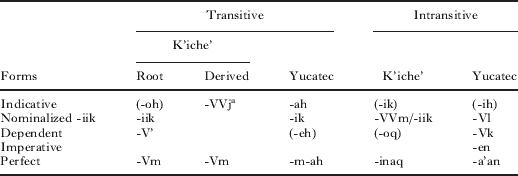
Table 2 displays the forms and the labels we use to refer to the status suffix entities in K'iche' and Yucatec. The labels are shown down the left side, and the verb class distinctions along the top. We define transitivity, mood, and verb class entities by their formal realization in K'iche' and Yucatec. Transitive verbs cross-reference two arguments; intransitive verbs cross-reference a single argument. Mood is formally defined by the status suffixes. Verbs in the indicative mood have an indicative suffix, nominalized verbs have nominalizing suffixes, and dependent verbs have dependent suffixes. The verb classes are also defined by morphological distinctions. Derived transitive verbs in K'iche' have the status suffix /-VVj/. These formal distinctions no longer correspond to fixed semantic distinctions due to semantic changes from their Proto-Mayan functions.
Correspondences between K'iche' and Yucatec status suffix forms (parentheses indicate omission in non-clause-final contexts)
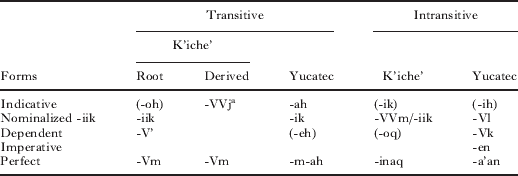
note: [a] V represents a vowel. The specific vowel realization depends upon the particular status suffix, verb stem, and language (Mondloch, Reference Mondloch1978; Bricker et al., Reference Bricker, Poot Yah and Dzul de Poot1998).
The indicative form of the status suffix on root transitive verbs in K'iche' is /-oh/, while the nominalized form of the status suffix on root intransitive verbs in Yucatec is /-Vl/. The parentheses in Table 2 indicate the status suffixes that appear only in clause-final position. The gaps in Table 2 indicate places where a distinct status suffix does not exist. The other forms are extended to fill in these gaps. For example, K'iche' extends the derived transitive form to fill in the gaps for the dependent and imperative forms of derived transitive verbs. We omit the perfect status suffix from the remainder of our analyses since this suffix has only sporadic production by adult and child speakers in both languages.
At first glance the Yucatec status paradigm bears little resemblance to the K'iche' status paradigm. We use the correspondences shown in Table 2 for our analysis, although the exact correspondence between the two paradigms is still a matter of debate (cf. England, Reference England1994; Hofling Reference Hofling2006; Robertson Reference Robertson1992). The labels we use for the suffix forms in Table 2 do not match the labels found in the grammars for either K'iche' or Yucatec, because historical changes in the forms and functions of the status suffixes have obscured the correspondences between the languages. The following discussion describes each dimension of the status suffix paradigm in detail.
Dimensions of the status suffix paradigm
In this section, we describe the dimensions of verb class, mood, and clause position with examples showing the intransitive and transitive forms used in each of these contexts.
Verb class
K'iche' and Yucatec make a primary distinction between the status suffixes used with the intransitive and transitive verb classes. The languages make a secondary distinction between the status suffixes used with root and derived verb classes. K'iche' has a class of transitive verbs that require the derived status suffix even though they do not have overt derivational affixes. K'iche' uses the status suffix /-VVj/ for the class of derived transitive verbs. Root verbs have monosyllabic verb stems, while derived verbs generally have polysyllabic verb stems, but there are exceptions such as the K'iche' derived verb -aaj ‘want’. Yucatec uses the same status suffixes on root and derived transitive verbs. Thus, the derived transitive verb class is defined formally in K'iche' by the presence of the derived status suffix /-VVj/, whereas derived transitive verbs in Yucatec are defined by the presence of derivational affixes such as the causative, but lack a distinct status suffix. Examples of root and derived transitive verbs in K'iche' are provided in (3).Footnote 2
(3) Root and derived transitive verb subclasses in K'iche'
Root transitive verb Derived transitive verb root
x-ø-in-tij-oh x-ø-in-kam-is-aaj
cmp-3abs-1erg-eat-indtv cmp-3abs-1erg-die-cause-dertv
‘I ate something.’ ‘I killed something.’
Mood
The status suffixes in Mayan languages also mark contrasts between the indicative, nominalized, subjunctive, and imperative moods. The indicative suffixes are used with verbs in the completive, incompletive, and progressive aspects in K'iche', and with only the completive aspect in Yucatec. The examples in (4) illustrate the indicative status suffixes on intransitive and transitive verbs in K'iche' and Yucatec.
(4) Indicative intransitive verb Indicative root transitive verb
Kiche' x-ø-war-ik x-ø-u-k'am-oh
cmp-3abs-sleep-indiv cmp-3abs-3erg-carry-indtv
‘S/he slept.’ ‘S/he carried it.’
Yucatec h ween-ih-ø t-u kuch-ah-ø
cmp sleep-indiv-3abs cmp-3erg carry-indtv-3abs
‘S/he slept.’ ‘S/he carried it.’
Mayan languages use nominalized verb forms in contexts of complementation (Noonan, 1985). Nominalization in K'iche' and Yucatec results in the addition of a distinctive set of nominalizing suffixes. We include the nominalizing suffixes in our analysis of the status suffixes because Yucatec reanalyzed the nominalizing suffixes as aspect-linked verb suffixes and extended the use of nominalized verb forms to incompletive and progressive aspect contexts (Bricker, Reference Bricker1981). K'iche' speakers have the option of using either indicative or nominalized complements with the progressive verb; the nominalized form is obligatory with the progressive in Yucatec. Examples of nominalized verbs for K'iche' and Yucatec are shown in (5).
(5) Nominalized intransitive verb Nominalized root transitive verb
K'iche' k-in-tajin pa b'in-eem k'ax u-b'aan-iik
inc-1abs-prog to walk-nomiv hard 3erg-do.pass-nomtv
‘I am walking.’ ‘It is hard to be done.’
Yucatec táan in k'uch-ul k-uy il-ik-en
prog 1erg arrive-nomiv inc-3erg see-nomtv-1abs
‘I am arriving.’ ‘S/he sees me.’
Mayan languages use dependent verb forms in dependent clauses and as subjunctives and imperatives. K'iche' uses the dependent status on imperative verbs and with the incorporation of verbs of motion into the verbal complex. The dependent suffix is referred to as the subjunctive in Yucatec studies because it frequently marks reference to possible events. Like K'iche', Yucatec extends the dependent form to verbs in imperative contexts, but retains a distinct imperative suffix form on intransitive verbs. Examples of dependent verb forms for K'iche' and Yucatec are shown in (6) (from Bohnemeyer, Reference Bohnemeyer2002: 231).
(6) Dependent intransitive verb Dependent root transitive verb
K'iche' ch-at-b'in-oq x-ø-ul-in-b'an-a'
imp-2abs-walk-depiv cmp-3abs-come-1erg-do-deptv
‘Walk!’ ‘I came to do it.’
Yucatec peek', hóok'-ok-ech sáan in kan-eh-ø
dog exit-deptv-2abs now 1erg learn-deptv-3abs
‘Dog, get out!’ (lit. may you get out) ‘Now I learned it.’
Clause position
One unusual feature of some Mayan status suffixes is their restriction to clause-final position. The intransitive indicative suffix is one of the status suffixes with this property in K'iche' (7a) and Yucatec (7b). Negation in K'iche' requires the addition of the irrealis particle taj. When intransitive verbs in K'iche' are negated, the irrealis particle blocks the intransitive indicative suffix /-ik/. The intransitive indicative suffix in Yucatec always appears in clause-final contexts and has a restricted use in non-final contexts. The use of a non third person absolutive suffix, the addition of a plural suffix, or the use of any particles after the verb, block the intransitive indicative suffix /-ih/ in Yucatec.
(7) Non-final context Clausal-final context
(a) K'iche' ma x-ee-b'in taj x-ee-b'in-ik
neg cmp-3abs.pl-walk irreal cmp-3abs.pl-walk-indiv
‘They did not walk.’ ‘They walked.’
(b) Yucatec h bin-o'ob h bin-ih-ø
cmp go-3abs.pl cmp go-indiv-3abs
‘They went.’ ‘S/he went.’
We conclude this section by observing that the status suffixes in K'iche' and Yucatec mark formal contrasts along the dimensions of transitivity, verb class, mood, and clause position. While minor differences exist, the status suffix paradigms in K'iche' and Yucatec preserve a general similarity in form and function. The CM takes full advantage of the overall similarity between the languages to separate the relative effects of the shared and variable features on language acquisition. We describe differences in the suffixes' contexts of use in the next section.
COMPARING CONTEXTS OF USE
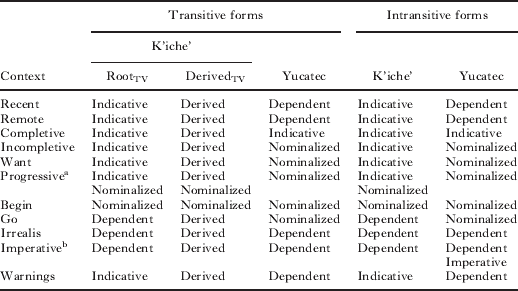
The next step in the Comparative Method is to identify the contexts in which the grammatical forms are used. While K'iche' and Yucatec preserve a number of cognate status forms, their use has changed dramatically. Yucatec extended the nominalized forms to incompletive and progressive contexts resulting in an increase in both the contexts of use and the frequency of nominalized verbs in Yucatec (Bricker, Reference Bricker1981).Footnote 3 Yucatec further restricts the use of the indicative form since the language uses the dependent form to mark recently (see (6) above) and remotely completed events. Yucatec now restricts the indicative forms (/-ih/, /-ah/) to mark only the completive aspect. Therefore, we consider the indicative form to be highly restricted in Yucatec. We consider nominalization to be highly restricted in K'iche', since K'iche' speakers use nominalized forms in only a small set of complement clauses and idiomatic expressions (Mondloch, Reference Mondloch1981; Larsen Reference Larsen1988). K'iche' lacks a distinct imperative form, while Yucatec has a distinct imperative form for intransitive verbs which contrasts with the dependent form that is also used in imperative contexts. K'iche' uses the derived status suffix /-VVj/ on derived transitive verbs in indicative and subjunctive contexts, whereas Yucatec extends the indicative, dependent, and nominalized forms to derived transitive verbs. Table 3 uses the form labels in Table 2 to display the contexts of use for each status suffix form in K'iche' and Yucatec.
Contexts of use for the status suffix forms in K'iche' and Yucatec

notes: [a] K'iche' allows both indicative and nominalized verb forms with the progressive.
[b] Yucatec uses dependent forms with transitive imperative verbs and imperative or dependent forms with intransitive imperative verbs.
The first column in Table 3 lists specific contexts of use while the following columns list the forms of the K'iche' and Yucatec status suffixes that are used in each context. The column labeled ‘root’ for K'iche' shows the status suffix forms that appear on root transitive verbs. The derived column shows where the derived suffix form /-VVj/ appears on derived transitive verbs in K'iche'. K'iche' speakers have the option of using indicative or nominalized verbs as complements to the progressive verb. The transitive and intransitive forms in Yucatec are shown in separate columns. Yucatec speakers have the option of using dependent or imperative forms of intransitive verbs in imperative contexts.
While Table 2 shows that K'iche' and Yucatec have similar status suffix forms, Table 3 shows how the use of the suffixes differs between K'iche' and Yucatec. Thus, although both languages have ‘rich’ status suffix paradigms marking contrasts in transitivity, verb class, mood, and clause position, the languages differ in how they deploy the status markers. We can take advantage of this natural experiment to explore the effect that differences in the contexts of use have on children's acquisition of the status suffixes. Children might acquire status suffixes that are used frequently before they acquire suffixes with restricted contexts of use. Status suffixes that are used in many contexts might appear to be used everywhere, whereas status suffixes that are used in restricted contexts might appear to be used nowhere. The structural similarity of the status suffix paradigm in K'iche' and Yucatec allows us to isolate the effect of frequency from the dimensions of transitivity, verb class, mood, and clause position on the children's acquisition of the status suffixes.
THE ACQUISITION OF MAYAN STATUS SUFFIXES
Once the grammatical forms and their contexts of use have been identified, we can compare how children use the forms in each context of use. We tackle this problem by assessing how frequently K'iche' and Yucatec children produce the status suffixes in their obligatory contexts, as well as assessing how productively the K'iche' and Yucatec children combine verbs with different status suffixes. Finally, we analyze the types of overextensions the children produced.
Participants and general measures
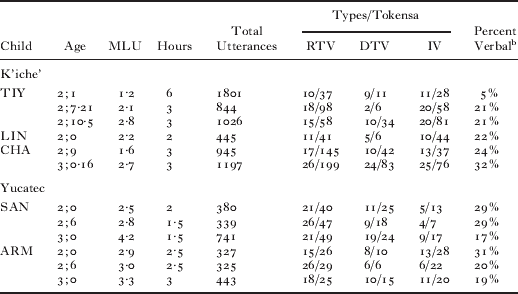
We derived the data for this article from recordings made in the children's homes as the children interacted with other family members and the investigators. Between 1978 and 1980, Pye recorded longitudinal samples of children acquiring K'iche' in the town of Zunil, Guatemala (Pye, Reference Pye1980, Reference Pye and Slobin1992). From 1995 to 1999, Pfeiler recorded longitudinal samples of children learning Yucatec in the town of Yalcobá in the eastern part of the state of Yucatán, Mexico (Pfeiler, Reference Pfeiler, Voeikova and Dressler2002, Reference Pfeiler, Bittner, Dressler and Kilani-Schoch2003). The recordings generally include the mother of the primary subject and a male K'iche' and female Yucatec assistant in addition to the primary participants and other siblings. We selected two children for each language, and selected between one and six hours of recordings for the children at about two, two and a half and three years of age. The K'iche' recordings include longitudinal data from only one child at two years of age. Therefore, we substituted data from another two-year-old K'iche' child (LIN) to fill this gap. These data were collected at the same time and under the same conditions as the longitudinal recordings. Table 4 provides summary statistics for the language samples that we analyzed for this study. It includes the total number of types and tokens that the children produced for each class of verbs in K'iche' and Yucatec, including both the correct and incorrect verb forms.
Mayan language sample measures
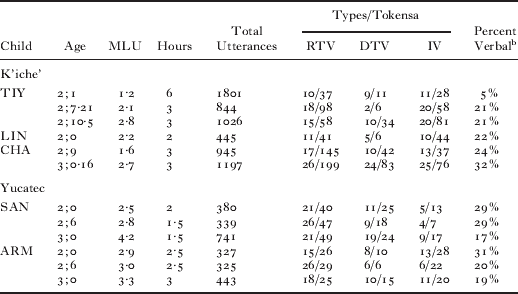
notes: [a] RTV – root transitive verb; DTV – derived transitive verb; IV – root intransitive verb.
[b] Percent verbal includes all predicate classes divided by the total number of utterances.
Although the K'iche' study was made in 1978 and the Yucatec study was made in the 1990s, the resulting K'iche' and Yucatec datasets are fairly similar. The children grew up in largely monolingual environments, and the language used in the families was exclusively K'iche' or Yucatec. CHA's family operated a restaurant, and her parents used Spanish with a few of their customers, but they used only K'iche' in speech to their children in the home. One Yucatec father was an incipient bilingual working as a bricklayer in the touristic Caribe area. The only contact the Yucatec children had with the Spanish language was through the television in a neighbor's house. The K'iche' children heard Spanish on the radio. We analyzed more hours from the K'iche' recordings than from the Yucatec recordings, but the children produced similar numbers of verbal utterances.
Production frequency
We used Brown's (Reference Brown1973) measure of the percentage use of morphemes in their obligatory contexts to assess the frequency of the children's status suffix production. We applied Brown's measure to the status suffixes by counting the number of verb tokens the children produced with each status suffix in each context of use (shown in Table 3). We analyzed the children's erroneous use of suffixes in a separate overgeneralization analysis (see below). We remind readers that some of the status suffixes are obligatory only in clause-final position.
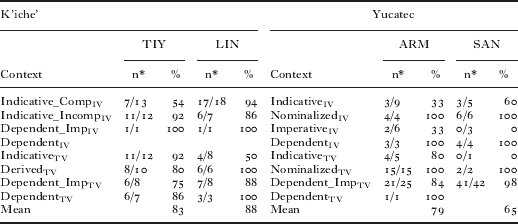
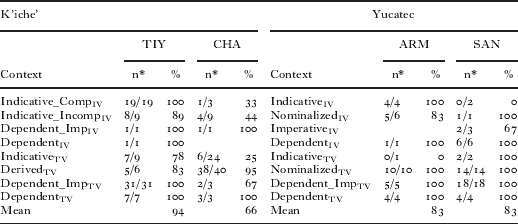
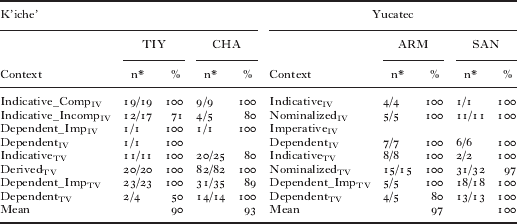
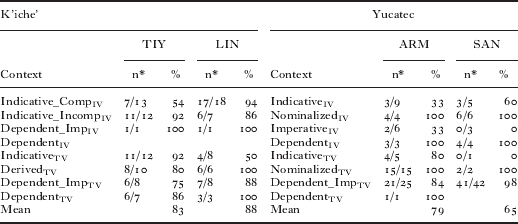
The results for each age period are shown in Table 5. Each row in Table 5 displays the status suffixes in K'iche' and Yucatec with the same contexts of use. We divided forms with different contexts of use in the two languages into the corresponding contexts in each language. For example, we divided the indicative forms in K'iche' into the indicative forms used in completive contexts (Indicative_Comp) and the indicative forms used in incompletive contexts (Indicative_Incomp). This procedure allowed us to compare the use of the completive indicative form in K'iche' in the same contexts as the indicative form in Yucatec, while comparing the use of the incompletive indicative form in K'iche' to the use of the nominalized form in Yucatec that is used in the same contexts. We also divided the dependent forms by their use in imperative (Dependent_Imp) and in non-imperative dependent contexts (Dependent). Recall that Yucatec has a distinct imperative form for intransitive verbs. These divisions enable us to evaluate the separate contributions of form and function on the children's status suffix productions.
Percent use in obligatory contexts of status suffixes at 2;0 (*tokens/contexts)
Percent use in obligatory contexts of status suffixes at 2;6 (*tokens/contexts)
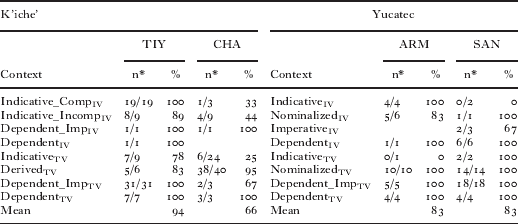
Percent use in obligatory contexts of status suffixes at 3;0 (*tokens/contexts)
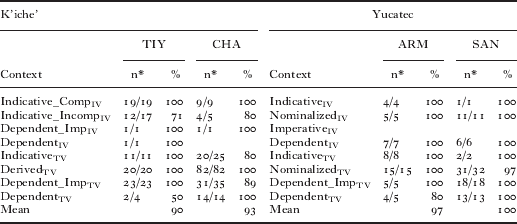
Two-year-old Mayan children generally produce the status suffixes with a remarkable degree of success. The children continue to produce the status suffixes in a high frequency of their obligatory contexts as they grow older. We provide examples of the two-year-old children's production of status suffixes in (8).
(8) Two-year-old production of status suffixes
Root intransitive verb Root transitive verb
(a) K'iche' TIY (2;1) LIN (2;0)
loq nchapu
=ch-at-el-oq =k-ø-in-chap-oh
imp-2abs-leave-depiv inc-3abs-1erg-grab-indtv
‘Leave!’ ‘I will grab it.’
(b) Yucatec ARM (2;0) SAN (2;0)
káhak kaxtik
=sáan kah-ak-ø =k-u kaxt-ik-ø
now begin-depiv-3abs inc-3erg find-nomtv-3abs
‘Now it began.’ ‘She finds it.’
The K'iche' and Yucatec children have a mean rate of status suffix production of 79% in obligatory contexts. A binomial distribution predicts the two-year-old children's rate of production in Table 5a would split evenly between the rates of production greater than the mean of 79% (=21) and those less than 79% (=8). The binomial test shows that the actual distribution is highly unlikely (z=−2·23, p<·05). These results indicate that Mayan children generally have an early and accurate knowledge of the inflectional paradigm for status suffixes.
We find individual differences in both K'iche' and Yucatec. The two-year-old K'iche' children produced status suffixes with great accuracy (83% mean for TIY; 88% mean for LIN). The K'iche' child CHA at 2;9 had a much lower mean (66%). We also found differences among the children in the production of individual suffixes. TIY at 2;0 produced the Indicative_CompIV suffix at 54%, while LIN produced the IndicativeTV suffix at 50%. These were the only suffixes that had such low rates of production, and we find it significant that these children display difficulty producing different suffixes. CHA at 2;9 had difficulty producing three different suffixes (the Indicative_CompIV at 33%, the Indicative_IncompIV at 44%, and the IndicativeTV at 25%). Thus, CHA displays considerably more difficulty in producing the status suffixes than either TIY or LIN.
The two-year-old Yucatec children had mean production frequencies of 79% (ARM) and 65% (SAN). The Yucatec children both had difficulty producing the indicative and imperative status suffixes on intransitive verbs. The Yucatec children display more uniformity in status suffix production than the K'iche' children. Even though K'iche' and Yucatec have rich status suffix paradigms with similar contrasts, the data suggest that K'iche' and Yucatec children have different production profiles. The CM enables us to explore the details of this cross-linguistic difference.
Productivity
If we confined our analysis to the use of the suffixes in their obligatory contexts, we would conclude that K'iche' children have individual difficulties producing different status suffixes, whereas Yucatec children have specific difficulty producing the indicative and imperative status suffixes on intransitive verbs. There remains the possibility that the children's use of status suffixes is not productive. The children might rely on unanalyzed verb forms instead of rules to produce the status suffixes. The children's use of status suffixes could be lexically based rather than rule based, consistent with Pinker's Lexical Paradigm Hypothesis (Reference Pinker1984) and Tomasello's Verb Island Hypothesis (Reference Tomasello1992) . The possibility of unanalyzed or frozen verb forms is likely, since the children produced few verb tokens in contexts where the status suffixes are clearly obligatory, i.e., in clause-final contexts. If the children's suffix use is lexically based, they would presumably treat each suffixed verb as a separate lexeme without distinguishing the root from the suffix. The Mayan children at ages 2;0 and 2;6 may have constructed lexical paradigms, but not yet extracted more general rules for suffix application.
We tested the productivity of the children's status suffix production by applying the analysis of inflectional contrasts pioneered by Pizzuto and Caselli (Reference Pizzuto, Caselli and Levy1994), Fernández Martínez (Reference Fernández Martínez, López Ornat, Fernández, Gallo and Mariscal1994), and Gathercole, Mueller, Sebastian, and Soto (Reference Gathercole, Mueller, Sebastian and Soto1999) . Gathercole et al. analyzed the number of inflections that children produced with each verb in Spanish. The idea is that children with a productive knowledge of verb suffixes should produce verbs with more than one suffix. If Mayan children only produce each verb with a single suffix, they could well display great accuracy in suffix use but not be able to produce the verb with a different suffix.
We analyzed the number of status suffixes the children produced with each verb to determine whether there was any evidence of early contrasts in the suffixes the children attach to each verb. For this analysis we analyzed the root and derived verbs together. We counted each production of a verb with a different suffix, including the absence of suffixes where their absence is appropriate in clause-medial contexts, as a contrast. We did not include the children's erroneous use or non-adult omission of suffixes in our productivity analysis. We provide examples of the children's status suffix contrasts in (9) (‘C-m’=‘Clause-medial’; “C-f”==“Clause-final).
(9) Contrastive use of status suffixes
(a) K'iche' Intransitive Transitive
TIY (2;0) LIN (2;0)
C-m wa le' no, awil taj
=k-ø-wa le' =no, ma k-ø-aw-il taj
inc-3abs-eat it no, neg inc-3abs-2erg-see irreal
‘It's eating.’ ‘No, you do not see it.’
C-f ik wilo
=k-ø-wa'-ik =k-ø-inw-il-oh
inc-3abs-eat-indiv inc-3abs-1erg-see-indtv
‘It's eating.’ ‘I see it.’
Yucatec Intransitive Transitive
ARM (3;0) SAN (2;6)
C-m bi meyah t'ok uhe
=(h) bin-ø meyah =t'ok u heel
cmp go-3abs work break.deptv 3erg replacement
‘He went to work.’ ‘Break another one!’
C-f bini xen t'okeh
=(h) bin-ih-ø =xen t'ok-eh-ø
cmp go-indiv-3abs go.imp break-deptv-3abs
‘He is gone.’ ‘Go, break it!’
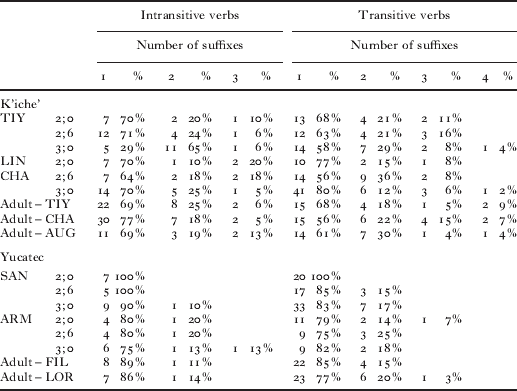
The majority of the multiple suffixes on K'iche' verbs are due to the contrast between the clause-final and non-final verb forms as shown in (9a). In Yucatec, contrasts between transitive and intransitive forms of the verbs were included, e.g., the difference between the forms lúub-s (fall-CAUSE) ‘make fall’ and lúub-uk (fall-DEPIV) ‘to fall’. Table 6 shows the number of verb types that the K'iche' and Yucatec participants produced with one, two, three, and four different status suffixes.
Number of verb types in child and adult K'iche' and Yucatec with multiple suffixes
The data in Table 6 show that at two years of age K'iche' children produce multiple verbs with different endings, while even three-year-old children acquiring Yucatec produce most verbs with a single status suffix. This difference suggests that whereas K'iche' children are using the status suffixes productively, Yucatec children rely upon a lexical strategy that generates verbs with suffixes as frozen forms.
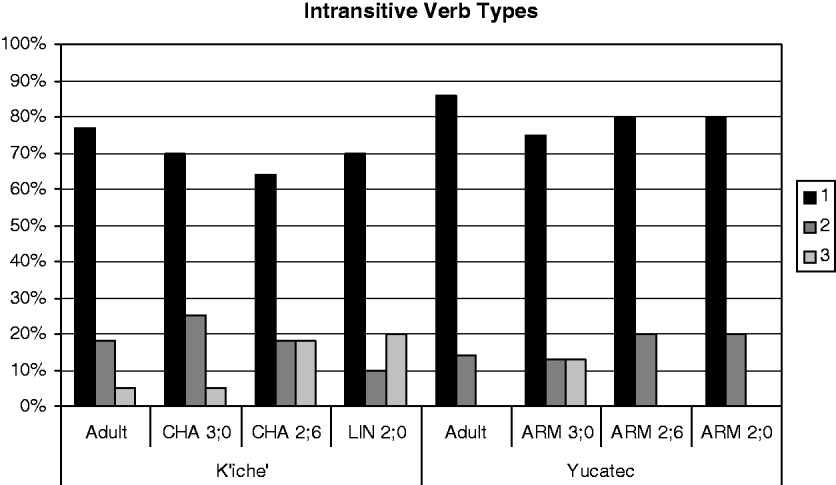
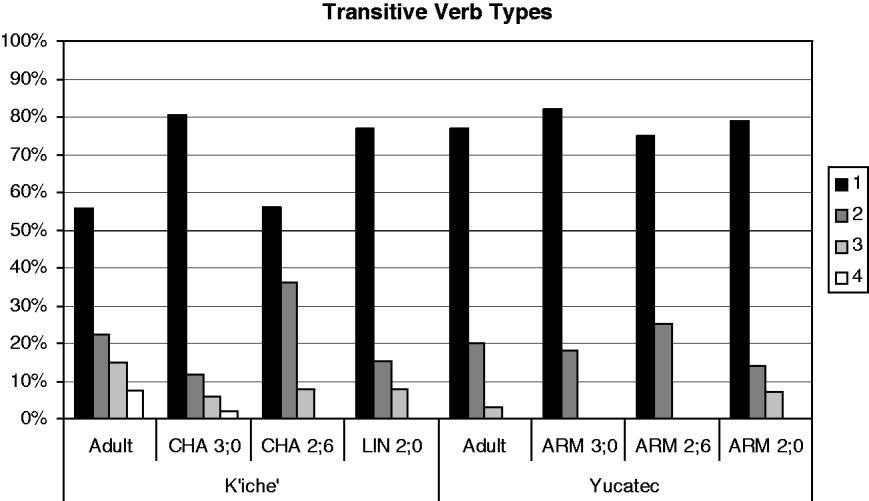
To better understand the child data, we analyzed the distribution of status suffixes in caregiver speech. This analysis allowed us to determine how productive adult speakers were in the use of status suffixes, and how closely children came to their presumed target. Specifically, for K'iche' we analyzed a one-hour sample of CHA's mother (BAS) and the male K'iche' investigator (AUG) speaking to TIY. For Yucatec, we analyzed one-hour samples of ARM's mother (LOR) and SAN's mother (FIL). We counted the number of distinct suffixes the adults produced on each verb. These results are included in Table 6 for comparison with the children's data. Our input analysis provides a basis for assessing the children's production of the status suffixes. The input analysis shows that 56% to 77% of K'iche' verbs and 77% to 89% of Yucatec verbs addressed to children only appear with a single suffix (Figures 1 and 2). Only 6–15% of the verbs appeared with more than two suffixes in the adult speech.
Percent of intransitive verb types with one or more status suffixes.
Percent of transitive verb types with one or more status suffixes.
We conclude that K'iche' children generally produce status suffixes more accurately than Yucatec children, as well as producing a greater variety of status suffixes on their verbs. The children's use of the suffixes closely tracks the adult use of the suffixes in both languages. The adult grammar limits the opportunity that children have to display productive use of the status suffixes. In the absence of the adult data, we might misinterpret the productivity of the Yucatec children as evidence of a limited knowledge of rule-based production. Although Yucatec children receive more limited evidence for the contrasts in status suffixes from their input than K'iche' children, the difference in adult productivity does not explain the selective deficits that the Yucatec children exhibit in the production of the indicative and imperative suffixes on intransitive verbs. The following section examines whether overextension errors in the children's suffix production are consistent with the observed cross-linguistic differences in accuracy.
Overextension
Overextensions provide a different assessment of inflectional knowledge. While frequency of use and productivity assess the use of inflections within their obligatory contexts, the analysis of overextended inflection assesses children's use of inflections in contexts outside the boundaries of the adult grammar. We expect children acquiring K'iche' and Yucatec to produce similar types of overextensions because the status contrasts in the two languages are similar. Differences in the children's overextensions indicate the effect of language-specific structural differences in the status paradigms. Differences between the individual participants provide information on the limits of the children's performance.
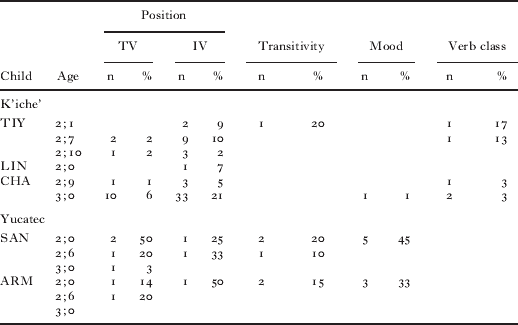
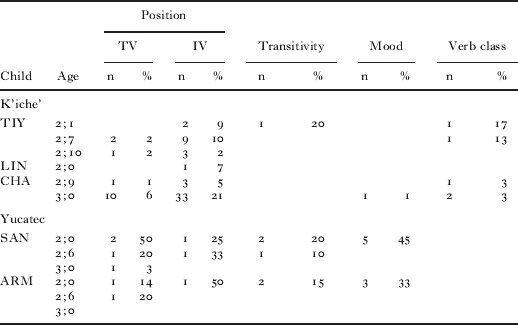
Table 7 shows the number and types of overextensions involving status suffixes that the K'iche' and Yucatec children produced. Other than the clause final/non-final distinction, the children produced a few, scattered overextensions of transitivity, verb class, or mood (Pye, Reference Pye1983, Reference Pye1990; Pfeiler Reference Pfeiler, Bittner, Dressler and Kilani-Schoch2003). The K'iche' children exhibited some overextensions for the derived transitive verb class distinction, while the Yucatec children exhibited some overextensions for modality distinctions. The transitivity overextensions appear to be less systematic in both languages. In the following sections, we analyze the children's status overextensions by transitivity, verb class, mood, and clause position (clause-internal vs. clause-final).
Status suffix overextensions
Overextension by transitivity
The errors in transitivity illustrate a difference between the languages as well as between the individual learners of Yucatec. The results in Table 7 show that TIY produced a single error for transitivity. TIY's transitivity error (shown in (10a)) is due to the fact that we counted as incorrect her use of the transitive verb suffix -oh rather than the obligatory focus antipassive form -ya'owik.Footnote 4 The exclamation mark (‘!’) in these examples indicates the overextension. This error was due to TIY's failure to use the antipassive verb form rather than to her failure to supply the correct suffix to an intransitive verb. The example in (10b) shows that CHA produced the same type of overextension. Outside of the data we examined for this study, the K'iche' children made a total of five transitivity errors in all the data for TIY and CHA (Pye, Reference Pye and Slobin1992: 287). We did not observe a similar difficulty with focus antipassive constructions in Yucatec due to the absence of this construction in the Yucatec children's productions. We conclude that K'iche' children do not make errors in marking verb transitivity, but have some difficulty with the focus antipassive. We expect Yucatec children to have a similar difficulty.
(10) Examples of the K'iche' children's transitivity errors
(a) TIY (2;1·17)
no', at !oh
=no', at x-at-ya'-ow-ik
no, you cmp-2abs-give-focus-indiv
‘No, you gave it.’
(b) CHA (3;3·14)
jachin ya'-!oh b'ay chupam
jachin x-ø-ya'-ow lee ab'aj chi-u-paam
who cmp-3abs-give-focus the rock at-3erg-stomach
‘Who put the rock inside it?’
The Yucatec children produced different types of transitivity overextensions (11). Four of the five transitivity errors in Table 7 result from the substitution of the transitive imperative suffix /-eh/ for the intransitive imperative suffix /-en/. SAN overgeneralized the transitive imperative suffix /-eh/ to intransitive verbs twice at 2;0 and once at 2;6 (11a). The imperative is a problematic form in the adult grammar. The verb taal ‘come’ has the irregular imperative form kotéh, which resembles the transitive imperative form in the adult's pronunciation. This verb is frequent and may have influenced the children's production of the imperative forms of other intransitive verbs. ARM once added the sound /e/to the irregular verb xen ‘go’, which does not take an imperative suffix (11b). Although the status of ARM's error as a transitivity overgeneralization is questionable, it illustrates a rare instance in which a Yucatec child extends a suffix to an irregular verb. We do not observe this type of overextension in K'iche'. The K'iche' verb -pet ‘come’ has the irregular imperative form (ta)saaj, which resembles the imperative form of derived transitive verbs. K'iche' children do not extend the derived transitive suffix /-VVj/ to other intransitive verbs.
(11) Examples of the Yucatec children's transitivity errors
(a) SAN (2;6·7)
oké Chito=ook-!eh Chitoenter-!deptv Chito‘Come in, Chito!’
(b) ARM (2;0·16)
xené cha'an=xen-!eh cha'angoimp-!deptv watch‘Go watching!’
(c) ARM (2;0·7)
tiwuk'i=t-inw uk'-!ihcmp-1erg drink-!indiv‘I drank it.’
ARM once added the sound /i/ to a transitive verb at 2;0 (11c). This sound resembles the intransitive indicative suffix /-ih/, but this error is not clear from the context, and can be interpreted as an attempt to say t(áan) inw uk'ik ‘I am drinking it’. This interpretation adds the transitive nominalized suffix /-ik/ rather than the intransitive indicative suffix /-ih/, but because the context is completive rather than incompletive the /-ik/ interpretation is unlikely. Altogether, the Yucatec children only produced sporadic instances of forms which could be conservatively attributed to difficulty with transitivity. The results in Table 7 show that the children made a total of five transitivity errors in all the data for SAN and ARM. We conclude that, like K'iche' children, the Yucatec children recognize the significance of the transitivity dimension by two years of age. The results also illustrate why the Yucatec children may encounter specific difficulty in the production of indicative and imperative status suffixes on intransitive verbs.
Overextension by verb class
The K'iche' children produced some overextensions by verb class while the Yucatec children did not. The K'iche' children occasionally omitted the final velar fricative /x/ (written <j>) of the derived transitive suffix, which could be interpreted as an overextension of the root transitive status suffixes (12). These omissions are unusual in that the K'iche' children commonly produced the derived status suffix on over 80 percent of their derived transitive verbs, including the same verbs where they omitted the suffix (cf. Table 5).
(12) Verb class overextension in K'iche'
TIY (2;7·21)
qxa chu q'ab' chik=x-ø-q-esa-j lee u-q'ab' chikcmp-3abs-4erg-take_out-dertv the 3erg-hand again‘We took out his/her hand again.’
Children acquiring Yucatec did not overextend status suffixes on the basis of verb class. We interpret the small number of verb class errors in K'iche' as cases of final consonant omission rather than verb class overextension due to general accuracy of the derived transitive verb suffixes in K'iche' and the absence of verb class errors in Yucatec.
Overextension by mood
We find a striking difference in the prevalence of overextension due to mood between K'iche' and Yucatec (significant at α=·05 by the binomial test). One K'iche' child overextended a verb form between moods once, while two-year-old Yucatec children do so relatively frequently. The Yucatec overextensions by mood are due entirely to substituting other forms for the indicative suffix /-ih/ on intransitive verbs. Most of these examples involved the verb -lúub ‘fall’. In (13a) SAN overextends the dependent suffix /-Vk/ to an indicative context. The Yucatec children also overextended the nominalized suffix /-Vl/ in place of the indicative suffix /-ih/ (13b). These substitution errors reinforce the results from production which indicate that children have particular difficulty producing the intransitive indicative suffix in its obligatory contexts.Footnote 5
(13) Overextensions by mood in Yucatec
a. SAN (2;0) b. ARM (2;0)
lúubuk lúubul
=(h-)lúub-!ih-ø =(h-)lúub-!ih-ø
cmp-fall-!indiv-3abs cmp-fall-!indiv-3abs
‘It fell.’ ‘It fell.’
We conclude that a qualitative difference exists between mood overextensions in K'iche' and Yucatec. We can eliminate structural considerations as an explanation for this difference because the indicative suffix has the same structural position in the grammars of K'iche' and Yucatec. The Yucatec children only produced overextensions by mood for the indicative suffix on intransitive verbs. The same type of overextension would be apparent on transitive verbs were the children to extend the nominalizing suffix /-ik/ or the dependent suffix /-eh/ in place of the indicative suffix /-ah/ on transitive verbs.
We believe that the highly restricted use of the indicative suffix in Yucatec accounts for its delayed acquisition relative to K'iche'. The suffix is only used with third person subjects in completive contexts in Yucatec, while it is used with all subjects in both completive and incompletive contexts in K'iche'. The absence of such substitutions in the Yucatec data may well be due to chance, because the children produced few examples of transitive verbs in indicative contexts. The absence of overextensions by mood on transitive verbs might also be due to the difference in positional constraints between the intransitive and transitive indicative status suffixes. While the intransitive suffix /-ih/ is only used with third person absolutive markers, the transitive suffix /-ah/ can optionally appear with non third person absolutive markers. The production data as well as the overextension results suggest that this difference in positional constraints affects both the frequency of use and types of overextension of the status suffixes.
Overextension by position
All of the children produced overextensions by position on both intransitive and transitive verbs (14). The children should not have produced these status suffixes in clause-medial position. The morpheme gloss line provides a gloss for the overextended suffix. CHA produced thirty-three tokens of positional overextensions on her intransitive verbs at 3;0. The Yucatec children produced fewer tokens of positional overextensions, but both Yucatec children produced positional overextensions over a sustained period of time. Unlike with the handful of transitivity errors, we have little doubt that the positional overextensions are a reliable feature of Mayan language acquisition.
(14) Overgeneralizations of final suffixes in non-final position
Intransitive Transitive
K'iche' TIY (2;7·28) CHA (3;0·8)
ek eyub' no, tijo la
=x-ø-b'ee-!ik pa juyub' =no k-ø-in-tij-!oh la
cmp-3abs-go-!indiv to mountain no, inc-3abs-1erg-eat-!indtvemph
‘He went to the mountain.’ ‘No, I am eating it!’
Yucatec ARM (2;0·16) SAN (3;0·10)
ts'o'oki bala' uk'eh awo'och biberón
=(h) ts'o'ok-!ih le ba'al-a' =uk'-!eh aw-o'och biberón
(cmp) finish-!indiv det thing-prox drink-!deptv 2erg-cl baby_bottle
‘This is already finished.’ ‘Drink your baby bottle!’
The positional overextensions support the idea that the children produce the verb stems as frozen forms with unanalyzed status suffixes. The use of unanalyzed verb stems accounts for the high frequency of using the status suffixes in clause-final position. If the children had truly failed to analyze the status suffixes, we would expect them to produce more positional overextensions in non-final position. We used the median test to evaluate the significance of the difference between the percentage of positional overextensions in K'iche' and Yucatec (Siegel, 1956). The rate is regularly below the median of 9·5% in non-final contexts for the K'iche' children and above the median of 9·5% for the Yucatec children. Table 8 shows this comparison. The difference between K'iche' and Yucatec is significant (α=·05). This difference reinforces the difference in productivity that we found for the children's status suffixes in K'iche' and Yucatec. We conclude that the positional contrast is sensitive to the unanalyzed use of verb stems in both languages, and compatible with a greater degree of productivity in K'iche' than in Yucatec.
Median test of the difference in positional overextensions in K'iche' and Yucatec

Comparison of the children's overextensions in K'iche' and Yucatec provides critical insight into the nature of the overextensions that is not available through the analysis of the overextensions within a single language. The positional overextensions are so frequent in K'iche' and Yucatec that we can be confident in claiming that children have difficulty observing the clause-final constraint. The difference between the rates of positional overextensions in K'iche' and Yucatec may reflect the degree to which the Yucatec children still treat the status suffixes as frozen forms. The presence of modality overextensions in Yucatec and verb class overextensions in K'iche' point to the language-specific factors that predispose children to produce these types of overextension. The differences in transitivity overextensions point to special conditions that can promote status suffix overextension as well as the possibility that rare constructions, such as the focus antipassive construction, are predicted to produce overextensions even though their use may not be observed in the children's language. In the following section, we analyze the degree to which frequency in the adult input can account for the children's production of status suffixes.
INPUT FREQUENCY
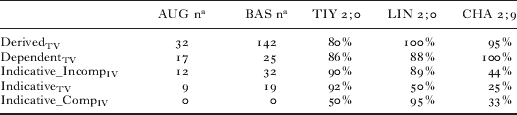
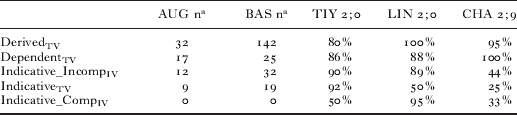
We analyzed the same samples of adult speech that we used in the productivity analysis to determine the frequency with which adult speakers produce status suffixes in K'iche' and Yucatec. We compare the input frequencies for the two K'iche' adults with the children's production of the status suffixes in Table 9. The children's percent use in obligatory contexts is derived from Table 5.
Comparison of input frequencies and status suffix production in K'iche'
note: [a] Number of tokens.
The K'iche' adults confined their production of verb suffixes largely to the indicative and dependent forms, although both adults produced at least one perfect token of a transitive verb. The adults used many derived transitive verbs in their speech. Neither adult used an intransitive verb in the completive aspect. Our analysis shows that K'iche' children hear status suffixes on less than half of the intransitive and root transitive verbs that adults produce due to the clause-final constraint which blocks the production of indicative status suffixes. We used the Spearman rank order statistic corrected for ties (Siegel 1956) to compare the adults' production of status suffixes with TIY and LIN's percent use of the status suffixes at 2;0, and with CHA's production at 2;9. The correlation statistics are shown in Table 10. We did not find a significant correlation between the children's use of the status suffixes and input frequency in K'iche'. Although CHA's production matches the adults' frequency order fairly closely, it is not significantly correlated with the adult frequency order.
Spearman rho rank order correlations for K'iche'

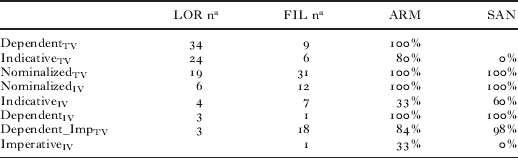
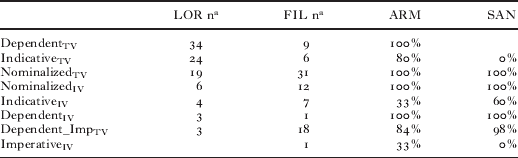
We also investigated the correlation between frequency of the status suffixes in the adult Yucatec speech and the children's frequency of status suffix use in obligatory contexts. This comparison is shown in Table 11.
Comparison of input frequencies and status suffix production in Yucatec
note: [a] Number of tokens.
LOR produced roughly equal numbers of transitive indicative and nominalized suffixes in clause-final position, FIL produced five times more transitive nominalized forms than transitive indicative verb forms. FIL produced more transitive imperative suffixes and fewer transitive dependent suffixes in final position than LOR. These results indicate that these Yucatec adults had different styles of speaking to their children, just as mothers in the United States do (Kaye, Reference Kaye1980).
We compared the children's use of the status suffixes shown in Table 5 with the input frequencies shown in Table 11. We did not find a correlation between the children's use of the status suffixes and input frequency in Yucatec. The Spearman rank order correlations (corrected for ties) for Yucatec are shown in Table 12. We conclude that the Yucatec children's use of the status suffixes is not positively linked to the adult frequency of use, although this result must be treated as tentative given the small number of adult utterances we analyzed for Yucatec.
Spearman rho rank order correlations for Yucatec

We also analyzed whether the language-specific and individual deficits in the children's status suffix production might be related to the frequency of the adult suffix production. Recall that TIY at 2;0 produced the Indicative_CompIV suffix at 54%, while LIN produced the IndicativeTV suffix at 50% (Table 5a). The two K'iche' adult speakers produced status suffixes at frequencies that were statistically similar to one another (r s=0·94, p<·05). The similarity between adult status suffix production does not account for the individual differences we found between the K'iche' children.
The two-year-old Yucatec children both had difficulty producing the indicative and imperative status suffixes on intransitive verbs, but not on transitive verbs (Table 5a). The frequency of the adult status suffix production does not account for this difference. While both adults produced few tokens of the imperative suffix on intransitive verbs, they also produced few tokens of the dependent suffix on intransitive verbs. ARM and SAN had no difficulty producing the dependent suffix, but had great difficulty producing the imperative suffix on intransitive verbs.
We conclude that our data show that input frequencies were not responsible for promoting status suffix production in children acquiring K'iche' or Yucatec. The adult input frequencies are not correlated with the overall frequency of production in the children and do not explain the language-specific differences between children acquiring K'iche' and Yucatec. The absence of a correlation between the children's acquisition of verb inflection and parental frequency expands an earlier result for K'iche' (Pye, Reference Pye1980). The absence of positive correlations between adult speech and the children's status suffix production in both K'iche' and Yucatec provide independent confirmation that children do not acquire Mayan status suffixes by imitating adult productions. In the following section, we summarize our results and provide our conclusions on the Comparative Method of language acquisition research.
CONCLUSION
In this article we introduced the Comparative Method for language acquisition research and used it to analyze the production of status suffixes in the speech of children acquiring K'iche' and Yucatec Maya. The CM allowed us to control the forms, verb classes, and analytical procedures we used to compare the acquisition of morphosyntactic features in two Mayan languages. These controls insure that the results we report reflect the children's use of the status suffixes rather than differences in counting procedures.
K'iche' and Yucatec have rich status suffix paradigms which fall outside the scope of acquisition theories that reference syntactic projections for tense and agreement to account for the acquisition of verb affixes. To the degree that K'iche' and Yucatec children successfully produce status suffixes in obligatory contexts, they demonstrate that the richness of inflectional paradigms rather than language-specific instantiations of agreement or status promotes the early use of verb suffixes.
We found a qualitative difference in suffix production between the K'iche' and Yucatec children. Yucatec children display special difficulty with the indicative and imperative status suffixes on intransitive verbs. K'iche' children display more individual variation. These differences were not found in the adult use of the suffixes. The K'iche' adults use the status suffixes with similar frequencies, whereas the Yucatec adults display different frequencies of use. The adult frequencies of use do not account for the individual or cross-linguistic differences in the children's suffix productions.
We have drawn attention to the difficulty that Yucatec children exhibit in the production of indicative and imperative suffixes on intransitive verbs. Yucatec children produce these suffixes at relatively low rates in their obligatory contexts and display a tendency to use other status suffixes in their place. K'iche' children do not have similar difficulties. One reason for this difference is that Yucatec has a specific form for imperative intransitive verbs. K'iche' does not. Instead, K'iche' extends its dependent suffix to imperative contexts. Yucatec also extends its dependent suffix to imperative contexts, which further restricts the use of the imperative suffix in Yucatec.
We can derive a more general prediction from this observation. The key connection between the imperative and the indicative intransitive suffixes in Yucatec is their relatively restricted context of use. While indicative intransitive suffixes are used in seven of eleven contexts shown in Table 3 for K'iche', the indicative and imperative suffixes only appear in one context each in Yucatec. In addition, Yucatec allows the dependent suffix to appear in the same contexts, which further erodes Yucatec children's exposure to the indicative and imperative suffixes. The Comparative Method highlights such cross-linguistic differences in the contexts of use and makes it possible to analyze their effect on language acquisition. Essentially, the CM provides the means for assessing the cross-linguistic equivalence of linguistic forms across several dimensions at once.
Space restrictions only allow us to present a brief example of the Comparative Method of language acquisition research. We have left several important issues to future research. These issues can easily be incorporated into the CM and would be expected to strengthen its results. This outcome is the basis for our claim that the CM institutes a cumulative approach to acquisition research. One issue that we set aside is the acquisition of status suffixes on the active and positional intransitive verb classes. Since both K'iche' and Yucatec have these classes of verbs, and others, a future analysis would compare the acquisition of status suffixes on these verb classes in K'iche' and Yucatec. The analytical procedures that we developed in this article can be extended in a straightforward manner to the status suffixes on other verb classes.
A second issue that we set to one side is the question of how children acquire status suffixes in other Mayan languages. The Comparative Method ultimately demands an analysis of every language within a language family. We can extend the analytical procedures that we developed for K'iche' and Yucatec to analyze the acquisition of status suffixes in other Mayan languages. We would use the dimensions of transitivity, verb class, mood, and clause position to organize the comparison, and anticipate that differences in contexts of use would affect the acquisition of status suffixes in additional languages.
A final issue that we will address in future research is the interaction between the acquisition of the status suffixes and the other morphosyntactic features of the Mayan verb complex. We can compare how children acquire the status suffixes relative to the ergative prefixes on the verbs. In essence, we can use the CM to create a template for cross-linguistic research. This template shows exactly which linguistic features need to be documented in other languages through a variety of observational and experimental methods. We anticipate that acquisition data from other Mayan languages will inform our analysis of K'iche' and Yucatec in ways that we cannot now predict.
We applied the Comparative Method to the analysis of verb suffix acquisition in two Mayan languages in order to illustrate a systematic approach to cross-linguistic research. Existing cross-linguistic comparisons of tense and agreement acquisition, among others, lack the systematic comparison of forms and their contexts of use that the CM affords. The CM provides a method that enables researchers to rigorously define linguistic units. Without such a procedure, cross-linguistic comparison, as Bowerman suggested, will remain a blunt instrument that can only refute gross theoretical overgeneralizations.
APPENDIX: LIST OF ABBREVIATIONS
All K'iche' words are shown in the practical orthography developed by the Proyecto Lingüístico Francisco Marroquín (Kaufman Reference Kaufman1976). The orthographic symbols have their standard IPA values except: <tz>=/ts/, <ch>=/tʃ/, <b’>=/&alphagtwin;/, <tz'>=/ts'/, <ch'>=/tʃ'/, <x>=/ʃ/, <j>=/X/. We use <VV>to indicate long vowels. We use the following abbreviations: