Introduction
Outdoor mobility is a complex phenomenon. On the one hand, it is a basic human need and denotes the physical ability to move; on the other hand, it is instrumental to any trip outside the home, either on foot or by any means of transport. Outdoor mobility is the key to maintaining out-of-home activities. Walking also promotes health, delays the onset of disabilities, and postpones frailty, thereby contributing to subjective wellbeing, life satisfaction and ‘healthy ageing’. Mobility, or the ability to move about independently and safely in one's environment, is fundamental to independent living and the quality of life (Gorgon, Said and Galea Reference Gorgon, Said and Galea2007; Mollenkopf et al. Reference Mollenkopf, Marcellini, Ruoppila and Tacken2004; Ruuskanen and Ruoppila Reference Ruuskanen and Ruoppila1995). With advancing age, however, maintaining mobility may be jeopardised by the increasing risk of physical and sensory impairments (Cooper et al. Reference Cooper, Bilbrew, Dubbert, Kerr and Kirchner2001).
Outdoor mobility is also a precondition for participation in many social relationships and activities, important elements in the quality of life of older people (Schaie Reference Schaie, Schaie, Wahl, Mollenkopf and Oswald2003). Mollenkopf et al. (Reference Mollenkopf, Marcellini, Ruoppila, Flaschentrager, Gagliardi and Spazzafumo1997) showed that there is a clear connection between an older person's social situation and his or her mobility patterns. People who are tied into a closely interweaved network of family or friends are away from home more frequently than those with thin social networks. Individual factors like a person's age, health status and driving ability are important for outdoor mobility. External factors that restrict mobility include spatial constraints and technical limitations, such as no or remote shops and other facilities, and no or inconvenient public transport services (Mollenkopf et al. Reference Mollenkopf, Marcellini, Ruoppila, Flaschentrager, Gagliardi and Spazzafumo1997).
Walking is a key component of outdoor mobility, and recognised as one of the best forms of physical activity for older adults (Morris and Hardman Reference Morris and Hardman1997), albeit that to gain useful benefits from the exercise, the consensual recommendation is that 30 minutes of moderate-intensity physical activity (i.e. brisk walking) should be taken most days of the week (Pate et al. Reference Pate, Pratt, Blair, Haskell, Macera, Bouchard, Buchner, Ettinger, Heath and King1995). The amount of activity can be expressed by the time spent walking, the number of steps taken, or the distance travelled. Another feature of walking is that it is the transport mode ‘of last resort’, meaning that it can be undertaken by many older people who can no longer drive or use public transport. According to an American study, walking is the most common type of reported physical activity across all racial, ethnic, income and age groups (Siegel, Brackbill and Heath Reference Siegel, Brackbill and Heath1995).
Studies of outdoor mobility have examined the factors that influence outdoor mobility, such as age, gender, body mass, physical activity, illness and pain, as well as the effects of having and maintaining outdoor mobility (Simonsick, Guralnik and Fried Reference Simonsick, Guralnik and Fried1999). Participation in various measures of outdoor mobility varies greatly by level of education. Sainio et al. (Reference Sainio, Martelin, Koskinen and Heliövaara2007) concluded that common chronic diseases, obesity, smoking and overwork were the main intervening links between low education and mobility limitations. Melzer, Gardener and Guralnik (Reference Melzer, Gardener and Guralnik2005) stated that mobility problems are an early marker of the progression of disability, increased use of health-care facilities, and of institutionalisation among older people. Laukkanen, Heikkinen and Kauppinen (Reference Laukkanen, Heikkinen and Kauppinen1995) reported that the risk of death among people aged 75–84 years is significantly related to difficulties in outdoor mobility. A reduced capacity to walk tends to associate with more general functional limitations, as with difficulties in managing essential instrumental and social activities. Such incapacities produce chronic strain that in turn increases the risk of depression (Bruce Reference Bruce2001).
Aims and objectives
The purpose of this study was to examine whether and in which ways socio-demographic factors, coping resources and self-esteem mediate the relationships between outdoor walking ability and health status. Few, if any, studies have tackled these questions specifically among older people, so we focused on a large nationally-representative sample of people aged 55–79 years living in their own homes (‘in the community’) in Norway. The ambition was to interpret the findings in ways that could inform health promotion and wellbeing promotion activities among older people with functional limitations and as delivered by health and social care professionals.
The conceptual and theoretical framework
Self-esteem taps the extent to which we feel positive or negative about ourselves, and reflects an individual's subjective evaluation of self-worth and attitudes about the self (Ben-Zurr Reference Ben-Zurr2002; Rosenberg Reference Rosenberg1965). Finding that one's mobility is limited devalues self-esteem (Maly Reference Maly2005), and we expect that self-esteem influences mobility. A large and diverse multi-disciplinary literature with disparate theoretical perspectives suggests that high self-esteem associates with positive life goals, higher expectations, better coping, and more purposeful uses of time (Trzesniewski et al. Reference Trzesniewski, Donnellan, Moffitt, Robins, Poulton and Caspi2006). Self-esteem probably influences an individual's health-promoting behaviour. A recent study by Huntsinger and Luecken (Reference Huntsinger and Luecken2004) showed that self-esteem mediated the effects of attachment relationships on several health-promotion practices, such as reducing alcohol consumption and taking regular exercise. Positive bodily experiences from exercise programmes are linked to the improvement of physical self-perception and self-esteem (Asci, Kosar and Isler Reference Asci, Kosar and Isler2001; Fox Reference Fox2000). Negative bodily experiences, together with weight gain, deterioration in physical competence and somatic manifestations, could be negatively related to physical self-perception and self-esteem. Previous research has also shown that self-confidence and self-esteem are important psychological resources for coping with stressful life events (Pearlin and Schooler Reference Pearlin and Schooler1978; Rothbaum, Weisz and Snyder Reference Rothbaum, Weisz and Snyder1982).
Coping and coping activities
Coping or mastery is a psychological construct that captures perceptions about oneself as an active agent in one's environment. Coping is widely considered to be a fundamental characteristic that defines an individual's ability to influence their environment and control important life outcomes (Rothbaum, Weisz and Snyder Reference Rothbaum, Weisz and Snyder1982). Coping is motivated by the aim of holding on to life and resolving one's problems (Lombardi and Ulbrich Reference Lombardi and Ulbrich1997). Lazarus and Folkman (Reference Lazarus, Folkman, Lazarus and Folkman1984: 141) defined coping as ‘constantly changing cognitive and behavioural efforts to manage specific external and/or internal demands that are appraised as taxing or exceeding (the) resources of the person’. Carpenter and Scott (Reference Carpenter, Scott and Carpenter1992: 102) subsequently refined the definition as ‘activities engaged in with the intention of reducing or avoiding stress by reducing demands, increasing resources, creating more favourable beliefs and appraisals, or reducing the emotional reaction to stress’. Although Carpenter and Scott (Reference Carpenter, Scott and Carpenter1992) argued that their definition elaborated statements about intentions and the favourable appraisal outcome, the two definitions similarly represent coping as a process that extends from appraisal of demands to action. Researchers have suggested that coping resources influence how individuals perceive stressful life demands and psychological resources, and how patterns of thinking about stressful events affect emotional reactions. Important outcomes of coping may be related to self-esteem and self-confidence in mastering competence in different fields (Pearlin and Piolo Reference Pearlin, Piolo, Zarit, Pearlin and Schaie2003).
Coping is instigated when an individual finds a situation stressful. Stress results from an imbalance between perceived demands and perceived resources (Lazarus Reference Lazarus1993), and develops when a situation is appraised as threatening one's capability and coping responses. Personal characteristics may influence an individual's appraisal of potential stressors, as well as their perceived coping abilities, and thereby either intensify, attenuate or prevent stress reactions. As stress and coping theories suggest, supportive actions mediate between the perceived threat of the stressor and stress-related outcomes. Stressful events can take the form of appraised harm, threat or challenge (Lazarus and Folkman Reference Lazarus, Folkman, Lazarus and Folkman1984). Most definitions do not further define ‘stressful’, but instead cast stress in terms of the targets towards which coping is directed, including the ‘stressful situation’ (problem-focused coping) or the attendant negative emotions (emotion-focused coping) (Aldwin and Revenson Reference Aldwin and Revenson1987).
Self-reported health status has become a widely accepted and deployed measure of health status at the population level, and research evidence supports its use as a valid indicator of morbidity and mortality (Wilson et al. Reference Wilson, Elliott, Eyles and Keller-Olaman2007). Based on the theoretical assumptions of the impact of coping resources, self-esteem and health status as outlined above, a conceptual model was proposed by which to understand the empirical structure of the associations between the variables explored in this study. We hypothesise that socio-demographic attributes influence self-esteem and coping, that the last two have bi-directional associations with each other and with health status, and that health status has bi-directional associations with outdoor walking ability.
Source data and research design
The data and sample
This analysis uses data collected from March 2001 to March 2002 (Slagsvold and Daatland Reference Slagsvold and Daatland2006; Slagsvold and Solem Reference Slagsvold and Solem2005). NorLAG recruited a random, stratified (by age and sex) sample of adults aged 40–79 years from 30 municipalities in Norway that represent different geographic regions and contexts.Footnote 1 The respondents were initially contacted by telephone and then mailed questionnaires. Statistics Norway interviewed 5,589 respondents aged 40–80 years (response rate 67%) using computer-assisted telephone-interview technology. Subsequently, 4,169 (75%) of these individuals completed a postal questionnaire. The combined response rate was 50 per cent. This study uses data from the 4,169 respondents who completed both interviews (Slagsvold and Daatland Reference Slagsvold and Daatland2006; Slagvold and Solem Reference Slagsvold and Solem2005; Solem Reference Solem2003). In this paper, we concentrate on the 3,069 respondents aged 55–79 years, since nearly all the younger interviewees were highly capable of walking outdoors.
The measures
The dependent variable was ‘outdoor walking ability’, which was established during the telephone interview by the following question: what is the longest distance you can walk without a pause? Seven response categories were used: (1) cannot walk; and can walk (2) only a few steps, (3) 10–99 metres (m), (4) 100–499 m, (5) 500–999 m, (6) 1–5 kilometre (km), and (7) more than 5 km. A dichotomy distinguished ‘1’ ‘those who could walk less than 1 km’ from ‘2’ ‘those who could walk further’. The cut-off of 1 km was chosen because this distance represents the average distance travelled on foot by all adults reaching a destination in Norway – as has also reported been reported in the United States of America (cf. Moudon and Lee Reference Moudon and Lee2003). The respondents' ages by design ranged between 55 and 79 years, and the other basic socio-demographic attributes were collected during the telephone interview. Gender was coded ‘1’ for women and ‘0’ for men. Level of education was measured in two categories: 8–12 years' schooling, and 13 or more. Partnership status was measured by a dichotomy coded ‘1’ for respondents living with a partner and ‘0’ otherwise. Current employment status was measured by a dichotomy coded ‘1’ for not employed and ‘0’ otherwise.
Coping or ‘sense of control’ was measured by the Personal Mastery Scale (Pearlin and Schooler Reference Pearlin and Schooler1978), which was administered during the telephone interviews and has seven items, each of which is evaluated on a five-point Likert scale ranging from ‘1’ ‘strongly agree’ to ‘5’ ‘strongly disagree’. This short, robust scale focuses on control of those aspects of life that people consider personally important (Pearlin and Piolo Reference Pearlin, Piolo, Zarit, Pearlin and Schaie2003). The seven items are: (1) I have little control over things that happen to me; (2) What happens to me in the future mostly depends on me; (3) There is really no way I can solve some of my problems; (4) There is little I can do to change many of the important things in my life; (5) I often feel helpless in dealing with the problems of life; (6) Sometimes I feel I'm being pushed around in life; and (7) I can do just about anything I really set my mind to do. An index of sense of control was estimated as the mean of the seven scores, with high scores indicating high mastery. The observed range was from 9 to 35, and Cronbach's alpha for the scores was 0.70.
To assess self-esteem or self-worth and attitude towards the self, the Rosenberg Self-Esteem Scale (RSE; Rosenberg Reference Rosenberg1965) was included in the postal questionnaire. It is a ten-item scale that requires participants to report their own feelings about themselves. The items are: (1) I feel that I'm a worthy person, at least equal with others; (2) I feel that I have a number of good qualities; (3) All in all, I am inclined to feel that I'm a failure; (4) I am able to do things as well as most other people; (5) I feel I do have much to be proud of; (6) I take a positive attitude towards myself; (7) On the whole, I am satisfied with myself; (8) I certainly feel useless at times; (9) I wish I could have more respect for myself; and (10) At times, I think I am no good at all. Responses were scored on a four-point Likert scale ranging from ‘1’ ‘strongly agree’ to ‘4’ ‘strongly disagree’. The ten scores were summed to produce an index with a range from 5 to 50, where higher scores represent better self-esteem. Cronbach's alpha for the scores was 0.79.
The health status variables, self-rated overall health, pain and mental health, depression and anxiety, were collected during the telephone interviews. The self-rated overall health measure was based on the questions, ‘How do you judge your own general state of health? Is it excellent, good, fair, poor, or bad?’, scored on a four-point ordinal scale from ‘1’ ‘excellent’ to ‘4’ ‘bad’. Pain was measured by the extent to which pain limited daily tasks on a five-point ordinal scale from ‘1’ ‘very much’ to ‘5’ ‘not at all’. Depression was collected in the postal questionnaire by the Center for Epidemiologic Studies Depression Scale (CES-D; Radloff Reference Radloff1977).Footnote 2 The score is the aggregate of the responses to 20 self-descriptions of mood, all of which were prompted by the request, ‘Please tell me how often you have felt this way during the past week’. Four categories of response were available: (1) rarely or none of the time (less than 1 day); (2) some or a little of the time (1–2 days); (3) occasionally or a moderate amount of time (3–4 days); and (4) most or all of the time (5–7 days). The respondents' aggregate scores ranged from 20 to 80, and Cronbach's alpha was 0.70. Anxiety was measured in the postal questionnaire by the Hopkins Symptoms Check List (Parloff, Kelman and Frank Reference Parloff, Kelman and Frank1954), which focuses on mental distress (anxiety) during the previous two weeks. This version has five items: (1) feeling nervous or shaky inside; (2) feeling hopeless about the future; (3) feeling fear without reason; (4) feeling very worried or anxious; and (5) feeling so restless that it is difficult to stay calm. Each item was rated on a five-point scale from ‘1’ ‘not at all bothered’ to ‘4’ ‘very much bothered’. The respondents' scores ranged from 0 to 20, and Cronbach's alpha was 0.74.
Pearson chi-squared tests (categorical variables) and t-tests (continuous variables) were used to identify significant bivariate associations between health factors, coping resources, self-esteem and the socio-demographic variables and the capacity for walking outdoors. To evaluate multivariate relationships, binary logistic hierarchical regression analyses were performed in the order indicated in the explication of the hypotheses. The dependent variable in the binary logistic hierarchical regression analyses was the dichotomised variable ‘outdoor walking ability’, which distinguished between ‘those who could walk less than 1 km’ from ‘those who could walk further’. Variables that reached statistical significance (p<0.05) in the bivariate analysis (Tables 1 and 2) were entered into the binary logistic regression equation in the following sequence: Step 1, the socio-demographic characteristics; Step 2, self-esteem; Step 3, coping; and Step 4, health status. The data were analysed using SPSS for Windows (version 16.0) (Pallant Reference Pallant2007).
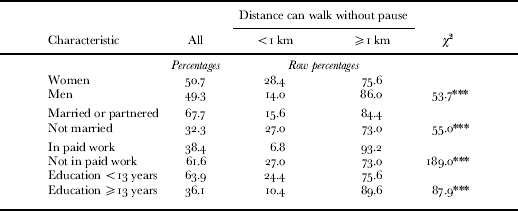
Associations between ability to walk more than one kilometre without pause and personal characteristics, Norway 2002–03

Notes: Sample size 3,069. 2×2 comparisons of frequencies of those who can and cannot walk at least 1 km.
Significance level: *** p<0.001.
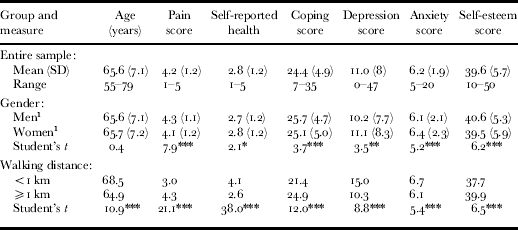
Associations between longest walking distance on foot without pause and individual characteristics, health and coping resources, Norway 2002–03

Notes: 1. Values are means and standard deviations. SD: standard deviation. t: Student's paired t-test statistic.
Significance levels: * p<0.05, ** p<0.01, *** p<0.001.
The results
The mean age of the participants was 65.6 years (range 55–79, standard deviation (SD) 7.2). Every second person was female and every second aged 65 or more years. Approximately two-thirds had less than 13 years' schooling and a similar proportion were not in paid work. One-third (32.3%) were married or co-habiting (see Table 1). Regarding outdoor walking ability, only 0.7 per cent were not able to walk at all, 1.4 per cent could walk only a few steps, 4.1 per cent 10–100 m, 6.1 per cent 100–500 m, 7.0 per cent 500–999 m, 25.2 per cent 1–5 km and 55.6 per cent more than 5 km.
Bivariate relationships
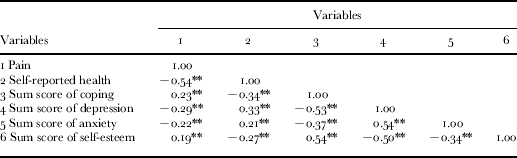
There were significant relationships between increasing age and a lower frequency of paid work (r=0.61; p<0.001), lower scores on coping (r=−0.28, p=0.00), poorer self-reported health (r=0.24, p=0.00), less education (r=−0.23, p=0.00), lower self-esteem scores (r=−0.13, p=0.00), more pain (r=−0.13, p=0.00), higher levels of depression (r=0.09, p=0.00), and higher levels of anxiety (r=0.06, p=0.00). Table 2 shows that, compared to men, women had more negative scores on self-esteem, coping, depression, anxiety, pain and self-reported health. Those who were able to walk well (⩾1 km) were significantly more likely to be men than women, to have had longer education and to be in paid work (Table 1), and to have relatively high scores for self-esteem, coping, depression, anxiety, pain and self-reported health (see Table 2). Table 3 shows the associations between self-esteem, coping and health status (pain, self-reported health, anxiety and depression). The correlation coefficients ranged between +0.19 and +0.54, indicating no multi-colinearity (Pallant Reference Pallant2007) (Table 3).
Bivariate correlation matrix for the health and wellbeing variables based on Spearman's correlation

Note: Sample size 3,069.
Significance levels: * p<0.05, ** p<0.01 (two-tailed).
Multivariate relationships with outdoor walking ability
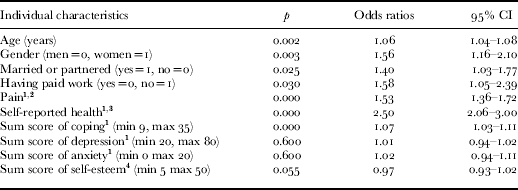
All the independent variables that significantly associated with outdoor walking ability were included in the binary logistic multivariate regression analysis. Table 4 shows that age, being female, living alone (no partner), no paid work, experiencing much pain, poor self-reported health and low perceived coping, were all significantly independently associated with not being able to walk 1 km or more, and the explained variance of the model was 41 per cent. The strongest associations were found between self-reported health and the dependent variable ‘outdoor walking ability’. The possible score on self-reported health ranges from 1 to 4 (a high score indicates poor results), and those with one point lower score on self-reported health had 2.5 higher odds of being able to walk at least 1 km outdoors. Having paid work or being a man had 1.58 and 1.56 higher odds of being able to walk at least 1 km than the reference groups (Table 4).
Binary multivariate logistic regression of capacity to walk at least less than one kilometre outdoors by socio-demographic factors, health status and coping resources

Notes: Sample size 3,069. Explained variance: 41%. CI: confidence interval. Cannot walk one kilometre scored ‘0’, can walk one kilometre of farther scored ‘1’. 1. High scores indicate poor result. 2. Five category ordinal scale from ‘1’ ‘very much’ to ‘5’ ‘not at all’. 3. Four category ordinal scale from ‘1’ ‘excellent’ to ‘4’ ‘bad’. 4. High scores indicate good result.
Discussion
The aim of this study was to explore the relationship between socio-demographic factors, coping resources, self-esteem, health status and outdoor walking ability. Self-reported health had the strongest independent significant relationship with the dependent variable ‘outdoor walking ability’ followed by the variable having paid work (yes or no). Like Friis et al. (Reference Friis, Nomura, Ma and Swan2003), we found that positive self-reported health significantly associated with the ability to walk a longer distance outdoors. Chad et al. (Reference Chad, Reeder, Harrison, Ashworth, Sheppard, Schultz, Bruner, Fisher and Lawson2005) reported a significantly higher level of physical activity among men, people with a partner and those with higher incomes, which corresponds well with our results. An independent relationship was observed between gender and outdoor walking ability, for men were more likely to be able to walk more than 1 km, even when controlling for other variables. This is consistent with the findings of Smith and Baltes (Reference Smith and Baltes1998) . Compared with women, the men in our study had better outdoor walking ability, better mental health, and fewer depressive and anxiety symptoms. Women had significantly higher ratings than men on the CES Depression Scale, consistent with Smith and Baltes's (Reference Smith and Baltes1998) findings. A depressed mood may either precede mobility limitation or follow from a mobility limitation (Hirvensalo et al. Reference Hirvensalo, Sakari-Rantala, Kallinen, Leinonen, Lintunen and Rantanen2007). Our results are consistent with those of Ross and Mirowsky (Reference Ross and Mirowsky2002), that men had a better sense of coping (personal control) than women.
Maly (Reference Maly2005) reported that people with poor self-reported mobility were more depressed and had more pain, consistent with our bivariate results, but only pain was significantly associated independently with outdoor walking ability. Fewer depressive symptoms (Clark Reference Clark1995) and anxiety (Klonoff, Annechild and Landrine Reference Klonoff, Annechild and Landrine1994) have been reported to be associated with good walking performance. In our study, depression and anxiety had no independent effect on outdoor walking ability when controlling for the other variables in the multivariate analysis. As Simonsick, Guralnik and Fried (Reference Simonsick, Guralnik and Fried1999) and Yang (Reference Yang2006) found, outdoor walking ability decreased with increasing age, and as Friis et al. (Reference Friis, Nomura, Ma and Swan2003) established, we found that younger age and higher income associated with good outdoor walking ability. While in the bivariate analysis self-esteem was associated with walking distance, this was not so when the co-variates were controlled for. Baltes (Reference Baltes1996) stated that functional incapacity and dependence are associated with a sense of helplessness and incompetence. Empirical studies show that the onset of disability, as in our case a problem with walking 1 km, could be a major stressor that leads to loss of perceived control and lower self-esteem (Allen, Ciambrone and Welch Reference Allen, Ciambrone and Welch2000; Boerner Reference Boerner2004; Schultz, Heckhausen and O'Brien Reference Schultz, Heckhausen and O'Brien1994).
Although this analysis has used a large, nationally-representative sample, it has several limitations. Martikainen et al. (Reference Martikainen, Laaksonen, Piha and Lallukka2007) state that a non-response rate of 20–40 per cent is typical in epidemiological studies based on postal or face-to face questionnaires. The occurrence of selective non-response can be assessed when data are available for both respondents and non-respondents, which was not the case. Nor was a non-response survey carried out. Selective non-response might lead to bias in the recording of coping, self-esteem and health as well as in the associations among them. Martikainen et al. (Reference Martikainen, Laaksonen, Piha and Lallukka2007) studied non-response bias and its impact on analyses of social class inequalities in health, and among other things concluded that women and those in the higher social classes are more likely to respond to health surveys, and that non-respondents had around 20–30 per cent higher age-adjusted sickness absence rates. However, Etter and Perneger (Reference Etter and Perneger1997) concluded that non-respondents are not homogeneous and that the strength and even direction of non-response bias depended on the particular mechanisms. Studies have shown that older non-responders are more cognitively impaired than responders, and have higher one-year prospective mortality rates (Bowns, Challis and Tong Reference Bowns, Challis and Tong1991; Hebert et al. Reference Hebert, Bravo, Korner-Bitensky and Voyer1996), more often live alone, have weaker social networks, and poorer quality of life (Holst and Holstein Reference Holst and Holstein1990). It should be noted that all the measures in this study were based on self-reports and are therefore subject to certain biases. In addition to social desirability, variation from recall bias might also be a source of error (Barrett et al. Reference Barrett, Crucian, Wingard, Graybealm and Heilman2003). Furthermore, we have little knowledge about environmental barriers and local walking hazards. While several theories have recognised the role of environmental or contextual factors in affecting the ability to conduct activities (Lawton and Nahenmow Reference Lawton, Nahenmow, Eisdorfer and Lawton1973), this has not been the focus of this paper. The cross-sectional design of the study makes it impossible to draw inferences about the direction of causality and causal pathways.
Conclusions
Our main findings are that those who had good outdoor walking ability (⩾1 km) were significantly younger than those who did not, and that they were predominantly men, partnered or married, not in paid work, experienced significantly little pain, had better self-reported health and higher perceived coping. In addition, these findings may have implications for clinicians and persuade policy makers to give older people better access to walkable areas. A marked gender differential was found and is important, since more women compared to men had problems with walking 1 km, had more pain, more negative scores on self-reported health, depression and anxiety, and in addition were more likely than men to live alone. Older women could in general be seen as a more vulnerable group, which all health and social workers should understand.