Introduction
Obsessive-compulsive disorder (OCD) is a neuropsychiatric disorder affecting between 0.3 and 3.1% of the general population,Reference Fontenelle, Mendlowicz and Versiani 1 which places enormous personal, social, and economic burdens on society.Reference Hollander, Doernberg and Shavitt 2 Clinically, OCD can present with a variety of unwanted obsessions, compulsions, or an idiosyncratic mix of both. In addition, OCD can also be associated with other compulsive and impulsive tendencies, such as substance and gambling addiction.Reference Fineberg, Brown, Reghunandanan and Pampaloni 3 Historically, there has been a strong focus on the symptom phenotypes of OCD; however, given its heterogeneous presentation and high rates of relapse, it is important to understand OCD from the perspective of motivational phenotypes that may underlie the disorder. That is, to understand the precise processes and traits that mediate the dysfunctional neural circuits implicated in OCD (for a review, see Pauls et al.Reference Pauls, Abramovitch, Rauch and Geller 4 ) and its superficial symptomatology.Reference Gottesman and Gould 5 This approach may offer new avenues for progress with regard to intervention and prevention.Reference Cuthbert and Insel 6 – Reference Robbins, Gillan, Smith, de Wit and Ersche 9
OCD has traditionally been viewed as a disorder driven primarily by anxiety avoidance and excessive self-control.Reference Grassi, Pallanti and Righi 10 In recent years, however, a competing perspective has emerged that sees two phenotypes driving the behavioral features of OCD: compulsivity and impulsivity.Reference Fineberg, Chamberlain and Goudriaan 7 , Reference Robbins, Gillan, Smith, de Wit and Ersche 9 , Reference Fontenelle, Oostermeijer, Harrison, Pantelis and Yücel 11 Impulsivity is commonly defined as a predisposition to reacting to stimuli in a rapid and unplanned fashion with reduced concern of the potential consequences.Reference Fineberg, Chamberlain and Goudriaan 7 , Reference Chamberlain, Leppink, Redden and Grant 12 In contrast, current conceptualizations suggest that compulsivity reflects the repetitive performance of behaviors without adaptive function that are carried out habitually or in response to avoidance and fear of potential negative outcomes.Reference Fineberg, Chamberlain and Goudriaan 7 Traditional views posit that these phenotypes are diametrically opposed, whereas contemporary views argue that compulsivity and impulsivity may be more overlapping in nature,Reference Robbins, Gillan, Smith, de Wit and Ersche 9 , Reference Tavares and Gentil 13 suggesting that disorders typically characterized by clinically significant expression of one may also show maladaptive expression of the other.
OCD has been labeled the archetypal compulsive disorder.Reference Chamberlain, Leppink, Redden and Grant 14 It is therefore unsurprising that individuals with OCD differ from healthy controls (HCs) by showing compulsive responses across a number of tasks.Reference Fineberg, Chamberlain and Goudriaan 7 However, a growing body of evidence highlights the potential implication of impulsivity in OCD. For example, a number of studies examining trait impulsivity in OCD have found that OCD patients show higher “attentional,” “motor,” and “nonplanning” impulsivity than HCs,Reference Grassi, Pallanti and Righi 10 , Reference Benatti, Dell'Osso, Arici, Hollander and Altamura 15 – Reference Summerfeldt, Hood, Antony, Richter and Swinson 19 as well as increased “negative urgency.”Reference Zermatten and Van der Linden 20 Individuals with OCD, relative to HCs, tend to make risky decisions, favoring options that provide large initial rewards but ultimately lead to a disadvantageous outcome.Reference Grassi, Pallanti and Righi 10 , Reference Cavedini, Riboldi, D'Annucci, Belotti, Cisima and Bellodi 21 – Reference Zhang, Dong and Ji 28 This consistent pattern of irrational responding might reflect an exacerbated anticipation for reward,Reference Fontenelle, Oostermeijer, Ferreira, Lorenzetti, Luigjes and Yücel 29 or failure of a somatic marker to signal differences between advantageous and disadvantageous outcomes,Reference Cavedini, Zorzi and Baraldi 30 or both. Furthermore, OCD patients show a robust impairment in response inhibition.Reference Wright, Lipszyc, Dupuis, Thayapararajah and Schachar 31 – Reference Chamberlain, Fineberg, Blackwell, Robbins and Sahakian 34 Most strikingly, Figee et al.Reference Figee, van den Munckhof, Schuurman and Denys 35 found increased reward anticipation in the nucleus accumbens—a key region subserving reward, motivation, and impulsivityReference Basar, Sesia, Groenewegen, Steinbusch, Visser-Vandewalle and Temel 36 —in individuals with OCD, compared to HCs.Reference Knutson, Adams, Fong and Hommer 37 This growing body of evidence notwithstanding, a number of issues remain. First, some scattered studies have not found differences between individuals with (clinical or subclinical levels of) OCD and HCs on some measures of impulsivity.Reference Chamberlain, Leppink, Redden and Grant 14 , Reference Benatti, Dell'Osso, Arici, Hollander and Altamura 15 Evidence from our large sample should assist in interpreting whether these few studies are exceptional. Second, and more importantly, it is also unclear whether a potential impulsive subgroup would show more or less severe clinical outcomes than other more compulsively driven subgroups. Impulsive tendencies could plausibly compound or protect against compulsive tendencies. The scant evidence that speaks to this issue suggests that a potential impulsive subgroup might be especially vulnerable to worse prognosis,Reference Kashyap, Fontenelle and Miguel 24 but further investigation is needed.
In this study, we apply k-means clustering to trait measures of compulsivity and impulsivity to regroup a large sample of individuals with OCD. Our aims were to determine whether (1) orthogonally related components of compulsivity and impulsivity could be used to separate groups of OCD patients, and (2) these phenotypes are linked to clinical severity. To address the first aim, we separated our sample into four clusters using self-report measures of compulsivity and impulsivity. Specifically, we expected to find a cluster of OCD individuals who score low on both compulsivity and impulsivity, a cluster who score high on compulsivity but low on impulsivity, a cluster who score low on compulsivity but high on impulsivity (i.e., the reverse of the previous cluster), and a cluster who score high on both. With regard to the traditional anxiety-avoidance model in OCD,Reference Grassi, Pallanti and Righi 10 we expected to find the largest proportion of individuals with OCD falling into the high compulsivity and low impulsivity cluster. Furthermore, we predict that the cluster scoring high in both clinical phenotypes should demonstrate the highest clinical severity.Reference Kashyap, Fontenelle and Miguel 24
Methods
Subjects
The total sample consisted of 217 age- and sex-matched participants (female=108; mean age=35.70 years; age range=18–77): 103 individuals clinically diagnosed with OCD; 79 “OCD-likely” individuals; and 35 HCs. All participants gave written informed consent to participate in study protocols approved by the relevant Australian and Brazilian ethics committees. Clinically diagnosed individuals participated in the present study at one of two clinical institutes as part of larger studies: the Monash Institute of Cognitive and Clinical Neurosciences–Melbourne (n=36) and the Institute of Psychiatry of the Federal University of Rio de Janeiro (n=67). Recruitment for both sites was primarily from patient clinics local to each site, as well as media advertisements placed in the broader community. A primary diagnosis of OCD was determined by the patient version of the Structured Clinical Interview for the DSM-IV (SCID–IV). If patients had other comorbid diagnoses thought to be more severe or to underpin their OCD, they were excluded from the study. OCD-likely individuals were recruited online through the Amazon Mechanical Turk community. “OCD-likely” was defined as a score of 21 or higher on the Obsessive-Compulsive Inventory–Revised (OCI––R), an 18-item self-report instrument that determines the severity of OCD symptoms in subclinical populations.Reference Foa, Huppert and Leiberg 38 HCs were part of a larger study at the Melbourne site. HCs were screened using the Mini International Neuropsychiatric Interview (MINI; DSM–IV) as well as an in-house structured interview designed to assess lifetime history of neurological illness, and were excluded if they presented with any past or present psychiatric or neurological illness.
The definitions of impulsivity and compulsivity outlined in the introduction have a strong focus on behavior; however, here we were interested in examining the underlying motivational phenotypes that drive these behaviors. As such, all participants completed a 30-minute computerized battery of self-report questionnaires that putatively assessed compulsivity and impulsivity. To assess compulsivity, we used the Intolerance of Uncertainty Scale-Short Form (IUS–12) Reference Carleton, Norton and Asmundson 39 and the Obsessive Beliefs Questionnaire-44 (OBQ–44). 40 The OBQ–44 measures belief domains linked to OCD using four subscales: perfectionism, importance and control of thoughts, responsibility, and overestimation of threat. The IUS–12 measures responses to uncertainty, ambiguous situations, and the future using two subscales: prospective intolerance to uncertainty, and inhibitory response to uncertainty. Obsessive beliefs and intolerance to uncertainty are hallmarks of OCD and are predictive of symptomatology.Reference Tolin, Abramowitz, Brigidi and Foa 41 , Reference Gentes and Ruscio 42 Thus, the IUS–12 and OBQ–44 likely capture critical motivational elements of compulsivity in OCD. To assess impulsivity, we used the well-validated UPPS–P.Reference Cyders, Smith, Spillane, Fischer, Annus and Peterson 43 , Reference Whiteside, Lynam, Miller and Reynolds 44 The UPPS–P measures several dimensions of impulsivity: negative urgency, lack of premeditation, lack of perseverance, sensation seeking, and positive urgency. Extended descriptions of the compulsive/impulsive measures can be found in supplementary material. Finally, the OCI––RReference Foa, Huppert and Leiberg 38 and the Beck Depression Inventory (BDI)Reference Beck, Steer and Brown 45 were included to measure symptom severity.
Data analysis
For assumption checks please refer to the supplementary material.
Compulsive and impulsive phenotypes of OCD
To investigate whether participants with OCD could be regrouped using the constructs of compulsivity and impulsivity, we performed unsupervised clustering on the subscales of the UPPS–P, OBQ–44, and IUS–12. Principal-component analysis (PCA) was first used to reduce the questionnaire data down to two leading principal components, which explained 52.7% of the variance in the data. A two-component (i.e., a compulsivity component and an impulsivity component) solution was selected primarily to be consistent with the theoretical framework of the study. These two components carried eigenvalues of 4.21 and 2.20, respectively. While a third PC may also have been retained due to having an eigenvalue greater than 1 (eigenvalue=1.10), it explained only an additional 9% of variance and contained loadings from only two subscales of the OBQ-44. Thus, to facilitate interpretability, we only retained two components. Additionally, as some subscales showed variance inflation factors of greater than 3, PCA also served to reduce multicollinearity, and subsequent overrepresentation, during clustering.
Primary analysis: compulsive and impulsive clustering of individuals with OCD
Using the PCA results from the above step, we clustered the clinical and OCD-likely participants by grouping individuals together with similar scores on our compulsive and impulsive phenotypes using k-means clustering.Reference Hastie, Tibshirani and Friedman 46 K-means clustering requires that the number of clusters drawn from the data be defined a priori. Given our primary aim to investigate the overlapping constructs of compulsivity and impulsivity, we extracted four clusters from the data. Participants within each k-means cluster should exhibit homogenous scores on the compulsive and impulsive phenotypes. To examine whether these groupings provide clinical utility in OCD, we compared the clusters' OCD severity using the OCI––R. See the supplementary materials for validation against different clustering methods and of the optimal number of clusters.
Secondary analysis: Compulsive and impulsive clustering of individuals with OCD and HCs
To capture a broad spectrum of OCD severity, we included OCD-likely participants in our primary analysis, which introduced the influence of subclinical OCD tendencies into our sample. To extend the spectrum of severity even further toward normality,Reference Cuthbert and Insel 6 , Reference Cuthbert and Kozak 47 we repeated our PCA and clustering analyses including 35 HC participants and examined the proportions of HCs and OCDs (both clinical and likely) that fell into each of the four clusters extracted from the data using k-means clustering.
Results
Sample characteristics
OCD and OCD-likely individuals had significantly higher (p<0.001) OCI–R scores (M=31.1) than HC participants (M=4.82). The OCD, OCD-likely, and HC samples did not differ on age or gender (p>0.05). Pearson correlations between total OCI–R scores and the questionnaire measures can be found in Supplementary Table 1.
Compulsive and impulsive phenotypes of OCD
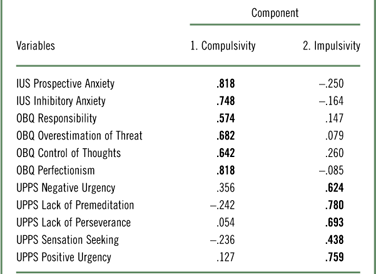
Our primary goal was to evaluate whether orthogonally related constructs of compulsivity and impulsivity, measured using the OBQ–44 and IUS–12, as well as the UPPS–P, respectively, could distinguish symptom severity in a sample of OCD and OCD-likely participants. PCA revealed two components that putatively represent an individual's level of compulsivity and impulsivity (Table 1). The internal consistency for the compulsivity and impulsivity components were α=0.76 and 0.70, respectively. Table 1 illustrates how the measures of compulsivity and impulsivity used loaded onto respective compulsive and impulsive components.
Pattern Matrix from principal component analysis showing variable loadings on the Compulsive and Impulsive components for a sample of OCD participants (N=182). The coefficients are displayed in descending loading order on the first component.

Note. OCI-R=Obsessive-Compulsive Inventory-Revised; OBQ-44=Obsessive Beliefs Questionnaire-44; IUS-12=Intolerance of Uncertainty Scale-12; UPPS-R+P=UPPS-R+Positive Urgency Impulsive Behaviours Scale; Extraction Method: PCA. Rotation Method: Premix with Kaiser Normalization.
Compulsive and impulsive clustering of OCD
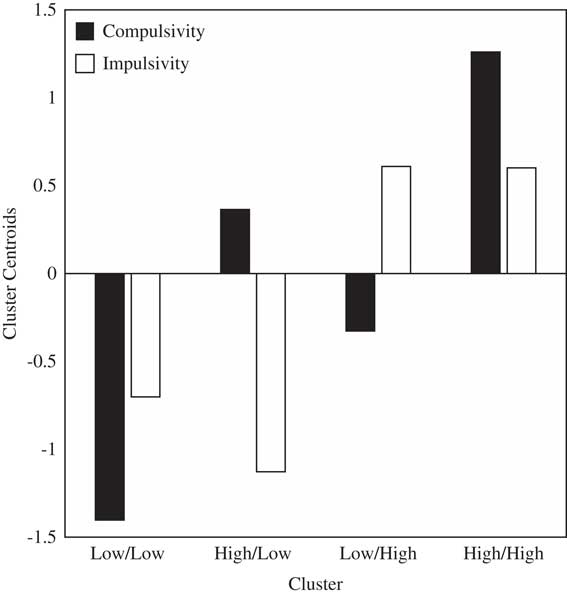
We employed unsupervised clustering methods to identify subgroups of OCD participants based upon their levels of compulsivity and impulsivity. When extracting four clusters using k-means, the results identify four groups of OCD participants that mapped onto our predicted compulsive/impulsive phenotype (Figure 1). Cluster 1 contained 30 participants scoring low on both compulsivity and impulsivity (hereafter referred to as low/low); cluster 2 had 41 participants scoring moderately on compulsivity and low on impulsivity (hereafter referred to as high/low); cluster 3 contained 71 participants low on compulsivity and high on impulsivity (hereafter referred to as low/high); and cluster 4 contained 40 participants high on both compulsivity and impulsivity (hereafter referred to as high/high). It is important to note that low and high scores on the PCs represents a score relative to the average of the sample. Thus, “low” on compulsivity (or impulsivity) may not represent qualitatively “normal” levels of compulsivity, but rather lower compared to other OCDs in this sample.
K-means clustering reveals four distinct groupings of OCD participants based on measures of compulsivity and impulsivity. Clustering yields a subgroup of OCD participants low on both compulsivity and impulsivity (Low/Low), a more classical OCD subgroup (High/Low), an impulsive subgroup (Low/High), and a subgroup high on both (High/High).

Assessing the robustness of our clustering solution using the OCD and OCD-likely groups, we also found that: (1) two-step cluster analysis confirmed the four-cluster solution as optimal, with the silhouette measure of cohesion and separation equal to 0.5Reference Zhang, Ramakrishnan and Livny 48 ; (2) a four-cluster solution was also supported by convergence between Ward's and k-means methods (Cramer's V=0.74, p<0.001); (3) cluster membership was not driven by whether participants were diagnosed with OCD or whether they were OCD-likely (Cramer's V=0.10, p=0.065); and (4) clusters did not differ in terms of gender (χ2=2.11; p=0.065), age (F(3, 178)=1.380, p=0.250), or depression (Cramer's V=9.185; p=0.105).
OCD severity across subgroups
There was a significant effect of cluster membership on OCD severity (F(3, 178)=19.91, p<0.001). Post-hoc t tests indicated that the high/high OCD cluster had higher scores on the OCI–R (M=39.23, SD=12.27) than all other clusters (ps<0.05; Figure 1), whereas the low/low OCD cluster had lower scores on the OCI–R than all the other clusters (M=21.60, SD=8.90, all ps<0.001). There was no difference between the high/low OCD cluster (M=32.88, SD=9.84) and the low/high OCD cluster (M=30.04, SD=9.48, p=0.937). Interestingly, apart from the obsessing subscale, which was significantly higher in the high/high OCD group compared to the other three clusters (p<0.008), there were no significant differences in OCI–R subtypes across the four clusters, suggesting that the clusters were not driven by classical OCD subtypes.
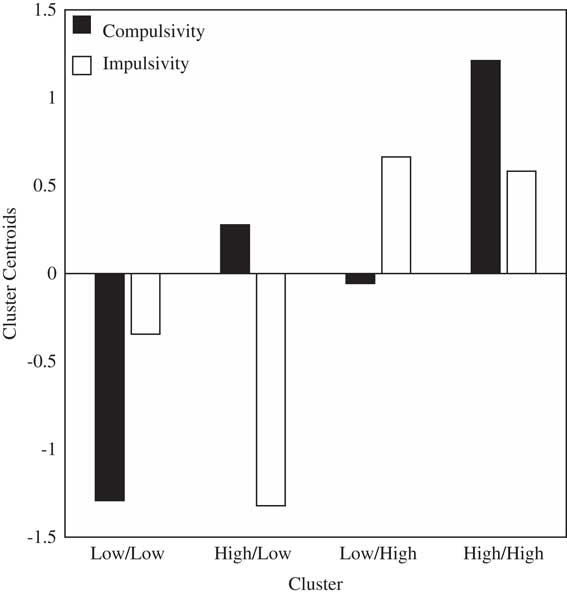
K-means clustering reveals four distinct groupings of HC and OCD participants based on measures of compulsivity and impulsivity. Clustering yields a subgroup of participants low on both compulsivity and impulsivity (Low/Low), a compulsive subgroup (High/Low), an impulsive subgroup (Low/High), and a subgroup high on both (High/High).

Compulsive and impulsive clustering of individuals with OCD and HCs
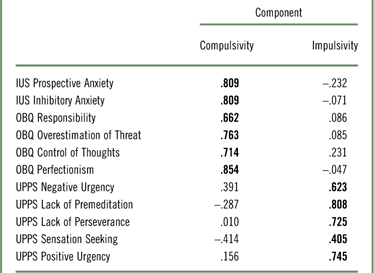
Having established that a self-reported compulsive/impulsive phenotype can be used to separate OCD participants to reveal significant differences in disorder severity, we wanted to explore what influence introducing a HC group had on the clustering solution. The above PCA and k-means analyses were repeated, this time including 35 HCs. This time the compulsivity and impulsivity components accounted for 58.2% of the overall variance. Again, a clear compulsive/impulsive phenotype emerged. Table 2 illustrates how specific compulsive and impulsive measures loaded onto the principal components.
Pattern Matrix from principal component analysis showing variable loadings on the Compulsive and Impulsive components for a sample of OCD and HC participants (N=217). The coefficients are displayed in descending loading order on the first component.

Note. OCI-R=Obsessive-Compulsive Inventory-Revised; OBQ-44=Obsessive Beliefs Questionnaire-44; IUS-12=Intolerance of Uncertainty Scale-12; UPPS-R+P=UPPS-R+Positive Urgency Impulsive Behaviours Scale; Extraction Method: PCA. Rotation Method: Premix with Kaiser Normalization.
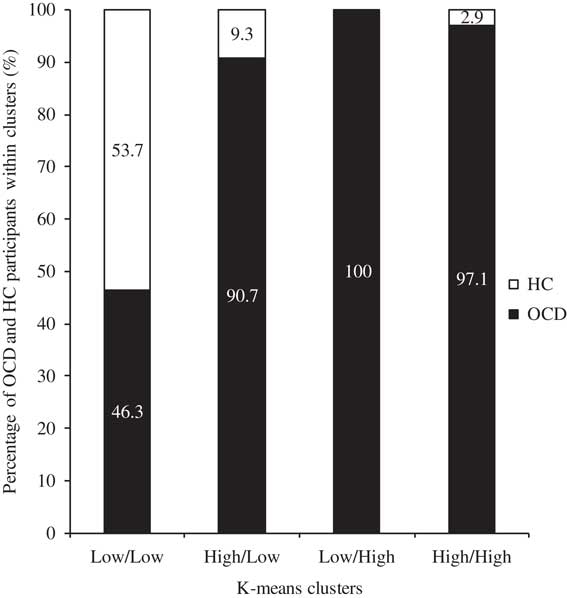
Results of k-means clustering revealed a qualitatively similar pattern of compulsive/impulsive clusters in the data (Figure 2). Specifically, the low/low, high/low, low/high, and high/high clusters were all recaptured when adding the HC participants. Notably, 83.3% of the healthy controls fell into the low/low cluster, making up approximately half of the participants in that cluster (Figure 3). The high/high cluster was made up exclusively of OCDs, and the high/low and low/high clusters were predominantly composed of OCDs. Again, as before, multiple clustering techniques converged on a four-cluster solution and clusters did not differ in terms of gender (χ2=2.78; p=0.42). There was an effect of age (F(3, 213)=2.75, p=0.043) but post-hoc analyses showed no age differences between any two clusters (all ps<0.524).
Proportions of HC and OCD subjects within each of the four subgroups from the k-means clustering solution presented in Figure 2. The majority of the HC participants are within the Low/Low cluster.

There was a significant effect of cluster membership on OCD severity (F(3, 213)=55, p<0.001). Post-hoc t tests indicated that the high/high cluster showed the highest OCI–R score (M=38.39, SD=11.74) compared to the other groups (all ps<0.001). Again, the low/low cluster recorded the lowest OCI–R scores (M=11.51, SD=11.30) (all ps<0.001). There was no difference between the high/low OCD cluster (M=28.26, SD=11.50) and the low/high OCD cluster (M=29.59, SD=9.72, p=0.45).
Discussion
Using unsupervised clustering methods applied to questionnaire data, we grouped participants with OCD into four distinct subgroups based on their levels of impulsivity and compulsivity. We expected that the constructs of impulsivity and compulsivity would relate orthogonally to one another. Accordingly, OCD participants were delineated on the basis of high levels of interindividual compulsivity (i.e., high/low), impulsivity (low/high), or both (high/high), as well as low levels of both (low/low). These phenotypic differences in OCD participants were also linked to differences in OCD severity.
Traditionally, OCD has been viewed as the archetypal compulsive disorder. Contemporary views have argued that OCD may also encompass issues with impulsivity and may therefore be alternatively conceptualized as a behavioral addiction.Reference Grassi, Pallanti and Righi 10 , Reference Fontenelle, Oostermeijer, Harrison, Pantelis and Yücel 11 , Reference Fineberg, Potenza and Chamberlain 49 However, this hypothesis remains controversial,Reference Abramovitch and McKay 50 with some researchers reporting higher impulsivity in OCDs relative to controls,Reference Grassi, Pallanti and Righi 10 , Reference Kashyap, Fontenelle and Miguel 24 while others report no differenceReference Tavares and Gentil 13 or lower impulsivity in OCD.Reference Stein, Hollander, Simeon and Cohen 51 Rather than argue for one driver over another, our results suggest that both impulsivity and compulsivity mediate obsessive-compulsive symptomatology. Within our sample of OCD participants, there are subsets of individuals characterized by elevated levels of impulsivity with or without elevated compulsivity. Notably, the largest cluster of participants in our results were characterized by high impulsivity and low compulsivity relative to the sample mean. This suggests that a “one-size-fits-all” approach to understanding OCD phenomenology (e.g., OCD as an anxiety-avoidance disorder vs. a behavioral addiction) is likely to be overly simplistic.
Fontenelle et al.Reference Fontenelle, Oostermeijer, Harrison, Pantelis and Yücel 11 postulated that OCD behaviors may become more “impulsive” in nature with chronicity, suggesting impulsivity as a potential endpoint for some OCD patients. While chronicity has been linked to increased severity of OCD,Reference Visser, van Oppen, van Megen, Eikelenboom and van Balkom 52 our results suggest that the relationship with impulsivity is not so clear. We found that OCD severity differed across our clusters, with the low/low cluster showing the lowest OCD severity and the high/high cluster showing the highest OCD severity, suggesting that an interaction between the phenotypes may be linked to worse prognosis. However, we also found that, while OCD severity was higher for the high/low and the low/high clusters relative to the low/low cluster, severity did not differ between the two. A more comprehensive understanding of the role of impulsivity in relation to OCD severity requires longitudinal data not present in the current study. Nevertheless, our results point toward the clinical importance of understanding an OCD patient's impulsivity and demonstrate how traditional diagnostic categories can mask the underlying motivations driving OCD behaviors.
Our finding that OCD severity links to a compulsive/impulsive phenotype may have potential implications for the management of OCD treatment in clinical practice. For instance, specific psychotherapeutic strategies to manage impulsivity may be added to exposure and response prevention of OCD patients. We have previously suggested that medication targeting impulsive behaviors (such as naltrexone, topiramate, and methylphenidate, among others) may be of theoretical help to some OCD patients.Reference Fontenelle, Oostermeijer, Harrison, Pantelis and Yücel 11 However, there is mixed data in relation to the efficacy of these drugs in OCD, with some reports of improvement,Reference Sandyk 53 , Reference Berlin, Koran and Jenike 54 no change,Reference Amiaz, Fostick, Gershon and Zohar 55 or even worsening of OCD symptoms.Reference Insel and Pickar 56 These heterogeneous outcomes may be ascribed to specific patient profiles and assessment of baseline impulsive features (e.g., severity of compulsive symptomsReference Berlin, Koran and Jenike 54 ) and may help us to determine the phenotype that would be best targeted by an anti-impulsive medication in OCD.
Limitations
One limitation of this study is the inclusion of only self-report measures of compulsivity and impulsivity. Compulsivity and impulsivity are both heterogeneous constructsReference Robbins, Gillan, Smith, de Wit and Ersche 9 , Reference Grant and Kim 57 and are unlikely to be fully covered by self-report alone. Thus, future work should investigate whether our findings replicate when including behavioral tasks either instead of self-report measures or alongside them. However, our results demonstrate that self-report measures of the compulsivity and impulsivity phenotypes are sensitive enough to distinguish clinically relevant differences in OCD subgroups. This has strong clinical utility given the convenient and cost-effective nature of self-report data compared to behavioral tasks, which often require training and practice to be administered successfully. Finally, the fact that approximately half of the low/low cluster was composed of OCD participants when including healthy control participants may be ascribed to the fact that our OCD sample includes patients who were in different stages of treatment.
Conclusions
In summary, we used objective data-driven methods applied to self-report data to show that individuals with OCD can be sub-grouped based on their levels of compulsivity (OBQ–44 and IUS–12) and impulsivity (UPPS–P), which in turn links to differences in clinical severity. We found that individuals with high levels of impulsivity (and relatively lower compulsivity) have comparable clinical severity to those with high compulsivity (i.e., the stereotypical OCD presentation). Furthermore, we showed that the combination of high levels of compulsivity and impulsivity is linked to the highest clinical severity.
Conflicts of Interest
The authors hereby declare that they have no financial or other relationships relevant to the subject of this article.
Disclosures
Luisa Prochazkova, Rebecca A. Segrave, and Murat Yücel are supported by the David Winston Turner Endowment Fund. Murat Yücel is also supported by an National Health and Medical Research Council senior research fellowship (grant no. APP1117188). Linden Parkes and Andrew Dawson are supported by Australian postgraduate awards. Leonardo F. Fontenelle is supported by the D'Or Institute for Research and Education, the Conselho Nacional de Desenvolvimento Científico e Tecnológico (#308237/2014-5), and the Fundação de Amparo à Pesquisa do Estado do Rio de Janeiro (#203590). George Youssef, Gabriela Ferreira, and Valentina Lorenzetti have nothing to disclose.
Supplementary Material
To view supplementary materials for this article, please visit https:/doi.org/10.1017/S1092852917000244