






No CrossRef data available.
Article contents
Ratio-based perceptual foundations for rational numbers, and perhaps whole numbers, too?
Published online by Cambridge University Press: 15 December 2021
Abstract
Clarke and Beck suggest that the ratio processing system (RPS) may be a component of the approximate number system (ANS), which they suggest represents rational numbers. We argue that available evidence is inconsistent with their account and advocate for a two-systems view. This implies that there may be many access points for numerical cognition – and that privileging the ANS may be a mistake.
Information
- Type
- Open Peer Commentary
- Information
- Copyright
- Copyright © The Author(s), 2021. Published by Cambridge University Press
References
Binzak, J. V., Matthews, P. G., & Hubbard, E. M. (submitted). Holistic magnitude processing of symbolic fractions and nonsymbolic ratios.Google Scholar
Bonn, C. D., & Cantlon, J. F. (2017). Spontaneous, modality-general abstraction of a ratio scale. Cognition 169:36–45.CrossRefGoogle ScholarPubMed
Chuang, Y. S., Hubbard, E. M., & Austerweil, J. L. (2020). The “Fraction Sense” Emerges from a Deep Convolutional Neural Network Proceedings of the 42nd Annual Meeting of the Cognitive Science Society (pp. 1207–1213). Cognitive Science Society.Google Scholar
Cochrane, A., Cui, L., Hubbard, E. M., & Green, C. S. (2019). “Approximate number system” training: A perceptual learning approach. Attention, Perception & Psychophysics 81(3):621–636. doi: 10.3758/s13414-018-01636-w.CrossRefGoogle ScholarPubMed
Gilchrist, A. L. (Ed.). (2013). Lightness, brightness and transparency. Psychology Press.CrossRefGoogle Scholar
Jacob, S. N., Vallentin, D., & Nieder, A. (2012). Relating magnitudes: The brain's code for proportions. Trends in Cognitive Sciences 16(3):157–166.CrossRefGoogle ScholarPubMed
Lewis, M. R., Matthews, P. G., & Hubbard, E. M. (2015). Neurocognitive architectures and the nonsymbolic foundations of fractions understanding. In: Development of mathematical cognition-neural substrates and genetic influences, eds. Berch, D. B., Geary, D. C. and Koepke, K. M., pp. 141–160. Elsevier. ISBN: 978-0128018712.Google Scholar
Matthews, P. M., Lewis, M. R., & Hubbard, E. M. (2016). Individual differences in nonsymbolic ratio processing predict symbolic math performance. Psychological Science 27(2):191–202. doi: 10.1177/0956797615617799.CrossRefGoogle ScholarPubMed
Park, Y., & Matthews, P. G. (in press). Revisiting and refining relations between nonsymbolic ratio processing and symbolic math achievement. Journal of Numerical Cognition.Google Scholar
Park, Y., Viegut, A. A., & Matthews, P. G. (2020). More than the sum of its parts: Exploring the development of ratio magnitude vs. simple magnitude perception. Developmental Science, e13043.Google Scholar
Yamakawa, M., Tsujimura, S. I., & Okajima, K. (2019). A quantitative analysis of the contribution of melanopsin to brightness perception. Scientific Reports 9:7568, https://doi.org/10.1038/s41598-019-44035-3.CrossRefGoogle ScholarPubMed
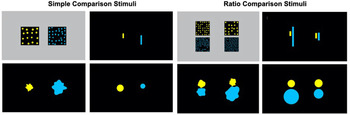
Figure 1. Comparison stimuli used by Park et al. (2020) organized by task type (simple vs. ratio comparison) and by format (dots, lines, blob, and circles).
Target article
Related commentaries (26)
Ratio-based perceptual foundations for rational numbers, and perhaps whole numbers, too?
The perception of quantity ain't number: Missing the primacy of symbolic reference
We applaud Clarke and Beck's (C&B's) compelling use of analogies with other domains of perception to defend the notion that the approximate number system (ANS) truly represents numbers. We were also gratified to see that they arrived at a similar conclusion to that proposed by our own study, one “closely related to a suggestion from the developmental and educational psychology literatures according to which there is a ‘ratio processing system’ (RPS).” We have previously advanced the view that humans and other animals possess a perceptual system for representing ratio magnitudes, and that they therefore represent rational numbers, rather than being limited to representing purely integers (e.g., Lewis, Matthews, & Hubbard, Reference Lewis, Matthews, Hubbard, Berch, Geary and Koepke2015; Matthews, Lewis, & Hubbard, Reference Matthews, Lewis and Hubbard2016; see also Jacob, Vallentin, & Nieder, Reference Jacob, Vallentin and Nieder2012). C&B go on to suggest that it isn't always clear whether the RPS is a separate system from the ANS or a component of it, deciding in favor of the latter. They further argue that “the hypothesis that the RPS represents rational numbers is not always clearly distinguished from the conjecture that it represents real numbers more generally” (sect. 7.3, para. 2). In this commentary, we focus on these points in light of the current empirical record.
Our view is informed by our prior findings that the RPS is operative in multiple visual formats – extending beyond the discrete dot arrays that have typically been the focus of ANS research. We showed that children and adults can also compare ratios made of lines, circles, and irregular blobs (e.g., Binzak et al., Reference Binzak, Matthews and Hubbardsubmitted; Park, Viegut, & Matthews, Reference Park, Viegut and Matthews2020; see also Bonn & Cantlon, Reference Bonn and Cantlon2017). Because ratio perception has been demonstrated using various continuous stimuli not typically considered the province of the ANS, we argue (1) that the RPS cannot be a component of the ANS, and (2) that perceiving numerical ratios may be every bit as fundamental as perceiving exact number (or numerosities). A corollary to this position is that one route to whole number representations might be an emergent property of ratio perception (i.e., when the denominator is 1).
Although these issues must ultimately be settled empirically, in the spirit of C&B, we think an analogy from brightness perception illustrates the plausibility of our argument that the ANS and RPS are two systems. Although individual photoreceptors signal absolute light levels, much of the perceptual system is tuned to relative (ratio) brightnesses of different portions of surfaces, such as when identifying edges in a scene or perceiving shades of gray in black and white images. This system yields the same percept even under a 1,000-fold difference in absolute light levels, such as when moving from indoors to outside under bright sunlight. That is, the visual system computes relative brightness as its primary perceptual feature (for a review, see Gilchrist, Reference Gilchrist2013) and either normalizes or discounts absolute illumination. In parallel, intrinsically photosensitive retinal ganglion cells signal absolute illumination and feed into systems that regulate the pupillary reflex and circadian rhythms (e.g., Yamakawa, Tsujimura, & Okajima, Reference Yamakawa, Tsujimura and Okajima2019). By analogy, the RPS could be specialized for perception of relative quantity (numerosity), whereas the ANS is specialized for perception of absolute numerosity. Furthermore, as with brightness perception, absolute number may be calculated less frequently and relative number perception may be the predominant mode of perception.
In line with the two-systems view, findings from our labs further suggest that the RPS is not a component of the ANS. For instance, in prior studies, we showed that the predictive power of the RPS was independent of ANS acuity, which contributed almost no explanatory power to the models (Matthews et al., Reference Matthews, Lewis and Hubbard2016; Park & Matthews, Reference Park and Matthewsin press). Moreover, if the ANS and RPS constitute a single system, we would predict that long-term ANS training – which successfully transferred across visual field locations – should also transfer across tasks to the RPS, but this was not observed (Cochrane, Cui, Hubbard, & Green, Reference Cochrane, Cui, Hubbard and Green2019). Moving forward, it would be interesting to test whether RPS training transfers to ANS tasks. Most importantly, Park et al. (Reference Park, Viegut and Matthews2020) carried out a battery of tasks using different stimulus formats (e.g., circles, dots, and lines) where participants compared simple stimuli (ANS style) and ratio stimuli (RPS style). They showed that performance was driven more by task similarity (ANS vs. RPS) than by stimulus format (circles, dots, and lines) (Fig. 1).
Comparison stimuli used by Park et al. (Reference Park, Viegut and Matthews2020) organized by task type (simple vs. ratio comparison) and by format (dots, lines, blob, and circles).
Despite our preferred take, however, this clearly remains an open question. For instance, in a recent computational modeling study, we trained a deep convolutional neural network (DCNN) to compare non-symbolic numbers, either as simple dot arrays or as ratios composed of two-dot arrays (Chuang, Hubbard, & Austerweil, Reference Chuang, Hubbard and Austerweil2020). Analysis of the hidden unit responses suggested that RPS representations might emerge from tuned (ANS style) units.
More research is necessary for the final adjudication. That said, C&B have done the entire field a service by highlighting that the ANS might be only one component of a multifaceted number sense that integrates various cues and generates various usable outputs from those cues. In highlighting the importance of ratios, C&B underscore that Weber-guided systems can compute not only integers, but also rational numbers. This implies that there may be many access points for numerical cognition – and that privileging the ANS may be a mistake.
As for what type of numbers might be represented by a perceptual number sense, we concur with C&B that the type of number represented may be limited by the nature and precision of the inputs of the perceptual system. The RPS can presumably represent the entire set of x/y for all x and y which a given input system can represent. Thus, if the RPS is truly limited to discrete inputs, then the number sense would include only the rationals. However, if it is more continuous in character, then it could include the reals.
Financial support
This research was supported by grants from the Eunice Kennedy Shriver National Institute of Child Health and Human Development (R01 HD088585) to E.M.H. and P.G.M. a core grant (U54-HD090256-01) to the Waisman Intellectual and Developmental Disabilities Research Center, and by the National Science Foundation (NSF REAL 1420211).
Conflict of interest
None.