





Over recent decades, we have witnessed a renewed interest in positive, adaptive processes and children’s strengths and competencies, rather than or in addition to the predominant emphasis on problematic socialization processes and children’s maladaptive developmental outcomes. Positive processes are conceptualized not simply as markers of absence or diminished levels of the negative factors or variables, but as alternative mechanisms that can be leveraged to support children’s adjustment and studied as phenomena in their own right. This positive lens has been increasingly visible and impactful in research in developmental psychology and psychopathology and in the field of psychology generally (e.g., Bethell et al., Reference Bethell, Jones, Gombojav, Linkenbach and Sege2019; Han et al., Reference Han, Dieujuste, Doom and Narayan2023; Lieberman et al., Reference Lieberman, Padrón, Van Horn and Harris2005; Narayan et al., Reference Narayan, Ghosh Ippen, Harris and Lieberman2017, Reference Narayan, Rivera, Bernstein, Harris and Lieberman2018, Reference Narayan, Lieberman and Masten2021, Reference Narayan, Merrick, Lane and Larson2023; Pluess, Reference Pluess2024; Rovnaghi et al., Reference Rovnaghi, Castilla-Liu, Lee, Shrivastava and Anand2025).
Although this renewed emphasis is relatively recent and rapidly growing over the last decade or two, developmental psychologists have been interested in understanding the role of positive experiences in children’s development and their role in promoting children’s positive outcomes for many decades, producing voluminous literature whose full review is beyond the scope of this article. Below, we mention just a few important research traditions.
Many ideas regarding positive aspects of socialization can be traced to Maccoby’s pioneering work on positive emotions (Maccoby, Reference Maccoby, Higgins, Ruble and Hartup1983; Maccoby & Martin, Reference Maccoby, Martin and Mussen1983), which continues to resonate (Seehagen et al., Reference Seehagen, Bartnick, Kärtner, Krasko, Luhmann, Schaal, Schneider, Witt and Zmyj2025). Influenced by reciprocity frameworks and attachment theory, Maccoby reformulated the socialization process, previously often seen as essentially adversarial, as a positive, mutually cooperative enterprise. She argued that an affectively positive, secure early parent–child relationship renders the child receptive to socialization, inaugurating a system of reciprocity, with both parent and child collaborating toward shared goals. Research on positive socialization forces, inspired by that perspective, has strongly supported this model (Kochanska & Aksan, Reference Kochanska and Aksan1995; Kochanska, Woodard, et al., Reference Kochanska, Woodard, Kim, Koenig, Yoon and Barry2010; Kochanska et al., Reference Kochanska, Kim and Boldt2015).
Researchers studying the science of resilience have focused on experiences and processes that can lead to children’s successful adaptation and development of strengths and competencies even under adverse, difficult, or high-risk circumstances (e.g., Luthar & Cicchetti, Reference Luthar and Cicchetti2000; Masten, Reference Masten2024; Masten et al., Reference Masten, Lucke, Nelson and Stallworthy2021). Attachment theory, broadly speaking, has produced abundant evidence for the importance of the early parent–child secure bond in positive development (Bowlby, Reference Bowlby1969/1982). The classic Minnesota Study of Risk and Adaptation (Sroufe, Reference Sroufe2005; Sroufe et al., Reference Sroufe, Egeland, Carlson and Collins2005) and research inspired by it have convincingly shown that early security, formed during infancy, has powerful effects on children’s positive developmental trajectories and long-term outcomes (e.g., Deneault et al., Reference Deneault, Hammond and Madigan2023; Shaver et al., Reference Shaver, Mikulincer, Gross, Stern, Cassidy, Cassidy and Shaver2016) and, intersecting with research on resilience, that it can buffer children from negative impacts of ecological adversities (e.g., Cyr et al., Reference Cyr, Pasalich, McMahon and Spieker2014; J. Kim & Kochanska, Reference Kim and Kochanska2026).
The rise of positive psychology (Seligman & Csikszentmihalyi, Reference Seligman and Csikszentmihalyi2000) provided further impetus and a broad umbrella for the study of diverse processes, experiences, and outcomes from the viewpoint of competence, strengths, thriving, and successful adaptation. Although positive psychology originally applied to adults, some of its ideas have been adopted into developmental frameworks, as evidenced by the presence of a developmental section in the recent Oxford Handbook of Positive Psychology (Snyder et al., Reference Snyder, Lopez, Edwards and Marques2021). Those extensions include Lerner’s (Reference Lerner, Snyder and Lopez2009) focus on positive youth development, Coffey’s (Reference Coffey, Snyder, Lopez, Edwards and Marques2021) construct of optimal early development, Cutuli et al.’s (Reference Cutuli, Herbers, Masten, Reed, Snyder, Lopez, Edwards and Marques2021) discussion of resilience, or interparental positivity spillover theory (Don et al., Reference Don, Simpson, Fredrickson and Algoe2025), applied to interparental relationships and child development.
Although, as aforementioned, research on positive experiences and positive development has rich historical traditions, an important, distinct, and relatively new focus has emerged as a counterpoint of sorts to the voluminous research on Adverse Childhood Experiences (ACEs). ACE research has a long history, and researchers have studied a variety of factors such as abuse, neglect, harsh or rejecting parenting, chaos, threat, deprivation, unpredictability, and family dysfunction, often examined as a total score to represent a cumulative measure of risk, in the context of etiology for a broad range of developmental problematic outcomes (e.g., Appleyard et al., Reference Appleyard, Egeland, van Dulmen and Sroufe2005; Deater-Deckard et al., Reference Deater–Deckard, Dodge, Bates and Pettit1998; Evans et al., Reference Evans, Li and Whipple2013; Gach et al., Reference Gach, Ip, Sameroff and Olson2018; McLaughlin et al., Reference McLaughlin, Sheridan, Humphreys, Belsky and Ellis2021; Rutter, Reference Rutter, M. and Rolf1979; Sahle et al., Reference Sahle, Reavley, Li, Morgan, Yap, Reupert and Jorm2022; Sameroff, Reference Sameroff1998; Tzouvara et al., Reference Tzouvara, Kupdere, Wilson, Matthews, Simpson and Foye2023). Of note, many studies and reviews have indicated that cumulative scores are better predictors of outcomes than individual risks.
Although studying ACEs is certainly important, developmental psychopathology researchers adopting the positive lens argue that positive experiences should be conceptualized and studied as independent from or complementary to adverse experiences and investigated as separate phenomena that can co-occur with ACEs, exert direct and promotive effects on outcomes in adulthood, and buffer from the negative impacts of ACEs. Those researchers have proposed the construct of Positive Childhood Experiences (PCEs). Mirroring the literature on adversity, the definitions or conceptualizations of PCEs vary broadly. They have been variously defined as resilience, assets, protective, or promotive factors. They often include memories of loving, positive caregiving experiences, the presence of supportive and trustworthy adults and friends, enjoyment of school, predictable home routines, or health and ecological factors (Lieberman et al., Reference Lieberman, Padrón, Van Horn and Harris2005; Narayan et al., Reference Narayan, Ghosh Ippen, Harris and Lieberman2017, Reference Narayan, Rivera, Bernstein, Harris and Lieberman2018, Reference Narayan, Merrick, Lane and Larson2023).
As with adverse experiences, the importance of cumulative positive childhood experiences has been suggested and advocated (e.g., see Cutuli et al., Reference Cutuli, Herbers, Masten, Reed, Snyder, Lopez, Edwards and Marques2021; Han et al., Reference Han, Dieujuste, Doom and Narayan2023; Kallapiran et al., Reference Kallapiran, Suetani, Cobham, Eapen and Scott2025; Raghunathan et al., Reference Raghunathan, Sosnowski, Musci and Johnson2024, for reviews). As reviewed earlier, this approach has a long history and has been repeatedly validated, although sometimes debated. Researchers who study PCEs have often adopted and effectively used a similar measurement strategy, one that mirrors the typical approach to cumulative risk: Rating each PCE as present or absent and computing a cumulative score (e.g., Bethell et al., Reference Bethell, Jones, Gombojav, Linkenbach and Sege2019; Narayan et al., Reference Narayan, Rivera, Bernstein, Harris and Lieberman2018, Reference Narayan, Merrick, Lane and Larson2023).
Narayan et al. (Reference Narayan, Rivera, Bernstein, Harris and Lieberman2018) proposed a construct of Benevolent Childhood Experiences (BCEs), and they developed a 10-item checklist targeting women’s memories of perceived relational and internal safety and security, positive and predictable quality of life, and interpersonal support during their first 18 years of life. The authors administered the checklist to pregnant women (pre- and postnatally), along with various assessments of mental health and stress during pregnancy, as well as ACEs, also pertaining to the first 18 years of life (Narayan et al., Reference Narayan, Rivera, Bernstein, Harris and Lieberman2018). They found protective effects of BCEs, such that higher levels of BCEs offset the effects of ACEs on prenatal stress and psychopathology. In a later study, Narayan et al. (Reference Narayan, Merrick, Lane and Larson2023) added a new set of 10 BCE items (physical and health factors, public safety, environmental factors) and administered both scales to a large sample of young adults, along with measures of specific dimensions of childhood adversity and mental health problems (depression, anxiety, post-traumatic stress). Higher scores on both BCE scales were related to lower levels of mental health symptoms, although the results of buffering effects of BCEs on the impacts of dimensions of early adversity were more complex.
Bethell et al. (Reference Bethell, Jones, Gombojav, Linkenbach and Sege2019) studied a very large sample of adults who were asked about retrospective memories of their childhood. Their PCE score, adapted from the Child and Youth Resilience Measure (Liebenberg et al., Reference Liebenberg, Ungar and LeBlanc2013), was based on the number of endorsed items (out of 7) that targeted subjective memories of feeling able to talk to their family about feelings, counting on support, safety, and protection from adults in their lives, enjoyment of community, sense of belonging in high school, supportive friendships, etc. The ACE score was based on the number of endorsed items (out of 11) that targeted subjective memories of experiences such as physical, emotional, or sexual abuse, neglect, and household dysfunctions such as substance abuse, parental incarceration, and divorce. The participants also reported their depression and poor mental health. Results indicated that PCEs show life-long associations with adults’ better mental and relational health, opposite but analogous to the cumulative effects of multiple ACEs, and PCEs can buffer adults from future mental health problems despite co-occurring adversities, assessed as ACEs.
Research on PCEs has grown rapidly, maturing to the point of producing comprehensive reviews. In a review of theoretical and empirical research bridging the attachment, resilience, PCE, and ACE frameworks, Narayan et al. (Reference Narayan, Lieberman and Masten2021) argued that parents’ PCEs serve to counteract intergenerational transmission of adversities. They framed PCEs as promotive or protective processes that buffer children against intergenerational risk and confer resilience.
In a comprehensive review of 58 studies, Han et al. (Reference Han, Dieujuste, Doom and Narayan2023) synthesized empirical evidence of PCEs as resilience factors for a range of adult outcomes. They concluded that childhood PCEs and ACEs were significantly but modestly associated. Higher levels of PCEs were linked to future mental health, better psychosocial functioning, physical health, health behaviors, and lower psychosocial stress, with direct, promotive effects of PCEs found in most studies. Buffering or moderating effects of PCEs on adversity were less common.
Although research on PCEs has been productive and grown rapidly, researchers have identified important gaps to be addressed as part of the future investigative agenda. Most PCE research has used parents’ or adolescents’ self-report measures, typically retrospective, obtained by asking about their memories of positive experiences (Bethell et al., Reference Bethell, Jones, Gombojav, Linkenbach and Sege2019; Lieberman et al., Reference Lieberman, Padrón, Van Horn and Harris2005; Narayan et al., Reference Narayan, Ghosh Ippen, Harris and Lieberman2017, Reference Narayan, Rivera, Bernstein, Harris and Lieberman2018, Reference Narayan, Merrick, Lane and Larson2023). Although very important, such an approach has significant limitations. For example, often the reports of PCEs and developmental outcomes come from the same informant. Further, early formative experiences, like those in infancy, cannot be recalled using explicit or declarative memory probes. And memories of childhood, even those accessible to recall, can be subjective and vulnerable to distortions caused by multiple factors.
Researchers have also argued for longitudinal prospective studies. Pluess (Reference Pluess2024) stated that “More work is also needed to identify the specific predictors of positive development. This requires well-powered and carefully designed longitudinal studies with repeated assessments of identified indicators of positive development to track change over time” (p. 2134). As well, Han et al. (Reference Han, Dieujuste, Doom and Narayan2023) argued that “When possible, studies should also use prospective, longitudinal study designs that examine how positive experiences documented during childhood associate with outcomes measured in adulthood” (p. 11). Further, they both argued for including observations of parent–child interactions and children’s functioning.
We embrace their recommended approach to address those limitations. Our first aim was to assess cumulative PCEs in “real time” – observed or reported by informants as they happen in the key periods of infancy or childhood – and their developmental implications in a prospective longitudinal design. We assessed PCEs in infancy, at 8 months, due to this period’s key importance as foundational in development (Kochanska et al., Reference Kochanska, Bendel-Stenzel and An2025; Sroufe et al., Reference Sroufe, Egeland, Carlson and Collins2005, Reference Sroufe, Coffino and Carlson2010; Thompson, Reference Thompson, Damon, Lerner and Eisenberg2006). We selected a set of dimensions of the early socialization environment that have each been supported by consensus among researchers and robust evidence as having adaptive and positive impacts. Of note, in this work, we focus on dimensions in the socioemotional domain; however, child experiences in other domains may certainly be important, for example, qualities of the family’s broader ecology, neighborhood, or schooling (Bronfenbrenner, Reference Bronfenbrenner2000; Narayan et al., Reference Narayan, Merrick, Lane and Larson2023).
The PCEs we studied encompassed the broad domain of parental mentalization, referring to parental views of relationships and the infant (secure base script knowledge, reflective functioning, and mind-mindedness; Aldrich et al., Reference Aldrich, Chen and Alfieri2021; Colonnesi et al., Reference Colonnesi, Zeegers, Majdandžić, van Steensel and Bögels2019; Garon-Bisonnette et al., Reference Garon-Bissonnette, Bailes, Kwasneski, Lempres, Takemoto, Li, DeLuca, Salo and Humphreys2025; Goffin et al., Reference Goffin, Kochanska and Yoon2020; Humphreys et al., Reference Humphreys, Garon-Bissonnette, Hill, Bailes, Barnett and Hare2024; Luyten, Nijssens, et al., Reference Luyten, Nijssens, Fonagy and Mayes2017; McMahon & Bernier, Reference McMahon and Bernier2017; Nikolic et al., Reference Nikolić, Zeegers, Colonnesi, Majdandžić, de Vente and Bögels2022), parental positive caregiving (responsiveness and positive affect; Ainsworth et al., Reference Ainsworth, Bell, Stayton and Schaffer1971; De Wolff & van IJzendoorn, Reference De Wolff and van IJzendoorn1997; Kochanska et al., Reference Kochanska, Bendel-Stenzel and An2025; Landry et al., Reference Landry, Smith and Swank2006; Leerkes et al., Reference Leerkes, Parade, Benito-Gomez, Morris and Smith2022; Thompson, Reference Thompson, Damon, Lerner and Eisenberg2006), and the positive interparental relationship (Davies & Cummings, Reference Davies, Cummings, Cicchetti and Cohen2015; Davies et al., Reference Davies, Cao, Hendrickson and Thompson2025; Don et al., Reference Don, Simpson, Fredrickson and Algoe2025).
We assessed positive outcomes at 4.5 years, conceptualized as socioemotional strengths and competencies, again choosing skills that have been robustly linked to salient developmental tasks and supported as crucial when children transition from preschool to kindergarten age. We included self-regulation (Eisenberg, Spinrad, et al., Reference Eisenberg, Spinrad, Hernández and Zuffianò2024; Kochanska et al., Reference Kochanska, Murray and Harlan2000; Montroy et al., Reference Montroy, Bowles, Skibbe, McClelland and Morison2016; Sroufe, Reference Sroufe, Cassidy and Shaver2016; Thompson, Reference Thompson, Lamb and Lerner2015), moral self (Christner et al., Reference Christner, Pletti and Paulus2020; J. Kim & Kochanska, Reference Kim and Kochanska2025a; Kochanska, Koenig, et al., Reference Kochanska, Koenig, Barry, Kim and Yoon2010; Söldner & Paulus, Reference Söldner and Paulus2025; Sticker et al., Reference Sticker, Christner, Pletti and Paulus2021), social cognition (Hughes & Devine, Reference Hughes, Devine, Lerner, Lamb and Lerner2015), and regard for rules (Kochanska, Koenig, et al., Reference Kochanska, Koenig, Barry, Kim and Yoon2010; Sroufe, Reference Sroufe, Cassidy and Shaver2016).
Our second aim addressed a question rarely studied in research on PCEs, but one that is clearly considered critical. How do PCEs exert their promotive impact?
Of course, multiple mechanisms accounting for legacy of early experiences, both positive and negative, and their unique and enduring impact on future development have long been studied (and debated) in developmental psychology and psychopathology broadly, and especially, although not exclusively, in research informed by attachment theory (e.g., Doyle & Cicchetti, Reference Doyle and Cicchetti2017; Fraley et al., Reference Fraley, Roisman and Haltigan2013; Groh et al., Reference Groh, Fearon, van IJzendoorn, Bakermans-Kranenburg and Roisman2017; Nivison et al., Reference Nivison, Fearon, Jenkins and Madigan2026; Raby et al., Reference Raby, Roisman, Fraley and Simpson2015; Roisman & Fraley, Reference Roisman and Fraley2013; Sroufe, Reference Sroufe, Cassidy and Shaver2016; Sroufe et al., Reference Sroufe, Egeland and Kreutzer1990, Reference Sroufe, Egeland, Carlson and Collins2005, Reference Sroufe, Coffino and Carlson2010). That extensive literature, whose review is beyond the scope of the current paper, has proposed multiple processes and mechanisms that explain the powerful legacy of early experiences. Those mechanisms include but are not limited to children’s evolving representations and expectations of others, self, and the social world, and the processing of social information (Carlson et al., Reference Carlson, Sroufe and Egeland2004; Dykas & Cassidy, Reference Dykas and Cassidy2011; Kochanska et al., Reference Kochanska, Boldt and Goffin2019; Main et al., Reference Main, Kaplan and Cassidy1985; Thompson, Reference Thompson, Thompson, Simpson and Berlin2021), behavioral and physiological emotion regulation strategies (Cassidy, Reference Cassidy1994; Cassidy et al., Reference Cassidy, Stern, Mikulincer and Shaver2025), executive function skills (Schmitt et al., Reference Schmitt, Paes, Duncan and Vandell2023), biology of response to stress (Niu et al., Reference Niu, Gao, Xie, Yip, Gunnar, Wang, Xu, Zhang and Lin2025), and brain development (Bernier et al., Reference Bernier, Calkins and Bell2016; Fox et al., Reference Fox, Levitt and Nelson III2010; McLaughlin et al., Reference McLaughlin, Sheridan and Lambert2014). Once children reach adulthood and become parents, their own early experiences influence their parenting and thus contribute to intergenerational transmission of adaptive and maladaptive outcomes (e.g., Jones et al., Reference Jones, Cassidy and Shaver2015; Simpson et al., Reference Simpson, Thompson, Berlin, Vangelisti, Perlman and Sprecher2026; van IJzendoorn, Reference van IJzendoorn1995).
However, despite the rapidly growing interest in PCEs, the question of why and how PCEs, specifically assessed as cumulative scores, exert their long-term impact is underexplored compared to research on ACEs. Several mediators have been proposed, for example, lower levels of shame (Novilla et al., Reference Novilla, Broadbent, Leavitt and Crandall2022; Rollins & Crandall, Reference Rollins and Crandall2021). It is also very likely that what researchers have studied as outcomes of PCEs (e.g., lower depression, stress, or PTSD, Narayan et al., Reference Narayan, Rivera, Bernstein, Harris and Lieberman2018) would also serve as sequential mediators of future positive outcomes in longer-term developmental cascades. In the aforementioned review, Han et al. (Reference Han, Dieujuste, Doom and Narayan2023) argued: “Future research should clarify the mechanisms by which PCEs contribute to more positive adjustment, including mediators and moderators of associations” (p. 11). We would add that such research is especially needed with regard to early development.
Thus, we aimed to examine one potential process explaining the path from PCEs to socioemotional outcomes. As described above, associations between positive early experiences, particularly in intra-family relationships as in our study, and various socioemotional outcomes have been consistently supported in research. However, very early positive experiences may not translate directly into socioemotional outcomes. Rather, they can provide a foundation for emerging core competencies, such as compliance, empathy, attunement to others’ emotions, motivation to cooperate, willingness to be socialized, or responsive imitation, which can then be recruited for the development of more complex socioemotional and sociomoral skills and adaptive competencies (Dahl & Killen, Reference Dahl and Killen2018; Forman et al., Reference Forman, Aksan and Kochanska2004; J. Kim & Kochanska, Reference Kim and Kochanska2025a; Kochanska et al., Reference Kochanska, Kim and Boldt2015; Maccoby, Reference Maccoby, Higgins, Ruble and Hartup1983, Reference Maccoby, Grusec and Hastings2007; Thompson, Reference Thompson, Damon, Lerner and Eisenberg2006, Reference Thompson, Killen and Smetana2013; Thompson et al., Reference Thompson, Meyer, McGinley, Killen and Smetana2006). Thus, we propose that PCEs in infancy trigger a positive cascade leading to children’s competence at toddler age, age 3, and in turn, to future outcomes.
Our third aim was to address moderators of the effects of PCEs on developmental outcomes, again as argued by Han et al. (Reference Han, Dieujuste, Doom and Narayan2023). This question is also underexplored, although it intersects with influential and vast research that has examined factors that account for differential impacts of early experience generally. Belsky (Reference Belsky1997) introduced the concept of “susceptibility to rearing influences” to describe differences in how children are influenced by their socialization experiences. This framework has been highly influential and productive, and the related concepts, such as differential susceptibility, differential sensitivity to environmental influences, and child plasticity, have significantly advanced our understanding of children’s development. Multiple comprehensive reviews summarize this critical work (e.g., Bakermans-Kranenburg & van IJzendoorn, Reference Bakermans-Kranenburg and van IJzendoorn2007; Belsky, Reference Belsky2026; Belsky & Pluess, Reference Belsky and Pluess2009; Belsky et al., Reference Belsky, Bakermans-Kranenburg and van IJzendoorn2007; Ellis & Boyce, Reference Ellis and Boyce2011; Ellis et al., Reference Ellis, Boyce, Belsky, Bakermans-Kranenburg and van Ijzendoorn2011; Kiff et al., Reference Kiff, Lengua and Zalewski2011; Pluess, Reference Pluess2015; Slagt et al., Reference Slagt, Dubas, Deković and van Aken2016). Although many traits or characteristics have been studied as potential indicators of vulnerability, plasticity, sensitivity, or differential susceptibility, children’s negative emotional reactivity, often described as difficult temperament, with anger proneness seen as a common marker, has emerged as a key candidate, especially when considered as a moderator of the effects of early experience (Bendel-Stenzel et al., Reference Bendel-Stenzel, An and Kochanska2022; J. Kim & Kochanska, Reference Kim and Kochanska2025b; S. Kim & Kochanska, Reference Kim and Kochanska2012; McElwain et al., Reference McElwain, Holland, Engle and Wong2012; Slagt et al., Reference Slagt, Dubas, Deković and van Aken2016).
We therefore operationalized negative emotional reactivity as anger proneness and examined children’s anger proneness, assessed at 16 months, as a factor that can moderate the impact of PCEs on development and thus can elucidate for whom PCEs exert their impact. We expected to find significant moderation, such that children who were high on negative emotional reactivity or anger proneness would be especially affected, and we planned to statistically probe that interaction to determine whether it reflects diathesis-stress, differential susceptibility, or vantage sensitivity (Jolicoeur-Martineau et al., Reference Jolicoeur-Martineau, Belsky, Szekely, Widaman, Pluess, Greenwood and Wazana2020; Pluess & Belsky, Reference Pluess and Belsky2013; Roisman et al., Reference Roisman, Newman, Fraley, Haltigan, Groh and Haydon2012).
According to the diathesis-stress model, some individuals are more vulnerable to negative environments (Monroe & Simons, Reference Monroe and Simons1991; Zuckerman, Reference Zuckerman1999). In the current study, such a pattern would be reflected in PCEs serving a buffering role: Highly anger-prone children would be expected to have low levels of positive outcomes if they also experienced few PCEs; however, having experienced more PCEs would buffer them from that risk. The buffering role of PCEs has been well documented (e.g., Narayan et al., Reference Narayan, Rivera, Bernstein, Harris and Lieberman2018, Reference Narayan, Lieberman and Masten2021, Reference Narayan, Merrick, Lane and Larson2023), but it has been typically studied as offsetting the negative impacts of ACEs. We did not find studies examining PCEs as buffering the child or the adolescent from the detrimental effects of their negative temperament or personality traits.
Differential susceptibility presumes that some individuals are more plastic and malleable to both positive and negative environments and therefore perform worse than others in adverse contexts but better in supportive contexts (Belsky, Reference Belsky1997; Belsky & Pluess, Reference Belsky and Pluess2009). Such a pattern would result in highly anger-prone children having worse outcomes if they had few PCEs but better outcomes if they had abundant PCEs.
Vantage sensitivity is a relatively recent concept, derived from differential susceptibility, which proposes that some individuals are particularly sensitive or responsive to positive environments (Pluess, Reference Pluess2015; Pluess & Belsky, Reference Pluess and Belsky2013). In this case, highly anger-prone children would benefit especially from an environment rich in PCEs. Given the mixed data in the literature, we had no specific expectations, and this direction was exploratory.
In sum, we tested a path model that proposed a cascade from PCEs, the predictor, assessed in infancy, to positive socioemotional outcomes at late preschool age. We elucidated the process linking PCEs with the outcomes by positing children’s competence at toddler age as a mediator that accounted for the effects. We also elucidated for whom the effects of PCEs were most pronounced by examining children’s individual differences in negative emotional reactivity, assessed as anger proneness, as a moderator. We deployed diverse observational and parent-reported measures. We studied a community sample of typical families. The focus on positive experiences and their effects on children’s competencies and strengths, also viewed through the positive lens (Eisenberg, Zuffianò, & Spinrad, Reference Eisenberg, Zuffianò and Spinrad2024), may be especially well suited for the study of low-risk community families, in which profound adversity may not be observed very often.
Method
Participants
The current study included volunteering families from the U.S. Midwest (typically developing infants born in 2017/2018 and their biological mothers and fathers). Participants were mostly White, although in 20% of families (N = 40), one or both parents were not “White alone.” Demographic details are in Supplement 1, Table S1. The University of Iowa IRB approved the study (Children and Parents Study, CAPS, 201701705), and all parents completed informed consents.
Overview of design
Data were collected when children were 8 months (PCEs, N = 200, 96 girls), 16 months (children’s anger proneness, N = 194, 93 girls), 38 months (3 years, children’s competence, N = 175, 86 girls), and 52 months (4.5 years, children’s positive socioemotional development, N = 177, 86 girls). Attrition at 3 years was due to the COVID-19 pandemic. At each time, each mother- and father–child dyad participated in 2.5–3-hour, scripted, video-recorded sessions conducted by experimenters (Es). At 8 months, the session was at the family’s home, and at all other times, the sessions were in the laboratory. For observational data, coders used 15% – 20% of cases for reliability and completed frequent realignments. Information about details, such as descriptive data, internal consistency, and coding reliability for the individual measures, is in Supplement 2, Table S2.
Measures
Predictor: Positive Childhood Experiences (PCEs), 8 months
Parents’ secure base script knowledge (SBSK). SBSK was measured through Attachment Script Assessment, a word-prompt-outline approach (Groh & Haydon, Reference Groh and Haydon2024; H. S. Waters & E. Waters, Reference Waters and Waters2006; H. S. Waters & T. E. A. Waters, Reference Waters, Waters, Waters, Vaughn and Waters2021). Parents’ four narratives were scored on a scale ranging from 1 to 7, with half points allowed. Higher scores represent higher SBSK. Narratives with a score of 7 were rich in SBSK (i.e., interpersonal in nature, with strong evidence of defusing negative emotions, featuring parents or romantic partners who readily provided, sought, and received comfort). Narratives with a score of 3 contained minimal SBSK and had a matter-of-fact quality. Narratives with a score of 1 were brief, disjointed, or atypical in nature, such that no SBSK was identified. The master coder was trained by Dr. Harriet Waters. SBSK scores were aggregated across stories into a composite for each parent. Cronbach’s αs were 0.72 and 0.76 for mothers and fathers, respectively.
Parents’ reflective functioning: interest and curiosity in the child’s mental states. Parents completed Parental Reflective Functioning Questionnaire (PRFQ, Luyten, Mayes, et al., Reference Luyten, Mayes, Nijssens and Fonagy2017). We used a mean score of the 6-item scale of Interest and Curiosity in the Child’s Mental States (rated from 1 to 7). Cronbach’s αs were 0.76 for both parents.
Parents’ observed mind-mindedness (MM). MM was assessed during a 10-min snack context in mother- and father–child dyads (for details, see An and Kochanska, Reference An and Kochanska2022; Bendel-Stenzel, et al., Reference Bendel-Stenzel, An and Kochanska2024; Goffin et al., Reference Goffin, Kochanska and Yoon2020). We followed Meins and Fernyhough’s (Reference Meins and Fernyhough2015) coding. Each parental comment to the child was transcribed and coded (while coders watched the videos) as mind-minded (referring to the infant’s desires, cognitions, emotions, or talking on the infant’s behalf) or not mind-minded. The latter were not considered further. Each mind-minded comment was then coded as appropriate (accurately aligned the infant’s internal state) or nonattuned. The latter were very rare (means 1.07 and 0.99 for mothers and fathers) and not considered further, following a common strategy (e.g., Regueiro et al., Reference Regueiro, Matte-Gagné and Bernier2022). We tallied all appropriate mind-minded comments. Although some studies employ proportional scores, the use of simple tallies is common and has several advantages (Aldrich et al., Reference Aldrich, Chen and Alfieri2021; An & Kochanska, Reference An and Kochanska2022; Bernier et al., Reference Bernier, McMahon and Perrier2017, Reference Bernier, Lapolice-Thériault, Matte-Gagné and Cyr2023; Goffin et al., Reference Goffin, Kochanska and Yoon2020; McMahon & Bernier, Reference McMahon and Bernier2017; Meins, Centifanti, et al., Reference Meins, Centifanti, Fernyhough and Fishburn2013; Meins, Fernyhough, et al., Reference Meins, Fernyhough, Arnott, Leekam and de Rosnay2013).
Parents’ responsiveness to the child. Parental responsiveness was coded during parent–child interactions (a total of 35 min for each mother- and father–child dyad) that included five naturalistic but carefully scripted contexts: parent–child play without toys, play with one toy, parent busy in the kitchen preparing a snack, snack time, and caregiving (changing the baby’s clothes and diaper). Each context was coded from 1= highly unresponsive to 7 = highly responsive. Coding integrated sensitivity-insensitivity, cooperation-interference, and acceptance-rejection, based on Ainsworth et al. (Reference Ainsworth, Bell, Stayton and Schaffer1971). The scores were averaged into an overall responsiveness score for the parent. Cronbach’s αs were 0.71 and 0.67 for mothers and fathers, respectively.
Parents’ positive affect to the child. Parents’ positive affect toward the child was assessed in the same contexts as parents’ responsiveness, except for play without toys (30 min total). For each 30-s segment, coders rated parent positive affect from 0 = not present, to 1 = neutral positive mood, to 2 = discrete positive affect to 3 = intense positive affect. For each context, the scores were added across all 30-s segments. Those four scores were averaged into a composite score of positive affect for each parent.
Parents’ positive marriage quality. Parents independently reported marriage quality using Quality of Marriage Index (QMI, Norton, Reference Norton1983). Responses targeted the global sentiment of the relationship between parents, with higher scores indicating better marriage quality (6 items, e.g., “We have a good marriage,” “My relationship with my partner is very stable,” rated from 1 to 7). The scores were averaged into a composite for each parent. Cronbach’s αs were 0.96 and 0.95 for mothers and fathers, respectively.
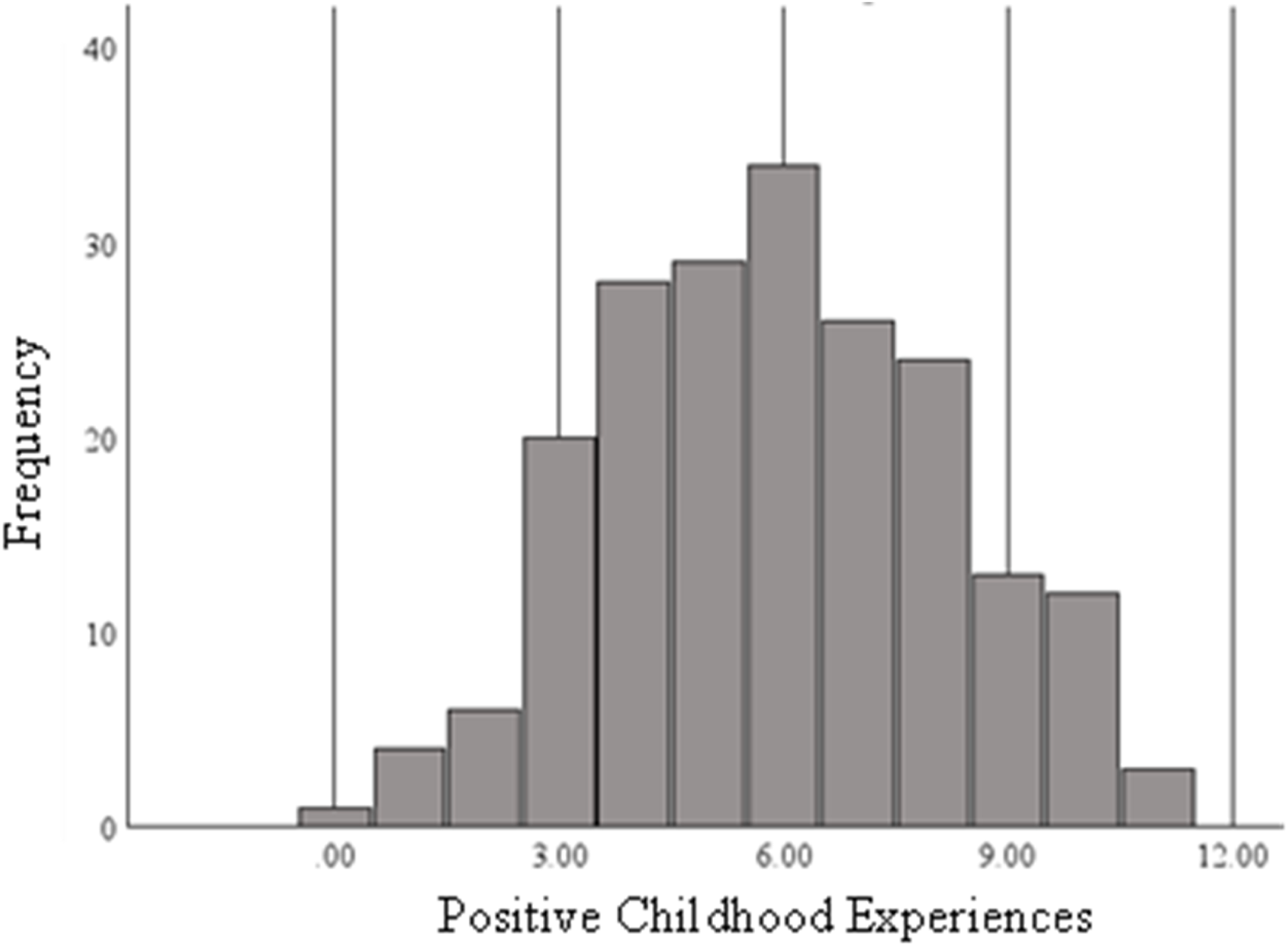
Cumulative PCEs score. Bivariate correlations among PCE constructs, after aggregating across mother- and father–child dyads, are in Table 1. To align our approach with that typically used in the literature on PCEs, we created a cumulative score as follows. For each parent, and for each of the above measures, we assigned a score of 1 for values above the median and 0 for values below the median. Those scores were then summed and standardized. The final PCEs scores were well distributed (see Figure 1).
Distribution of Cumulative Positive Childhood Experiences. Note. M = 5.91, SD = 2.31, range 0–11, skewness = 0.05, and kurtosis = −0.51.

Correlations among positive childhood experiences constructs

Table 1. Long description
A table showing correlations among positive childhood experiences constructs. The table has six rows and six columns, with the first row and column labeled with the specific constructs being measured. The constructs listed are Secure base script knowledge, Reflective functioning, Mind-mindedness, Responsiveness, Positive affect, and Marriage quality. The values in the table represent correlation coefficients. Row 1: Reflective functioning with Secure base script knowledge: .11. Row 2: Mind-mindedness with Secure base script knowledge: .22** and with Reflective functioning: .05. Row 3: Responsiveness with Secure base script knowledge: .19**, with Reflective functioning: .16*, and with Mind-mindedness: .41***. Row 4: Positive affect with Secure base script knowledge: .14, with Reflective functioning: .08, with Mind-mindedness: .31***, and with Responsiveness: .58***. Row 5: Marriage quality with Secure base script knowledge: .01, with Reflective functioning: -.06, with Mind-mindedness: -.04, with Responsiveness: .01, and with Positive affect: .10.
Note. For each construct, scores were averaged across parents due to high cross-parent correlations. *p < .05. **p < .01. ***p < .001.
Outcome: Children’s positive socioemotional development, 4.5 years
Self-regulation. We assessed children’s effortful control, or ability to deliberately suppress the dominant response and perform a subdominant response (Kochanska et al., Reference Kochanska, Murray and Harlan2000; Rothbart & Bates, Reference Rothbart, Bates, Damon and Eisenberg2006). There were two delay tasks and one set-shifting, Stroop-like task (see J. Kim & Kochanska, Reference Kim and Kochanska2026 for details).
The two delay tasks involved gifts and were very similar; in one, the child was asked to wait to open the package, staying in their seat, until E wrapped the gift and brought a bow (Wrap and Bow), and in the other, the child was asked to wait to reach into a bag with the gift, staying in the seat, until E brought a bow (Gift in Bag). Child self-regulated behavior involving the gift was coded from 0 to 3 for Wrap and Bow and from 0 to 4 for Gift in Bag, and for staying in the seat from 0 to 3 for both. Latencies to unregulated behavior and leaving the seat were also coded. We aggregated the behavior scores, seat scores, and latencies from the two segments into a single score by standardizing and averaging them, one for Wrap and Bow and one for Gift in Bag. Cronbach’s αs were 0.74 and 0.66, respectively.
The set-shifting task (Day/Night and Snow/Grass) was adapted from Carlson and Moses (Reference Carlson and Moses2001). There were two sets of 10 trials for each, coded from 0 to 3. We summed the scores of Day/Night and Snow/Grass and standardized the sum.
Children’s scores correlated across the tasks (rs = .18–.53, ps < .05, .01 or .001). Therefore, they were aggregated into a composite, with higher scores reflecting better self-regulation, M = −0.02, SD = 0.62.
Moral self. We used a puppet interview, as in past work (see details in J. Kim & Kochanska, Reference Kim and Kochanska2025a; Kochanska, Koenig, et al., Reference Kochanska, Koenig, Barry, Kim and Yoon2010). E used two puppets to present 14 items, assessing low and high ends of several moral dimensions (e.g., guilt, empathy, and internalization of rules) with each puppet adopting either low or high end for each (i.e., “If my mom and dad can’t see me, I sometimes break the rules” versus “I usually follow the rules even when my mom and dad can’t see me”). The child then chose the puppet that best represented the child’s own characteristics. The response was coded as 0 if the child chose the puppet endorsing the low end of a dimension, as 1 if the child hesitated or said “both”, and 2 if the child chose the puppet endorsing the high end. The items were averaged, and that score was standardized to reflect moral self. Cronbach’s α was 0.69.
Social cognition. We assessed children’s Theory of Mind (ToM). We used four established false-belief tasks (Hughes et al., Reference Hughes, Jaffee, Happé, Taylor, Caspi and Moffitt2005): unexpected contents (Band-Aid Box story), unexpected location (Andy’s Apple and New Toy stories), and belief-desire (Juice story), complemented by appropriate pictures, puppets, and props. Details are in Kochanska, Bendel-Stenzel, et al. (Reference Kochanska, Bendel-Stenzel, An and Sivagurunathan2025). Following the coding procedure in Hughes et al. (Reference Hughes, Jaffee, Happé, Taylor, Caspi and Moffitt2005, pp. 369–370), coders scored the child’s response to each critical test question as either 0 or 1 for each story (the child had to respond correctly to control questions to earn a point). We then summed the scores across the tasks into the total ToM score and standardized that score.
Regard for conduct rules. E introduced a basket with stuffed animals for the child to play a game to win a prize. To win, the child had to guess what animals were hidden under scarves that obscured their shapes (Aksan & Kochanska, Reference Aksan and Kochanska2005). The child was asked to follow three rules: not to peek under a scarf or in the basket, and touch only with one fingertip (the rules rendered the game practically impossible to win). The child was then left alone for 3 min. Upon return, E apologized for using “wrong animals”, the child played again, using an easy-to-guess animal, and every child won a prize. For every 3-s segment, we coded the child’s rule-compatible behavior. We then computed the proportion of the child’s rule-compatible behavior in all segments coded and standardized that score.
Overall composite of positive socioemotional development. Finally, we aggregated the constructs of self-regulation, moral self, social cognition (ToM), and regard for conduct rules into a composite of positive socioemotional development, M = −0.01, SD = 0.63. Cronbach’s α was .61. Additionally, principal components analysis supported the aggregation, as it recovered only one factor, Eigenvalue 1.91, 47.76% of variance, with all measures loading positively.
Mediator: Children’s competence, 3 years
Parents completed the Infant–Toddler Social and Emotional Assessment (ITSEA; Carter et al., Reference Carter, Briggs-Gowan, Jones and Little2003). We used the Competence scale, which encompasses six subscales: attention (5 items), compliance (8 items), imitation/play (6 items), mastery motivation (6 items), empathy (7 items), and prosocial peer relations (5 items). Parents rated individual items from 0 = not true/rarely, to 1 = somewhat true/sometimes, to 2 = very true/often. We computed the scores for each subscale and averaged them into an overall score, for mothers and fathers. Those scores significantly correlated across the parents, r = .21, p < .01, and thus were averaged into the overall parent-rated competence score, M = 1.50, SD = 0.18, and standardized. Cronbach’s αs were 0.78 and 0.74 for mothers and fathers, respectively.
Moderator: Children’s negative emotional reactivity or anger proneness, 16 months
Anger proneness. We observed children’s anger expression in the Car Seat episode from Laboratory Temperament Assessment Battery (Goldsmith & Rothbart, Reference Goldsmith and Rothbart1999), when they were buckled tightly in a commercially available car seat for 60 s. For each 5-s segment, coders rated body anger (kicking, waving arms, wiggling, pushing, struggling, yanking the straps, trying to arch back, etc.), from 0 = none, to 1 = mild, to 2 = medium, to 3 = moderate, to 4 = strong, facial anger, from 0 = none, to 1 = mild, to 2 = moderate, to 3 = strong, and vocal anger (crying, screeching, fussing, etc.), from 0 = none, to 1 = mild, to 2 = moderate, to 3 = strong. Latency to express anger was also coded. We then standardized body, facial, and vocal anger scores, which were summed across coded segments, reversed latency, and averaged across those variables into the final composite of anger proneness. Cronbach’s α was 0.79.
Plan of analyses
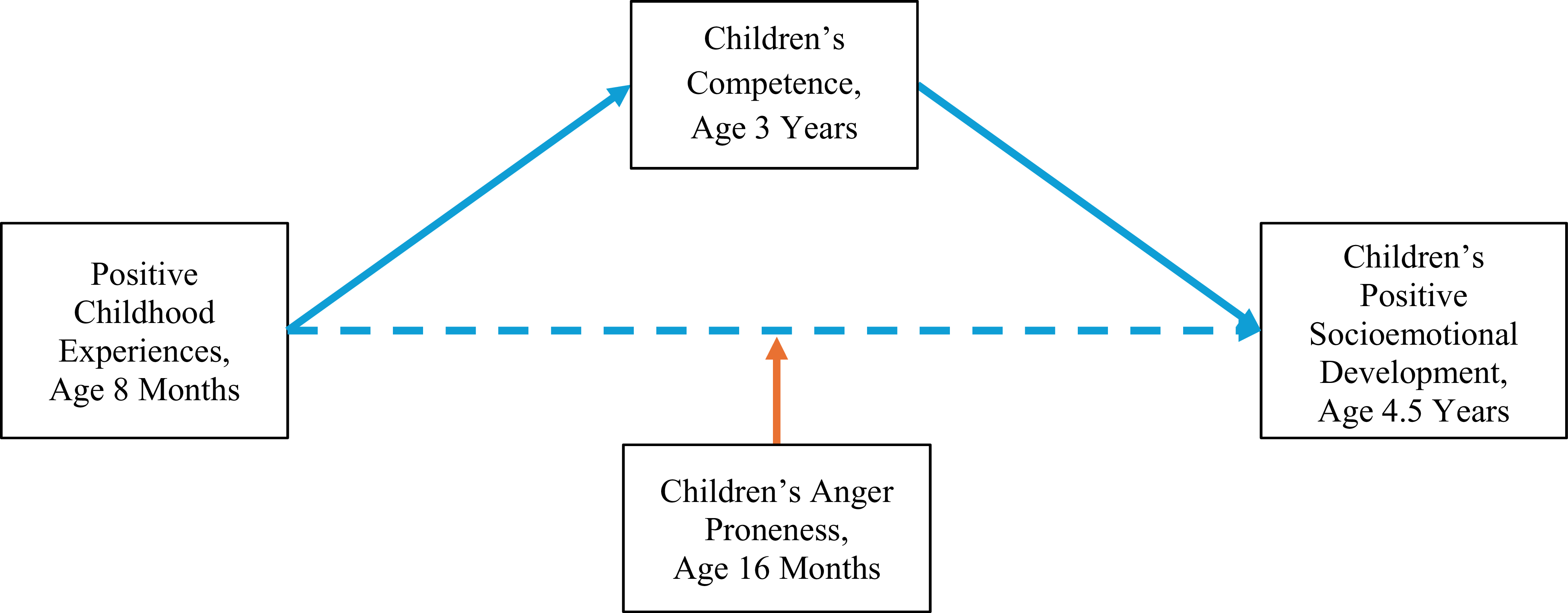
We first calculated descriptive statistics and correlations in SPSS 31. Then we tested longitudinal mediation and moderation in Mplus 9 (Muthén & Muthén, Reference Muthén and Muthén1998–2025) with 5,000-sample bootstrapping. We used a full information maximum likelihood estimator to handle missing data. Model fit was evaluated using the comparative fit index (CFI) and the root mean square error of approximation (RMSEA) with its 90% confidence interval (CI). Model fit is considered good when CFI ≥ 0.95 and RMSEA ≤ 0.05 (Hu & Bentler, Reference Hu and Bentler1999). The PCE score in infancy was modeled as the predictor, children’s competence at age 3 as the mediator, children’s positive socioemotional development at age 4.5 as the outcome, and their proneness to anger at 16 months as the moderator of the path from the predictor to the outcome. We covaried child gender. Our hypothesized cascade is depicted in Figure 2.
Proposed Model of Developmental Paths from Positive Childhood Experiences (PCEs) to Positive Socioemotional Development: Mediation by Competence and Moderation by Anger Proneness. Note. Blue lines represent paths related to mediation and the orange line represents a path related to moderation.

We tested the significance of mediation using a bias-corrected 95% CI. We then probed significant moderation effects: simple slopes were probed and plotted at 1 SD above and below the mean (Aiken & West, Reference Aiken and West1991), and the regions of significance (RoS) were generated using the method developed by Fraley (Reference Fraley2012), cited in Roisman et al. (Reference Roisman, Newman, Fraley, Haltigan, Groh and Haydon2012). The RoS analyses provide more detailed information about interaction effects by identifying the upper and lower bounds of values for the predictor and the moderator related to significant effects. For practical interpretation of the results, the range of the predictor and the moderator was bounded by ±2 SD from the mean in the RoS analyses. This approach was specifically designed to help researchers decide whether the model aligns with diathesis-stress, differential susceptibility, or vantage sensitivity.
If the effect of the moderator on the outcome is significant at only the low end of the predictor, it supports the diathesis-stress model because it suggests that children who are more anger prone perform worse when experiencing less adaptive environments. If the effect of the moderator on the outcome is significant at both low and high ends of the range of the predictor, it can support differential susceptibility. It indicates that children who are more anger prone are more sensitive to and affected by both positive and poor conditions – “for better or worse”. They flourish more when experiencing highly positive environments than their less reactive peers, but they have worse outcomes in environments with fewer positive features. If the effect is significant at only the high end, it supports vantage sensitivity because it demonstrates that children who are more anger prone benefit more from beneficial, adaptive environments. In other words, diathesis-stress refers to individual differences in response to negative influences only, whereas vantage sensitivity refers to differences in response to positive influences only (Pluess, Reference Pluess2015).
Recall that in our key model tested, we adopted the binary approach when considering each of the proposed components of the positive environment (yes/no) to create our cumulative score. This was an arbitrary decision, made to align with the predominant tradition in the respective research. But as noted earlier, the continuous scores for each component of PCEs were available as well. Therefore, we also conducted sensitivity analyses. In those, we standardized each component and averaged those scores rather than summing the individual yes/no scores. We then additionally estimated another model with thus constructed alternative PCEs score (ALTPCEs). To explore whether the process differs across different individual PCEs, we also ran additional sensitivity analyses with each individual construct, aggregated across parents, as a predictor.
Results
Preliminary analyses
Children who returned at age 4.5 years had significantly lower competence at age 3 than those who did not return, t(170) = 2.59, p = .01, but did not differ on any other variables of interest. The data were considered missing completely at random (MCAR) according to Little’s (Reference Little1988) MCAR test, χ 2(23) = 33.00, p = .08.
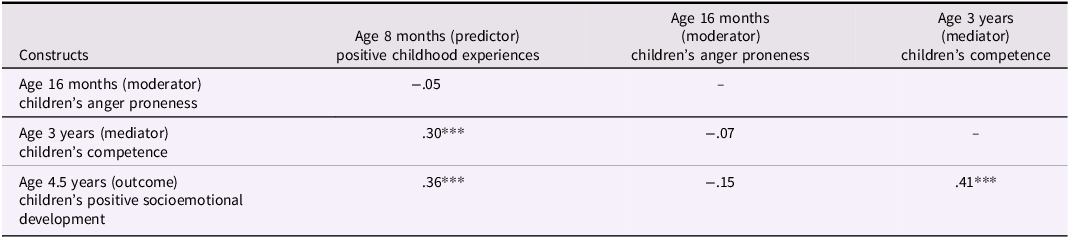
Correlations are in Table 2. Children’s PCEs in infancy, competence at age 3, and positive socioemotional development at age 4.5 were all positively inter-correlated.
Intercorrelations among constructs
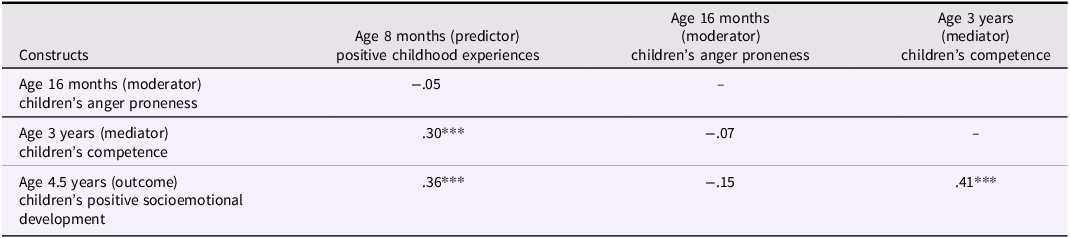
Table 2. Long description
A table showing intercorrelations among constructs, including positive childhood experiences, children’s anger proneness, children’s competence, and positive socioemotional development. The table has four rows and four columns, with the first row and column labeled with the ages and the specific constructs being measured. The values in the table represent the correlation coefficients between the constructs. Row 1: Age 16 months (moderator) children’s anger proneness with Age 8 months (predictor) positive childhood experiences: -.05. Row 2: Age 3 years (mediator) children’s competence with Age 8 months (predictor) positive childhood experiences: .30*** and with Age 16 months (moderator) children’s anger proneness: -.07. Row 3: Age 4.5 years (outcome) children’s positive socioemotional development with Age 8 months (predictor) positive childhood experiences: .36***, with Age 16 months (moderator) children’s anger proneness: -.15, and with Age 3 years (mediator) children’s competence: .41***.
***p < .001.
Testing the path from children’s Positive Childhood Experiences (PCEs) to positive socioemotional development as mediated by children’s competence and as moderated by their anger proneness
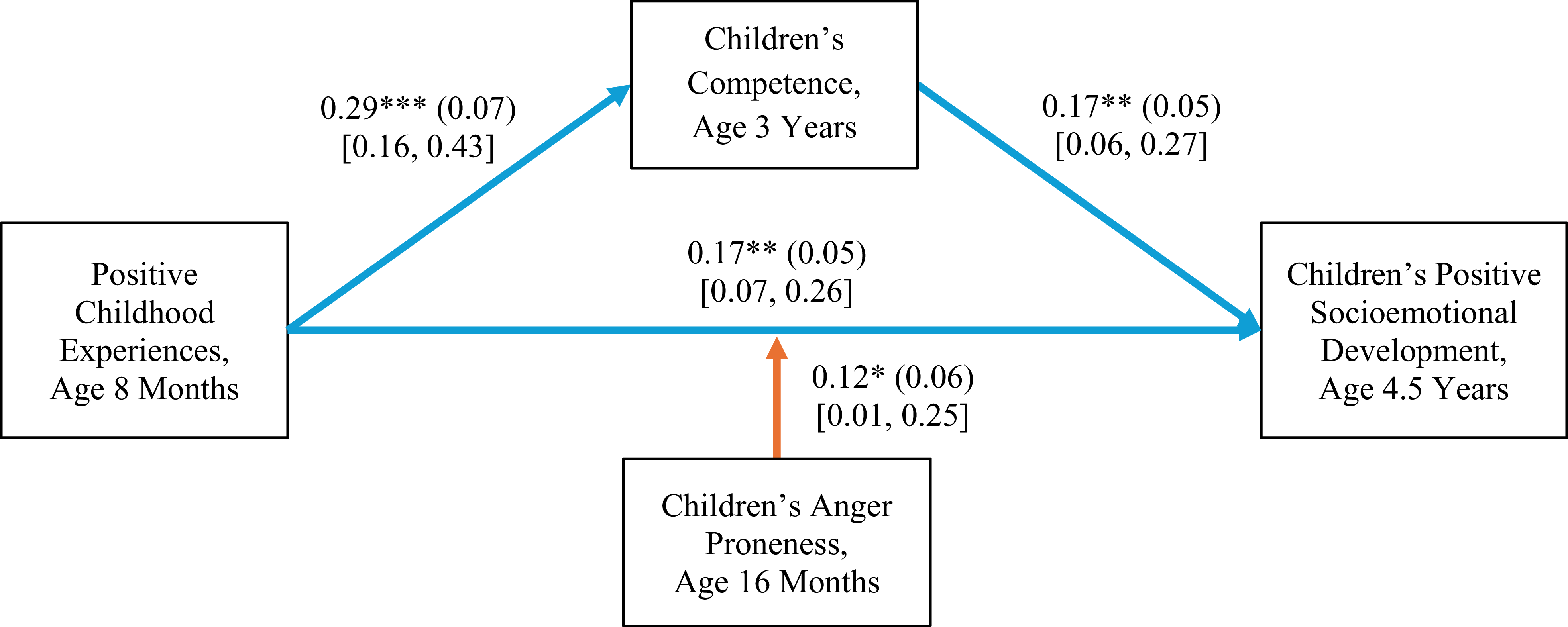
Results are in Figure 3. The model fit the data well, CFI = 1.00, RMSEA = 0.00 [0.00, 0.09]. The expected mediation was present: Children with more PCEs in infancy were seen as more competent at age 3, and competence, in turn, led to more positive socioemotional development at age 4.5, B = 0.05, SE = 0.02, 95% CI [0.02, 0.10].
Main Results: Developmental Paths from Positive Childhood Experiences (PCEs) to Positive Socioemotional Development: Mediation by Competence and Moderation by Anger Proneness. Note. Unstandardized coefficients, standard errors in parentheses, and 95% confidence intervals in brackets are presented for significant paths. Children’s gender was covaried but is not depicted. *p < .05, **p < .01, ***p < .001. The relation between positive childhood experiences and positive socioemotional development was mediated by children’s competence, B = 0.05, SE = 0.02, 95% CI [0.02, 0.10].

We also found significant expected moderation of the direct path from children’s PCEs in infancy to positive socioemotional development at age 4.5 by children’s anger proneness at age 16 months (see Figure 4 for simple slopes and RoS). Children who had experienced more PCEs had more positive socioemotional development, but only if they were highly anger prone, B = 0.29, SE = 0.09, p < .01, 95% CI [0.11, 0.48]. There was no relation between PCEs and positive socioemotional development for children who were less anger prone.
Anger Proneness as a Moderator of Developmental Paths from Positive Childhood Experiences (PCEs) to Positive Socioemotional Development. Note. Regressions based on values between 2 SD above and below the means of PCEs at 8 months and anger proneness at 16 months were probed and plotted, holding children’s gender (0 = girls) and competence at age 3 constant. Positive socioemotional development was assessed at age 4.5. Purple areas around the regression lines represent the regions of significance with respect to the moderator (child anger proneness; greater than −0.53 SD), whereas the gray box represents the region of significance with respect to the predictor (PCEs; less than −0.59 SD).

The RoS indicated that highly anger-prone children showed worse outcomes when they had experienced fewer PCEs (i.e., less than −0.59 SD). Thus, our moderation effect supported the diathesis-stress model: Highly anger-prone children were more affected by their less adaptive earlier experiences. Having had a history of rich PCEs (more than −0.59 SD, or approximately 4.5 or more PCEs) buffered highly anger-prone children from the negative effects of anger on their socioemotional outcomes. On the other hand, their peers who were less anger prone did not significantly differ in their socioemotional outcomes at age 4.5 years depending on their histories of positive experiences in infancy.
Sensitivity analyses
We estimated an additional model using the continuous version of the predictor, ALTPCEs, formed by standardizing and averaging all components. Results are in Supplement 3, Figure S1. The model fit the data well, CFI = 1.00, RMSEA = 0.00 [0.00, 0.05]. The significant indirect path was replicated. Children with greater ALTPCE scores in infancy were seen as more competent at age 3, which in turn led to more positive socioemotional development at age 4.5, B = 0.15, SE = 0.06, 95% CI [0.06, 0.28]. However, with ALTPCE score as the predictor, we failed to support significant moderation by children’s anger proneness.
Additionally, we estimated separate models for individual components of the PCE construct (each score combined across parents due to high cross-parent correlations, rs = .14–.59, ps < .05, .01, or .001) and for individual components of the positive socioemotional development construct. First, the significant mediation in the original model was replicated in the models with SBSK, MM, parents’ responsiveness, and positive affect to the child, but moderation was not supported in any of the models. Second, significant mediation was found in the models for all outcomes except for self-regulation, and moderation was significant only in the model predicting moral self. See Supplement 3, Table S3 for more details.
Discussion
In this work, we have adopted the framework that emphasizes the role of positive experiences, adaptive developmental trajectories, and competencies and strengths, increasingly influential in developmental psychology and psychopathology. One of our contributions – and our first aim – is the use of a prospective longitudinal design, advocated by Han et al. (Reference Han, Dieujuste, Doom and Narayan2023) and Pluess (Reference Pluess2024), with the assessment of PCEs “as they happen” in infancy, rather than relying on retrospective recall. In our approach to PCEs, we selected various aspects of the early socialization environment, which have been well supported as having positive relations with future socioemotional outcomes. We obtained several measures selected from the broad domain of parental mentalization, including SBSK (H. S. Waters & T. E. A. Waters, Reference Waters, Waters, Waters, Vaughn and Waters2021); reflective functioning (Luyten, Nijssens, et al., Reference Luyten, Nijssens, Fonagy and Mayes2017); and mind-mindedness (Aldrich et al., Reference Aldrich, Chen and Alfieri2021; Colonnesi et al., Reference Colonnesi, Zeegers, Majdandžić, van Steensel and Bögels2019; Garron-Bisonnette, et al., Reference Garon-Bissonnette, Bailes, Kwasneski, Lempres, Takemoto, Li, DeLuca, Salo and Humphreys2025; McMahon & Bernier, Reference McMahon and Bernier2017; Meins, Centifanti, et al., Reference Meins, Centifanti, Fernyhough and Fishburn2013; Meins, Fernyhough, et al., Reference Meins, Fernyhough, Arnott, Leekam and de Rosnay2013; Nikolic et al., Reference Nikolić, Zeegers, Colonnesi, Majdandžić, de Vente and Bögels2022). We also targeted the parent’s positive caregiving, focusing on two features most often studied in infancy, responsiveness and positive affect (Ainsworth et al., Reference Ainsworth, Bell, Stayton and Schaffer1971; Aksan et al., Reference Aksan, Kochanska and Ortmann2006; Bornstein et al., Reference Bornstein, Tamis-LeMonda, Hahn and Haynes2008; De Wolff & van IJzendoorn, Reference De Wolff and van IJzendoorn1997; Dix, Reference Dix1991; Humphreys et al., Reference Humphreys, Garon-Bissonnette, Hill, Bailes, Barnett and Hare2024; Kochanska, Reference Kochanska1997; Kochanska et al., Reference Kochanska, Bendel-Stenzel and An2025; Landry et al., Reference Landry, Smith and Swank2006; Leerkes et al., Reference Leerkes, Parade, Benito-Gomez, Morris and Smith2022; Thompson, Reference Thompson, Damon, Lerner and Eisenberg2006). Finally, we assessed the positive interparental relationship, a widely studied important adaptive feature of early environment (Davies & Cummings, Reference Davies, Cummings, Cicchetti and Cohen2015; Davies et al., Reference Davies, Cao, Hendrickson and Thompson2025; Don et al., Reference Don, Simpson, Fredrickson and Algoe2025).
Although we selectively chose PCEs that we viewed as representing different relational features of early socialization, well supported by the literature, one might argue that our choices of the PCE measures were, in part, arbitrary. It would be a legitimate concern. A case could easily be made for including many other features of early experiences in future work, both social and non-social, such as parental robust mental health, the presence of supportive and trusted non-parental adults, sufficient family resources, access to various sources of effective support, predictable family routines, good quality caregiving resources and schooling, and many others.
In addition, it will be important in future work to include both the measures of PCEs as they happen (as in the current study) and those based on future retrospective recall. Of course, this will require very long-term prospective designs or new recall measures from participants for whom archived data on early environment are available. In this context, it is important to acknowledge that although measures of children’s and adults’ early experiences that rely on subjective recall have significant limitations, those limitations apply mostly to retrospective recall probed by direct or veridical questions. However, many indirect measures of subjective perceptions of one’s environments, integrating cognitive science and attachment research, have been developed. Those could be used to assess concurrent or remembered environment, even by very young children, providing an important window into their construals of positive (or adverse) experiences (Dykas & Cassidy, Reference Dykas and Cassidy2011; Luo et al., Reference Luo, vanMarle and Groh2025; Smith & Pollak, Reference Smith and Pollak2021).
We conceptualized children’s outcomes as socioemotional strengths and competencies based on the strengths-based framework (Eisenberg, Spinrad, et al., Reference Eisenberg, Spinrad, Hernández and Zuffianò2024; Eisenberg, Zuffianò, & Spinrad, Reference Eisenberg, Zuffianò and Spinrad2024; Pluess, Reference Pluess2024), emphasizing skills that are widely recognized as essential at the age when children transition from preschool to kindergarten, and we observed those behaviorally: self-regulation, moral self, social cognition, and regard for rules. However, many other child outcomes would be important, including school readiness, positive peer relations, physical health, and adaptive emotion regulation, to mention just a few (Pluess, Reference Pluess2024). Future research on different aspects of developmental outcomes is warranted.
Our second aim, also advocated by Han et al. (Reference Han, Dieujuste, Doom and Narayan2023), was to examine what accounts for the positive cascade triggered by PCEs in infancy to positive outcomes four years later. We posited, and supported, the role of children’s competence at toddler age as one mediator that links early PCEs with future socioemotional competence. It is consistent with findings and arguments from empirical and theoretical work, which highlight the effects of socialization within parent–child relationships on children’s future developmental outcomes (Forman et al., Reference Forman, Aksan and Kochanska2004; Kochanska et al., Reference Kochanska, Kim and Boldt2015; Maccoby, Reference Maccoby, Higgins, Ruble and Hartup1983, Reference Maccoby, Grusec and Hastings2007; Thompson, Reference Thompson, Damon, Lerner and Eisenberg2006, Reference Thompson, Killen and Smetana2013). We used a well-established Competence scale from ITSEA (Carter et al., Reference Carter, Briggs-Gowan, Jones and Little2003) reported by parents; however, strengths and competencies salient at toddler age that ITSEA targets can and have been measured behaviorally as predictors for future adaptive developmental outcomes. For example, imitation, compliance, and empathy, observed at toddler age, consistently predicted a range of measures of sociomoral development at preschool age and beyond (Forman et al., Reference Forman, Aksan and Kochanska2004; S. Kim & Kochanska, Reference Kim and Kochanska2017; Kochanska, Reference Kochanska2002). In future research, incorporating such behavioral measures and parent reports of children’s competence is warranted. As well, a strong case could be made for including other mediators, for example, adaptive emotion regulation skills, representations of relationships and self, or executive functions, as reviewed previously. When studying links between parents’ recalled PCEs and children’s outcomes, the improved quality of the parent–child relationship is a likely mediator (Narayan et al., Reference Narayan, Lieberman and Masten2021).
In this context, in future research, preferably with larger samples, it would be important to replicate our mediation findings, as well as examine in a more nuanced ways causal effects that account for the long-term impact of PCEs. It is possible, even likely, that various aspects of PCEs in infancy affect various aspects of children’s competence at toddler age in different ways. Elucidating such relations, assessed over time, would inform our understanding of mechanisms of impact at a deeper level than simply establishing the presence of significant mediation. Further, such more nuanced knowledge would have practical implications for implementing parenting prevention and intervention programs, as it would allow for tailoring the intervention to the parent’s specific needs (e.g., addressing their mentalization capacities or behavioral responsiveness skills).
Our third aim was to examine if children differing in their negative emotional reactivity or anger proneness were differently affected by early PCEs. Consistent with previous findings showing significant interaction effects between positive parent–child relationships and children’s anger proneness on positive developmental outcomes (e.g., Bendel-Stenzel et al., Reference Bendel-Stenzel, An and Kochanska2022; S. Kim & Kochanska, Reference Kim and Kochanska2012; McElwain et al., Reference McElwain, Holland, Engle and Wong2012), we found a significant moderation effect. Specifically, the interaction supported diathesis-stress: Highly anger-prone children appeared more affected by lower levels of PCEs and therefore had poorer socioemotional outcomes than their less anger-prone peers in less adaptive contexts. This suggests that high negative emotional reactivity or anger proneness reflects vulnerability to negative or less adaptive environmental influences. In other words, this also suggests that more adaptive and positive early experiences can buffer the potential negative effects of high anger proneness on socioemotional outcomes. These findings have translational implications. Children who are temperamentally high on negative emotionality are often considered at risk; further, they often elicit more negative parenting (Hyde et al., Reference Hyde, Trentacosta and Bezek2025). Their greater sensitivity to the environment further compounds developmental risks. Therefore, such infants and their parents may be particularly in need of educational, prevention, and intervention efforts that target relational health and strengthen positive early experiences, including parental mentalization, parenting practices, and interparental relationships.
The results are somewhat surprising, given that many previous studies supported differential susceptibility rather than diathesis-stress (e.g., Bendel-Stenzel et al., Reference Bendel-Stenzel, An and Kochanska2022; S. Kim & Kochanska, Reference Kim and Kochanska2012; McElwain et al., Reference McElwain, Holland, Engle and Wong2012). This discrepancy may be in part due to how early experiences were defined. Those previous studies included a single domain of positive experiences (e.g., parent–child shared positive affect, mutually responsive orientation, parent–child attachment security). In contrast, the current study focused on the cumulative effects of multiple indicators of early PCEs, encompassing broader aspects of the caregiving and family environment, and these effects can differ from domain-specific effects. For example, it is plausible that children high in anger proneness are differentially susceptible to certain types of experiences (e.g., parent–child interactions) but not others (e.g., interparental relationships, parental mentalization), and combining these domains into a cumulative index may have attenuated and obscured domain-specific effects. Indeed, in our sensitivity analyses, we found moderation effects for some constructs but not all, suggesting that cumulative effects could be different from a single construct’s effects.
As Pluess and Belsky (Reference Pluess and Belsky2013) emphasized, a true distinction among diathesis-stress, differential susceptibility, and vantage sensitivity requires responses across the full environmental spectrum, including truly adverse conditions (e.g., harsh parenting, parental hostility, high interparental conflicts). It is important to note that lower levels of PCEs in the present study do not necessarily represent adverse experiences, although they may reflect less adaptive parent–child or interparental relationships. Future research should incorporate both positive and adverse experiences to investigate whether children’s specific plasticity characteristic functions differently in negative and positive environments.
As well, future research should examine moderated mediation models, in which children’s plasticity traits may moderate the path from PCEs to child future competence (or another mediator) and perhaps also the path from the mediator to future outcomes. Although we did estimate such a model, we failed to find moderated mediation. It may be that – as we found – children’s plasticity traits moderate the effects of positive environments on more advanced socioemotional skills rather than the effects on emerging socialization competence. Alternatively, future research with behavioral measures of competence, as we have suggested above, or another mediator or predictor (e.g., ACEs) may reveal significant moderated mediation.
In addition to our key aims, we also addressed a measurement issue in additional analyses. Although PCE research is a counterpoint of sorts to ACE research, PCE measures that often mirror a cumulative-risk approach (i.e., each PCE is coded as present or absent, and the items are summed to create a cumulative score). To align with the field, we adopted a similar strategy; but in sensitivity analyses, we also estimated a model using ALTPCEs scores (an average of standardized original dimensions used as components of the PCEs). These analyses replicated the proposed mediation through child competence but not moderation by child anger proneness. Consequently, whereas we feel confident about the robustness of our mediational model, we interpret our moderation findings with some caution. Clearly, systematic research focused on measurement issues will be important.
A limitation of our study is that our participating families are considered a relatively low-risk, socioeconomically advantaged population. As such, the generalizability of the findings may be constrained. However, the low-risk nature of the sample should be interpreted in light of the study’s focus on PCEs, rather than ACEs. In community samples, ACEs tend to be relatively infrequent, making it hard to obtain sufficient variability among participants. In contrast, PCEs show meaningful variation even within low-risk contexts. Thus, while replication in more diverse samples is warranted, the current sample was well suited for the purpose of our study.
In sum, the current study advances a growing field focused on positive developmental processes and outcomes by examining longitudinal relations between PCEs and children’s later socioemotional functioning, highlighting how and for whom these associations are present. By assessing real-time PCEs, identifying competence as a mediator, and demonstrating negative emotional reactivity as a potential plasticity marker, we enhance the understanding of how positive early relational environments shape adaptive development. Together, these findings highlight the importance of early positive relational experiences and suggest that highly reactive children may especially benefit from enriched caregiving environments.
Supplementary material
The supplementary material for this article can be found at https://doi.org/10.1017/S0954579426101801.
Data availability statement
Although we will gladly share the coding systems or the syntax used in the analyses, we are unable to share data for individual families. Our consent forms the parents signed clearly preclude any sharing of individual data, even if deidentified. The parents have consented to the data being shared in the aggregate form only, and we are ethically and legally bound to follow this agreement.
Acknowledgments
We thank Harriet Waters for providing the training in Attachment Script Assessment. We are also grateful to all members of Child Lab and to the families participating in our Children and Parents Study.
Funding statement
This study was supported by NIH grants R01HD091047 and R01HD110427 to Grazyna Kochanska. The content is the responsibility of the authors and does not necessarily represent the official views of the National Institutes of Health.
Competing interests
The authors have no conflicts of interest.
Pre-registration statement
This study was not pre-registered. Although we had not pre-registered the current hypotheses and models, we have previously presented methods and findings from our research program in multiple empirical and theoretical papers (many of them cited in the current paper). Additionally, we described our program of research in our grant applications, and that information is publicly available.



 Open access

