1 Aims and organization
The present study discusses the development of the be + V-ende/V-ing periphrasis, which I take to be the ancestor of the Present-day English progressive.Footnote 2 On the basis of quantitative data, I argue that the periphrasis was originally an emphatic alternative to the simple tenses. With time the construction was reinterpreted as an emphatic progressive marker, with subsequent loss of emphasis in those contexts in which the construction became obligatory. The grammaticalization of the periphrasis as (primarily) a progressive marker probably started in the Early Modern English period (c. 1500–1700). From the Late Modern period onwards (c. 1700 till today) other, optional, uses have developed, viz. the so-called subjective uses of the construction. However, the present article focuses on the grammaticalization of the periphrasis as a progressive marker, touching only briefly on the development of subjective uses.
This article builds on the data presented in Killie (Reference Killie2008), and I will refer to that article a number of times. In Killie (Reference Killie2008) I test the claim of Bertinetto et al. (Reference Bertinetto, Ebert and de Groot2000) that the English periphrasis has undergone ‘PROG imperfective drift’, which means that it originated as a locative construction, gradually developing into a durative progressive, and subsequently also into a focalized progressive. I argue that neither the locative nor the durative stage can be traced in the extant Old and Middle English data, but that the periphrasis shows a variety of uses from Old through Early Modern English. The durative type is not predominant at any stage; in fact, it is not even frequent. The only clear finding in Killie (Reference Killie2008) is that the construction became more focalized in the Early Modern period, suggesting that this is the period when it evolved into a progressive construction. This idea is developed further in the present study.
The article is organized as follows. Section 2 is devoted to terminological and methodological issues, while section 3 presents the data. As the article seeks to investigate the original meaning of the periphrasis, most of the examples come from Old English. In section 4 I provide an analysis of the development of the progressive based on the data and some hypotheses about the development of progressive markers. Finally, the main points are summarized in section 5.
2 Terminology and methodology
The term progressive is a semantic label. A progressive marker marks a dynamic (nonstative) situation as being in progress at reference time (Comrie Reference Comrie1976: 35). However, in many historical studies of the be + V-ende/V-ing periphrasis, the term is not restricted to progressive meaning, but refers to the construction as such, regardless of meaning. This practice is unfortunate given that, as will be shown below, the be + V-ende/V-ing periphrasis did not function as a progressive in earlier English. In the present study, progressive is a semantic label, while the formal category is referred to more neutrally as ‘the periphrasis’ or ‘the construction’.
Bertinetto et al. (Reference Bertinetto, Ebert and de Groot2000) and Bertinetto (Reference Bertinetto2000) distinguish between two types of progressive constructions, viz. durative progressives and focalized progressives. Durative progressives are progressives that are ‘evaluated relative to a larger interval of time’, while focalized progressives are ‘those expressing the notion of an event viewed as going on at a single point in time’, referred to as the ‘focalization point’ (Bertinetto et al. Reference Bertinetto, Ebert and de Groot2000:527). Examples are provided in (1) and (2), respectively.
(1) [Yesterday, during my sleep], Ann was playing for two hours all by herself. (from Bertinetto Reference Bertinetto2000: 571)
(2) When John came, Ann was still working. (from Bertinetto Reference Bertinetto2000: 564–5)
What both durative and focalized progressives have in common is that they represent a situation as unbounded. Declerck (Reference Declerck1991, with further reference to Comrie Reference Comrie1976), provides the following discussion of the notion of boundedness in relation to progressive forms:
A progressive verb form refers to an internal portion of the situation, without making explicit reference to its beginning or end. A nonprogressive verb form, in contrast, represents a situation as ‘complete’, i.e. it ‘presents the totality of the situation referred to . . . without reference to its internal temporal constituency: the whole of the situation is presented as a single unanalysable whole, with beginning, middle, and end rolled into one; no attempt is made to divide this situation up into the various individual phases that make up the action (Comrie Reference Comrie1976: 3)’. (Declerk Reference Declerck1991: 122, note 6; see also Smith Reference Smith1997: 25, 35–7, 98, 102)
As should be clear from the examples in (1) and (2) above, the present-day periphrasis has both durative and focalized uses. Studies of the English periphrasis do not normally distinguish between the two types, but I will do so in this study as the distinction is relevant to the grammaticalization of the periphrasis as a progressive marker. Grammaticalization may involve obligatorification in the sense that the grammaticalizing construction becomes increasingly obligatory during the process (see e.g. Lehmann Reference Lehmann2002: 124 and Heine & Kuteva Reference Heine and Kuteva2007: 34). This has happened also to the progressive uses of the English periphrasis; however, it is clearly only the focalized use of the construction which has become obligatory, not the durative one (hence the sentence in (1) is grammatical also with a non-progressive form).
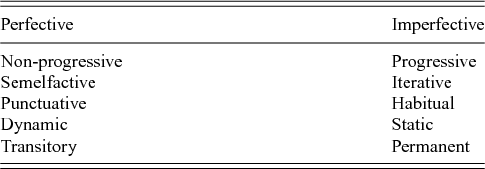
The bounded–unbounded distinction does not only separate between progressive and non-progressive forms, but also – more widely – between imperfective and perfective forms. Progressivity is just one subclass of imperfective meaning. As one aim of the present article is to discuss whether the periphrasis may originally have been an imperfective marker, which at some stage developed into a progressive marker (cf. section 4.1), we need to look briefly at what characterizes imperfective markers. A classification of imperfective – and perfective – meanings is proposed by Binnick (Reference Binnick1991), who provides the list in table 1.
Oppositional values of the imperfective and perfective aspects (Binnick Reference Binnick1991: 154)
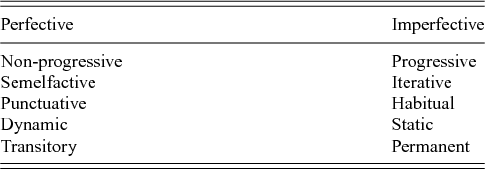
As can be seen, imperfectives typically cover a whole range of meanings, progressive meaning being only one of them. As regards iterative and habitual situations, these both involve repetition, but while habitual meaning implies that the repeated activity takes place over an extended time period, iterative meaning does not. Iterative meanings can be paraphrased ‘to go on doing’ (Binnick Reference Binnick1991: 204).
We have seen that both durative and focalized progressives portray the situation as unbounded. The same goes for another common historical use of the periphrasis which will be discussed in this study – the so-called stative uses. These involve static, i.e. non-dynamic situations. According to Comrie (Reference Comrie1976: 12–13), dynamic situations require a continuous input of energy to be maintained, while static situations require input of energy not to be maintained, as in He sits on the sofa. The stative uses in this study correspond to Binnick's ‘static’ and ‘permanent’ meanings. As we will see below, the corpus also contains uses of the periphrasis that appear to be perfective.
As one main aim of the present article is to explore the increased progressivity of the periphrasis, all uses which are compatible with a progressive meaning have been classified as such. This need not in all cases have been the intended meaning, but the relevant classification strategy has the advantage of revealing the potential for reinterpretation, i.e. the proportion of potential ‘bridging contexts’ (cf. the discussion in section 3.1)
Adverbial collocates have been an important diagnostic in the classification process. Durative and focalized progressives differ with respect to what adverbial collocates they take (see Freckmann Reference Freckmann1995 and Bertinetto Reference Bertinetto2000). Some examples of durative adverbials are found in (1). Others are, for example, since early this morning, until midnight, during the uprising, from ten to twelve, etc. Focalized progressives may occur within a so-called frame construction where the progressive event functions as a frame around the punctual event, as in (2). They may also collocate with adverbials such as at the moment, now, still, etc. Periphrases collocating with adverbials like generally, permanently etc. have been classified as stative, while periphrases co-occurring with adverbials denoting sequence (e.g. subsequently, afterwards, etc.) have mostly been analysed as perfective. While time adverbials have been a useful tool in the classification process, a considerable proportion of the corpus examples do not involve a time adverbial at all. In such cases the context has often been all-important: examples which were compatible with a progressive (‘activity in progress at reference time’) reading have been classified as such; examples which seemed to refer to a permanent situation have been classified as stative, while examples which were most naturally understood as bounded have been classified as perfective.Footnote 3
3 The data
3.1 Progressive-like uses of the periphrasis
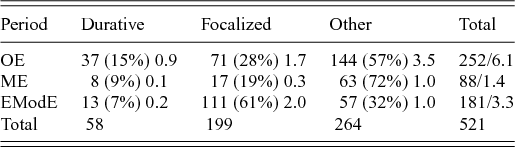
The data of this study are taken from the Helsinki Corpus of English Texts: Diachronic Part. Table 2 below shows the distribution of uses which are compatible with a durative and focalized interpretation. The figures are given in absolute frequencies, percentages (in parentheses), and frequencies per 10,000 words.
Functions of the periphrasis in the Helsinki Corpus
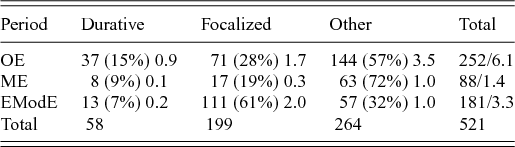
The data have been tested using chi-square, and the differences are statistically significant at the 99 per cent confidence level or higher, including all conditions except the distribution of durative vs focalized uses between Old and Middle English.Footnote 4 As shown in table 2, 43 per cent of the Old English periphrases allow a progressive reading, two-thirds of these being compatible with a focalized reading. The sentences in (3)–(6) below provide examples of what from a present-day perspective look like durative progressives (examples (3) and (4)) and focalized progressives (examples (5) and (6)).
(3)

(4)
(5)
(6)
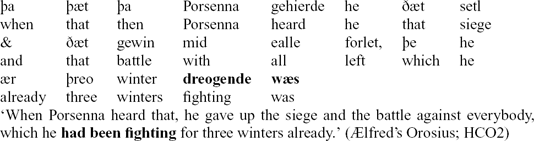

Examples such as those in (3)–(6) have frequently been cited as evidence that there is continuity in the development of the periphrasis from Old English to the present day. However, there clearly is no identity between the Old and Present-day English periphrases. The proportion of possible progressive uses of the periphrasis in Old English simply is not large enough to legitimate the view that the construction was first and foremost a progressive marker at this stage. Sentences such as those in (3)–(6) above may at some stage, though probably not in the Old English period, have provided a ‘bridging context’ (Evans & Wilkins Reference Evans and Wilkins1998: 5; Heine Reference Heine2002: 84) or ‘critical context’ (Diewald Reference Diewald2002) in the grammaticalization of the periphrasis as a progressive marker. Bridging contexts are potentially ambiguous between a source meaning and a possible target meaning. They invite inferences or implicatures and are therefore crucial in the type of semantic change under discussion here. In grammaticalization processes such bridging contexts increasingly develop into ‘switch contexts’ (Heine Reference Heine2002: 85) or ‘isolating contexts’ (Diewald Reference Diewald2002), i.e. contexts in which the source meaning is ruled out while the target meaning provides the only possible interpretation (Heine Reference Heine2002: 85).
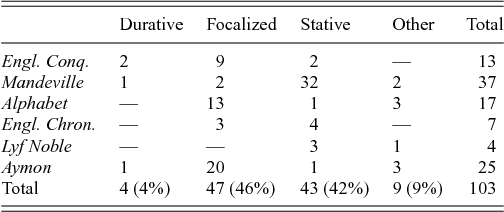
Grammaticalization normally involves an increase in frequency (see e.g. Hopper & Traugott Reference Hopper and Traugott2003: 129–30). Hence, if the periphrasis started to become grammaticalized as a progressive marker in Old English, one would expect a steady increase in progressive-like uses of the periphrasis from Old English onwards. As shown in table 2, there is instead a decrease in such uses between Old and Middle English, both in absolute and relative terms. In Killie (Reference Killie2008) I showed that the Middle English data of the Helsinki Corpus may not yield representative results in regard to the function of the periphrasis because there are rather few occurrences and an over-representation of a few writers. I therefore analysed an additional corpus of six Middle English texts (see the bibliography for details). Of 103 uses of the periphrasis in that corpus, 50 per cent were found to be compatible with a progressive reading. If the data in the additional corpus are representative, the proportion of progressive-like uses of the periphrasis was considerably higher in written Middle English than the data in table 2 would seem to indicate. The large proportion of uses which are not compatible with a progressive reading nevertheless suggests that the progressive function of the periphrasis had not yet grammaticalized in the Middle English period.Footnote 5 In Early Modern English there is a sharp increase in uses which lend themselves to a progressive interpretation, the proportion going up to 68 per cent. This suggests that the construction was shifting towards an increasingly progressive meaning. The increase seems first and foremost to have taken place in the focalized use of the construction. There is still considerable variation in the use of the periphrasis in Early Modern English, but one finds long passages such as the one in (7) below, where the distribution of ‘progressive’ and ‘non-progressive’ forms very much resembles Present-day English usage.
(7) I was amazed at all this, and did not know whether he was crazed, or had come to me on design to involve me in a concealing of treason. So I went to Lloyd, and sent him to the secretary's office with an account of that discourse of Tonge’s, since I would not be guilty of misprision of treason. He found at the office that Tonge was making discoveries there, of which they made no other account but that he intended to get himself to be made a dean. I told this next morning to Littleton and Powle, and they looked on it as a design of Danby’s, to be laid before the next session, thereby to dispose them to keep up a greater force, since the papists were plotting against the king's life. This would put an end to all jealousies of the king, now the papists were conspriring against his life. But lord Halifax, when I told him of it, had another apprehension of it. He said, considering the suspicions all had of the duke's religion, he believed every discovery of that sort would raise a flame which the court would not be able to manage. (Burnet's History of my own time, HCE3)
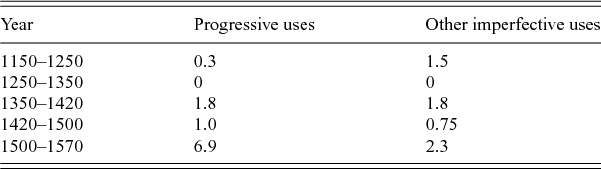
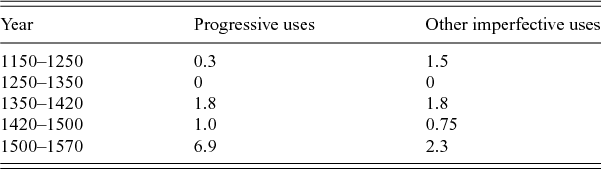
Both Smith (Reference Smith2007) and Kranich (Reference Kranich2008) provide quantitative data supporting the view that the grammaticalization of the periphrasis as a progressive marker took place in Early Modern English. Both studies have used the same classification strategy as the one applied in the present study, i.e. to classify as progressive all uses which are compatible with a progressive reading, so the results of the three studies should be comparable. Neither Smith (Reference Smith2007) nor Kranich (Reference Kranich2008) distinguishes between durative and focalized progressives, so those studies cannot be used to trace possible shifts in the relative proportion of the two types of progressive, but both studies inform us about the grammaticalization of progressivity in English. Smith (Reference Smith2007) maps the frequency of progressive and other imperfective uses of the periphrasis in a corpus covering the period 1150–1710. As shown in table 3 above, he finds that there is a dramatic rise in the use of the periphrasis with progressive meaning in the Early Modern period, both in terms of sheer frequency and in terms of relative proportions.Footnote 6
Frequency of progressive and other imperfective uses of the periphrasis per 50,000 words in Middle and Early Modern English (adapted from Smith Reference Smith2007: 216)
Kranich (Reference Kranich2008) provides data mapping the development of the periphrasis as a progressive marker. Her data, which are taken from the ARCHER corpus, are given in table 4 below. (Here 17th/1 refers to the first half of the seventeenth century and 17th/2 to the second half, etc.)
Progressive-like uses of the periphrasis 1600–2000 (adapted from Kranich Reference Kranich2008: 249)

As can be seen, there is a close match between the proportion of progressive-like uses in Kranich's material from the first half of the seventeenth century and the Early Modern English figures in table 2. Kranich finds that there is a sharp increase in the proportion of progressive-like uses between the first and second half of the seventeenth century, suggesting that the construction became increasingly grammaticalized in the eighteenth century (see also Strang Reference Strang1982: 429 and Arnaud Reference Arnaud1998: 141). Nehls (Reference Nehls1988: 186) finds that the use of the periphrasis ‘had become largely the rule’ in progressive contexts by the end of the eighteenth century. In addition to his own data, Nehls finds support for his claim in Louis Brittain's Rudiments of English Grammar from 1778, which states that the periphrasis is used in progressive function at the time. Since (prescriptive) grammarians are traditionally hesitant to ‘admit’ that a new feature has entered the language, there is reason to assume that the grammaticalization of the periphrasis as a progressive had taken place well before the publication of Brittain's grammar. The late eighteenth century is also the time when new forms, such as the passive progressive and progressive be, started to occur (Denison Reference Denison1993: 394–5, 440–3; Denison Reference Denison2000; Pratt & Denison Reference Pratt and Denison2000: 412–15). This suggests that the periphrasis was becoming increasingly integrated into the verbal paradigm, or ‘paradigmatized’ (cf. Lehmann Reference Lehmann2002: 120–1), which is a typical sign of increased grammaticalization. According to Kranich (Reference Kranich2008: 327), the progressive became obligatory in the late nineteenth and early twentieth centuries (see also Smitterberg Reference Smitterberg2005: 244). Nehls (Reference Nehls1988: 183, 188) dates this stage to the mid nineteenth century.
Interestingly, the figures in table 4 show a small decrease in the proportion of progressive-like uses from the latter half of the nineteenth century. This drop is first and foremost caused by a corresponding rise in the so-called ‘interpretative progressive’ (Kranich Reference Kranich2008: 306–7), which was grammaticalizing at the time (cf. also Smitterberg Reference Smitterberg2005: 231).
3.2 Uses of the periphrasis which are incompatible with a progressive reading
We have now seen that the periphrasis has become increasingly progressive from the Early Modern period onwards. What we have not looked at so far are those uses which are not compatible with a progressive reading. As shown in table 2, 144, or 57 per cent, of the Old English uses of the periphrasis have been classified as ‘other’. A closer study of the ‘other’ category revealed that there is a preponderance of two specific types of uses, viz. stative and perfective uses.
As mentioned above, stative uses of the periphrasis do not involve dynamic situations at all. They refer to facts or unchanging relations such as belonging, feelings and eternal truths.Footnote 7 Some examples from Old English are given in (8) and (9) below.
(8)
(9)
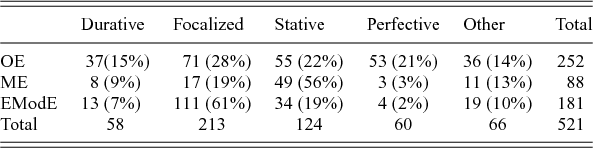
The proportion of stative uses from Old to Early Modern English is shown in table 5 below.
Functions of the progressive in the Helsinki Corpus, more fine-grained analysis
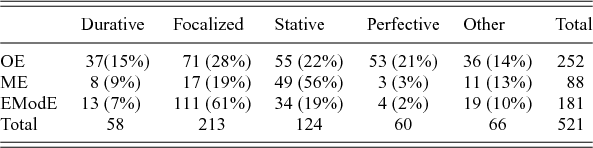
The data in table 5 show that the proportion of stative uses is fairly large in all periods under study. In the Old English corpus, about one-fifth of the periphrases are of this type. In the Middle English corpus 56 per cent of the uses are stative, while the corresponding figure in Killie's additional 2008 corpus was 42 per cent. Even in the Early Modern English corpus approximately one-fifth of the examples are stative, and this in spite of the fact that the proportion of progressive-like uses increases sharply.
Some examples of stative uses from the latter part of Early Modern English are given in (10) and (11) below. These involve highly stative predicates and illustrate that even though the periphrasis was grammaticalizing in Early Modern English, it was still in some respects different from its Present-day English counterpart.
(10) . . . money I brought along with me: and I will gladly satisfy you in any thing. Some of it is yet remaining in my hands, for uses: and I question not but you are well contented I should have something laying by mee against necessity. (Diaries and letters of Philip Henry, HCE3)
(11) There is not any of the batcholers in this country are inclineing to marry this yeare that I heare of. (Diaries and letters of Philip Henry, HCE3)
The fourth column of table 5 shows that perfective uses make up as much as one fifth of the Old English corpus sentences. Examples are given in (12) and (13).
(12)
(13)
Like focalized and durative uses, perfective uses involve dynamic situations, but unlike focalized and durative uses, they are not naturally interpreted as unbounded. Perfective uses often occur within a sequence of verb forms where the neighbouring verb forms are simple forms with a perfective meaning. From a present-day viewpoint, it would be more ‘natural’ to use a simple verb also where the periphrasis has been used. The function of the periphrasis here is probably to draw attention to one specific verb phrase, making it stand out from the surrounding context.
While perfective uses of the periphrasis are quite frequent in the Old English corpus, they are as good as non-existent in the Middle and Early Modern English corpora. Similarly, in Killie (Reference Killie2008) I found only three examples of such uses in my additional Middle English corpus. Smith (Reference Smith2007) excludes perfective uses from his Middle and Early Modern English data because of their very low frequency (Reference Smith2007: 218). These facts suggest that the use of the construction with perfective predicates was particular to Old English.
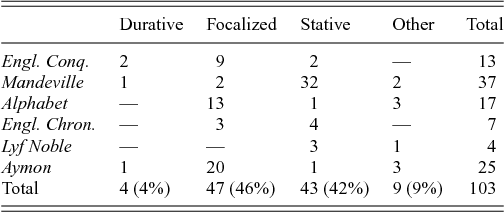
I have argued that progressivity was not yet encoded as the main meaning component of the periphrasis in Middle English. This claim was based on the observation that a substantial proportion of the Middle English data is incompatible with a progressive reading, and that many of these are compatible with a stative reading. The hypothesis that the use of the periphrasis was at this stage determined by personal preference and not by grammatical rules is further strengthened by the high degree of inter-speaker variation at this stage. Table 6 above presents the data in my additional 2008 corpus at text level. Here it emerges that in some texts progressive-like uses clearly predominate, while in other texts they hardly occur at all.Footnote 8
The use of the periphrasis in six Middle English texts (adapted from Killie Reference Killie2008: 83)
The data in tables 2 and 5 clearly show that the Old English periphrasis is far from being semantically identical to the Modern English one; instead, the construction has clearly gone through some major semantic changes since Old English times. There has been a major rise in progressive uses, with an accompanying drop in stative and perfective uses.Footnote 9 In what follows I will try to provide a coherent explanation of these shifts.
4 The development of the be+ V-ende/V-ing periphrasis
4.1 Imperfective > progressive?
During the last few decades, it has been shown that progressive and imperfective constructions tend to evolve along specific paths. Specifically, imperfective markers often develop into progressive markers and vice versa (Dahl Reference Dahl1985: 93). Of these two shifts, the shift from progressive to imperfective is most common (Bybee & Dahl Reference Bybee and Dahl1989: 56f; Bybee, Perkins & Pagliuca Reference Bybee, Perkins and Pagliuca1994: 141–2; Heine Reference Heine1994: 279f; Bertinetto et al. Reference Bertinetto, Ebert and de Groot2000: 540); however, the construction under study here could not have undergone such a development given that the Old English periphrasis was not a progressive while the present-day construction is. The question, then, is whether the data just presented are compatible with a development from imperfective to progressive for the English periphrasis.
It has been claimed that there is ‘an association’ between imperfectivity and the English periphrasis from the earliest records (Wischer Reference Wischer2006: 177; Smith Reference Smith2007: 211, footnote 5).Footnote 10 This association is perhaps not surprising given the large proportion of Old English uses which are compatible with imperfective meaning. However, the proportion is hardly large enough to warrant the claim that the Old English periphrasis was an imperfective construction. In the corpus of the present study, 65 per cent of the Old English examples are compatible with either a progressive or a stative reading and thus also with an imperfective reading (see table 5). A second problem for the imperfective hypothesis is that there are so many uses in Old English which appear to be perfective rather than imperfective (21 per cent in the present study). A third problem is the fact that imperfective markers normally have habitual and iterative uses. According to Scheffer (Reference Scheffer1975: 211), the Old English periphrasis does not seem to have had such uses. Scheffer's claim is supported by the corpus data of the present study. Habitual and iterative uses are in fact so infrequent in the data that they have been put in the ‘other’ category in table 5. Finally, as noted by Kranich, ‘if a form truly expresses imperfective aspect, the typologically expected situation in the language should be one where there is an obligatory contrast between imperfective and perfective aspect . . . This is clearly not the case of the OE/ME progressive’ (2008: 128–9, see also p. 160).
In sum, the data presented here seem incompatible with the idea that the Old English periphrasis was an imperfective marker, which subsequently developed into a progressive marker. Before we explore other possible scenarios, we will address the question of Latin influence on the Old English periphrasis. Given that the perfective uses are confined to the Old English corpus, it is possible that such uses may have been the result of influence from Latin. It is essential to settle this question before we can determine what exactly the meaning of the Old English periphrasis may have been.
4.2 Latin influence and the meaning of the periphrasis in Old English
As is well known, the majority of the extant Old English texts are translations from Latin. It has been claimed that the syntax in such manuscripts is heavily influenced by the source language (Blatt Reference Blatt1957; Sørensen Reference Sørensen1957). This claim also concerns the use of the periphrasis, which is much more frequent in translations from Latin than in native Old English texts. According to Mossé, scribes encountered the following translation problem:
Under each Latin word, under each form, one was to render the corresponding Old English word or form. The aim was not to create a coherent or readable text, but to render as exactly as possible a Latin original by using the methods taught by the master. This was an unequal battle since Latin is the richest of the two languages: it possesses verbal forms, passive and deponent, which Old English did not have. (Mossé Reference Mossé1938: 55, my translation)
Mossé argues that the solution was to translate different kinds of Latin periphrastic forms by way of the Old English periphrasis (Reference Mossé1938: 55; see also Jespersen Reference Jespersen1909–49: vol. IV, 165–6 and Smith Reference Smith2007). The Old English periphrasis therefore came to be a calque of all types of Latin periphrastic deponent verb phrases as well as other periphrastic verb phrases. It was, among other things, used to translate its structural equivalent, the esse + present participle construction. The Latin construction is in turn said to be a calque of a parallel construction in Greek (Mossé Reference Mossé1938: 15–16). The Greek construction almost exclusively occurred in the New Testament, but here it was frequent, and the alleged influence from the Greek onto the Latin construction is said to have come via the translations of the Greek New Testament (Mossé Reference Mossé1938: 10–16; Amenta Reference Amenta2003). According to Mossé (Reference Mossé1938: 13), the Greek periphrasis was duratif ‘durative’. Mossé's durativity concept is comprehensive and seems to correspond more or less to the concept of imperfectivity. It subsumes concepts such as l’actualité ‘present relevance’, la simultanéité ‘simultaneity’ and la durée limitée ‘limited duration’, which apparently correspond to focalized and durative uses in the present study; la permanence ‘permanence’ and la durée indéterminée ‘indeterminate duration’, which correspond to stative uses in the present study; and la repetition ‘repetition’, which corresponds to habitual and iterative uses (Mossé Reference Mossé1938: 78–94). As we have seen, the Old English periphrasis expressed all of these meanings, except habitual and iterative ones. Why habitual and iterative uses of the Latin periphrasis are rarely translated by the Old English periphrasis is unclear, but one possibility is that the Latin periphrasis was as a rule translated by the Old English periphrasis only in those cases where there was semantic equivalence. But here we should note that habitual and iterative uses may have been peripheral also in Latin. Mossé provides no statistics showing the relative frequencies of the various meanings of the Latin construction.
A Latin periphrastic construction may in many cases have promoted the use of the Old English periphrasis. It is nevertheless likely that the Old English periphrasis had its own, independent meaning. One argument comes from grammaticalization theory. The grammaticalization of a construction must be accompanied by a semantic reinterpretation. If a new construction cannot be assigned a meaning, at least a very general one, it is unlikely to become grammaticalized in the first place. Also other facts point to an independent existence for the Old English periphrasis. Firstly, the periphrasis does occur (albeit infrequently) in original texts. Secondly, in Smith's words (Reference Smith2007: 211), the periphrasis is ‘not an obligatory reflex for any Latin construction in Old English writing’. Thirdly, it is not only Latin periphrastic verb phrases which are translated by the Old English periphrasis; also Latin simple tenses are (Nickel Reference Nickel1966: 391–2). In the Orosius, which dates back to the late ninth century, the periphrasis is used 53 times to translate a simple tense in Latin, and it is used 105 times where there is no periphrastic equivalent in Latin (Mossé Reference Mossé1938: 66). In Historia Ecclesiastica, simple tenses of deponent verbs are translated by the periphrasis in as many as one quarter of the cases, i.e. about fifty times (Scheffer Reference Scheffer1975: 162),Footnote 11 and in the Lindisfarne Gospels, a simple past tense is translated by the periphrasis thirty times (Mossé Reference Mossé1938: 59). Such facts are hard to reconcile with the idea that the use of the Old English periphrasis was solely motivated by structural similarity with a Latin construction. Structural similarity may well have played a role, but the use of the construction must have been licensed by some semantic component in the Old English periphrasis itself. The question, then, is what this meaning component consisted in. Mossé (Reference Mossé1938) argues that this semantic component was precisely durativity, noting that in the Lindisfarne Gospels, thirty instances of a simple imperfect (and six of a pluperfect) are translated by the periphrasis when the meaning is durative (Reference Mossé1938: 59). The Lindisfarne Gospels are from the late seventh or early eighth century, so it is quite an early text. Mossé goes on to discuss which durative use represents the original Old English use of the periphrasis. He maintains that of his various durative uses, the durée limitée is native to English:
This use is one of the most original uses that Old English has developed. It expresses that an activity went on until a specific point in time or until some other activity has put an end to it or interrupted it. It is therefore with oþ, oþþæt that one encounters this construction. One should note, in the following examples, that it is independent of Latin influence. . . and it is above all found in texts or in sections of texts which are not translated, and in the era of Ælfred (especially in Orosius). (Mossé Reference Mossé1938 : 86; my translation, emphasis added)
The idea that limited duration is at least one of the original meanings of the Old English periphrasis is supported by the use of the construction in the various versions of the Anglo-Saxon Chronicle. Although it is, according to Scheffer, not possible to find texts with no Latin influence at all (1975: 143), the Chronicles (along with the Law Codes and the Charters) are said to show ‘comparatively little Latin influence’ (Reference Scheffer1975: 143). One might therefore expect the uses of the periphrasis in this text to be fairly representative of Old English usage at this stage. Interestingly, Scheffer finds that ‘[i]t is pretty clear that in 23 out of 26 cases the periphrasis is used to denote restricted duration’ (Reference Scheffer1975: 146).
On the basis of the above discussion, it is tempting to conclude that the original meaning of the periphrasis in English was limited/restricted duration, i.e. that the construction was originally a durative progressive, in the taxonomy of the present study. However, in addition to periphrases expressing durée limitée, Mossé discusses another use of the periphrasis which he also claims existed in Old English independently of Latin, viz. uses with valeur descriptive ‘descriptive value’ (1938: 85–6). Mossé, like several others who use the term, makes no attempt at defining it, so we are left to infer the meaning of the term from his examples. The uses in question are said to be either descriptive or both descriptive and durative at the same time. Most of them look like focalized and perfective uses. Some examples are provided below (where the glosses are mine, while the modern translations are provided by Mossé). The examples in (14) and (15) below look like focalized uses. Here we find focalizing adverbials such as ‘now again on this day’ and ‘just then’, which give us a ‘situation in progress’ reading.Footnote 12
(14)
(15)
An example of a perfective-like use is given in (16). The relevant example has a very strong sequential/punctuative character. The extract in (17) may be an example of a stative use. Another possibility is that the participle is adjectival, meaning ‘full of wonder/in a state of wonder’. If this is the case, the relevant example is not an instance of the periphrasis at all, but represents what many scholars see as the main source of the periphrasis, viz. adjectival participles (see e.g. Sweet Reference Sweet1891–8: vol. 2, 96).
(16)
(17)
‘Descriptive’ uses are said to be frequent in independent Old English writing (Mossé Reference Mossé1938: 85). Thus, the use of the periphrasis with perfective predicates, as illustrated in (16), may have been a normal feature of Old English and not simply the result of a mindless calquing of periphrastic Latin constructions.
To conclude, it seems unlikely that the Old English periphrasis did not have an independent meaning, but was simply a calque of all kinds of Latin periphrastic constructions. A more plausible hypothesis is that the construction developed as a more emphatic alternative to the simple tenses and was used to highlight specific episodes or facts. This may explain why it is often difficult to discern any difference in ‘meaning’ between the periphrasis and the non-periphrastic verb forms at this stage, as has been noted by many (see e.g. Mossé Reference Mossé1938: 68). In fact, Mossé himself argues later in his monograph that the Old English periphrasis may have an expressive function, or a valeur affective: l’insistance ‘affective value: insistence’. This affective or expressive value is said to derive from the length of the construction:
One should note that the periphrastic form lends itself well to expressive use simply because it is a periphrasis. Indeed, to express in two words, (he) was feohtende, what one would normally express in one, (he) feaht, is to insist, to dwell for a fraction of a second longer on an idea, to put it in relief. In this way the quantitative here serves as the vehicle of the qualitative, which is a fundamental principle of expressivity in language. In emphasizing a process, Old English uses the periphrastic form, and here we have more evidence of the skill with which the resources of this new form are put to use. (Mossé Reference Mossé1938: 99, my translation; for a similar view, see Hübler Reference Hübler1998: chapter 4)
In addition to its length, the low frequency and optionality of the construction would have given it a marked character, which made it well suited as an emphatic marker. The marked value of the construction would have made it a less natural choice for speakers of Old English when producing texts in their native language. In translations from Latin, however, the periphrasis represented a handy device in translating the many periphrastic constructions referred to above. Its non-specific meaning allowed such a general use. The Old English periphrasis was thus reinforced through contact with Latin. However, syntactic constructions are only in exceptional cases borrowed from another language (see e.g. Thomason & Kaufman Reference Thomason and Kaufman1988), so the relevant reinforcement probably consisted in an increase in frequency, as has been suggested by Scheffer (Reference Scheffer1975):
In the field of syntax phrases and turns of speech that are utterly foreign to a language are not easily adopted from another, in contrast to what happens in the domain of vocabulary. But phrases and constructions that occur to a lesser extent in one language may derive new strength from analogical constructions in other languages. It seems reasonable to assume that there existed a progressive in Old English, which was as it were given a new lease of vigorous life when English writers became acquainted with Latin texts. (Scheffer Reference Scheffer1975: 132; see also the discussion in Smith Reference Smith2007: 213–14)
Such contact-based reinforcement is well attested. Jendraschek (Reference Jendraschek2006: 160) notes that most of the contact-induced changes discussed by him ‘deal with indigenous material whose functional domain or discourse frequency has been expanded’ (cf. the discussion in Killie Reference Killie2012). According to Heine & Kuteva (Reference Heine and Kuteva2003: 562), a peripheral or low-frequency construction may become activated by a similar construction in a contact language so that it gains in frequency, eventually emerging as a full-fledged grammatical category. At this point it is interesting to note that most Germanic languages at some point experimented with a be + present participle periphrasis (see the discussion in Mossé Reference Mossé1938: 21–52 and Poppe Reference Poppe2003: 10–12). It has been claimed that also the periphrases in these other languages are calques of Latin periphrases (and of Greek ones, in the case of Gothic) (Mossé Reference Mossé1938: 31). However, the fact that a periphrasis occurs in older texts from so many Germanic languages more likely suggests that all these languages had a weakly grammaticalized periphrasis, which was reinforced through contact with Latin and Greek. In fact, it has been argued that even Sanskrit had a periphrasis (see Kranich Reference Kranich2008: 95), so the construction may be very old. The puzzle is why the periphrasis became a full-fledged grammatical category only in English.Footnote 13 The explanation may be that in English it was further reinforced by a number of language-internal developments, notably the coalescence of -ende and -ing, the merger of the be +-ing periphrasis and the progressive be on hunting/verbal noun construction (which was clearly progressive in meaning), and possibly also other developments involving -ing forms, such as the development of the gerund and of adverbial participial clauses (converb clauses) (see e.g. Killie Reference Killie2006 and Reference Killie2007 and Killie & Swan Reference Killie and Swan2009: 358–9 and the discussion below). Contact with Celtic and French, which had imperfective and progressive constructions, respectively, may also have been important (see Mittendorf & Poppe Reference Mittendorf and Poppe2000; Poppe Reference Poppe2002; Wischer Reference Wischer2006: 181–4; Killie Reference Killie2012).
If the high frequencies of the periphrasis in Old English were the result of influence from Latinate, biblical writing conventions, then the lower incidence of the construction in Middle English may have a related explanation. Mossé (Reference Mossé1938: 76) argues that the sharp fall in the use of the progressive towards the thirteenth century occurred because the Latin-inspired style went out of fashion. By contrast, Nehls (Reference Nehls1988: 180) claims that the drop occurred because the Old English literary traditions were replaced by the literary traditions of Latin and French after the Norman Conquest. Whatever happened, the reduced frequencies of the periphrasis are likely somehow to be related to a shift in writing conventions. What is more difficult to explain in such terms is the shift in meaning between Old and Middle English. Given that the use of the periphrasis in perfective verb phrases was autochthonous (though it, too, may have been reinforced through contact with Latin), the almost complete disappearance of such uses between Old and Middle English cannot be straightforwardly accounted for in terms of diminished – or increased – influence from Latin, but must be explained with reference to language-internal developments. Here we can only speculate about the reasons, but it seems likely that the shift must somehow be linked to the durative character of the present participle itself. What may have happened in Middle English is that the durative character of the participle became more pronounced, reserving the periphrasis for use with predicates that were compatible with imperfective meaning (see the discussion below). The trigger of this shift is uncertain, but reinforcement through contact with French is a possibility.
4.3 From emphatic marker to progressive marker?
The hypothesis that Old English beon + V-ende was an emphatic marker is not novel. Mustanoja (Reference Mustanoja1960: 594) claims that the construction primarily served to ‘describe the action in a more graphic and forceful way’ and Braaten that it could be used ‘for dramatic effect’ (Reference Braaten1967: 172). Scheffer (Reference Scheffer1975: 213) argues that its general function was to give a verb phrase emphasis, while it was the context which determined the exact meaning.Footnote 14 According to Wischer, the emphatic-marker hypothesis is supported by the fact that in the Orosius, the periphrasis frequently occurs with adverbs such as swiþe (‘very, greatly, strongly’) and longe (‘long’), or with superlatives of adjectives (Reference Wischer2006: 176; see also Hübler Reference Hübler1998: chapter 4).
It is likely that the periphrasis first functioned mainly as an emphatic marker, which was used in a whole range of contexts, much like emphatic do in Present-day English.Footnote 15 There is nothing in the evidence that contradicts this hypothesis. Indeed, the problem with the relevant hypothesis is rather that it cannot be either falsified or confirmed as an emphatic marker imposes very few restrictions on the accompanying verb or predicate. On the other hand, the analysis has the advantage of being compatible with all the Old English uses of the periphrasis, including the perfective ones.
The grammaticalization of the progressive as an aspectual marker is probably connected to the meaning of the present participle. The participle is known to be inherently durative (see e.g. Mossé Reference Mossé1938: 114). With time the emphatic nature of the construction became less pronounced while the durative component of the participle was strengthened. This laid the foundation for the reinterpretation of the construction as a progressive. Wischer (Reference Wischer2006) explains the transition from emphatic to aspectual marker in the following way:
The next step, in which the whole construction acquires a grammatical meaning, namely to code the progressive aspect, lies again in the speaker–hearer interaction. The speaker uses this construction for emphatic reasons, or to catch the attention of the hearer, according to the speech act maxim of extravagance (cf. Haspelmath Reference Haspelmath1999).Footnote 16
In the – frequent – contexts with durative verbs this focus on vividness, emphasis, or intensity implied a focus on duration as a conversational implicature. This was obviously the status of the expanded form in Old English, where the aspectual meaning was not yet conventionalized. It was basically a stylistic device . . . (2006: 177)
Hopper & Traugott (Reference Hopper and Traugott2003: 82) note that in the early stages of grammaticalization conversational implicatures frequently become ‘semanticized’, i.e. they become part of the semantic polysemies of a form. Dahl (Reference Dahl1985: 11) argues that if a condition is fulfilled frequently when a certain category is used, ‘a stronger association may develop between the condition and the category in such a way that the condition comes to be understood as an integral part of the meaning of the category’. Hopper & Traugott also emphasize the importance of frequency in the semanticization of conversational implicatures, noting that ‘only standard inferences can plausibly be assumed to have a lasting impact on the meaning of an expression or to function cross-linguistically’ (Reference Hopper and Traugott2003: 82). Emphasis on durativity is presumably an inference which is general enough to become semanticized during a grammaticalization process. The relevant inference may thus have led to a strengthening of the durative component of the periphrasis in Middle English, causing perfective uses of the periphrasis to disappear.
The analysis outlined here is compatible with the Old and Middle English data given that so many of the relevant uses are compatible with a durative meaning. Similar mechanisms probably lay behind the reinterpretation of the periphrasis as a focalized progressive. The reinterpretation may here have been based on the inherently durative meaning of the participle combined with an inclination among speakers to focus on events that are going on at the moment of speaking. This analysis is also consistent with the data given that a considerable proportion of the Early Modern uses of the periphrasis are compatible with a progressive reading.
As mentioned above, the grammaticalization of progressivity as the main meaning component of the periphrasis may have been triggered – or at least further reinforced – by the merger of -ende and -ing. This merger may have caused the periphrasis to be influenced by the clearly focalized progressive be on hunting construction, which was reduced to be a-hunting in the Early Modern period (see e.g. Nehls Reference Nehls1988). According to Nehls (Reference Nehls1988), be a-hunting was mostly used in speech, but found its way into colloquial literature in the seventeeth century. In the seventeeth and eighteenth centuries there was ‘functional blending’ of be a-hunting and the periphrasis, in which the former exerted a decisive influence on the latter in restricting its meaning/function to the expression of an action in progress (Reference Nehls1988: 184; see also Jespersen Reference Jespersen1949: 169, Nehls Reference Nehls1974 and Pertejo Reference Pertejo1996).Footnote 17 Following this functional blending, it became ‘inadmissible’ to use the periphrasis with stative predicates, according to Nehls (Reference Nehls1988: 185).
That grammatical markers are at first emphatic, losing in emphasis as they become increasingly grammaticalized, is a well-known phenomenon (see for example the discussion in Rostila Reference Rostila2006). In fact, a newly grammaticalized grammatical marker which alternates with an older marker is probably as a rule felt to be emphatic as long as the original construction remains the unmarked choice. Thus, in many languages with weakly grammaticalized, optional progressive constructions, the relevant constructions are used when the speaker wishes to underline that the event referred to is in progress. Norwegian progressive constructions are a case in point here. Norwegian does not have mandatory marking of progressive aspect, but the language has a number of optional progressive constructions. Thus, the Norwegian sentences in (18) below all mean ‘Are you painting?’, but the progressive constructions in (18b–d), where progressivity is overtly marked, are clearly more emphatic than the default simple present in (18a), where progressivity must be inferred contextually as the sentence could also refer to a habit or hobby.
(18)
In Early Modern English, the periphrasis may increasingly have worked in a similar way as these Norwegian progressive constructions, marking progressive aspect in an emphatic way.Footnote 18
The history of the periphrasis is thus characterized by increased obligatoriness with a concomitant loss of emphasis. However, it appears that the loss of emphasis first and foremost took place in focalized contexts. The emphatic character of the construction has never been entirely lost. Durative progressives, which are not obligatory, are probably still felt to be emphatic. In addition, subjective uses such as the tentative progressive, the interpretative progressive, the subjective always progressive and the foregrounded progressive are based on the emphatic component of the construction and remain emphatic to this day.
On the basis of the discussion above, I propose that the periphrasis has gone through the following development:
1. Old English (up till c. 1100): periphrasis = EMPHATIC MARKER, an emphatic alternative to the simple forms, used to emphasize all kinds of events but having a close association with durativity because of the durative character of the participle. Possible reinforcement from Latin and/or Celtic.
2. Middle English (c. 1100–1500): periphrasis = EMPHATIC MARKER, an emphatic alternative to the simple forms. The durative element of the participle becomes more prominent and the periphrasis is therefore increasingly used to emphasize durative events. Possible influence from French.
3. Early Modern English (c. 1500–1700): periphrasis = increasingly an optional and emphatic PROGRESSIVE MARKER, used to emphasize progressivity. Possible influence from other participial constructions and from the be a-hunting construction.
4. Late Modern English (nineteenth century) onwards: periphrasis = PROGRESSIVE MARKER showing increased obligatoriness in its focalized use with accompanying loss of emphasis in such contexts. Durative uses remain optional and emphatic, and new subjective uses develop, which are also optional and emphatic. Possible influence from other participial constructions.
It is likely that the periphrasis will continue to have both obligatory, non-emphatic and optional, emphatic uses. Such a development is probably not exclusive to progressive/aspectual markers, but may characterize the development of different types of grammatical markers. Periphrastic do, for example, has both a grammatically required use (as an operator) and an optional, emphatic use and may have gone through a rather similar development as the one sketched above.
The analysis provided here is at odds with Rydén's claim that the periphrasis has ‘a panchronic, core meaning’, viz. that of ‘dynamic process’ with one ‘action-focused’ and one ‘attitude-focused’ facet (see Rydén Reference Rydén1997: 421). Instead, the development of the attitude-focused meaning is a fairly late development in the history of the periphrasis. Although the periphrasis was emphatic in its early stages, and remains so in some of its uses to this day, it was hardly attitude-focused or subjective in the sense of expressing speaker perspective. As noted by Kranich (Reference Kranich2008: 124), ‘[t]he uses in OE and ME are much less specific: the choice often rather has to do with narrative conventions, in the sense that the progressive is chosen to highlight the most dramatic events in a narrative . . .’ (Kranich Reference Kranich2008: 124).
5 Summary
We have seen that Old English beon/wesan +V-ende was clearly not a progressive marker. The proportion of examples which are compatible with a progressive reading is simply too small for such an interpretation to make sense. The periphrasis may have originated as an emphatic alternative to the simple tenses, to develop into an emphatic progressive marker. The grammaticalization of the periphrasis as a progressive marker probably started in the Early Modern period. The construction then gradually lost its emphatic character in those contexts in which it was becoming obligatory, while the optional uses of the construction continued to be emphatic. The focalized use of the construction became obligatory in the nineteenth century. In the Late Modern period additional emphatic uses developed, viz. the so-called subjective uses.
The question of influence from Latin has also been explored, the conclusion being that any such influence is likely to have consisted in a reinforcing effect. Specifically, contact with Latin and the Latin written tradition led to an increase in frequency for the construction, but not to a change in meaning.