Introduction
The Old World armyworm, Spodoptera litura (Fabricius) (Lepidoptera: Noctuidae), is widely distributed in Asia, Africa, Australia, New Zealand, and the Pacific Region (International Institute of Entomology 1993). It is polyphagous (Holloway Reference Holloway1990; Qin et al. Reference Qin, Ye, Huang, Ding and Luo2004) and a serious pest of several economic crops in Pakistan such as cotton (Gossypium hirsutum Linnaeus; Malvaceae), tobacco (Nicotiana tabacum Linnaeus; Solanaceae), vegetables, legumes (Fabaceae), and oilseeds (Maree et al. Reference Maree, Kallar and Khuhro1999). The leaf-feeding activity of this species incurs heavy yield losses under favourable environmental conditions. In Pakistan, it can be found the year round migrating from one crop to another.
As a major pest on many crops, S. litura has been subjected to frequent applications of insecticides, alone or in mixtures, to minimise damage. Consequently, the Pakistani populations of S. litura developed a multiple resistance against conventional insecticide classes, namely organophosphates, carbamates, and pyrethroids (Ahmad et al. Reference Ahmad, Arif and Ahmad2007; Saleem et al. Reference Saleem, Ahmad, Ahmad, Aslam and Sayyed2008; Shad et al. Reference Shad, Sayyed, Fazal, Saleem, Zaka and Ali2012), and several new chemistries (Ahmad et al. Reference Ahmad, Sayyed, Saleem and Ahmad2008, Shad et al. Reference Shad, Sayyed, Fazal, Saleem, Zaka and Ali2012; Ahmad and Mehmood Reference Ahmad and Mehmood2015). It was therefore essential to determine the level of susceptibility/resistance of S. litura to other promising chemistries such as insect growth regulators, diamides, spinosyns, and avermectins, which could fit into an insecticide resistance management strategy for the successful control of this pest.
Benzoylphenylureas are an important type of insect growth regulators, which have become an imperative component of insecticide resistance management. They have recently attracted considerable attention due to their unique mode of action coupled with a high degree of activity on target pests and low toxicity on non-target organisms (Oberlander and Silhacek Reference Oberlander and Silhacek1998). Benzoylphenylureas act on the larval stages of Lepidoptera by inhibiting chitin synthesis (Matsumura Reference Matsumura2010). The insect growth regulator methoxyfenozide belongs to the chemical class diacylhydrazine and acts as ecdysone agonist and thus disrupts moulting process (Carlson et al. Reference Carlson, Dhadialla, Hunter, Jansson, Jany, Lidert and Slawecki2001).
The other new chemistries targeted nervous system with novel modes of action. The anthranilic and phthalic diamides, chlorantraniliprole and flubendiamide, respectively, represent a new class of very effective insecticides that activate the ryanodine-sensitive intracellular calcium release channel (ryanodine receptor) (Caboni et al. Reference Caboni, Sarais, Angioni, Vargiu, Pagnozzi, Cabras and Casida2008). Spinosyns are polyketide-macrolide insecticides derived by fermentation of the soil actinomycete bacterium, Saccharopolyspora spinosa Mertz and Yao (Pseudonocardiaceae). Spinosad is a mixture of spinosyn A and spinosyn D. Spinetoram is a mixture of chemically modified spinosyns J and L and it is more potent and faster acting than spinosad. It is considered that spinosyns affect nicotinic acetylcholine receptors (nAChRs) and γ-aminobutyric acid (GABA) receptors existing on postsynaptic membranes in insect nervous systems, thereby causing abnormal neural transmission (Salgado et al. Reference Salgado, Sheets, Watson and Schmidt1998).
Avermectins represent a novel class of macrocyclic lactones that have demonstrated nematicidal, acaricidal, and insecticidal activity. They are produced by fermentation of a soil actinomycete, Streptomyces avermitilis (ex Berg et al.) Kim and Goodfellow (Streptomycetaceae). Abamectin is an avermectin B and emamectin benzoate is a semi-synthetic avermectin derived from fermentation of abamectin. Avermectins work by stimulating the release of GABA, an inhibitory neurotransmitter, thus finally activating chloride channels (Lasota and Dybas Reference Lasota and Dybas1991).
Indoxacarb is an oxadiazine insecticide, which has good field activity against a number of Lepidoptera, as well as certain Hemiptera and Coleoptera. It is a pro-insecticide that is metabolised to decarbomethoxyllated JW062 (DCJW) by esterases inside the insects following ingestion. Decarbomethoxyllated JW062 is a highly potent, voltage-dependent blocker of Na+-dependent compound action potentials (Wing et al. Reference Wing, Schnee, Sacher and Connair1998). Thiocyclam or thiocyclam hydrogen oxalate is a new introduction in Pakistan. It is an analogue of natural toxin nereistoxin and is a tertiary amine insecticide, which acts as a nicotinic acetylcholine receptor agonist (Liu et al. Reference Liu, Chen and Shang1985).
This paper documents the susceptibility of field populations of S. litura to novel insecticides such as insect growth regulators benzoylphenylureas (chlorfluazuron, lufenuron, flufenoxuron, triflumuron) and diacylhydrazine (methoxyfenozide), diamides (chlorantraniliprole, flubendiamide), spinosyns (spinosad, spinetoram), avermectins (abamectin, emamectin benzoate), indoxacarb, and thiocyclam by using a diet overlay bioassay. The data collated in this paper come under the concept of field-evolved resistance as defined by Tabashnik et al. (Reference Tabashnik, Mota-Sanchez, Whalon, Hollingworth and Carriere2014).
Material and methods
Insects
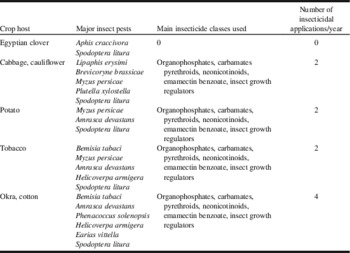
Fifth or sixth instars of S. litura were collected from various locations of the Punjab province of Pakistan during 2008–2013. The crops from which larvae were collected included cotton, okra (Hibiscus esculentus Linnaeus; Malvaceae), potato (Solanum tuberosum Linnaeus; Solanaceae), cabbage (Brassica oleraceacapita (Linnaeus) Metzger; Brassicaceae), cauliflower (Brassica oleraceabotrytis (Linnaeus) Metzger; Brassicaceae), tobacco, and berseem or Egyptian clover (Trifolium alexandrinum Bory and Chaubard; Fabaceae) (Table 1). Table 1 further indicates major insect pest complex on these hosts, main insecticides applied against these insect pests, and number of applications per season/year of any insecticide selected out of the insecticide classes shown against each host crop.
Crop hosts of Spodoptera litura along with their other major insect pests and pesticide use patterns against themFootnote *.

* Based on “personal communication” with the farmers.
Each collection of about 300 larvae of S. litura was made by walking through a 2-ha block of a particular host crop in a zigzag manner to randomise collections. Larvae were fed in the laboratory on a semi-synthetic diet, which consisted of chickpea flour (300 g), ascorbic acid (4.7 g), methyl-4-hydroxybenzoate (3 g), sorbic acid (1.5 g), streptomycin (1.5 g), corn oil (12 mL), vitamin mixture (10 mL), yeast (48 g), and agar (17 g). Yeast and agar were dissolved in 800 mL of boiling water and added to other constituents premixed in 500 mL of water. Adults were fed on a solution containing sugar (50 g), vitamin mixture (10 mL), methyl-4-hydroxybenzoate (1 g), and distilled water (500 mL).
Insecticides
Commercial formulations of insecticides used in bioassays were: chlorfluazuron (Caprice, 50 g/L EC [emulsifiable concentrate]; Elhelb Pesticides & Chemicals, New Damietta, Egypt), lufenuron (Match, 50 g/L EC; Syngenta, Basel, Switzerland), flufenoxuron (Cascade, 100 g/L DC [dispersible concentrate]; BASF Corporation, Princeton, New Jersey, United States of America), triflumuron (Capture, 200 g/L SC [suspension concentrate]; Tonghua Pest Chemical Industries, China), methoxyfenozide (Runner, 240 g/L SC; Dow AgroSciences, Indianapolis, Indiana, United States of America), chlorantraniliprole (Coragen, 200 g/L SC; DuPont, Wilmington, Delaware, United States of America), flubendiamide (Belt, 480 g/L SC; Bayer CropScience, Leverkusen, Germany), spinosad (Tracer, 240 g/L SC; Dow), spinetoram (Radiant, 120 g/L SC; Dow), abamectin (Cure, 18 g/L EC; Hebei Vian Biochemical Company, Shijiazhuang, China), emamectin benzoate (Proclaim, 19 g/L EC; Syngenta), indoxacarb (Steward, 150 g/L SC, DuPont), and thiocyclam (Evisect, 40 g/L SP [water soluble powder]; Nippon Kayaku, Tokyo, Japan).
Bioassays
One-day-old second instars of S. litura were treated by using a diet overlay bioassay as described by Ahmad and Hollingworth (Reference Ahmad and Hollingworth2004). Liquefied diet (3 mL) was poured into 30-mL plastic cups and allowed to dry for 30 minutes. Serial dilutions as mg/L of the active ingredient of each formulated insecticide were prepared using distilled water. Insecticide concentration (100 μL each) was applied onto the surface of the diet in individual cups. Cups were rotated and shaken to evenly distribute the insecticide solution over the diet. Diet treated with distilled water was used as control. After the insecticide solution had dried (45 minutes), five larvae were released into each cup and the cups capped. Eight replicates of five larvae were used for each concentration and five to nine serial concentrations were used for each test insecticide. The same number of larvae per treatment was kept as an untreated check. Before and after the treatment, larvae were maintained at a constant temperature of 25 °C (±2 °C) with a photoperiod of 14 hours. Larval mortalities were recorded after 120 hours. Larvae were considered dead if they did not move when prodded with a probe.
Data analysis
Mortality data were corrected for control mortality using Abbott’s (Reference Abbott1925) formula and analysed by probit analysis (Finney Reference Finney1971) using Poloplus programme (LeOra Software 2003). The lethal-concentrations were calculated and any two values compared were considered significantly different if their respective 95% confidence limits did not overlap. Resistance factors were determined at LC50s and LC90s by dividing the lethal-concentration values of each insecticide for a population by the corresponding lethal-concentration values for the Faisalabad population. The 95% confidence limits for the resistance factors were determined according to Robertson et al. (Reference Robertson, Savin, Preisler and Russell2007). As described previously (Ahmad and Mehmood Reference Ahmad and Mehmood2015), resistance was generally classified as none (resistance factors=1), very low (resistance factors=2–10), low (resistance factors=11–20), moderate (resistance factors=21–50), high (resistance factors=51–100), and very high (resistance factors >100).
Results
Baselines
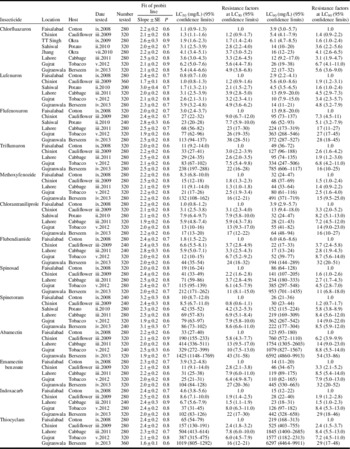
The Faisalabad population of S. litura, collected in September 2008 from cotton, was used as a reference strain to determine resistance factors in the current study. It may not be a true susceptible strain; however, it generally exhibited the lowest LC values with reasonably good slopes of the dose-mortality probit lines. Among the benzoylphenylureas, the baseline LC values of lufenuron (LC50=0.8 mg/L, LC90=2.9 mg/L) and chlorfluazuron (LC50=1.1 mg/L, LC90=3.9 mg/L) were the lowest and similar against S. litura (Table 2). Their LC50s were approximately one-third of the LC50 of flufenoxuron (LC50=3.0 mg/L) and 1/11th of that of triflumuron (LC50=11 mg/L). The baseline LC values of chlorantraniliprole (LC50=1.0 mg/L, LC90=3.9 mg/L) were similar to lufenuron and chlorfluazuron; whereas LC values of flubendiamide (LC50=1.8 mg/L, LC90=6.0 mg/L) were around two-fold higher than those of chlorantraniliprole, lufenuron, and chlorfluazuron. The baseline LC values of methoxyfenozide (LC50=8.3 mg/L, LC90=32 mg/L) were found similar to triflumuron.
Toxicity of insect growth regulators, diamides, spinosyns, avermectins, indoxacarb, and thiocyclam against field populations of Spodoptera litura from Pakistan.

Note: LC, lethal concentration; SE, standard error.
Spinosyns showed high baseline LC values on S. litura, where LC values of spinosad (LC50= 19 mg/L, LC90=86 mg/L) were two to threefold higher than that of spinetoram (LC50=10 mg/L, LC90=26 mg/L) (Table 2). The baseline LC values of emamectin benzoate (LC50=3.9 mg/L, LC90=14 mg/L) and indoxacarb (LC50=4.6 mg/L, LC90=15 mg/L) were found similar and comparatively low. However, baseline LC values of abamectin (LC50=33 mg/L, LC90=123 mg/L) and thiocyclam (LC50=65 mg/L, LC90=219 mg/L) were very high and they can therefore be considered ineffective insecticides against S. litura.
Insect growth regulators
The populations of S. litura collected in September 2008 and March 2009 were found susceptible to chlorfluazuron (Table 2). The LC and resistance-factor values of the March 2009 population also showed non-significant differences with the September 2009 population. The populations collected during 2010–2013 exhibited a very low level of resistance to chlorfluazuron (2.8–5.6-fold at LC50 and 3.1–6.7-fold at LC90).
Like chlorfluazuron, both the populations of S. litura tested in 2008 and 2009 were susceptible to lufenuron (Table 2). The other four populations tested during 2010–2013 demonstrated a very low resistance (2.1–4.9-fold at LC50 and 1.6–4.8-fold at LC90), in spite of the fact that lufenuron was used extensively to control S. litura in Pakistan during the 2000s.
There was a very low resistance to flufenoxuron in S. litura in the years 2009 (ninefold at LC50 and 7.3-fold at LC90) and 2010 (7.7-fold at LC50 and 5.1-fold at LC90) (Table 2). In 2011, the flufenoxuron resistance was almost low (23-fold at LC50 and 17-fold at LC90) but it increased to a moderate level in 2012 (26-fold at LC50 and 27-fold at LC90) and 2013 (38-fold at LC50 and 28-fold at LC90). This is interesting because flufenoxuron was used only occasionally in Pakistan.
The three populations of S. litura tested during 2009–2012 showed a very low resistance to triflumuron (2.6–7.5-fold at LC50 and 1.9–6.8-fold at LC90) (Table 2). However, the Gujranwala population tested in 2013 demonstrated a low triflumuron resistance (22-fold at LC50 and 16-fold at LC90).
There was no resistance to methoxyfenozide in the populations of S. litura tested in 2008 and 2011 (Table 2). The 2009 population had a slight resistance at LC50 (1.8-fold) but no resistance at LC90. The 2012 population had a very low resistance (2.5-fold) and the 2013 population had a low resistance (15–16-fold).
Diamides
The three populations of S. litura tested during 2009–2011 had a very low resistance to chlorantraniliprole (3.1–7.9-fold at LC50 and 3.3–8.2-fold at LC90) and those tested in 2012 and 2013 had a low resistance (13-fold and 17-fold at LC50 and 14-fold and 16-fold at LC90, respectively) (Table 2). Similarly, the populations of S. litura evaluated against flubendiamide during 2009–2012 showed a very low resistance (3.3–6.7-fold at LC50 and 2.8–8.7-fold at LC90). The Gujranwala population of 2013, however, exhibited a moderate level of flubendiamide resistance (24-fold at LC50 and 32-fold at LC90).
Spinosyns
All the four populations of S. litura assessed during 2009–2013 showed a very low level of resistance to spinosad (2.2–11.0-fold at LC50 and 1.6–11.0-fold at LC90) (Table 2). Nevertheless, no resistance was found to spinetoram in the 2008 and 2009 populations. Like spinosad, the rest of four populations tested during 2010–2013 showed a very low level of spinetoram resistance at LC50 (4.2–8.6-fold) as well as at LC90 (5.8–8.5-fold, except 2012 population having 14-fold).
Avermectins
The populations of S. litura evaluated against abamectin in 2009 and 2012 had a very low resistance, 5.8-fold and 10.0-fold at LC50 and 6.2-fold and 8.8-fold at LC90, respectively (Table 2). The population tested in 2011 produced a low level of abamectin resistance (13-fold at LC50 and 14-fold at LC90). However, the population of 2013 exhibited a moderate (43-fold at LC50) to high (54-fold at LC90) resistance to abamectin.
The three populations assessed during 2009–2012 demonstrated a very low level of resistance to emamectin benzoate (2.8–7.9-fold at LC50 and 3.3–8.5-fold at LC90) (Table 2). The Gujranwala population of 2013 showed a moderate resistance to emamectin benzoate (27-fold at LC50 and 32-fold at LC90).
Indoxacarb and thiocyclam
The populations of S. litura evaluated in 2008 and 2011 had no resistance and that of 2012 had a very low level of resistance to indoxacarb (8.0–8.4-fold) (Table 2). However, the 2013 population from Gujranwala produced a moderate resistance to indoxacarb (22-fold at LC50 and 29-fold at LC90).
The three populations of S. litura tested during 2009–2012 exhibited a very low level of resistance to thiocyclam (2.4–7.8-fold at LC50 and 2.4–8.4-fold at LC90) (Table 2). However, the Gujranwala population of 2013 showed a low resistance to thiocyclam at LC50 (16-fold) but a moderate resistance at LC90 (29-fold).
Discussion
In the current studies, the toxicities of lufenuron and chlorfluazuron were much higher than flufenoxuron and triflumuron on the baseline Faisalabad population of S. litura. Similarly, lufenuron was found more toxic than flufenoxuron and triflumuron against cotton leafworm Spodoptera littoralis (Boisduval) (Lepidoptera: Noctuidae) (El-Sheikh and Aamir Reference El-Sheikh and Aamir2011). Lufenuron was approved for use in Pakistan in 1996 (Ali Reference Ali2011) and since then it has become the most popular insecticide among insect growth regulators for the control of S. litura. The present studies demonstrated that there was no resistance to lufenuron in 2008 and 2009 and a very low resistance (<5-fold) during 2010–2013 by using a diet-overlay bioassay. Likewise, Ahmad and Mehmood (Reference Ahmad and Mehmood2015) recorded no or very low resistance to lufenuron in the Pakistani S. litura during 1997–2010 by using leaf-dip bioassay. So far no field failure of lufenuron has been reported against S. litura in Pakistan. Conversely, a moderate to high resistance to lufenuron was reported in the Pakistani populations of S. litura (Ahmad et al. Reference Ahmad, Sayyed, Saleem and Ahmad2008) and beet armyworm Spodoptera exigua (Hübner) (Lepidoptera: Noctuidae) (Ishtiaq et al. Reference Ishtiaq and Saleem2012, Reference Ishtiaq, Saleem and Razaq2014).
Among other benzoylphenylureas, chlorfluazuron and triflumuron generally exhibited a very low resistance in S. litura, whereas flufenoxuron showed a low to moderate resistance in the current studies. A moderate to high level of resistance to chlorfluazuron was documented in S. exigua (Zhou et al. Reference Zhou, Liu, Yu, Deng, Gao, Liu and Mu2011; Che et al. Reference Che, Shi, Wu and Yang2013; Su and Sun Reference Su and Sun2014) and diamondback moth Plutella xylostella (Linnaeus) (Lepidoptera: Plutellidae) (Xia et al. Reference Xia, Lu, Shen, Gao, Qiu and Li2014; Zhang et al. Reference Zhang, Zhang, Shen, Mao, You and Li2016) from China.
No, very low, or low resistance was found to benzhydrazide insect growth regulator, methoxyfenozide in S. litura by diet-overlay bioassay in the present studies. However, low to moderate (Ahmad et al. Reference Ahmad, Sayyed, Saleem and Ahmad2008; Ahmad and Mehmood Reference Ahmad and Mehmood2015) and even very high (Shad et al. Reference Shad, Sayyed, Fazal, Saleem, Zaka and Ali2012) levels of resistance to methoxyfenozide were earlier reported in S. litura, and S. exigua (Ishtiaq and Saleem Reference Ishtiaq, Razaq, Saleem, Anjum, Ane, Raza and Wright2011; Ishtiaq et al. Reference Ishtiaq and Saleem2012) from Pakistan by using leaf-dip method. Methoxyfenozide was strongly synergised by piperonyl butoxide in a resistant strain of S. litura from Pakistan, indicating the involvement of monooxygenases in this resistance (Rehan and Freed Reference Rehan and Freed2014a). Higher activity of metabolic enzymes was responsible for resistance to methoxyfenozide in S. littoralis (Mosallanejad and Smagghe Reference Mosallanejad and Smagghe2009) and cotton bollworm Helicoverpa armigera (Hübner) (Lepidoptera: Noctuidae) (Liu et al. Reference Liu, Dong, Tan, Fan and Rui2011).
Diamides are a new class of insecticides that have demonstrated a particular efficacy against Lepidoptera pests at fairly low rates. A very low to low level of resistance was found to chlorantraniliprole in S. litura in our studies over a six-year period. Chlorantraniliprole resistance was also reported in S. litura (Su et al. Reference Su, Lai and Li2012), S. exigua (Che et al. Reference Che, Shi, Wu and Yang2013), P. xylostella (Wang and Wu Reference Wang and Wu2012; Zhang et al. Reference Zhang, Zhang, Shen, Mao, You and Li2016), tomato borer (Tuta absoluta (Meyrick); Lepidoptera: Gelechiidae) (Roditakis et al. Reference Roditakis, Vasakis, Grispou, Stavrakaki, Nauen, Gravouil and Bassi2015), rice striped stem borer (Chilo suppressalis Walker; Lepidoptera: Crambidae) (Gao et al. Reference Gao, Yao, Zhang, Wu, Zhang and Su2013), and rice leaf-folder (Cnaphalocrocis medinalis Guenée; Lepidoptera: Crambidae) (Zhang et al. Reference Zhang, Ren, Wang and Su2014). According to Su et al. (Reference Su, Lai and Li2012) chlorantraniliprole resistance in S. litura was not correlated with the activities of metabolic enzymes. However, esterase mediated biochemical resistance was developed in chlorantraniliprole-selected strains of S. litura (Muthusamy et al. Reference Muthusamy, Vishnupriya and Shivakumar2014) and obliquebanded leafroller, Choristoneura rosaceana (Harris) (Lepidoptera: Tortricidae) (Sial et al. Reference Sial, Brunner and Garczynski2011). A glycine to glutamic acid substitution (G4946E) in ryanodine receptor (PxRyR) was found to confer resistance to chlorantraniliprole in P. xylostella (Guo et al. Reference Guo, Wang, Zhou, Li, Liu, Pei and Gao2014). Quantitative real-time polymerase chain reaction analysis showed that expression of the ryanodine receptor gene was higher in the resistant strain of P. xylostella (Liu et al. Reference Liu, Wang, Ning, Qiao and Wang2015). Enzymic detoxification by glutathione-S-transferase (Hu et al. Reference Hu, Xia, Lin, Chen, Li and Fei2014) and cytochrome P450 (Liu et al. Reference Liu, Wang, Ning, Qiao and Wang2015) were the main mechanisms responsible for resistance to chlorantraniliprole in P. xylostella. Resistance to flubendiamide was very low in S. litura in the current studies, except the 2013 population that showed moderate resistance. Flubendiamide resistance was found very low in C. suppressalis in China (Wu et al. Reference Wu, Zhang, Yao, Wu, Su and Gao2014) and very high in T. absoluta in Italy (Roditakis et al. Reference Roditakis, Vasakis, Grispou, Stavrakaki, Nauen, Gravouil and Bassi2015).
Resistance to spinosyns spinosad and spinetoram remained very low in all the Pakistani populations of S. litura tested during 2008–2013 by using diet-overlay method (Table 2). Similarly, a very low resistance to spinosad was recorded in Pakistani S. litura during 1997–2010 by using leaf-dip method (Ahmad and Mehmood Reference Ahmad and Mehmood2015). A very low to low resistance to spinosad was also documented in H. armigera (Ahmad et al. Reference Ahmad, Arif and Ahmad2003; Qayyum et al. Reference Qayyum, Wakil, Arif, Sahi, Saeed and Russell2015) and spotted bollworm Earias vittella (Fabricius) (Lepidoptera: Nolidae) (Ahmad and Arif Reference Ahmad and Arif2009; Jan et al. Reference Jan, Abbas, Shad and Saleem2015) in Pakistan. Contrarily, a moderate to high (Ahmad et al. Reference Ahmad, Sayyed, Saleem and Ahmad2008; Sayyed et al. Reference Sayyed, Ahmad and Saleem2008; Rehan and Freed Reference Rehan and Freed2014b) and a very high (Shad et al. Reference Shad, Sayyed, Fazal, Saleem, Zaka and Ali2012) spinosad resistance was reported in S. litura as well as in S. exigua (Ishtiaq and Saleem Reference Ishtiaq, Razaq, Saleem, Anjum, Ane, Raza and Wright2011; Ishtiaq et al. Reference Ishtiaq and Saleem2012, Reference Ishtiaq, Saleem and Razaq2014) from Pakistan during the same period. However, spinosad resistance is now widespread in insect pests in other countries such as S. exigua in China (Zhou et al. Reference Zhou, Liu, Yu, Deng, Gao, Liu and Mu2011; Che et al. Reference Che, Shi, Wu and Yang2013) and the United States of America (Moulton et al. Reference Moulton, Pepper and Dennehy2000), P. xylostella in China (Xia et al. Reference Xia, Lu, Shen, Gao, Qiu and Li2014; Zhang et al. Reference Zhang, Zhang, Shen, Mao, You and Li2016), and tobacco budworm (Heliothis virescens (Fabricius); Lepidoptera: Noctuidae) in the United States of America (Young et al. Reference Young, Bailey, Wyss, Roe, Sheets, Larson and Sparks2000). Enzymatic detoxification by esterases in S. litura (Ahmad Reference Ahmad2009), and by monooxygenases and esterases in S. exigua (Wang et al. Reference Wang, Mo, Cheng, Zhuang and Tang2006) may be responsible for resistance to spinosad. Increased activity of mixed function oxidases and esterases was the most frequent metabolic resistance mechanism involved in resistance to spinosad in T. absoluta (Reyes et al. Reference Reyes, Rocha, Alarcón, Siegwart and Sauphanor2012). Contrarily, enzyme inhibitors piperonyl butoxide, tribufos or S,S,S-tributyl phosphorotrithioate (DEF), and diethyl maleate (DEM) failed to synergise spinosad in resistant S. exigua (Moulton et al. Reference Moulton, Pepper and Dennehy1999). The involvement of mixed-function oxidases was responsible for resistance to spinetoram in C. rosaceana (Sial et al. Reference Sial, Brunner and Garczynski2011).
Among avermectins, the baseline lethal-concentration values of abamectin in S. litura were more than eight times higher than that of emamectin benzoate in the present studies. Similarly, lethal-concentration values of abamectin were 6.5-fold (at LC50) and 8.5-fold (at LC90) higher than emamectin benzoate in a susceptible strain of S. litura collected in 1997 from Pakistan by using leaf-dip bioassay (Ahmad and Mehmood Reference Ahmad and Mehmood2015). There was a very low to moderate resistance to avermectins abamectin and emamectin benzoate in S. litura by using diet-overlay method in the current study. A very low to high resistance to these avermectins was earlier reported in the Pakistani populations of S. litura (Ahmad et al. Reference Ahmad, Sayyed, Saleem and Ahmad2008; Sayyed et al. Reference Sayyed, Ahmad and Saleem2008; Shad et al. Reference Shad, Sayyed and Saleem2010, Reference Shad, Sayyed, Fazal, Saleem, Zaka and Ali2012; Ahmad and Mehmood Reference Ahmad and Mehmood2015), S. exigua (Ishtiaq and Saleem Reference Ishtiaq, Razaq, Saleem, Anjum, Ane, Raza and Wright2011; Ishtiaq et al. Reference Ishtiaq and Saleem2012, Reference Ishtiaq, Saleem and Razaq2014), H. armigera (Qayyum et al. Reference Qayyum, Wakil, Arif, Sahi, Saeed and Russell2015), and E. vittella (Ahmad and Arif Reference Ahmad and Arif2009; Jan et al. Reference Jan, Abbas, Shad and Saleem2015) by using leaf-dip method. Low to high resistance to avermectins was also found in S. litura (Tong et al. Reference Tong, Su, Zhou and Bai2013), S. exigua (Zhou et al. Reference Zhou, Liu, Yu, Deng, Gao, Liu and Mu2011; Che et al. Reference Che, Shi, Wu and Yang2013; Su and Sun Reference Su and Sun2014) and P. xylostella (Xia et al. Reference Xia, Lu, Shen, Gao, Qiu and Li2014; Zhang et al. Reference Zhang, Zhang, Shen, Mao, You and Li2016) from China. Abamectin resistance in P. xylostella in China was attributable to enhanced detoxification by monooxygenases and carboxylesterases (Wu et al. Reference Wu, Zhang, Zhang, Xu and Zhu2002a), and decreased cuticular penetration and insensitivity of GABA receptor binding (Wu et al. Reference Wu, Zhang, Zhang, Xu and Zhu2002b).
Indoxacarb was approved for use in the Pakistani agriculture in 1998 (Ali Reference Ali2011), yet S. litura exhibited a moderate to high resistance to indoxacarb during 1998–2004 (Ahmad and Mehmood Reference Ahmad and Mehmood2015), which was probably a consequence of cross resistance from previous chemistries. This resistance then dropped to a low level in 2005–2006 and to a very low resistance during 2007–2010 due to reduction in the use of indoxacarb and introduction of other new chemicals with different modes of action (Ahmad and Mehmood Reference Ahmad and Mehmood2015). The present studies also confirmed that the indoxacarb resistance remained very low in the Pakistani S. litura during 2008–2012 as determined by diet overlay method, but a population collected in 2013 had a moderate resistance (Table 2). Conversely, a moderate to high (Ahmad et al. Reference Ahmad, Sayyed, Saleem and Ahmad2008) and a very high (Shad et al. Reference Shad, Sayyed and Saleem2010, Reference Shad, Sayyed, Fazal, Saleem, Zaka and Ali2012) resistance to indoxacarb were reported in Pakistani S. litura during 2004–2006. A moderate to high level of resistance to indoxacarb was also found in other Lepidoptera such as S. exigua (Ishtiaq and Saleem Reference Ishtiaq, Razaq, Saleem, Anjum, Ane, Raza and Wright2011; Ishtiaq et al. Reference Ishtiaq and Saleem2012), E. vittella (Ahmad and Arif Reference Ahmad and Arif2009), P. xylostella (Xia et al. Reference Xia, Lu, Shen, Gao, Qiu and Li2014; Zhang et al. Reference Zhang, Zhang, Shen, Mao, You and Li2016), and C. rosaceana (Ahmad et al. Reference Ahmad, Hollingworth and Wise2002). The activity of esterases in the 16-fold resistant population of S. litura increased by 2.3-fold compared with the susceptible population, while the activities of mixed-function oxidases and glutathione-S-transferases had no significant difference (Wang et al. Reference Wang, Dong and Yuan2009). Resistance mechanisms of S. exigua to indoxacarb were found to be associated with glutathione S-transferase, carboxylesterase and a Leu-1014-Phe mutation (Gao et al. Reference Gao, Mu, Wang, Zhou and Li2014). Activity and kinetic parameters observed in detoxification enzymes and synergism by diethyl maleate and triphenyl phosphate demonstrated that the enhanced activity of carboxylesterase and glutathione-S-transferases may be critical for indoxacarb resistance in oriental tobacco budworm Helicoverpa assulta (Guenée) (Lepidoptera: Noctuidae) (Pang et al. Reference Pang, You, Duan, Song, Li and Wang2012). Piperonyl butoxide strongly synergised indoxacarb in C. rosaceana (Ahmad and Hollingworth Reference Ahmad and Hollingworth2004) and probably enhanced metabolism by mixed function oxidases was involved in resistance.
Resistance to the tertiary amine thiocyclam remained very low in S. litura during 2008–2012 but a population collected in 2013 exhibited a 16–29-fold resistance in the present studies. A moderate resistance to thiocyclam in P. xylostella in Japan (Hama et al. Reference Hama, Suzuki and Tanaka1992) and Egypt (Diab Reference Diab2011) was reported earlier.
Spodoptera litura is a serious pest of annual crops in Pakistan. In late winter and spring (February–March), it is found on cabbage, cauliflower, and potato. It then shifts to Egyptian clover in March–April. During summer, it is present on tobacco, okra, and cotton. Egyptian clover is not sprayed; cabbage, cauliflower, potato, and tobacco receive two sprays, once for sucking insect pests and once for caterpillars including S. litura. Okra and cotton are usually sprayed four times during the season (Table 1). Hemiptera pests are normally controlled with organophosphates and neonicotinoids whereas Lepidoptera pests are sprayed with carbamates, pyrethroids, insect growth regulators, and emamectin benzoate. Under this scenario, S. litura developed moderate to high levels of resistance to conventional insecticides such as organophosphates, carbamates, and pyrethroids (Ahmad et al. Reference Ahmad, Arif and Ahmad2007; Saleem et al. Reference Saleem, Ahmad, Ahmad, Aslam and Sayyed2008), which were commonly used during 1980s, 1990s, and 2000s. During 2010s, there was a major shift towards the use of novel compounds (Table 2). Now, there are reports of the development of practical resistance (Tabashnik et al. Reference Tabashnik, Mota-Sanchez, Whalon, Hollingworth and Carriere2014) of S. litura to flufenoxuron, abamectin, indoxacarb, and thiocyclam.
The lower baseline lethal-concentration values of benzoylureas lufenuron, chlorfluazuron and flufenoxuron, diamides chlorantraniliprole and flubendiamide, emamectin benzoate, and indoxacarb (Table 2) indicate that these insecticides were quite effective against susceptible S. litura as determined by diet-overlay bioassay method. They should therefore be effective at lower application rates under field conditions and the field experience supports this. Based on lower baselines and resistance levels, the insect growth regulators lufenuron and chlorfluazuron, diamides chlorantraniliprole and flubendiamide, emamectin benzoate, and indoxacarb may be particularly included in devising a sound insecticide resistance management strategy for S. litura. The effective chemistries belonging to different modes of action can be rotated in conjunction with other integrated pest management tactics to achieve a sustainable control of S. litura in host crops.
Acknowledgements
The technical assistance of Shamim Akhtar, Asia Kishwar, Qamar Abbas, and Imran Sohail is gratefully acknowledged. This research was funded in part by Pakistan Science Foundation under Project PSF/NSLP-NIAB(14) “Insecticide resistance management of lepidopteran pests of cotton”.