Healthcare decision making requires considering multiple criteria to determine the optimal resource allocation (Reference Baltussen and Niessen1). Healthcare systems have limited resources to cover the maximum possible needs of their population. This goal involves consideration of several decision criteria, not only based on efficacy, safety, and cost, but considering disparate streams of information and balancing individual and group/jurisdictional perspectives, based on ethical principles (Reference Baltussen and Niessen1). This complex process demands objectivity, consistency, and accountability to be perceived as legitimate and transparent by the public and healthcare providers and to increase the likelihood of making good decisions (Reference Dhalla and Laupacis2).
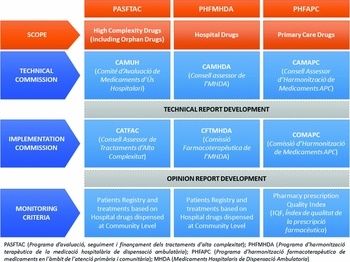
In Spain, health competences are almost totally devolved to the regional level. These competences include the design of market access policies for pharmaceuticals (3), and to that end, most regions have specific structures and procedures for drug evaluation and decision making. In Catalonia, CatSalut (Servei Català de la Salut) is the agency responsible for the funding, procurement, and equity in access of public healthcare services (4). CatSalut runs a specific program for drug evaluation and decision making, the Programa d'Harmonització Farmacoterapèutica (PHF). This program centers in three main areas according to the evaluation scope (4) (Figure 1): PASFTAC (Programa d'avaluació, seguiment i finançament dels tractaments d'alta complexitat) is the Program's stream focused in the assessment of orphan drugs (4), formed by an advisory committee (CAMUH, Comité d'Avaluació de Medicaments d’Ús Hospitalari), and an executive/decision-making committee (CATFAC, Consell Assessor de Tractaments d'Alta Complexitat) (4).
Organization of the Programa d'Harmonització Farmacoterapèutica (PHF).

CatSalut and PASFTAC have standardized procedures for orphan drugs evaluation and decision making (4). However, despite the development of accurate and public evaluation reports, the criteria and contents used as drivers for decision-making discussions are not specifically defined. As well as in Catalonia, other Spanish regions have identified the same issue with data reporting related to healthcare decision making, and, in this regard, MCDA has been explored and identified as a tool that could improve these procedures (Reference Gilabert-Perramon, Betolaza and March5). Despite the interest of other Spanish regions for MCDA methods, CatSalut was pioneer in conducting a study to assess the potential implementation of a reflective MCDA framework (EVIDEM) for evaluation and decision making in orphan drugs.
Multi-criteria decision analysis (MCDA) methods can support healthcare decision making by taking into account multiple criteria in an explicit manner and beyond the traditional assessments (Reference Devlin and Sussex6–Reference Thokala, Devlin and Marsh8). MCDA, considered in this case as a value measurement model (Reference Thokala and Duenas7;Reference Thokala, Devlin and Marsh8), allows systematic and explicit consideration of multiple criteria that may impact in the drug value concept and, finally, healthcare decision making. MCDA structures complex problems into a comprehensive set of criteria. Each criterion is weighted, and the performance of each healthcare intervention is scored per criterion allowing identification of weaknesses and strengths, and providing arguments and support for decision making (Reference Devlin and Sussex6;Reference Thokala and Duenas7). Furthermore, reflective MCDA, such as the approach proposed by EVIDEM (Evidence and Value: Impact on DEcisionMaking) (9), provides an operationalizable framework to integrate the underlying ethical aspects and support the balancing act necessary to achieve accountable and reasonable decision making and reducing the uncertainty of the process (Reference Daniels10;Reference Wagner, Khoury, Willet, Rindress and Goetghebeur11).
Rare diseases are usually chronic, progressive, life-threatening, and characterized by a lack of effective treatments. Small population, substantial heterogeneity, lack of knowledge about natural history, and difficulty in defining practical clinical end points create greater uncertainty around treatments’ evidence in these diseases compared with the most common ones (Reference Drummond12;Reference Picavert, Cassiman and Simoens13). Evaluation and decision making for these diseases are a challenge (Reference Picavert, Cassiman and Simoens13;Reference Rosenberg-Yunger, Daar, Thorsteinsdóttir and Martin14), and the MCDA approach could be a useful tool to support both evaluators and decision makers, resulting in a better management of the uncertainty around the process (Reference Daniels10;Reference Wagner, Khoury, Willet, Rindress and Goetghebeur11).
METHODS
One of the standardized tools that could be used for MCDA assessments, regarding healthcare, is the EVIDEM framework (9). This is a framework designed and standardized to stimulate reflection and integrate ethical underpinning of decision making to provide efficient MCDA-based solutions for: (i) evaluation of healthcare interventions, (ii) weighting based on a comprehensive set of decision criteria organized into pragmatic tools, and (iii) support for healthcare decision making (Reference Goetghebeur, Wagner, Khoury, Levitt, Erickson and Rindress15). It was created as an adaptable and pragmatic open-source MCDA-based framework for accountable and reasonable healthcare decision making and priority setting (9;Reference Goetghebeur, Wagner, Khoury, Levitt, Erickson and Rindress15). This framework has been used as basis for the development of specific MCDA approaches in different healthcare contexts (9;Reference Goetghebeur, Wagner, Khoury, Levitt, Erickson and Rindress16;Reference Tony, Wagner and Khoury17), including orphan drugs (Reference Wagner, Khoury, Willet, Rindress and Goetghebeur11). The EVIDEM framework was thus selected as basis for the development of this assessment in Catalonia.
Feasibility Analysis for the Adaptation of the EVIDEM Framework to PASFTAC and CatSalut Needs
PASFTAC procedures and drug assessment methods were described and analyzed from literature review, internal standard operating procedures (SOP), and personal interviews with members of CAMUH and CATFAC. The collected information was compared with the ethical and methodological basis of the EVIDEM framework (version 3.0, June 2015) (9). Both methodology and the specific contents of each framework criteria were compared to assess the feasibility of their adaptation to the Catalan perspective. This analysis was performed by two external researchers (X.B. and S.M.).
Review, Adaptation, and Validation of the EVIDEM Framework to the PASFTAC Context
The EVIDEM framework was field-tested by PASFTAC members (from both CAMUH and CATFAC) during a Workshop session held on October 9th, 2015, in Barcelona.
A total of 26 panelists were invited to participate, including CatSalut professionals and external advisors (clinicians and patient representatives). In preparation for the Workshop, each participant received a guideline including the basis for conducting the Workshop exercises including the EVIDEM criteria definition and the weighting tools to be used during the Workshop.
The review, adaptation, and validation of the framework followed three main steps: (i) evaluation and adaptation of the MCDA Core Model (quantitative criteria), (ii) evaluation and adaptation of the Contextual Tool (qualitative criteria), and (iii) weighting of the framework.
The panelists were classified according to their professional profile in: decision makers, evaluators, clinicians/advisors, and patient representatives. The results were analyzed according to the participants’ profile.
Weighting Techniques
The weighting of the framework was done using two different techniques to assess results consistency (9;Reference Van Til, Groothuis-Oudshoorn, Lieferink, Dolan and Goetghebeur18): (i) Five-point weighting technique. Each participant gave a relative weight per criterion using a nonhierarchical simple 5-point scale (1 = lowest relative importance, 5 = highest relative importance). (ii) Hierarchical point allocation (HPA) technique. Each participant distributed 100 points between the 5 domains of the framework, according to its relative importance. Then, each participant distributed 100 point among the criteria in each domain.
To assess reproducibility of weights, scores, and value estimates, a re-test was performed individually by the same participants 2 months after the Workshop session (December 2015).
Data Analysis
All data analysis was run in Microsoft Excel. For each weighting technique, data were analyzed including mean, standard deviation, and minimum and maximum value. Criteria weights were normalized to sum up to 1 for each participant to be compared among techniques: for the five-point weighting technique, each weight was divided by the sum of weights across all criteria; for HPA, criteria weights were multiplied by domain weights and normalized to range from 0 to 1. Re-test consistency was assessed by calculating intra-rate correlation coefficients (ICC) (Reference Shrout and Fleiss19). ICC for each quantitative criterion (n = 13) were calculated to compare the mean results of the two weighting exercises (test and re-test). ICC was interpreted as follows (Reference Kuna, Benca and Kushida20): ≤0.2 indicates poor agreement; 0.3–0.4 indicates fair agreement; 0.5–0.6 indicates moderate agreement; 0.7–0.8 indicates strong agreement; and > 0.8 indicates almost perfect agreement.
RESULTS
Feasibility Assessment
The procedure for evaluation and decision making in the context of PASFTAC is standardized through specific SOPs (internal CatSalut information), and it starts once the drug receives the marketing authorization from the Committee for Medical Products for Human Use (CHMP) of the European Medicines Agency (EMA). For orphan drugs, CAMUH is the multidisciplinary advisory committee whose mandate is to prepare the drug's evaluation Technical Report (with similarities to an health technology assessment [HTA] report). This Technical Report is a systematic review and assessment of the drug's published scientific evidence.
According to the literature reviewed and the information collected from PASFTAC interviews, the draft report is reviewed by an external expert, usually a clinician, who provides feedback. External experts are requested ad hoc on the basis of the therapeutic area, depending on the expertise area required. At this stage, the Technical Report is validated by CAMUH and sent to the pharmaceutical company and Scientific Societies for consultation. Once finished, the Technical Report is appraised and discussed, together with a drug positioning recommendation, by the executive/decision-making committee (CATFAC). CATFAC is composed by evaluators, healthcare decision makers, clinicians acting as advisors and patient representatives, and its mandate is to decide, for those drugs financed by the Spanish Healthcare System (national level), the final drug therapeutic positioning and use recommendations within the region. CATFAC issues its definitive recommendations in the form of a Summary of opinion report, which is approved by CatSalut and published in its official Web site for regional implementation (4).
The PASFTAC process is similar to the MCDA process supported by EVIDEM (9). Both methodologies consider standard procedures for evaluation (preparation of technical report) and decision making, multiple criteria to define the value of the drug and involvement of multidisciplinary teams, including patient's opinion. The main differences are shown in terms of data reporting (report structure versus MCDA evidence matrix), criteria consideration (discussions versus criteria weighting), and type of value assessment (open discussions versus criteria scoring supporting deliberation).
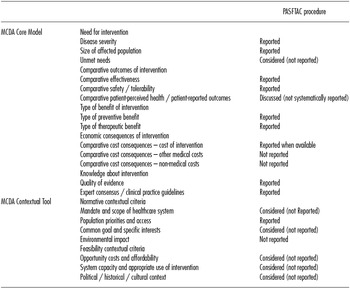
Regarding the content and structure of the PASFTAC's Reports, the included information met most of the criteria considered by the standard quantitative section of the EVIDEM framework (MCDA Core Model) (Table 1). The exception was found in the structured reporting of information related to: “unmet needs,” “Comparative patient-perceived health / patient-reported outcomes,” “Comparative cost consequences—other medical costs,” and “Comparative cost consequences—nonmedical costs.” The information regarding these topics was included across the Technical Report, being not specifically structured in individual sections or criteria. However, according to the information collected from the interviews, these criteria not explicitly included in the technical report, were considered and discussed for healthcare decision-making purposes.
Comparative Analysis between the Contents of the PASFTAC Technical Report vs MCDA Criteria (EVIDEM Framework)

PASFTAC (Programa d'avaluació, seguiment i finançament dels tractaments d'alta complexitat)
The criteria included in the Contextual Tool of the framework were not explicitly included in the PASFTAC Reports (nor Technical Report neither Summary of opinion report), even though, as indicated by PASFTAC members, they are key criteria usually discussed for decision-making purposes (Table 1).
Adaptation of the EVIDEM Framework
The EVIDEM framework was adapted and validated, according to PASFTAC standard procedures, by a total of 16 PASFTAC members (CatSalut) of the twenty-six initially invited to participate (62 percent). All the participants were experienced in evaluation and decision making, with a mean time (SD) involved in these tasks of 14.6 years (11.0). Most of the participants were identified as CATFAC members (69 percent), followed by 25 percent of CAMUH members (6 percent of the participants had a general CatSalut drug management role). Regarding professional profile, 63 percent of the participants were identified as “evaluators,” while the rest were distributed as: “clinician/advisor” (n = 1), “patient representatives” (n = 1), “decision makers” (n = 1) and “other roles” (n = 3), such as members of the evaluation services. The participants well represented the standard composition of PASFTAC.
All participants evaluated the standard domains and criteria included in the EVIDEM 3.0 framework. The majority of participants (≥75 percent) agreed in keeping all the quantitative framework criteria (MCDA Core Model). Some considerations were provided by the 25 percent of the participants: (i) “Size of affected population”: The ethical basis of this criteria reflects an aspect of the utilitarianism principle (greatest good for greatest number). Orphan drugs target small populations. Then, this principle, albeit important, need to be considered as a low priority to minimize differences in priority between rare and ultra-rare diseases. (ii) “Comparative cost consequences - nonmedical costs”: Nonmedical costs are usually difficult to quantify. Participants decided to consider them in a qualitative perspective.
Regarding the Contextual Tool, after review and discussion of the results individually provided, the PASFTAC participants agreed on removing three of the contextual criteria and adapt another one: (i) “Mandate and scope of healthcare system”: almost half of the participants (44 percent) suggested to remove this criterion, as they considered that orphan drugs always fall in the mandate and scope of the healthcare system. The suggestion was discussed and the criterion removal was confirmed. (ii) “Population priorities and access”: 88 percent of the participants considered this criterion to be important. However, clarifications should be included regarding disease prevalence (common disease, rare disease, ultra-rare disease). (iii) “Environmental impact”: 56 percent of the participants considered that this criterion should be removed because of the difficulty to collect and evaluate this information in daily clinical conditions. (iv) “Political / historical / cultural context”: Although the criterion was considered as important, it was also considered included in other criteria of the framework. For this reason, it was excluded from the final framework.
The final framework validated by the PASFTAC members is shown as Supplementary Table 1.
Criteria Weighting
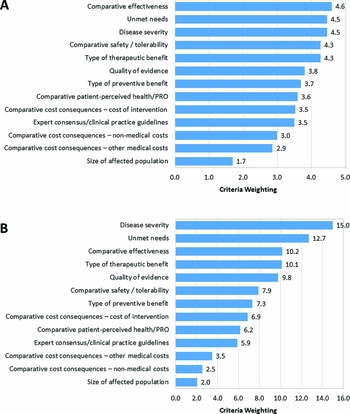
The PASFTAC participants were invited to do the weighting of the EVIDEM framework (domains and criteria). According to the mean results collected from the five-point weighting scale (Figure 2A), most important criteria for Orphan drugs were (mean ± SD): “comparative effectiveness” (4.6 points ± 0.5), followed by “disease severity” (4.5 points ± 0.7) and “unmet needs” (4.5 points ± 0.5). Criteria least important were “comparative cost consequences, other medical costs” (2.9 points ± 1.2), and “size of affected population” (1.7 points ± 1.2). Results collected with the second weighting technique (HPA) showed a similar trend to that collected with the nonhierarchical technique (Figure 2B).
Criteria weighting (mean) provided by the PASFTAC participants according to (A) five-point weighting technique (n = 15) and (B) the hierarchical point allocation technique (n = 15).

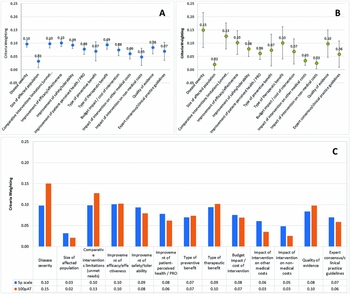
Normalization of the results for the two weighting techniques showed high consistency among them (Figure 3), with most important criteria being “disease severity,” “unmet needs,” “comparative effectiveness,” “type of therapeutic benefit,” and “quality of evidence.”
Normalized results of the criteria weighting used in the workshop session. (A) Five-points weighting technique. (B) Hierarchical point allocation technique. (C) Results comparison (n = 15).

Criteria weights were analyzed according to the professional profile of participants, showing similar weighting trends. The main discrepancies were found in the participants categorized as “decision makers” that considered the attributes included in the “economic consequences,” “type of benefit,” and “Comparative” domains as the most important for orphan drug assessments. On the contrary, the “patient representative” considered all the criteria included in the “economic” domain as “low interest” criteria (1 point).
Reliability Assessment
Reliability was explored by comparing the two weighting techniques using a test–retest exercise. The results confirmed the similarity of the trends observed between both weighting techniques. Additionally, reproducibility was evidenced by ICC data, showing a fair agreement, defined as difference <0.35 (Reference Kuna, Benca and Kushida20) for 10 of the 13 framework criteria (test–retest). According to the overall weighting results, the most important criteria for orphan drugs were: “disease severity,” “unmet needs,” “comparative effectiveness,” “type of therapeutic benefit,” and “quality of evidence.” The “size of the affected population” was confirmed as the criteria with the lowest priority for this type of drugs.
DISCUSSION
CatSalut is the public healthcare insurance in Catalonia, responsible for the funding, procurement, and equity in access of public healthcare services (4). The process of assessing and evaluating the effectiveness of new drugs is done according to HTA, considering internal standardized procedures focused in guarantying the quality of the assessment results. CatSalut's drug use recommendations are agreed with decision makers, establishing the conditions under which the new drug will be available, conditional to pricing and reimbursement decisions taken by the Spanish government (4).
Regarding orphan drugs, PASFTAC is the Committee responsible for drug evaluation and decision making (4). Essentially, PASFTAC procedures for orphan drug evaluation are very similar to MCDA (EVIDEM) methodology (9;Reference Wagner, Khoury, Willet, Rindress and Goetghebeur11;Reference Tony, Wagner and Khoury17). In both cases, all the scientific drug's evidence is compiled through a systematic literature review; multidisciplinary team participates through the whole process; and there is consideration of multiple criteria for the evaluation of the drug, development of the Technical Report, and final decision making reported by the Summary of opinion (4). In both cases, ethical considerations are the basis for the evaluation and they are also considered for decision-making purposes.
Nonetheless, some areas for improvement were identified such as: the reporting of all the criteria considered, the relative importance (weighting) of these criteria or the specific scoring of the criteria for drug value assessment, which are useful to support deliberation. These areas could be improved through MCDA, a method increasingly used to support healthcare decision making (Reference Wagner, Khoury, Willet, Rindress and Goetghebeur11;Reference Goetghebeur, Wagner, Khoury, Levitt, Erickson and Rindress15;Reference Sussex, Rollet, Garau, Schmitt, Kent and Hutchings21;Reference Paulden, Stafinski, Menon and McCabe22), and implemented in different countries (Reference Tony, Wagner and Khoury17;Reference Radaelly, Lettieri and Masella23;Reference Endrei, Molics and Ágoston24), such as the case of Lombardy (Italy), were a specific MCDA framework has been developed and it has been used since 2011 for healthcare decision making regarding diagnostics, devices, interventional procedures, and drugs (Reference Radaelly, Lettieri and Masella23); or Hungary, where MCDA was introduced by a ministerial decree in 2010 for the evaluation of new hospital medical technologies applied in hospital care (Reference Endrei, Molics and Ágoston24); among many other international experiences using MCDA methods (Reference Devlin and Sussex6–Reference Thokala, Devlin and Marsh8).
MCDA is a useful tool, especially considering interventions in complex decisions, such as end-of-life diseases or rare diseases (Reference Wagner, Khoury, Willet, Rindress and Goetghebeur11;Reference Sussex, Rollet, Garau, Schmitt, Kent and Hutchings21). The use of a standardized healthcare specific reflective and deliberative MCDA framework, such as EVIDEM, could be a good starting point for the development of MCDA adapted to the disease and country context and procedures (Reference Wagner, Khoury, Willet, Rindress and Goetghebeur11;Reference Goetghebeur, Wagner, Khoury, Levitt, Erickson and Rindress15;Reference Tony, Wagner and Khoury17), in this case to CatSalut and PASFTAC (rare diseases). The framework considered a comprehensive standard set of criteria to promote systematic and explicit consideration of all aspects of decision, similar to the criteria usually considered by the PASFTAC for the development of the Technical Report (4;9).
In this regard, similarly than for other HTAs (Reference Devlin and Sussex6–Reference Thokala, Devlin and Marsh8;Reference Schlander25), the EVIDEM framework and methodology could provide a benefit for evaluation purposes to PASFTAC by developing an MCDA technical report geared to support the decision process. Indeed, this MCDA framework could be the basis for the development of structured drug appraisals that could be used to start rich, multidisciplinary, and evidence-based discussions among all the stakeholders involved in decision-making purposes, by integrating, by design, the ethical basis of healthcare providers.
According to the PASFTAC procedures, the contents of the original EVIDEM framework required only minor adaptations to be useful for the Catalan context and rare diseases. In all cases, the adaptations were done in the Contextual Tool, not affecting the criteria included in the MCDA Core Model, which is the focus for drug value assessment and the most similar to the PASFTAC standard reports (4). The adaptation of the Contextual Tool for PASFTAC was done by removing contextual criteria that could be perceived as not relevant. Then, the guidelines, goals, and political/contextual issues are common and well-defined for all the considered orphan drugs, allowing the removal of the criteria considering these issues.
Because of the similarities between the standard procedures of PASFTAC and EVIDEM, the adapted framework could be used to identify the key drivers for decision-making purposes regarding orphan drugs. With independence of the weighting elicitation technique used, the results provided by the different PASFTAC participants were very similar, showing consistency in the importance of the different framework criteria for the assessment of orphan drugs in Catalonia, and resulting in valid weighting methods to support PASFTAC decisions (Reference Van Til, Groothuis-Oudshoorn, Lieferink, Dolan and Goetghebeur18). This consistency was also confirmed by test–retest results for both of the weighting techniques used in this study.
The key criteria for the evaluation of rare diseases were those included in the domain “need for intervention.” Specifically, the criteria “disease severity” and “unmet needs” were identified as the main value drivers for the assessment of orphan drugs, in agreement with previous MCDA experiences carried out in other countries and with the most recent adaptations of EVIDEM, focusing in orphan drugs (Reference Wagner, Khoury, Willet, Rindress and Goetghebeur11;Reference Sussex, Rollet, Garau, Schmitt, Kent and Hutchings21). Especially for the assessment of these type of drugs, criteria inherent to the disease (severity, lack of a suitable alternative treatment [unmet need], and rarity) have been identified as essential for defining the overall value of the drug. However, most decision-making bodies do not consider explicitly these criteria for drug value assessments. The results collected in this study demonstrate that PASFTAC members, in Catalonia, would be aware of the need to value and emphasize this type of criteria, especially regarding drug assessments for the treatment of rare diseases.
In contrast to drug assessment for common diseases (Reference Gilabert-Perramon, Betolaza and March5), the “size of the affected population” was the criterion identified as least important by PASFTAC for the value assessment of orphan drugs, regardless of the stakeholder or the weighting technique used. This result was aligned with previous studies conducted for the assessment of orphan drugs value (Reference Sussex, Rollet, Garau, Schmitt, Kent and Hutchings21). Rare diseases are a varied set of disorders that affect a small number of people, considering no more than five cases in 10,000 inhabitants (4).
According to the EVIDEM criteria definition, the “size of affected population” operationalizes the objectives of healthcare systems of “doing the greatest good to the greatest number,” which is an aspect of utilitarianism (9). PASFTAC experts considered that, in case of rare diseases, this consideration could negatively impact ultra-rare diseases, where the unmet need is high, and the number of patients is low. The need for considering this criterion into the MCDA framework was widely discussed during the workshop. The final agreement was to include this item but with a marginal weight, to ensure consideration and balancing of its ethical underpinning with that of other criteria (e.g., the imperative to help patients with many unmet needs, an aspect of fairness and distributive justice) (Reference Daniels10). It was also agreed to mention the case of ultra-rare diseases in the Contextual Tool of the final framework.
Cost considerations for rare diseases were also widely discussed by the PASFTAC members. It was clear that the budget impact was the cornerstone for drug evaluation purposes. However, other nonpharmacological costs also need to be considered for orphan drug's evaluation (Reference Wagner, Khoury, Willet, Rindress and Goetghebeur11,Reference Sussex, Rollet, Garau, Schmitt, Kent and Hutchings21). In Spain, other costs different to pharmacological costs are not frequently addressed, with the exception of other direct medical costs collected and reported in the clinical trials (4). The PASFTAC experts agreed that all costs should be included in data reporting, even though the main concern was the reliability of the sources of resource use data and cost estimations. In this regard, the MCDA framework was identified as a useful tool to structure the reporting of healthcare resource use data (especially in case of nonpharmacological resources) and for the qualitative evaluation of the impact that could be attributed to the considered intervention on these resources.
Despite the identification of differences in the criteria weighting due to the professional profile of the PASFTAC participants, discussed with the members of the Committee and considered as completely coherent, all the PASFTAC members agreed in the structure of the adapted MCDA framework and mean weights defined during the project for the evaluation of orphan drugs. The PASFTAC and CatSalut members agreed that MCDA may improve the traditional evaluation and decision-making procedures currently used by the Committee, through implementation of the EVIDEM framework by means for improving discussions related to healthcare decision making in Catalonia.
The main perceived advantages of MCDA for healthcare decision making in Catalonia were based on: structure and contents of data reporting, criteria weighting, and drug value scoring that supports deliberation and integration of ethical underpinnings of accountable and reasonable decision making. These advantages could be also a limitation if they are not appropriately addressed. On one hand, the information should be organized in a criterion-by-criterion basis, according to clear guidelines to avoid redundant information that could introduce bias in the evaluation. The training of the staff involved in the development of the MCDA Technical Report is critical for MCDA successful implementation, and it is supported by detailed tools developed in the EVIDEM framework. On the other hand, value quantification could be perceived as a value threshold, confusing the real value of reflective MCDA and its objective to facilitate considerations of ethical concerns and to support deliberation inherent to decision-making discussions.
Further analysis should be performed to evaluate the impact of these possible limitations through comparative evaluations of orphan drugs using standard PASFTAC procedures and MCDA. These future analyses should also consider the inclusion of a higher representation of roles different to “evaluator,” such as “patient representatives” or “decision makers.” In this study, only one representative of each of these groups participated, constituting a limitation that should be addressed in further assessments.
CONCLUSION
CatSalut and PASFTAC procedures are similar to MCDA methodology, considering systematic literature review, report of the information collected as standard Technical Report and multidisciplinary discussions for decision making and development of the final Summary of opinion.
MCDA, as a methodology compatible with the current standard procedures of PASFTAC, was identified as a useful tool to articulate the multicriteria discussions inherent to healthcare decision making. Reflective MCDA, supported by the EVIDEM tools, could be used as leverage points for the improvement of the evidence organization and reporting, contributing to the explicit consideration of a wide range of criteria relevant to decision makers while considering all ethical aspects related to healthcare decision making.
MCDA methodology could be used as a cornerstone to enhance evidence-and ethical-based discussions among all the different stakeholders involved in evaluation and decision-making purposes, including CatSalut staff and external stakeholders, such as clinical advisors or patient representatives. The development of a tool to be used as basis for decision making, based in robust ethical pillars and validated by a multidisciplinary team makes MCDA as a methodology potentially implementable in the CatSalut procedures.
This study allows to establish the work basis for MCDA implementation, even though further field testing is required to establish the final reference framework, optimization, and use in daily practice for CatSalut.
SUPPLEMENTARY MATERIAL
Supplementary Table 1: https://doi.org/10.1017/S0266462317000149
CONFLICTS OF INTEREST
X.B. and S.M. received research funds from BMS.