Working in a healthcare setting poses a variety of risks to healthcare workers (HCWs), including the risk of infection with Mycobacterium tuberculosis. The risk is related to the burden of disease, exposure, and implementation of infection-control measures in healthcare institutions. Tuberculosis (TB) and latent TB infection (LTBI) rates among HCWs were high in the prechemotherapy era, but they declined rapidly after the introduction of effective treatment.Reference Sepkowitz 1 – Reference Seidler, Nienhaus and Diel 4 More than 30 countries in the world have now reached the status of low incidence, with <100 reported TB cases per million population.Reference Lönnroth, Migliori and Abubakar 5 This low incidence reduces the risk for HCWs to be exposed to an infectious TB patient in healthcare institutions in these countries. Nosocomial outbreaks in the 1990s in the United States and in several European countries, however, underscored the need to maintain high-standard infection-control policies and practices in US hospitals as well as in low-incidence countries. 6 – Reference Hannan, Peres and Maltez 11
DNA fingerprinting studies have shown that a substantial proportion of TB in HCWs in low-incidence countries is not a result of occupational exposure in healthcare settings in these countries.Reference De Vries and Sebek 12 , Reference Davidson, Lalor, Anderson, Tamne, Abubakar and Thomas 13 In the United Kingdom, 85% of HCW TB cases were foreign born, and TB was presumably the result of an infection acquired before starting work in a UK healthcare institution;Reference Davidson, Lalor, Anderson, Tamne, Abubakar and Thomas 13 the infection was likely acquired during healthcare work in the HCW’s country of origin. In 3 years (2010–2012), only 10 events (3.3 per year) were identified involving patient-to-HCW transmission. In the Netherlands (1995–1999), <50% of reported HCW TB cases resulted from transmission in a Dutch healthcare institution and consisted of 28 HCW TB cases (4.6 per year) during this period.Reference De Vries and Sebek 12 In addition, the number of HCW TB cases with an infection acquired abroad was 5.0 per year during these years. Since the study, the TB incidence declined in the Netherlands from 9.8 per 100,000 population in 1999 to 5.1 per 100,000 in 2015.Reference Slump, Erkens, van Hunen, Schimmel, van Soolingen and de Vries 14 A training program of hospital TB coordinators was introduced in 2010 that included TB infection control practices such as an isolation policy, occupational screening, and contact investigation. These and other topics were recently described in a review of TB control in the Netherlands.Reference de Vries, van Hest and Bakker 15
The Dutch National TB Control Plan 2016–2020 describes the steps toward TB elimination and recommends that TB surveillance in the pre-elimination phase should focus on the adequacy of control measures in known risk groups, including HCWs.Reference de Vries and Riesmeijer 16 Important monitoring issues include whether the defined policy is being implemented correctly and whether the guidelines remain an adequate base for risk-group management.
The aims of this study were to update the proportion and trend of HCWs that acquired TB while working in Dutch healthcare institutions and to learn from the circumstances in which these infections occurred.
METHODS
In the Netherlands, TB cases are reported to the Netherlands TB Register (NTR), which includes information on risk groups such as working in the healthcare sector. Until 2005, this variable was defined as ‘working in the healthcare and/or welfare sector’ but was split in 2005 into 4 subcategories: (1) HCWs, (2) welfare workers, (3) workers with refugees, asylum seekers, or detainees, and (4) workers in other healthcare and welfare settings.
In the Netherlands, all M. tuberculosis complex isolates are subject to genotyping. From 1993 to 2008, restriction fragment-length polymorphism (RFLP) typing was the standard method; it was replaced in 2009 by 24-loci mycobacterial interspersed repetitive unit variable number of tandem repeats (MIRU-VNTR) strain typing. These DNA fingerprinting techniques have been described elsewhere.Reference Kremer, van Soolingen and Frothingham 17 , Reference Beer, Ingen and Vries 18 If the DNA fingerprints of M. tuberculosis complex isolates are 100% identical, they form a molecular cluster. Using these results, public health TB nurses investigate relationships between patients with identical DNA fingerprints (cluster investigation).
The Registration Committee of the NTR approved our request for a data regarding cases reported during the years 2000–2015 as working in the healthcare and/or welfare sector (2000–2004) or as an HCW (2005–2015). The dataset included several variables: gender, age, type of TB disease, culture confirmation, DNA fingerprint results, and the reason for TB diagnosis. We requested the public health professionals of the TB control departments of all Municipal Public Health Services (MPHSs) to provide additional information on (1) HCW status (in particular in cases reported before 2005), including specific occupation and healthcare institution; (2) recall of missing HCW TB cases in the study population based on a previous study methodology;Reference De Vries and Sebek 12 (3) results from epidemiological and/or cluster investigation to classify time and place of infection; (4) factors that contributed to transmission to HCWs in healthcare settings in the Netherlands (only category 1 cases), including relevant details of the source patients.
Based on the NTR data, including DNA fingerprints of the bacteria, and additional information from the TB public health professionals, HCW TB patients were classified into 4 groups, as previously described.Reference De Vries and Sebek 12 Category 1 comprised HCWs infected during work in the Netherlands. Cases were included when (1) an epidemiological link was confirmed by matching DNA fingerprints, (2) TB was diagnosed during contact investigation at the workplace, and/or (3) HCW performed high-risk procedures while the risk of TB was low outside the healthcare institution. Category 2 comprised HCWs infected in the community in the Netherlands. These cases had either matching DNA fingerprints with a close contact in the community, or, if culture negative, were considered infected in the community based on epidemiological evidence, such as contact investigation. Category 3 comprised HCWs infected outside the Netherlands (ie, abroad). Cases were included based on DNA fingerprints (eg, a unique fingerprint), tuberculin skin test (TST) conversion after returning from a TB high-incidence country, history of work in a hospital in a high-incidence country, and/or born in a high-incidence country. Category 4 included cases that could not be assigned to 1 of the first 3 categories.
Statistical Analysis
We calculated the annual average HCW TB cases per 5–6-year period (2000–2004, 2005–2010, and 2011–2015) by dividing the number of HCW TB cases by the total number of TB cases during these periods. We used the same method to calculate the annual average number of HCW TB cases per category. We applied a χ2 test to analyze trends during these periods.
RESULTS
During the study period, 173 cases were registered in the NTR as working in the healthcare and/or welfare sector (2000–2004) or as HCW cases (2005–2015). Excluded from the study were 8 cases from the MPHS that declined the request for participation, 8 cases that were actually LTBI cases (all reported before 2005), 3 cases for which the patient file could not be retrieved, and 39 cases that were not HCWs but were workers in the welfare sector (most of these cases were reported before 2005). Additionally, 16 patients were added to the study population because TB public health professionals recalled these cases during the interviews; they were all reported TB cases but not reported as HCW cases. Thus, the total study population consisted of 131 HCWs with TB.
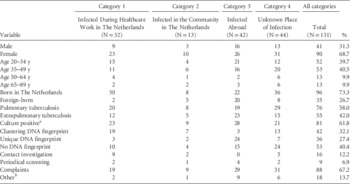
Overall, 32 case patients (24%) were infected while working in the Netherlands (category 1), 13 (10%) were infected in the community in the Netherlands (category 2), 42 (32%) were infected abroad (category 3), and 44 (34%) were included in category 4 (ie, did not meet inclusion criteria for categories 1–3) (Table 1). Of the HCW TB cases with a known place of transmission (categories 1–3), 37% were infected while working in the Netherlands; 15% were infected in the community in the Netherlands; and 48% were infected abroad.
Characteristics of Healthcare Workers With Tuberculosis (TB) in the Netherlands, 2000–2015.

a TB diagnosis without culture is by clinical decision which is usually based on symptoms, chest radiography abnormalities suggestive for TB, together with tuberculin skin test (TST) or interferon gamma release assay (IGRA) positivity or TST/IGRA conversion, and the likelihood of TB disease.
b For example, migrant screening, pre-employment screening, other, and unknown.
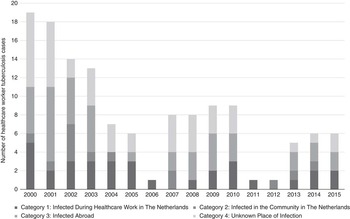
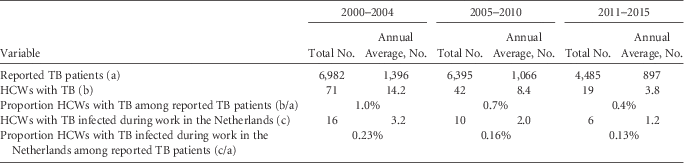
The annual number of HCW TB cases declined during the study period (Figure 1) (χ2 test for trend, P<.01) as did the proportion among reported cases during the 3 periods (χ2 test for trend, P<.01) (Table 2). The average annual number of HCW TB cases infected during work in the Netherlands also showed a downward trend from 3.2 per year in 2000–2004 to 2.0 per year in 2005–2010 to 1.2 per year in 2011–2015 (χ2 test for trend, P=.18) (Table 2). The average annual numbers of HCW TB cases infected abroad were 4.6 per year in 2000–2004 (n=23), 2.6 in 2005–2010 (n=13), and 1.2 in 2011–2015 (n=6) (χ2 test for trend, P=.02).
Healthcare workers with tuberculosis in the Netherlands, 2000–2015.

Reported Tuberculosis (TB) Patients, Healthcare Workers (HCWs) with TB, and HCWs with TB Infected During Work in The Netherlands, 2000–2015.

Characteristics of HCWs Infected During Work in the Netherlands (Category 1)
The occupations of the 32 HCWs that acquired TB while working in the Netherlands were medical doctor (n=6), nurse (n=15), bronchoscopy assistant (n=3), laboratory assistant (n=1), medical equipment sterilisation assistant (n=2), pathology assistant (n=1), autopsy assistant (n=3), and medical assistant (n=1). Moreover, 9 (28%) were male and 23 (72%) female. The median age was 39 years, and 30 of these patients (94%) were born in the Netherlands. Furthermore, 20 of these patients (63%) had pulmonary TB and 12 (37%) had extrapulmonary TB. Among the pulmonary TB cases, 5 included positive microscopy smears and 1 showed positive microscopy of the bronchoalveolar lavage. None of the 23 culture-confirmed cases showed a drug-resistant strain. One HCW (a bronchoscopy assistant) was treated for LTBI when starting tumour necrosis factor (TNF)-α–blocking therapy and 1 HCW had had an earlier episode of TB.
Risk Factors for Patient-to-HCW Transmission in the Netherlands (N=32)
Delayed diagnosis of (presumptive) TB (N=15; 47%). A total of 4 HCWs (2 medical doctors and 2 nurses) developed TB after giving emergency aid to an air traveller at an international airport or during the short period of admission in the hospital; this patient died the day of admission. Two of these HCWs were diagnosed with TB in the subsequent contact investigation; 1 HCW case had bacteriological confirmation and the same DNA profile as the index patient. The other 2 HCWs were diagnosed with culture-negative TB after presenting with symptoms. They resided in an MPHS area other than the location of the international airport and were missed in the contact investigation.
Furthermore, 2 HCWs (both nurses) were diagnosed with TB in a contact investigation of an index patient in whom diagnosis and isolation were delayed. Both HCWs had identical DNA fingerprints as the index patient.
In addition, 1 HCW (nurse) had exposure to several TB patients in the hospital, all having the same DNA fingerprints and was not included in any contact investigation. The HCW was diagnosed after presenting with symptoms.
Another 8 HCWs were infected after diagnostic and isolation procedures were delayed in 8 different index patients. Among these patients, 3 (1 medical doctor, 1 nurse, and 1 medical aid) were diagnosed in subsequent contact investigations, 2 (1 medical doctor and 1 nurse) were repeatedly invited for a contact investigation but failed to participate, and 3 (1 medical doctor and 2 nurses) were not invited for contact investigation.
High-risk procedures or activities (N=17; 53%). Notably, 2 HCWs (both nurses) were diagnosed with culture-negative TB after exposure to a patient on an intensive care department while performing high-risk procedures. Infection-control measures, such as personal protection, were not in place and were not adequate.
In addition, 13 HCWs performed high-risk procedures: bronchoscopy (3 assistants and 1 medical doctor); cleaning surgical equipment at the sterilisation unit (2 assistants); autopsies (3 assistants); work in the pathology department (1 assistant); work in the microbiology laboratory (1 assistant); operating on a patient with extrapulmonary TB (1 medical doctor); and irrigating the abscess of an extrapulmonary TB patient (1 nurse).
Among these HCWs, 8 had the same DNA fingerprint as the putative source patient and cluster investigation revealed the epidemiological link. In the other 5 HCWs, either TB was not confirmed by culture (1 laboratory assistant and 1 bronchoscopy assistant), the DNA fingerprint was unique (1 autopsy assistant and 1 pathology assistant), or the DNA fingerprint clustered but an epidemiological link with another patient could not be confirmed (1 autopsy assistant).
Moreover, 4 of the HCWs performing high-risk procedures were diagnosed at screening: 1 case was diagnosed at periodical screening (TST conversion and radiological findings consistent with TB), 1 case was diagnosed with a TST conversion at periodical screening but the HCW refused preventive treatment and was subsequently diagnosed with TB during radiological follow-up, 1 case was diagnosed at pre-employment screening (with recurrent TB), and 1 case was diagnosed coincidentally at pre-emigration screening. The other 9 were diagnosed after presenting with symptoms.
In addition, 2 HCWs (both nurses >75 years old) worked in a sanatorium and were likely infected during their past professional career. They were both diagnosed after presenting with symptoms. In 1 of these cases, culture confirmed the disease with a unique DNA fingerprint of the M. tuberculosis isolate.
Characteristics of the Source Patients of the Category 1 HCW TB Cases
The source patient could be identified in 24 HCW TB cases, all had been infected <5 years before diagnosis (19 had been infected <2 years before diagnosis). Altogether, 19 different source patients were identified (1 source patient caused 4 secondary HCW TB cases and 2 source patients caused 2 secondary HCW TB cases each). Overall, 14 source patients (74%) had pulmonary TB, all with positive microscopy of the sputum smear, and 5 source patients (26%) had extrapulmonary TB. The median age of the source patients was 53 years (7 were >65 years old). In addition, 14 of these TB patients (73.7%) were born in the Netherlands, and 5 (26.3%) were born in another country.
Characteristics of HCWs Infected Outside The Netherlands (Category 3) (N=42)
Among the category 3 patients, 47.6% were foreign born and presumably were infected before residence and work in the Netherlands. The native-born HCWs in this category (52.4%) were predominantly medical doctors (15 of 22) who had worked in high-incidence countries during their medical careers. The average annual number of HCW TB patients in this category declined from 4.6 in the first 5 years to 1.2 in the last 5 years of the study.
DISCUSSION
During the 16-year study period, 131 HCWs developed TB in the Netherlands. We determined that 32 of these cases developed TB due to an infection acquired during work in a healthcare setting in the Netherlands. The annual average number of HCW TB cases infected while working in the Netherlands declined from 3.2 in the first 5 years of the study to 1.2 in the last 5 years. Delayed diagnosis in a TB patient was the predominant underlying factor of nosocomial transmission in 47% of these HCW TB patients; most were identified in a subsequent contact investigation. Performing high-risk procedures and activities were the contributing factors in the other 53% cases. Moreover, 42 HCWs developed TB due to an infection acquired outside the Netherlands; 55% of them were born in the Netherlands and presumably were infected during their work in a high-incidence country.
It is well known that HCWs have a higher risk for TB due to the nature of their work.Reference De Vries and Sebek 12 The risks depend on the number of infectious TB patients exposed, the early identification of disease in these patients, and the timely implementation of infection-control measures in healthcare institutions. The number of TB patients reported declined during the study period by 43%, and this trend partly explains the decrease of occupationally acquired TB in HCWs in the Netherlands. A common pitfall in TB diagnosis is not recognizing the symptoms in time, for example, in the elderly native-born patient, resulting in the subsequent absence of infection-control measures, thus creating a risk of transmission to HCWs and other patients.Reference De Vries and Sebek 12 The adage “Think TB” remains valid in TB low-incidence countries to further reduce this risk. In these countries, infection-control measures should remain at a high standard to prevent nosocomial transmission. Apart from well-known high-risk procedures such as bronchoscopies, our study also revealed a relatively high proportion of transmission from extrapulmonary TB patients through procedures such as cleaning TB-contaminated surgical instruments, irrigating abscesses, and handling materials and specimens by health professionals, as has been reported in case reports.Reference Hutton, Stead, Cauthen, Bloch and Ewing 19 , Reference Frampton 20
Tuberculosis infection control in healthcare facilities is based on a number of principles. First, transmission of M. tuberculosis bacteria should be prevented by applying administrative, environmental, and personal protection measures.Reference Jensen, Lambert, Iademarco and Ridzon 21 Patients with presumptive TB should be quickly identified and, if hospitalization is necessary, admitted in rooms with negative pressure and attended by staff using adequate respiratory protective masks; such measures are all part of the recently revised Dutch hospital TB infection-control guideline. 22 Secondly, interventions to early identify LTBI in at-risk HCWs should be taken and 3 groups can be targeted: (1) HCWs with a high risk in the past, eg, due to exposure in high-incidence countries; (2) HCWs exposed to an infectious patient not isolated or not adequately protected; and (3) HCWs performing high-risk procedures, eg, bronchoscopy, autopsy, microbiological laboratory work, etc. Interventions responding to these risks include (selective) pre-employment screening, contact investigation, and periodical screening. The revised screening guideline for HCWs follows these principals of risk assessment.Reference de Boer, Bos and Keizer 23 Screening now includes pre-employment LTBI screening of HCWs from countries with a TB incidence of >50 per 100,000; LTBI screening of HCWs who have worked >1 month in a hospital in a country with a TB incidence of >50 per 100,000 during the last 2 years; and LTBI screening of HCWs who were exposed to an infectious TB patient. Periodical screening is limited to HCWs at higher risk in hospitals with >5 TB patients or >2 smear-positive pulmonary TB patients annually. A similar screening algorithm has been recommended in the United Kingdom.Reference Davidson, Lalor, Anderson, Tamne, Abubakar and Thomas 13 Furthermore, HCWs should repeatedly receive education on infectious risks, prevention, and self-protection.
The strength of our study is the detailed TB surveillance system in the Netherlands, which includes information on professional risk groups, such as HCWs, and a universal genotyping programme of all M. tuberculosis complex strains; this system has been in place for more than 20 years. Furthermore, collaboration with the MPHS enabled us to retrieve additional information. During our study, we noted that the definition of an HCW did not comprehensively include all occupational risks; the definition in the NTR was limited to the risk of personal contact with untreated TB patients. Therefore, we recommend broadening the HCW definition in surveillance systems to capture all occupational health risks.
Our study has several limitations. We were able to classify only two-thirds of the HCW TB cases in 1 of the 3 categories with a known place of transmission. Cases with unknown place of infection (ie, category 4) had either insufficient epidemiological and bacteriological information or had multiple risk factors, which precluded their assignation with confidence to 1 of the 3 categories. Another limitation is that we only investigated HCWs with active TB, not those diagnosed and treated for LTBI. Thus, the TB cases reported among HCWs represent only a small portion of nosocomial TB transmission in the Netherlands.
In conclusion, studying HCW TB cases based on genotyping and epidemiological data is useful to assess whether infection-control measures are in place and effective and to identify potentially new risks of nosocomial transmission. In low-incidence countries that move toward TB elimination, every TB case in an HCW should warrant timely and thorough investigation, and reports of confirmed nosocomial transmission should be shared at the national level to help further define and fine-tune HCW screening policy and to monitor its proper implementation within healthcare institutions.
ACKNOWLEDGMENTS
The authors thank the public health professionals of the TB Control Departments of the Municipal Public Health Services participating in this study.
Financial support: No financial support was provided relevant to this article.
Potential conflicts of interest: All authors report no conflicts of interest relevant to this article.