The discourse of authenticity has become central to our understanding of twentieth-century folk music revivals in the United States. The process of musical revival, that is, the self-conscious restoration of musical systems deemed in danger of decline or extinction, has been closely tied to perceptions of exactly what constitutes authentic, or genuine, folk tradition. The term tradition, like authenticity, is a slippery concept that folklorists and cultural studies specialists have come to view as “a construction rather than an inheritance.”Footnote 1 That construction of tradition, argues folk music scholar Burt Feintuch, involves “an ongoing process of interpreting and reinterpreting the past” through a kind of cultural editing. As a result, “each of the revivals achieved its own momentum with its own preferred repertoire, its own sanctioned styles, and its own selective view of the past.”Footnote 2 Through such cultural editing, a musical revival becomes, in the words of Philip Bohlman, “an overt and explicit act of authentication.”Footnote 3
The bulk of the scholarship on U.S. folk music revivals has been focused on the commercial folk music boom of the late 1950s and 1960s. Cultural historian Robert Cantwell interprets this revival as a complex social and political response by young people and students to the stifling conformity of middle-class suburban life—a movement marked by a rejection of authority and rigid structure, nostalgia for an imagined past inhabited by an idealized folk, and the search for community and self-transformation.Footnote 4 In such self-conscious movements, Tamara Livingston observes, “revivalists position themselves in opposition to aspects of the contemporary cultural mainstream, align themselves with a particular historical lineage, and offer a cultural alternative in which legitimacy is grounded in reference to authenticity and historical fidelity.”Footnote 5
Although this model provides a useful framework for approaching the U.S. postwar revival, the complex mechanism of cultural editing that undergirds the authentication process remains little understood. This essay will flesh out this process by focusing on the efforts of one band, the New Lost City Ramblers, to introduce northern audiences to what they judged to be authentic southern string-band and bluegrass styles at a time when the urban revival was dominated by popular and artsy interpreters of folk music. The Ramblers’ struggles to render accurately southern rural instrumental and singing styles, while maintaining their own distinctive sound, offer insight into the challenges that authenticity posed for mid-century folk musicians and their urban audiences, and continues to pose for scholars and cultural workers today.
The roots of the U.S. postwar folk music revival stretch back to the early decades of the twentieth century. Antecedents include the publication of folk song anthologies such as Cecil Sharp's and Olive Dame Campbell's 1917 English Folk Songs from the Southern Appalachians; the founding of the Archive of American Folksong in 1928; John and Alan Lomax's subsequent field collecting projects of the 1930s; the establishment of various Appalachian festivals and the National Folk Festival in the 1930s; the arrival of rural artists such as Leadbelly, Woody Guthrie, and Aunt Molly Jackson in New York City in the 1930s; and the singing union movements of the 1930s and early 1940s.Footnote 6 The serious commoditization of folk music began in the early 1950s with the success of Pete Seeger and the Weavers, but McCarthyism drove the group underground and out of the mainstream. A few years later a full-blown commercial boom would erupt when the Kingston Trio's “Tom Dooly” topped the pop charts in 1958, the same year the Ramblers were formed.Footnote 7
Although popularizers of folk songs, such as the Weavers and the Kingston Trio, received the lion's share of national attention, the folk revival was multidimensional and not easily reducible to a single category of music, a particular political ideology, a common set of values, or even a shared cultural perspective. Roger Lass described the diversity of the movement in a provocative piece he penned for the folk music fan magazine Caravan in the spring of 1958. Sketching a brief history of the urban revival, he pondered the conundrum of urban folk singers who were generally removed from indigenous folk culture, and their involvement in the pursuit of various social, political, and cultural agendas. Surveying the scene in the late 1950s he identified several categories of urban folk singers, ranging from classically trained “arty” adaptors and Pete Seeger–inspired amateurs to “ethnic-professionals” such as Jean Ritchie, Woody Guthrie, and Lead Belly who hailed from a particular regional folk group and who somehow found their way to urban audiences where they specialized in their native folk style. A final group identified by Lass was the “self-consciously ethnic” artists who, though presumably not originally members of a particularly ethnic or regional folk group, “devote themselves, in their own playing, to the imitation of existing ethnic styles. Their aim is idiomatic faithfulness.” Lass heralded Tom Paley, who would soon become a founding member of the Ramblers, as a quintessential representative of this final group. He concluded that the self-conscious ethnic singers, located in northern urban cities, would need to play a vital role in the preservation of regional folk styles.Footnote 8 In a follow-up Caravan article Lass argued further that urban folk singers must pay close attention to instrumental and vocal styles of the culture whose material they are interpreting, because popular arrangements of folk songs “are incongruities. They are the sort of thing that would produce laughter, revulsion, or utter puzzlement in a member of the folk from which the song came.”Footnote 9
Lass's repudiation of popular and “arty” adaptations of folk songs and his call for “idiomatic faithfulness” are critical to understanding the milieu from which the Ramblers emerged and their obsession with authentic performance style. Classically trained singers such as Richard Dyer-Bennett stressed pure tonality and controlled vibrato while occasionally employing devices such as rubato and dramatic dynamic variation. Their vocal accompaniments usually consisted of simple guitar chords, strummed or picked in a generic fashion. The Weavers, the Kingston Trio, and other pop folk groups favored more vernacular vocal styles but tended to stick to the pitches of the diatonic scale and consonant harmonies built around simple major and minor triads. Their singing was generally accompanied by banjo and guitar chords and a rudimentary bass line, with occasional string and brass orchestrations for sweetening. Absent in both cases were the distinctive bends, slurs, blues tonalities, and pinched nasal timbres common to much traditional southern mountain singing. Nor was any attention paid to the unique tunings or the complex picking and bowing patterns employed by mountain guitar, banjo, and fiddle players. Lass's challenge to acknowledge regional style, coincidentally written precisely at the time of the Ramblers’ formation, in retrospect reads like an early mission statement for the group. Indeed, the Ramblers would quickly come to the forefront of the self-consciously ethnic, or what would become known as the “purist” or “traditional,” stream of the revival. They and other like-minded traditionalists positioned themselves in direct opposition to the art and popular interpreters of folk music.
The Ramblers Perform and Record the Folk
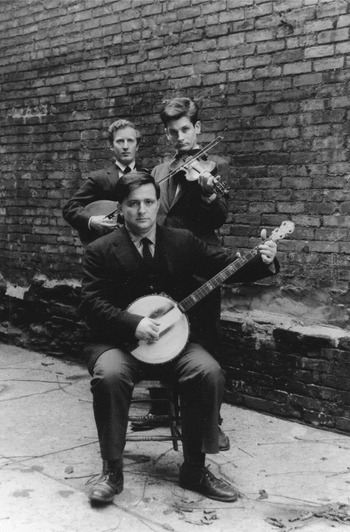
In September 1958 Mike Seeger, John Cohen, and Tom Paley performed their first live concert at Carnegie Recital Hall in New York City. The following day they made their initial recording for Moe Asch's Folkways Records under the quirky moniker The New Lost City Ramblers (Figure 1). The three musicians embodied the paradoxes of the postwar urban folk music revival. All were born in New York City and as youngsters had no direct personal contact with the rural southern communities whose music would captivate them as adults. Yet each experienced the sounds of southern country music at an early age. Mike Seeger (1933–2009), son of the erudite musicologist Charles Seeger and ultra-modernist composer Ruth Crawford Seeger, was reared on folk music field recordings that his mother transcribed and his family sang in their home in suburban Washington D.C. John Cohen (b. 1932), a native of Queens and suburban Long Island, grew up hearing folk music at leftist Catskill summer camps, listened to traditional country music records as a high school student, and helped organize hoots at Yale, where he received his B.F.A. and M.F.A. degrees in art and photography. Bronx-born Tom Paley (b. 1928) collected old 78 rpm country and blues records and followed Woody Guthrie around before entering graduate school at Yale to study mathematics. A fourth Rambler, Tracy Schwarz (b. 1938), would replace Paley in 1962. The son of an investment banker and a classically trained pianist, he tuned in late-night country radio stations from his homes in suburban New Jersey and Connecticut. Though city born and suburban bred, the Ramblers would eventually immerse themselves in the sounds of traditional southern mountain music, initially through recordings and later through visits south to meet, record, and commune with rural artists.
The New Lost City Ramblers: John Cohen (guitar), Mike Seeger (fiddle), Tom Paley (banjo). Photograph by Robert Frank, 1961. Copyright Robert Frank, used by permission.

The Ramblers built their sound around the classic mountain string-band ensemble of fiddle, banjo, and guitar that had become popular in the upland South by the early twentieth century. Playing instrumental pieces in a pre-bluegrass style, they rarely took flashy breaks or improvised solos, but rather played in a polyphonic mix with the fiddle carrying the main, ornamented melodic line, the banjo picking or strumming a simplified version of the melody, and the guitar adding chords and occasional counterpoint bass lines. Mandolin, slide guitar, autoharp, and harmonica provided additional instrumental variety. All three members sang, rotating the lead vocals and often harmonizing in two or three parts generally organized around the notes of the major triad. Their spare, vibratoless, slightly nasal vocals were, at least to the ears of most city listeners, suggestive of the styles commonly associated with southern mountain singing.
The music on the group's first Folkways LP, simply titled The New Lost City Ramblers (Folkways Records FA 2396, 1958), set in place the tropes of repertoire and style the trio would maintain on the twenty-some recordings they released between 1958 and 1978. The choice of songs and tunes was broad, ranging from string-band breakdowns and rags to ballads, love songs, songs of drinking and gambling, blues, gospel, and early bluegrass numbers. The focus was on southern, Anglo-American rural material (with one exception as discussed below) as captured on commercial hillbilly records and Library of Congress (LOC) field recordings from the 1920s and 1930s. Although blues- and ragtime-influenced pieces are included, the sources for these genres were consistently white, rather than black, southerners, the former having absorbed the influences of African American blues, jazz, and ragtime into their music.
A sampling of the songs and tunes from The New Lost City Ramblers demonstrates the diversity of styles and genres the group embraced. The LP opens with a rollicking rendition of the fiddle breakdown “Forked Deer.” Five commercial records and a 1939 LOC field recording of Virginia fiddler H. L. Maxey are listed as sources. Seeger played fiddle, Cohen banjo, and Paley guitar on what would become one of the Ramblers’ standard instrumental configurations. Seeger's choppy, slightly syncopated bowing propels the piece forward with a strong rhythmic drive while Cohen's nimble three-finger banjo picking outlines the chord changes and provides a skeletal version of the melody. Paley's counterpart guitar bass lines occasionally mirror the fiddle's main melody. There are no flashy solos, but rather a rich polyphonic mix of interlocking sounds (audio sample: www.journals.cambridge.org/sam2010007).Footnote 10
The same fiddle-banjo-guitar configuration is heard again on the popular hillbilly song “Don't Let Your Deal Go Down,” on which Cohen sings lead and Paley provides a tenor harmony on the chorus. The accompanying commentary regarding “the influence of jazz and sophisticated ‘popular’ songs, particularly in its chord progression,” is undoubtedly a reference to the use of VI and II chords commonly found in ragtime and Tin Pan Alley songs but generally absent from older mountain songs and dance tunes that revolved around variations of a simple I–IV–V chord progression. The lilting guitar, banjo, and fiddle accompaniment, along with Cohen's understated and slightly pinched lead vocal, closely followed the original 1925 recording by Charlie Poole and the North Carolina Ramblers, the first of five commercial recordings listed as sources (audio sample: www.journals.cambridge.org/sam2010008).Footnote 11
“Tom Cat Blues” introduces a new configuration with Paley on Hawaiian slide guitar and Cohen on standard guitar. The humorous piece, filled with sexual innuendos about a stud cat named Tom, is delivered in a laid-back voice interspersed with bluesy lines on the Hawaiian guitar. Described in the notes as a “white folk blues” learned from Bob Clifford, the piece's melodic line emphasizes blues tonality, but the lyrics are cast in an eight-bar verse rather than the more familiar twelve-bar blues structure (audio sample: www.journals.cambridge.org/sam2010009).Footnote 12 Paley and Cohen play standard guitars on another blues-tinged number, “Brown's Ferry Blues,” gleaned from recordings by the McGee Brothers and Delmore Brothers. The guitars, one played in standard position, the second using a capo, interlock with great precision, and the vocal harmony is among the tightest on the recording (audio sample: www.journals.cambridge.org/sam2010010).Footnote 13
“Sailor on the Deep Blue Sea,” learned from the Carter Family and a Lomax LOC recording by Kentucky ballad singer Lilian Napier, is accompanied by autoharp and banjo played by Seeger and Cohen, respectively. The ballad is sung in tight, two-part harmony with Seeger leading and Cohen providing the bass vocal line. The interplay of autoharp and banjo creates a light, shimmering texture that serves as a pleasant counterpoint to the coarse voices (audio sample: www.journals.cambridge.org/sam2010011).Footnote 14 Seeger's rendition of “Roving Gambler” cites four hillbilly recordings for sources, but his arrangement of the ballad features an unusual accompaniment of a banjo picked in a rolling, three-fingered style and a harmonica (played on a rack) doubling the banjo's melody between sung verses (audio sample: www.journals.cambridge.org/sam2010012).Footnote 15 On later recordings Seeger would employ other unconventional instrumental parings such as fiddle and harmonica, and banjo and quill pan pipes.
The LP's final number, the gospel tune “Crossed Old Jordan's Stream,” was taken from a recording by Bird's Kentucky Corn Crackers. The slightest hint of sarcasm is perceptible in Cohen's voice as he laments the good old neighbor, the mother, and the Christian who have “crossed old Jordan's Stream.” The three-part vocal chorus evokes the spirit of untutored country-church singing, while the guitar, mandolin, and Hawaiian slide guitar provide a lilting accompaniment with a slightly bluesy feel (audio sample: www.journals.cambridge.org/sam2010013).Footnote 16
The discographic sources included in the album booklet suggest that the Ramblers had little in common with the typical urban folk singers of the time who learned their material from songbooks or at informal song swaps. Twelve of the eighteen selections source commercial hillbilly recordings of the 1920s and 1930s; four more source hillbilly and LOC field recordings; the remaining two come solely from LOC field recordings. The degree to which the Ramblers’ arrangements on their first and subsequent albums replicated their original sources varied, however. They were reasonably successful at duplicating the lilting fiddle-banjo-guitar sound of Charlie Poole's North Carolina Ramblers and the twin guitar and duo harmonies of the Delmore Brothers from the above-mentioned recordings. However, many arrangements were clearly composites drawn from multiple sources. As a male trio they could not replicate the exact sounds of four- and five-piece string bands; nor could they reproduce the precise harmonies of groups such as the Carter Family who featured female vocalists.
A comparison of three of the Ramblers’ arrangements with their source recordings demonstrates the group's early attempts at creative re-creation without rigid imitation. The source for “Colored Aristocracy” was an LOC recording of the Rich Family string band, a group documented by Charles Seeger in 1936 at a West Virginia fiddle contest. The original LOC recording featured an ensemble of two lead fiddles backed by guitar and strumming mandolin, whereas the Ramblers’ arrangement used fiddle, banjo, and guitar. Although Seeger accurately reproduces the basic melodic line on the fiddle, he plays with a choppier bow stroke and slurs the notes more noticeably than does Sanford Rich on the original; the latter's melody is more clearly articulated with a slightly warmer timbre. The fiddles carry the melodic line throughout the Rich Family original, but Seeger (fiddle) and Paley (banjo) rotate the lead melody. The guitar and mandolin on the Rich Family original play a simple I (G)–VI (E)–I (G)–V (D) chord progression, while Paley (banjo) and Cohen (guitar) add a IV (C) and a II (A) chord to the mix. The resulting Ramblers’ arrangement is unquestionably derived from the Rich original but has had its own unique, slightly more modern feel (audio sample: www.journals.cambridge.org/sam2010014).Footnote 17
“Dallas Rag” comes from a 1927 commercial recording (Columbia 14290) by the Dallas String Band, one of the few African American groups that provided the Ramblers with source material. The Dallas String Band employed two mandolins, a guitar, and a string bass. Their arrangement consists of a series of sixteen-measure, A/B themes organized AABBAABBBA. The mandolin plays the bluesy, syncopated melody over guitar and string bass accompaniment. The Ramblers arranged the piece for mandolin, banjo, and guitar, organizing the two themes ABABABABA. Seeger plays a close approximation of the original recording's lead melodic line on the mandolin during the initial A/B chorus, backed by Paley's lightly plucked chordal accompaniment on the banjo and Cohen's punchy guitar bass lines. During the stop-time section of the first B theme Cohen improvises the two-measure melodic fill on the guitar, which was played on mandolin by the Dallas String Band. In the second AB section the banjo takes the lead melody, with Paley adding ornamentation not heard on the original. Seeger's mandolin returns to lead the third AB section, Paley's banjo the fourth, and Seeger's mandolin the fifth (A theme only). The Ramblers’ arrangement provides more instrumental variation by rotating the lead between mandolin and banjo and conveys an overall lighter textural feel and bouncier rhythmic lilt than the original Dallas String Band recording (audio sample: www.journals.cambridge.org/sam2010015).Footnote 18
“It's a Shame to Whip Your Wife on Sunday” was learned from a 1927 Fiddlin’ John Carson recording (OKeh 45122). The Ramblers’ choice to record the song, whose lyrics equated wife beating with card playing and drinking and satirically denounced all three, is a sobering reminder that the late 1950s were much closer to the 1930s than the 1960s in terms of attitudes toward women. The source recording features Carson singing and fiddling, backed by a guitar and a strumming banjo. Carson begins the piece by playing the main melodic line for eight measures as a prelude to the first sung verse. The opening line, “It's a shame to whip your wife on Sunday,” is sung twice, followed by the chorus, “Cause you've got Monday, Tuesday, Wednesday. . . .” Interspersed between the next four verses are sixteen- and eight-bar sections of the primary melodic line played on the fiddle. Each of the repeated verse lines is sung solo, with a high female harmony joining in only during the chorus. The Ramblers’ arrangement also opens with fiddle, guitar, and banjo, but the last provides a rolling, arpeggiated accompaniment that is absent on the Carson original. Seeger plays a full sixteen-measure introduction on the fiddle but pitched in the key of E rather than the original key, which was in the vicinity of G. Following the initial verse and chorus, Seeger returns with another sixteen-measure refrain of the main melody, but this time played on the mandolin, adding a bluegrass feel to the arrangement. After the second verse he plays another sixteen-measure refrain on the fiddle, but this time accompanied by Cohen's more assertive, contrapuntal guitar bass lines that occasionally double the fiddle's lead melody. Seeger sings the first line of the verse solo and then is joined by Paley (tenor) and Cohen (bass) for three-part harmony on the second repeated line and the chorus. The Ramblers’ harmony singing is fuller and more prominent than in the original Carson recording. Although Seeger makes an effort to sing in the vibratoless, slightly tense timbre of the early country singers, his voice could not be mistaken for Carson's. The latter employed courser timbre and a more irregular phrasing as well as an enunciated “whoop,” whereas Seeger clearly pronounces the word “whip” (audio sample: www.journals.cambridge.org/sam2010016).Footnote 19
Close listening reveals subtle differences between the Ramblers’ arrangements and their source recordings. It should be kept in mind, however, that except for a handful of record collectors and academics, most urban and college listeners in the late 1950s would not have had access to the source recordings. Thus a number of critics, even those with some familiarity with early hillbilly music, incorrectly characterized the Ramblers’ arrangements as strict imitations, carbon copies, or note-for-note reconstructions of their original hillbilly and LOC sources.Footnote 20 For more casual folk music fans, the Ramblers simply sounded closer to what they perceived to be authentic mountain music than did the popular folk singers Pete Seeger, Burl Ives, the Kingston Trio, and others. The fact that the Ramblers stressed the sources of their material in their liner notes and during spoken segments of their live performances only reinforced the perception that they were rigid reconstructionists.
The Ramblers would eventually reject this position, arguing vehemently that their aim was to capture the spirit of the original recordings, rather than to reproduce them note for note. A decade later journalist Jon Pankake, a longtime observer of the group, summed up their approach: “Far from imitating, they [the early Ramblers] managed the feat of learning the musical syntax of old time song—the instrumental attacks and licks, the vocal shadings, the interplay of ensemble lead and support—and then used their mastery of this syntax to recreate in their own voices new performances.”Footnote 21
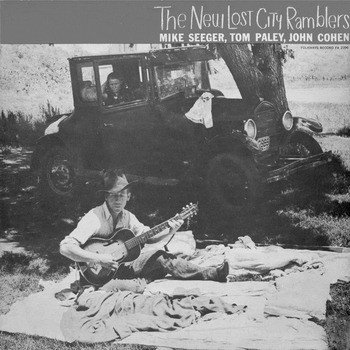
On this first recording, however, the impression of authenticity was reinforced by the cover design and the notes. Cohen designed the album cover, choosing a 1930s image by photographer Russell Lee of a young man and woman, presumably about to enjoy a country picnic (Figure 2). The photograph depicts a country scene that is bucolic but unsettling given the unresolved mystery of the woman, who appears reluctant to leave the dark confines of her car and move into the sunshine to join the man with his guitar. The decision to use the Lee photograph instead of images of the actual band members on the album cover reveals much about the sensibility the Ramblers brought to their initial record project. Evoking an atmosphere of a bygone era, when hard times and uncertain love might be soothed with the balm of music, was more important to the Ramblers than foregrounding themselves as featured artists. The choice of the Lee image acknowledged the power and mystery that rural Depression-era music held for the group and stood as a marker of historical authenticity.
Cover of The New Lost City Ramblers, Folkways FA 2396, 1958. Farm Security Administration photograph by Russell Lee. Image courtesy of the Ralph Rinzler Folklife Archives and Collections, Smithsonian Institution.

The liner notes and inserts that accompanied The New Lost City Ramblers LP and the group's subsequent early releases on Folkways are replete with source information on the recordings, commentary on instrumentation and style, and individual reflections on the Ramblers’ cultural mission; but more germane for this study, a close read reveals a preoccupation with questions of authenticity and performance style. In the debut album notes, Cohen and Paley consciously differentiated the Ramblers from their counterparts who dressed up folk material with pop pretensions and artsy affectations. Cohen chided city singers who attempt to “water down and smooth off” original folk material: “This intrusion of Art (capital A) is done with the intent of making the music more palatable, so that the folk songs can fit in with the décor of the living room or what have you. But this becomes the death of these songs.” Reflecting on the group's repertoire and style, Paley noted that “we avoid the most commercial aspects and try to stay fairly close to genuine folk material.” The Ramblers had not moved in the direction of “the slick, modernized, carefully arranged approach of the Weavers and the Tarriers.” Paley's critique of the popularization of folk music became more strident on the Ramblers’ second release, Old Timey Songs for Children (Folkways Records FW 07064, 1959): “You will not find slick, commercial arrangements on this record—you can hear that kind of pap on the juke box and the pot-luck juke box called radio any day—we prefer to leave the songs with their original vigor and feeling.”
Seeger's most articulate statement on the import of style came in his liner notes to The New Lost City Ramblers Volume 4 (Folkways Records FA 2399, 1962). There he criticized the “Art” style of Dyer-Bennet and William Clauson for its “non-dynamic antiquarian views of a peasant folk music which must be molded to fit classical musical traditions.” The practitioners of popular styles such as the Weavers, Kingston Trio, and Burl Ives “often tend to fit the tune to intricate vocal and instrumental harmonic conceptions rather then vice versa. Also the profit incentive in the current popularity of folk music has encouraged many singers to enter this field with an out-put of little lasting musical value.” Seeger favored a third approach, which he identified as “folk song performance.” Practitioners of this method used “vocal styles and accompaniments from those already existing in authentic folk music in the belief that the traditional performance is important and exciting enough for an audience outside its own immediate culture. . . . Their musical education consisted of ‘learning the rules’ by ear from watching and listening to performances and phonograph records of traditional folk musicians in order to play more or less within the tradition.”
Seeger was serious in his pronouncement that aspiring urban folk artists must experience the music live, stressing the “necessity to know some of the people who sing the songs.” Seeger and Cohen had made a number of trips to the rural South to meet, record, and play with living traditional performers, including Roscoe Holcomb, Clarence Ashley, Dock Boggs, Maybelle Carter, and Eck Robertson—many of whom they would eventually present on urban stages. In the notes to The New Lost City Ramblers Volume 4 Cohen recounted how the intrinsic qualities of the music were revealed to him through “listening to old recordings, visiting old-time country musicians, and singing and living with the songs.” He recalled with pride meeting Clarence Ashley amid the hills and barns of his Tennessee home, and recording bluegrass pioneer Bill Monroe at a gathering of local fans in a small Kentucky town. By noting their authenticating journeys south and their personal ties to those they identified as “genuine country musicians,” the Ramblers separated themselves from armchair folknics who learned solely by listening to records. In doing so they further bolstered their credentials as the urban interpreters of authentic rural styles.
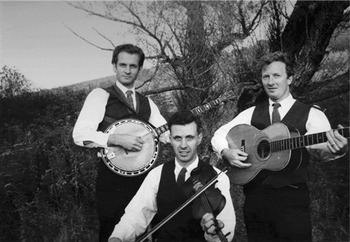
By the time Tracy Schwarz replaced Tom Paley in 1962 (Figure 3), the Ramblers were heralded by Peter Welding of Sing Out! magazine as “crusaders for old-time music.”Footnote 22 They personified Feintuch's cultural editors who eagerly embraced the task of selecting and defining what constituted authentic Appalachian repertoires and styles and presenting them to urban listeners. They aimed to establish canons of preferred artists (living and deceased) and favorite songs and tunes, as well as explicating the correct ways of tuning and playing mountain stringed instruments. They were the sorts of cultural middlemen described by cultural historian Benjamin Filene—individuals who “made judgments about what constituted America's true musical traditions” and “helped shape what ‘mainstream’ audiences recognized as authentic, and inevitably, transformed the music that the folk performers offered.”Footnote 23
The New Lost City Ramblers: Mike Seeger (banjo), Tracy Schwarz (fiddle), John Cohen (guitar). Photograph by Robert Frank, circa 1965. Copyright Robert Frank, used by permission.

Folk Authenticity and Music Performance Style
During the late 1950s and early 1960s the Ramblers' concerns with documenting and recreating authentic southern instrumental and vocal styles created a degree of synergy with an emergent wing of U.S. folk music studies. Throughout the 1950s Alan Lomax, Charles Seeger, and Ruth Crawford-Seeger were pushing their scholarly colleagues to redefine the idea of folk authenticity in terms of performance style. The criteria for judging the authenticity of folk songs employed by early folk song scholars and collectors such as Francis Child and Cecil Sharp was based purely on issues of age, supposed anonymity, and certain textual features, including rhyme, meter, theme, and so forth. Critical printed collections of American folk songs by John and Alan Lomax, Vance Randolph, Malcolm Laws, and Tristram Coffin, as well as the classic compendiums by Sharp and Child, followed this textual model. Notions of what constituted authentic folk music would change, however, with the advent of recording technology capable of capturing the full range of aural performance style that annotation by pen and paper could not hope to rival.Footnote 24
Writing in 1940, only seven years after he and his father had embarked on a trip across the rural South to collect folk music with a three-hundred-pound “portable” tape recorder in tow, Alan Lomax noted how recordings could reveal “a complete authenticity of performance,” which included, in addition to elements of melody and text, “rural singing and playing styles” that dated back at least fifty years before the recordings.Footnote 25 Lomax's early infatuation with style led him to develop critical models for comparing and analyzing the world's folk music in articles written for the Journal of the International Folk Music Council (1956), American Anthropologist (1959), and eventually in a provocative monograph, Folk Song Style and Culture (1968). In his 1959 article he compared the stylistic characteristics of Afro- and Anglo-American folk singing and concluded that “Southern Negro Folk” sing in a relaxed, resonant voice that employs multiple timbre variations (from grunts and groans to falsetto swoops), favors strong rhythms and improvised, fragmented text, and most often occurs in groups where it functions to coordinate work, dance, or worship activities. “Southern White Folk,” in contrast, tend to sing solo, with a rigidly pitched, harsh, hard, nasal timbre, while employing simple rhythms and structured texts with minimal variation.Footnote 26 It was this latter singing style that the Ramblers would most closely attempt to emulate.
Mike's father Charles Seeger, who was a friend and collaborator with Lomax during the late 1930s and early 1940s when both men worked in Washington, similarly emphasized performance style in scrutinizing folk authenticity and strongly advocated the use of recording technology to determine the parameters of style. Writing for the Journal of International Folk Music Council in 1953, he took folklorists and city revivalists to task for “stressing written tradition almost to the exclusion of oral tradition,” warning that overemphasis on written sources might sound the death knell to the oral-transmission process. He concluded: “The disc and tape, for example, at last puts in the hands of folklorists and revivalists alike, a means of bypassing the bottleneck of the notation of folk song. Millions are now learning to sing from hearing the voices of authentic singers.”Footnote 27 In a 1958 article for the journal Western Folklore, appropriately entitled “Singing Style,” the elder Seeger argued for more precise analysis of structural concepts of pitch, volume, timbre, tempo, proportion (division of sung syllables), and accentuation, and suggested the use of electronic devices for the comparative graphing of sound performances.Footnote 28
Similar discussions of the limitations of written sources and the import of recorded material in denoting folk music style and authenticity were also cropping up in popular folk song collections and magazines. Mike's mother, Ruth Crawford-Seeger, meticulously transcribed the Lomaxes’ field recordings for the popular 1941 folk song collection Our Singing Country and later published three widely distributed collections of children's folk songs. The project made her keenly aware of the shortcomings of printed notation in capturing the intricacies of folk song style. In her original 1941 introduction to the Lomax collection, she encouraged readers to sing in a “natural,” as opposed to a “trained, bel canto,” voice and to accompany the songs whenever possible on traditional instruments such as the guitar, banjo, fiddle, or dulcimer, as well as to avoid obtrusive piano.Footnote 29 In her introduction to her 1950 Animal Folk Songs for Children, she claimed that after years of listening to recordings, “I have come to feel that the way folk singers sing and play their music is almost as important as the music itself.” She readily admitted that “Listening of this sort can yield an enjoyment and understanding which reading of notes or words cannot give.”Footnote 30
Crawford-Seeger's folk song collections were used primarily by teachers and parents of young children, but Lomax pointed his provocative pen directly at the urban folk singers who were fueling the late 1950s revival. Writing for Sing Out! in 1959, Lomax scolded city “folkniks” for their overdependence on written collections and their ignorance of traditional style:
The American city folk singer, because he got his songs from books or from other city singers, has generally not been aware of the singing style or the emotional content of these folk songs, as they exist in tradition. . . . When songs are ripped out of their stylistic contexts and sung “well,” they are, at best changed. It would be an extreme form of cultural snobbery to assert, as some people do, that they have been “improved.” In my view they have lost something, and that something is important.
Lomax went on to explain to his Sing Out! readers that singing style cannot be written down in conventional musical notation “but can be heard and felt in a recorded or live performance.” He encouraged city singers to “experience the feelings that lie behind it, and learn to express them as the folk singers do.” He warned that such an undertaking is time consuming but ultimately worthwhile, for serious folk musicians who pay attention to style could become vital links between rural and urban audiences.Footnote 31 Lomax's piece articulated a strategy that the Ramblers whole-heartedly embraced and were just starting to put into action.
In redefining folk authenticity with aural stylistic criteria that could be replicated through recordings, Lomax, Charles Seeger, and Ruth Crawford-Seeger presented the possibility that urban musicians might—and in Lomax's mind should—aim to recreate rural vocal and instrumental folk styles as accurately as possible. Their position called into question the validity of popular folk singers who gleaned material from written collections and performed in styles shaped by conservatory training or Tin Pan Alley experience with no connection to the original source of the music. The Ramblers, in turn, would move this new theory of folk authenticity beyond the pages of scholarly and popular literature directly to lay urban and college audiences through their stage performances and Folkways recordings. They aimed to answer Lomax's challenge by demonstrating that city folk musicians could, through careful study of aural sources, emulate rural styles with a high degree of accuracy.
Not everyone agreed. Early on the Ramblers were challenged by ultra-purists who questioned their use of hillbilly and early bluegrass recordings from the 1920s and 1930s. Such commercial sources tainted these songs and tunes for individuals such as John Dildine, who ran informal song hoots and hosted a folk music program for a local Washington, D.C., radio station. When Seeger, Cohen, and Paley came on his program in May 1958 he questioned the authenticity of their hillbilly songs, asking if they were from “the people” or from some record company trying to reap profit. Seeger and Cohen had to defend their sources, noting the roots of most hillbilly recordings were in traditional mountain ballads and dance music. It was a criticism that they would continue to have to deflect, since the ultra-purist camp of the early urban revival remained skeptical of the folk efficacy of any material drawn from commercial recordings.Footnote 32
Whereas some deemed the Ramblers’ sources unacceptable by the strictest criteria of what constituted genuine folk music, others questioned their ability to render faithfully regional southern instrumental and vocal styles. Historian Bill Malone, whose 1968 tome Country Music USA would bring scholarly validity to the study of southern folk and country music, addressed the question of stylistic authenticity head on. Although noting that the Ramblers’ “instrumentation sounds almost like a carbon-copy of the early string-band styles,” he offered up the caveat that their vocal styles “do not fare as well,” as too often they “give the impression of trying to sound country.”Footnote 33 Malone's decision to include the Ramblers in his seminal survey certainly attested to his respect for their work, but his commentary raised the critical question of vocal authenticity. Nor was he alone in hearing something slightly affected in the singing style of the three educated, New York–born musicians who were attempting to sound like southern hill people with whom they shared little in terms of vernacular speech patterns.Footnote 34 Moreover, his observation that the Ramblers’ instrumentals were “carbon copies of the originals” did not sit well with the group, who resented being branded slavish imitators rather than creative emulators.
Folk music scholars, many of whom were skeptical of the commercial folk revival, were unsure what to make of the Ramblers. In 1959 Ed Cray reviewed the New Lost City Ramblers LP for the journal, Western Folklore. Cray was somewhat perplexed about how to categorize a group of “citybillies” who played “primarily hill-billy” songs whose origins are “clearly folk.” “If they are not authentic hill-billies,” he concluded, “whatever that may be, they remain a good copy of a vigorous tradition.”Footnote 35 Cray's commentary went straight to the thorny issues of cultural and stylistic authenticity that would plague the Ramblers’ efforts to forge deeper alliances with academic and government folklorists. As the fledgling field of American folklore sought to establish itself as a serious academic discipline in the early 1960s, scholars increasingly turned to the notion of cultural context as a touchstone for defining and interpreting their subject matter. The implications of this orientation for interpreting the folk music revival were painfully clear in a 1966 essay written by folklorist Ellen Stekert. A ballad singer herself, Stekert had begun her scholarly career under the tutelage of Richard Dorson, the patriarch of academic folklore who famously dismissed the revival as a form of commercial “fakelore.”Footnote 36 Stekert was more sympathetic toward the revival than was Dorson, but characterized groups like the Ramblers as “imitators”—that is, urban folk singers who carefully studied traditional styles and repertories by “immersing themselves in the aesthetic of a culture different from their own.” Such urban, middle class, educated, “imitators” couldn't possibly be authentic, she explained: “Think twice, and nothing seems more incongruous than John Cohen of the posh suburbs of New York City's ‘West Egg’ [F. Scott Fitzgerald's fictitious name for Great Neck, Long Island in The Great Gatsby] singing in old-time style with the New Lost City Ramblers.”Footnote 37 Reflecting twenty-five years later on her piece, Stekert expressed regret at her use of the “unconsciously disparaging” term “imitator,” but admitted that at the time (1966) she was genuinely “puzzled by people such as John Cohen and Mike Seeger, who were beginning to take on the mannerisms of the southern mountaineers whose music they were beginning to master,” and that she still had trouble “see[ing] beyond imitation to the potentials for creativity in their approach.”Footnote 38
Although the Ramblers would continue to play for college audiences, they received little attention or support from members of the expanding ranks of academic folklorists and ethnomusicologists with whom they had hoped to form alliances. Folk music scholar D. K. Wilgus bemoaned this situation in a 1968 Journal of American Folklore review, pointing out that although the Ramblers had “presented and taught to countless numbers the materials and styles of Southern folk tradition,” they “have not been integrated into academic study, and both sides are poorer for the separation.”Footnote 39 Richard Dorson's disdain for the 1960s folk revival would cast a long shadow—in 1976 one of his protégés, Jan Brunvand, pronounced that folk song revivalists were “largely irrelevant to the study of folklore” in his widely circulated Folklore: A Study and Research Guide. Footnote 40
Stekert's comments revealed the paradoxical nature of the Ramblers’ project. Their efforts to remain true to authentic renderings of folk music were at times at odds with their artisanship. They wished to be seen as creative interpreters of tradition, not as sterile imitators or quaint antiquarians on an archeological crusade to preserve the past. In the notes to Volume 3, Cohen argued that many of the early country singers the Ramblers most admired, including Charlie Poole, Earl Scruggs, Bill Monroe, and the Stanley Brothers, were “artistically progressive innovators” in their day who saw their music as a living, evolving entity. Similarly, the Ramblers were “finding our own voices, and despite any attempt to duplicate the old records, we have found that we are getting to sound more like the New Lost City Ramblers than anything else.” He concluded: “Each artist [each Rambler] brings his own ideas to the music, which makes it directed and meaningful to the present as well.” Paley declared in his Volume 3 notes that the “temptation to learn everything note for note and inflection for inflection from old recordings” can “lead down a complete blind alley from any artistic standpoint.” One must be “steeped in the sound he wishes to reproduce . . . in order to be able to sound authentic without note for note copying.” Seeger, in his notes to the Ramblers’ Rural Delivery Number One album (Folkways Records FA 2496, 1964), further explained: “In learning our music, we choose material from musicians that appeal to us and mix our esthetic with theirs. We may copy closely or rearrange completely, but in nearly all cases, the outcome differs from the original. . . . It is important today that we preserve and create among the old forms and make room for the best of the evolving forms.” From this perspective, authentic folk music style was malleable and dynamic rather than static and frozen in time. This orientation explains in part the Ramblers’ fascination with hillbilly music and early bluegrass styles, both of which were clearly “evolving forms” in the 1920s and 1930s.
Commentary from their early albums underscored the Ramblers' struggle to demonstrate a mastery of traditional folk styles while leaving room for their own individual creativity, and to please sophisticated urban audiences steeped in the modernist paradigm of innovation. The larger conundrum of synthesizing the traditional/modern dialectic was one that Ruth Crawford-Seeger and Charles Seeger wrestled with but never resolved in their own creative works, and one that challenged Alan Lomax in his efforts to harness, in the name of cultural preservation, the very mass media he saw threatening traditional expression and perpetuating cultural gray-out.
Authenticity and Government-Supported Folk Arts
Academic folklorists were not the only ones to lock horns with the Ramblers. By the late 1960s the group was running afoul with folklorists working in the nascent arena of government-sponsored cultural programming. In the summer of 1966 the Smithsonian Institution sponsored a series of outdoor events on the National Mall that Secretary S. Dillon Ripley hoped would bring broader public attention to the museum. The program of 10 August was hosted by folklorist Archie Green and featured music by the Ramblers. In his introduction to the program, Green drew connections between the historical artifacts in the Smithsonian Museum of History and Technology and the early country music played by the Ramblers; he reminded listeners that the latter was an amalgamation of diverse strains of Irish, Scottish, African, and Latin influences. He deftly contextualized their performance within the rhetoric of cultural preservation and diversity, the ideological cornerstones that would undergird the soon-to-be-realized Smithsonian Festival of American Folklife and the expansion of government-sponsored folk arts programming over the next decade.Footnote 41
The Ramblers proved to be an excellent choice for such a presentation. Over the previous five years they had been working in lecture-demo situations at venues such as the University of Chicago Folk Festival, the UCLA Folk Festival, and the reconstituted Newport Folk Festival. In addition, they often served as cultural interpreters and back-up players for older traditional musicians whom they had located and presented at those events. In 1961 Cohen and folk music researcher Ralph Rinzler, with assistance from Seeger, folk singer Jean Ritchie, and folk music promoter Izzy Young, helped form the New York City Friends of Old-Time Music. The loosely knit organization brought traditional performers such as Clarence Ashley, Doc Watson, Roscoe Holcomb, Dock Boggs, and the Stanley Brothers, to name a few, to small venues in New York City. These early attempts to recontextualize informal folk musical performance in more formal workshop and stage settings provided models for Rinzler when he became director of the first Smithsonian Festival of American Folklife in 1967. Indeed, the Smithsonian Festival was the culmination of a vision the Ramblers, Rinzler, Lomax, Green, and other like-minded folk music activists had been wrestling with for a number of years: the dignified presentation of traditional artists, located through field research, in settings that consciously blended education, entertainment, and the politics of cultural equity.Footnote 42
From its inception the Smithsonian Festival aimed to “deepen and advance public appreciation of the richness and viability of American grass-roots creativity.”Footnote 43 Its focus was on traditional, community-based practitioners of American music, dance, storytelling, crafts, and occupational practices, presented on stage and in workshop settings with an emcee-interpreter who could add an educational dimension to the proceedings. Key to Rinzler's concept of “folklife” and “grass-roots” was a strong anchor in local community culture. Rinzler and his people were committed to presenting artists who had learned their craft in their home communities—with an emphasis on rural and urban-ethnic communities—not middle-class revivalists who learned from recordings or other city singers of similar ilk.
Their close relationship with Rinzler notwithstanding, the Ramblers were not invited to appear as performers in the early Smithsonian festivals. When the group finally did appear at the fourth festival held in 1970, Rinzler's stage introduction reflected his uneasiness about their status as nontraditional musicians—he characterized that evening's program as “a departure for us.” After reiterating the festivals’ mission to present grassroots music from America's diverse communities, he continued:
But we also have some musicians who perhaps didn't grow up singing and playing the kind of music they're playing tonight. But they heard that kind of music all their lives, and happened to choose it. It wasn't the only music they could have chosen, but they decided that they liked this style and they really learned the traditional style. We have three such groups tonight, the Pennywhistlers, the New Lost City Ramblers, and Norman Kennedy, who have really deeply studied and immersed themselves in tradition.Footnote 44
Rinzler's 1970 remarks foreshadow attitudes that would shape funding priorities for government-supported documentation, festivals, and media projects that proliferated in the 1970s and 1980s with the establishment of the Folk Arts Program of the National Endowment for the Arts in 1973 and the American Folklife Center in 1976.Footnote 45 Projects receiving funding would focus on traditional and grassroots artists rather than urban revivalists. According to NEA guidelines, the Folk Arts Program supported “folk and traditional arts that are rooted in and reflective of the cultural life of a community. Community members may share a common ethnic heritage, language, religion, occupation, or geographic region.”Footnote 46 Folk revivalists were automatically judged to lack cultural authenticity because they did not grow up and learn their musical craft in a traditional community. Thus, the logic followed, a city-bred group such as the Ramblers could never fully grasp and recreate the deep-seated, subconscious essence of rural Appalachian music—they could never be native speakers, only practitioners of a second language. In order to justify the use of federal and state tax dollars for folklore programming, government-based folklorists would have to distinguish carefully between those artists who were actually community-based tradition bearers and those who had come to the music through the urban folk revival.
Under the new guidelines, the Ramblers might work in the capacity of workshop leaders or apply for funds for their documentation projects, but they were not eligible for support as traditional performers, or even to play at festivals supported by the new NEA program. Not surprisingly, they took umbrage with such developments, feeling like victims of their own success who were suddenly on the outside looking in. After a decade of documenting and promoting traditional musicians, they found themselves more often than not disqualified from performing as equals with their mentors on festivals and concerts that received government support. Ironically, at least in their view, the rigid criteria defining folk in such a narrow and exclusionary terms had been developed and implemented by Rinzler, Alan Jabbour (the first director of the NEA Folk Arts Program), Bess Lomax Hawes (Alan Lomax's sister and Jabbour's successor at the NEA Folk Arts Program), and other folklorists who, like the Ramblers, had discovered folk music through the urban revival. The Ramblers would appear once more on the 1971 Festival of American Folklife, but not again as a trio until they were honored at a reunion concert in 1997.
Although the Ramblers never officially applied for government funds as a group, they deeply resented their exclusion from the government-supported, education-oriented festivals, the model they had helped develop a decade earlier. That resentment was captured in a 1989 letter from Schwarz published in the fan magazine The Old-Time Herald. He commented on tensions between “folklorists and so-called folk revivalists,” complaining that he and his revivalist colleagues suffered “discrimination, based on origin of birth.” Schwarz remarked somewhat sarcastically, “If only I'd lied back in '57 [when he first started to play] I bet you a month's supply of old strings I could have passed for traditional.”Footnote 47 Three years earlier Cajun fiddler Dewey Balfa had invited Schwarz to be part of his band, which was to appear at the Smithsonian Festival. Despite the fact that Schwarz had played and recorded with Balfa for more than a decade, the festival programmers would not permit Schwarz, a non-Cajun, to play with Balfa. Schwarz was smuggled on stage anyway wondering if security—“the folk music police”—would cart him away. In the end cool heads prevailed and Schwarz played (but was not paid). For Schwarz the episode was a painful reminder that the folklore establishment still refused to recognize his legitimacy as a traditional musician.Footnote 48 More recently, while exploring funding possibilities for a Ramblers’ Fiftieth Anniversary concert in the spring of 2008, Cohen was politely told by a state government folklorist that members of his review panel would probably not see the Ramblers’ music as fitting the community-based criteria necessary to qualify as folk art. For the folklorist and the panel, limited funds meant tight restrictions on what constituted fundable folk art. For Cohen, “plus ça change, plus c'est la même chose.”Footnote 49
The Ramblers as Cultural Catalysts
In retrospect the Ramblers’ commitment to authenticity proved to be a double-edged sword. Early in their career they emerged as leaders of the traditional music wing of the revival, appealing to a small but devoted niche of musicians and fans who positioned themselves in opposition to commercial folk music. At that same time they found common ground with a core group of folk music scholars who were pushing the discipline away from literary textual analysis and toward the study of musical style captured on sound recordings or witnessed in live performances. Playing nearly a third of their engagements at college-sponsored concerts and festivals, the Ramblers introduced many young folklore and ethnomusicology students to the basic tenets of folk music style and to the use of historical recordings as legitimate research materials.Footnote 50
The Ramblers’ unwavering commitment to authenticity, however, proved problematic and eventually contributed to the group's demise. Purists groused that their hillbilly and bluegrass sources were not traditional. Scholars and government-based folklorists challenged their authenticity, arguing that as northern-born revivalists they could never accurately recreate the nuances of southern vocal and instrumental practices. Charges of imitation called into question the Ramblers’ status as creative artists. Their decision to adhere strictly to traditional performance styles and repertoire while never composing their own material undoubtedly limited their audience. This reality translated into low record and ticket sales and a constant struggle to make financial ends meet.
Livingston concluded her survey of musical revivals with the observation that “the tensions caused by static definitions of authenticity and historic fidelity may sow the seeds of the revival's breakdown; yet frequently the revival will have served as a cultural catalyst, stimulating new sounds, new textures, and new repertoires.”Footnote 51 Although the old-time music revival never completely broke down, her general thesis is useful in understanding the eventual demise of the Ramblers and the continued evolution of the old-time music movement in the group's aftermath. By the mid-1960s the commercial boom was waning; as groups like the Kingston Trio and the Weavers faded from the scene, so diminished a crucial element of the Ramblers’ raison d'être—to stand in opposition to what they perceived to be the commercial bastardization of folk music. While the Ramblers and other traditionalists continued to dismiss popular music, Bob Dylan was leading a national movement to meld folk and rock styles. The Ramblers continued as torchbearers for traditional music, but much of the folk music audience was won over to the more innovative folk rock sound.Footnote 52 As rock festivals replaced folk festivals, the Ramblers and their supposedly authentic sound appeared increasingly antiquated to younger listeners. Demand for their music diminished, and the group cut back its touring and recording schedule in the early 1970s. The Ramblers officially disbanded in 1979.
The Ramblers certainly were the sort of cultural catalysts that Livingston references. In their wake came scores of bands devoted to old-time music. Although most listened carefully to the Ramblers and to reissues of hillbilly records and field recordings of mountain musicians, the rigid emulation of source recordings seemed to be less of an issue in the 1970s. The two most popular bands of the era, the Highwoods Stringband from Trumansburg, New York, and Red Clay Ramblers from Chapel Hill, North Carolina, took the music in new directions. The Highwoods featured driving double fiddles and a booming acoustic bass that produced a raucous sound throbbing with the exuberance of a rock band.Footnote 53 The Red Clay Ramblers played an eclectic mix of old-time string band, bluegrass, vaudeville blues, early jazz, ragtime, and gospel music, as well as original numbers. Their sophisticated arrangements included improvised solo breaks, key modulations, jazzy harmonies, and unusual medleys of vocal and instrumental pieces.Footnote 54
By the early 1980s the old-time music revival had neither broken down nor disappeared, but rather had morphed into a cultural movement that remained mostly below the pop culture radar. A 1985 double-LP release, titled appropriately The Young Fogies, documented a vibrant scene consisting of some forty bands that stretched from coast to coast. Collectively the musicians on the album formed, according to producer Ray Alden, “a family of ‘fogies’ sharing the old fashioned notion that we can play our own style of music using traditional instruments.”Footnote 55 Many of the groups credit early Ramblers recordings as their introduction to the music, but most were not strict reconstructionists, and, like the Highwoods and Red Clay Ramblers, had developed their own unique sound and eclectic repertories.
Old-time, bluegrass, and blues were among the earliest forms of southern regional music to come to the attention of urban audiences in the postwar years, but other ethnic and regional styles would soon follow. By the 1970s Cajun, klezmer, Irish, polka, and Balkan music had become the focus of renewed interest as legions of young musicians discovered their roots and celebrated multiculturalism. The Ramblers had a hand in the Cajun revival; according to historian Mark DeWitt, the group's 1966 recording of “Parlez Nous a Boire” was crucial in introducing Cajun music to the larger folk music revival.Footnote 56 In the mid-1970s Schwarz recorded two albums with Cajun fiddler Dewey Balfa that inspired young players outside Louisiana. On a broader scale, as historian Philip Gura points out, the Ramblers helped lay the foundation for the post-Bicentennial ethnic-music movement by “ignit[ing] a cultural movement in which music became the marker for a renewal of interest in the oldest kinds of communities, those built on respect for tradition.”Footnote 57 In 1979 ethnomusicologist David Evans singled out the Ramblers for helping usher in a new stage of the urban folk revival “characterized by an increasing competence and authenticity in the re-creation of folk style and a strong tendency toward conscious specialization and regionalism or ethnicity.”Footnote 58 Worth noting is that many of the leading ethnic revivalists moved quickly from reconstructing older styles based on historical recordings to innovative reinterpretation of traditional material, the incorporation of ragtime, blues, jazz, and rock into their arrangements, and composing their own tunes and songs. Authenticity was less of a self-conscious concern for these musicians, perhaps because many of the key figures were cultural insiders—Jewish-American klezmer players Andy Statman, Lev Liberman, and Henry Sapoznik; Louisiana Cajuns Michael Doucet and Dewey Balfa; and Irish Americans Mick Maloney, Eileen Ivers, and Joanie Madden, to name but a few.Footnote 59
Rethinking Music Revivals
From our current historical position we can understand why the Ramblers’ pursuit of authenticity would inevitably prove futile. Strictly speaking there was nothing pure or genuine about their music, any more than there existed, by the 1920s, some pure or genuine body of authentic southern folk music from which the Ramblers or other like-minded traditionalists might draw. Dildine's assertion that the Ramblers’ sources were not totally from “the people” (that is, of some imagined, untainted, preindustrial folk) was correct; many early hillbilly and bluegrass artists arranged their material for three-minute recordings, radio broadcasts, and live stage shows. Most did, in one way or another, have commercial aspirations to take their music making beyond the strict confines of their home communities. Nevertheless they did draw heavily on older, premediated styles and repertoires, transforming old traditions into new sounds that remained grounded in regional practices. The southern musicians who made those recordings in the 1920s and 1930s, and indeed the Ramblers themselves, are best viewed as players in this ongoing process of musical transformation centered in aural transmission. By paying close attention to the way in which those regional styles were rendered on sound recordings, and by frequently visiting rural practitioners in order to absorb the music first hand, the Ramblers maintained a more vital link in that chain than did those urban singers who simply took melodies and lyrics gleaned from written folk song collections and attempted to jam them into classical or Tin Pan Alley–based forms. Circumventing the rubric of authenticity, we can envision the Ramblers as occupying an intermediate cultural space between regional mountain music and the urban folk revival. They positioned themselves stylistically closer to the former, emulating, without slavishly duplicating, the instrumental and vocal music of their mentors who actually grew up in rural southern communities.
The Ramblers’ story underscores the dilemma of placing authenticity—a discourse precariously perched on the constructs of folk and tradition—at the center of our understanding of folk music revivals. Without the pillars of pure folk and genuine tradition to support it, the notion of authenticity quickly collapses. This collapse, in turn, calls into question the whole process of musical revival, which assumes a priori the existence of an authentic ur form that has gone through a strict cycle of life, death, and rebirth. Mark Slobin challenged this assumption more than a quarter of a century ago, writing that the term “revival” was not applicable to most music situations because culture does not generally proceed in a linear fashion where expressive forms completely die out and must be brought back to life on a regular basis. Rather, he viewed culture as “more of a spiral, changing, but dipping back along the way.”Footnote 60 In his more recent work, Slobin has jettisoned the notions of folk and revival, choosing rather to conceptualize Jewish-American klezmer music as a “transatlantic heritage music system” shaped by the complex forces of nationalism, diaspora, cultural nostalgia, exoticism, and transnational looping.Footnote 61 Likewise, in his study of Cajun and Creole music, Mark DeWitt identified the key role that perceptions of heritage played in the resurgence of the music in Louisiana and in northern California migrant communities. Although DeWitt continued to use the term “revivalists” as “shorthand for cultural outsiders,” he made it clear that Cajun music was never in danger of dying out or even in critical need of resuscitation. Rather, so-called folk revivalists played an essential role in “the partnership between insiders and outsiders in maintaining Louisiana French dance music, in California and more generally.”Footnote 62 In his provocatively titled study Romancing the Folk, Benjamin Filene bypassed the folk revival quagmire by choosing to focus on what he identified as American “roots music,” that is, those genres that were self-consciously “glorified as the ‘pure’ sources out of which the twentieth century's commercial popular music was created.”Footnote 63 Notions of authenticity, folk, and roots were thus approached as cultural constructs rather than as hard-wired realities. Filene referred to Pete Seeger and Bob Dylan as “folk stylists,” that is, “figures who grew up outside the regional or ethnic traditions that produced roots music but who became public performers and emissaries for that music.”Footnote 64 Terms such as “heritage,” “roots,” and “emissaries” emphasize preservation, history, and advocacy while at the same time ascribing positive cultural value to such musics and their practitioners.
These fresh approaches avoid the endless debates over authenticity and revival that too often diminish the validity of certain musical practices. They rightfully acknowledge that self-conscious reinvigoration and transformation are natural, not spurious, components of dynamic music cultures, and that the interactions of community insiders and outsiders are often necessary to maintain the vitality of local music traditions. Such a reorientation promises to enhance our understanding of regional and ethnic music cultures and their place in contemporary U.S. society, and to appreciate more fully musicians and cultural activists such as the Ramblers who sought to connect worlds that were eagerly waiting to discover one another.