Glyphosate is a broad-spectrum herbicide that acts exclusively via foliar uptake. The target site in plants is the inhibition of the enzyme 5-enolpyruvylshikimate-3-phosphate synthase (EPSPS) (EC 2.5.1.19), which catalyzes the conversion of shikimate-3-phosphate and phosphoenolpyruvate to 5-enolpyruvylshikimate-3-phosphate and inorganic phosphate in the shikimic acid pathway (Geiger and Fuchs Reference Geiger and Fuchs2002). Inhibiting this enzyme prevents the biosynthesis of the aromatic amino acids phenylalanine, tyrosine, and tryptophan. Glyphosate has for decades been the leading and most widely used herbicide in perennial crops such as olive (Olea europaea L.), citrus fruit, and grapevine (Vitis spp.). In extensive parts of Mediterranean Europe, the widespread use of cover crops to reduce fertile soil erosion in perennial crops makes it necessary to use high glyphosate doses to control both cover and weeds during the dry season (Fernandez et al. Reference Fernandez, Gauvrit, Barro, Menendez and De Prado2015). This crop management has inevitably led to the emergence in this area of glyphosate-resistant species, including those within the Lolium genus such as perennial ryegrass (Lolium perenne L.) (Portugal), Italian ryegrass (Lolium multiflorum Lam.) (Spain), and rigid ryegrass (Spain and France) (Fernandez et al. Reference Fernandez, Alcantara, Osuna, Vila-Aiub and De Prado2017; Fernandez-Moreno et al. Reference Fernandez-Moreno, Alcantara-de la Cruz, de Portugal, Calha, Costa, Brants and De Prado2015).
To improve chemical alternatives to the loss of glyphosate effectiveness in these perennial crop farming systems, the use of the herbicide oxyfluorfen for PRE and/or early POST control, alone or in tank mixtures with glyphosate, has increased significantly. Oxyfluorfen inhibits the enzyme protoporphyrinogen oxidase (PPO) (EC 1.3.3.4), an essential enzyme that catalyzes the last common step in the pathway leading to heme and chlorophyll biosynthesis (Duke et al. Reference Duke, Lydon, Becerril, Lehnen and Matsumoto1991). This enzyme inhibition eventually leads to the accumulation of protoporphyrin IX (Proto IX) in the cytosol and the generation of singlet oxygen that causes lipid peroxidation and cell death (Sherman et al. Reference Sherman, Becerril, Matsumoto, Duke, Jacobs, Jacobs and Duke1991).
Currently, the use of oxyfluorfen for both PRE and POST control to prevent and/or control glyphosate-resistant weed populations has continued with no other chemical rotations, and as expected, oxyfluorfen effectiveness has declined in a typical case of multiple resistance. Multiple herbicide resistance evolves when various dissimilar resistance mechanisms that are each encoded by particular resistance genes coexist at the individual and/or population level, providing resistance to several herbicides with different modes of action (Hall et al. Reference Hall, Holtum and Powles1994; Rousonelos et al. Reference Rousonelos, Lee, Moreira, VanGessel and Tranel2012). Given the importance of glyphosate in modern agriculture, the most serious multiple herbicide–resistance scenarios are those involving glyphosate. In fact, half the glyphosate resistance cases include multiple resistance (Heap Reference Heap2017). Multiple resistance involving glyphosate is especially troublesome in allogamous Lolium species such as rigid ryegrass, since these species develop resistance to herbicides at a fast pace. Because chemical control of multiply resistant rigid ryegrass has relied on glyphosate, multiple resistance involving this herbicide is a worst-case scenario (Preston et al. Reference Preston, Wakelin, Dolman, Bostaman and Boutsalis2009).
The goal of the present study was to characterize multiple resistance to the nonselective herbicides glyphosate and oxyfluorfen in several rigid ryegrass weed populations currently infesting different perennial crops in southern Spain.
Materials and Methods
Plant Material
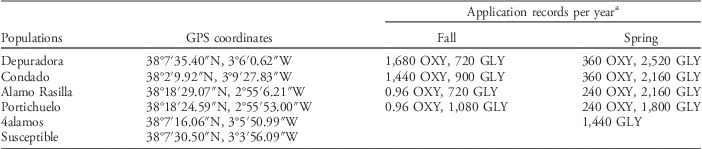
In August 2015, mature seeds of five populations (20 plants per population) of rigid ryegrass were collected from different olive groves in Villacarrillo, Jaen (southeastern Spain) (Table 1). These olive groves had been treated for at least 15 consecutive years with glyphosate applied at field doses higher than 1,800 g ae ha−1 (Roundup®, 360 g ae L−1, Monsanto Agricultura España, Spain). After 10 consecutive years of glyphosate treatments, larger doses started to fail. As farmers reported their inability to control weed population growth, they began to apply oxyfluorfen (Goal®, 240 g ai L−1, Dow AgroSciences Iberica, Spain) in tank mixtures with glyphosate as an alternative. Therefore, four populations were exposed to 10 consecutive years of glyphosate treatments (2 per year) plus 5 more years of glyphosate+oxyfluorfen applications (Table 1). These populations are now suspected of being resistant (R) to both oxyfluorfen and glyphosate. Only the 4alamos population was treated differently; 4alamos received the same 15 yr of glyphosate exposition, but no oxyfluorfen treatments. This population is considered to be resistant to glyphosate and susceptible to oxyfluorfen. Subsequent surveys in the area did not reveal the rise of new populations resistant to glyphosate, oxyfluorfen, or both.
Herbicide records and location of the different rigid ryegrass populations.

a Glyphosate (GLY) during 15 yr and oxyfluorfen (OXY) during 5 yr. Herbicide rates are expressed in g ai ha−1 (OXY) or g ae ha−1 (GLY). Final herbicide rates are presented.
Seeds of a susceptible (S) rigid ryegrass population were collected from a nearby olive grove that had never received either glyphosate or oxyfluorfen treatments. All seeds were germinated in petri dishes with filter paper moistened with distilled water and placed in a growth chamber at 28/18 C (day/night) under a 16-h photoperiod, 850 µmol m−2 s−1 photosynthetic photon flux, and 80% relative humidity. Seedlings of R and S populations were transplanted into pots containing sand:peat in a 1:1 (v/v) ratio and placed in a growth chamber under the environmental conditions described.
Whole-Plant Dose–Response Assays
Oxyfluorfen and glyphosate treatments were applied at the 2-leaf and 3- to 4-leaf growth stages, respectively. Herbicides were applied within a laboratory chamber (SBS-060 De Vries Manufacturing, Hollandale, MN) equipped with 8002 flat-fan nozzles delivering 200 L ha−1 at 250 kPa at a height of 50 cm. Glyphosate (Roundup Energy® SL, 450 g ae L−1, Monsanto Agricultura España) rates ranged from 31.25 to 10,000 g ae ha−1, while oxyfluorfen (Goal® SL, 240 g ai L−1) rates ranged from 30 to 11,520 g ai ha−1. After being spray, plants were maintained for 21 d in growth chambers under the conditions previously described. Afterward, R and S plants were cut at ground level, and growth was evaluated by plant mortality and aboveground fresh weight. Herbicide rates causing 50% and 90% in both mortality (LD) and reduction in shoot fresh weight (GR) compared with nontreated controls were calculated for each experiment. The experiment was repeated twice and was arranged in a completely randomized design using five replicates (pots, 4 plants pot−1) per rate.
Leaf Segment Shikimate Accumulation Assay
Leaf disks (50-mm diameter) were harvested from the youngest fully expanded leaf from a sample of 15 plants population−1 at the 3- to 4-leaf growth stage (Hanson et al. Reference Hanson, Shrestha and Shaner2009). Approximately 50 mg of fresh tissue was transferred to 2-ml Eppendorf tubes containing 1 ml of 1 mM NH4H2PO4 (pH 4.4). Glyphosate was added to the Eppendorf tubes at concentrations ranging from 0.1 to 1,000 µM. The microcentrifuge tubes were incubated in a growth chamber for 24 h under the previously described conditions. After 24 h, they were stored at −20 C until further analysis. Eppendorf tubes were removed from the freezer and thawed at 60 C for 30 min, after which 250 µl of 1.25 N HCl was added to each tube. Again, they were incubated at 60 C for 15 min. Afterward, a 125-µl aliquot from each tube was pipetted into a new 2-ml Eppendorf tube, and 500 µl of periodic acid and sodium metaperiodate (0.25% [wt/v] each) was added. The tubes were incubated at room temperature for 90 min, after which 500 µl of 0.6 N sodium hydroxide and 0.22 M sodium sulfite were added. All Eppendorf tube contents were then transferred to glass vials. Samples were measured in a spectrophotometer (Beckman DU-640, Fullerton, CA) at 380 nm within 30 min. Each glyphosate concentration contained three replicates of each population. The assay was repeated twice (three replications per assay).
Determination of Proto IX Levels
Determination of the Proto IX levels were carried out following the methodology described by Dayan et al. (Reference Dayan, Owens, Corniani, Lima-Silva, Watson, Howell and Shaner2015). Ten 4-mm-diameter leaf disks (approximately 0.1 g) from the six populations were incubated individually in a 6-cm-diameter petri dish containing 6 ml of 2% (w/v) sucrose, 1 mM 2-(N-morpholine) ethanesulfonic acid, and 100 µM technical grade oxyfluorfen for 20 h at 25 C in darkness. All extractions of Proto IX from leaf disks were made under a dim, green light source. After incubation, the 10 leaf disks were pooled, homogenized using a mixture of LC-grade methanol and 1N NH4OH (9:1) with a volume of 2 ml at full speed for 15 s, and kept in the dark for 10 min. Homogenates were centrifuged at 3,000×g for 3 min, after which the supernatants were collected. Pellets were resuspended in 1 ml of methanol in the dark for 10 min and centrifuged again. Supernatants from both centrifugations were combined and dried under an airstream. Concentrates were reconstituted in 1 ml of LC-grade methanol and filtered through a 0.2-µm nylon syringe filter to remove precipitates. The extracts were stored in opaque glass vials at −20 C until their analysis by the LC method.
Fifty microliters of the reconstituted phase was injected into an HPLC system (Beckman Coulter 126 Gold HPLC System, Fullerton, CA) equipped with a fluorescence detector (Jasco FP-1520, Easton, PA) with excitation and emission wavelengths of 400 and 630 nm, respectively, and an ODS column with dimensions of 25 cm by 4.6 mm and a particle size of 5 μm (Phenomenex SphereClone®, Torrance, CA). Deionized water was used as mobile phase A and pure LC-grade methanol was used as mobile phase B. The elution program started with 60% of mobile phase B and followed the linear gradient until 100% methanol was reached in 10 min. After 30 min, the solvent system was returned to the initial conditions. The constant flow rate and column temperature were 1.0 ml min−1 and 25 C, respectively. Proto IX levels in the extracts were quantified using a calibration curve obtained with a commercially available Proto IX standard (Sigma Aldrich, St. Louis, MO). The data were expressed as nmolg−1 fresh weight. All treatments were carried out three times, with three repetitions per treatment.
Statistical Analysis
All dose–response data from the two experiments were analyzed by ANOVA. There was no significant (P>0.05) trial by treatment interaction from each experiment, so the data were pooled. Pooled dose–response data were subjected to nonlinear regression analysis using a three-parameter log-logistic equation (Equation 1) to determine the doses causing 50% and 90% reductions in fresh weight (GR50, GR90) and the doses causing 50% and 90% mortality (LD50, LD90) compared with the untreated control (Fernandez et al. Reference Fernandez, Gauvrit, Barro, Menendez and De Prado2015). Regression analysis was conducted using the statistical freeware program R v. 3.2.4 with the ‘drc’ package (Ritz et al. Reference Ritz, Baty, Streibig and Gerhard2015).
 $${\rm Y}\,{\equals}\,\left( {\left[ {d\,/\,1{\plus}\left( {{x \mathord{\left/ {\vphantom {x g}} \right. \kern-\nulldelimiterspace} g}} \right)^\wedge b} \right]} \right)$$
Where Y is the aboveground fresh weight or the survival expressed as the percentage of that of the nontreated control, d is the coefficient corresponding to the upper asymptote, b is the slope around the inflection point, g is the herbicide rate at the halfway inflection point (GR50, LD50), and x (independent variable) is the herbicide rate. Resistance indexes (RIs) were calculated as R:S GR50/90 or LD50/90 ratios. Values of GR and LD were considered significantly different when their respective RI ratios differed from 1 at α=0.05. Data from Proto IX and shikimate studies were subjected to ANOVA, and Tukey’s HSD test was used to separate population means. Model assumptions of normal distribution of errors and of homogeneity of variance were checked by visual inspection of the residual plots. When required, data were previously squared-root transformed. In those few cases, nontransformed values are presented for clarity. Where variances were not homogeneous even after transformation, a generalized linear model with normal error distribution and identity link function (McCullagh and Nelder Reference McCullagh and Nelder1989) was used.
Results and Discussion
Whole-Plant Dose–Response Assays
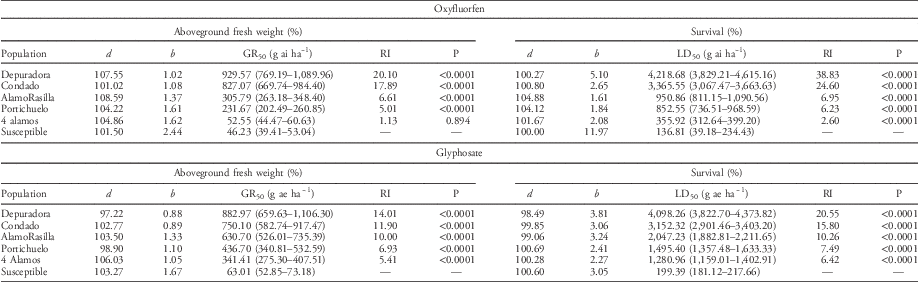
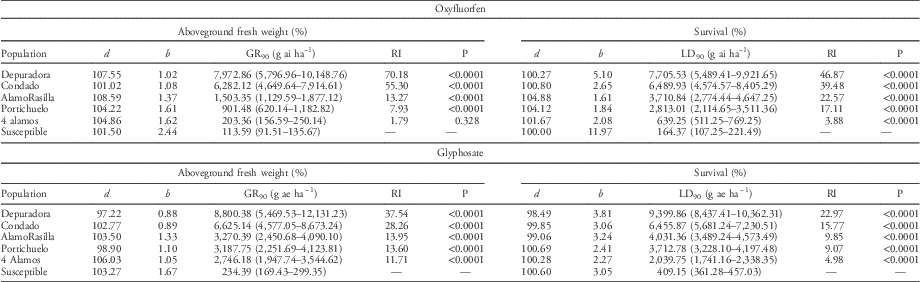
Effective growth reduction (GR) and lethal (LD) dose were calculated at both the 50% (GR50 and LD50, respectively) and 90% (GR90 and LD90, respectively) levels. Therefore, GR50 and LD50 allow comparison of the results to those of other resistant rigid ryegrass populations, such as the temperature-dependent and glyphosate-resistant rigid ryegrass (Vila-Aiub et al. Reference Vila-Aiub, Gundel, Yu and Powles2013); the glyphosate-resistant rigid ryegrass from South Australia (Adu-Yeboah et al. Reference Adu-Yeboah, Malone, Gill and Preston2014); the first case of resistance to glyphosate in rigid ryegrass in France (Fernandez et al. Reference Fernandez, Gauvrit, Barro, Menendez and De Prado2015); or the multiple resistance to nonselective herbicides detected in rigid ryegrass (Fernandez et al. Reference Fernandez, Alcantara, Osuna, Vila-Aiub and De Prado2017). Likewise, the GR90 and LD90 provide an accurate approximation to whether the field use rates recommended for any crop can control these rigid ryegrass populations. While the S population showed similar dose–response values to those reported in previously described S populations, all the remaining populations tested were significantly resistant to glyphosate relative to the S population in terms of both effective dose growth reduction and mortality measured at the 50% and 90% levels (Tables 2 and 3). Depuradora was the most resistant population, exhibiting RIs ranging from 37.5 (GR90) to 14.0 (GR50), while the 4alamos population was the least resistant, with RIs of 11.7 (GR90) and 5.0 (LD90). The need for a glyphosate rate of 9,399.6 g ha−1 (26 L ha−1) to achieve the usual field goal of 90% effectiveness means the Depuradora population is extremely resistant to glyphosate action. Although showing a lower degree of resistance than Depuradora, the Condado and AlamoRasilla populations also displayed high levels of resistance to glyphosate. Under these conditions, we could split the five populations into two groups: the first one, represented by the Depuradora, Condado, and AlamoRasilla populations, which exhibited greater than 10-fold resistance compared with the S population; and the second group, represented by Portichuelo and 4alamos, which would be described as having medium resistance, with GR50 and LD50 RI values lower than those observed in the first group but still significantly different from the S ones.
Parameters of the log-logistic equations used to calculate the oxyfluorfen and glyphosate rates required for 50% reduction in fresh weight (GR50) and percent survival (LD50) expressed as the percentage of the mean untreated control of the rigid ryegrass populations.Footnote a

a Equation 1 was used for data analysis. Abbreviations: d, coefficient corresponding to the upper asymptote; b, the slope around the inflection point; RI, resistance index.
Parameters of the log-logistic equations used to calculate the oxyfluorfen and glyphosate rates required for 90% reduction in fresh weight (GR90) and percent survival (LD90) expressed as the percentage of the mean untreated control of the rigid ryegrass populations.Footnote a

a Equation 1 was used for data analysis. Abbreviations: d, coefficient corresponding to the upper asymptote; b, the slope around the inflection point; RI, resistance index.
The level of resistance of the first group could be considered similar to other weed populations that have been characterized as highly resistant to glyphosate, such as goosegrass [Eleusine indica (L.) Gaertn.] and hairy beggarticks (Bidens pilosa L.). These two populations are characterized as having double EPSPS mutations (Yu et al. Reference Yu, Jalaludin, Han, Chen, Sammons and Powles2015; Alcantara-de la Cruz et al. Reference Alcantara-de la Cruz, Fernandez-Moreno, Ozuna, Rojano-Delgado, Cruz-Hipolito, Dominguez-Valenzuela, Barro and De Prado2016); these double mutations (Pro-106-Ser and Thr-102-Ile) are responsible for their higher resistance. However, non–target site resistance (NTSR) mechanisms cannot be disregarded in the Spanish populations, as herbicide selective pressure exerted on NTSR plants tends to cause the accumulation of NTSR alleles (especially in outcrossing species). This results in a pool of genes providing increasingly stronger resistance to an increasingly broad range of herbicides over time (Menendez et al. Reference Menendez, Rojano and De Prado2014).
In terms of glyphosate resistance, the second group aligns more closely with rigid ryegrass populations previously described as moderately resistant to glyphosate. Those described biotypes displayed both NTSR and target site–resistance (TSR) mechanisms (Menendez et al. Reference Menendez, Rojano and De Prado2014; Sammons and Gaines Reference Sammons and Gaines2014).
The presence of five populations with different levels of resistance at a distance of no more than 25 km from each other is also noteworthy. Putative hypotheses explaining this may be (1) the independent selection of five different mutations (or clusters of mutations) due to the level of selection pressure exerted on the wild populations, or (2) the development of partial resistance in individuals throughout the years as well as subsequent gene-flow processes (i.e., seed and pollen) between individuals from nearby populations. This is the case for cross-pollinated species, such as those of the Lolium genus, in which individuals from nearby populations can share male gametes as pollen and thus accumulate herbicide-resistance alleles (Fernandez et al. Reference Fernandez, Alcantara, Osuna, Vila-Aiub and De Prado2017). However, these two assumptions cannot be proved until a complete characterization of their mechanisms of resistance has been carried out.
Surprisingly, the results from oxyfluorfen assays were highly consistent with those obtained with glyphosate (Tables 2 and 3). Not only were the Depuradora and 4alamos populations those most and least resistant to oxyfluorfen, respectively, but the remaining populations also displayed the same order of RI with respect to the S population for both herbicides. In addition, the 4alamos population was classified as susceptible to oxyfluorfen according to its GR50 and GR90 values but showed significantly higher LD50 and LD90 values than did the S population. Although these significant differences were observed, at no time did these values exceed the recommended field dose. The Depuradora population exhibited an RI ranging from 70.18-fold (GR90) to 20.10-fold (GR50) higher resistance than that of the S population. The remaining populations also showed different RI values, and all of them were higher than the 4alamos values (Tables 2 and 3).
Leaf Segment Shikimate Accumulation Assay
EPSPS enzyme inhibition generates changes in shikimic acid levels in plants (Amrhein et al. Reference Amrhein, Deus, Gehrke and Steinrücken1980). Shikimic acid assays in treated plants are appropriate measures for determining resistance or susceptibility to glyphosate (Kleinman and Rubin Reference Kleinman and Rubin2017); the higher the accumulation of shikimic acid, the greater the toxicity of glyphosate (Henry et al. Reference Henry, Shaner and West2007).
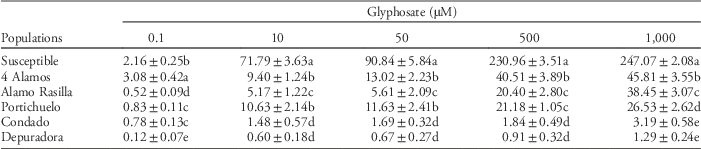
There were significant differences in shikimic acid accumulation between the R and S populations at all glyphosate concentrations tested (Table 4). Under these circumstances, two groups of R populations were observed. One group was completely insensitive to herbicide concentrations, as the S population exhibited 191- and 78-fold higher accumulation levels than did the Depuradora and Condado populations, respectively. On the other hand, the other group, composed of the AlamoRasilla, Portichuelo, and 4alamos populations, showed some degree of shikimic acid accumulation. This accumulation was much less than that observed in the S population. Differences in shikimic acid accumulation between R and S populations were consistent with the results of the dose–response assays. Rapid screening tests based on shikimic acid detection have been previously used for different glyphosate-resistant Lolium spp. populations with encouraging results. For instance, in species such as Italian and rigid ryegrass, the susceptible population accumulated six to seven times more shikimic acid than did the resistant population (González-Torralva et al. Reference González-Torralva, Gil-Humanes, Barro, Brants and De Prado2012; Fernandez et al. Reference Fernandez, Gauvrit, Barro, Menendez and De Prado2015). In our case, the assay was sensitive enough to discern not only between R and S populations but between resistant populations with different degrees of resistance to glyphosate.
Shikimic acid accumulation (expressed as µg of shikimic acid g−1 fresh weight [FW]) in leaf segments of rigid ryegrass populations incubated in different glyphosate concentrations.Footnote a

a One of two similar experiments is presented. Data are means of three repetitions. Mean values (n=3) ± standard error of the mean; means with different letters within a column are statistically different at 95% probability determined by the LSD test.
Determination of Proto IX Levels
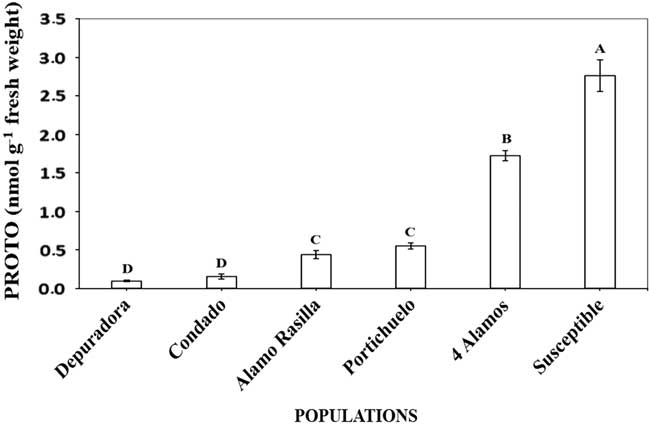
One of the key features of the inhibition of PPO-inhibiting herbicides is the rapid accumulation of the photodynamic tetrapyrrole Proto IX, the product of the reaction (Duke and Dayan Reference Duke and Dayan2011). Unlike many other mechanisms of action, it is not the substrate but the product of the inhibited enzyme that accumulates, as the accumulated protoporphyrinogen IX (protogen, the substrate) leaks from the plastid to the cytoplasm, where it is oxidized to Proto IX by extraplastidic oxidases (Dayan et al. Reference Dayan, Owens, Tranel, Preston and Duke2014). Hence, the measurement of the accumulation of Proto IX can be used for determining the effect of PPO inhibitors (Dayan et al. Reference Dayan, Owens, Corniani, Lima-Silva, Watson, Howell and Shaner2015). As in shikimic acid accumulation studies, the data were highly consistent with dose–response results.
All the herbicide-resistant populations accumulated significantly less Proto IX than did the susceptible ones (Figure 1). Not only did the Depuradora population again display the lowest results, with Proto IX values (0.098 nmol g−1 fresh weight [FW]) 27 times lower than those observed in susceptible plants (2.648 nmol g−1 FW), but the Condado population displayed Proto IX values similar to those of the highly resistant Depuradora (0.137 nmol g−1 FW); the values of 4alamos were again similar but significantly different (1.688 nmol g−1 FW) from those of the susceptible population (Figure 1). To date, a few species, such as wild poinsettia (Euphorbia heterophylla L.) (Trezzi et al. Reference Trezzi, Felippi, Mattei, Silva, Nunes, Debastiani, Vidal and Marques2005), common waterhemp (Amaranthus rudis Sauer) (Shoup et al. Reference Shoup, Al-Khatib and Peterson2003), common ragweed (Ambrosia artemisiifolia L.) (Rousonelos et al. Reference Rousonelos, Lee, Moreira, VanGessel and Tranel2012), goosegrass (Askew et al. Reference Askew, Cox and Spak2013), Asian copperleaf (Acalypha australis L.), and flixweed [Descurainia sophia (L.) Webb. ex Prantl] (Heap Reference Heap2017), have been reported to be resistant to PPO-inhibiting herbicides. Only in some of them has the mechanism of resistance been studied, with TSR being the only one reported (Dayan et al. Reference Dayan, Owens, Tranel, Preston and Duke2014; Salas et al. Reference Salas, Burgos, Tranel, Singh, Glasgow, Scott and Nichols2016). In our case, it seems very unlikely that a mere 5 yr of exposure to oxyfluorfen would have resulted in a burst of PPO resistance in such a small land area. The presence of a non–PPO exposed, PPO-resistant population (4alamos) also does not support PPO selection pressure. In any case, PPO resistance in these populations is due to either the presence of PPO-specific TSR/NTSR alleles or to the presence of non–PPO specific NTSR alleles that confers resistance to both glyphosate and oxyfluorfen. Gene flow of PPO-resistant alleles from an oxyfluorfen-resistant population(s) to susceptible ones may explain both this multiple resistance and the presence of a non-PPO exposed, PPO-resistant population. However, if there was flow of PPO-resistant, non–glyphosate resistance related alleles, we should be able to identify oxyfluorfen-resistant, glyphosate-susceptible populations in the area, but none have been identified to date. This suggests that glyphosate resistance in these populations may be predisposing them to selection for oxyfluorfen resistance.
Protoporphyrin IX accumulation in leaf disks of rigid ryegrass populations. The data are the means of three repetitions. Bars represent the standard error of the mean. Means with the same letter were not significantly different at α=0.05.

When TSR both fails to provide an adequate level of resistance and increases the fitness penalty (Preston et al. Reference Preston, Wakelin, Dolman, Bostaman and Boutsalis2009; Shaner et al. Reference Shaner, Lindenmeyer and Ostlie2011), as in the case of glyphosate, NTSR genes tend to accumulate until fitness penalties associated with them make individuals unviable (Menendez et al. Reference Menendez, Rojano and De Prado2014). Therefore, glyphosate-resistant rigid ryegrass populations displaying more than one different mechanism of resistance have often been described (Preston et al. Reference Preston, Wakelin, Dolman, Bostaman and Boutsalis2009). Previous studies have shown that glyphosate-resistant rigid ryegrass populations are very prone to developing cross-resistance after only two or three cycles of exposure to a new herbicide under laboratory-controlled conditions (Fernandez et al. Reference Fernandez, Alcantara, Osuna, Vila-Aiub and De Prado2017). This is possible because the polygenic pool of different mechanisms of resistance enables a more plastic, unspecific response to the new herbicide in terms of herbicide penetration, translocation, sequestration, and/or metabolism. In our case, oxyfluorfen-exposed glyphosate-resistant rigid ryegrass populations have naturally developed resistance to oxyfluorfen after only 5 seasons of treatment. In addition, even a non–oxyfluorfen exposed rigid ryegrass population (4alamos) showed an initial but significant resistance to this herbicide, as field rates could hardly control it under lab conditions. Although further studies are needed to characterize the nature of the underlying mechanisms of resistance to oxyfluorfen and glyphosate in our populations, a mixture of NTSR and/or TSR mechanisms is expected. For glyphosate, both NTSR and TSR have been thoroughly described (Sammons and Gaines Reference Sammons and Gaines2014), but for PPO-inhibiting herbicides, only TSR has been described in waterhemp (Patzoldt et al. Reference Patzoldt, Hager, McCormick and Tranel2006), common ragweed (Rousonelos et al. Reference Rousonelos, Lee, Moreira, VanGessel and Tranel2012), and Palmer amaranth (Amaranthus palmeri S. Wats.) (Salas et al. Reference Salas, Burgos, Tranel, Singh, Glasgow, Scott and Nichols2016).
Glyphosate resistance has been described as a potential threat to modern agriculture. Our studies show that this threat may be worse than previously anticipated, because polygenic glyphosate NTSR weed populations may display a natural tendency to more easily evolve multiple resistance to herbicides. This crucial fact should be considered when designing new integrated weed management strategies involving glyphosate-resistant weeds.
Acknowledgments
The authors are grateful to Rafael Roldan-Gomez for technical assistance during this research. This work was funded by the Spanish Ministry of Economy and Competitiveness (AGL2016-78944-R).