


INTRODUCTION
Due to its falling birth rate and improved life expectancy figures, Japan has been experiencing a decline in population and aging of society at an exceptional rate. This situation has recently caused a shift in Japan's initially restrictive attitude toward migrants to a more accepting one. This policy shift raises the question of whether the introduction of more relaxed migration policies will cause anti-migrant sentiment, especially in an ethno-cultural country such as Japan. Furthermore, it also calls for an examination into whether increased exposure to migrants will build familiarity, comfort, and acceptance or trigger more negative reactions among natives when there is an influx of migrants. Understanding the public's perceptions of migrants is an essential task for both academia and policymakers, as negative attitudes toward migrants may lead to anti-migration sentiment, possibly causing public disorder.
To address these concerns, this article examines whether Japanese people view migrants in a consistent manner, primarily through the disaggregation of migrants by their types and the application of contact theory. Specifically, I argue that Japanese people do not necessarily view all the migrants uniformly, and therefore, we should distinguish migrants by their types. I hypothesize that native Japanese prefer migrants who most closely resemble “Japanese-ness” (e.g., Befu Reference Befu2001)—either through physical or ethnic linkages or linguistic and cultural understandings. Following earlier works on contact theory, I also speculate that close contact with migrants will enhance natives’ views toward migrants overall, while mere coexistence with them is less likely to generate a positive impression that is able to overcome threat perception.
In order to test these claims, I designed and conducted a survey of public sentiment toward migrants in Japan (2015). The survey presented the types of migrants that Japanese people most commonly interact with or encounter in their daily lives, divided into six categories according to their residential or social statuses, and asked respondents how positively they felt toward each type of migrant. The questions produced a number of interesting results. First, in regard to migrant types, respondents expressed the most negative views toward short-term labor migrants, while they tended to reveal more favorable perceptions of permanent or naturalized migrants. Surprisingly, they did not express more positive views toward ethnic return migrants. It can be speculated that Japanese people harbor generally more positive views of migrants who have integrated into their society through a long duration of residency. Second, according to a statistical analysis on the impact of contact, respondents who have migrant friends or acquaintances tended to have more positive feelings for all six types. In contrast, simple coexistence with migrants in the workforce or neighborhoods produced an inconsistent impact: while it moderately enhances public sentiment toward most migrants, it fails to do so toward labor migrants, particularly those whose stay in Japan is temporary.
These findings contribute to the study of migration in several ways. First, Japan's unique relationship with migration may serve as an interesting case for comparison with Western countries. Japan is commonly characterized as an ethnic nationalist regime, where ethnic homogeneity is fundamental to national stability. This condition is distinctive when compared to the United States, an exemplary case of a civic nationalist regime, or member states of the European Union, where the free movement of people is allowed. As Smith (Reference Smith1991) notes, civic-ethnic distinctions are not mutually exclusive since all countries possess civic and ethnic elements in varying degrees and diverse forms. In this sense, Japan can be regarded as an extreme case of ethnic nationalism along the spectrum in the civic and ethnic divide. A close examination of public sentiment toward migrants in Japan therefore serves as an important case for our comprehensive understanding of the relationship between migrant sentiment and national identity.
Second, this research advances the discussion on how to classify migrants and introduces a new way to do so. Past migration studies in Japan predominantly relied on the ethnicities of migrants in order to gauge the variation in public sentiment. Indeed, ethnic and racial differences have also been highlighted by Western scholarship (Brader, Valentino, and Suhay Reference Brader, Valentino and Suhay2008; Dustmann and Preston Reference Dustmann and Preston2007; Hainmueller and Hangartner Reference Hainmueller and Hangartner2013). However, Western scholarship has also investigated the effects of various migrant features, such as education and skill level (Hainmueller and Hiscox Reference Hainmueller, Hangartner and Hiscox2010; Mayda Reference Mayda2006) and purpose of residence or planned duration of stay (Kondoh Reference Kondoh2017; Hatton Reference Hatton2016; Wright, Levy, and Citrin Reference Wright, Levy and Citrin2016), all of which are largely determined by visa types. Recently, Hainmueller and Hopkins (Reference Hainmueller, Hangartner and Hopkins2015) have engaged in conjoint experiments, simultaneously assessing the importance of these variables in a comprehensive fashion. This kind of approach, shedding light on ethnic and non-ethnic dimensions, is lacking in Japanese research. Thus, further examination into this matter advances Japanese migration study.
Third, these results provide evidence to influence policy discussions on whether Japan should recruit more labor migrants in its current form in order to counteract economic decline due to its aging and shrinking population. The third arrow of Abenomics—referring to the economic policies implemented since 2012 under Abe's second prime ministership—was initially geared toward highly skilled migrants, for instance, the introduction of a point-based system for highly skilled professional (HSP) migrants since 2012. Considering Japan's original conservatism toward migrants, the enactment of a new immigration policy since April 2019, accepting 500,000 low-skilled labor migrants by 2025 with allowance for five to ten years of residency rights, is a remarkable development. In this situation, my findings raise concerns on whether these labor migrants should be continuously treated as temporary foreign residents who will eventually return to their home countries. An in-depth discussion is presented later in this article.
RESEARCH AND THEORIES ON MIGRATION SENTIMENT IN JAPAN
An examination of past studies yields an important question: Why do researchers find dissimilar results on public perceptions of migrants in Japan? Past studies largely take one of three approaches: examining how people react to the term “migrants” in general, focusing on preferences toward one particular type of migrant, or engaging in comparative analyses based on migrants’ ethnicities. For instance, Hamada (Reference Hamada2008) and Nagayoshi (Reference Nagayoshi2008, Reference Nagayoshi2012) used surveys that asked respondents how they viewed an increase of “foreign residents” (gaikokujin jūmin) or “foreigners” (gaikokujin), which are terms commonly used to refer to migrants. Most of the works that shed light on a particular type of migrant in Japan mainly focused on public sentiment toward “economic labor migrants,” gaikokujin rōdōsha (Mazumi Reference Mazumi2015, Reference Mazumi2016; Noro Reference Noro2002). Recent works point out the importance of dividing migrants into different categories, claiming that respondents may picture differing images of migrants depending on the context (Matsumoto Reference Matsumoto and Matsumoto2004). Acknowledging this point, much research has predominantly classified migrants based on their nationalities or races (Green and Kadoya Reference Green and Kadoya2015; Nagayoshi Reference Nagayoshi2008; Nukaga Reference Nukaga2006; Okada Reference Okada2011; Ohtsuki Reference Ohtsuki2006). For instance, Nakazawa (Reference Nakazawa2007) found the strongest negative perception against the Brazilian migrant population, while Okada (Reference Okada2011) confirmed this xenophobic stance against the Chinese migrant population. Nagayoshi (Reference Nagayoshi2009) also noted a racial hierarchy with regard to the South American and Chinese populations. Meanwhile, Tanabe's (Reference Tanabe2009) research found North Korean and Chinese groups to be most negatively perceived.
While these approaches provide us with invaluable findings, each holds distinctive limitations. When a study focuses on migrants in general, it is difficult to identify the specific kind of migrant group to which the respondents were referring. When a study highlights one particular type of migrant, on the other hand, it does not tell us whether the nature of the public's perception is unique to that type compared to feelings toward other migrant types. In studying labor migrants, for instance, because the surveys do not measure the public's feelings toward other types of migrants, a comparison between attitudes toward labor migrants and that toward other types cannot be conducted, which makes it impossible to discern whether these attitudes are caused by people's feelings toward migrants in general or whether it is exclusive to labor migrants, activated by people's economic or employment concerns. This article attempts to push Japan's current migration study further by introducing a categorization of migrants based on their visa types. The migrant type is a factor that legally defines migrants’ duration of residence and their post-entry rights, both of which would impact people in Japan.
There may be concerns about the validity of stressing migrant type due to its potential correlation with migrant nationality. Indeed, special permanent residents are mainly composed of ethnic Koreans and Chinese while ethnic return migrants (Nikkeijin) largely consist of those from Latin American countries, and labor migrants mostly come from Southeast Asian countries. Here, I do not intend to reject the value of the migrant nationality approach but instead suggest that other factors such as migrant type can complement it. When people think of migrants, it is natural that they think of the characteristics of the ethnic groups that are close to them. Yet, my concern is whether people think of the same nationality of migrants when conceptualizing a particular migrant type. For instance, age may be a factor that influences a person's interpretation of a particular migrant type. Older Japanese may think of ethnic Koreans when they hear the phrase “descendants of migrants” while younger Japanese may think of more diverse nationalities. The former group may think of Nikkei Brazilians based on the word Nikkeijin while the latter group may think of Nikkei Americans. These people may also think of different nationalities when conceptualizing “labor migrants.” In this sense, a deeper investigation into the relationship between nationality and type of migrants may enhance our understanding on how public perception is formulated.
In understanding the formation of public perceptions of migrants, studies in Japan have mainly centered on group threat theory and contact theory, following Western scholarship. Group threat theory, mainly developed by Blumer (Reference Blumer1958) and Blalock (Reference Blalock1967), stresses racial and ethnic hierarchy. It claims that a dominant group responds with prejudice and hostility when they feel that a minority group is threatening resources that they possess. In this sense, migrants can be viewed as a threat to natives’ economic, political, or social status (Kunovich Reference Kunovich2004; Quillian Reference Quillian1995; Scheepers, Gijsberts, and Coenders Reference Scheepers, Gijsberts and Coenders2002). This framework has also been popularly applied in studying migration in the United States and Europe (e.g., Hood and Morris Reference Hood and Morris1997; Quillian Reference Quillian1995; Semyonov et al. Reference Semyonov, Raijman, Tov and Schmit2004). Particular emphasis has been paid to economic or cultural threats. For instance, many scholars highlight the importance of employment status, education level, and age. These studies implied that people tend to become more anti-migrant if they are unemployed, less educated, and older (Burns and Gimpel Reference Burns and Gimpel2000; Citrin et al. Reference Citrin, Green, Muste and Wong1997; Quillian Reference Quillian1995; Raijman and Semyonov Reference Raijman and Semyonov2004; Scheve and Slaughter Reference Scheve and Slaughter2001; Semyonov et al. Reference Semyonov, Raijman, Tov and Schmit2004). Compared to these research results in Western scholarship, findings in Japan have been somewhat mixed. Nukaga (Reference Nukaga2006) did not find much significance in economic factors. While both Nukaga (Reference Nukaga2006) and Matsumoto (Reference Matsumoto, Hirota, Machimura, Tajima and Watado2006) concluded that education level mattered, Itō (Reference Itō2005) and Tanabe (Reference Tanabe and Morioka2002) claimed that the effect of education was dependent on the applied models and thus fragile. In regard to age, Japanese scholars have also found similar negative views on migrants (Green and Kadoya Reference Green and Kadoya2015; Hamada Reference Hamada2008: Itō Reference Itō2005; Matsumoto Reference Matsumoto, Hirota, Machimura, Tajima and Watado2006; Nukaga Reference Nukaga2006; except Nakata Reference Nakata2017).
In contrast, contact theory, advocated by Allport (Reference Allport1954), claims that intergroup contact leads to favorable views toward initial out-group members due to decreasing prejudice and increasing familiarity. He also notes that the quality of contact is important, and optimal conditions include 1) equal status among the groups in the situation, 2) acquisition of common goals, 3) intergroup cooperation, and 4) institutional support. This framework has been widely applied to studies on immigration in North America and Europe (e.g., Ha Reference Ha2010; McLaren Reference McLaren2003; Oliver and Wong Reference Oliver and Wong2003; Stein et al. Reference Stein, Post and Rinden2000; Wagner et al. Reference Wagner, Christ, Pettigrew, Stellmacher and Christ2003, Reference Wagner, Christ, Pettigrew, Stellmacher and Wolf2006). Scholars in Japan, such as Asada (Reference Asada2003), Horiuchi (Reference Horiuchi2006), Itō (Reference Itō and Morioka2000, Reference Itō2005) and Tanabe (Reference Tanabe2001), have also applied this theory to understand Japanese public sentiment toward migrants. Ohtsuki (Reference Ohtsuki2006), Nagayoshi (Reference Nagayoshi2009) and Nukaga (Reference Nukaga2006) found that even superficial contact can reduce negative perception of migrants, echoing Pettigrew's (Reference Pettigrew1998) argument. Group threat theory and contact theory are not necessarily opposing propositions. Instead, they are two sides of the same coin (Dixon Reference Dixon2006): If group threat theory is interested in what generates threat perceptions, contact theory investigates under which conditions such tensions can be alleviated.
Although public perception of migrants in Japan has shown signs of improving in recent years, Japan has been widely regarded as a country that is closed to migrants. For instance, an opinion poll on human rights collected by the Cabinet Office of Japan in 2007 showed that almost 60 percent of respondents claimed it was inevitable that foreigners experienced unwelcoming treatment, because they did not understand Japanese values or culture (Cabinet Office 2007). Similarly negative views have been observed from other survey results (Noro Reference Noro2002, on labor migrants; Ōtsuka et al. Reference Ōtsuka, Akiyama, Mori and Hoshino2006, on comparative surveys between Japan and Sweden). In spite of Japan's reluctance to welcome migrants and people's conservative views toward migrants, recent research has also pointed out that trends are changing in Japan. Although the number of migrants in Japan may seem extremely small in comparison to that in other advanced countries, it has actually been increasing within Japan over time. In 1990, the migrant ratio to the total population was 0.9 percent, and by 2015 that number had doubled (Kodama Reference Kodama2015, 4); and the majority of Japanese people seem to have acknowledged this increase over the years (Cabinet Office 2004; Nikkei Newspaper 2020). It also seems that their previously restrictive stances toward migrants have become more relaxed. According to Cabinet office opinion polling (Cabinet Office 2004, 2006, 2012, 2017), more than 50 percent of Japanese citizens believed their public order was disrupted partly due to migrants in the early years, but less than 30 percent shared the same opinion in later years. Similar trends can be also found in National Identity II and III surveys (ISSP Research Group 2012, 2015). Considering that Japanese natives have been aware of the increase in migrant volume, it may be that the increased chance of contact with migrants has improved public sentiment toward them, mitigating the initial threat perception.
HYPOTHESES
Of what kind of migrants do Japanese people have the most favorable perception? It is widely understood that Japan has maintained ethnic homogeneity over several centuries. Ethnicity commonly refers to a publicly recognized shared feeling of belonging to the same group defined by kinship or biology (Hall Reference Hall1998, 252). Therefore, ethnically homogenous countries, in which one or two ethnic groups dominate the populace and enjoy a distinctive language, culture, or religion, have a high tendency to cling to a sense of nationalism that is based on the sharing of the same bloodline (Vink and Bauböck Reference Vink and Bauböck2013, 4). Given this, I expect that Japanese natives would prefer ethnic return migrants and their descendants who emigrated in the past over other types of migrants, since they hold the same Japanese lineage:
Hypothesis I: Japanese natives prefer migrants who share Japanese blood and ancestry.
Much literature points out that natives prefer migrants who share a deep understanding of and connections to the host country, such as having relatives who are citizens, being born in the country themselves, or residing there for a long time (Hainmueller and Hangartner Reference Hainmueller and Hangartner2013; Wright, Levy, and Citrin Reference Wright, Levy and Citrin2016). Considering its strong emphasis on ethnic homogeneity, this assimilationist stance would be strong in Japan, constructing people's passive views toward migrants who do not share physical, cultural, or linguistic similarities with the Japanese (Bitō Reference Bitō1993; Buckley Reference Buckley1985; Hollifield Reference Hollifield1992; Howell Reference Howell and Weiner2004; Kibe Reference Kibe, Vosse, Drifte and Blechinger-Talcott2014; Kumagai Reference Kumagai1996; Lie Reference Lie2001; Reischauer Reference Reischauer1988; Tsuda Reference Tsuda and Tsuda2006; Vogt Reference Vogt, Vosse, Drifte and Blechinger-Talcott2014, Reference Vogt2017). It is likely that Japanese natives prefer migrants who share features that more strongly resemble “Japanese-ness:”
Hypothesis II: Japanese natives prefer migrants who have acculturated into Japanese society.
In examining what can improve the public's views toward migrants, we first need to ask whether one's perception of a particular migrant will spread to migrants overall in a uniform manner. In other words, do people generalize an impression obtained from one out-group member towards the overall out-group or towards other out-groups? A Japanese native may have close contact through repetitive interactions with migrant friends, but it is uncertain if this positive feeling will spread to that person's perception of other migrants. In addition, when the contact is shallow, such as simple encounters in neighborhoods or the workforce, it is questionable whether it will breed any positive impression of migrants, ameliorating the more general perception of threat perception from migrants overall. Pettigrew and Tropp (Reference Pettigrew and Tropp2006) report a strong relationship between a contact with one out-group and an image of secondary out-groups. Tausch et al. (Reference Tausch, Hewstone, Kenworthy, Psaltis, Schmid, Popan, Cairns and Hughes2010) add that the perception of the primary out-group can function as a mediator of the correlation between positive contact with the primary out-group and reduced prejudice toward the secondary out-group. Pettigrew (Reference Pettigrew2009) calls this generalization effect the secondary transfer effect. Based on these past studies, I speculate that close contact with migrants will enhance natives’ views of them, and that this will lead to favorable views of migrants in general. In contrast, shallow contact with migrants will yield an inconsistent impact. On one hand, superficial contact may lead to positive images (Pettigrew Reference Pettigrew1998) which then can be generalized to overall migrants. On the other hand, it may not be enough to overcome a threat-perception or powerful enough to translate into an image toward other migrant groups. Two hypotheses can be formulated on the basis of these theories and expectations:
Hypothesis III: Actual and repetitive interactions with migrants will enhance natives’ perception of overall migrants.
Hypothesis IV: Mere coexistence with migrants is less likely to generate positive impacts.
SURVEY DESIGN AND OPERATIONALIZATION
I designed and conducted an internet survey in Japan during the fall of 2015. It was administered by Nikkei Research, and the respondents, who self-identified as Japanese citizens, were randomly recruited by an opt-out method among its pool of six million registered monitors in Japan. By omitting responses that were either “I don't know” or “refuse to answer,” the sample included 1,597 respondents between the ages of 20 and 69. The survey is composed of eighteen questions, which can be clustered into three groups: six questions on respondents’ perceptions of the different migrant types (which would be later used as dependent variables), two questions dealing with contact theory, and ten screening questions for standard controls (see Appendix 1 for further details and Appendix 2 for descriptive statistics).
The survey begins with the presentation of six different types of migrants: naturalized migrants, descendants of migrants, Nikkeijin (returning emigrants or their spouses or descendants), long-term labor migrants, short-term labor migrants, and international students. There could be a greater range of migrant types and these six types can be further subcategorized depending on the context and technical definitions. However, in an effort to avoid any confusion or ambiguity in perceiving these terms, I only included migrant types that are most familiar among the Japanese public. The first category includes those initial migrants who have succeeded in naturalization. Some may wonder why they are categorized as a type of migrant since they have already acquired Japanese citizenship. As already mentioned, Japanese people tend to differentiate themselves from outsiders based on ethnic, physical, or cultural distinctions, and it is plausible that they may still hold some prejudice against those naturalized migrants. Thus, I include this category as one of the migrant types.
The second category includes the descendants of migrants, the exact phrase being “migrants who were born and raised in Japan.” In the Japanese visa system, permanent migrants can be distinguished into “regular permanent residents (eijūsha)” and “special permanent residents (tokubetsu eijūsha).” The former refers to migrants who have succeeded in obtaining permanent residency after fulfilling certain necessary requirements. The latter category is rather unique to Japan. This term mainly refers to ethnic Koreans and Chinese that stayed in Japan after the end of World War II (Chung Reference Chung2010). Because Japanese citizenship law follows a strict jus sanguinis principle, this special status passes onto their descendants, which means that the children of immigrants are not treated as Japanese citizens although they were born and raised in Japan. The same rule holds for regular permanent residents, and their descendants also cannot claim Japanese citizenship unless they naturalize. Despite this clear distinction between the two categories under permanent residency, it was questionable whether respondents would be aware of the difference between them (or even the difference between regular permanent residency and naturalization). Because I wanted to avoid confusion, I deliberately asked about the descendants of migrants instead of asking about ethnic Koreans and Chinese or using legal terms such as special or regular permanent residents.
The third category is ethnic return emigrants or their spouses and descendants, widely referred to as Nikkeijin. Since the 1980s, Nikkeijin, who are ethnically Japanese, are a popular migrant group that has been allowed to enter Japan to fulfill manual labor demands (Endoh Reference Endoh2009). This is an attempt by the Japanese government to deter employment of irregular migrants by middle- and small-sized firms in the midst of rapid economic growth. Since the 1990s, their rights have been extended to their second and third generations as well as spouses, and those migrants have been exclusively and officially granted the unconditional right to work as low-skilled labor. The consequence is that the number of first- and second-generation Nikkeijin has decreased while the numbers of third-generation and non-Japanese spouses, who do not share physical or cultural similarities with the Japanese, have increased (Higuchi Reference Higuchi2006). I included Nikkeijin as one of the migrant types since not only is the term itself well known but it is questionable whether Japanese people still view these migrants as Japanese. Much research points out that people are more likely to show a strong prejudice toward foreigners in areas where there is a large proportion of Brazilians (Nakazawa Reference Nakazawa2007). It is worth investigating whether Japanese people value ancestral ties at the national-level.
The fourth and fifth migrant types are long-term and short-term labor migrants. These are the migrant types that the Abe Cabinet has recently tried to boost by increasing the number of low-skilled migrants permitted entry into the country. According to data by the Ministry of Health, Labor and Welfare (2019), the number of foreign workers has been steadily increasing since 2012, marking growth rates of 15.3 percent and 19.4 percent in 2015 and 2016, respectively. These economic migrants are considered as temporary laborers who will stay in Japan for a given period of time and eventually return to their home countries. Among them, however, some migrants succeed in renewing their visas and end up residing in Japan for a long period of time. Some of them frequently attempt to obtain permanent residency. Thus, I sub-categorized labor migrants into long-term and short-term in order to observe whether their duration of stay affects people's perceptions.
The last category refers to international students, another common form of migrants that Japanese people frequently encounter in their daily lives. Government programs such as Global 30 (2009–2014), later replaced by the Top Global University project (2014~), as well as the Re-inventing Japan project (2011~) have aimed at increasing the number of international students coming to Japan. Indeed, except for a temporary dip in 2011 due to the Tohoku earthquake and tsunami, the number of international students in Japan has steadily risen every year. I include this category especially because international students are allowed to work as part-time workers. Hence, this group is considered to be an important part of the workforce.
In the survey, I asked respondents how close or positive they feel in regard to migrants in each category. Here, respondents were asked to fill out a number between zero and one hundred: zero indicating the coldest (lowest sense of familiarity or affinity), one hundred indicating the warmest (highest familiarity or affinity), and fifty indicating a neutral perception. This is a feeling thermometer scale that has been widely used in social science (e.g., Fischhoff and Bruine de Bruin Reference Fischhoff and de Bruin1999; Schuman and Presser Reference Schuman and Presser1981). The actual survey was conducted in Japanese, and the exact wording used is “shitashimi,” which can be translated as “familiarity” or “affinity” in English. According to Daibō and Okuda (Reference Daibō and Okuda1996), information about the similarities or commonalities between oneself and the “other” has a powerful influence on the process of intimacy formation in interpersonal relations. In other words, a realization of shared similarities will breed affection and shitashimi toward the other. These similarities or commonalities can be generated based on any factor, ranging from social status to values or hobbies. More importantly, the similarities between oneself and the other are considered to trigger fondness toward one another (Daibō and Okuda Reference Daibō and Okuda1996; Yamagishi Reference Yamagishi2001). In this sense, the level of shitashimi is an important barometer in measuring respondents’ positive feelings toward migrant types. When a respondent feels a greater shitashimi toward a particular migrant type, it is an indication that the respondent finds many commonalities between them, perceiving the migrant as an in-group member instead of an outsider. This would more likely reduce the chance that the respondent views the migrant as an economic or cultural threat. Because there is no perfect translation of shitashimi into English, I interchangeably refer to shitashimi as familiarity, affinity, and favorable or positive feelings throughout the rest of this article.
The next two questions aim to test contact theory, namely the importance of actual and superficial contacts. One of the questions asks how many migrant friends or acquaintances the respondents have while the other question asks how often respondents encounter migrants in their workplaces or neighborhoods. This is to observe whether different levels of contact produce dissimilar perceptions. Earlier works conceptually differentiate contact into “deep contact,” meaning a close interpersonal relationship through building friendships or working together (O'Neil and Tienda Reference O'Neil and Tienda2010), and “superficial contact,” meaning an acquaintance relationship, such as simply exchanging greetings (Ohtsuki Reference Ohtsuki2006). Earlier works on the quality of contact in Japanese literature found that even superficial contact can reduce anti-immigrant sentiment (Nukaga Reference Nukaga2006; Nagayoshi Reference Nagayoshi2009). Based on this earlier distinction, I divide contact into deep and shallow forms, with deep contact referring to having migrant friends or acquaintances while shallow contact referring to whether respondents observe any migrants in their daily lives. The intuition is to observe whether the frequency of simple encounters with migrants in their daily lives has any impact. For the former question, respondents could choose between 1) zero friends, 2) one to five friends, 3) six to ten friends, and 4) more than ten friends. For the latter question, respondents could choose between 1) almost never, 2) a few times a year, 3) a few times a month, 4) a few times a week, and 5) almost every day. For both questions, as the value increases, the number of friends or frequency of encountering migrants in their daily lives increases as well.
While these variables provide information on the degrees of deep and shallow contacts, one concern emerges based on their distributions: Friends ranges from one to four with a mean of 1.58 while Encounter ranges from one to five with a mean of 3.35 and a larger standard deviation (Appendix 2). In other words, the data indicates that about half of the respondents have no immigrant friends while their exposure to migrants shows a wider spread. One issue that may arise is that biased results may be generated when a model assumes equidistance between all of the categories of these variables or directly compares their effects. To minimize these potential problems, I categorized the various responses into a more meaningful dichotomy. For Friends, 0 indicates no migrant friends and 1 otherwise. In the same way, for Encounter, 0 implies that a respondent almost never encounters migrants and 1 otherwise.
The remaining ten questions are related to the characteristics of the respondents that have been emphasized by past studies. The first question asks how long respondents have lived or stayed abroad. The intuition is that people with ample experience abroad may have more positive perceptions of migrants. Possible responses are as follows: 1) never been abroad, 2) less than a week, 3) a week to a month, 4) a month to six months, 5) six months to a year, 6) a year to three years, and 7) longer than three years. The next question asks about respondents’ political views. They could select between zero indicating “liberal,” ten indicating “conservative,” and five indicating a neutral political stance. It is commonly regarded that people with conservative political views tend to be more hostile toward migrants (Chandler and Tsai Reference Chandler and Tsai2001; Citrin et al. Reference Citrin, Green, Muste and Wong1997). The third question asks about respondents’ income level. The range is categorized into eight levels, a higher number indicating a higher level of household income. The next question is also about the economic conditions of the respondents. It asks about their sense of job security: whether they believe that it will be easy to get another job with conditions similar to the one they currently have. The answers are again ordered categorically, with a higher value representing the respondents’ greater sense of positive prospects. Another question asks about respondents’ education levels, with higher values indicating a higher level of educational attainment. The three variables are included in order to see whether these previously contested factors actually hold any impact on public perception. If we follow past findings in studies of migrants in Japan, we would not observe much significance.
Furthermore, following the demographic and ideological concerns of Burgoon and Hiscox (Reference Burgoon and Hiscox2008) and Hays (Reference Hays2009), I added female (binary—0 if male, 1 if female), marital status (single: binary—0 if married, 1 if not married), and children (1 if no children in the household, 2 if one child, and 3 if more than one child). Especially in regard to gender, past research has shown that men are more likely to show stronger anti-migrant attitudes than women (e.g., Quillian Reference Quillian1995). The last question asks for the respondents’ age. Conventional wisdom is that age is negatively associated with favorable attitudes toward migrants (Duanway et al. Reference Duanway, Branton and Abrajano2010; Mulder and Krahn Reference Mulder and Krahn2005). However, Mazumi (Reference Mazumi2015) found that a higher age of the local population contributed to a more favorable view toward the idea of receiving a greater number of foreign workers in Japan because it alarmed local residents of the need to sustain the local economy and labor market. Finally, the next question asks for the region in which respondents reside among Japan's forty-seven prefectures and metropolitan areas. It is commonly regarded that in comparison to those who live in large cities, rural residents tend to be more conservative toward newcomers, particularly foreigners (Mazumi Reference Mazumi2016), although Green and Kadoya's (Reference Green and Kadoya2015) finding does not support this claim. I include this variable in order to control for prefecture-level heterogeneity.
In applying these screening controls, one concern emerges again due to the categorization and distribution of certain variables. The Political and Age variables can be regarded as continuous measures while Income, Security, and Education can be assumed to hold equidistance across respective categories. Meanwhile, Female and Single are binary variables. Yet, in regard to Abroad and Children, there is neither a theoretically justifiable reason to believe equidistance between the categories or a comparable distribution: Nearly half of the respondents have never been abroad nor have children. Thus, it may be a matter of whether one has experience abroad and whether one has children. Thus, I have also categorized these variables into a more meaningful dichotomy: 1 if having an experience abroad, 0 if not (for Abroad): 1 if having child(ren), 0 if not (for Children).
STATISTICAL ANALYSIS
The questions on perceptions of migrant types are feeling thermometer questions, asking the respondents to give an answer on a 0–100 scale, thus I mainly use linear regression models with prefectural fixed effects for analysis. Of course, there are some caveats in treating these questions as interval-level responses due to potential variances emerging from respondents’ various personal propensities, such as non-differentiating ratings (McCarty and Shrum Reference McCarty and Shrum2000) and dissimilar interpretations of scales (Wilcox, Sigelman, and Cook Reference Wilcox, Sigelman and Cook1989). However, according to Oswald et al. (Reference Oswald, Mitchell, Blanton, Jaccard and Tetlock2013), whose meta-analysis assesses the validity of various techniques measuring implicit and explicit biases, a simple feeling thermometer outperforms many other approaches, especially for topics on sensitive issues, such as ethnic and racial discrimination and prejudice.
An alternative approach is to create ordered categorical answers on how respondents feel toward each respective migrant type, for instance, five answers ranging between “the most favorable” to “the least favorable.” While it is a widely accepted style, an issue related to the middle category (“neutral” or “refuse to answer”) arises, especially for the current version of survey due to the sensitivity of the questions. It is commonly recognized that respondents tend to select a middle position even when their actual opinions are not neutral due to various reasons, such as indifference toward the given topic (Krosnick and Schuman Reference Krosnick, Presser and Schuman1988), satisficing behavior (Krosnick Reference Krosnick1991; Krosnick and Presser Reference Krosnick, Presser, Marsden and Wright2010) or a belief that “middle means typical” (Tourangeau, Couper, and Conrad Reference Tourangeau, Couper and Conrad2004). While acknowledging the necessity to include these midpoint answers (Baumgartner and Steenkamp Reference Baumgartner and Steenkamp2001; De Vaus Reference De Vaus2002), past research also shows that a tendency to select these neutral answers greatly sway survey results (Garland Reference Garland1991; Kalton, Roberts, and Holt Reference Kalton, Roberts and Holt1980; Weems and Onwuegbuzie Reference Weems and Onwuegbuzie2001).
This seems to be an even greater concern for Japan because Japanese people tend to avoid radical responses (Chen, Lee, and Stevenson Reference Chen, Lee and Stevenson1995; Lee et al. Reference Lee, Jones, Mineyama and Zhang2002). For instance, the National Identity III Survey (ISSP Research Group 2015) asks the question, “Do you think the number of immigrants to [country] nowadays should be …?” in which respondents can answer between seven categories ranging between “increased a lot” to “reduced a lot.” Among 1,234 Japanese respondents, 67.67 percent (835 respondents) selected middle categories: “remain the same,” “can't choose,” and “no answer.” In order to avoid such a situation, I asked respondents to discretionally fill out responses between zero and hundred since it allows me to better gather information about the direction and intensity of respondents’ feelings toward specific groups of migrants. Indeed, among 1,597 respondents in my sample, a much smaller number of them selected a midpoint of the scale (361 for naturalized migrants, 348 for migrant descents, 478 for Nikkeijin, 513 for long-term labor migrants, 558 for short-term labor migrants, and 519 for international students).
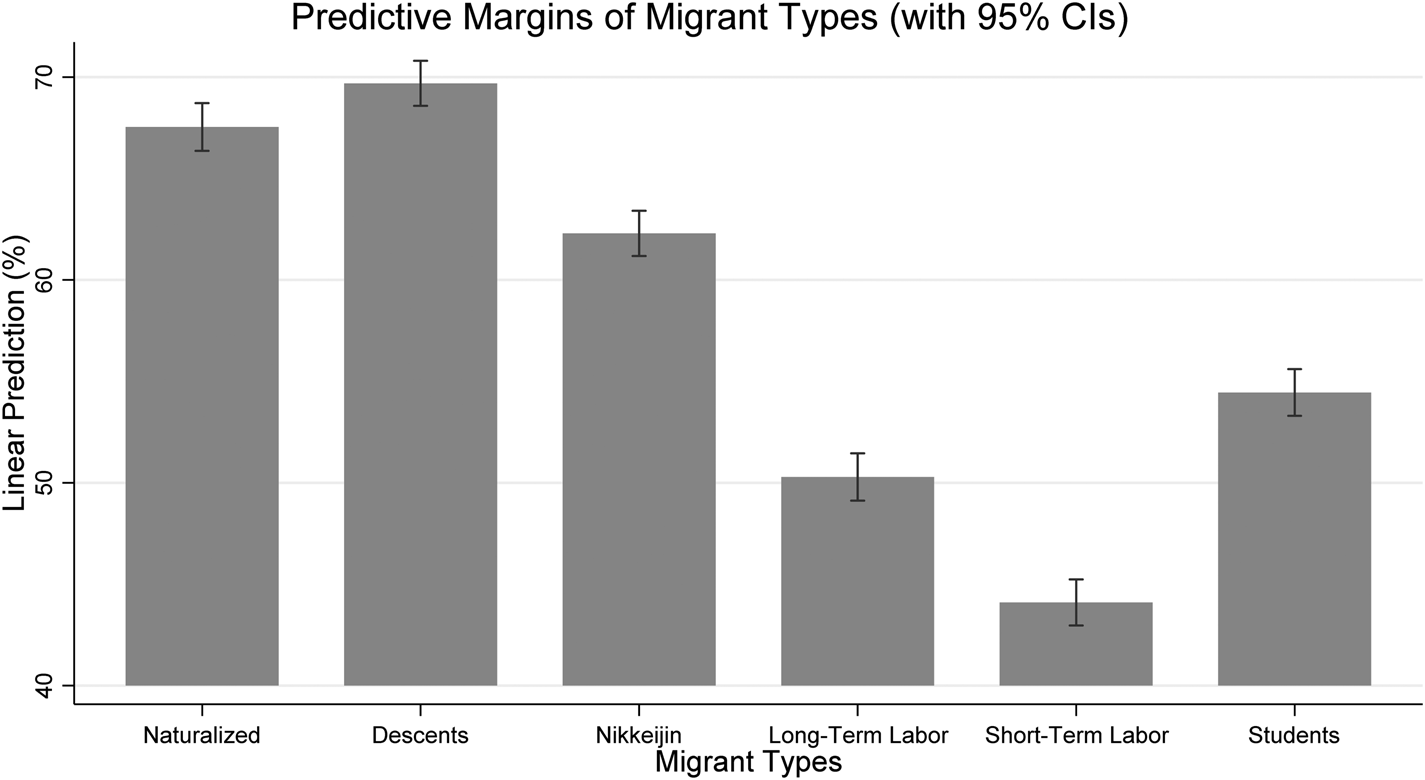
In testing the first and second hypotheses, I compare the mean scores of the different migrant types through linear regression analyses with prefectural fixed effects as shown in Figure 1, which depicts predicted values across the six migrant types (see Appendix 3 for regression results). Standard errors are clustered by respondents. The descendants of migrants received the highest intimacy level (69.70 percent; Standard Error 0.57). This type even recorded a higher value compared to that of naturalized migrants (67.55 percent; SE 0.60) although the difference is negligible. This difference may be because the descendants of migrants tend to have resided in Japan for a longer period of time compared to many naturalized migrants, who do not necessarily reside in Japan since their births. In contrast, Nikkeijin only marked the third highest intimacy level (62.29 percent; SE 0.57) although they are technically connected to Japan by blood. This seems to reflect emerging criticisms against these migrants. Because recent Nikkeijins residing in Japan are third-generation or their spouses, they typically do not speak Japanese or share the same appearance (Tsuda Reference Tsuda2003). In this sense, Japanese people may have revealed a higher familiarity toward those with Japanese language proficiency as well as an understanding of Japanese culture. International students marked the fourth highest intimacy level (54.45 percent; SE 0.59) while both long-term and short-term labor migrants received the lowest levels, 50.28 percent (SE 0.59) and 44.10 percent (SE 0.58) respectively. It seems that Japanese people hold greater positive feelings for migrants who are embedded in Japanese society rather than those who entered Japan for economic reasons or temporary purposes, confirming the second hypothesis, yet with somewhat different outcomes in regard to the first hypothesis on ancestral ties.
Predicted values on migrant preferences.

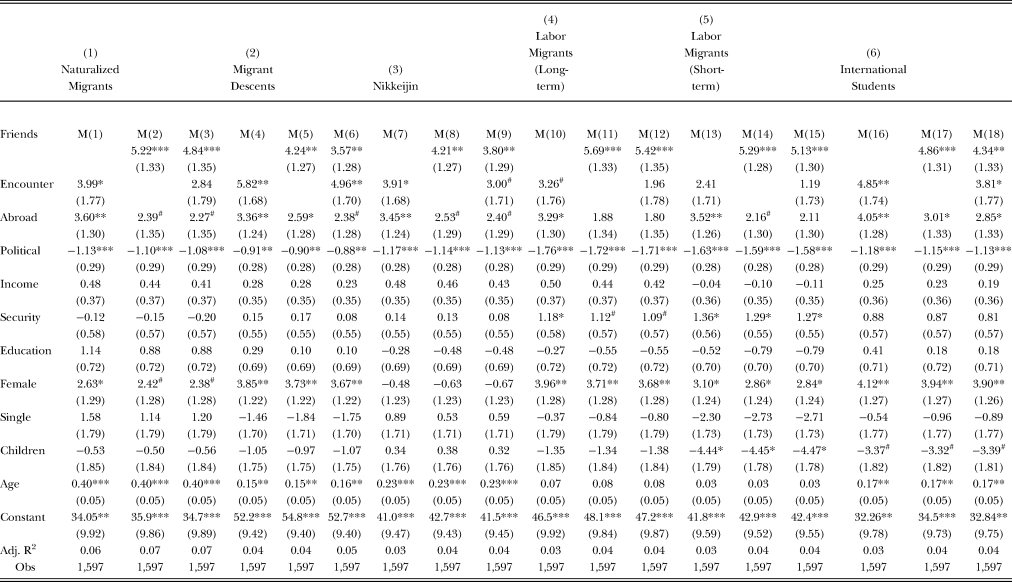
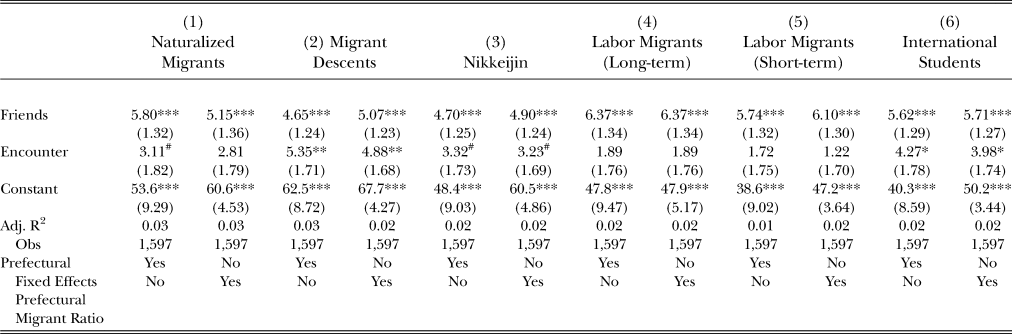
In order to test effects of contact (two binary measures on the quality of contact), I used linear regression models with prefectural fixed effects as presented in Table 1. The results are grouped by the six migrant types, and each type involves three sets of different models: ones that focus on Encounter (M1, M4, M7, M10, M13, M16), ones that stress Friends (M2, M5, M8, M11, M14, M17), and ones that involve both variables (M3, M6, M9, M12, M15, M18). Instead of simply reporting the third model for each migrant type, I additionally present the first and second models due to a concern that the variables Friends and Encounter may be closely related with each other, causing multicollinearity. Although this may be a concern, these variables measure different dimensions of contact and thus do not cause perfect multicollinearity (Stock and Watson Reference Stock and Watson2012, 244). Therefore, I focus on the third model for my main interpretation while also paying attention to the results of the variables run separately. Moreover, I have also conducted regression analyses based on the original variables, which include Friends, Encounter, Abroad, and Children based on ordered categories. The results indicate that neither categorization of variables alters the results (Appendix 4).
Linear Regressions on Familiarity toward Types of Migrants

*** p < 0.001, **p < 0.01, *p < 0.05, #p < 0.1; standard errors in parentheses.
By comparing the results between having migrant friends and encountering migrants, two observations emerge. First, Friends constantly turns out to be statistically significant across all migrant types. It indicates that deep contact with migrants will contribute to optimistic views toward overall migrants, confirming my third hypothesis. A surprising finding is that labor migrants, either long- or short-term, hold the largest coefficient sizes, above 5.00, compared to those of other migrant types. Simply put, deep contact through close relationships with migrants will yield a greater positive impact toward public perception of labor migrants.
Second, in contrast to the effects of Friends, the statistical significance and positive impact size of Encounter oscillate depending on the type of migrant and model specifications. On the one hand, it consistently marks statistical significance for the descendants of migrants (M4; M6), Nikkeijin (M7; M9 at the 10 percent level), and international students (M16; M18). Interestingly, the coefficient size of Encounter is even greater than that of Friends with the same level of statistical significance for migrant descendants (M6). On the other hand, for naturalized migrants and long-term labor migrants, although Encounter appears to be statistically significant when it is independently included in the model (M1; M10), it loses its significance when it is controlled by Friends (M3; M12). Lastly, in regard to short-term labor migrants, Encounter does not turn out to be statistically significant at all across any model (M13; M15). Considering these dissimilar results for Encounter, three implications can be made. First, shallow contact yields a positive, yet relatively weak, impact on public sentiment toward most types of migrants. Second, Japanese natives can formulate a favorable view toward migrant descendants through simple coexistence with migrants. Third, this shallow contact will not enhance public perception of short-term labor migrants. Familiarity toward this migrant type will be more greatly achieved by actual interactions with migrants. These outcomes may be due to people's initial perceptions of each migrant type. For instance, Japanese people are well aware of migrant descendants since their youth, and therefore, simple coexistence with migrants can generate familiarity toward this type. On the contrary, people may not have enough information to generate an image of labor migrants (especially short-term labor migrants), and therefore, only a positive impression through actual interactions with migrant friends can generate positive feelings for this type.
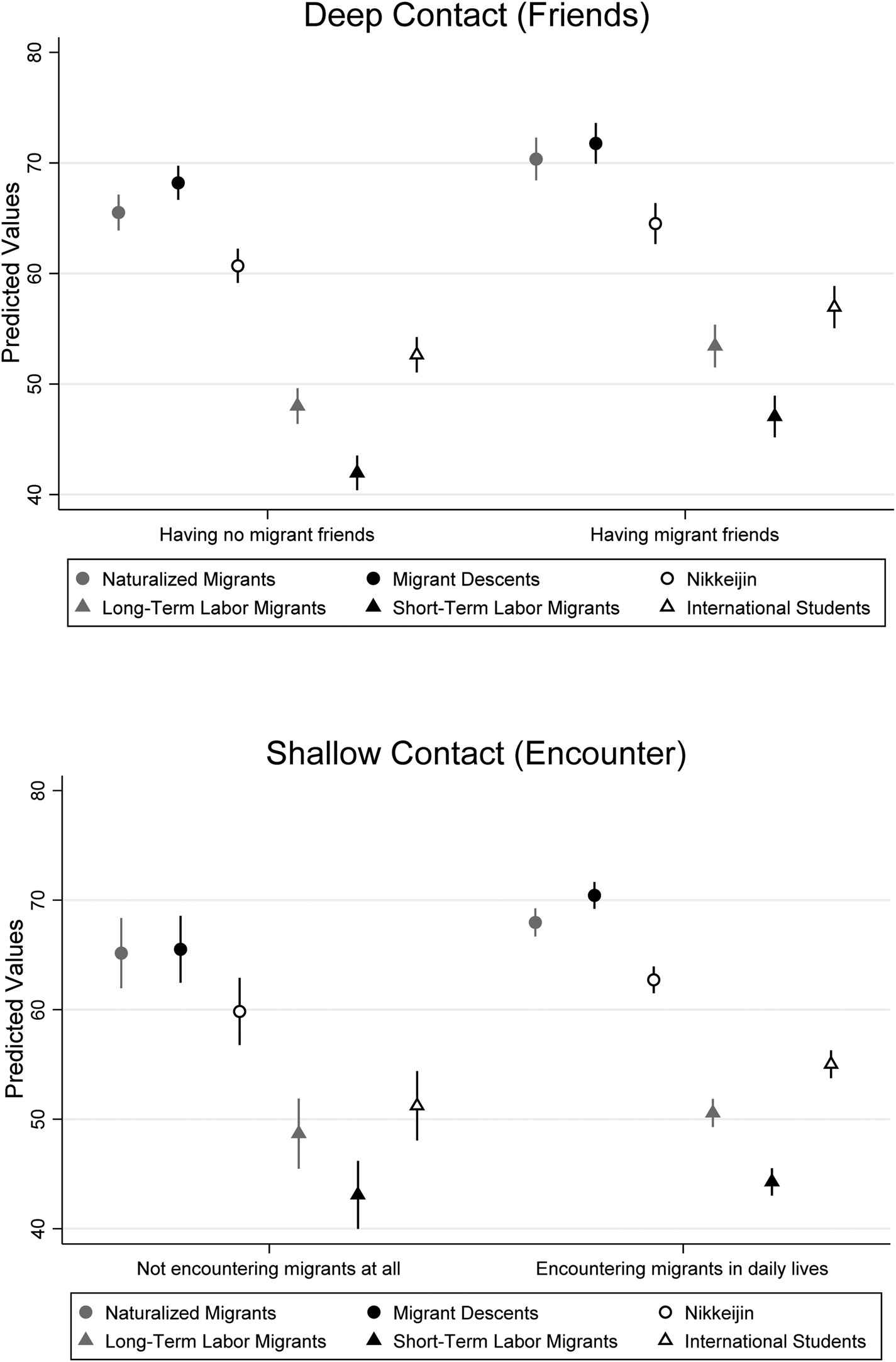
In addition, predicted values based on marginal effects reveal similar results (Figure 2). When the effects of Friends are compared (the upper graph), it is noticeable that deep contact clearly enhances affinity toward all migrant types. When the effects of Encounter are taken into account (the lower graph), they also show that even simple coexistence increases people's affinity toward migrants, especially toward the descendants of migrants. However, for the rest of the migrant types, its impact seems to be smaller than that of Friends since the confidence intervals between encountering and not encountering migrants largely overlap. Particularly, those of short-term labor migrants completely overlap, and any effect of Encounter is undetectable. These results suggest that deep contact has a strong influence on attitudes toward overall migrants while shallow contact holds an inconsistent or moderate effect depending on the migrant type, confirming my fourth hypothesis.
Predicted values based on Contacts

The rest of this section summarizes findings on control variables. Experience abroad yields a positive and significant impact, with the exception of the attitudes toward labor migrants. Political ideology holds a strong and consistent impact on public perception across all migrant types. As people identify themselves to be conservative, they tend to express a restrictive stance against migrants in general. Interestingly, economic variables such as income level and job security as well as education level do not appear to be statistically significant, echoing findings by Itō (Reference Itō2005), Nukaga (Reference Nukaga2006) and Tanabe (Reference Tanabe and Morioka2002). The exception is that job security shows statistical significance only toward long-term and short-term labor migrants. Simply put, as people feel confident about their job security, their positive feelings toward labor migrants increase. It is understandable that those people whose jobs are being threatened become more sensitive especially toward labor migrants, who may exacerbate labor market competition. In sum, income level or education level does not have much influence on public perception in Japan while job security does in viewing labor migrants. These findings support earlier studies on income and education in Japan as well as, partially, the economic threat argument in general. Female also yields a positive and significant impact, with the exception of attitudes toward Nikkeijin, for which the female variable loses its significance. Marital status and number of children do not reveal any statistical significance across most types of migrants, except that people tend to become favorable toward Nikkeijin as they have children. Surprisingly, age turns out to be significantly positive except for long-term and short-term labor migrants. It indicates that older Japanese people tend to view most migrants more positively, while age loses its effect when it comes to labor migrants. This result is intuitive as, according to conventional wisdom, we should find a consistently negative association across all types of migrants (e.g., Hamada Reference Hamada2008; Mazumi Reference Mazumi2015, Reference Mazumi2016; Nagayoshi Reference Nagayoshi2008, Reference Nagayoshi2009).
ROBUSTNESS CHECKS
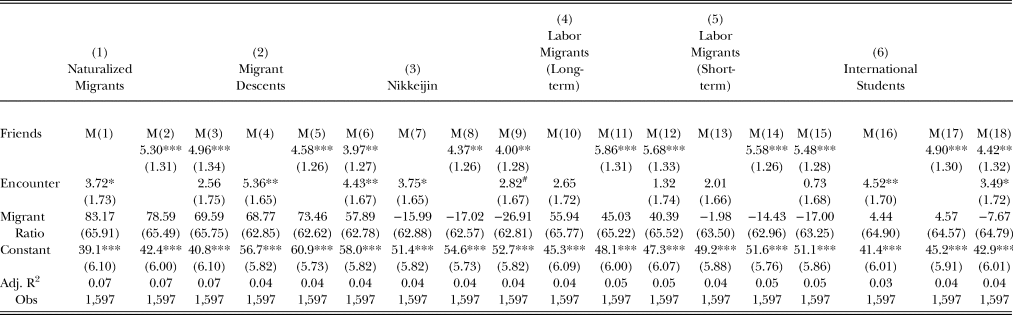
In order to confirm these findings, I ran additional regression analyses. First, I altered model specifications by inserting the prefecture variable into the model instead of treating it as a fixed effect. To do so, I calculated the prefectural level migration density by dividing the number of migrants (Ministry of Justice 2015) by the population (Statistics Bureau Japan 2015) for each prefecture, labeled as Migrant Ratio (Table 2; Appendix 5 for further details). Second, for additional sensitivity analysis, I changed model specifications by excluding variables that turn out to be statistically significant in Table 1 in order to confirm that the results are not biased by multicollinearities among independent and control variables. In so doing, I conducted the analyses using both prefectural fixed effects and Migrant Ratio (Table 3; see Appendices 6 and 7 for further details). In an effort to detect any multicollinearity among variables, I also conducted variance inflation factor (VIF; Appendix 8). While there is no definite threshold, values above 2.5 are commonly considered as an indication of multicollinearity. As none of the variables hold a value exceeding 2.5, this result supports the fact that this model does not involve multicollinearity. These moderations of the original model as well as an additional test do not change the implications, hence supporting the robustness of the main results.
Robustness Check Using Prefectural Migrant Ratio (Key Results)

Robustness Check Excluding Statistically Significant Variables (Key Results)

CONCLUSION
This article has argued that responses to migrants in Japan vary by migrant type while overall perception can be enhanced through deep contact with them. My survey (2015) disaggregated migrants into the six types that Japanese natives are widely aware of: naturalized migrants, migrant descendants, Nikkeijin, long-term and short-term labor migrants, and international students. The results highlight the importance of differentiating views of migrants by their types: Respondents hold the most negative views toward short-term migrants while they tend to express more favorable feelings for permanent or naturalized migrants. Furthermore, a statistical analysis on contact theory suggests that respondents’ perceptions become more favorable for all types of migrants if they have migrant friends or acquaintances, although simple coexistence with them in neighborhoods or workplaces produces an inconsistent impact: while it moderately enhances public sentiment toward most migrants, it fails to do so toward labor migrants, particularly those whose stay in Japan is temporary. Overall, my statistical results yield that Japanese people do not harbor negative attitudes toward every kind of migrant, and positive feelings increase as migrants integrate into Japanese society through long-term residence and acculturation as they interact with Japanese people.
The findings in this article can contribute to policy discussions in regard to the recent debate over labor migrants in Japan. The Abe Cabinet has revised and enacted the Immigration Control and Refugee Recognition Act since April 2019. The new program under this policy will allow low-skilled labor migrants who meet certain technical and language requirements to stay in Japan for up to five to ten years. Although this new policy would increase the number of applications for permanent residence and naturalization by low-skilled migrants, the majority of Japanese people are supportive of the policy. This is mostly due to Japan's pronounced labor shortage and the need for foreign workers in Japan. However, this public support seems to come with some ambivalence. Nikkei Newspaper (2020) shows that although the majority claims that migrants are necessary labor in Japan, most of them answer that this solution is not preferable but inevitable. Similarly, Yomiuri Newspaper's (2019) survey shows that despite a high support rate of the policy, almost 60 percent of respondents claim to feel uncomfortable being cared for by foreign caregivers. In sum, while this new policy is supported by the public mainly for Japan's labor shortage, an influx of low-skilled migrants with long-term residency may trigger anti-migration sentiment in the near future.
While this issue involves multidimensional factors, this research suggests two implications. First, excessively emphasizing the economic purposes of those migrants as labor migrants may increase anti-migrant sentiment because the public seems to be relatively conservative about this type of migrant. While it is important to shed light on the economic contributions by migrants, it seems also important to highlight the demographic and cultural contributions that they can bring. According to NHK survey results (NHK Broadcasting Culture Research Institute 2020), more than half of respondents supported the idea of attracting various kinds of migrants instead of solely accepting labor migrants. This result reflects Japanese people's willingness to admit various kinds of migrants, and thus, overly emphasizing the economic dimension of labor migrants may not be an effective policy tool. Second, even if those migrants intend to apply for permanent residency after entering Japan, this does not seem to aggravate public perception of migrants as long as those migrants possess cultural and linguistic understanding through a long-term residency. Yomiuri Newspaper (2019) shows that almost half of respondents feel uncomfortable working in workplaces or residing in neighborhoods with migrants due to differences in languages, cultures, religions, and lifestyles. Hence, potential anti-migration sentiment is less likely to emerge as migrants increase their overall understanding of Japan. In this sense, the government's recent attempts to increase the number of service and information centers as well as Japanese language schools could assist in resolving these difficulties.
However, migrants also point out the aforementioned differences from Japanese as critical challenges while additionally addressing distinctive corporate cultures and systems as the greatest difficulties to work in Japan (Ministry of Economy, Trade and Industry 2016). Thus, there could be limitations with the current one-way assimilationist approaches pursued by the Japanese government as migrants who share different norms and identities continuously arrive and reside in Japan. Instead, it is important to consolidate social integration policies for both Japanese natives (i.e., recognizing and appreciating cultural diversities) and incoming migrants (i.e., understanding Japanese language and culture). Without these reciprocal efforts, migrants will be required to continuously assimilate until they meet the standards of Japanese people, which are institutionally justified and reinforced by a mono-ethnic conception of national identity. This article concludes with some optimism for a potential multicultural society in Japan with the smooth integration of migrants.
SUPPLEMENTARY MATERIAL
The supplementary material for this article can be found at https://doi.org/10.1017/jea.2020.30
ACKNOWLEDGEMENTS
The author would like to thank Ikuo Kume, Masaaki Higashijima, Takeo Hoshi, Phillip Lipscy, Jaehyun Song, Akira Igarashi, Fumiko Takahashi, David Leblang, Herman Schwartz, and Young Jin Chun for their constructive feedback on earlier drafts. This article also benefitted enormously from comments and suggestions from Stephen Haggard and the anonymous reviewers.
FINANCIAL SUPPORT
Support for this research was provided by the Japan Society for the Promotion of Science (Grants-in-Aid for Scientific Research, Award no. 17H02484).
CONFLICT OF INTEREST
The author declares none.