Introduction
The Lower Cretaceous fossil genus Lebanoculicoides Szadziewski holds a particularly important position in the phylogeny of the Ceratopogonidae (Diptera), because it forms the sister group to all other extant and extinct members of the family. It is the sole genus in the subfamily Lebanoculicoidinae (Borkent Reference Borkent2016). Fortunately, all specimens of Lebanoculicoides are preserved in amber, providing superior views of these inclusions and allowing for pertinent morphological comparisons to be made with other adult Ceratopogonidae.
The genus includes four species, two of which are known from males and females (L. daheri Choufani, Azar, and Nel; L. mesozoicus Szadziewski) and two as only females (L. bloudani Choufani, El-Halabi, Azar, and Nel; L. excantabris Pérez-de la Fuente, Delclòs, Peñalver, and Arillo), recorded from Spanish (110–116 million years old) and Lebanese and Syria ambers (125–129 million years old). The single male of L. daheri from Lebanese amber was tentatively identified as such by Choufani et al. (Reference Choufani, Azar and Nel2015a). Although it has been previously described, re-examination indicated that further features were visible and worth describing, especially considering the important phylogenetic position of the genus. The only other known male, that of L. mesozoicus, was described by Borkent (Reference Borkent and Grimaldi2000).
There is an older fossil Ceratopogonidae, represented by a single wing, at 142 million years old (Borkent et al. Reference Borkent, Coram and Jarzembowski2013), and other contemporaneous taxa in Lebanese amber (Borkent Reference Borkent2016), but these all belong to more derived lineages within the family.
Materials and methods
The single specimen was examined, measured, and drawn using a Wild M3 dissecting microscope (Wild Heerbrugg, Gais, Switzerland) and a Zeiss Jenaval compound microscope (Carl Zeiss, Jena, Germany). Photomicrographs were taken with a Canon EOS Rebel T3i (Canon, Taichung City, Taiwan) through these microscopes and compiled using Zerene Stacker version 1.04 (Zerene Systems LLC, Richland, Washington, USA).
Terms for structures follow those used in the Manual of Central American Diptera (Brown et al. Reference Brown, Borkent, Cumming, Wood, Woodley and Zumbado2009), with the exception of wing vein CuA1, now recognised as M4, following the system in the Manual of Afrotropical Diptera (Borkent Reference Borkent, Kirk-Spriggs and Sinclair2017).
The amber piece including the specimen was originally loose on cotton in a small plastic box. During earlier transport, the specimen broke in half. After my initial study, the two broken halves were glued together with epoxy and the amber piece was mounted in Canada balsam on a microscope slide. Damage is generally unwelcome, but in this instance it allowed for examination of further details of the fossil, especially of the thorax and lateral view of the head, both of which had not been previously reported. The specimen originally had two written labels “1107A ♂ Ceratopogonidae Lebanoculicoides” and “L. Daheri.” I replaced the first label with a new label on the microscope slide: “1107A ♂ Ceratopogonidae Lebanoculicoides daheri Det. J. Choufani, D. Azar, A. Nel, Hammana/Mdeyrij outcrop, Lebanon” and affixed the previous identification label as well. The specimen is housed in the Azar collection, in the Natural History Museum of the Lebanese University, Faculty of Sciences II, Fanar, Lebanon.
Redescription of male Lebanoculicoides daheri
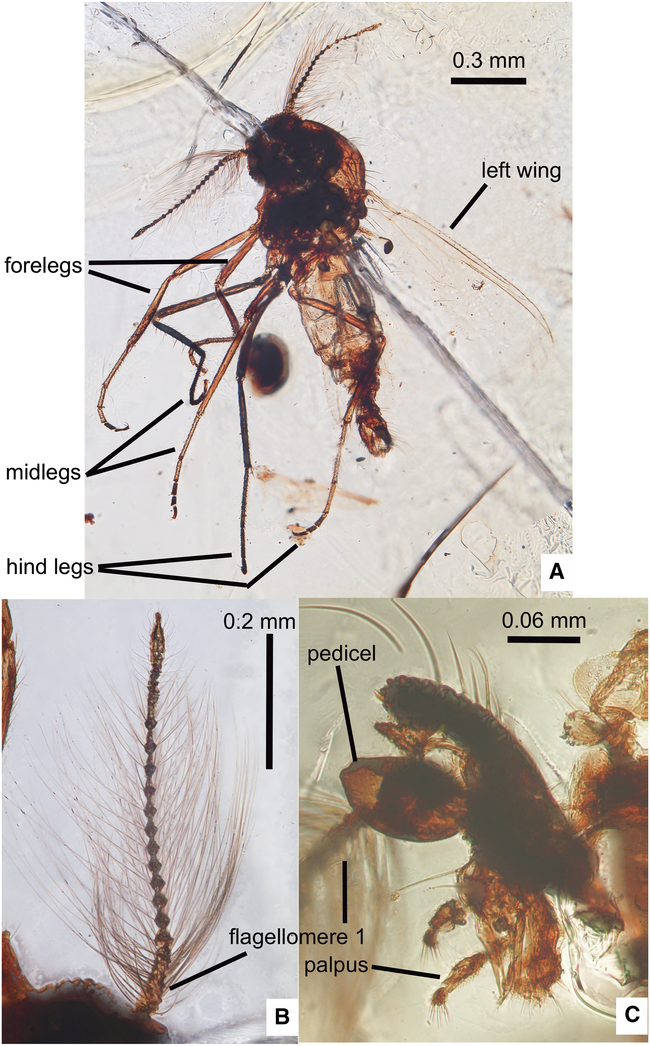
Lebanoculicoides daheri male: A, habitus, ventral view; B, right antenna; C, head capsule, lateral view.
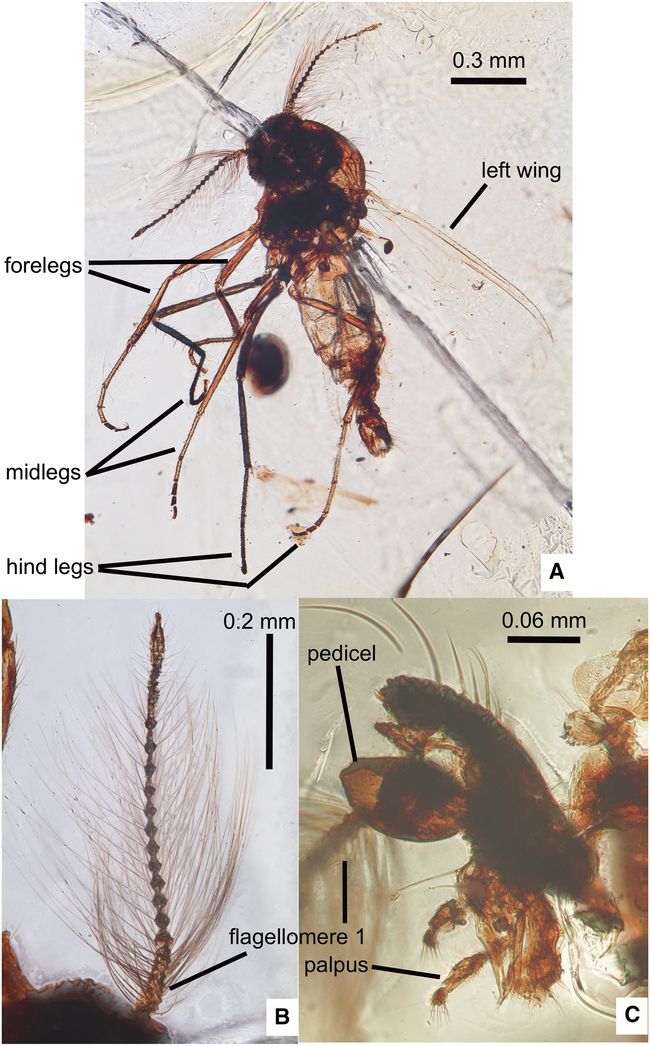
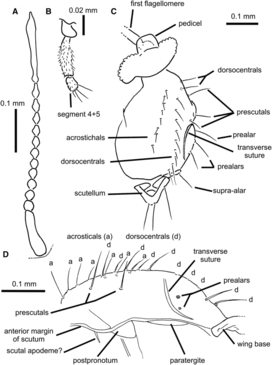
Lebanoculicoides daheri male: A, right antenna; B, left palpus, lateral view; C, head and thorax, dorsal view; D, dorsum of thorax, lateral view (acrostichal setae indicated with an “a,” dorsocentrals with a “d”).

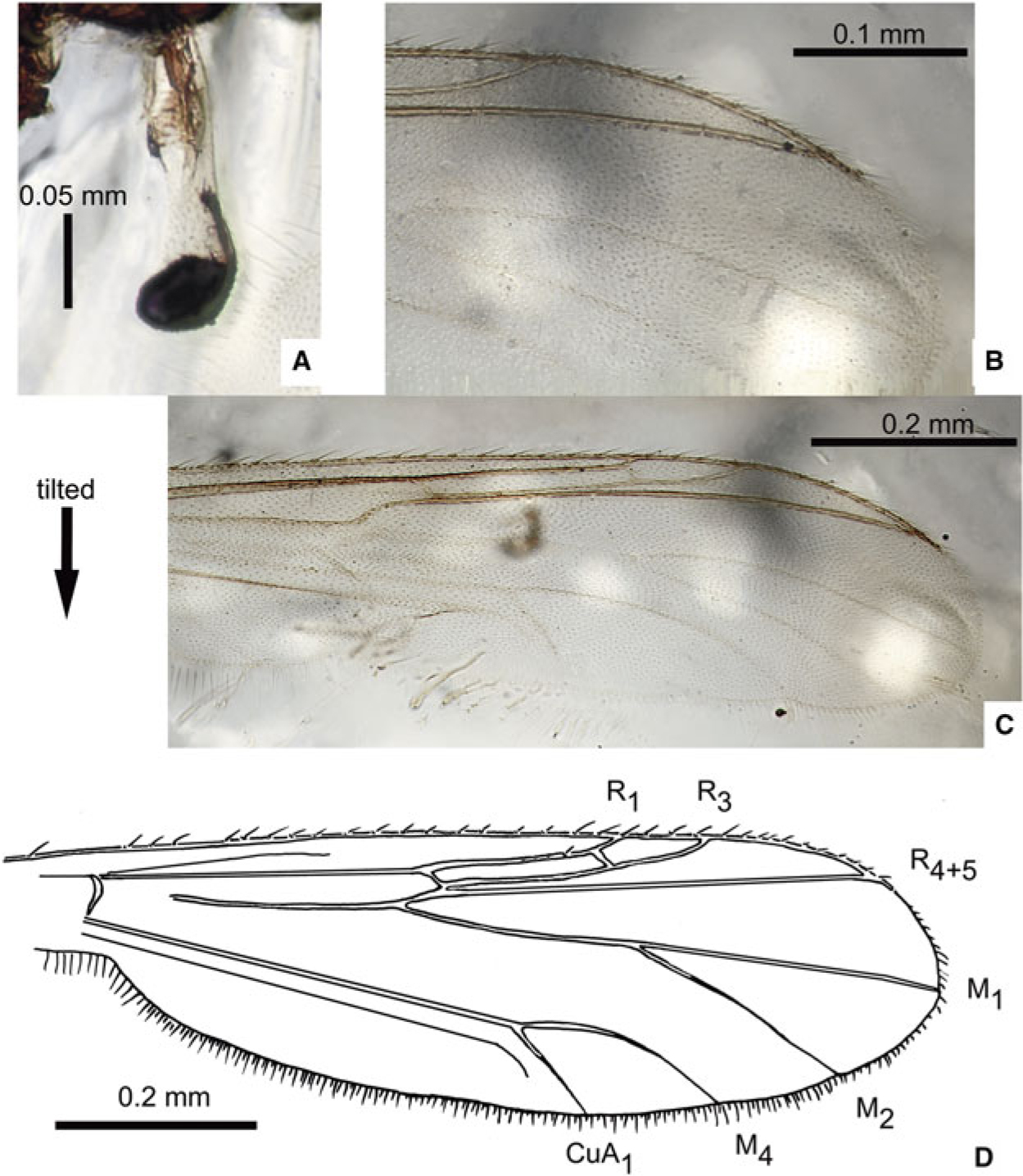
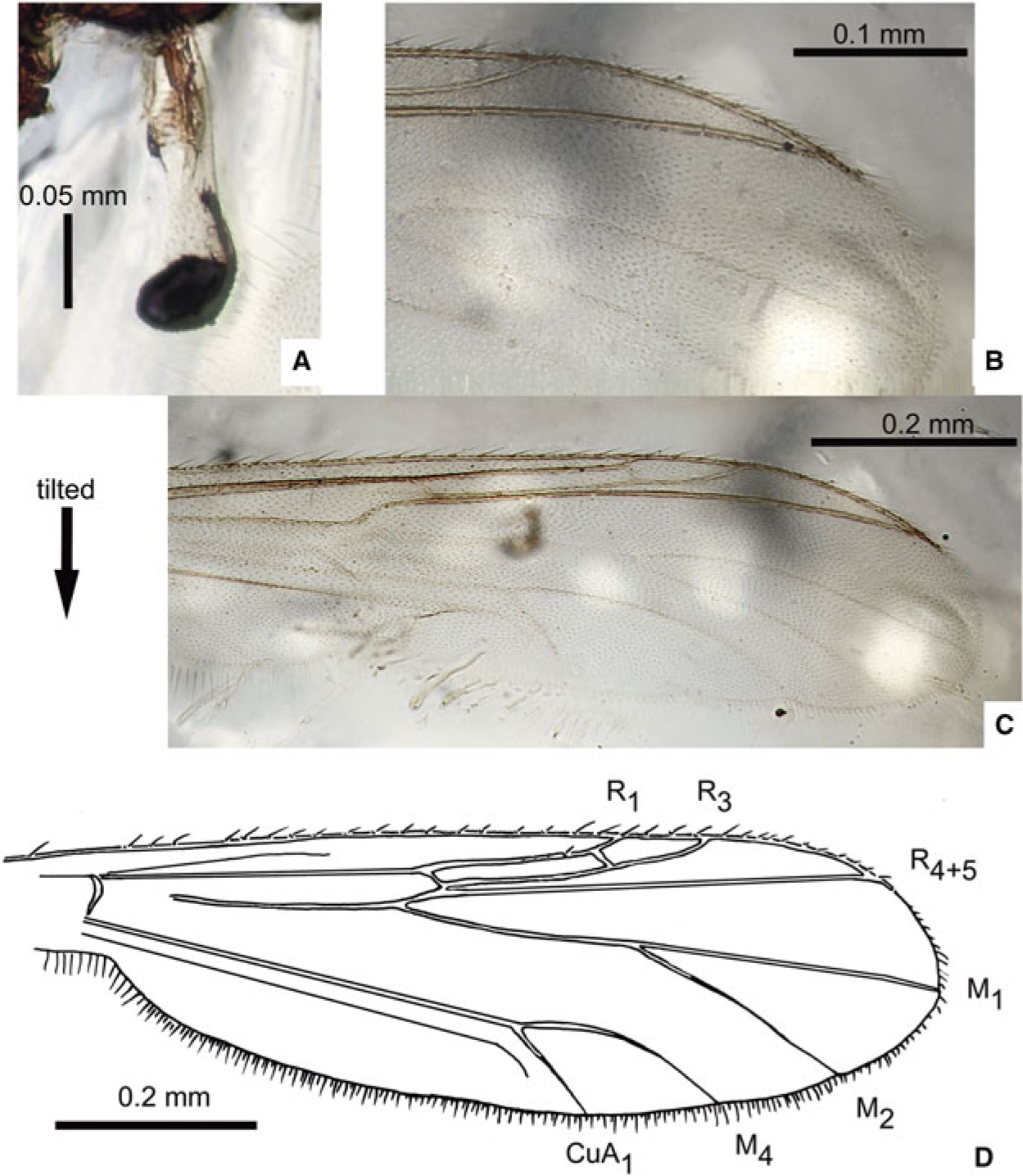
Lebanoculicoides daheri male: A, left halter, ventral view; B, apex of left wing, ventral view; C, apical portion of left wing, ventral view; D, wing, composite of both wings.
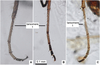
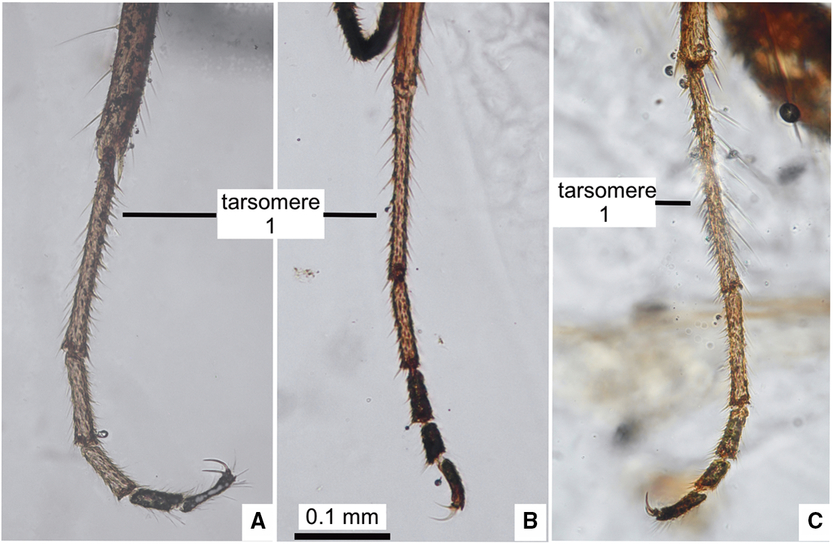
Lebanoculicoides daheri male: A, right foreleg, posterior view; B, left midleg, mostly dorsal view; C, left hind leg, anterior view.
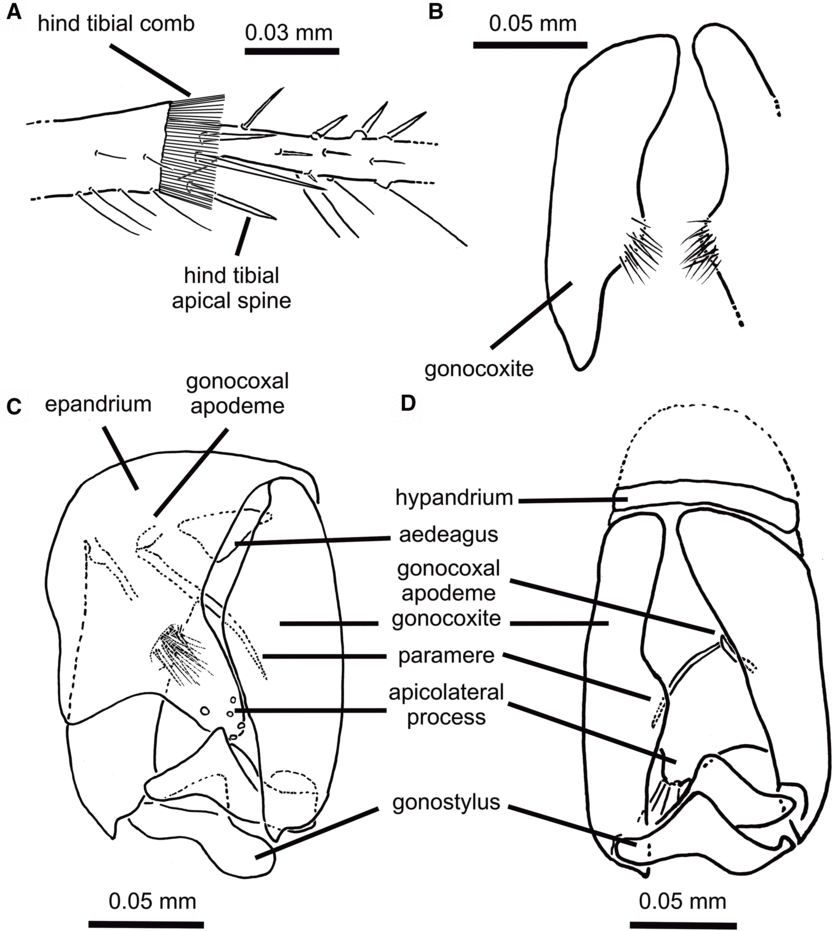
Lebanoculicoides daheri male: A, apex of left hind tibia and base of first tarsomere, posterior view; B, outline of gonocoxites showing inner gonocoxal lobes, ventral view; C, genitalia, dorsolateral view; D, genitalia, oblique ventrolateral view (gonocoxal lobe setae not shown).

Lebanoculicoides cf. daheri (male specimen 1107A): Choufani et al. Reference Choufani, Azar and Nel2015a: 275.
Diagnosis. Male: Only species of Lebanoculicoides with four palpal segments (one beyond segment 3) (Figs. 1C, 2B) (female L. bloudani and L. excantabris have four palpal segments, making it likely that their unknown males have the same condition). Also the only species of Ceratopogonidae with four palpal segments (Figs. 1C, 2B), two well-developed radial cells, and a well-developed R4+5 (Fig. 3B–D).
Description. Male adult. Head: Ommatidia broadly abutting medially, with elongate medial setae. Pedicel basal foramen wide but details uncertain (Fig. 2C). Antennal flagellum (Figs. 1B, 2A) with 13 flagellomeres, with decumbent plume; flagellomere 1 elongate with about eight poorly defined whorls of trichoid setae; flagellomeres 2–12 short, each with single whorl; flagellomere 13 elongate, with swollen base bearing single whorl, apex narrowed, tip somewhat rounded; antennal ratio (11–13/1–10) = 0.71. Palpus (Figs. 1C, 2B) with four segments (4 + 5 fused); segment 3 relatively elongate, without sensory pit; segments 3/4 + 5 = 3.2. Thorax (Fig. 2C–D): Scutum with elongate setae in well-defined rows: 8 acrostichal, 11 dorsocentral, 3 humeral, 3 prealar, and 1 supra-alar. Transverse suture well developed. Likely with three anterior scutal apodemes (only one poorly visible). Paratergite narrow. Scutellum with four elongate setae, posterior margin somewhat angled medially. Postpronotum triangular. Other details of pleura uncertain. Wing (Fig. 3B–D): Length 0.83 mm, costal ratio 0.95. R1 with at least one and likely four more setae basal to R2. Membrane with fine microtrichia, without macrotrichia. Posterior margin with fringe of alternating short, elongate setae. Alula with row of setae. Costa extending slightly beyond apex of R4+5. Both radial cells elongate, well developed. M1+2 bifurcating distal to r–m, r–m oblique to R1. Halter (Fig. 3A) with slender stem, well-developed knob. Legs (Figs. 1A, 4A–C): Femora, tibiae slender, lacking armature, except for tarsomere 1 of each leg with scattered thicker setae (Fig. 4A–C). Pair of thick setae not present on foreleg and midleg trochanter. Foreleg tibial spur well developed, elongate. Midleg tibia without apical spur, or if present, very small. Hind tibia apex with well-developed comb, row of three thick spines (Fig. 5A). Claws each slender, elongate, without inner tooth, apically simple (not bifid). Empodium small. Tarsal ratio: foreleg = 2.2, hind leg = 2.0, foreleg/hind leg = 1.1. Genitalia (Fig. 5B–D): Not rotated. Epandrium (tergite 9) well developed; apicolateral process short, blunt, with several elongate apical setae. Hypandrium (sternite 9) short, posterior margin nearly straight. Gonocoxite of moderate length, with inner, midlength lobe with group of dense, elongate setae. Gonostylus thick, curved, expanded at midlength, tapered distally to rounded apex (subapical tooth may be present but uncertain visibility). Parameres separate, each elongate, slender; apices sharply pointed, articulating with well-developed gonocoxal apodeme. Aedeagus short, translucent, questionably identified, poorly visible, possibly triangular.
Bionomics. The extant earliest lineages of each of the families of Culicomorpha (Diptera) live in small aquatic habitats and feed on microorganisms (Borkent and Craig Reference Borkent and Craig2004; Borkent Reference Borkent2012a). The earliest extant lineage of Ceratopogonidae is the Leptoconopinae, with two extant genera, Austroconops Wirth and Lee and Leptoconops Skuse, both of which were present during the Lower Cretaceous (Borkent Reference Borkent and Grimaldi2000; Szadziewski Reference Szadziewski2017). The specific natural aquatic habitat of Austroconops is unknown (Borkent and Craig Reference Borkent and Craig2004), but the immatures of Leptoconops are present in wet sand (marine or freshwater) or in cracked clay, or halomorphic calcareous soils. The larvae of both genera feed on microorganisms. It is likely, therefore, that the immatures of the species of Lebanoculicoides, and other extinct early lineages of Cretaceous Ceratopogonidae, also lived in restricted aquatic habitats and fed on microorganisms.
Extant species of Austroconops and Leptoconops occur in primarily xeric habitats. The general climate of Spanish amber, with L. excantabris, had a pronounced dry season (Najarro et al. Reference Najarro, Peñalver, Pérez-de la Fuente, Ortega-Blanco, Menor-Salván and Barrón2010), suggesting that this species of Lebanoculicoides was also adapted to a more xeric environment. However, the other three species of Lebanoculicoides, from Lebanese and Syrian amber, were interpreted as being in a humid, tropical climate (Azar et al. Reference Azar, Dejax and Masure2011).
Finally, the male of Lebanoculicoides daheri, the only male of this genus for which the antenna is known, has a well-developed plume (Fig. 1B). In extant Culicomorpha, a well-developed plume is present in five families and is associated with swarming behaviour in which the male plume enhances hearing the wing beat of an approaching female (Cator et al. Reference Cator, Arthur, Harrington and Hoy2009). The plume of L. daheri suggests that it too had this behaviour.
Taxonomic discussion. The holotype of L. daheri is a female and the male was stated as unknown by Choufani et al. (Reference Choufani, Azar and Nel2015a). These authors did, however, describe, photograph (no drawings), and tentatively associate a single male, which is redescribed herein and considered to be the male of L. daheri. Both sexes have a four-segmented palpus (Figs. 1C, 3A), with segments 4 and 5 fused, and I consider this partial evidence that they are conspecific. This reduction, however, is also present in L. bloudani (Syrian amber) and L. excantabris (Spanish amber), indicating it is more widespread in the genus.
The gonostylus of L. daheri may have a subapical spine but it could not be confidently interpreted (it might be an artefact). The gonostylus of L. mesozoicus also may have an apical spine but it too was uncertain (Borkent Reference Borkent and Grimaldi2000). The presence of an apical gonostylar spine is likely plesiomorphic within the Ceratopogon-idae, with at least several independent losses (Borkent Reference Borkent and Grimaldi2000: 397).
There are a number of differences between the description here and that by Choufani et al. (Reference Choufani, Azar and Nel2015a), some because the specimen could be examined in more detail here. Differences are as follows:
1. “Mouthparts not visible”. The mouthparts were short and mostly obscured (Fig. 1C) but the palpus is clearly visible, with a reduced terminal segment, providing reasonable evidence that this male is correctly associated with the female of L. daheri.
2. “Scutellum rounded apically”. An enhanced dorsal view of the scutellum indicated it to have an acute angle (Fig. 2C).
3. “Wing 1.01-mm long”. The wing length of 0.83 reported here likely differs because of a different method of measurement. As is standard for Ceratopogonidae, wing length was measured from the arculus to the wing tip.
4. “First radial cell not clearly visible”. Wing venation was readily visible (Fig. 3C–D).
5. “Foreleg TR [tarsal ratio] 1.83”. Here it is recorded as 2.2, possibly because of differences in the angles of observation. Other tarsal ratios are similar to those of Choufani et al. (Reference Choufani, Azar and Nel2015a).
6. “Basitarsus of all legs with palisade-like setae”. Tarsomere 1 of each leg had no palisade setae as defined by Borkent (Reference Borkent and Grimaldi2000: 393) but did have more broadly spaced thick setae, similar to that of the female (Choufani et al. Reference Choufani, Azar and Nel2015a; figs. 3–4) and to those of many extant Forcipomyia Meigen (Fig. 4A–C).
7. “Genitalia rotated”. The genitalia was not rotated (Fig. 1A).
8. “Parameres fused basally”. The bases of the parameres were separate (Fig. 5C–D).
Key to the species of Lebanoculicoides

Phylogenetic relationship of Lebanoculicoides to other Ceratopogonidae
The phylogenetic position of Lebanoculicoides was first analysed by Borkent (Reference Borkent and Grimaldi2000), who concluded that it formed the sister group of all other extant and extinct Ceratopogonidae. As such, it has the potential to shed light on the earliest features of the family and provide important outgroup information for interpreting more derived lineages within the family. It is particularly important, therefore, to understand members of the genus as fully as possible. All character states pertaining to this early cladogenesis and considered interpretable are presented in the following (Fig. 6), and other features needing further study are also discussed.
Phylogenetic position of Lebanoculicoides in relation to all other Ceratopogonidae. Numbers refer to synapomorphies discussed in the text.

1. Male antennal plume permanently erect (plesiomorphic); antennal plume generally decumbent, erect only when sexually active (Fig. 1B) (apomorphic)
Within extant Ceratopogonidae, only males of the species of Austroconops have permanently erect plumes (Szadziewski Reference Szadziewski1996; Borkent and Craig Reference Borkent and Craig2004: fig. 11). Other Ceratopogonidae have erect plumes only when they are sexually aroused (while swarming or otherwise seeking females) and the plume is otherwise decumbent. In other Culicomorpha, four families also have plumose antennae. Those of Chironomidae, Corethrellidae, and Chaoboridae are permanently erect. Within Culicidae, only male Anopheles Meigen have a facultatively decumbent plume, while those of other mosquitoes are permanently erect. The male Lebanoculicoides daheri has a clearly decumbent plume (Fig. 1B). These comparisons indicate that the facultatively decumbent state is a synapomorphy of Ceratopogonidae with Austroconops and two related extinct genera reverting to the plesiomorphic, permanently erect condition. The condition in Anopheles is here considered to be due to homoplasy. Nijhout and Sheffield (Reference Nijhout and Sheffield1979) described the mechanism by which male Anopheles stephensi Liston erect their plume and it would be a test of homology to see if the same process is present in Ceratopogonidae.
A permanently erectile plume is also present in the Cretaceous extinct genera Minyohelea Borkent (at least one species, M. schleei Szadziewski; Szadziewski Reference Szadziewski1996: fig. 17a) and Archiaustroconops Szadziewski (R. Szadziewski, personal communication), providing a second synapomorphy grouping of these two genera with Austroconops, as otherwise suggested by Borkent (Reference Borkent and Grimaldi2000). The condition is unknown for species of the other fossil genera also presently placed in Leptoconopinae: Jordanoconops Szadziewski (male unknown) and Fossileptoconops Szadziewski (male unknown). The conclusion that Minyohelea was the sister group of Leptoconops by Borkent and Craig (Reference Borkent and Craig2004), based on their shared reduction of the radial cells and the presence of a thickened stigma in some Minyohelea conflicts with this interpretation. This likely explains why some Minyohelea such as M. lebanicus (Szadziewski), M. minutus (Szadziewski), and M. schleei Szadziewski do not have a thickened stigma. As such, this homoplasy is present in all species of Leptoconops and only in some species of Minyohelea.
2. Male adult tergite 9 without apicolateral process or, if present, lacking apical setae (plesiomorphic); pair of apicolateral processes present and each bearing at least one apical seta (Fig. 5C–D) (apomorphic)
This synapomorphy was discussed by Borkent (Reference Borkent and Grimaldi2000: 390, as his character 3). The presence of apicolateral processes on the posterolateral margin of tergite 9 appears to be unique within the Culicomorpha. In both species of Lebanoculicoides for which males are known, the apicolateral process is broad and apically rounded, with at least three setae in L. daheri.
3. Setae on vertex of adult head capsule scattered or in dorsolateral arrangement (plesiomorphic); in addition to other setae on vertex, a single seta located medially, just dorsal to where the ommatidia meet medially or between these in groups where the ommatidia are separated dorsomedially (apomorphic)
This synapomorphy was discussed by Borkent (Reference Borkent and Grimaldi2000: 391, his character 9) and modified by Borkent and Craig (Reference Borkent and Craig2004, their character 6). At that time, the condition was unknown for Lebanoculicoides. The single seta was evident in the male of L. daheri but because of its angle and the break in the middle of head not fruitfully illustrated. Choufani et al. (Reference Choufani, El-Halabi, Azar and Nel2015b: their fig. 6C) illustrated a dorsal view of the head of the female of L. bloudani showing an apparently single stout (but unexpectedly short) medial seta.
Borkent and Craig (Reference Borkent and Craig2004) discussed the implications of discovering that species of Lebanoculicoides have a medial seta on the placement of Fossileptoconops. The absence of the seta in this genus and Leptoconops suggests that these two are sister groups as originally suggested by Szadziewski (Reference Szadziewski1996) (but see commentary by Borkent Reference Borkent and Grimaldi2000: 395).
4. Male adult antennal pedicel with a narrow basal foramen (plesiomorphic); pedicel with a wide basal foramen (apomorphic)
This feature was discussed in part by Borkent et al. (Reference Borkent, Wirth and Dyce1987) and Borkent and Craig (Reference Borkent and Craig2004). Lebanoculicoides, Leptoconops, Austroconops, and Protoculicoides succineus Szadziewski have a wide foramen (the feature cannot be seen or is not reported in most other Cretaceous fossils) (see Borkent Reference Borkent2019 for new combination of P. succineus). Other families of Culicomorpha have a narrow foramen. The only exception is Chaoborus Lichtenstein with a wide foramen which, considering its derived position within the Chaoboridae (Sæther Reference Sæther1992; Ogawa Reference Ogawa2007), is clearly secondarily derived. This character state pattern indicates the wide condition is a synapomorpy of the Ceratopogonidae. Within the family, there is a secondary reversal to the plesiomorphic condition, with Forcipomyiinae and Dasyhelea Kieffer having an intermediate condition and Ceratopogoninae with a small foramen (Borkent et al. Reference Borkent, Wirth and Dyce1987).
Although the condition in Lebanoculicoides is here reported as wide, the very base of the pedicel was partially obscured and the head itself was partially collapsed (Fig. 1C). It is therefore important for this feature to be confirmed when further male specimens of Lebanoculicoides are discovered.
5. Male flagellomere 1 with 1–2 whorls of elongate trichoid setae (plesiomorphic); with about eight whorls of elongate trichoid setae (Fig. 1B) (apomorphic)
Within the Ceratopogonidae, this feature is likely unique to Lebanoculicoides but is known for only L. daheri. The male of Protoculicoides punctus Borkent has an elongate flagellomere 1 that may be similar to that of L. daheri but this requires confirmation (Borkent Reference Borkent and Grimaldi2000) (see Borkent Reference Borkent2019 for new combination of P. punctus). In other Culicomorpha, an elongate flagellomere 1 with numerous whorls is present in Corethrellidae (Borkent Reference Borkent2008: 207). Most Chironomidae have a relatively short first flagellomere but it is somewhat elongate (without whorls) in Telmatogetoninae (which otherwise have reduced numbers of antennal flagellomeres) (Wiederholm Reference Wiederholm1989). In Dixidae, flagellomere 1 is elongate, as are most of the flagellomeres in most dixids, but only short trichoid setae are present (Chaverri and Borkent Reference Chaverri and Borkent2007). Other Culicomorpha, with the exception of the following species, have a short flagellomere 1.
Borkent (Reference Borkent and Grimaldi2000: 398) partially described the male in Lebanese amber that he identified as a Chironomidae and which had an antenna virtually identical to that described here for L. daheri. Re-examination of two of the three specimens, both of which are in rather poor condition, indicates that these are in fact also Lebanoculicoides. These two re-identified specimens are housed in the American Museum of Natural History (JS210 and JG-194-9). Specimen JS210 had a clearly visible, well-developed hind tibial comb and spines, a synapomorphy recognised here as unique to Ceratopogonidae. The wings of both of these specimens were in poor condition, but at least the radial veins of JS210 are very similar to that described here for L. daheri. The third specimen (JG17/55), which was drawn by Borkent (Reference Borkent and Grimaldi2000), should be in the Dany Azar collection but appears to be missing and could not be restudied (Dany Azar, personal communication). However, it is certainly a male of Lebanoculicoides as well. These specimens have ommatidia that are abutting medially, the palpus has four segments, and the antenna has 13 flagellomeres that are in similar proportions to that of L. daheri, including a similarly elongate flagellomere 1.
As presently understood, this character state distribution indicates that the condition in L. daheri is likely at least an autapomorphy of the species and potentially of the genus (presented as such here). The condition in Corethrellidae and possibly P. punctus are considered instances of homoplasy.
6. Wing with well-developed R4+5 (Fig. 3B–D) (plesiomorphic); R4+5 thin and faint, very poorly defined or absent (apomorphic)
This synapomorphy was discussed by Borkent (Reference Borkent and Grimaldi2000: 390, as his character 4) and Borkent and Craig (Reference Borkent and Craig2004, their character 7).
The synapomorphies described above support previous proposals that Lebanoculicoides is the sister group of all remaining extinct and extant Ceratopogonidae (Fig. 6).
Other features of potential phylogenetic importance
Dorsomedial separation of ommatidia. Moderately or closely spaced ommatidia was presented by Borkent (Reference Borkent1995: his character 13) as a synapomorphy of all Ceratopogonidae other than Leptoconops, where the ommatidia are very broadly separated. As a further development, the broadly abutting ommatidia of Forcipomyiinae and Dasyheleinae were interpreted as a synapomorphy, but with some instances of homoplasy, by Borkent (Reference Borkent1995: his character 18). Borkent (Reference Borkent and Grimaldi2000: 398) described a number of Lebanese ceratopogonid fossils with broadly abutting ommatidia (e.g., Minyohelea, Archiaustroconops szadziewskii Borkent. Since then Lukashevich and Przhiboro (Reference Lukashevich and Przhiboro2001: fig. 1n) also described a Jurassic fossil chironomid Podonomus macromastix Lukashevich and Przhiboro with broadly abutting ommatidia.
The report here and by Choufani et al. (Reference Choufani, El-Halabi, Azar and Nel2015b) that Lebanoculicoides have broadly abutting ommatidia further indicates that relative dorsomedial separation of the ommatidia cannot be confidently interpreted within Ceratopogonidae. The medially abutting eyes of a Chironomidae described by Borkent (Reference Borkent and Grimaldi2000) were a misidentification of additional specimens of Lebanoculicoides (see above under character 5).
The broad and plain frons separating the widely spaced ommatidia of adult Leptoconops and Fossileptoconops may be a synapomorphy of these two genera (and possibly together with Alautunmyia Borkent) but only after the frons is better defined and compared to other Ceratopogonidae and Culicomorpha. If this feature is considered a synapomorphy of Leptoconops + Fossileptoconops + Alautunmyia, the interpretation of the reduced wing venation of Minyohelea + Leptoconops (Borkent and Craig Reference Borkent and Craig2004: their characters 20, 21) would need to be reconsidered (see also synapomorphy 1 above).
Male flagellomere 13 shape. Borkent and Craig (Reference Borkent and Craig2004, their character 13) considered the presence of a subbasal constriction (so the flagellomere has a basal bulb) to be a synapomorphy of Leptoconops, Minyohelea, Austroconops, Jordanoconops, Archiaustroconops, and Fossileptoconops, with this condition secondarily reduced in Minyohelea but unknown in Fossileptoconops. Within Lebanoculicoides, the male of L. daheri has this same condition (Figs. 1B, 2A), while the male of L. mesozoicus does not (Borkent Reference Borkent and Grimaldi2000: fig. 1d). Further to this, the Lebanese amber chironomid discussed above (Borkent Reference Borkent and Grimaldi2000: fig. 20h) also has the same condition. As discussed by Borkent et al. (Reference Borkent, Wirth and Dyce1987), this feature is also present in Chaoboridae and some Culicidae. As such, this pattern indicates that a subbasal constriction of flagellomere 13 is susceptible to homoplasy among basal lineages of Ceratopogonidae and therefore suspect as a synapomorphy of the aforementioned group of genera.
Hind tibial comb. The presence of a hind tibial comb composed of two transverse rows of spines (Fig. 5A) was considered a synapomorphy of the Ceratopogonidae by Borkent (Reference Borkent and Grimaldi2000: 389, his character 1). The more basal comb is composed of abutting short spines and the more distal row has large, widely spaced, elongate spines. The presence of two transverse rows is present in all members of Lebanoculicoides (Borkent Reference Borkent and Grimaldi2000; Choufani et al. Reference Choufani, Azar and Nel2015a, Reference Choufani, El-Halabi, Azar and Nel2015b). Although Pérez-de la Fuente et al. (Reference Pérez-de la Fuente, Delclòs, Peñalver and Arillo2011) state that the hind tibia of L. excantabris has only a single row, their photograph (Fig. 3E) depicts a typical arrangement of apical spines and at least a partial indication of the more basal row of short spines.
Further outgroup comparisons, however, show that both rows are in fact present in at least some members of the following families: Thaumaleidae (two rows very close together), Dixidae, Chaoboridae, and Culicidae. Simuliidae have the distal row, but instead of a basal row of smaller spines, these are scattered in a large patch, which I consider to be a modified form of the single basal row in other taxa. Corethrellidae have a single row of basally abutting small spines but no larger, more distal spines. In Chaoboridae, Eucorethra underwoodi Underwood has both basal and distal spines, Mochlonyx Loew has only the basal, abutting row, and the comb is entirely absent in Chaoborus. Basal lineages of Chironomidae have a single row of spines that are either spaced (e.g., Archaeochlus bicirratus Brundin) or abutting basally (e.g., Parochlus araucanus Brundin; Spies et al. Reference Spies, Anderson, Epler, Watson, Brown, Borkent, Cumming, Wood, Woodley and Zumbado2009). Many Chironominae have combs that are probably tibial spurs that are fused to the tibia. Other nematocerous Diptera either lack the comb (e.g., Blephariceridae) or appear to have only a single row (e.g., Anisopodidae, Mycetophilidae, and Bolitophilidae) but further study is needed (especially of slide mounted specimens). If this pattern is true, it would indicate that the double row of all Culicomorpha other than Chironomidae is a synapomorphy of that group and further evidence that Chironomidae are the sister group of all other Culicomorpha (Borkent Reference Borkent2012a).
Other Culicomorpha have one or two tibial spurs (none in some Chaoboridae) that are in addition to the tibial combs and not pertinent to the discussion here. A ventral tibial spur is present in all (or nearly all) Ceratopogonidae (it may be either missing or very small in a few taxa).
Male terminalia. Borkent et al. (Reference Borkent, Wirth and Dyce1987) discussed the homologies between the complex genitalia of Austroconops mcmillani Wirth and Lee (representing an early lineage with the family), other Ceratopogonidae, and other Culicomorpha. The aedeagus of Ceratopogonidae is homologous to the ventral plate of Simuliidae, ventral appendages of Thaumaleidae, dorsomedial lobes of Ceratopogon-idae, prosophallus of Dixidae, and the claspettes of Culicidae; Chaoboridae and Corethrellidae lack this structure (Wood and Borkent Reference Wood and Borkent1982; Wood Reference Wood, Weismann, Országh and Pont1991). The aedeagus of Ceratopogonidae bears the gonopore on its dorsal side (which defines the true aedeagus) (Pomerantsev Reference Pomerantsev1932). In Austroconops mcmillani and A. annettae Borkent, there is a dorsal projection from the aedeagus that is called the median sclerite of Simuliidae and this projection supports the gonopore in these taxa. Borkent et al. (Reference Borkent, Wirth and Dyce1987), calling this the aedeagal sclerite, suggested it could be the homologous to the median sclerite of Simuliidae. The aedeagus of Leptoconops is simple and varies from much reduced in size to a single rod, to a more moderately sized, basally forked (some parallel-sided), apically rod-shaped structure (Smee Reference Smee1966; Wirth and Atchley Reference Wirth and Atchley1973; Clastrier and Wirth Reference Clastrier and Wirth1978; Clastrier Reference Clastrier1983), and there is no indication of a median sclerite. The conclusion that extant Austroconops and Leptoconops are extant sister groups (Borkent and Craig Reference Borkent and Craig2004) suggests either that the median sclerite is lost in Leptoconops or that the median sclerite of Austroconops and Simuliidae is not homologous. The aedeagus of Lebanoculicoides daheri was only tentatively identified as such, but if truly present, it is relatively short and simple. If true, it would also suggest that the median sclerite is not homologous between the two families. Finally, Thaumaleidae, as sister group to Simuliidae (Borkent Reference Borkent2012a), have only a simple ventral plate (basically similar to those of most Ceratopogonidae), further indicating that the condition in Austroconops is actually independently derived.
The two separate, slender parameres of L. daheri are similar to those present in a number of other Cretaceous lineages such as Fossileptoconops lebanicus (Borkent Reference Borkent and Grimaldi2000: fig. 2f), Archiaustroconops (Borkent Reference Borkent and Grimaldi2000: fig. 9h), Minyohelea (Borkent Reference Borkent and Grimaldi2000: figs. 16a, b, 17e, g, 18d, e, g; Szadziewski Reference Szadziewski1996: figs. 14g, 15f, g (as Lebanoconops Szadziewski), 17e), Heleageron grimaldi Borkent (Borkent Reference Borkent1996: fig. 3F), and some Protoculicoides Boesel (Borkent Reference Borkent2012b, Reference Borkent2019; Szadziewski et al. Reference Szadziewski, Arillo, Urbanek and Sontag2015). The parameres of Austroconops (known only for extant species) are fused medially (Borkent et al. Reference Borkent, Wirth and Dyce1987). Those of Leptoconops (extant and fossil) are thicker and are either partially fused (with a mediotransverse extension) or may be separate (perhaps yet medially connected with a difficult to discern, pale extension). This pattern suggests that the condition in Lebanoculicoides represents the plesiomorphic condition in Ceratopogonidae; therefore, the fused parameres of Austroconops and the thicker parameres of Leptoconops are derived.
The detailed homologies of the genitalia of some Culicomorpha were elegantly interpreted by Wood (Reference Wood, Weismann, Országh and Pont1991). There is a need to provide further detailed morphological comparisons between the parts of the male terminalia within Culicomorpha, especially those of Chironomidae, to interpret their function, and to use such details to better interpret their phylogenetic relationships.
Vaginal apodeme. Borkent et al. (Reference Borkent, Wirth and Dyce1987: their character 1) and Borkent (Reference Borkent and Grimaldi2000: his character 2) indicated that a reduced or absent vaginal apodeme (a fused anterior extension of sternite 9 on the dorsal wall of the common oviduct) may be a synapomorphy of all Ceratopogonidae. An elongate vaginal apodeme is present in one species of Leptoconops (L. nicolayi de Meillon) (Clastrier Reference Clastrier1983) and in one undescribed species of Dasyhelea from Florida, United States of America (personal observation), but these are certainly independent instances of reversal.
Even though females are known for four species of Lebanoculicoides, there are not yet any specimens with a cleared abdomen allowing for the scoring of the character state and therefore it is uncertain whether this synapomorphy includes this lineage.
Conclusion
The re-examination of the male of L. daheri confirms its identity as a member of this genus. Choufani et al. (Reference Choufani, Azar and Nel2015a) discussed the lack of synapomorphies indicating the monophyly of Lebanoculicoides and there was, therefore, the possibility that more than one genus is represented by the four species presently recognised (presumably to be based on synapomorphies indicating such paraphyly). Herein, a synapomorphy is indicated for the male of L. daheri and is presented as a synapomorphy of the genus, even though this state is unknown for the other three species. Considering that four species of Lebanoculicoides have been described in just the past few years, it is hopeful that males of the other three species will be discovered and that additional species are also described.
Acknowledgements
My scientific endeavours are made possible through the much-appreciated support, financial and in so many other ways, of my wife Annette Borkent. I thank Dany Azar for generously loaning the male of L. daheri and David Grimaldi for specimens of Lebanoculicoides from the American Museum of Natural History. I thank Peter Cranston, John Epler, Martin Spies, Torbjørn Ekrem, and Elisabeth Stur for advice concerning character states in Chironomidae. I very much appreciate the helpful and constructive reviews by William L. Grogan and an anonymous reviewer.