Wiltshire
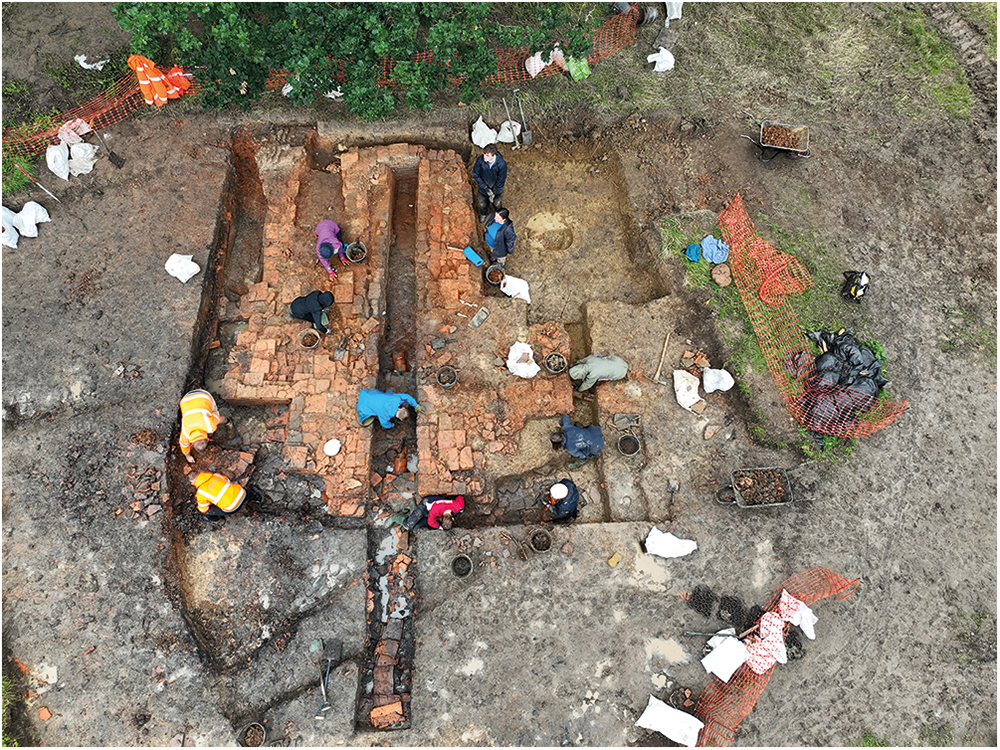
(1) Minety, Brandier (SU 015 916): a community excavation spanning three seasons was completed at a previously unknown Roman tile kiln. The site lies 2 km from two tile kilns investigated in the early 1970s at Oaksey Park, Minety. At Brandier there were three sequential tile kilns and a complex sequence of drains. Flooding was evidently an issue. Of the earliest kiln, only the central flue and a portion of the cross flues beneath the floor of the firing chamber survived. A drain was laid in the bottom of the main flue. This kiln was largely demolished when it was replaced by a new kiln aligned at right angles (north–south). This was also poorly preserved, although two associated drains survived. A roof covered the superstructure of the kiln to judge from two lines of post-holes on either side of it. This kiln was in turn replaced by a final structure which reverted to the orientation of the first kiln and partially reused a side wall of the original flue as a foundation upon which to found one of the walls of the firing chamber. A further five drains relate to this kiln which was made from ceramic building material (CBM). A central flue, stoke hole and southern part of the firing chamber were well preserved, the northern part much less so, but enough survived to show that the original chamber measured c. 5.4 m × 4.8 m (Fig. 30). The kiln was repaired on several occasions. A large clay-extraction pit, 3 m deep, was examined. The lowest fills were waterlogged and contained preserved timber planks. Above this the pit was backfilled with kiln rake-out, waste tiles and fragments of vitrified kiln wall. Some 9.4 tonnes, 31,000 fragments, of CBM were processed, including 218 tiles stamped variously LHS, TPF, TPFA, TPFB, TPFC or TPFP.Footnote 122 The pit was particularly productive of stamped tiles. Apart from a single LHS stamp found in the level immediately beneath the topsoil, all are from the TPF series, although curiously TPFB was not present in the pit at all. LHS stamps were much more common in the upper layers of debris associated with the third and final kiln and, with two exceptions, all came from the area in front of the stokehole, perhaps debris from the collapse of a roof covering the kiln. The LHS stamps are assumed to be the product of the final kiln and are thus likely to follow on chronologically from the TPF series.Footnote 123
Minety. The third (final) tile kiln under excavation. The firing chamber to the left of the central flue is better preserved than the right-hand, north side (© Cotswold Archaeology).

Supplementary material
For supplementary material for this article, please visit https://doi.org/10.1017/S0068113X25100585.