Introduction
Geriatric rehabilitation plays an important role in the health system and services. In the subacute setting, there is a strong focus on physical and functional rehabilitation to enable individuals to go home and function in their home environment. Any factor that may influence an individual's ability to benefit from rehabilitation is of great interest to rehabilitation therapists, and this has resulted in a drive to investigate which patient co-morbidity factors may influence both participation and progress during rehabilitation.
Psychiatric comorbidities have the potential to impact upon the outcome of patients’ hospitalization. Information about the prevalence and influence of psychiatric comorbidities on outcome post-hospitalization has been derived mostly from studies conducted in acute medical inpatient settings. For instance, Anderson et al. (Reference Anderson, Crist and Payne2004) found that levels of depression, anxiety and apathy correlated significantly with extended hospital stay among adult acute in patients. While this association between depression and length of stay has not been found in older acute inpatients (Fulop et al., Reference Fulop, Strain, Fahs, Schmeidler and Snyder1998; Nuyun et al., Reference Nuyen, Spreeuwenberg, Groenewegen, van de Bos and Schellevis2008), other adverse outcomes for depressed older acute inpatients have included increased mortality, transfer to inpatient rehabilitation or discharge to an institution rather than to home (Cullum et al., Reference Cullum, Metcalfe, Todd and Brayne2008; Givens et al., Reference Givens, Sanft and Marcantionio2008; Nuyen et al., Reference Nuyen, Spreeuwenberg, Groenewegen, van de Bos and Schellevis2008).
In rehabilitation populations, research investigating the prevalence and impact of psychiatric comorbidities has rarely studied a wide range of psychiatric illnesses. The majority of studies have tended to focus on the impact of particular diagnoses, most commonly depression, but results have been variable. For instance, Lenze et al. (Reference Lenze2007) found that depression did not affect functional outcomes after 12 weeks and Galynker et al. (Reference Galynker2000) found no association between depression and length of stay. By contrast, other research has documented significant associations between depression and rehabilitation outcomes such as length of stay, functional gain and discharge destination (Hershkovitz et al., Reference Hershkovitz, Kalandariov, Hermush, Weiss and Brill2007; Denti et al., Reference Denti, Agosti and Franceschini2008; Yohannes et al., Reference Yohannes, Baldwin and Connolly2008). As yet, there have been few investigations of the prevalence of a broad range of psychiatric illnesses among older subacute hospital patients, or on the impact of these on patient outcomes.
Despite these reviewed studies, the overall burden of psychiatric comorbidities is unknown for several reasons; chief among them is their unknown prevalence among various patient populations, particularly in older adults. Challenges associated with determining the prevalence of psychiatric comorbidity in older hospital patients include both the difficulty in detection when there is a concurrent physical illness and the potential for different presentations of psychiatric comorbidity among older adults compared with younger cohorts (Menzel, Reference Menzel2008).
This study aimed to measure the prevalence of a range of psychiatric illnesses among older subacute hospital inpatients and to examine the relationship between psychiatric comorbidity and rehabilitation outcome. In the context of this study, the term “psychiatric comorbidity” does not refer to a medically diagnosed psychiatric disorder but rather to a participant obtaining a score falling within the clinical range on any of the assessment scales designed to measure the severity of mental health symptoms such as depression, anxiety, and/or psychiatric symptomatology. It was hypothesized that a substantial subset of the inpatients will exhibit mental health symptoms, and that these mental health symptoms will affect the patients’ rehabilitation outcomes. In terms of these outcomes, it is predicted that greater severity of symptoms will be associated with a longer subacute stay, poorer ratings of quality of life and reduced functional improvement.
Methods
Design
This was a prospective cohort study with assessments being undertaken following patient admission and prior to discharge from subacute inpatient care. The Southern Health Human Research Ethics Committee approved this study.
Participants and setting
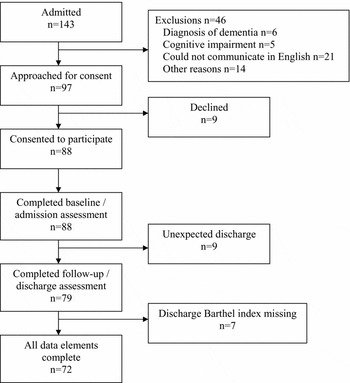
This study was conducted at the Kingston Rehabilitation Centre, Melbourne, Australia. The participants were consecutive patients admitted to two subacute aged care and rehabilitation wards (East 1 and South 5) in the period September–December 2009. The exclusion criteria from this study were: (a) patients under the age of 60 years old; (b) presence of a cognitive impairment (i.e. scored less than 24 out of 30 in the Mini-Mental State Examination (MMSE; Folstein et al., Reference Folstein, Folstein and McHugh1975) when tested upon admission to the rehabilitation unit or with a diagnosis of dementia, acquired brain injury or delirium); and (c) English language skills insufficient for participation in the study. On this basis, a sample of 88 out of 146 admitted patients consented to participate in this study (i.e. 60% recruitment rate; Figure 1). While admission data were collected for all 88 participants, participant attrition meant that discharge surveys were only collected for 79 (i.e. representing a 90% retention rate for the discharge assessment). However, of these 79 participants, the Discharge Barthel index scores of seven participants were absent from their medical records and could not be included in the analyses.
Participant flow through the study.

Measurement scales
Four scales were used to assess psychiatric comorbidity.
1. Geriatric Depression Scale – Short Form (GDS). A patient-completed scale developed specifically for the detection of depression among elderly individuals. The severity of depressive symptoms was assessed using the 15-item GDS (Sheikh and Yesavage, Reference Sheikh and Yesavage1986). The short-form version is the most common version currently used, and a standardized cut-off score of 6 or above out of a maximum score of 15 indicates the presence of depressive symptoms (Burns et al., Reference Burns, Lawlow and Craig2002).
2. Geriatric Anxiety Inventory (GAI). The GAI assesses the severity of anxiety symptoms in older adults. It is a 20-item self-report questionnaire with a standardized cut-off score of 9 or above out of a maximum score of 20 indicating the presence of anxiety symptoms (Pachana et al., Reference Pachana, Byrne, Siddle, Koloski, Harley and Arnold2007).
3. Brief Psychiatric Rating Scale (BPRS). The BPRS (Overall and Gorham, Reference Overall and Gorham1962) is a clinician-rated 16-item categorical scale which assesses common psychopathological symptoms: somatic concern, anxiety, emotional withdrawal, conceptual disorganization, guilt feelings, tension, mannerisms and posturing, grandiosity, depressed mood, hostility, suspiciousness, hallucinatory behavior, motor retardation, uncooperativeness, unusual thought content, excitement, disorientation, and blunted affect. Higher scores are indicative of greater psychiatric severity. Scores range from a minimum of 18 to a maximum score of 126. A score of 32 or above is indicative of mild, moderate or marked psychiatric illness (Leucht et al., Reference Leucht2005).
4. HoNOS 65+. The Health of the Nation Outcome Scale 65+ is a 12-item clinician-rated scale used to assess the general severity of psychiatric disability in elderly individuals (Burns et al., Reference Burns1999). The HoNOS 65+ specifically assesses issues with aggression, self-harm, drug and alcohol use, cognitive problems, physical illness and disability, hallucinations and delusions, activities of daily living, residential environment and daytime activities. Higher scores are indicative of greater severity, with a minimum score of 0 and a maximum score of 48. A score of 2 or above on any one item of the HoNOS 65+ is indicative of a clinically significant problem worthy of active monitoring or intervention (Burgess et al., Reference Burgess, Trauer, Coombs, McKay and Pirkis2009). Given the broad scope of the HoNOS 65+, we focused upon items specifically relating to psychiatric comorbidity (i.e. items 1, 2, 3, 4, 6, 7, 8, 9). Any participant scoring 2 or above on these items was classified as showing a psychiatric comorbidity symptom or problem within the clinical range. Australian national outcome data for this scale has a mean score of 12.4 (SD 6.2) for those admitted to community aged psychiatry services in 2008–9. (AMHOCN, 2008–9). A Full Scale score of 13 or above was selected as a general estimation of greater severity of psychiatric disability.
In addition to the four measures of psychiatric comorbidity, data from three measures of rehabilitation outcome were collected. Two of these (the EQ-5D and Barthel Index) were scales that were administered at admission and discharge. The remaining measure was LOS (length of stay) in days.
1. EQ-5D and EQ-5D Visual Analogue Scale (VAS). The EQ-5D (Rabin and de Charro, Reference Rabin and de Charro2001) measures health-related quality of life on five domains: mobility, self-care, usual activities, pain/discomfort, and anxiety/depression. Responses are patient-rated according to three levels: no problem, some problems, and severe problems. These items can be converted to a “health utility score” ranging from −0.59 to 1.0, using a standardized scoring formula (Dolan, Reference Dolan1997). The visual analogue scale (EQ-5DVAS) in which an individual ranks his/her perceived health status on a scale of 0–100 (low to high perceived health) was also used.
2. Barthel Index. The Barthel Index is a clinician-rated scale measuring functional independence in an individual's activities of daily living (Mahoney and Barthel, Reference Mahoney and Barthel1965). Scores from the Barthel Index range from 0 to 100, with 0 representing total dependence and 100 representing total independence. According to the Barthel Index, three categories of functional impairment are possible: severe impairment (0–50); moderate impairment (51–75); and mild to no impairment (76–100).
3. Length of Stay (LOS). The third measure of rehabilitation outcome was the patients’ length of stay in days.
Procedure
A trained research assistant in collaboration with a clinical psychologist screened the medical records of patients admitted to the studied wards to determine their eligibility as research participants for this study. After obtaining the patient's written informed consent, the research assistant administered the assessment scales of psychiatric comorbidity (GDS, GAI, BPRS, HoNOS65+), the EQ-5D (including EQ-5DVAS) and the Barthel Index. Participant demographics (including past history of psychiatric illness and use of psychiatric medications) were collected from the medical care admission notes. Participants’ acute medical care case notes were also consulted for reports of a current or past history of a psychiatric illness. Psychiatric comorbidity was defined as a participant obtaining a total score within the scale's specified clinical range i.e. a total score of 6 or above for GDS, 9 or above for GAI, 32 or above for BPRS, 13 or above for HoNOS 65+ Full Scale, and 2 or above for individual items. Any severely depressed, anxious or suicidal participants were referred to psychological and/or consultation-liaison psychiatry services. The assessment scales of psychiatric comorbidity, the EQ-5D and the Barthel Index were re-administered within two days prior to discharge from the ward. The participants' length of stay was obtained from their medical care progress notes. Contact with consultation liaison psychiatry services in the acute and subacute hospital setting and treatment from clinical psychology services during the subacute hospital admission were also collected from the medical records.
Analysis
Summary descriptive statistics for the GDS, GAI, HoNOS 65+, BPRS, EQ-5D (including EQ-5DVAS), and Barthel Index and tests of significant difference were computed using SPSS (PASW, 2009). The percentage of normal participants and those with scores falling within the clinical range of each assessment scale was also calculated at admission and at discharge and the pattern of change between admission and discharge among these participants' scores is also described.
To assess the association and influence of psychiatric comorbidity at admission upon rehabilitation outcome, the four admission scores of the assessment scales (GDS, GAI, BPRS, HoNOS65+) were correlated with the four rehabilitation outcome variables (LOS, the discharge EQ-5D (including EQ-5DVAS) and the discharge Barthel index). These same variables were subject to linear regression analyses for each of the outcome variables.
The investigators categorized participants as having clinically important symptoms of psychiatric illness during their subacute admission if they were assessed as having scores above previously established thresholds at either admission or discharge assessments. Thus, the association between clinically significant symptoms of psychiatric illness at some point during their subacute admission and the outcome measures (EQ-5D and EQVAS, Barthel Index, length of stay) was examined.
Linear regression analyses using the change (admission – discharge values) in the EQ-5D and EQ-5DVAS and Barthel Index, along with the raw length of stay measure were used as the dependent variables. A separate model was created with each measure of psychiatric comorbidity entered as a single independent variable. An additional model was created in which participants who scored above the threshold level for any one of the psychiatric comorbidity variables at admission or discharge assessments was used as the independent variable. All analyses were also adjusted for whether the participant had received psychological services or psychiatric consultation liaison services during subacute hospitalization.
Analyses using length of stay as the dependent variable used a log transformed version of this outcome to account for the skewed distribution of this data (untransformed Shapiro Wilk's W = 0.86, transformed Shapiro Wilk's W = 0.98).
Two versions of the data analysis were pursued. First, a complete case data analysis was conducted in which data from participants with missing discharge assessments for the relevant predictor or outcome variables were excluded. The second analysis was conducted using a dataset with values imputed for missing data. Outcome measures missed at discharge (Barthel index – 7 missing, EQ-5D utility – 9 missing, EQ-5D VAS – 10 missing) were imputed using best-subsets regression. Predictor variables (nine missing for each variable, each from the same patients) were imputed using multiple imputations (Rubin, Reference Rubin1996). A multivariate normal data imputation approach with ten sets of plausible imputed values per missing data point was pursued.
Results
A preliminary analysis of the participants' data from the two subacute rehabilitation wards (East 1 and South 5) showed that participants in East 1 were significantly older (mean age of 80.24; SD 5.8) with higher levels of physical dysfunction on admission (Admission Barthel mean score of 54.14, SD 20.7) compared to the South 5 participants (age mean score of 76.7 years, SD 7.9; Admission Barthel mean score of 31.7, SD14.9). On all other measures, the participants from these two wards were comparable and their scores were combined for the analyses. The average length of stay across the subacute units was 23.1 days (SD:13.2)
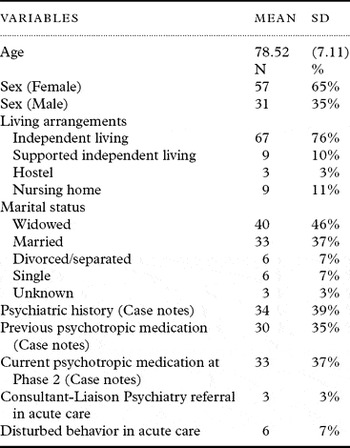
A review of the 88 participants' case notes describing their stay in acute care preceding their admission to the subacute wards showed that 39% of the participants were reported to have a current psychiatric illness, or a history of a psychiatric illness (Table 1). Of these participants, 35% were on psychotropic medication at the time of admission to the subacute rehabilitation unit. These prescribed medications included: 8% antipsychotics alone, 11% antidepressants alone, 7% anxiolytics alone and 9% combinations of psychiatric medications. Despite this prevalence of psychiatric illness and prescribed medication among the patients, only 3% of the participants received psychiatric input during their stay in acute hospital care. In comparison, 8% (n = 7) of the participants received a psychiatric consultation liaison assessment, 23% (n = 20) received clinical psychology intervention and 8% (n = 7) received neuropsychological consultation during the admission to the subacute rehabilitation wards.
Demographic characteristics of the study sample (n = 88)

At admission, the assessments on the GDS, GAI, BPRS, and the Full Scale HoNOS 65+ identified 60 out of the total 88 (68%) participants who scored in the clinical range on at least one of the four scales, with the remaining 28 (32%) participants scoring in the subclinical range. The sample of participants presenting without symptoms of psychiatric comorbidity was considered too small to allow reliable comparative analyses between those participants presenting with and without psychiatric comorbidity problems. Subsequent analyses focused predominantly on studying the differential effects of various psychiatric comorbidity symptoms on rehabilitation outcome.
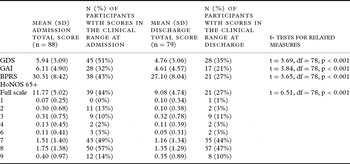
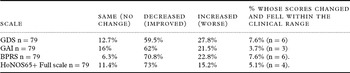
An analysis of the participants' admission and discharge scores on the GDS, GAI, BPRS and the HoNOS 65+ Full Scale showed that the distributions of the discharge total scores of the GAI and the GDS were positively skewed, though only the latter reached statistical significance (p < .05). Table 2 presents the prevalence of psychiatric comorbidity among the participants in this study at both admission and discharge. The percentage of participants who scored in the clinical range on the GDS, the GAI, the BPRS and the HoNOS 65+ Full Scale indicated a prevalence of psychiatric comorbidity symptoms at admission being higher than 30% (n = 88) in this sample. Based on the standardized cut-off point of the assessment scale, the percentage of participants showing symptoms of depression at clinical levels was 51% at admission which fell to 35% at discharge (GDS). With anxiety symptoms (GAI), the percentages were slightly lower, i.e. 32% on admission and 21% at discharge. By comparison, approximately 43% of participants at admission and 27% at discharge had scores in the clinical range on both the BPRS and the Full Scale HoNOS 65+. Individual item analysis of the HoNOS 65+ revealed that items 7 and 8 measured higher prevalence rates falling within the clinical range at admission and discharge in comparison with the other HoNOS 65+ items. Item 7 relates to depression and item 8 to other mental health issues, predominantly anxiety. The difference between the admission and discharge prevalence levels was statistically significant for each of the assessment scales, the GDS, GAI, BPRS and the HoNOS65+ Full Scale (Table 2). While the majority of participants demonstrated maintenance or improvement on their four assessment scales scores, a minority worsened as shown in Table 3. There were 3–8% of the total participants who possessed subclinical scores at admission which then changed to within the clinical range at discharge.
Prevalence of psychiatric comorbidity at admission and discharge from inpatient rehabilitation

Psychiatric comorbidity was defined as a participant obtaining a total score within the scale's specified clinical range, i.e. a total score of 6 or above for GDS, 9 or above for GAI, 32 or above for BPRS, 14 or above for HoNOS 65+ Full Scale and 2 or above for individual items.
GDS = Geriatric Depression Scale; GAI = Geriatric Anxiety Inventory; BPRS = Brief Psychiatric Rating Scale; HoNOS 65+ = Health of the Nation Outcome Scale 65+.
Percentage of participants whose scores on assessment scales for psychiatric comorbidity changed or remained unchanged between admission and discharge

GDS = Geriatric Depression Scale; GAI = Geriatric Anxiety Inventory; BPRS = Brief Psychiatric Rating Scale; HoNOS 65+ = Health of the Nation Outcome Scale 65+.
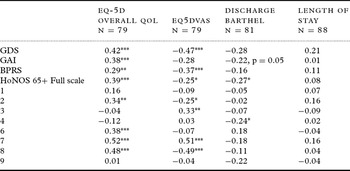
An analysis of the rehabilitation outcome data showed that distributions of length of stay, Discharge Barthel index and Discharge EQ-5D score were significantly positively skewed. Spearman correlational analyses which addressed statistical issues related to scaling issues and skewness were undertaken to investigate the association between the presence of psychiatric comorbidity features at admission and rehabilitation outcomes for all 88 participants (Table 4). The outcome of these analyses showed that the degree of association between the admission scores (GDS, GAI, BPRS and HoNOS65+ Full Scale) and the rehabilitation outcome measures (LOS, Discharge Barthel, EQ-5D and EQ-5DVAS) ranged from ρ = 0.01 to ρ = −0.47. The highest correlations were between the GDS total score at admission and the EQ-5D and EQ-5DVAS scores (both p < 0.001). Other significant correlations appeared between the GAI admission score and the EQ-5D (p < 0.001) and between the BPRS admission score and the EQ-5DVAS (p < 0.001). The GAI score showed a trend towards an association with the discharge Barthel index but this failed to reach statistical significance. Like the GDS, GAI and BPRS total scores, the HoNOS 65+ Full Scale score was also highly significantly associated with the EQ-5D (p < 0.001). It was noted that none of these assessment scores on admission was correlated with length of stay or the Barthel index.
Spearman (ρ) correlation analyses of admission self-report scale scores and rehabilitation outcome measures

*= p < 0.05, **= p < 0.01, ***= p < 0.0001.
GDS = Geriatric Depression Scale; GAI = Geriatric Anxiety Inventory; BPRS = Brief Psychiatric Rating Scale; HoNOS 65+ = Health of the Nation Outcome Scale 65+; EQ-5DVAS = EuroQoL -5 Domain Visual Analogue Scale; QOL = quality of life.
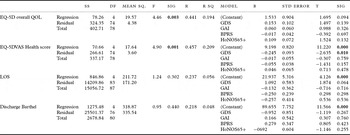
Linear regression analyses undertaken to investigate the extent to which outcome in rehabilitation (LOS, Discharge Barthel, EQ-5D, EQ-5VAS) may be predicted from the participants' total admission scores on the GDS, GAI, BPRS and the HoNOS 65+ (psychiatric comorbidity) are reported in Table 5. The outcome of the analyses showed two regression models significantly predicting EQ-5D and EQ-5DVAS but not LOS or Discharge Barthel. The overall variance of these models were R2 = 0.19 and 0.20 respectively. A closer examination of the regression analyses identified a trend for the predictor admission GDS score as contributing the highest proportion of variance to the overall variance of each of the dependent variables (rehabilitation outcomes), with GAI making the least contribution to the overall variance in three out of the four models (not EQ-5D). Apart from GDS making a significant contribution to EQ-5DVAS, none of the other predictors' contributions achieved statistical significance in any of these models.
Multiple regression analyses with the predictor variables (admission scores on GDS, GAI, BPRS and HoNOS 65+ Full scale total scores) and rehabilitation outcome measures (LOS, Discharge Barthel and EQ-5D, EQ5-VAS)

GDS = Geriatric Depression Scale; GAI = Geriatric Anxiety Inventory; BPRS = Brief Psychiatric Rating Scale; HoNOS 65+ = Health of the Nation Outcome Scale 65+; LOS = length of stay; QOL = quality of life; EQ-5DVAS = EuroQoL −5 Domain Visual Analogue Scale
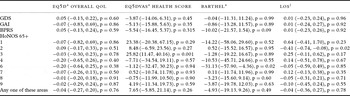
Further correlation analyses based on length of stay and change scores (admission-discharge values) in the EQ-5D and EQ-5DVAS and Barthel Index were undertaken to assess the contribution of change in the participants' status between admission and discharge on rehabilitation outcome (Table 6). Significant associations between HoNOS 65+ item 3 (substance misuse) and change in EQ-5DVAS, HoNOS 65+ item 6 (hallucinations/delusions) and change in Barthel index, and HoNOS 65+ item 2 (self-harm) and length of stay were identified. The findings revealed unexpected relationships among some of the variables. The association between HoNOS 65+ item 6 and change in Barthel index indicated that participants who experienced more hallucinations or delusions at either assessment point during inpatient rehabilitation had ~31 points less improvement in their Barthel index compared to patients who did not experience these symptoms. In contrast, the association between HoNOS 65+ item 3 and change in EQ-5D VAS indicated that participants who experienced substance abuse had ~26 points more improvement in their health-related quality of life than participants who did not. Finally, participants who had self harm ideation had a ~41% shorter length of stay.
Pearson correlation analyses between change in dependent variable (discharge-admission) with binary classification of whether patient had a problem with the specified independent variable (GDS, GAI, BPRS, HoNOS items 1–4, 6–9, or any one of these) after adjusting for psychology/psychiatry intervention. (n = 88)

* Positive coefficients indicate that participants with psychiatric comorbidity had better levels of improvement in these outcomes than those without psychiatric comorbidity.
† Positive coefficients indicate that participants with psychiatric comorbidity had longer length of stay than those without psychiatric comorbidity.
EQ-5DVAS = EuroQoL −5 Domain Visual Analogue Scale; GDS = Geriatric Depression Scale; GAI = Geriatric Anxiety Inventory; BPRS = Brief Psychiatric Rating Scale; HoNOS 65+ = Health of the Nation Outcome Scale 65+; LOS = length of stay.
These results from the complete cases analysis were consistent with those from the analysis using imputed data for the missing data points with the exception of one analysis. Here, the association between HoNOS 65+ item 6 and change in Barthel index was no longer significant (p = 0.10). Regression analysis failed to yield any significant predictive models between the change assessment scores and rehabilitation outcome measures.
As a considerable majority of patients presented with depressive symptoms at admission, further analyses were undertaken to address questions raised about the status of these patients’ symptoms. A final correlation analysis examined the relationship between the length of patients’ acute admission stays and their psychiatric comorbidity scores (GDS, GAI, BPRS and HoNOS65+) on admission to and discharge from their subacute inpatient stay, and the outcome measures (LOS, discharge EQ-5D, EQ-5DVAS and Barthel score). The results showed a small but significant correlation between acute admission length of stay and the patients’ GDS scores at the time of admission to subacute care (ρ = 0.25, p < 0.05). A significantly modest correlation was also found between the patients’ admission Barthel score and length of stay in acute care (ρ = −0.36, p < 0.01). Interestingly, the admission GDS and Barthel scores were not significantly associated with each other.
Discussion
The view that the prevalence of psychiatric comorbidity is considerable among older adults admitted to inpatient subacute care was upheld in this study. This study found that half of the participants admitted to subacute care presented with clinical levels of depressive symptoms. At discharge, this rate fell to a third of all the participants. A similar pattern was observed for anxiety, though the prevalence was a third of the participants presenting with clinical levels of anxiety symptoms at admission and falling to a fifth at discharge. This pattern was also repeated for the BPRS and the HoNOS65+ Full Scale. Most of the total number of participants identified as having a psychiatric comorbidity on this latter scale were due to the high proportion of participants having problems for items 7 (depression) and 8 (other mental problems – predominantly anxiety). Overall, the pattern of change suggested that a process of improvement was occurring during the participants' rehabilitation period.
This broader characterization of the psychiatric comorbidities of an older age subacute inpatient cohort is consistent with other research that has examined single diagnostic groups. Bryant et al. (Reference Bryant, Jackson and Ames2009) investigated a similar geriatric subacute group using the Geriatric Mental Status Schedule and found admission depression symptoms (syndrome-level) in 48% and anxiety symptoms in 16% of participants. By post-discharge follow-up two months later, these figures had reduced to 37% and 6% respectively. No similar geriatric subacute inpatient data are known to be available for comparison using the BPRS or the HoNOS 65+. Overall, it was found that the change between participants' admission and discharge scores on the psychiatric comorbidity scales represented significant improvement for slightly more than half of all the participants. However, participants showed considerable individual variation during the rehabilitation period with some participants showing no change and a small proportion showing a worsening of their scores, with a subset of these obtaining scores within the clinical range by the end of the rehabilitation period.
In accordance with the literature, the investigators hypothesized that participants with psychiatric comorbidity would have poorer rehabilitation outcomes compared to those who did not. The naturalistic observational approach adopted in this study revealed an absence of a sufficiently large sample of participants presenting without psychiatric comorbidity problems at admission. The allotted time of three months for recruitment to this study also made it difficult to achieve sufficient numbers for reliable comparative analyses between those presenting with and without psychiatric comorbidity. As a result, the analyses of this study focused mainly on an evaluation of the influence of different expressions of psychiatric comorbidity on rehabilitation outcome.
Correlational analyses revealed stronger associations between the admission assessment scales of psychiatric comorbidity and both EQ-5D and EQ-5DVAS, rather than with the Discharge Barthel Index or the length of stay. This association appears to reflect the similarity of the domains being assessed by the symptom assessment scales and the EQ-5D and EQ-5DVAS, as compared with the Barthel or LOS. Subsequent regression analyses showed that, of the different possible rehabilitation outcomes, the GDS, GAI, BPRS and HoNOS65+ scores at admission best predicted the EQ-5D/EQ-5DVAS scores at discharge. Of these predictors, the (not significant) trend was for the depressive symptoms (GDS) to be the most reliable predictor of the participants' status as measured by the EQ-5D and EQ-5DVAS. While the present study contributes to the understanding of how psychiatric comorbidities may impact on rehabilitation outcomes, the literature in this field does not provide a definitive view.
Other interesting findings in the correlational analyses included the observations that the participants with higher scores for the HoNOS 65+ item relating to hallucinations/delusions showed less improvement in functional independence. By contrast, those noted to rate higher on the self-harm ideation item and the substance misuse item had outcomes that were regarded as more positive, that is, shorter length of stay and greater improvement in perceived quality of life respectively. The association between self-harm ideation and shorter length of stay has also been substantiated in the psychiatric literature. The review undertaken by Trauer (Reference Trauer2008) of HoNOS scores for acute psychiatric patients over a 17-month period found no direct relationship between HoNOS total severity scores and length of stay, but identified that severity scores on certain items (including hallucinations/delusions) are associated with longer length of stay, while others (including self-harm and substance misuse) are associated with shorter length of stay. Given that these findings arose as a result of exploratory analyses in the context of a naturalistic observation or descriptive study, the actual significance of these findings is not fully known. Hence, a conservative interpretation of these observations is recommended.
There are several possible reasons why a stronger association between psychiatric comorbidity and poorer rehabilitation outcomes was not identified. First, the results indicated that the size of the variable effects under study is inherently small, with considerable symptom heterogeneity (mental and physical) among the participants present. Second, the psychiatric scales for some tests were shortened versions and this raises the possible relevance of issues related to reliability and sensitivity of the assessment tools. It is also difficult to assess the extent to which these assessment tools measured the full range of psychiatric comorbidity factors, and structured diagnostic interviews might provide a more comprehensive perspective of the participants' status rather than the dimensional scales used in the present study. For the majority of the present patients, it is likely that the manifestation of their adverse psychological state was symptomatic, not syndromal. Patients with, for instance, a clinically-diagnosed depression may have poorer rehabilitation outcomes. Lastly, the period of time over which the study occurred may be argued to be too short to assess the impact of psychiatric disability on rehabilitation outcome. The absence of a relationship between psychiatric comorbidity and length of stay may be associated with the subacute inpatients units’ strict adherence to Health Department clinical criteria-based funding guidelines for length of stay (CRAFT, 2009) where the patients’ length of stay is predetermined by policies concerning the minimum and maximum length of stay for specific diagnoses and functional level at admission. The achievement of rehabilitation goals may not always be the main determinant for when a patient is discharged from rehabilitation. Patients may be discharged after a predetermined period, such as once the optimal funding for the stay is completed. Alternatively, a patient may have an extended length of stay in a subacute ward if they are awaiting a new placement in a residential aged care facility. Variability due to whether a patient has support at home can also influence the patient's length of stay in a subacute ward as well as any association with concurrent problems, such as the range and severity of patients’ medical comorbidities among different participants.
Given the considerations above, it may be more appropriate to use alternative measures of outcome such as measures of achievement in actual performance of activities of daily living rather than the Barthel index which measures physical capacity (though investigation of real life participation in activities of daily living would require that the research extends into the post-discharge period). There appears to be some justification to this suggestion in so far as some research with younger adult rehabilitation populations, using broader measures of psychiatric co-morbidity, have reported strong relationships of these measures with indicators of rehabilitation outcomes. An example is the study by Ponsford et al. (Reference Ponsford, Hill, Karamitsios and Bahar-Fuchs2008) which found that the presence of ongoing pain, anxiety, depression and post-traumatic stress disorder symptoms to be the strongest predictors of orthopedic rehabilitation outcome when assessed by a health-related quality of life measure. In another study of adult neurological rehabilitation, early psychiatric morbidity was shown to be the strongest predictor of not returning to paid employment (Glozier et al., Reference Glozier, Hackett, Parag and Anderson2008).
The small but statistically significant correlation between acute admission length of stay and patients’ GDS score at the time of admission to the subacute unit suggests that for some patients, their depressive symptoms predate their admission to rehabilitation. It is not possible in this study to distinguish between those patients who may have been depressed prior to their admission to acute care and those whose depressive symptoms arose in the course of their acute admission. Certainly, it is conceivable that for some patients, longer acute admissions appear to affect patients’ mood adversely by the time of transfer to subacute care, but do not necessarily lead to a lengthening of stay in subacute care. Some of the differences between acute and subacute care that could give rise to psychologically vulnerable patients manifesting affective symptoms could include the relatively higher turn-around of patients in acute care compared with subacute care, a situation often associated with a greater experience of social anomie for the individual. Greater emphasis is placed on physical medicine in acute care rather than on addressing social or psychological concerns, or on the possible great distress associated with pain or the trauma of the injury leading to the admission. In contrast, the greater emphasis in subacute care on multidisciplinary clinicians addressing broader health issues and using collaborative goal-setting allows relationships with the patients to develop. Positive effects on patients' emotional states may be associated with the person-centered care approach within subacute units and the more predictable length of time over which treatment occurs. There was no association between the acute length of stay and patients’ discharge GDS, and as noted earlier, the overall severity of all psychiatric symptom scales significantly reduced during the subacute stay. Lastly, it cannot be ignored that rehabilitation in subacute care has the advantage over acute care of often being connected with a return home for the patient. For most patients, this represents an anticipation of a positive experience that would be reflected in more positive discharge measures of emotional well-being.
The other subgroup of patients with greater length of stay in acute comprised those who had greater functional dependence scores upon admission to the subacute hospital. Subacute admission Barthel and GDS scores were not correlated, suggesting that patients’ depressive mood is independent of their level of physical dependency. The small correlation between the admission GDS scores and acute length of stay also shows that depressive patients are a heterogeneous group in terms of when they manifest their depressive symptoms during various stages of care. It seems conceivable that some patients present with a premorbid history of depressive mood prior to their admission to acute care, while others differ in relation to whether their psychological vulnerabilities manifest during acute or subacute care. A better understanding of the contextual constituents triggering depressive symptoms in both groups would be helpful in providing better patient care. Depending on this new understanding, there may be implications as to how these patients’ depressive symptoms are best managed.
Overall, the present study provides support for the claim that older subacute inpatients experience a substantial prevalence of psychiatric comorbidity problems. A significant proportion of the participants experienced either or both depressive and anxiety symptoms, and exhibited elevated levels on measures of psychopathology and psychiatric disability. These psychiatric symptoms significantly lessened during the subacute stay. Though there appear to be a myriad and complexity of factors affecting patient rehabilitation outcome, this study highlighted depressive symptoms at admission as being the most relevant in contributing negatively to the rehabilitation of the older patient in subacute care. This finding suggests a need for early assessment and identification of depressive symptomatology to enable patients to optimize their uptake of rehabilitation therapies and to minimize the likelihood of adverse affective states arising from having a prolonged illness. The finding also points to the emotional vulnerability of patients during longer stays in acute care and suggests that increased support is needed to assist them in coping with this stage of their treatment. Future longitudinal research on the prevalence and impact of psychiatric comorbidity on functional and other outcome variables during the acute and subacute inpatient stays and into the post-discharge period would be extremely valuable. This will help to elucidate the range of factors at each stage of the patient's journey that are significant for their eventual outcome from an episode of illness or injury involving hospitalization.
Conflict of interest
None.
Description of authors' roles
The study was designed by C. Gluyas, C. Borg and T. Hayes. Data collection was carried out by S. Y. Chong under the supervision of C. Borg, and data analysis was conducted by T. Hayes and C. Lum. C. Gluyas, C. Lum and T. Hayes wrote the paper.
Acknowledgments
This research was generously funded by the John Cockayne Memorial Fellowship Trust Fund, sponsored by the Lions Club of Oakleigh and the Kingston Centre.