INTRODUCTION
Non-indigenous species invasions are considered to be among the most serious environmental problems worldwide. A large number of organisms from many different phyla have been accidentally or intentionally introduced to regions far from their native range (e.g. lionfish Pterois volitans in the Atlantic and Caribbean—Whitfield et al., Reference Whitfield, Gamer, Viues, Gilligan, Courtenay, Ray and Hare2002; Chinese mitten crab Eriocheir sinensis in Europe and the north-eastern Pacific—Robbins et al., Reference Robbins, Sakari, Baluchi and Clark2006; seaweed Caulerpa taxifolia in California—Anderson, Reference Anderson2005). Once established, these invasive species have the potential to drive important community- and ecosystem-level changes with substantial environmental, social, and/or economic costs. The mechanisms driving these changes have only recently begun to be explored and understood (Torchin et al., Reference Torchin, Lafferty and Kuris2001). Information on life history strategies and population dynamics of invasive species may be a first step in ameliorating their negative effects in the near future. Nonetheless, studies describing life history and basic population parameters of non-indigenous species are still rare, both in marine and terrestrial systems.
Charybdis hellerii is one of several recently reported invasive crustaceans in the western Atlantic and Caribbean Sea (Lemaitre, Reference Lemaitre1995; Dineen et al., Reference Dineen, Clark, Hines, Reed and Walton2001; McMillen-Jackson, Reference McMillen-Jackson2008). This crab was first reported outside of its native range (i.e. Indo-Pacific) in the Mediterranean during the latter part of the 19th Century, following the completion of the Suez Canal in 1869 (Por, Reference Por1971). Charybdis hellerii was first reported on the east coast of The Americas during the late 1980s in waters off South Carolina, Cuba, Venezuela and Colombia (McMillen-Jackson, Reference McMillen-Jackson2008 and references therein). During the 1990s, observations of small immature individuals cohabiting with large brooding females in the same locality suggested established populations in Florida and Brazil (Lemaitre, Reference Lemaitre1995; Negreiros-Fransozo Reference Negreiros-Fransozo1996; Dineen et al., Reference Dineen, Clark, Hines, Reed and Walton2001; Mantelatto & Garcia, Reference Mantelatto and Garcia2001). The current range of its distribution in The Americas extends from North Carolina, USA to Santa Catarina, Brazil (McMillen-Jackson, Reference McMillen-Jackson2008).
Charybdis hellerii's coastal range expansion on the east coast of The Americas, including the Gulf of Mexico, is attributed to larval transport via coastal currents (Tavares & Braga de Mendonça, Reference Tavares and Braga de Mendonça1996, Reference Tavares and Braga de Mendonça2005), via shipping along the coast (Tavares & Amouroux, Reference Tavares and Amoroux2003) and via migration of adult crabs (McMillen-Jackson, Reference McMillen-Jackson2008). The well developed swimming ability of portunid crabs (including members of Charybdis spp.) and the long larval period in this species (~44 days in the laboratory—Dineen et al., Reference Dineen, Clark, Hines, Reed and Walton2001) suggest that all of the proposed mechanisms of colonization and expansion above are plausible. Nevertheless, phylogeographical studies are needed to confirm multiple independent colonization events and expansion mechanisms throughout the western Atlantic (Holland, Reference Holland2000).
Charybdis hellerii finds refuge in places with or without structural heterogeneity both in its native and non-native range. Individuals have been retrieved from soft bottom areas or from underneath rocks and rubble, among living coral, in rock rip-rap of jetties, subtidal mangrove prop roots and from dense patches of subtidal algae (Negreiros-Fransozo Reference Negreiros-Fransozo1996; Mantelatto & Garcia, 2000; Dineen et al., Reference Dineen, Clark, Hines, Reed and Walton2001). The reproductive ecology of this species is only partially known. In Florida and Brazil (Ubatuba Bay, São Paulo), C. hellerii seems to breed throughout the year. However, reproduction peaks in spring through to autumn in Florida (Lemaitre, Reference Lemaitre1995; Dineen et al., Reference Dineen, Clark, Hines, Reed and Walton2001) and in winter through to spring in Brazil (Mantelatto & Garcia, 2000). In Brazil, female sexual maturity is attained precociously, at approximately 35 mm carapace width (CW), as indicated by relative growth analysis and on the basis of the smallest ovigerous females detected (Mantelatto & Garcia, Reference Mantelatto and Garcia2001). Also, most females in the population above 40 mm CW brood embryos. In contrast, in Florida, brooding females are not common and are restricted to the largest size-classes (Dineen et al., Reference Dineen, Clark, Hines, Reed and Walton2001). This information suggests that different non-native populations of C. hellerii have different reproductive schedules. The conditions driving differing reproductive schedules along the native and non-native range of this crab remain to be addressed.
The aim of this study is describing the life history of an invasive population of the crab C. hellerii in the south-western Caribbean Sea. Reproductive output, population structure, sex-ratio, percentage of brooding individuals, size at first maturity, and variability of most of the parameters above through the year are described. The information provided in this study is a first step toward understanding of the ecology of this species and for future management of the effects at the community level that this invasive species might be causing.
MATERIALS AND METHODS
Sampling of C. hellerii
Individuals of C. hellerii were collected once monthly, from June 2007 to May 2008 at Playa Valdéz, El Morro de Porlamar, Isla Margarita, Venezuela. At the study site, free-diving surveys were conducted in shallow subtidal areas (1–2 m depths) along ~80 m transects parallel to the coast. Crabs were collected by hand from around the roots of Thalassia testudinium and underneath rocks found intermittently among the seagrass beds. Each crab collected was transported alive to the laboratory.
Carapace width of each crab was measured using a caliper (to the nearest 0.1 mm) as the maximum distance between the left and right margin of the carapace. Crabs were classified as male or female based upon the shape of the first pleopod (i.e. rigid, modified as gonopods, and bearing spines in males; absent in females) and the width of the abdomen (much wider in females than in males). Also, the presence or absence of embryos beneath the abdomen of females was recorded.
Sex-ratio of C. hellerii
Sex-ratio was calculated as the number of males divided by the total number of individuals (males plus females) in the population. For each sampling date, the observed proportion of males to females was tested for deviations from a 1:1 sex phase ratio using a binomial test (Wilson & Hardy, Reference Wilson, Hardy and Hardy2002).
Size at maturity in C. hellerii
In females, size at first maturity was estimated as the CW at which the probability of brooding embryos was 0.5 using logistic regression (Wilson & Hardy, Reference Wilson, Hardy and Hardy2002). Also, ‘behavioural’ size at first maturity was estimated in both males and females using logistic regression. Behavioural maturity was estimated as the size at which the probability of having a movable abdomen was 0.5. In the family Portunidae, the abdomen is fixed in prepubertal (immature) individuals and usually breaks when attempting to separate this structure from the ventral sterna with a probe. In contrast, the abdomen is movable in pubertal (mature) males and females (Callinectes sapidus—Van Engel, Reference Van Engel1990; C. ornatus—Haefner, Reference Haefner1990; C. arcuatus—Fischer & Wolff, Reference Fischer and Wolff2006).
Reproductive output in C. hellerii
To quantify reproductive output, 14 brooding females with early embryos covering most of the range in body sizes reported for the species were collected throughout the sampling period and transported alive to the laboratory. The embryos were gently extracted from the abdomen of each female using forceps. The female crabs and embryo masses were then dried for 48 hours at 70°C in an oven and weighed to the nearest 0.01 mg with an analytical balance (Pionner, Ohaus).
From the measurements above, reproductive output was estimated as the ratio of embryo mass to body mass and represents the relative proportion of resources that female crabs invest in reproduction. We tested whether or not reproductive output increases linearly with female body size. The relationship between embryo dry mass and body dry mass of females was examined using the allometric model y = axb (Hines, Reference Hines1982). The slope b of the log–log least-squares linear regression represents the rate of exponential increase (b > 1) or decrease (b < 1) of the reproductive output with crab dry mass. To determine if the relationship deviates from linearity, an F test was used to test if the estimated slope b deviates from the expected slope of unity (Zar, Reference Zar1999). If reproductive output per body mass neither increases nor decreases with body size in C. hellerii, then the relationship should be linear.
RESULTS
Population dynamics and sex-ratio of C. hellerii
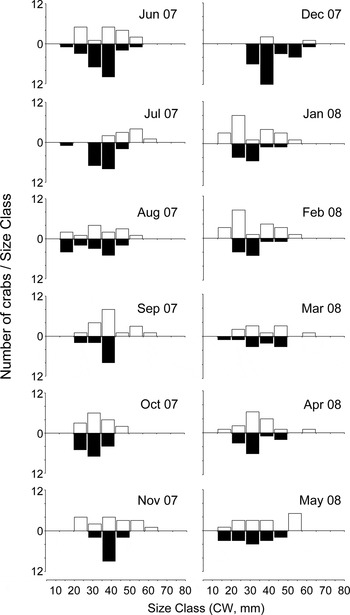
A total of 387 crabs were collected during the study period. Individuals of the two sexes, both large and small, were found year-round at the study site (Figure 1). The body sizes of the smallest and largest crabs captured were 9.4 and 77.4 mm CW, respectively. Unfortunately, it was not possible to distinguish different cohorts in the studied population due to the small number of crabs collected each month. However, the size–frequency distributions reflected at least 2 or 3 year old size-classes during some months (e.g. June 2007 and February 2008).
Population dynamics of Charybdis hellerii from June 2007 to May 2008 at Playa Valdéz, El Morro de Porlamar, Isla Margarita, Venezuela. Males and females are represented by black and white bars, respectively.

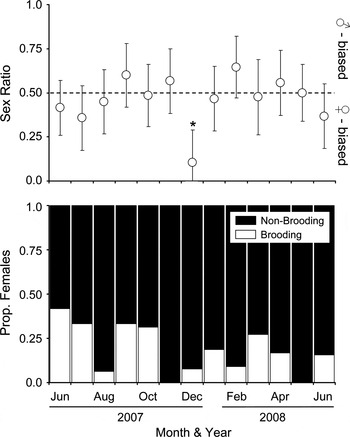
The percentage of brooding females was low (<45%) during the sampling period (Figure 2) with a mean (±SD) of 0.19 (±0.14). Visual examination of the frequency of occurrence of brooding females throughout the year did not reveal any evident seasonality. Thus, C. hellerii reproduces continuously but with very low intensity during the year at the study site. Small individuals (<25 mm carapace length ) were uncommon and intermittently found during the year (Figure 2).
Sex-ratio (above) and proportion of brooding females (below) of Charybdis hellerii between June 2007 and June 2008 at Playa Valdéz, El Morro de Porlamar, Isla Margarita, Venezuela.

Sex-ratio varied between 0.1 and 0.65 with a mean (±SD) of 0.46 (±0.14). Sex-ratio did not differ significantly from a 1:1 ratio during most of the sampling period (Figure 2). Only during December 2007 was the sex-ratio biased towards males at the study site.
Size at maturity in C. hellerii
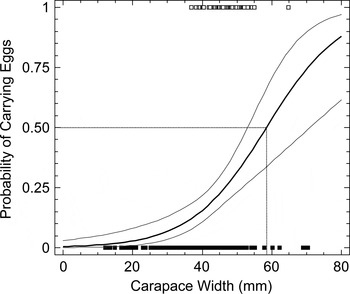
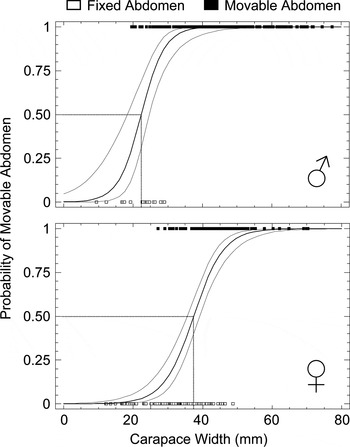
Logistic regression indicated that the size at which 50% of the females were predicted to have attained puberty and functional maturity is 58.45 mm CW (confidence limits (c.l.): 53.01–70.96) (Figure 3). Clearly, this value is overestimated due to the relatively large number of non brooding (prepubertal) females in the population (Figures 1 & 3). The body size of the smallest female with eggs was 36.81 mm CW. Behavioural size at first maturity in females was estimated to be 37.43 mm CW (c.l.: 35.55–39.09), a value that is considerably smaller than that estimated for functional maturity (Figure 4). In turn, behavioural size at first maturity was smaller in males (22.39 mm CW, c.l.: 18.35–24.72) than in females (Figure 4).
Predicted size at first maturity of females of Charybdis hellerii using embryo brooding as a proxy for maturity. Upper and lower curves are 95% confidence limits. Brazil.

Predicted size at first maturity of males and females of Charybdis hellerii using breakage of the abdomen as a proxy for maturity. Upper and lower curves are 95% confidence limits.

Reproductive output
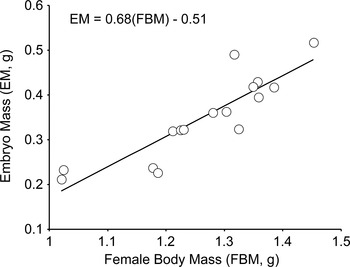
The ratio of embryo to female body dry mass varied between 0.052 and 0.084 with an average (±SD) of 0.07 (±0.008). Females allocated disproportionately to egg production with increasing body size; the slope of the relationship between crab dry mass and embryo dry mass differed significantly from unity (b = 0.68, P < 0.001; Figure 5). Thus, in the studied population, reproductive output is size-dependent with large females allocating proportionally less resources to egg production compared to small females.
Relationship between female body mass and embryo brood mass in females of Charybdis hellerii at Playa Valdéz, El Morro de Porlamar, Isla Margarita, Venezuela.

DISCUSSION
The studied population of the non-indigenous crab Charybdis hellerii at Isla Margarita, southern Caribbean Sea, comprises both immature and mature individuals. The above suggests that C. hellerii is established in the studied area ~15 years after initial colonization (Hernández & Bolaños, Reference Hernandez and Bolaños1995). Importantly, the proportion of large brooding females observed throughout one year of sampling was extremely low. This low proportion of brooding females suggests that the reproductive potential of this established population is low. In other crustaceans from tropical/subtropical latitudes, including crabs and shrimp from the Caribbean Sea, reproduction is continuous and intense during all or most of the year, and many females are frequently found brooding embryos year-round (Felder, Reference Felder1982; Bauer, Reference Bauer1985, Reference Bauer1989; Baeza et al., Reference Baeza, Braga, López-Greco, Perez, Negreiros-Fransozo and Fransozo2010). Intense and continuous reproduction is also reported for other species from the family Portunidae, to which C. hellerii pertains. For instance, in C. natator from Australia, numerous females carrying eggs are present throughout most of the year, although, comparatively little spawning activity is reported for this species during winter (Sumpton, Reference Sumpton1990). It could be argued that the low proportion of brooding females among the study population is due to a risk adverse behaviour of these brooding females, hiding in secluded places and leaving refuges rather infrequently while carrying eggs, as suggested before for a cancrid crab (Baeza & Fernández, Reference Baeza and Fernández2002). Nonetheless, the observed non-biased sex-ratio does not support this notion. If females were less active when carrying embryos, we would have expected a male biased sex-ratio throughout most or all of the sampling period. Furthermore, the low frequency of ovigerous females detected here contrasts with that reported for a second non-native population of C. hellerii from Ubatuba, Brazil, where most of the females collected during one year of sampling were found brooding embryos (Mantelatto & Garcia, Reference Mantelatto and Garcia2001). Future studies need to address the general activity of females to explain the low proportion of brooding females at Isla Margarita. The conditions accounting for variability in terms of brooding intensity among populations of C. helleri in the western Atlantic and the Caribbean remain to be addressed.
Female reproductive output in C. hellerii did not increase proportionally with body size. In most brachyuran crabs, brood weight exhibits an isometric or nearly isometric constraint to about 10% of female body weight and limitations on space available for yolk accumulation in the body cavity appeared to be the main constraint on brood size (Hines, Reference Hines1982). In particular, a linear or nearly linear relationship between brood mass and female body mass (after log–log transformation of the data) has been reported for the few portunid crabs whose reproductive output has been examined (e.g. Callinectes sapidus, Callinectes ornatus and Ovalipes ocellatus—Williams, Reference Williams1965; Hines, Reference Hines1982). One possibility explaining this unexpected negative allometric scaling of brood production with body size in C. hellerii is food constraints increasing more than proportionally with body size in the population. The importance of food availability and quality for brood production is well known in several crustaceans, including crabs (Calado, Reference Calado2008). If food availability is low in the natural environment, small but not large females might not have access to enough resources in this non-native locality to produce and accumulate yolk in their body cavity. Unfortunately, nothing is known about the diet of C. hellerii in either its native or its non-indigenous range as well as potential food items in our study site. Future work needs to address food requirements and natural food availability to determine whether or not food becomes more limited for larger females of C. hellerii, at least, in Isla Margarita.
In C. hellerii, the intensity of recruitment during the sampling period was low at the study locality. Most recruits (crabs <15 mm CW), were present at very low abundance during the complete year, however from September to December they were not observed. Again, populations of other crustaceans from the Caribbean show episodic recruitment, and occasionally, hoards of newly born individuals can be observed recruiting to the benthic population (Bauer, Reference Bauer1985, Reference Bauer1989). This episodic recruitment reported for several tropical species does not agree with the pattern observed for C. hellerii. Admittedly, it is not possible to discard a failure to detect and collect crabs below 1.5 mm CW in the shallow subtidal zone due to the present sampling protocol that involved only visual detection of crabs. Compared to larger crabs, smaller crabs are expected to be more difficult to spot with limited underwater time when free diving. An additional or alternative explanation for the low recruitment in the studied population might be that settlement by competent larvae of C. hellerii occurs preferentially in environments different from those used by large juvenile and adult crabs. Indeed, the presence of recruits of C. hellerii among bryozoan and algal patches (Sargassum cymosum) in the intertidal zone has been reported before for Brazilian populations of C. hellerii (Mantelatto & Souza-Carey, Reference Mantelatto and Souza-Carey1998). Sargassum sp. and Ulva spp. were observed at the intertidal zone in our study site. Unfortunately, we did not search for the presence of C. hellerii on these heterogeneous microhabitats. Future studies need to test whether or not the absence of strong recruitment in the studied population is a sampling artefact or is due to the existence of nursery grounds for C. hellerii.
The set of life history traits observed here for the non-indigenous crab C. hellerii in the south-western Caribbean goes against the generalized idea of exotic populations ‘thriving’ in an environment free of natural enemies (e.g. predators, competitors and diseases). Indeed, the information above suggests that the studied population of C. hellerii might represent a ‘sink’ (herein defined sensu Dias (Reference Dias1996) as populations using habitats that yield a demographic deficit) because of several life history traits, including the considerably large number of mature but non-reproductive females comprising the population, the low reproductive output of the few brooding females, and the observed (negative allometric) scaling of brood mass with female body mass. Alternatively or in addition to the hypothesis above, phenotypic plasticity might explain the life history of C. hellerii at Isla Margarita as well as differences in reproductive schedules among conspecific non-native populations (e.g. Isla Margarita, Venezuela versus Ubatuba, Brazil). Individuals from different populations might be adjusting life history traits according to biotic and abiotic conditions (e.g. differing levels of predation pressure, inter-specific competition and productivity) to optimize survival and lifetime fitness. Such phenotypic plasticity has been previously observed in other brachyuran crabs with a wide geographical distribution (e.g. Aratus pisoni—Díaz & Conde, Reference Díaz and Conde1989) and is expected in successful global invaders such as C. hellerii. We argue in favour of future long-term studies on the life history of this species conducted in parallel over large geographical ranges (e.g. Greater Caribbean, North and southwestern Atlantic) to improve our understanding of the ecology of invasive species in the marine environment.
ACKNOWLEDGEMENTS
J.A.B. acknowledges the support from a STRI Marine Postdoctoral Fellowship and a SMSFP Postdoctoral Fellowship. Sampling was conducted according to Venezuelan federal laws. We appreciate the helpful comments by Angelo Jason Spadaro and Fernando Mantelatto. This is contribution number 850 from the Smithsonian Marine Station at Fort Pierce.