Sharecropping is known to have been in operation in Italy in the early ninth century, in Tuscany, and seems to have become much more common after 1200. From the seventeenth to the mid twentieth century, the sharecropping system dominated the agriculture and land management of central Italy, and therefore necessarily dominated the lives of most of its population. Having come through the political upheavals of the Italian Risorgimento and unification largely unchanged, and then bolstered under Fascism, sharecropping (la mezzadria) imploded in the 1950s and 1960s. In the Marche, the region where it had been most prevalent and from which it was slowest to disappear, the area farmed under this system had shrunk from 69.2 per cent of all productive land in 1947 to 31.3 per cent by 1970, and it continued to shrink fast thereafter.Footnote 1 The dynamics of this implosion are complex: the post-war political environment did not favour sharecropping, and ultimately legislated for its demise; the central regions lost much of their rural workforce to employment abroad and then to Italy's own industrialisation, profoundly affecting the supply of agricultural labour; peasant families’ expectations of a reasonable standard of living changed, and could no longer be met by subsistence agriculture; the population slid from the mountains to the hills, from the hills to the valleys and plains, and thence to the cities; and agriculture itself went through a process of modernisation. This article approaches these upheavals by examining one specific aspect of change in the rural worlds of this region after 1945: the mechanisation of agriculture. Within this, I focus on the increasing use of the tractor. This is particularly symbolic of modernisation, being both a very visible replacement of the old ways of farming, supplanting oxen and other animals, and the largest expense on equipment a farmer would have yet had to confront.
Accounts of social and economic change within Italy in the post-war decades normally concentrate on the ‘economic miracle’, and specifically the boom of 1958 to 1963. This was supported by migration from Italy's South towards its North West (the ‘industrial triangle’ of Genoa-Turin-Milan) as internal destinations became more important than the traditional external destinations of northern Europe and the Americas. My own research has concentrated, instead, on change in central Italy, the present-day regions roughly equivalent to the Grand Duchy of Tuscany and the Papal States of pre-unification Italy, which have been largely ignored in the general tendency to compare North with South. Within this central bloc I have examined in particular the Umbria and Marche regions, which have been less studied than their Tuscan neighbour, and where sharecropping was particularly dominant and most resistant to change. Umbria and the Marche were outside the general remit of the Cassa del Mezzogiorno, the investment fund set up in 1950 to assist the development of the Italian South, but shared many characteristics with southern regions: over sixty per cent of the workforce was engaged in agriculture in 1951, as against forty-three per cent at the national level.
As one of my informants said of the changes in farming the rural landscape that she had observed over the post-war decades:
It's changed, because they’ve all got the equipment to work the land, to thresh the grain . . . I remember, when they used to cut the wheat, it took weeks, weeks, there were all these people cutting it manually. But now, in two days it's all done, they’ve got this machinery . . .Footnote 2
This article takes it as a given that mechanised farming saved enormously on the use of labour. Of itself, this did not lead to its introduction: it was simply not needed where there was an underemployed agricultural workforce with limited alternatives, as in central Italy in 1945.
After describing the rural environment immediately after the end of the Second World War, I turn to a detailed consideration of the process of mechanisation and its contribution to the rupture of the exclusive relationship between a sharecropping family and the land they were contracted to farm. This analysis employs, alongside other sources, a range of personal testimony, either collected by myself in recorded interviews, or published in local collections of reminiscences.
The sharecropping contract
The mezzadria (from ‘mezzo’, meaning ‘half’) can be described in simple terms as a contract between a landowner, who provided a defined parcel of land, including accommodation, and a sharecropper, who committed his family to work and live on this land. The produce of the various harvests was then divided equally between the two parties, and the peasant family consumed most of the share they retained. In view of the need for peasants to be largely self-sufficient, sharecropping farms were characterised by a full range of production: olive trees, vines strung along lines of fruit trees, cereals, vegetables, poultry for eggs, goats and sheep for milk, and small numbers of livestock. Although the farm accounts with the landowner quantified every item in monetary terms, the sharecropper operated for the most part without recourse to cash; when dealings took place outside the relationship with the landowner, farm produce was often bartered rather than sold. The sharecropping arrangement changed very little over time, from its proliferation in Tuscany before 1500, through its increasing dominance right across central Italy during the next two centuries, to the late 1940s. There were some shifts in favour of the sharecropper as a result of peasant unrest after the First World War, but these were then reversed. Sharecropping had been recognised in the newly-unified Italy's Civil Code of 1865, and under Fascism a Carta della mezzadria (Sharecropping charter) was published in 1933 and endorsed in the new Civil Code of 1942, but there were also local traditions and variations developed and negotiated by the provincial branches of landowner associations and sharecropper federations.Footnote 3 For example, whereas in Tuscany the landowner normally shouldered the expenses of livestock provision, in the Marche region a family that took on a sharecropping tenancy committed itself to sharing these costs; this peasant investment may partly account for its slower disappearance from the latter area.
While the sharecropping contract was a legal agreement between two parties, these were scarcely equal. Its detail was such that for the members of a peasant family it determined most aspects of how they led their lives. Contracts ran for a year at a time and would often be renewed, but this renewal was dependent on the family's good husbandry of the farm and on maintenance of an adequate workforce within the household. This household might be large, with often more than twenty members, and extended. For a landless peasant in central Italy, to be a sharecropper was relatively desirable: the loss of a sharecropping tenancy meant relegation to the hand-to-mouth existence of casual labouring. Perhaps the best description of how the system worked is given by Anselmi, and there are good English-language descriptions by Andrews and Kertzer.Footnote 4 For the purposes of this article, it is important to understand that the contract expected peasant families, selected and retained because they had the right size and composition for a specific farm, to devote themselves exclusively to farming the allotted land. Any wilful disruption of the normal rhythms of farming, or any other action that affected good standing with the landowner, rendered sharecroppers vulnerable to being served notice to quit at the end of the agricultural year.
Sharecropping has had a varied press. It was condemned by Sereni, the pre-eminent Marxist historian of Italian agriculture in the post-war period, as responsible for the slow development of farming in these regions.Footnote 5 The debates about responsibility for investment are discussed below. Anselmi and others, however, have seen it as a relatively benign arrangement which worked well in terms of the management of natural resources and the landscape. All are agreed that the population growth of the nineteenth century strengthened the landowner's hand, in that there was increased competition for any sharecropping tenancies that became available. Sereni's baton has been picked up in the Marche, for example, by local historians aligned with the labour movement who have focussed on the organised peasant action of the period after 1945, and who tend to emphasise the more oppressive aspects of the sharecropping contract. My own research suggests that some sharecroppers were relatively content with their situation and enjoyed good relationships with landowners.
Change after 1945
In discussing the changes after 1945 and the departures from the country parishes in northern Umbria for which he had responsibility, the priest Don Ubaldo Braccini said about the end of the mezzadria:
There were struggles, do you see? Politics as well, ‘land for the peasants’, and so on . . . but even if they’d acquired it, they would have abandoned it. Because it no longer produces bread; it no longer produces enough bread.Footnote 6
While the peasant struggles (lotte contadine) in practice related far more to the conditions of the sharecropping contract than to the issue of land ownership, and while the issue of productivity has to be put in the context of expectations about standards of living, Don Ubaldo's point about the departure from the land would seem to be essentially valid. The years of dispute between unions and landowners, over the details of the sharecropping contract and implementation of national agreements, are now overshadowed by the fact that the old relationship, between sharecropping families and the land conceded to them, became unsustainable in the wider and changing social and economic climate.
In the immediate post-war years the sharecroppers of central Italy, despite their dispersal across the countryside and their many different landowners, became strongly unionised. Although gains made had been reversed under Fascism, it had been demonstrated in 1919 to 1920 that mass action in sharecropping regions at harvest time could win improvements in conditions.Footnote 7 Substantial peasant protests and a request from the union led to the intervention of the Christian Democrat Prime Minister, Alcide De Gasperi, whose coalition government published a proposed interim settlement in June 1946.Footnote 8 This modified the contract in favour of the sharecroppers on a temporary basis, in recognition of the hardships of the war years, and opened the way for negotiations over the contract in the longer term. Although this measure, known as the Lodo De Gasperi, carefully avoided making definitive changes, its symbolic importance was considerable, because among other things it introduced a short-term shift away from the centuries-old fifty-fifty division of produce between landowner and peasant: fifty-three per cent was to go to the sharecropper, forty-three per cent to the landowner, with the balance to be spent on farm improvements. For the next eighteen years a more permanent settlement remained pending: union energy was channelled into action to force landowners to recognise the Lodo and the interim measure, the tregua mezzadrile (or sharecropping truce) which succeeded it, whose detailed implementation was frequently contested at the local level. By the time of the legislation in 1964 which represented a much firmer position on the limited future of sharecropping, the general economic environment and the agricultural labour market were much changed.
In the late 1940s, various bilateral agreements between Italy and northern European countries facilitated the flow of Italian labour to, for example, the mines of Belgium and northern France. In due course, the industrial cities of northern Italy replaced other European countries as the destinations of choice. My research has shown how a large proportion of the younger working generation from sharecropper families left to take advantage of these chances to accumulate hard cash and improve the family's material situation at home. Whereas in previous phases of Italian mass emigration the domestic population had continued to grow because of the high birth rate, the population of regions like Umbria and the Marche fell in the decades immediately after the Second World War. Towns and cities were growing, but the rural population was shrinking markedly.
Development and its obstacles
Sereni's view of sharecropping, as a relationship between landowner and peasant which hindered development, has already been mentioned: he saw both parties as being reluctant to take the lead with innovation and investment, because neither would reap the full benefits when agricultural produce was divided between the two.Footnote 9 The obstacles to development can certainly be seen in the individual stories of many farmers, some of which are recounted below. As will become clear, other features of the mezzadria compounded the problem of the costs of modernisation.
Prior to 1945, the only agricultural task not done either with hand tools or powered by mules or oxen had generally been the threshing part of the harvest (la trebbiatura), which separated the ears of wheat from the straw and the rest of the plant. The wheat was cut and brought by cart to the centre of the farm, where it was fed into the machinery that had replaced the gruelling task of threshing with wooden flails. This was transported from farm to farm. Otherwise, the machinery that had been adopted was not motorised, and had served to improve the way in which a manual task was carried out, rather than to replace human labour.
Pretelli suggests that in 1950 there were 2,132 tractors in the Marche region, and that three quarters of these were specifically for providing motor power for the threshing machines. It was only subsequently, and slowly, that tractors with caterpillar tracks were replaced by those with large wheels and tyres, which could operate on hillier terrain and potentially replace the oxen.Footnote 10 In June 1951 there was a three-day convention on agricultural machinery in Pesaro, organised jointly by the provincial inspectorate for agriculture and Pesaro's Camera di commercio, industria e agricoltura. While this was intended to promote mechanisation, and included practical demonstrations, there were also notes of caution. The Giornale di Agricoltura reported that Professor Giuseppe Stefanelli of Bologna, speaking to the title ‘Mechanisation and motorisation on small hill farms’, warned that there was a much smaller range of tractors available in Italy than in Germany, and that farmers planning to buy one should therefore ensure that it had been demonstrated as suitable for the terrain. They should also be circumspect about the economic advantages:
The speaker, having discussed the various types of tractors for hills, with guidance on traction using wheels, caterpillar tracks, or winches, also indicated that to be economically viable a tractor should be in productive use for a determined minimum number of working hours per year. He stated that on small hill farms, where resources are limited, it would be much better to hire machinery to work the land rather than to acquire this for the farm itself.Footnote 11
At the national level, insufficient mechanisation was addressed in the Ministry for Agriculture's Twelve Year Plan for development, finally agreed in 1952.Footnote 12 This noted that after 1945 the focus had been on the repair of war damage, but drew attention to a series of measures introduced by Antonio Segni as Minister of Agriculture. Laws passed in 1949, 1950 and 1951 had allowed for assistance with public improvement works, farm improvements such as irrigation, tree planting, and building up livestock. The 1949 law had made special provision for southern agriculture, establishing a fund to support the acquisition of working animals and farm equipment and machinery, and the creation of the Cassa del Mezzogiorno in 1950 gave southern farmers another possible resource to draw on. The 1952 plan made more general provision for low-interest loans to assist farmers with acquiring machinery, alongside irrigation and building work, establishing a fund that would be channelled through existing credit institutions. Machinery was to be of Italian make to stimulate domestic production. The loans would require farmers themselves to put forward twenty-five per cent of the sum required, ‘a share high enough to determine the applicants, and especially to heighten their sense of responsibility’.Footnote 13
The purchase of a tractor was a very substantial investment, and could not be justified in relation to the average size of a farm being worked by a sharecropping family, which Mori estimated had shrunk, in response to demographic pressure over time, to about 7.5 hectares by the 1940s in the Marche.Footnote 14 In 1958 the agronomist Aristide Formichetti bemoaned Italy's low level of mechanisation relative to other members of the new European Common Market, highlighting a number of obstacles including the profile of land ownership:
For the small enterprise, the development of a more marked process of mechanisation presupposes that particular organisational difficulties have been overcome. Mechanisation is hindered not just by difficulties of a financial type – finding the capital needed for equipment and absorbing the costs over time – but also by technical difficulties regarding usage, inherent in the ‘topographical’ structure of the holding. On pieces of land that are too small, motorization, which is the highest level of mechanisation, is not only more costly, but almost impossible. Sometimes on very small farms motorisation is suitable if limited to small machines that can just plough one furrow and do the work of a pair of oxen. But the small tractor cannot do two things at the same time, such as ploughing and harrowing, so the farmer has to subject the land that has been worked to more trampling, reducing the advantages of motorisation over using draught animals. There is no firm ground here on which to fight the battle of cost reduction.Footnote 15
On a national level, Formichetti saw the prospects for mechanisation as being better in the areas where large agricultural businesses predominated, and also in sharecropping areas, although this presumed the organisation of sharecropping farms within larger units. Large agricultural estates with centralised management and services were more characteristic of Tuscany, less so of Umbria, and less again of the Marche, where many landowners, including many parishes where the priest owed his living to endowments of farmland, owned just one or two farms. As a result a tractor and its driver might be brought in and paid for by the day, while some tasks continued to be done in the traditional way using oxen. The new profession of trattorista, someone who drove tractors for a living, presented an opportunity which was taken up by, for example, small landowners who needed to supplement their farming income with other work.Footnote 16
Sesto Spadoni, who was among the last sharecroppers on an estate of ten farms in the Frontone area, talked about their first tractor, which was shared across three farms:
Later, in farming, all manner of machines came out, and for the countryside, every type, you’ve seen . . . [. . .]. Yes, we had a tractor. [. . .] It did for the three farms, this one, that one, and the one up there. Man was still in charge, and the tractor was used by all of us. When it was time for ploughing, the fallow land, we’d do a bit here and a bit there, and then everywhere. Afterwards, some of the sowing was still done using oxen, using animals.Footnote 17
Thus, according to Sesto and others, the replacement of draught cattle was gradual. Initially, they were still being used for some of the ploughing, being more adept on steeper slopes, and other tasks, and manpower was still the most important factor.
The potential outlay on mechanised farm machinery by sharecroppers or small landowners was without precedent, and presented new challenges. Firstly, all aspects of the farming operation might be meticulously recorded in financial terms in the farm accounts, but this seldom translated into large amounts of cash. Secondly, such purchases would not immediately repay the investment, and therefore required financing in a way which had implications for the accounts of more than one agricultural year, while sharecropping contracts, although renewable, might only last a year. Nello Guidi, of Montegrimano in the Montefeltro area, describes the general challenge of acquiring machinery and consumer goods from the market:
The war brought absolute poverty. After the war the whole economic system was changing, and agriculture was increasingly losing its importance. Moreover, within the turn of twenty years the first tractors, which cost a fortune, arrived; to get machinery like this, and try to continue their work, people were in debt up to their necks. At that time I was working in public transport and I had to make 12 payments of 100 lire a month, for a little gas cooker! So, many peasants managed to survive by bartering. The only resources that a peasant had, in fact, were his cheeses, eggs, and chickens, which he’d exchange at Mercatale for salt and oil.Footnote 18
The post-war disputes between sharecroppers and landowners about the terms of the contract included arguments about who should meet expenses, such as the additional labour required at harvest time, and about the nature of the expected improvements in conditions on farms. The issue of responsibility was discussed with me by Franca Carloni, a former landowner who in the absence of male heirs was trained by her grandfather to run the family estate outside Urbino:
Who was supposed to mechanise? The first battle was over the machine for reaping and binding (mietilega). It had a cutter at the front and left the sheaves in bundles, as it was just for tying them up, and that was it. So, a union fight. The party – in this area, when one says ‘the party’, there was just the Communist Party – the party said, through its sharecropper leaders, that the landowner should pay, and this still seems fair to me now. Because in the end he would save on the supplementary labour force. We didn't pay for this as we managed things by exchange of labour between our farms, but the extra workers increased your chances of a good harvest, because if on a harvest day it was also going to rain, the dry sheaves could be got away quickly. The Agriculture Confederation started to say ‘No’, that the costs should be shared half-and-half, and that's where the big battle started. [. . .] It was very difficult.Footnote 19
Later in the same interview she added:
When mechanisation came, so did the great drama: who pays for the machines? Expensive, very expensive. Some peasants entered partnerships with the landowner, but others didn’t. The most able sought to cover the costs by going to work as outside contractors. [. . .] That is, they went to work on other people's farms. [. . .] And they got good money with which to pay the instalments.
Mechanisation presented a difference of opinion that was not easily resolved. It could be argued that the acquisition of machinery was the responsibility of the landowner as a capital improvement. Landowners, however, often argued that since the use of machinery at harvest time reduced the need for labour, for which the sharecropper was responsible, the costs of tractor hire should be debited to the sharecropper in the accounts. This is also illustrated by the recollections of Angelo Seri, whose parents were sharecroppers and who became a union official in the Senigallia area:
The landowners didn't want to contribute to paying for the tractors and other machinery that could be used in the various phases of the work. They always justified their position with the fact that the workforce should be supplied by the sharecropper, and if he needed to use machines then he ought to meet the cost on his own. The struggle was particularly bitter with the Carbone estate. Carbone had bought some farm machinery and had debited his sharecroppers with half the costs. But in 1959, as retaliation for the battles that had in the meantime been fought over respect for the law on division of the harvest, he decided to sell them all. The resistance organised by the sharecropper union was really strong: protesters lay down in front of the vehicles, trying to stop them being taken away. The affair even went to court, where many years later Carbone was found guilty, but at the time the machines were sold and replaced by others that the sharecroppers either acquired or hired.Footnote 20
The union strategy, Seri explains, had been to target key landowners, and at the time Carbone was president at the provincial level of the landowners’ organisation.
The gradual advance
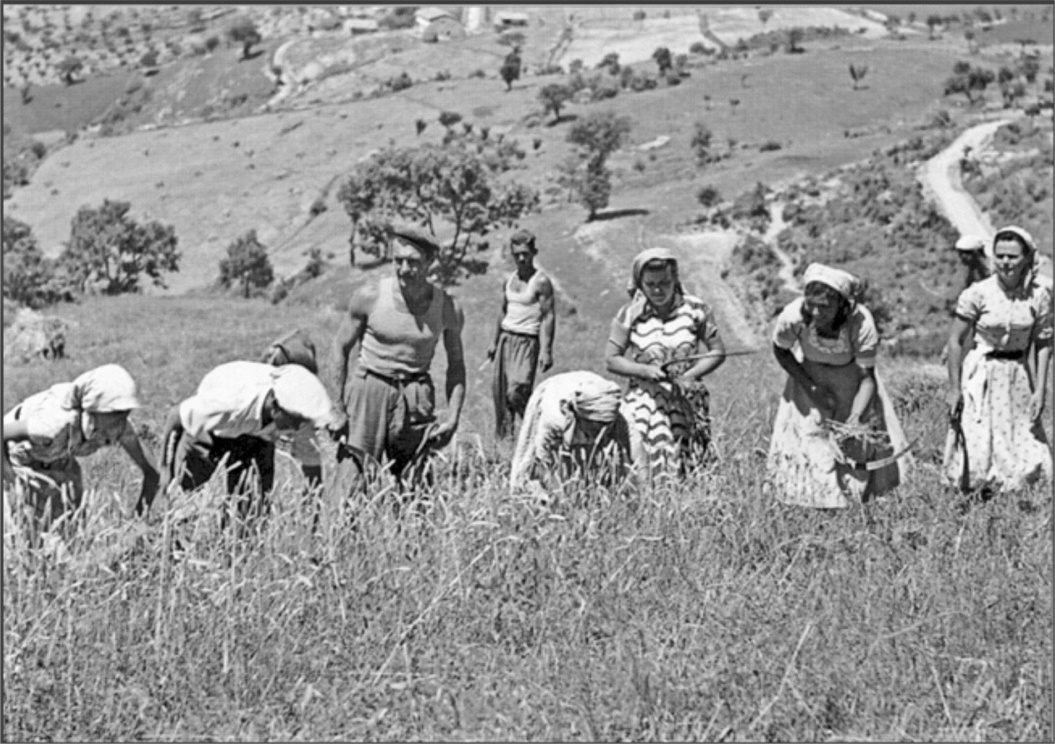
In practice, mechanisation on farms appears to have been somewhat haphazard and slow. Henri Desplanques’ major work on Umbria, published in 1969, reviews the spread of motor-powered farm equipment across the region. His photograph of harvesters with sickles in the hills above Assisi is shown in Figure 1.
Henri Desplanques, ‘Assisi. Squadra di mietitori in alta collina’ (1958). Source: Archivio fotografico del consiglio regionale dell’Umbria.

Having discussed the different techniques and equipment for ploughing, he turns to other machinery:
The other products of mechanisation are establishing themselves with greater difficulty. Machines for seeding, cutting, reaping, and threshing are little by little making their way onto the larger estates. In 1957–58, at reaping time, one could go for kilometres through the grain fields without coming across motorized reapers: even in the plains the grain was more often cut with sickles than with a cutting machine [. . .].
In 1961, on a large estate near Lake Trasimeno, the agent talked of the use of a reaper-binder over the previous four years as a great victory, and said that hill farms were still using cutting machines and sickles. In 1964, in the high hill land of Gubbio's Buranese area, they were using the ‘treggia’ and the tractor, the threshing flail and the double Brabant plough, and reaping the grain with both the sickle and the reaper-binder.Footnote 21
Thus traditional equipment such as the treggia, the wide wooden sledge-like platform drawn by oxen or mules to transport heavy loads in hilly country, continued to coexist with more modern machinery. The latter was not always more suitable, particularly on steeper or more uneven land. When Desplanques was writing, for example, there was uncertainty about the longer term consequences of the use of tractors on hillsides. Above a certain gradient the tractors could not plough across the slope for risk of overturning, and so ploughed up and down, arguably contributing to soil erosion. It was already clear that the introduction of tractors was incompatible with the traditional style of planting diverse crops in close proximity, in particular with the lines of trees, supporting vines, that broke up sowings of other crops. Motorised ploughing went deeper, damaging tree roots, and over time the appearance of the landscape changed. Mixed cultivation for self-sufficiency was replaced by specialisation and production for the market.
Desplanques charts the growth of the tractor population in the province of Perugia, shown in Table 1. In the seven years after 1950 this almost tripled, and then doubled again over the next eight. The most spectacular invader of the landscape was however the mietitrebbiatrice, the combine harvester. In 1961 there were just three of these in the province, but by 1965 there were eighty-six. Desplanques comments that ‘Evolution proceeds at a pace Umbria has never known before; even in places where only the sickle was used in 1956–1957, we saw combine harvesters working in 1964’.Footnote 22 Desplanques does not suggest that mechanisation was a ‘push’ factor in the rural exodus but rather that the exodus provided the spur for mechanisation. He says that ownership of a tractor could not be cost-effective for the small landowner, but suggests that there were other factors in play:
Besides, motorisation has become an absolute necessity because of the rural exodus. And at the same time, it is something that enthuses people. Owners of 5 to 6 hectares want their own tractor, and in such cases it is obvious that its use is neither necessary nor profitable. There are peasants who go to work on a scooter or in a car.Footnote 23
Small farmers would have done better to hire tractors as necessary, or buy them collectively, but seem to have been drawn to acquire them by their perceived status and modernity. It was no longer possible to be unaware of the increased availability of consumer goods, nor of the fact that Italians generally had more disposable income. Cardini says that between 1948 and 1971, the number of cars in circulation in Italy rose from three hundred thousand to ten million.Footnote 24 The anthropologist Sydel Silverman, returning in 1971 to the small town in Umbria where she had done her research ten years earlier, noted the changes in consumption and the extent and nature of people's possessions:
The shops had all expanded their wares, and a new general store offered an elaborate selection of luxury foods, as well as toys and other merchandise not sold in Montecastello in the past. The variety of items and fresh foods suggested that goods were now trucked in frequently. [. . .] It had become usual for families to eat a second complete dinner, instead of the light evening meal that had formerly sufficed for all but the elite. Almost half the houses in the commune had bathrooms, as compared to only a tenth in 1961. Automobiles were now as common as motorcycles and scooters had been ten years before, and many of the autos were owned by peasants. In the evenings the sound of television sets could be heard from many houses, instead of only a few.Footnote 25
Mechanisation seems sometimes to have been part of an attempt to retain the disappearing workforce. Adolfo Barbi, born in 1934, whose family owned five farms dispersed around the Gubbio countryside, described the attempts made by his father, who lived on his military pension and the farming income, to improve conditions:
The landowners, when they found themselves facing these enormous difficulties, sought to adapt, to improve the living conditions of the peasant. As I sought, with my father, at both La Spada and Padule [two of the farms], to put in toilets for the peasants, then . . . to improve the sanitary conditions, to clean out the house, and so on. And then to call in outside workers, to work the land, to remove the difficulty of working the land with oxen. He was called the trattorista, this third party who would work the land and so on. Then in the meantime, landowners were buying the . . . sowing machine, the machine to sow the grain . . . [. . .] So, to take away the hard work from the peasant, d’you see? To improve his living conditions, although not everybody did this [. . .]. The most responsible ones were also perhaps pushed by their children, the older people, it was I who pushed my father into improving these things; I’d not long since graduated in Agrarian Sciences, so I knew this world well, and some people were starting to change things a bit. The toilet, the tractor, working the land, relief of various sorts, improvements in living conditions. However none of this was enough for the peasant. Because even if living conditions improved a bit, earnings were what they were. Income was perhaps improved, as logically with the help of the tractor production was a bit higher, and so on, but there was still a big gap between the very low earnings of the peasant, of the sharecropper, in relation to the man working in Milan or Turin. Lots went to Fiat, lots abroad, and so on. A sharecropper might close the yearly accounts with two or three hundred thousand lire, or just a hundred thousand, while up there someone could send home two or three million.Footnote 26
One of the Barbi farms, in the hills, had been abandoned by the sharecropper, and in 1960 they found another family who were willing to take on the farm as sharecroppers if certain improvements were made. Adolfo oversaw considerable expenditure on running pipes underground and through a wood to bring water to the farmhouse from a spring a kilometre and a half away. After two years, however, this family also left:
The point is this, that landowner sought to make improvements, to improve living conditions, but these were totally insufficient and just palliatives, as one might say, because the gap was too big. So, at some point, people left . . . people left, and so . . . .Footnote 27
Adolfo was himself forced to take a different course. While the Barbi family could improve conditions on the farms, they were not able to consolidate their land to make it suitable for large-scale mechanised farming. The five separate units were no longer viable, either for the tenants or for the landowners. Although Adolfo had graduated in Agrarian Sciences, he became a schoolteacher, selling these farms in the 1970s and ending the family's association with the land.
Tractor numbers, Province of Perugia, Reference Pretelli and Sergio1924 to 1965.

Source: Desplanques, Campagne umbre.
Stepping outside the sharecropping contract
A frequent development outside the sharecropper's relationship with the landowner, described earlier by Franca Carloni, was the acquisition of a tractor which could then be hired out to other farms. This was rather different to the old style of collaboration between farms, seen in the exchange of labour at harvest time, as it involved payment in cash. This development is described in several of the accounts collected by Cascia and Montesi on behalf of the Marche section of the Confederazione Italiana Agricoltori (CIA), to which many farmers previously active in the sharecroppers’ union belonged. By its nature this edited collection presents success stories, but within these the uneven development of a more market-oriented agriculture can be discerned. One such account is that of Emilio Eusebi, born in 1935, whose parents and grandparents had been sharecroppers on the same farm of eight hectares outside Fano. When the landowner and then his widow died, the land was left to a charitable body, the Istituto Cante di Montevecchio, and Emilio felt that the transfer brought with it progress:
The new agent, who looked after the interests of the Istituto, showed more initiative than his predecessor, giving a clearer priority to investment in mechanisation; this new approach initiated more rational and profitable production. We started to work with greater satisfaction: certainly there was more work, but less struggle, which was a fundamental difference. We started growing strawberries and potatoes; we were able to widen the range of production.Footnote 28
While the agent was modernising the farm and encouraging the cultivation of new crops, the Eusebi family stepped outside the sharecropping relationship to purchase a tractor and supplement their income by working for other farmers:
We also threw ourselves into work as outside contractors, and in fact we bought some machinery, of a higher specification than was necessary for our own farm, so as to be able to provide particular services to farmers. We undertook this activity with the Tre Ponti cooperative, which dealt with the threshing process and got together about 35 partners, mainly sharecroppers. [. . .] We bought our first tractor in 1965, on our own rather than jointly with the landowner; before that we’d bought a motorised cultivator, in 1963.Footnote 29
The family were not able to buy the land until 1983. They remained as sharecroppers until the legislation of 1982 that provided for the conversion of any residual sharecropping contracts into rental agreements, then for a brief period they rented the land. According to Emilio they continued to rent their machinery out until the late 1980s.
Other contoterzisti (outside contractors) were Franco Cicarilli and his brother:
In 1968–69, the difficulties had not improved; so I and my brother Giorgio decided to buy a tractor to plough as outside contractors, alongside managing the land we were sharecroppers on. In 1970 we bought another tractor with equipment for manure and for beet. Meanwhile we’d taken on five more hectares, previously farmed by a relative, still as sharecroppers. The work as contractors carried on until 1974, the year we bought the farm which we’re still working on today.Footnote 30
The 1964 law on sharecropping stated that while contracts could be renewed, no new sharecropping contracts could be agreed, thus in effect determining that sharecropping would slowly wither away. It also removed the need for the landowner's permission for changes in the composition of the sharecropping family.Footnote 31 Previously, a family head who signed a new contract with a landowner would have provided details of the family composition as evidence of its productive capacity in relation both to the terrain to be farmed, and to its own consumption needs. The family was listed in the sharecropping account book by age and gender, with females, elderly and younger family members reckoned as worth varying proportions of an adult male. Family members would be expected not to work outside that farm, other than when exchanging labour with other farms at harvest time. Transgression of these expectations would have been sufficient reason for the landowner to consider serving notice to a family. By 1964, however, such restrictions were no longer seen as justifiable, nor were they enforceable. It had become harder for landowners or their agents to find families whose composition precisely matched the size of the farm available. In addition, mechanisation meant that the old relationships between family size and area to be cultivated no longer held true. This aspect of the 1964 law was not, however, recalled as important in interviews with former sharecroppers, in contrast to the Lodo De Gasperi of 1946, presumably because it simply recognised a new reality that was already widely accepted on both sides.
Mechanisation and the Antoniucci family
The slow process of the mechanisation of agriculture in central Italy can be effectively illustrated by the stories of individual families such as the Antoniucci. Vittorio Antoniucci of Mercatello sul Metauro, born in 1936, is one of those who managed to stay working the land, at one point only narrowly avoiding departure for work elsewhere. Like Emilio Eusebi, mentioned above, Vittorio and his family remained sharecroppers until the passing of the 1982 law and the enforced conversion of full time sharecropping contracts into rental agreements. Vittorio's account illustrates how changing conditions in the countryside itself, not just elsewhere, enabled some people to remain and still meet increased expectations of a better standard of living. On 11th November 1952, when Vittorio was sixteen, the Antoniucci family moved from a farm at Brancaleone to Valdivatica, as sharecroppers to the Collegiata, the main church of Mercatello. They had been forced to move many times from farm to farm until they had been able to strengthen the family composition and its labour force. Valdivatica had nine hectares of cultivatable fields and a further twenty of woodland, to be cut in rotation at a hectare a year. As the new agricultural year started, the Antoniucci replaced a family which no longer had a large enough workforce. At this point there were eleven of them: the family head Giuseppe; his wife Margherita Bravi; Giuseppe's unmarried brother Luigi; and Giuseppe and Margherita's eight children. Vittorio was the fourth child, and the first son.
Although tractors and other machinery were being exhibited in 1951 at the Pesaro convention, this technology was slow to penetrate the Apennine valleys. Interviewed by Marchetti, Vittorio and his brother Felice recalled their ‘amazement when in about 1955, as teenagers, we saw a tractor ploughing the fields for the first time. It was using the plough that the oxen used.’Footnote 32 The family's mechanised transport had consisted of one bicycle between them. Vittorio said that his first experience of a coach journey was his departure for national service in 1958. Mercatello's centre lay on the road that snaked inland up the Metauro valley to cross the main Apennine ridge and descend into the upper Tiber valley. The Valdivatica farmhouse was located only two fields above this road, which meant that when the electricity supply started to spread into the countryside they were early beneficiaries. This came to the farm, initially with a very weak current, in 1958 or 1959, Vittorio said, replacing a lighting system based on carbide which itself had replaced candles and oil lamps soon after the family took on the farm.
Running water was slower to arrive in the house. The family had always been able to get water from the river, less than half a kilometre below, and water their livestock there. In 1963, when Vittorio was about to get married, he noticed a long hosepipe after visiting the council offices in Mercatello. By this time he was head of the household since his father had died, and his mother was in failing health. The pipe was a revelation: he said that he could see for the first time a way to bring running water right into the house:
The first pipe – long and unbroken – I saw in 1963. [. . .] When I came out to go home, I saw right in front of me a woman who had a small ironmongery shop. She had this long pipe . . . I was amazed [. . .]. It was a hundred metres: no one in the village had ever seen anything like it. I bought it. I spoke to the woman, who was very considerate . . . ‘The day after I get married I’ll be getting some money, if you can wait for me’. It was a surprise. More for my mother than for my wife. We’d discovered, where it still is now, but before there was nothing, then it was discovered by chance among the rocks, [. . .] among the vegetation. Among the animal tracks we discovered that there was water. I went behind, and found the little spring, which is still there and provides drinking water. Well, with that pipe . . . . [. . .] I took a wife, and . . . I took her in November, 24 November, and then went to visit an aunt in Modena, for my honeymoon. I came back and channelled the water into the house. What a celebration! A great success, and my mother was in tears.Footnote 33
At about the same time, in 1963, Vittorio said that he acquired a motorised chainsaw, which was his first significant mechanical innovation: ‘It was a revolution’.Footnote 34 Previously they had used axes to thin a portion of the woodland each year. Not only was the chainsaw far quicker and less exhausting, but less wood was lost in the cutting. Further mechanisation was gradual, with each step having to be financed. The next acquisition was a cutting machine, which Vittorio remembered as being in about 1965:
First, I had the cutter to cut hay and grain. Then there was a motorised cutter that came out, with a system which also tied up the grain, a binder, so I bought that . . . it used to make little stooks. And to pay for it, using my own resources, I started to work as an outside contractor. I went to work for other people, and it was hard, but I managed to do it. Then . . . then, the motorised cutter that I got in 1965 or 1966. And then, in 1972 . . . I had a friendship with a well-to-do gentleman, De Rossi, and as he used to push me on, he’d say ‘as for that equipment, buy it’, I got the tractor, which caused a scandal in the village: a farmer, a peasant, who lets himself get a tractor. People came from the priest, to give me advice. [. . .] And I started to get going. The motorised cutter brought me the tractor, the caterpillar tractor that I’ve still got, although later I got a bigger one [. . .]. And after this, from the caterpillar tractor, I got a tractor with tyres, which I’ve also still got. I got a system for putting equipment on the back, which cost me a pile of money.Footnote 35
Vittorio's acquisition of his first tractor in 1972 was his biggest expense, and confirmed the absolute rupture of the exclusive relationship between his family and the land they were contracted to farm as sharecroppers: a relationship that had been weakening over the previous decade. The tractor was to work both the land at Valdivatica and that belonging to others, and its purchase could only be justified on this basis. The fact that people apparently went to the priest, Vittorio's landowner, to express their disapproval suggests that such innovations met with suspicion and dismay at what this purchase represented. Although backed by his friend, Vittorio still had to sell two animals to put down the deposit, and paid the loan back in instalments over five years.
Vittorio remained at home apart from when he went to do his national service, but he was the only one of his parents’ four male children who did not at some point leave for work elsewhere. His continued presence at Valdivatica, where he took responsibility for looking after his mother following his father's death, was at times precarious. At one point, he said, he came very close to having to leave. A fire in a haystack was followed by hail damage at the critical point of the harvest, and Vittorio prepared to go to work in Riccione on the Adriatic coast. The family were able to save more of the harvest than they had initially feared, however, and he was able to stay. His success in staying on the farm was for him, in retrospect, a source of pride:
Back then there was absolute poverty, and it had been a big disaster. However, we stayed here, and I’m very satisfied by that. It gave a lot of pleasure to my mother that I had been . . . hard, to stay and hold the reins in my hand, to hold onto . . . the place. She wanted me to stay close, and I’m happy that I could stay there. Perhaps there aren't many like me, perhaps they laugh at me, but if I was to have to start again from scratch, knowing what I do, I’d take the same path again. Even if it hasn't brought me much money, I don't . . . it's always made me feel at peace.Footnote 36
While Vittorio was able to secure permanent accommodation for the family, he was not able to acquire the land. The Antoniucci family remained sharecroppers until after the 1982 law on sharecropping, when they entered a rental agreement with the Church. This was still in place when I interviewed Vittorio in 2007. The local office of the Church body, which took over land management from individual parishes in 1985, allowed the Antoniucci family to buy the farmhouse and a belt of land immediately around it, thus divesting the Church of the costs of maintaining the buildings. However, it was apparently unwilling to sell the fields and woods. Ownership of the land on which the house stood allowed the family to develop the site, and in time create a new house for Vittorio's son where old farm buildings had stood.
By 1970, sharecroppers seldom only worked the land from their tenancy: for Vittorio and others, it was the work outside the sharecropping contract that made farming viable and provided an acceptable standard of living, and it was mechanisation that made this possible.
Conclusions
‘È stata una rivoluzione’ (It was a revolution), Vittorio Antoniucci said of his acquisition of a motorised chainsaw in 1963, and he told of a series of subsequent purchases which saw him working for other people as well as on the family's sharecropping tenancy. Until the 1950s, almost all farming activity in the sharecropping regions of central Italy were still powered by human or animal labour. As farmers acquired motorised machinery in response to the departure of much of the agricultural workforce, the relationship between the farmer and the land changed rapidly. Large farming families were no longer needed for the small farms, nor were teams of extra workers required at harvest time. The process of mechanisation, and its consequences, can be contrasted with the political action that sharecroppers engaged in after 1945. This sought to improve their position, mainly by changes to the sharecropping contract in favour of peasant families, but was ultimately overtaken by wider processes of change. Particular aspects of this contract may have inhibited the development of agriculture. Although in practice sharecropper families often stayed on the same farm for many years, the annual nature of the contract and the perpetual threat of its non-renewal militated against longer-term investment in expensive machinery, and there were disputes over who was responsible for this type of investment. Furthermore, peasant families were accustomed to living their lives largely without recourse to cash, and had no way of making large purchases.
Mechanisation seems to have been largely a response to other changes, as we have seen in Adolfo Barbi's account of his family's attempts to retain sharecroppers on their land. Desplanques’ survey of Umbrian agriculture paints a picture of rapid but uneven change, and the individual stories of farmers show how gradual the process could be. However, the changes mechanisation brought were irreversible. It increased the speed at which tasks could be carried out and progressively removed the need for squads of workers in the fields at every stage of the cycle of sowing, tending, and harvesting crops. The technological and political processes were not independent: responsibility for modernisation and its cost was one of the issues debated between sharecropper and landowner organisations.
By the 1960s, the exodus from the countryside meant that there was no longer a reserve of families ready to take on vacant sharecropping farms. Landowners had to allow farming families more flexibility, and this shift was acknowledged in the law of 1964 which recognised performance of the task rather than family composition as the criterion by which satisfactory conduct in a sharecropping tenancy should be judged. I have quoted several accounts of sharecroppers starting to work outside the sharecropping contract. It was only this and their acquisition of machinery that could lift them above subsistence levels and make a farming life still acceptable. In 1964, it must have seemed that sharecropping would quietly and quickly disappear as contracts came to an end, and would be superseded by rental agreements or the peasant's purchase of the land. A further law was in fact needed in 1982 to enforce the replacement of any remaining sharecropping contracts with rental agreements. Land farmed under sharecropping had continued to dwindle, but the tradition had proved surprisingly resistant. This was only possible, however, because the exclusive relationship between sharecroppers and the land they contracted to farm had long since been broken, and farming families could operate both outside and within the sharecropping contract.
Acknowledgements
This article is based on doctoral research at University College London, funded by the Arts and Humanities Research Council.