I. INTRODUCTION
Settlement law provides the background for some of the most contentious but fruitful areas of research in early modern English social history. The system of settlement or ‘belonging’ to a home parish was a relatively late development of the Tudor poor laws, and was designed to determine responsibility for all paupers or potential paupers. In theory, every individual had a legal ‘settlement’ which was earned or inherited in one of a number of different ways (including paying local rates (taxes), office-holding, marriage, apprenticeship and, in certain cases, birth), and which could be superseded by another if the individual fulfilled one of the requirements elsewhere.Footnote 1 Responsibility for maintaining the indigent was with the parish of settlement, and migrants needing relief elsewhere could be removed back to where they belonged. The system thus allowed for the mobility of useful hands, and divorced it from vagrancy.Footnote 2 In fact, the reality was more complex, relying (at least theoretically) on public notification of arrival in a new parish, the presentation of certificates from the home parish acknowledging responsibility for the migrant, ambiguity over who was ‘likely to become chargeable’ and was thus eligible for removal and the not insignificant costs of sending paupers home. Some of these problems were at least theoretically smoothed out in amending legislation of 1795, which stated that paupers ‘likely to be’, as opposed to ‘actually’, chargeable could not be removed, although this also removed the discretion of parish officers to regulate migration in the same way.Footnote 3 Opinions on the usefulness of the settlement and removal laws as tools of labour migration have been very varied, and the legacy of contemporary criticisms of its stifling action on economic growth has continued to cast a long shadow.Footnote 4
Most of the attention on removals and settlement law has focused on the early industrial period; the later eighteenth and early nineteenth centuries in England. Changed labour markets, greater wage dependency and a decline in agricultural employment had all greatly altered both the risks of poverty and the way that people accessed work and moved to find it. This changed employment market, coupled with rising concerns about the costs of poor relief resulted in a tightening up of the ways to gain a new settlement.Footnote 5 This forms part of the argument about settlement law acting as a brake on migration and the free functioning of labour markets. Poor law officials and employers were eager to avoid the burden of an increasing number of transient and wage-dependent labourers, and apparently colluded to avoid giving the critical year's employment contract to incomers (or ‘sojourners’). A waning in the completion rate for apprenticeships also reduced the chance of gaining a settlement on this basis, and office-holding was restricted for the same reasons. Many more people came to rely on settlements they had inherited from parents – or even grandparents if the parents had also failed to establish an independent settlement. If the person in question had migrated away since this original settlement was gained, this could mean ‘belonging’ to a place to which they had no ties of their own, and maybe had never even visited. A further corollary of the decrease in opportunities to gain a new settlement was that migrants were less likely to be able to become settled when they did move, so increasing their vulnerability to removal if they became poor, and the likelihood that their children would be attached to a place they had perhaps never been to.
The settlement and associated removals system did, however, generate a large amount of first-person documentation, and historians are coming to realize its enormous potential in shedding further light on these matters. J. S. Taylor, and subsequently Steven King, Tom Sokoll and Alannah Tomkins, have drawn attention to the numerous letters that survive in local record offices from paupers who were not resident in their place of belonging, but who negotiated relief from their parish of settlement to maintain them where they were.Footnote 6 This work illustrates not only that indigence outside one's parish of settlement did not necessarily bring about a removal order, but also that poverty was mutated and varied according to stages in the life cycle. Child-bearing, child-rearing and old age were particularly straitened times for the poor, and families went through a multiplicity of extended and nuclear forms at different times. So far, however, this work has focused on the indigent who managed to negotiate to stay where they were; we have yet to investigate the ways in which poor families were affected by being removed back to their parish of settlement. Other historians have focused specifically on working-age adults and removals in order to make broader statements about poverty and labour supply, but this has removed our gaze further from how whole families were affected.Footnote 7 We still have little idea about how common it was for whole domestic groups to be passed on – or broken up – and what this can tell us about migration, indigence and attitudes to poor families. Landau and Taylor have both noted that single women with children were subjected to removals and that married men with children were common among those examined for settlement, but we have yet to quantify or probe more deeply into how far the system brought about family disintegration.Footnote 8 Yet the information exists, and reveals that removals did affect a very large number of families with young children in late-eighteenth- and early-nineteenth-century London, many more than the focus on working-age adults in the historiography would have us believe. The critical factor that affected their treatment in law for almost the whole period of the Old Poor Law was whether they were bound together by marriage – but analysis reveals a significant amount of discretion in reality, which was probably based on a weighing of costs and attitudes towards different types of paupers, and on negotiation between the two parishes involved.
Marriage was the vital hook on which to hang the integrity of the family bond for the poor in settlement law, because it conferred a common place of belonging on all its members. Women took their husband's settlement on marriage, and all legitimate children inherited that of their father. What this reveals about attitudes and conceptualizations of the poor family per se must remain debatable. The poor laws were based on an assumption that families would look after their own members; indeed, parents, grandparents and children all had legal obligations of care in need, although they were not always in a position to fulfil them in reality.Footnote 9 By the later eighteenth century the poor family was, however, viewed with some ambivalence by policy-makers. Reformers were concerned that parents could pass on a tendency to fecklessness and poverty to their children, and this fear fed directly into the separation of spouses and children in workhouses and to the provisions for the boarding out of children after the Poor Law Amendment Act of 1834.Footnote 10 Nonetheless, views on the poor family as a unit tended not to be overtly debated or formulated in this period, and we must rely on practice to reveal attitudes. In England, pragmatism and a relatively low level of social policing tended to prevail under the Old Poor Law, giving considerable flexibility to family forms among the poor. Rates of illegitimate birth and pre-marital conceptions were high in England in the early modern period, and there is little evidence of overt persecution of unmarried mothers by the eighteenth century.Footnote 11 Parish officials tended to be pragmatic in their treatment of illegitimate children, preferring to have them brought up by their mothers and supported by the putative father if possible rather than removing them.Footnote 12 This was in marked contrast with certain areas of the European Continent, where social and cultural mores strictly forbade such a public flouting of family ideals.Footnote 13
Flexibility may have been the watchword, but removal law, at least up to 1795, put the unmarried family at risk of separation. Its members did not necessarily share their place of legal belonging, and the weight of settlement law was brought to bear on them in order to determine where responsibility for the individual members lay. Unmarried women did not take the settlement of their partner even if they had children together and, while illegitimate children inherited their father's place of settlement if he could be traced, they otherwise took that of the place where they were born.Footnote 14 In either case, they had a strong chance of not sharing a settlement with their mother, especially if she had migrated away from her home parish for work, or to bear her child in secret. The potential for domestic disintegration in law was, however, mitigated for young children by a rare and explicit mandate in favour of the integrity of the poor family: a clause that allowed children under seven to remain with their mother ‘for nurture’ even where they had different parishes of settlement.Footnote 15 This clause undoubtedly had practical advantages for the parish where the child legally belonged since it could pass on responsibility for it elsewhere (although they were still expected to pay for its relief, and the child's settlement in that parish and therefore future right to relief remained unchanged), but it is also a clear direction for parish officials to respect the rights of mothers and dependent children to remain together. By the later eighteenth century this had been joined by two laws propelled through Parliament by Jonas Hanway for London parishes to keep better care of poor infants and young children, further demonstrating a heightened emphasis on the nurture and survival of the young.Footnote 16 Significantly, the allowance to remain with the mother under removal law extended well beyond the period of breast-feeding, indicating that dependence was considered much more than a strictly biological matter. This clause is noted in passing by several scholars, but its implementation and implications have not been rigorously tested.
This sympathy towards mothers and young illegitimate children (even if based as much on pragmatism as on sentiment) was further underpinned in a clause within the 1795 Poor Removal Act which stated that if an unmarried pregnant woman was under order of removal at the time of the birth of her child, the child was given her parish of settlement.Footnote 17 This was designed to address the inhumane practice of harrying heavily pregnant unmarried women across parish boundaries in order to avoid taking on responsibility for their infants. It was another mandate to treat mothers and children with sympathy, although its effects have not been examined in practice. It meant that by the last decades of the Old Poor Law, even certain groups of illegitimate children – the under-sevens and those whose mothers were under order of removal at the time of the birth – had a secure position in law when it came to remaining with their mother.
Settlement law thus brought a host of implications for families, which were different than those for single adults and which were further complicated for some unmarried mothers and illegitimate children. This article examines the relationship between removals and the integrity of poor families who came under the remit of two large London parishes towards the end of the Old Poor Law period, and spanning the legal changes in settlement law in 1795: St Luke Chelsea and St Clement Danes. It asks three questions in particular: first, what types of families were affected by the removals system; secondly, how did this experience and also the risk of enforced separation differ according to the composition of the family (married, unmarried, widowed and deserted, with younger children or older, children without parents); thirdly, what can this reveal about contemporary attitudes and practices towards the mother–child bond and the poor family more widely, and whether this changed over time? The background of changing economic circumstances and the raised profile given to child survival will be significant, as will the particular setting of the metropolitan parish.
II. THE PARISHES AND SOURCES
The two parishes of St Luke Chelsea and St Clement Danes were selected for the quality of their records on settlement and removal, and for their contrasts in socio-economic type. Both were large parishes: as indicated in Table 1, St Luke's had a population of 11,604 in 1801 and St Clement's 12,861. While both parishes grew in population over the next few decades, St Luke's expanded at a significantly greater rate, suggesting that there were key differences in economic opportunities and in-migration in the two parishes, as will be explored further below.Footnote 18 Both have removal orders and settlement examinations extant for concurrent periods: a vital consideration for this study since linkage between the two types of records provides much extra information on family composition.Footnote 19 Each also had a workhouse and supported large numbers of locally settled poor.Footnote 20
Population and coverage of removal orders in the parishes of St Luke Chelsea and St Clement Danes

a See the text for details of the sample.
Sources: Population figures from Abstract of returns relative to the poor, 1804 (British Library, 433.i.12); St Clement Danes Certificates to Move, City of Westminster Archive Centre, B1246; St Luke Chelsea Removal Orders, London Metropolitan Archive, P74/LUK/140.
Variations in employment opportunities in the two parishes would have affected their attraction for migrants, and their risks of poverty and pre-marital pregnancy once migrants had arrived (the latter another potential precipitating factor for indigenceFootnote 21). St Luke's was not yet quite the well-heeled place it later became, but it housed some fashionable residences and places of leisure including the popular Ranelagh Gardens, creating a demand for domestic servants and those serving the leisure industries.Footnote 22 It also had a strong agricultural sector, supplying much of London's market produce, but contained significant pockets of poor housing.Footnote 23 St Clement's, in contrast, lay in the heart of Westminster's legal district and so had quite a different occupational profile. It might have lacked St Luke's grand and fashionable houses, but it would be wrong to characterize it as poor: the proportion of the population in domestic service was actually higher in St Clement's than in St Luke's by the time of the 1831 census (the first to outline occupations): 8.6 compared with 6.8 per cent.Footnote 24 Furthermore, a larger share of these servants were women in St Clement's, again suggesting a high level of wealth among employers, as well as a demand for female labour. These opportunities did not translate evenly into population growth, however, as has already been mentioned. The more rapid growth of St Luke's suggests that employment opportunities here were more attractive or more easily realized, while perhaps also being more conducive to the creation or maintenance of large families. At an aggregate level as well, St Luke's was the richer parish: the annual value of its rateable property in 1815 was almost double that per head of population compared with the equivalent figure for St Clement's.Footnote 25
These differences are apparent in other indicators of socio-economic profile as well. St Clement's was known for its large and poor Irish population, for example, who were unlikely to hold settlements under English law.Footnote 26 This is confirmed in the dataset in this article, with 82 Irish individuals recorded in the St Clement's register of removal orders, and none in St Luke's. Their presence highlights that there was poverty present in the parish of St Clement's, and also perhaps that it was sympathetic to giving casual relief. St Luke's, in contrast, housed the Royal Chelsea Hospital, a large provider of indoor and outdoor welfare for the non-settled and ‘deserving’ poor, which probably also raised the number of pensioners' dependent poor wives and children locally.Footnote 27
In terms of source material, it has already been noted that both parishes have settlement examinations and removal orders extant. Settlement examinations were the result of face-to-face interviews to establish where each pauper or potential pauper belonged, while removal orders were the legal instrument to return him or her there if that was a different parish. In the current dataset, the settlement examination almost invariably preceded the removal order by only a matter of days, suggesting that the removal order was prompted by actual rather than potential indigence.Footnote 28 A more pertinent question for the current investigation is whether a removal order was always put into practice. In some cases a note states that it was, and in others that it was contested at the Quarter Sessions. The lack of subsequent appearances in the examination books implies that the majority were carried out, however.
There are two further significant points of difference in the two samples. The first is that while the St Luke's sample covers removals both into (41 per cent) and out of (59 per cent) the parish, that for St Clement's almost exclusively covers those removed out – only two concern removals into the parish. This may have a bearing on the patterns they reveal, but comparison will be made only with those removed from St Luke's in order to investigate this. Removal orders were fairly standard in their details, and in fact were often filled in on a printed pro forma, although a smaller number were handwritten letters. The most common pieces of information recorded were the name and parish of origin of the pauper or head of the pauper family, their current location, whether they had family with them and, sometimes, their names and age(s). Frequently, however, the order noted simply the presence of an adult pauper ‘and family’ or ‘and children’, and so links could only be made for this study via a manual search for corresponding settlement examinations in all these cases in order to maximize the information on dependent family members. This had a success rate of 86.2 per cent for the St Clement's dataset and of 37.7 per cent for St Luke's, almost all concerning people being removed from the parish.Footnote 29 The examinations of those being returned to St Luke's probably remained in the parish whence they came. This record linkage is thus vital for providing further detail on family members, their ages, and circumstances. The settlement examinations flesh out the minimal and formulaic detail of removals to create much fuller vignettes of the circumstances of the non-settled and indigent. They also make clear how far removals were a reality for families as well as for single adults.
The second point of difference is the time period covered by the records. In particular, while the data for St Clement's cover the mid- to late eighteenth century – a period starting with the Seven Years War, continuing into a time of peace, then encountering the disruption to overseas markets caused by the American War of Independence, and ending with a time of rising prices and poverty – that for St Luke's focuses entirely on the latter end of the period and coincides also with the years of the Napoleonic Wars. This is also likely to have had an impact on employment opportunities, risks of poverty and reactions to the indigent or potentially indigent from poor law authorities. Wartime recruitment, for example, removed many fathers from their families but brought fuller employment for those left behind. It also had an impact on overseas markets for English goods, and the early nineteenth century further witnessed shortages of coinage alongside poor harvests and rising levels of poverty. The resultant increased demand for poor relief led to what has been seen as a hardening of attitudes towards the poor, and especially the unemployed able-bodied, which may have been played out in policies on removals.Footnote 30 Moreover, it is important to note that the two datasets also lie either side of the amending poor law legislation of 1795 which mandated that only those actually indigent should be removed, and that illegitimate children of a mother under a removal order inherited their mother's settlement. The impact of the latter change will be muted by the fact that only removals including live children are included in this investigation, however. Nonetheless, the period of coverage will allow some appraisal of whether the change in legal attitude towards the children most vulnerable to separate removal had any effect on practice. This legal change also placed the expense of removing a pauper onto the parish that ordered the removal rather than on the parish of settlement as before, which might have affected the inclination of parish officers to remove paupers at all, although the impact of this change on families with children in particular is hard to discern.Footnote 31 Although the differences in coverage in these two samples are driven by record-survival, therefore, it allows us an opportunity to reflect on the impact of wider socio-economic and legal trends on the workings of the removals system and on attitudes towards poor families.
III. THE FAMILY COMPOSITION OF THE REMOVED PAUPERS
Analysis of the individuals covered by removal orders reveals immediately that the young were a significant presence among those who were passed on. The definition of a ‘child’ is always problematic, but in this study children are classified as those aged 13 or under, as this corresponds with the average age of apprenticeship for pauper children in London. This age range thus suggests a raised likelihood of dependency on adults, although we certainly should not assume that younger children were not economically productive, or that those over 13 were always independent.Footnote 32 In St Luke's, children of 13 or under made up 44.2 per cent of all the individuals removed (846 individuals), while in St Clement's the equivalent proportion was 25.6 per cent (913 individuals).Footnote 33 Among removals from St Luke's only, children made up 41.0 per cent. It is thus immediately clear that our preoccupation with working-age adults and removals needs to be substantially revised to include a much more varied group of people: a group which included large numbers of children.
The differences between the two parishes raise some interesting further questions. Did the larger proportion of children in the St Luke's sample relate to a higher likelihood of families moving there, for example, while St Clement's offered more opportunities to single adults? Or, rather than providing increased opportunities, did the employment profile in St Luke's present a greater risk of failing to remain independent for those with children? Was St Luke's more stringent in passing families with dependents back to their parish, while St Clement's allowed them to stay? In other words, does the difference reflect the profile of people coming to the parish – the type of people who failed to establish themselves there after they had arrived – or the attitudes of parish officials to the non-settled poor? The difference in time period may also be critical here, with the early decades of the nineteenth century perhaps bringing particular hardship for families with dependent children, and a greater uncertainty as to their ability to make shift for themselves. The possibility that it represented an increased tendency to pass on illegitimate children born in the parish with their mothers will be tested below.
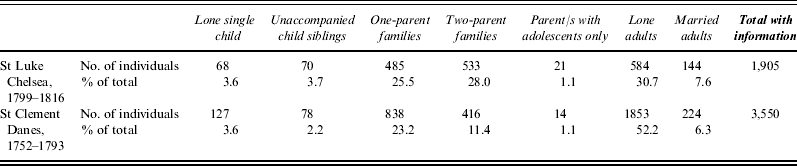
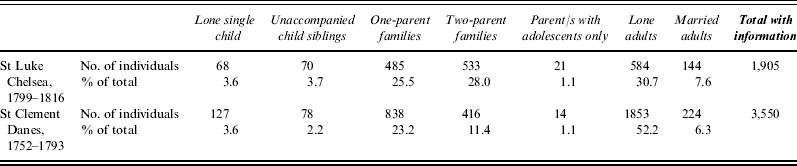
We can approach a closer understanding of some of these issues via a more detailed breakdown of family type in each sample. Each individual was coded according to the family group he or she appeared in, and the results for each parish are shown in Tables 2 and 3.Footnote 34 The data are presented in two different ways. Table 2 indicates the proportion of individuals in each type of family (including ‘lone adults’ and ‘lone children’ – either single or with siblings – as types of family). This method of clustering is not weighted by family size, so large families are up-weighted because each individual is counted separately. Table 3 shows the same data broken down by family unit, regardless of how many people there were per family. This method is a better way of illustrating how common different types of family configurations were, but the former method is a clearer indication of scale in terms of individuals.
Family groupings of paupers appearing in removal orders in the parishes of St Luke Chelsea (1799–1816) and St Clement Danes (1752–1793), by numbers of individualsFootnote a
a Children are classed as being aged 13 or under; adolescents are aged above 13 to 16. See also endnote 34.
Sources: Removal orders as above; St Luke Chelsea settlement examinations, London Municipal Archive, P74/LUK/140–3; St Clement Dane's Examination books, City of Westminster Archive Centre, B1175–90.
Family groupings of paupers appearing in removal orders in the parishes of St Luke Chelsea (1799–1816) and St Clement Danes (1752–1793), by familiesa

a See notes to Table 2.
Sources: As Table 2.
Families containing or composed of children are more prominent when paupers are clustered by individuals than by domestic groups. For example, as shown in Table 2, 28 per cent of all paupers were in two-parent units in St Luke's, but only 11 per cent of all families in the removal orders were of this type. This is because there were more children on average per family than adults, and also there were many lone adults. In both parishes the latter make up the largest category of removed paupers (just under one-third of all individuals in St Luke's and a little over half in St Clement's). As the table indicates, however, in St Luke's this proportion was almost matched by two-parent families (28 per cent), which suggests that the change in law in 1795 amending the settlement of certain illegitimate children was not a major factor behind the differences between the two parishes. Individuals in one-parent families made up another quarter of the total in the St Luke's sample, while unaccompanied children were relatively uncommon although still noteworthy (7.3 per cent in total, both alone and with siblings). In St Clement's things were a little different: as already indicated, lone adults were more prominent (52.2 per cent of all individuals removed) and two-parent families were proportionately a much smaller presence: 11.4 per cent compared with 28 per cent in St Luke's. Unaccompanied children formed 5.8 per cent of the total here, and people in single-parent families were again approximately a quarter of all those removed. Separating out those removed from St Luke's reveals only little difference from the whole sample. While we cannot be sure that the same mechanisms and influences were at work in the two parishes, there is little reason to worry that the broad patterns uncovered for St Clement's would be significantly altered if the data included paupers taken in as well as passed on.
Controlling for family size by grouping individuals by families amplifies these trends. As shown in Table 3, in both cases single adults (three-quarters of whom were women) become still more prominent. In both cases again, single-parent families were the next most common, while in St Luke's, two-parent families featured almost as heavily. Children appearing alone were also slightly more visible when grouped in this way in both parishes. While lone adults are indeed the most common type of family ‘group’ in these records, single-parent families are much more prominent than the previous discussion of removals would suggest. Furthermore, if we keep in mind the people making up these families, parents and children in various configurations become even more significant. In total, approximately half (53.5 per cent) of the individuals removed in St Luke's and one-third (34.6 per cent) in St Clement's were parents and their children, and 7.3 and 5.8 per cent, respectively, were unaccompanied children. As far as the children's own experiences were concerned, the likelihood of being with either one or both parents varied from one parish to the other, while a quarter to a third in both samples were unaccompanied by adults (26 and 29 per cent; not shown in the tables).
In both cases, then, removal was predominately a mechanism for reasserting which parish was responsible for singleton adults and one-parent families. In St Luke's, intact nuclear families were also prominent. Having two adults present almost certainly lowered the background risk of indigence for a family, and also increased the chances of gaining a settlement by continuous service. The change in legislation in 1795 might have played a part in the different patterns seen in the two parishes, in that up to that date (the period covered by the St Clement's data) families with many children could be pre-emptively removed before they became indigent. However, this assumes that one-parent families were regarded with more suspicion than those with two, and this is impossible to prove. Indeed, two-parent families were more likely to continue producing children than those with only one. This distinction must thus remain unproven. There were other explanations for poverty among the non-settled, however, most notably the local employment market and the attitudes of parish officials to different types of paupers. The large proportion of two-parent families passed from St Luke's suggests that the employment market was not particularly conducive to the maintenance of a whole family there despite its greater potential for earning. This fits with the picture of this parish as one with a large presence of live-in single servants, but it might also relate to the straitened circumstances of the early nineteenth century and the increased likelihood of families being truncated by the impressment or desertion of the father to the armed services. In St Clement's, it was single adults who were left without means, although families would also have been at risk of losing the father to the services during the Seven Years War. It is also possible that parish officials differed in the strictness with which they enforced the law of removals, for example tolerating some types of paupers or potential paupers more than others. On the one hand, families with many children needed a higher level of income to remain self-sufficient – especially when the children were very young – but, on the other, single parents had fewer resources to balance earning and childcare. Both posed the threat of becoming long-standing charges on the rates if they were casually relieved. Again, patterns of poverty, employment and law-enforcement may have varied, but the evidence does so far point to different patterns of family poverty among the non-settled in these two parishes.
The significance of the proportion of children among removed paupers is thrown into sharper relief by a comparison with the (settled) workhouse population in St Luke's.Footnote 35 In particular, there was a greater proportion of children among removed paupers than in the institution: 44.2 per cent of individuals removed compared with 27.8 per cent of workhouse entrants between 1743 and 1799. The latter figure corresponds very closely with that found in the institution in St Marylebone at a similar time.Footnote 36 The same pattern is seen in the St Clement's workhouse, although there the proportion of children was much smaller.Footnote 37 In contrast, only 5.3 per cent of children entering the St Luke's institution were with both parents, compared with 39.8 per cent of those in the removal orders. It is likely that both removed paupers and workhouse inmates were among the poorest residents of the parish or they would neither have fallen subject to a removal order nor accepted workhouse incarceration.Footnote 38 Poor but settled families could use the poor law alongside other strategies to make shift, however, including sending their children into the workhouse while they remained outside.Footnote 39 The non-settled poor were liable to removal as soon as they came to the attention of the authorities – a fate which was perhaps also accelerated by the trade restrictions on luxury manufactured goods of the Napoleonic War period, and the lack of compensating industrial expansion in London.
The corollary of these differentiated patterns is that lone children were somewhat more common in the workhouse than among removed paupers. Unaccompanied children (either alone or with siblings) represented 26–29 per cent of all the children removed in the two datasets, while in the St Luke's workhouse they made up 35.3 per cent. The average age of unaccompanied children in the workhouse was older, however: 8.4 years compared with between 5 and 5.5 among those removed. This is striking, but overall the pattern again indicates a difference in the circumstances of both settled and non-settled paupers, and of the treatment of children and adults. Above all, it suggests that children were at greater risk of being separated from parents, albeit perhaps temporarily, if they entered the workhouse than if they were passed back to their parish of settlement. In the next section I will investigate how this risk of separation from parents was mediated among the removed populations of the two parishes, and how it related to legitimacy, orphaning and abandonment.
IV. FAMILY INTEGRITY AND RISKS OF SEPARATION UNDER REMOVAL LAW
It has already been noted that removal orders alone give a fairly bald account of family composition and poverty but that, taken in conjunction with settlement examinations, they start to reveal a more detailed narrative of what had brought the family or individual to a state of indigence. In this section these narratives will be analysed to examine their implications for the treatment of the family as a whole unit and, in particular, whether the removal brought about its further disintegration.
Separation was clearly a greater risk for families who were not bound together by marriage, since they did not necessarily share a settlement. Children under the age of 7, however, should at all times have been spared this risk because of the belief that they needed maternal nurture. In reality, this covered the vast majority of children in both samples: 76 per cent in each parish were aged 7 or under, and the average was actually under 5 years: 4 years and 10 months in St Luke's and 4 years and 9 months in St Clement's. Around a fifth of the children were infants aged 1 or under. Children removed with only one parent had the lowest average age at 4.5 and 4.3 years respectively, while unaccompanied children had the highest – 5.2 and 5.6 years. The age profiles of children in the two parishes – both in total and divided by family type – were thus very similar. The proportion of young children also confirms that the parish risked having to support fairly long-term dependency if they offered them and their families relief. This may have made them more likely to seek to pass children on whenever they could. After 1795 this was accommodated in law in cases where the mother was actually under an order of removal when she gave birth, although such women generally fall into the category of single adults in the dataset here since this was their status when the order was made.
Single-parent families had the greatest risk of separation in the period covered by the data from St Clement's (that is, prior to 1795). These families were overwhelmingly headed by women: only 20 out of 302 single parents in the St Clement's removal register were men (6.6 per cent), and only 9 of 160 in St Luke's (5.6 per cent), most of whom were widowers in both parishes. This supports the impression that women were particularly vulnerable to poverty on bearing an illegitimate child, or on being widowed or deserted, and were perhaps also vulnerable to failing to gain a settlement in a parish to which they had moved. Further investigation reveals, however, that removals data do not support the wider focus in the historical literature on unmarried mothers as welfare recipients. In contrast to the picture of female poverty gained from settlement examinations and workhouse registers, single mothers removed with children were much more likely to be ever-married than unmarried, even if they had been deserted or widowed by the time of the examination. The majority of single-parent families should thus have been safe from the risk of enforced separation when they were removed because they shared a common settlement through the marriage of the parents.
Unmarried women formed only 13 to 14 per cent of all single mothers in both parishes.Footnote 40 Widows were more common: just over a quarter of all cases in both parishes.Footnote 41 Over half of all female-headed single-parent families in this dataset, however, had been abandoned or deserted by their partner, either permanently or temporarily (52 per cent in St Clement's; 56 per cent in St Luke's). A further 5 to 7 per cent of women were married but seem not to have been with their husbands when they were removed, and they gave their own settlement testimony. The similarities between the breakdowns in the two parishes are very striking and point to the significant risks of both poverty and removal for married but deserted women. A similar trend has been found in wider studies of migration for the same period.Footnote 42 The impact of war on family circumstances is confirmed, with several fathers noted as being absent through naval or military service. This could in itself be a way of abandoning a family, but some had been impressed and others may have been using service overseas as a way of earning money to support the family. This form of separation features in both datasets: 8.6 per cent of single mothers in the St Luke's dataset, and 10 per cent in St Clement's (these form part of the 52 and 56 per cent who had been abandoned). The latter dataset, which covers the Seven Years War, was thus even more affected by armed campaigns than the one coinciding with the period of the Napoleonic Wars. Other husbands were in gaol, transported or waiting to be, absent looking for work or ill. Information on the date of absence or desertion is too rarely given to permit comment on whether it was the direct cause of destitution. Unmarried mothers were more likely to have an infant than single mothers as a whole, however, suggesting that child-bearing led rapidly to destitution for the unmarried, and perhaps more than pregnancy out of wedlock per se.Footnote 43 It also suggests that parishes were alert to ordering the prompt removal of unmarried pregnant women (who were automatically deemed to be chargeable by the fact of their pregnancy), precisely to try to escape accepting responsibility for the child.
The high likelihood that the parents of children captured in the records of removal orders in St Luke's and St Clement's were (or had been) married means that most families shared a common settlement. For this reason alone, the separation and removal of young children from their parents is not a frequent occurrence in this dataset. Poor law officials faced with these families did not need to debate the nature of the family bond and the need to preserve it or otherwise; their primary concern was to ascertain where the whole family belonged and pass them back there. Where mother and child did not share a settlement, however, a greater degree of subjectivity was necessary, and the practices of parish officers must be used instead to allow us to draw inferences about attitudes to the integrity of poor families and the significance of the mother–child bond in particular. The earning power of non-settled pauper families and the costs of their removal probably also played a part.
Despite the clear allowance for young children to remain with their mothers, we have seen that approximately 20 per cent of all children were passed on without an adult, and that they comprised around 7 per cent of all removals in total. What is most striking is that this holds true across both parish datasets, which between them cover the amending changes to removal law. The average age of these children was a little over 5 years, indicating that they should legally have remained with their mothers, however. Some of these infants and children were orphaned or deserted, making the clauses on nurture a moot point in any case (38 per cent of lone children were orphaned, deserted or making their own settlement statement, as will be discussed further below). In other cases, however – including examples after 1795 – a parent was present, and the parish elected to split them up by removing them to different places, as will be described below. We cannot access the reasoning behind such cases but we can try to draw out common patterns, and thus uncover whether particular characteristics such as age or family size, played a part in this lack of regard for the legal protection of young illegitimate children. One of the principal practical deciding factors prior to 1795 was probably whether either party had a settlement in the parish where they currently were. Where neither did, it was less trouble to pass them on together than to deal with two places of settlement and a separation must indicate not only a lack of regard for the mother–child bond but also a real stickling for the letter of the law on the part of at least one of the parishes involved. If the mother was settled locally but the child was not, the parish put itself to some expense by instigating the latter's removal, but perhaps less than the ongoing costs of supporting the non-settled child until the age of 7. Cases such as these take some careful tracing, as children of locally settled mothers appear to be alone in the records on removals, and it is only the linkage to settlement examinations that allows us to see if the mother was also present. Finally, if the child was settled locally but the mother was not, the parish gained by passing them both on together – although they remained liable for the costs of relief. After 1795, this was modified when the mother was already under order of removal at the time of the birth. We should also consider the possibility that other cases where a mother was entitled to relief in the parish did not make it as far as a removal order if the parish officers were sympathetic to the child remaining with her. The records may thus overstate the degree to which the children of locally settled mothers were separated from them.
The most straightforward cases to trace are those where neither mother nor child/ren was settled locally. Specific references to ‘nurture’ in the removal orders are rare, as is commented on further below, but it was observed in practice in the majority of cases. Of 302 one-parent families in the St Clement's register whose parish of removal was recorded, only 3 were split up and removed to separate places. It is difficult to quantify how many in total had different settlements and so were at risk of separation, but of 33 unmarried mothers with linked settlement examinations in St Clement's 28 did not share a settlement with their child. None of these pairs where a settlement examination was also found were separated by a removal order, however. In a further 6 cases no information was given on the place of birth of the child, suggesting that there was no thought of sending it elsewhere. Most of the children affected were infants, but the three removed separately from their mothers were all also under the age of seven. All three were illegitimate and were passed to their place of birth, while their mothers were sent to the parishes where they had gained settlements via yearly contracts in service. In none of these cases was St Clement's responsible for either party, making it noteworthy that its officers went to the effort of risking disputes over responsibility with two separate parishes. These cases were also spaced out over time (one in 1756, one in 1760, and one in 1792) making it very unlikely that they reflect any underlying and coherent policy. In 13 of the 33 cases of unmarried mothers with linked settlement examinations in St Clement's, the parish passed on responsibility (although not costs) for a child who had been born locally by sending it with its mother. In St Luke's, 2 of the 159 single-parent families were broken up by separate removal, one of whom was among the 89 being removed from the parish. Despite the relatively common scenario of separate settlements for unmarried mothers and children, the nurture clause was generally upheld in both parishes: actual separation was rare and reveal no obvious underlying reason when it did take place.
These cases are easy to see because both parties were named on the removal order. Harder to trace are cases where the mother was not named because she was settled locally, so that her child/ren look like lone individuals in the records. Once these cases are identified by linking them with information on settlement examinations, they reveal a significant degree of hidden family break-up in both parishes, and it is possible that there were more for whom no settlement examination was found. Sarah Atlee (aged 20 months) and Elizabeth Walton (aged 7 weeks), for example, were both separated from mothers who were settled in St Luke's. William and Rebecca Sims, aged 3 and a half and 5 were sent to two different London parishes while their mother remained in St Luke's (a baby who was born in the latter parish is not recorded in the removal order, presumably because he remained with his mother). A similarly greater degree of hidden family break-up is revealed in the St Clement's dataset. Here, 47 per cent (52 cases) of apparently lone children with a linked settlement examination had a parent with them who made the deposition (almost invariably the mother).
In some of these cases, the statement of settlement was made by the parent, but only on the child's account and not their own. This additionally reinforces the significance of adult earning potential as a way to avoid removal. It also suggests that parents sometimes sought, or agreed to, separate removal for their child as one aspect of their ‘economy of makeshifts’. We must assume that this was only an option if the parents were not indigent themselves (and thus certainly not affected by the legal change in 1795 regarding inherited settlements when a removal order was in process), but it would suggest that the integrity of the family was not always held to be paramount by the parent either. These records offer no insight into the situation the child was passed on to, however, nor to the way the parent felt about it, so it is unwise to draw any firm conclusions about family sentiment or bonding. They do, however, show how parish officials did flout the spirit of ‘nurture’ by removing children under 7 from their mothers – albeit perhaps with the agreement of the parent.
In a further handful of cases the examination was sworn by a close family member: a grandparent, aunt, uncle or sibling, or in the temporary absence of a parent (one was in hospital, one in prison). It is interesting that some children clearly had other kin nearby but were still ordered to be removed. The accountability of close family members under the Old Poor Law did not extend to collateral relations, but it is still instructive to see that parish officers did not press them to take responsibility for the child – or at least they were not successful in doing so. Of course, we do not know how many of these relatives were examined and found unable to take the child, or how many more children were kept from removal by the support of family members. In this dataset, however, settlement law was upheld above preserving (or enforcing) wider family ties, and a large proportion of the children who appear as unaccompanied were in reality being removed from living relatives. This is a strong suggestion that parentless and non-settled young children were seen as particularly undesirable residents by parish officers, and that every effort was made to pass them on. This was also generally followed, where possible, in cases where a child ‘belonged’ to the parish in the longer-term sense but its mother did not. In these cases, however, the right to nurture was being upheld by this action, and the gain to the parish was incidental.
Cases such as these indicate that children were indeed separated from parents in both parishes and time periods, and that this was actually more common than a simple count of removal orders would suggest. However, it was still a minority experience, and most families with any theoretical risk of separation remained together. The right to nurture was generally upheld, even though this meant condoning the integrity of unmarried families. This fits with the generally pragmatic response to the support for unmarried mothers from London parishes in this period, but it is notable that it was effectively enshrined in law first through the clause on the right to nurture, and later for a further minority of cases in the 1795 amendment. Of course the parish benefited in a practical sense from this relaxed moral stance too, since it meant that it could sometimes pass on the day-to-day burden of its own infant poor.
Despite the tacit approval of the concept of maternal nurture, the term itself was rarely used. It was only explicitly noted in 4 settlement examinations in St Clement's and in none at all in St Luke's. A further 10 removal orders used the term to explain the removal of young children with their unmarried mothers. It may be no coincidence that all four settlement examinations mentioning ‘nurture’ and five out of ten removal orders were from the 1760s, when Hanway's laws enforcing better record-keeping and greater uniformity and supervision of parish nursing arrangements – were bringing policies on poor children in London parishes into particular focus. The cases were all very similar, and all concern the mother and child being passed to the place of the mother's settlement – often gained by a year's service. This was a common scenario across the dataset, regardless of outcome. The chance to pass on practical responsibility for locally settled children was almost certainly one significant factor directing the actions of parish officials, but their relationships with other individual parishes, and also their own personal inclinations, were probably also important. We should not underestimate the practical significance of inter-parish dealings and connections in the interpretation of settlement for individual paupers and their families.
The final group of children affected by removals were those who were genuinely alone. They needed to have their settlement established in the same way as adults; in fact the need to be sure where they ‘belonged’ was if anything more pertinent since they potentially represented a longer-term burden on resources than an adult. Children rarely made their own statements, as has already been noted; instead family or parish officials testified on their behalf. In the St Clement's dataset, 22 per cent of the lone children were orphaned or half-orphaned, 12 per cent had been deserted and 4 per cent made their own settlement testimony (almost all returned or runaway apprentices). In total 38 per cent were therefore really unaccompanied by parents. Sets of unaccompanied siblings were almost as common, and in a handful of cases they faced further separation because they had separate settlements. There were 4 sets of siblings in this position in the St Clement's dataset (out of 34 altogether). The range of circumstances among unaccompanied children was very similar in St Luke's. Many of them were very young: in the St Clement's sample approximately as many babies under the age of one year were alone and unaccompanied as were with both their parents (25 and 27 respectively), and the same is true for those under 6 months (17 and 14). In St Luke's only a tiny handful of babies were passed alone: three under 6 months and 8 under a year, perhaps indicating a greater willingness to place such children with family members or friends. The higher incidence of families with both parents among the removed paupers in St Luke's may also have made this scenario less common. The impact of the removal on the children undoubtedly varied according to whether they had connections in the place to which they were passed or not. Some were probably simply transferred to another set of parish and workhouse officials. Again, the impact of desertion and parental death or sickness is highlighted in triggering poverty and removal among the non-settled young.
We have seen that, although there was no consistent policy regarding the separation or integrity of families with young children in these parishes, mothers and children were generally kept together. Practices towards unaccompanied young children, however, suggest that sympathy for family integrity did not always extend to siblings, and that the simple facts of settlement and responsibility were the crux of decisions as to their fates. This also played a part in decisions over what to do with young children whose mothers were settled elsewhere and who could legitimately be sent on with them. The cohesion of families bound together in common settlement by marriage was invariably protected, although even here the details of settlement law were subject to interpretation and the family might still be passed to somewhere where they had no personal links. This was especially true for immigrant families who lacked a settlement in England: some were passed back to Ireland (for example), while others were sent instead to the mother's pre-marital parish of settlement. Again, there is little evidence of a clear rationale at work; instead officials seem to have reacted to the immediate exigencies of individual cases.
V. CONCLUSIONS: REMOVALS AND THE CONCEPTUALIZATION OF POOR FAMILIES
This article set out to examine what settlement law and removals could reveal about the enforced mobility of, and attitudes towards, poor families in late-eighteenth- and early-nineteenth-century London. It has shown that families were a significant presence among those removed, and that they deserve more attention than they have been given in the literature so far. Children made up between a quarter and two-fifths of all the individuals removed in these two datasets, were especially likely to be in single-parent families and were commonly of a young age. Two-parent families were much more common among this group of the poor than they were in several London workhouse populations, and especially in St Luke's. In most cases marriage (even if dissolved by desertion or death) made the question of family separation a moot point, but the investigation has brought out a number of other factors that were likely to have played a part in the way that parish officials reacted to non-settled families.
The first is the question of costs to the rates, both immediate and future. Several decisions in St Clement's make this particularly clear, allowing some of its own infants to remain with mothers who were settled elsewhere, while passing on others whose mothers were settled locally. Young children had to be nursed and cared for and even if the ‘home’ parish was still responsible for meeting these costs, it could pass on responsibility for arranging them. There was also the chance that the child would gain a new settlement via an apprenticeship, relieving the parish of any further burden. Passing children on with mothers who were settled elsewhere was thus a rational course of action, as was the rarer course of passing on a child whose mother had settlement rights in the parish. It suggests that ongoing costs and the likelihood that an individual would go on to be self-sufficient loomed large in decisions about how to treat poor children and their families. The costs of removal in themselves could be large, and more if the order was contested, and this is further evidence of the priority given to passing on current costs over incurring long-term future ones. Contested removals heard by the Middlesex Bench testify to the potential expense, especially if the settlement was far off and could amount to several pounds in total, plus costs.Footnote 44 The length and expense of some of these cases indicate the extent to which parishes feared accepting responsibility for potentially dependent families. We see little change in these patterns after 1795, but the fact that the removal orders include only those where children were already born probably downplays the impact of some of the changes in law.
Factors such as this were irrelevant in the treatment of married families, as there was no discretion in how to treat the whole domestic unit. We may, however, speculate that parishes responded differently to types of families according to their earning power and the parish's own resources. Two-parent families were a much larger proportion of all those passed on in the St Luke's dataset than in St Clement's, for example, and this may reveal a reluctance to allow people with several dependent children to remain in the parish compared with single adults who might find employment. We would need a much more detailed snapshot of the local poor at any given time to be able to substantiate this, and this is sadly inaccessible when we are dealing with the non-resident and casual poor. The discussion does, however, highlight how different parishes reacted differently to the non-settled poor, according to their own attitudes, employment prospects and rate-base. The occupational profile of the parish, for example, made some places more attractive to young families than others, and brought their own different needs for labour. The prospects for employment in leisure businesses in St Luke's, for instance, might have been enticing but ultimately fruitless for married adults who needed daily rather than residential labour. The parish itself may have prioritized informally assisting single adults who could fill the seasonal need for live-in service. This in itself may have changed over time and in response to conditions affecting both poverty levels and the labour market, such as war and economic downturns. The change in law in 1795 to cover those actually rather than potentially indigent may also have altered the way that removals were used to manage more and less desirable migrants. These factors go some way to explaining the differences between the two parishes, although both periods of coverage were clearly affected by the removal of husbands and fathers into the armed services. The impact of the economic circumstances of the late eighteenth as opposed to the early nineteenth century is probably similarly complex. These factors thus had a bearing both on the type of families who entered the parish and on the types who were likely to be allowed to stay – and these almost certainly differed from one parish to another.
A third consideration in the treatment of different types of sojourning families was their moral standing. Generally speaking, parish officials in England were not unduly concerned with stigmatizing or punishing unmarried mothers and their children. Attitudes may have been less forgiving, however, when they were faced with people who were not legally their own responsibility. Even if this were true, unmarried parents are a relatively small presence in these datasets and so this was clearly not a major consideration. Widows were surely the most deserving of single parents, since their misfortune was beyond their own control. Whether this affected their access to casual relief is, however, impossible to ascertain on the basis of these records. One-parent families almost certainly had a smaller range of resources to call upon than those with two, making the relationship between need and moral probity difficult to unpick. Married families, conversely, occupied an ambiguous place in the scale of deservingness. Those overburdened with children were a common feature of parish relief rolls, but if their family heads were able-bodied they were generally regarded with less sympathy and, as several historians have pointed out, their reliance on the poor law was growing over the period considered here.Footnote 45 Removal was potentially a way to facilitate their finding work elsewhere, but their treatment might also have been mitigated by the attitude of the parish officials locally. Again, these attitudes may have mutated over time, in response to growing numbers of the poor and the changed intellectual context provided by Malthus's Essay on population (first published in 1798). In the absence of recorded discussion on the merits of individual cases, these suggestions must remain in the realm of speculation, but it is worth considering how practices related to the conceptualization of different categories of poor families in terms of deservingness, moral worth and capacity to contribute economically, and how this may have changed over time.
Finally, the investigation has thrown up some suggestions about the role of sentiment and the perceived value of the family and mother–child bond. Although the emotive (to modern ears) word ‘nurture’ was rarely called upon, parish officers did tend to interpret the settlement laws in a way that reveals sympathy to family integrity, even where children over the age of 7 were involved. The legal change to protect illegitimate children whose mothers were under order of removal underscores this further. Of course, these questions also played into concerns about costs and accountability, but the response of parish officers demonstrates that the integrity of poor families was a significant part of the consciousness of law-makers and enforcers. This was further shored up by the way that the cohesion of married families was underpinned by settlement law. The Old Poor Law may not have overtly prioritized the emotional or succouring aspect of the family unit, but it did provide for its practical maintenance, and this seems to have percolated down into the treatment of more fragmented families as well. It may be significant to note that under the Poor Law Amendment Act of 1834, the clause giving illegitimate children their mother's place of settlement was preserved, indicating that it had been deemed to be a success on some level.Footnote 46 It is also interesting that under the pre-1834 regime the age of dependency was not as clear-cut as the nurture clause suggests. Some babies were passed on alone in both samples, indicating that even breast-feeding was not necessarily privileged as a time of extreme dependence; others over the age of 7 remained with their parents when the law allowed for their separation. This further suggests that there was no clear and consistent notion of ‘childhood’ as a time when the bond with mothers or parents was paramount in the eyes of poor law administrators. This was also a factor underlying decisions about whether to send babies outside London to be wet-nursed.Footnote 47
We may conclude with a brief reflection on what these data can tell us about parish priorities more generally, and their relevance to a broader geographical context. The latter half of the eighteenth century was a time when pauper children were taking on much greater prominence for parish officials, thanks largely to the reforming efforts of Jonas Hanway. Their survival prospects were growing, and they were increasingly singled out as a distinctive body of the pauper population, with their own needs for nursing, employment, supervision and even record-keeping. On the one hand, this made them more valued in the eyes of policy-writers and political economists, who dwelt on the gains to the nation their saved work potential represented. On the other, however, it made children a very much more expensive potential burden for parish officials, who now had to face a higher risk of long-term support if they and their families could not be restored to self-sufficiency. Non-settled families were in many ways thus the least desirable of all types of pauper: numerous, dependent and unsuited to many aspects of the local employment needs – especially in service-heavy economies like Westminster's and Chelsea's. It is perhaps unsurprising that they were passed on in large numbers, and that officials preferred to keep young children with their mothers. Indeed, as the century turned, the question of belonging probably became more pressing as the economy tightened and the expenses of poor relief rose. It has already been suggested that the increased chance of intact family units being passed on in the St Luke's dataset than in the (earlier) St Clement's one relates to this changed economic climate, a contraction of employment prospects and a reduced chance of accessing casual relief in the interim. If Hollen Lees is correct in her perception that rate-payers were increasingly intimidated by the poor as a group, then a hardening of attitudes to large families would be entirely possible.Footnote 48
We must be more cautious in applying these findings to the country beyond London. Hanway's laws were not enforced outside the metropolis; migration was, generally speaking, less intense, except in particular areas of industrial expansion, and poor law administration was usually smaller-scale and less professionalized.Footnote 49 London's employment profile was also very different from other areas with growing demands on the poor law: it did not have large-scale factory labour requirements in the way that parts of the north-west and the West Riding were starting to in this period, and so settlement law, removals and out-parish relief probably occupied a different place in officials' thinking. Families with children may have been very much more desirable in a labour market where factories played a prominent role, but less so in London's service- and small-unit manufacturing-dominated economy. Just as parish relief in the north-west of England was a tale unto itself, so may have been the interpretation of settlement and removals law in the capital city. Nonetheless, this investigation has illustrated how revealing this aspect of the poor laws can be about family poverty, migration – enforced and otherwise – and the conceptualization of the poor family and its dependent members in particular.
ACKNOWLEDGEMENTS
Sincere thanks to the British Academy for funding this research under their Small Grant scheme, and also to Dr Peter Jones, Dr David Green and Dr Joanna Innes for their close reading and encouraging comments. Any mistakes or misinterpretations are my own.