Introduction
Normandina is a small genus of three currently accepted species: N. acroglypta (Norman) Aptroot, N. pulchella (Borrer) Nyl. and N. simodensis (Asahina) Aptroot (Aptroot Reference Aptroot1991). Aptroot suggested that Lauderlindsaya borreri (Tul.) J. C. David & D. Hawksw. represented the perithecia of N. pulchella, and not a lichenicolous fungus, and confirmed the presence of zeorin for the first time in the family Verrucariaceae, in N. pulchella and N. simodensis. Muggia et al. (Reference Muggia, Gueidan and Grube2010), in a multilocus analysis, confirmed that the genus was monophyletic and that Lauderlindsaya was a synonym. Molecular variation within N. pulchella showed no clear relation with geography, in samples originating from Europe and North America; N. acroglypta was nested within N. pulchella, and differed from N. pulchella only in a few positions of the mitochondrial marker. Frisch & Ohmura (Reference Frisch and Ohmura2015) showed that N. simodensis was basal to N. acroglypta and N. pulchella in a multilocus analysis. In the sequences used, N. acroglypta and N. pulchella were recovered as separate clades within the genus but the authors reported conflicts between loci in some samples of these two species, which were excluded from the analysis. Lücking & Moncada (Reference Lücking and Moncada2017) published an mtSSU tree with Normandina acroglypta, N. pulchella and N. simodensis; in addition, three undescribed species morphologically similar to N. pulchella were recovered in material from North America and Colombia. A clade comprising a single sequence of N. simodensis and a single sequence of Normandina sp. from Norway was basal to the other species.
An unidentified sterile lichen producing subsquamulose areoles on dead mosses was collected several times in a survey of montane rocks by the author in 2018 on Helvellyn, Northern England. Molecular analysis suggested a position in Verrucariaceae, but the sample was unusual for that family in containing two terpenoids. Attempts to identify the material led to a reappraisal of crustose species of Normandina, with the resurrection of N. chlorococca from synonymy with N. acroglypta. In addition, a collection from the Falkland Islands is described below as the new species N. dictyospora.
Materials and Methods
DNA was extracted from recently collected specimens, using the Qiagen DNeasy Plant Mini Kit; the manufacturer's instructions were followed except that water at 65 °C was used for the final elution. PCR amplification was carried out using Bioneer AccuPower PCR Premix 50 μl reaction tubes. The two internal transcribed spacer regions and the 5.8S region (ITS1-5.8S-ITS2) of the nuclear ribosomal gene, and part of the small subunit of the mitochondrial ribosomal DNA (mtSSU), were amplified using the primers ITS1F and ITS4, and mrSSU1 and mrSSU3R. PCR products were cleaned enzymatically using PureIT ExoZAP PCR CleanUp (Ampliqon). The PCR thermal cycling parameters followed Orange et al. (Reference Orange, Palice and Klepsland2020) for both gene regions. Sequencing was performed by The Sequencing Service, College of Life Sciences, University of Dundee (www.dnaseq.co.uk).
Sequences were assembled in BioEdit 7.0 (Hall Reference Hall1999) and aligned using PRANK (Löytynoja & Goldman Reference Löytynoja and Goldman2010) (http://wasabiapp.org/software/prank/) with the online interface at https://www.ebi.ac.uk/goldman-srv/webprank/. Gaps in the alignment were coded using FastGap (Borchsenius Reference Borchsenius2009).
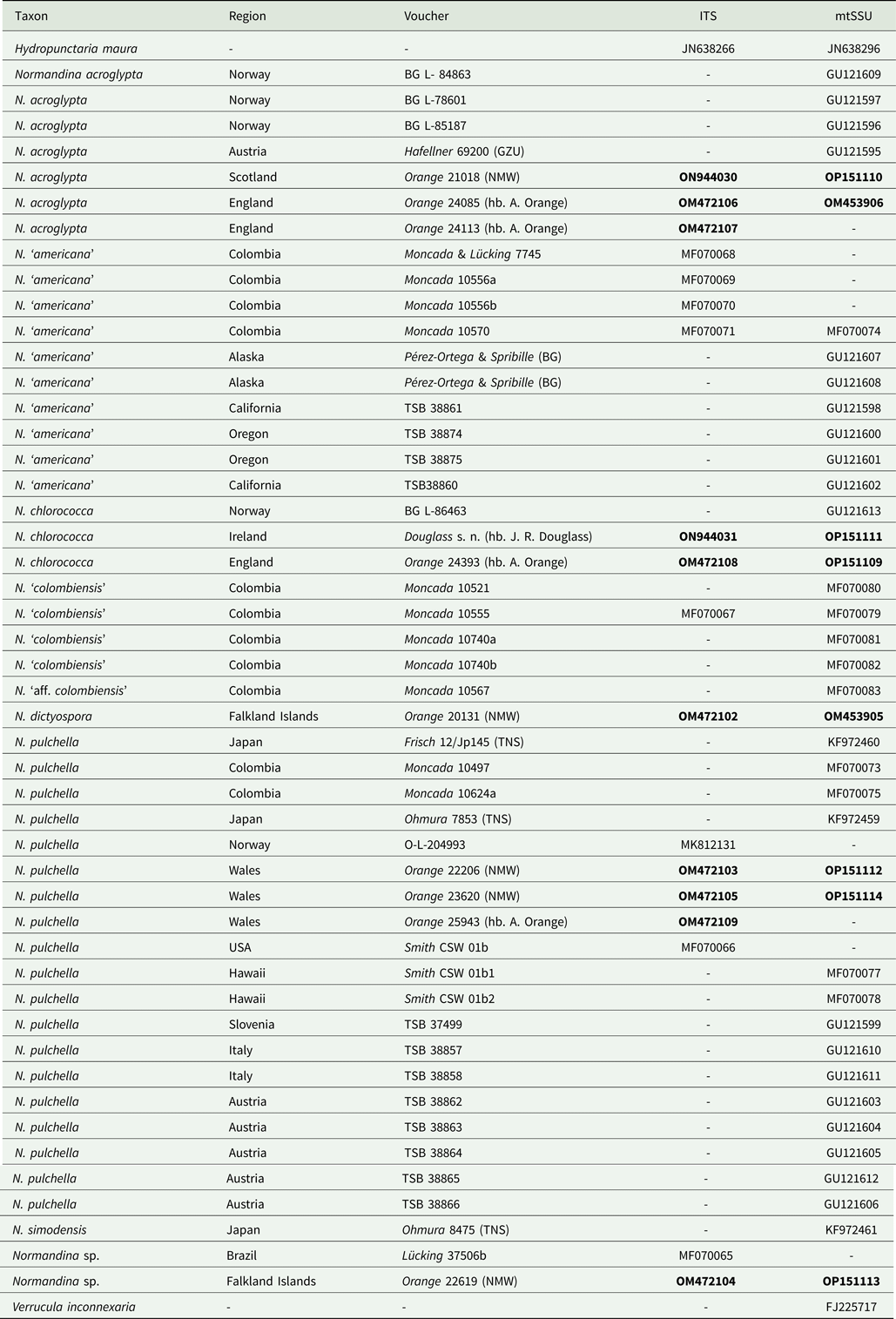
Phylogenetic relationships and support values were investigated using maximum likelihood (ML) bootstrapping, as implemented in RAxML (Stamatakis Reference Stamatakis2006; Stamatakis et al. Reference Stamatakis, Hoover and Rougemont2008), hosted on the CIPRES Science Gateway (Miller et al. Reference Miller, Pfeiffer and Schwartz2010). Analyses with RAxML used rapid bootstrapping with 1000 iterations and the GTRGAMMA substitution model; a search for the best-scoring ML tree was carried out with the bootstrap analysis in a single run. The resulting tree was visualized using MEGA v. 4 (Tamura et al. Reference Tamura, Dudley, Nei and Kumar2007). Support values of ≥ 70% ML bootstrapping were regarded as significant. ITS and mtSSU sequences were analyzed separately and then concatenated for a further analysis. Sequences used in the analyses are shown in Table 1.
Sequences of Normandina used in analyses, with additional voucher information. Newly produced sequences are shown in bold.

Thin-layer chromatography (TLC) was carried out using solvent system G (Orange et al. Reference Orange, James and White2010). Cladonia coccifera s. lat. was used as a control for zeorin.
Spore sizes are cited as: (minimum–) mean minus one standard deviation – mean – mean plus one standard deviation (–maximum). The number of spores measured, and the number of specimens in which spores were measured, are shown in square brackets.
Results
Eighteen new sequences were obtained (Table 1).
A BLAST search of the mtSSU of the unidentified material from Helvellyn returned Normandina species and other Verrucariaceae, whereas the ITS sequence returned Verrucaria species. The morphology and the presence of terpenoids suggested a placement in Normandina and the sequences aligned well with other members of the genus.
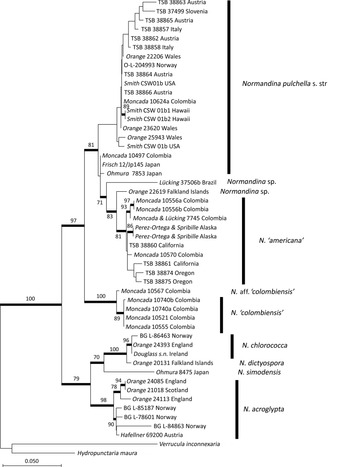
Few accessions of Normandina are represented by both ITS and mtSSU sequences. However, the newly generated ITS and mtSSU trees recovered similar clades and showed no conflicts in topology (data not shown). The tree derived from the concatenated ITS and mtSSU sequences is shown in Fig. 1. There are two major clades: the first comprises Normandina pulchella s. lat., including the undescribed taxa N. ‘americana’ and N. ‘colombiensis’ proposed by Lücking & Moncada (Reference Lücking and Moncada2017); the second includes N. acroglypta s. lat. and a single collection of N. simodensis. Seven collections, from Great Britain, Norway and Austria, are recovered in a well-supported subclade considered here to represent N. acroglypta s. str. This is sister to a subclade comprising three collections from Great Britain, Ireland and Norway, considered to represent N. chlorococca, previously regarded as a synonym of N. acroglypta, the single collection of N. simodensis, and a collection from the Falkland Islands. The Falklands collection is basal to N. chlorococca; it is morphologically distinctive and is described below as the new species N. dictyospora. Normandina simodensis is basal to the clade comprising N. chlorococca and N. dictyospora.
Phylogenetic relationships of Normandina based on a maximum likelihood (ML) analysis of the ITS and mtSSU regions. The tree was rooted using Hydropunctaria maura and Verrucula inconnexaria. Significant ML bootstrap values are shown adjacent to each branch. Branches in bold indicate a support of ML bootstrap ≥ 70%. The names in inverted commas are provisional names used by Lücking & Moncada (Reference Lücking and Moncada2017).

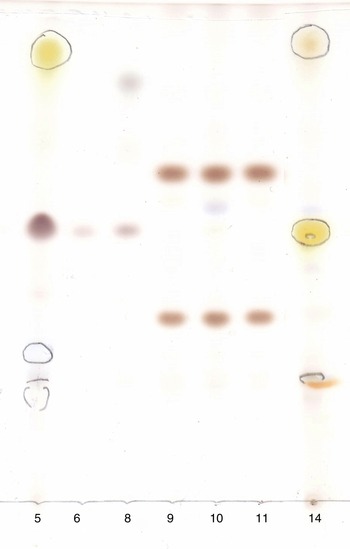
Thin-layer chromatography of selected specimens is shown in Fig. 2. Newly sequenced material showed zeorin, or no substances, in two sequenced specimens of Normandina chlorococca respectively, and two terpenoids (neither zeorin) in three sequenced specimens of N. acroglypta. An additional ten specimens of unsequenced herbarium material contained either zeorin (in small amounts), no substances, or two terpenoids. Specimens with two terpenoids were associated with rock and the others with bark. Specimens containing two terpenoids and growing over rock were identified as N. acroglypta s. lat., by comparison with sequenced and type material, and specimens containing zeorin or with no substances and growing over bark were identified as N. chlorococca (see below).
Thin-layer chromatography plate in solvent G (some lanes omitted from figure); compounds are listed from bottom to top in each lane. Lane 5, Cladonia coccifera s. lat. (porphyrilic acid, unknown, zeorin, usnic acid). Lane 6, Normandina chlorococca (Orange 8866, zeorin). Lane 8, Flakea papillata (Orange 19425, zeorin, unknown terpenoid?). Lane 9, N. acroglypta (Gilbert & Giavarini NMW C.97.28.4, two terpenoids). Lane 10, N. acroglypta (Orange 16709, two terpenoids). Lane 11, N. acroglypta (Orange 21018, two terpenoids). Lane 14, controls (connorstictic acid, fumarprotocetraric acid, norstictic acid, atranorin). In colour online.

The upper clade recovered within Normandina acroglypta s. lat. (Fig. 1) is referred to N. chlorococca, since two specimens which cluster here (Orange 24393 and Douglass s. n.) lack any trace of subsquamulose areoles, and are shown by TLC to contain a trace of zeorin or no substances, respectively. This is in accordance with the lectotype of N. chlorococca, which lacks subsquamulose areoles and contains no substances detectable by TLC. The lower clade is referred to N. acroglypta s. str., since three specimens that cluster here (Orange 21018, 24085 and 24113) have subsquamulose areoles and possess two terpenoids detected by TLC; this is in accordance with the morphology and chemistry of the syntype of N. acroglypta in O.
The Species
Normandina acroglypta (Norman) Aptroot
In Wirth, Flechtenflora, Bestimmung und ökologische Kennzeichnung der Flechten Südwestdeutschlands und angrenzender Gebiete (ed 2) (Stuttgart, Eugen Ulmer), 634 (1995).—Thelidium acroglyptum Norman, Botaniska Notiser 1, 154 (1867); type: Norway: Nordland, ‘Ad Indyr parochia Gilderskaal Nordlandiae’, ‘Hab. supra muscos in rupibus Nordlandiae meridionalis’, J. M. Norman (H-NYL 3654b!, O-L-1000! [thin-layer chromatography: 2 terpenoids], UPS—syntypes).
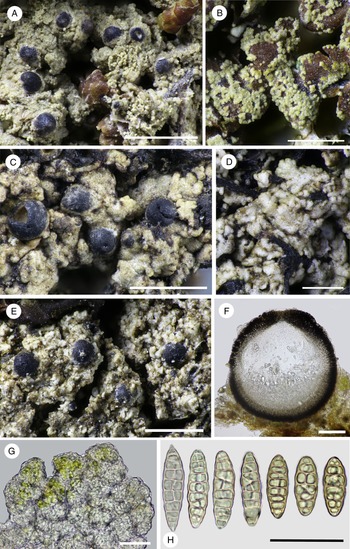
Crustose species of Normandina. A, N. chlorococca (Giavarini, NMW C.2002.018.5), thallus with perithecia and soralia. B, N. chlorococca (Orange 24393), young areoles. C, N. acroglypta (Orange 21018). D, N. acroglypta (Orange 24151), marginal areoles. E, N. dictyospora (holotype), thallus with perithecia. F, N. dictyospora (holotype), section of perithecium. G, N. dictyospora (holotype), thallus tissue, lightly squashed to show goniocyst-like units. H, N. dictyospora (holotype), ascospores. Scales: A, C & E = 1 mm; B & D = 500 μm; F & G = 100 μm; H = 50 μm. In colour online.

Thallus crustose, forming an uneven grey-green crust, but very young areoles have a subsquamulose appearance, being somewhat lobed at the margin, and either plane or slightly convex. The subsquamulose appearance is often ill-defined and was best seen in small sterile specimens from a montane site. The surface of the thallus locally gives rise to ill-defined soralia, comprising soredia 60–250 μm diam. In the few confirmed specimens seen, ascospores were hyaline, (23.5–)27.5–32.2–37(–43) × (5–)6–6.7–7.5(–8.5) μm, (3–)5–7-septate [22/3].
Chemistry
Two unidentified terpenoids, brown soon after heating then dull purple, UV+ orange-pink after heating (Fig. 2). Thallus K−, C−, PD−.
Ecology
On dead cushions of bryophytes, rarely lichens, over rock. The few confirmed specimens with habitat details are from lake shores, montane flushed faces, and damp shady stonework.
Notes
The syntype of Thelidium acroglyptum in O contained two terpenoids, and the thallus showed traces of subsquamulose areoles. The species differs from N. chlorococca and all other Verrucariaceae, as far as is known, by the presence of two terpenoids, neither of them zeorin. Normandina chlorococca differs by containing zeorin, or by lacking secondary substances; the young areoles lack a subsquamulose appearance and the species occurs over bark.
Additional specimens examined (all containing two terpenoids detected by TLC)
Great Britain: England: V.C. 69, Westmorland, Helvellyn, Water Crag, NY33965.15415, 2018, Orange 24085 (hb. A. Orange); Helvellyn, Red Tarn, NY34784.15036, alt. 765 m, 2018, Orange 24113 (hb. A. Orange); ibid., NY34600.15030, alt. 790 m, 2018, Orange 24122 (hb. A. Orange); Helvellyn, Brown Cove, crags on west side, NY33920.15563, alt. 765 m, 2018, Orange 24151 (hb. A. Orange). Wales: V.C. 42, Breconshire, near Rhayader, below Caban-coch Reservoir, 22/925.644, 2006, Orange 16709 (NMW C.2005.001.604); V.C. 49, Caernarvonshire, N side of Snowdon, Llyn Glas, 23/619.558, 1997, Gilbert & Giavarini s. n. (NMW C97.28.4). Scotland: V.C. 108, West Sutherland, Loch Stack, 29/2868.4211, 2012, Orange 21018 (NMW C.2012.002.38).
Normandina chlorococca (Leighton) Orange comb. nov.
MycoBank No.: MB 846186
Verrucaria chlorococca Leighton, The Lichen Flora of Great Britain and Ireland (ed. 3), 484 (1879); type: Great Britain, England, Oxfordshire, ‘On ash near Stokenchurch, highest point of Chiltern Hills’, February 1876, C. Larbalestier (BM 001107462—lectotype! [thin-layer chromatography: no substances]).
Thallus crustose, forming an uneven grey-green crust, but very young areoles have the form of convex granules without any subsquamulose appearance, and rapidly become irregular in shape and coalesce with other areoles. Ill-defined soralia often occur locally on the thallus. In the few confirmed specimens seen, ascospores were hyaline, (22.5–)27.5–31.7–36(–39.5) × (6–)6.5–7.4–8(–9) μm, 5–8-septate [34/4].
Chemistry
Zeorin in trace amounts, or no substances detected by TLC.
Ecology
On dead cushions of bryophytes, over bark of Acer pseudoplatanus, Corylus avellana, Fraxinus excelsior, Populus tremula, Quercus, Salix and Ulmus; evidently preferring base-rich bark.
Additional specimens examined (with TLC data)
Great Britain: England: V.C. 5, South Somerset, S of Withypool, River Barle, SS8589.3381, 2019, Orange 24393 (hb. A. Orange) [trace of zeorin]; V.C. 23, Oxfordshire, on ash near Stokenchurch, [c. SU7696], February 1879, C. Larbalestier (BM 001107462) [no substances]. Wales: V.C. 48, Merioneth, Nannau Estate, E side of Llyn Cynwch, 23/7385.3272, 2002, Giavarini s. n. (NMW C.2002.018.5); Llanbedr, Pentre Gwynfryn, 23/593.270, 2002, Giavarini s. n. (NMW C. 2002.018.6) [no substances]; V.C. 49, Caernarvonshire, Porthmadog, Prenteg, 23/5772.4088, 2002, Orange 14301 (NMW C.2005.001.693). Scotland: V.C. 73, Kirkcudbrightshire, Wood of Cree, NX38101.70894, 2018, Douglass s. n. (hb. J. R. Douglass) [no substances].—Ireland: V.C. H38, Down, Murlough National Nature Reserve, IJ4113.3512, 2020, Douglass s. n. (hb. J. R. Douglass) [no substances]; V.C. H39, Antrim, Glenshesk, Breen Oakwood, ID12172.33962, 2018, Douglass 2018-1235 (hb. J. R. Douglass) [trace of zeorin].—Norway: Sogn og Fjordane: Aurland, S side of Vassbygdvatnet, 60°51ʹN, 7°17ʹE, 1991, Orange 8866 (NMW C.95.19.22) [trace of zeorin].
Normandina dictyospora Orange sp. nov.
MycoBank No.: MB 846252
A crustose species of Normandina distinguished from other members of the genus by the submuriform ascospores.
Type: Falkland Islands, West Falkland, Port Howard, 51.6288°S, 59.53992°W, dead moss on top of low, mortared wall, 19 January 2011, Orange 20131 (NMW C.2011.015.227—holotype!).
Thallus crustose, grey-green, becoming whitish in the herbarium; areoles initially convex but rapidly becoming irregular in shape and coalescing into a coarsely and irregularly warty crust; vegetative propagules absent. Thallus in section without a true cortex, composed of goniocyst-like units 25–45 μm diam.
Perithecia 415–540 μm diam., 0.5–0.75-immersed in thallus, exposed part black, smooth. Involucrellum absent. Exciple 60–75 μm thick at sides and base, opaque in outer half, hyaline within, outer part dark reddish brown, K+ dark (greenish) grey. Periphyses 75 μm long. Mature asci not seen. Ascospores narrowly ellipsoid, (34–)36.5–41.7–46.5(–50) × (12–)13–13.8–14.5 μm [19/1], hyaline or pale brown, submuriform with 3–7(–9) transverse septa, usually 0–1(–2) longitudinal septa per tier, with a total of 11–17(–20) cells visible in optical section.
Conidiomata not seen.
Chemistry
No substances detected by TLC.
Ecology
One collection from dead moss on top of a low wall adjacent to turf.
Notes
The new species differs from the other crustose species of Normandina, N. acroglypta and N. chlorococca, in the larger, submuriform ascospores. Although all the ascospores seen were outside asci, the submuriform condition is interpreted as normal and not due to the spores being overmature. No longitudinal septa have been observed in any collections of N. acroglypta or N. chlorococca. Although only one collection is known, the species is well characterized by morphology and is supported by molecular data, so is described here as new. Calcareous substrata are rare in the Falkland Islands, represented almost exclusively by bones and by built structures, so this is likely to be a rare species. This is the first species in the genus to have submuriform rather than septate ascospores.
Secondary lichen compounds are very rare in Verrucariaceae. Zeorin was reported for Verrucariaceae by Aptroot (Reference Aptroot1991), from Normandina pulchella and N. simodensis, and it occurs in small amounts in N. chlorococca. Normandina acroglypta is reported here to contain two terpenoids, neither of them zeorin. During the present study, small quantities of zeorin were detected in a specimen of Flakea papillata (Lesser Antilles, Martinique, Orange 19245, NMW C. 2010.001.125).
Acknowledgements
I would like to thank John Douglass, and the curator of O, for the loan of material, the curators of BM and NMW for access to specimens, and two anonymous reviewers for their helpful comments.
Author ORCID
Alan Orange, 0000-0002-3181-5435.