Introduction: Conceptual Models of Compulsivity and Impulsivity
In psychiatric classification systems, certain symptom domains cut across traditional diagnostic boundaries and appear in seemingly disparate categories of human behavior. Constructs of compulsivity and impulsivity appear throughout clinical psychiatry and serve as the focus of this issue of CNS Spectrums. Here, we describe ways in which these cross-cutting symptom domains can be grouped and identified. Specifically, we study compulsivity and impulsivity as conceptual constructs, as identified by the Diagnostic and Statistical Manual of Mental Disorders, 5th edition (DSM-5) Research Planning Agenda, as approached by the DSM-5 workgroups and field trials, and by alternative classification systems such as the Research Domain Criteria (RDoC) and International Classification of Diseases (ICD-11). As we will see, the lens through which we view compulsivity and impulsivity has important implications for nosologic grouping and clinical practice.
Impulsivity is a multifaceted construct that is generally characterized by inability to resist impulses and urges, deficits in delaying gratification, unreflective decision making, and premature behavior.Reference Robbins, Curran and de Wit 1 Impulsive behavior can be expressed in a valuation of immediate rewards over long-term goals and thrill seeking.Reference Meda, Stevens and Potenza 2 Impulsivity is a tendency to act without foresight or regard for consequences, and is most commonly associated with pathological gambling, substance dependence, and attention deficit hyperactivity disorder (ADHD).Reference Dalley, Everitt and Robbins 3 Impulsivity can appear differently depending on temporal circumstances (ie, the distance of a reward vs the pleasure of short-term gratification), or how it relates to motor behaviors and higher-order cognitive factors. Impulsive behavior is not a unitary construct, and different forms of impulsivity correspond to specific psychopathologies and underlying neurocircuitry.Reference Meda, Stevens and Potenza 2 , Reference Robbins, Gillan, Smith, de Wit and Ersche 4
Compulsivity can be characterized by perseverative, repetitive actions that are excessive and inappropriate to a situation.Reference Robbins, Gillan, Smith, de Wit and Ersche 4 Obsessive-compulsive disorder (OCD) is the classic disorder used to illustrate features of compulsivity. OCD is a characterized by intrusive, obsessive thoughts and compulsive rituals to alleviate stress/anxiety. Compulsions can manifest as higher-order cognitively related behaviors (ie, mentally reviewing a conversation, counting a series of numbers) or simple motor behaviors (ie, hand-washing, touching or tapping rituals). Compulsions are highly inflexible and generally fall within categories of contamination/cleaning rituals, hoarding, symmetry/ordering rituals, or checking rituals.Reference Fibbe, Cath and van den Heuvel 5
Compulsivity and impulsivity have a number of important differences. While impulsive behaviors are not well thought out when performed, a patient suffering from compulsions often understands logically that rituals are harmful and perseverative but feels emotionally compelled to perform them. Impulsive behavior is characterized by action without foresight, and compulsive behavior can be thought of as ruminative, rigid, and stereotypic in nature.Reference Robbins, Gillan, Smith, de Wit and Ersche 4 There are differences in ego-syntonicity as well: Impulsive behaviors (ie, gambling) are often paired with feelings of pleasure or gratification, but compulsions in OCD are often performed to reduce tension from obsessive thoughts and are highly ego-dystonic.Reference el-Guebaly, Mudry, Zohar, Tavares and Potenza 6 This is an important means by which to distinguish whether a specific behavior is compulsive or impulsive. For example, if an individual gambles for pleasure while ignoring potential consequence, the behavior may be impulsive, but if wagering is done to assuage negative feelings it may be compulsive. Impulsive behavior corresponds to devaluation of risk, while compulsive behavior is related to reliance on stimulus–response habit learning.
Though these constructs can be understood as individual symptom domains, they co-occur and must be understood together in terms of gradation and severity. For example, the degree of impulsivity in someone with OCD can indicate poor clinical outcome.Reference Kashyap, Fontenelle and Miguel 7 Individuals with pathological gambling (ie, an impulsive disorder) may display high levels of harm avoidance, which is a reflection of compulsivity. Impaired performance on the stop signal reaction time (SSRT) task has been implicated in both compulsive and impulsive disorders. Further, both compulsive and impulsive behaviors persist in the face of severe consequence (ie, persistent gambling despite the loss of funds, or compulsive hand-washing despite excoriated skin). Some have theorized that compulsivity and impulsivity both stem from dysfunction in top-down inhibitory control of behavior.Reference Hollander and Wong 8
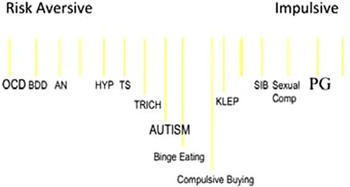
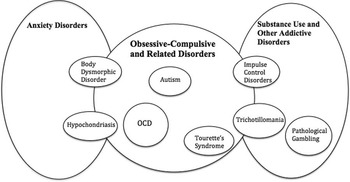
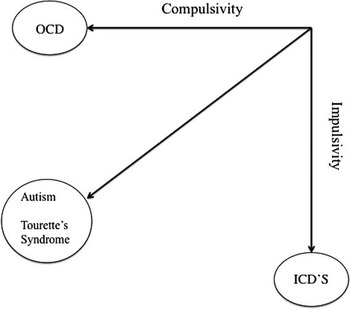
As broad constructs, compulsivity and impulsivity have been understood from 3 viewpoints. Historically, they may be conceptualized as lying along a compulsive–impulsive dimension where disorders lie closer to a risk aversive pole or an impulsive pole (Figure 1).Reference Hollander and Wong 8 – Reference Zohar 11 In this model, for example, OCD primarily manifests compulsive traits and has little impulsivity.Reference Hollander and Rosen 9 Compulsivity and impulsivity may also occur within the same disorder, which may be grouped within a certain spectrum (Figure 2).Reference Hollander and Rosen 9 In this spectrum model, obsessive-compulsive spectrum disorders can be seen as a bridge spanning from anxiety disorders to substance use and behavioral addiction. Grouping spectrum conditions along a broader spectrum of behavior emphasizes that some spectrum conditions are anxiety-like, and some are closer to substance use disorders. Additionally, compulsivity and impulsivity can be viewed as orthogonal dimensions along an X–Y axis (Figure 3). In this model, disorders are plotted in a quadrant based on their phenotypic compulsivity or impulsivity. In placing both constructs together, the orthogonal grouping emphasizes the co-occurring nature of cross-cutting symptoms by showing that disorders classically that are understood as compulsive or impulsive can show features of both.
Dimensional model of behavior, where compulsive and impulsive disorders lie on opposite ends of a spectrum. Reproduced from Hollander E, Poskar S, Gerard A. Subtypes and spectrum issues. In: Zohar J. Obsessive-Compulsive Disorder: Current Science and Clinical Practice. West Sussex, UK: Wiley-Blackwell; 2012. With kind permission from Wiley-Blackwell.

Unique illustration of the spectrum model of psychopathology, where obsessive-compulsive spectrum behaviors act as a bridge between anxiety disorders and substance use and other addictive disorders.

Unique illustration of an orthogonal grouping of psychopathology. The orthogonal model plots disorders together according to their phenotypic compulsivity or impulsivity.

Research Planning Agenda for DSM-5: Obsessive-Compulsive Spectrum Disorders
A Research Planning Agenda process examined putative Obsessive-Compulsive Spectrum Disorders by comparing these disorders and OCD. The Research Planning Agenda process entailed a review of disorders with obsessive-compulsive features (ie, OCD, obsessive-compulsive personality disorder, body dysmorphic disorder, eating disorders, Tourette syndrome), disorders of impulse control (ie, pathological gambling, trichotillomania), and related disorders (ie, substance use disorders, autism) and examined similarities and differences along 5 symptom domains: clinical symptomatology, comorbidity, family history, brain circuitry, and treatment response. 12
In terms of clinical symptoms, compulsivity crosses diagnostic boundaries that are not otherwise specified. For example, compulsivity is a core symptom domain in both autism and OCD (ie, compulsive behaviors in OCD, repetitive/stereotyped behaviors in autism). 13 Phenomenologically, impulse control disorders as described in the Diagnostic and Statistical Manual of Mental Disorders, 4th edition, text revision (DSM-IV-TR) are typified by impulsive behaviors, but the repetitive engagement in such behaviors resembles OCD-like compulsivity in that, over time, they become rigid, compulsive, and are performed to alleviate distress.Reference Hollander, Zohar, Sirovatka and Regier 10 Pathological gambling, a disorder that is characterized by impulsively risking something of value for a potentially greater reward, has a component of compulsivity in that impulsive behaviors continue despite adverse consequences (ie, loss of funds to gamble, strained relationships with family).Reference Potenza 14 Endophenotypic similarities between OCD and substance addiction implicate impaired behavioral inhibition in both disorders.Reference Hollander, Zohar, Sirovatka and Regier 10 (p.22)
Compulsive and impulsive disorders are often comorbid and influence the development of each other. Childhood ADHD has been significantly associated with heroin dependence and current OCD in a group of patients in methadone maintenance treatment.Reference Peles, Schreiber, Sutzman and Adelson 15 It may be that disinhibition stemming from ADHD leads to impulsive drug use that can, over time, develop into compulsory drug use. Furthermore, clinical samples report OCD in 22% of individuals with intermittent explosive disorder.Reference McElroy, Soutullo, Beckman, Taylor and Keck 16
The presence and severity of compulsions are also useful in clarifying comorbid conditions. Specifically, the presence of tics in OCD can indicate an earlier age of onset and has been correlated with violent, sexual, or religious images/thoughts; counting rituals; tic-like compulsions; and hoarding.Reference Hollander, Zohar, Sirovatka and Regier 10 (p.62)
Compulsivity and impulsivity are also important symptom domains in understanding family history. For example, autistic children with high repetitive behaviors, restricted interests, and rituals are likely to have parents with OCD traits.Reference Hollander, King, Delaney, Smith and Silverman 17 Additionally, rates of mood, psychotic, anxiety, and eating disorders are similar in body dysmorphic disorder (BDD) and OCD probands.Reference Hollander, Zohar, Sirovatka and Regier 10 (p.38)
Brain circuits associated with compulsive and impulsive behaviors are remarkably similar. Though anatomically separate, both compulsive and impulsive behaviors derive from similar striatal projections and correspond to deficits in inhibitory prefrontal control. In other words, parallel, dysregulated inhibitory/excitatory circuits underlie multiple compulsive/impulsive disorders, and the manner in which these circuits modulate compulsive–impulsive behavior leads to symptoms associated with specific disorders.Reference Hollander, Zohar, Sirovatka and Regier 10 (p.170), Reference Fineberg, Potenza and Chamberlain 18 For example, basal ganglia dysfunction can lead to obsessive-compulsive spectrum behaviors in widely different disorders such as autism and Parkinson's disease.Reference Hollander, Zohar, Sirovatka and Regier 10 (p.170), Reference Graybiel 19
Pharmacological dissection suggests selective efficacy of serotonin reuptake inhibitors (SRIs) over norepinephrine reuptake inhibitors (NRIs) in obsessive-compulsive spectrum conditions. OCD responds preferentially to SRIs (such as clomipramine) and does not respond to NRIs (such as desipramine).Reference Leonard, Swedo and Rapoport 20 This preferential response to clomipramine over desipramine has also been shown in BDD.Reference Hollander, Allen and Kwon 21 Further, while NRIs such as imipramine or desipramine work well in treating generalized anxiety disorder and panic disorder, these drugs do not effectively treat the symptoms of OCD, especially when compared with selective serotonin reuptake inhibitors (SSRIs).Reference Huh, Goebert, Takeshita, Lu and Kang 22 – Reference McDougle, Goodman and Price 24 In other words, disorders of depression and anxiety respond to both SRIs and NRIs, while obsessive-compulsive spectrum disorders respond preferentially to SRIs and not to NRIs.Reference Hollander, Allen and Kwon 21
Further, SSRIs are effective in treating compulsory behaviors across disorders on the obsessive-compulsive spectrum. Specifically, low-dose SSRI treatment is effective in treating repetitive behaviors in autistic disorders in both children and adults.Reference Kolevzon, Mathewson and Hollander 25 – Reference Hollander, Soorya and Chaplin 27
From the perspective of the Research Planning Agenda, we find that there is great merit to examining compulsivity and impulsivity together. These constructs are often similar in terms of clinical presentation, occur within the same patient despite diagnosis, run in families, project from parallel brain circuits, and may respond to similar pharmacological therapies. Understanding these seemingly different constructs together provides a fuller picture of a patient's symptomatology, underlying biology, and treatment options.
DSM-5 Workgroups, Reviews, and Field Trials
Leading up to the DSM-5 launch, the American Psychiatric Association (APA) organized a series of literature reviews, workgroups, and field trials to formulate and test draft criteria for DSM-5. 28 Workgroups and literature reviews focused on refining diagnostic issues while adhering to the APA's principles: the DSM-5 should be useful to those who diagnose and treat patients and to the patients being treated, and to facilitate research based on observable, non-etiological grounds. 29 Field trials focused on developing assessments to test the reliability of proposed draft criteria.
First, literature reviews on compulsivity were published in Depression and Anxiety and outlined key issues of DSM-5 development. These reviews offered tentative, creative solutions to problems associated with categorizing cross-cutting symptoms. This stage of research detailed current ideas across the anxiety disorders, OCD spectrum disorders, and trauma/stress-related disorders.Reference Wittchen, Gloster, Beesdo-Baum, Fava and Craske 30
Authors recommended the development of self-report measures that assess anxiety symptoms in verbal, somatic, and motoric modalities in a way that could be integrated with empirical paradigms.Reference Phillips, Stein and Rauch 31 Additionally, the authors sought to differentiate disorders based on temporality and historical circumstance, offering ideas such as the collapse of agoraphobia into a dimensional symptom to better clarify supraordinate classifications. 32 Importantly, Phillips etalReference Phillips, Stein and Rauch 31 argued for the inclusion of an “obsessive-compulsive spectrum” grouping for the DSM-5. Grouping disorders according to core features such as obsessions/preoccupations and/or compulsions/repetitive behaviors (ie, compulsive dimensions) was said to enhance clinical utility of diagnosis and bring DSM classification in line with current pharmacological and phenomenological research.
Second, DSM-5 Workgroups were responsible for proposing draft criteria, as well as performing secondary data analyses and collecting feedback from other professionals. The workgroups studying obsessive-compulsive spectrum conditions recommended a reclassification of OCD and related disorders into a broader category of spectrum conditions that would better promote assessment.Reference Wittchen, Gloster, Beesdo-Baum, Fava and Craske 30
Lastly, proposed revisions were put through a series of field trials (FTs) that were intended to test the clinical utility, feasibility, reliability, and convergent validity of the new categories and dimensional measures. 32 The central idea was to ensure the validity and reliability of diagnostic criteria and to ease the burden of administrating severity measures of cross-cutting symptom dimensions.Reference Clarke, Narrow and Regier 33
Of interest here was the development of a Trait Dimensional Diagnostic System for Personality Disorders that was used in conjunction with the FTs. The Trait System sought to cover the 4 major areas of maladaptive personality variation, add psychoticism as a trait, and express multiple core trait facets within the 5 domains of introversion, antagonism, impulsivity (referred to as disinhibition), psychoticism, and emotional dysregulation (negative affectivity).Reference Krueger, Derringer, Markon, Watson and Skodol 34
The trait diagnostic system demonstrated the integration of cross-cutting symptom domains into axis II–type dysfunction and allowed for the assessment of dimensional symptoms that do not necessarily constitute a formal personality disorder. In other words, the trait diagnostic system translated broad, core features of disorders into observable factors in dimensional assessment.Reference Krueger, Derringer, Markon, Watson and Skodol 34
The DSM-5 literature reviews, workgroups, and field trials harken to and enhance our initial discussion on conceptual issues of compulsivity and impulsivity. While these later stages of research emphasize continued focus on the dimensionality of cross-cutting symptom domains, they also translate basic neuroscientific and phenomenological research into assessment and classification in applied environments. In light of the literature reviews and field trials, an individual can demonstrate levels of compulsivity and impulsivity without receiving a formal diagnosis.
DSM-5 Classification of Compulsivity and Impulsivity
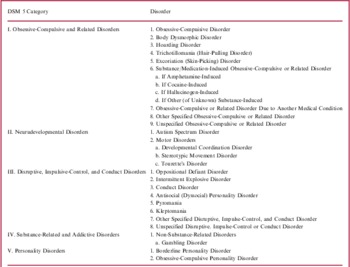
Per recommendations of the workgroups, disorders of compulsivity and impulsivity were moved to categories that better reflect underlying nosology and brain circuitry. Table 1 reflects the DSM-5 grouping of disorders with strong compulsive and impulsive features. 35
DSM 5 Classification of Selective Disorders Characterized by Compulsivity and Impulsivity

Source: Diagnostic and Statistical Manual of Mental Disorders, 5th ed. Arlington American Psychiatric Association; 2013.
A grouping of Obsessive-Compulsive Related Disorders (OCRDs) has been integrated into the DSM-5. This grouping encompasses OCD and a number of disorders that were previously classified elsewhere (ie, BDD was previously listed as a somatoform disorder). This new grouping also includes disorders involving simple motor behaviors (ie, trichotillomania and skin-picking disorder), which were previously listed as impulse-control disorders. Hoarding disorder has been added as a diagnosis and is also included in the OCRDs.
Some disorders involving stereotyped movements and compulsions are not included in the new class of OCRDs. Specifically, autism spectrum disorder, a disorder where compulsivity is a core symptom domain, is listed among Neurodevelopmental Disabilities.
In terms of impulsive disorders, DSM-5 expands on Impulse-Control Disorders with the inclusion of a Disruptive, Impulse-Control, and Conduct Disorders grouping. Included in this category are oppositional defiant disorder, intermittent explosive disorder, conduct disorder, pyromania and kleptomania.
It is theorized that the new DSM-5 criteria, especially with regard to OCRDs, will bring 2 benefits to clinicians. First, the new DSM-5 criteria should bring about comprehensive diagnosis by emphasizing comorbidity and dimensionality. The DSM-5 introduction to the OCRD chapter advises clinicians to screen for related conditions in individuals who present with one of them and be aware of overlap. 35 (p. 235) In this regard, DSM-5 emphasizes a comprehensive examination of symptom profiles. 36
Second, the addition of new disorders in DSM-5 should facilitate accurate diagnosis. Specifically, the addition of hoarding allows for more precise diagnosis. 36 Further, although autism spectrum disorder was not included in the OCRD section, but was included in other diagnoses presenting in childhood, it has been reorganized to recognize repetitive behaviors as 1 of the 2 core symptom domains.
Conclusion: Future Directions, RDoC, and ICD-11
The DSM-5 classification of disorders with compulsive and impulsive features includes a new class called Obsessive-Compulsive Related Disorders, which encompasses OCD and disorders that were previously classified elsewhere. This new grouping emphasizes comorbidity and dimensionality, and reclassifies a number of disorders previously listed elsewhere. The revision process for the DSM-5 produced a wealth of knowledge about cross-cutting symptom domains, and public queries concerning the revisions drew nearly 2,300 responses. 37
The revisions adopted by the DSM-5 are up to date, but it is helpful to keep in mind that the APA required overwhelming evidence to include new disorders and for certain proposed changes. Considering also the historical interest in certain disorders, one can portray the DSM-5 as a conservative document. Indeed, not all changes proposed by the Workgroups and the experts who headed them have been adopted. In addition, it has yet to be made clear how the new guidelines will lead to meaningful drug and genetic discoveries, as the purpose of DSM-5 is not primarily to facilitate research.
For issues the DSM-5 does not address, there are parallel efforts led by other organizations to clarify research and biological approaches to classification. Specifically, the National Institute of Mental Health (NIMH) has developed a Research Domain Criteria (RDoC): a classification symptom based on symptom domains and corresponding observable behaviors and neurobiological correlates. This effort aims at basic, observable functioning with the intention of rapidly integrating basic neurobehavioral research into current understanding of psychopathology. 38 The RDoC approach is fundamentally translational and dimensional, and it emphasizes a broad array of dysfunction and normal behavior as they relate to functional biological circuits. The RDoC scheme is heavily research-oriented, and many of its goals presuppose solid research as the foundation of effective treatment.Reference Cuthbert and Insel 39 , Reference Morris and Cuthbert 40
Implications for compulsivity and impulsivity from the RDoC perspective are numerous. As compulsivity and impulsivity both have well-studied biological correlates and must be understood temporally, this method of classification may be a boon to understanding these symptom domains. Further, the RDoC is not fundamentally grounded in symptom profiles and hierarchical classification; cross-cutting symptom domains thus become central to its framework. Though compulsivity and impulsivity are not yet cited as key dimensional constructs, the RDoC uses features of compulsivity and impulsivity (defined as “subconstructs”) such as attention, response inhibition, and responsiveness to reward to examine biological correlates of behavior. The RDoC is in its nascent stages of development, and its key subconstructs are liable to change before implementation.
Additionally, the World Health Organization (WHO) continues to revise the International Classification of Diseases (ICD), with the 11th edition set for release in 2015. 41 The ICD follows the incidence and prevalence of diseases and problems of mental health that contribute to epidemiological and clinical issues globally. Along with the DSM-5, the ICD is a benchmark in determining the incidence and prevalence of mental health issues. The ICD offers an alternative approach in understanding the influence of cross-cutting symptoms.
We have examined compulsivity and impulsivity from a range of different perspectives, each providing a different way to understand dimensional symptom domains. Conceptually speaking, compulsive and impulsive behaviors cross diagnostic boundaries and appear symptomatically as well as categorically. In the Research Planning Agenda, we found that compulsivity and impulsivity were evaluated by endophenotyping in terms of clinical symptoms, comorbidity, family history, treatment response, and brain circuitry. From the workgroups, we saw that dimensional constructs could be integrated into a diagnostic classification system. Finally, literature reviews and field trials demonstrated that broad constructs of compulsivity and impulsivity can be further broken down into more homogenous subgroups and could be reliably studied in different settings. Each approach demonstrates a shift toward understanding compulsivity and impulsivity symptomatically, orthogonally, and along a spectrum of behavior.
Disclosures
Eric Hollander has the following disclosures: Transcept-consultant, consulting fee; Transcept-research support, research grant; Coronado-consultant, consulting fee; Coronado-research support, research grant; Roche-consultant, consultant fee; Roche-research support, research grant; Forest-research support, research grant. Gregory Berlin does not have anything to disclose.