A key component of dry cow mastitis management is the use of antibiotic dry cow therapy (DCT). DCT essentially has two functions, the elimination of existing intramammary infections (IMI) at dry-off and the prevention of new IMI during the dry period (Bradley & Green, Reference Bradley and Green2004). DCT has been shown to achieve a 1·78 times higher cure rate compared with self-cure in untreated quarters (Halasa et al. Reference Halasa, Nielen, Whist and Osteras2009). In year 2013, 80% of cows received antibiotic DCT in Germany (Wallman, Reference Wallman2014).
According to the guidelines of organic farming the use of DCT has to be restricted (European Commission, 2008). It should be applied only to ‘single problematic animals if indicated medically and with proof of agent’ (Bioland Standards, 2015). However, there are no alternative strategies and therapies to reduce IMI during the dry period. Therefore, on organic farms at calving the mastitis prevalence is high due to low cure and a high new infection rates (NIR) and contagious pathogens are predominant (Hayton & Bradley, Reference Hayton and Bradley2004).
Even if selective DCT is mandatorily performed, infected cows should not be left untreated (Berry & Hillerton, Reference Berry and Hillerton2002a; Berry et al. Reference Berry, Hogeveen and Hillerton2004). Thus the criteria for accurately identifying infected cows to receive treatment at dry-off need to be improved to enhance the accuracy of the selective DCT (Huxley et al. Reference Huxley, Green, Green and Bradley2002; Robert et al. Reference Robert, Roussel, Bareille, Ribaud, Sérieys, Heuchel and Seegers2008).
Logistic and financial considerations involved in sampling and examining milk from all cows usually make this selection method impractical (Eberhart, Reference Eberhart1986; Sargeant et al. Reference Sargeant, Leslie, Shirley, Pulkrabek and Lim2001). The most commonly used selection method is based on the monthly recorded cow somatic cell counts (SCC) (Bradley & Green, Reference Bradley and Green2004; Torres et al. Reference Torres, Rajala-Schultz, DeGraves and Hoblet2008; Biggs et al. Reference Biggs, Barret, Bradley, Green, Reyher and Zadocks2016). Furthermore, the California mastitis test (CMT) at dry-off and the clinical mastitis (CM) history of the cow are mentioned as selection tools (Sanford et al. Reference Sanford, Keefe, Sanchez, Dingwell, Barkema, Leslie and Dohoo2006; Torres et al. Reference Torres, Rajala-Schultz, DeGraves and Hoblet2008).
Even if infected cows are identified correctly, several factors influence the probability of cure in treated cows and animals with low healing prospects should rather be recommended for culling (Osteras, Reference Osteras2006). However, as a long lifespan is an objective on organic farms, improvement of the overall udder health by culling has limited application. Therefore, prevention of new infections (NI) is of particular importance. The application of internal teat sealants (ITS) at dry-off is one opportunity to effectively protect cows from NI (Rabiee & Lean, Reference Rabiee and Lean2013).
The aim of the present study was to create a decision scheme for the use of DCT on organic dairy farms based on cow level factors, which were evaluated for identifying infected cows at dry-off and for their influence on the probability of cure of existing infections and prevention of NI during the dry period.
Material and methods
Farms and cows
The field study was carried out on five organic dairy farms in Lower Saxony, Germany. Herd size ranged from 71 to 175 lactating German Holstein cows. Milk yield per cow and year varied between 6500 and 9890 kg (mean 8402 ± 1544 kg). The mean intercalving interval was 399 ± 19 d. Bulk tank somatic cell count at the beginning of the study ranged from 197 000 to 289 000 cells/ml. On four farms cows were milked twice a day in a milking parlour, one farm used an automatic milking system. Dry cows were either kept on pasture for the whole dry period or had continuous access to it.
The 250 cows that had finished their first or subsequent lactation and had been dried off between 13 June and 30 October 2014 were recruited for the study.
Dry cow therapy and data collection
During the study period no attempt was made to influence the dry cow management on the farms. All farms performed selective DCT. Dry cow products containing either cloxacillin, cefquinom, a combination of benzyl penicillin, dihydrostrepromycin and nafcillin or a combination of benethamin penicillin, penthamathydroiodid and framycetin were used. The date of dry-off was scheduled based on the expected calving date. None of the farms used a strict selection and treatment policy at dry-off. The selection of cows for antibiotic DCT was primarily based on DHI SCC records. An average SCC > 200 000 and >250 000 cells/ml in lactation were stated as thresholds for the application of antibiotic DCT by the farmers. Four farms also included cases of CM during the previous lactation in their decision making. An ITS containing bismuth subnitrate was used on four farms and either applied to all animals (two farms) or only to those that did not received antibiotic treatment (two farms). One farm did not use ITS at all. DCT was administered by the farmers using a hygienic procedure immediately after the last milking.
Cow information was obtained from DHI records. Parity, date of calving, milk yield and SCC were collected. Cases of CM in the previous lactation and milk yield at dry-off were obtained directly from farm records. On two farms the milk yield at dry-off was calculated from the previous DHI record.
At dry-off, all cows had a CMT performed by the first author on each functional quarter. The CMT reaction of each quarter was recorded as 0 indicating no reaction and ranging to 3, a strong positive reaction (Sargeant et al. Reference Sargeant, Leslie, Shirley, Pulkrabek and Lim2001).
After calving, animals were examined by the farm staff for signs of CM until 100 d in milk (DIM).
Sampling and laboratory procedures
Quarter foremilk samples were collected aseptically by one of the authors at three points in time according to National Mastitis Council (NMC) guidelines as cited by the German Veterinary Association (GVA, 2009): At dry-off, within 5 to 12 DIM (C1) and 7 d later (C2). Sampling on a farm was usually on the same day and at the same time of day each week. Milk samples in tubes containing Ly 20 (boric acid and methylene blue) were transported in a cool box to the microbiological laboratory at the University of Applied Sciences, Hannover and were usually assayed within 24 h after arrival. Otherwise, samples were stored at 8 °C for no more than 2 d before assay. Milk samples were cultured according to the NMC and GVA recommendations (GVA, 2009).
Definitions
The two most numerous types of colony on a plate were identified. A milk sample was bacteriologically positive if ≥100 colony forming units (cfu)/ml of a major contagious pathogen (S. aureus, Sc. agalactiae, Sc. dysgalactiae and T. pyogenes) or ≥500 cfu/ml of any other pathogen were isolated. A quarter was considered infected at dry-off based on a single sample. After calving, a quarter was considered infected if the same pathogen was isolated from both samples (C1 and C2). Bacteriological cure was defined as a pathogen present at dry-off which was not cultured after calving. Quarters were termed ‘newly infected’ if they had positive results for a pathogen not been isolated at dry-off. A cow was considered infected if at least one quarter was infected. If all infected quarters within a cow at dry-off were cured, at least one quarter had a NI during the dry period or showed signs of CM within 100 DIM, the cow was termed ‘cured’, ‘newly infected’ or ‘affected by CM’, respectively.
Data analysis
Analyses were performed at cow level using Excel 2010 (Microsoft Corporation) and SPSS (SPSS 23·0, Chicago; USA). Differences in cure rate and NIR between treatment groups (untreated, antibiotic DCT, ITS) were analysed using chi2-analysis.
Probabilities of cure, NI and CM within 100 DIM were analysed using backward stepwise regression analysis. Predicting variables were: treatment group, teat disinfection at dry-off, type of pathogen present at dry-off, parity, milk yield at dry-off, CM during lactation, CMT at dry-off, lactation period length, dry period length and mean SCC during lactation. Statistical significance was assumed at P ≤ 0·05. Nonsignificant variables were excluded from the final model. If predictors showed strong correlations with each other (r > 0·8), the predictor with the highest significance was kept in the final model. As clustering was present in the study design a generalised estimating equation (GEE) model was used with those main effects included in the final logistic model. A random cow in herd effect was included in the model. Finally, odds ratio (OR) with 95% confidence intervals (CI) were calculated.
For the analysis of selection criteria for infected cows at dry-off the target parameter (infected or infected with certain pathogen) was determined based on the final regression model for cure. Results of the bacteriological analysis served as the gold standard. For SCC as selection criterion the optimal threshold and the optimal number of DHI records (1 month prior to dry-off, 3 months, all records) were evaluated. When considering more than one DHI record the geometric mean SCC was used. Receiver operating characteristic (ROC) curves were created and sensitivity (SE) and specificity (SP) were calculated. Accuracy (number of true positives and true negatives/total number of samples), positive predictive value (PPV) and negative predictive value (NPV) were also calculated. PPV and NPV were estimated in relation to prevalence ranging from 0 to 100%. CM history, parity and CMT as selection criteria were tested alone and in combination with SCC. All selection criteria were also evaluated with the purpose of identifying only cows infected with agents other than minor pathogens (i.e. coryneforms and coagulase-negative staphylococci (CNS)). In a GEE model all selection criteria were tested as fixed effects for their influence on the probability of IMI at dry-off (for rules for statistical significance, correlation and random effects see above).
Results
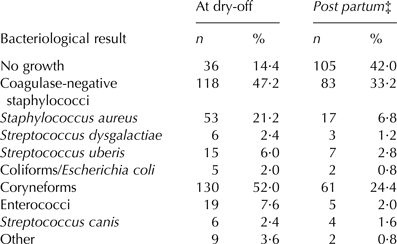
Overall prevalence of IMI at dry-off based on the pooled data was 85·6% of cows. The most common bacteria at dry-off and after calving were CNS and coryneforms, followed by S. aureus. Table 1 shows the distribution of pathogens. Excluding IMI caused by minor pathogens 96 of 250 cows were infected at dry-off (38·4%). The prevalence after calving was 58·0 and 14·4%, respectively.
Distribution of pathogens isolated from quarter milk samples from 250 cows at dry off and post partum on five organic farms. Results are presented in percentages of cows infected with a particular organism†

† A cow was classified as infected if at least one quarter was infected; however, she could be infected with more than one pathogen if she had more than one quarter infected with different organisms and/or if she had mixed infections.
‡ Based on paired samples.
Identifying infected cows at dry-off
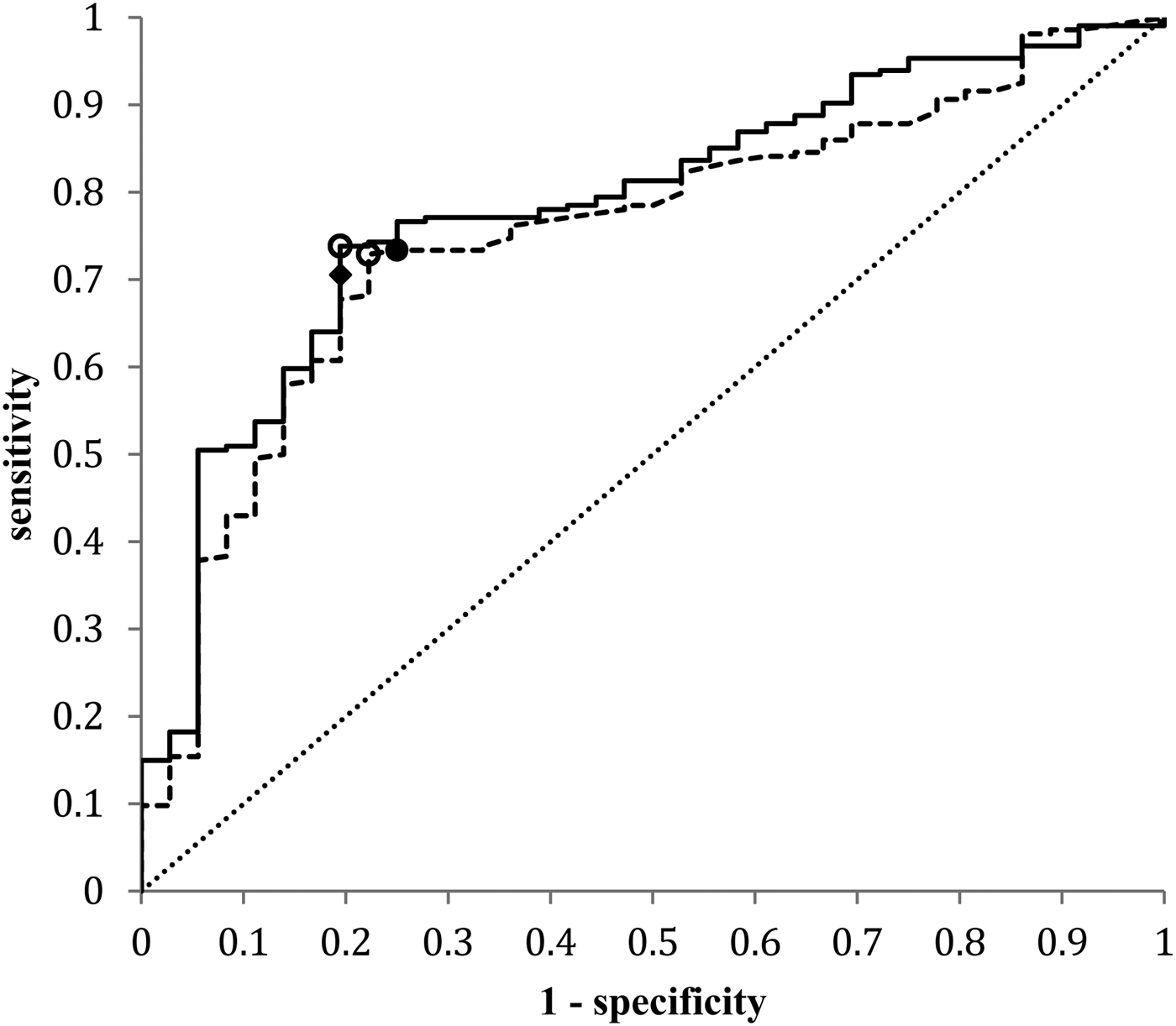
To determine a selection criterion for identifying infected cows at dry-off, the SCC threshold of 100 000 cells/ml was closest to the optimal cut-off values on the ROC curves if SE and SP were weighted equally (maximum sum of SE and SP) (Fig. 1). As expected, SP increased using 200 000 cells/ml as the threshold but both SE and accuracy decreased. Selection based on SCC from all DHI records during lactation was least accurate (data not shown). The accuracy was almost identical using only the most current DHI record or the three last consecutive records prior to dry-off, having a higher SE in the first and a higher SP in the second case (73·6 and 72·0%, respectively).
Criteria receiver operating characteristic (ROC) curves for identifying cows with an intramammary infection (IMI) at dry-off, based on somatic cell counts (SCC) of either the last dairy herd improvement (DHI) record (---) or three consecutive records (—) prior to dry-off. Optimal SCC cut-off values (○) giving equal weight to sensitivity and specificity and SCC thresholds of 100 000 cells/ml (●, ♦) are marked. Diagonal line for a test without benefit is shown for comparison.

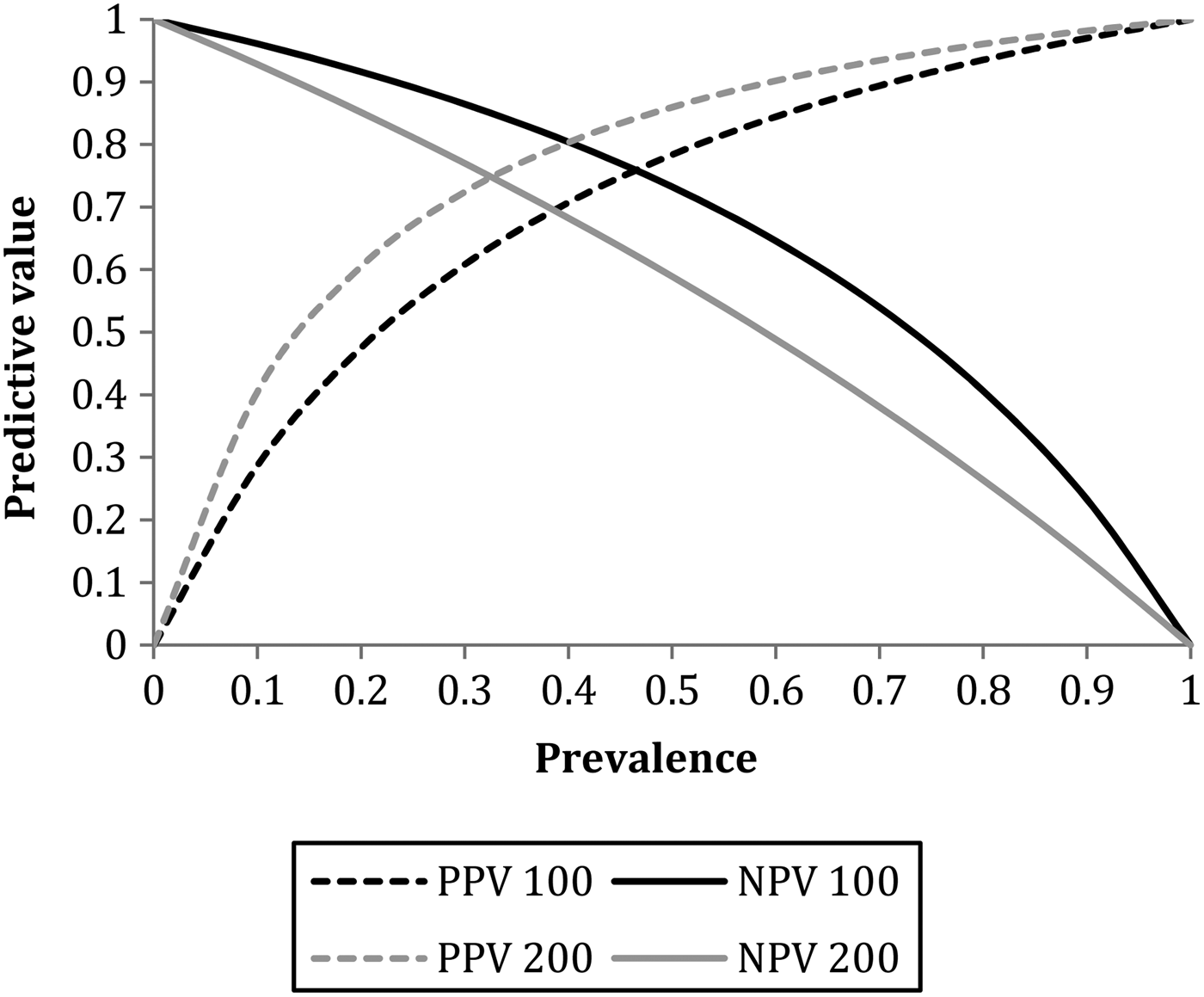
The PPV and NPV for SCC cut-offs at 100 000 and 200 000 cells/ml in relationship to all possible prevalences of IMI at dry-off are shown in Fig. 2. Overall, and especially at lower prevalences, the threshold of 200 000 cells/ml led to a higher probability that a cow classified as infected was indeed infected (PPV 97·3% at prevalence of 85·6%). In comparison, the probability that a cow classified as uninfected had no IMI was higher using 100 000 cells/ml as threshold and three consecutive DHI records prior to dry-off (NPV 31·5%). The NPV for using only one DHI record was almost similar (32·4%). At higher prevalence, the lower threshold performed better as the NPV was higher and the difference in PPV between both thresholds became smaller. The calculated values for SE, SP, accuracy, PPV and NPV are shown in Table 2.
Positive predictive values (PPV) and negative predictive values (NPV) for geometric mean somatic cell count (SCC) for the last three consecutive records prior to dry-off as selection criterion for infected cows in relation to the prevalence. SCC threshold is set at 100 000 cells/ml (100) and 200 000 cells/ml (200).

Sensitivity (SE), specificity (SP), accuracy, positive (PPV) and negative predictive values (NPV) for identifying cows with an intramammary infection (IMI) at dry-off using somatic cell counts with threshold 100 000 cells/ml (SCC 100) or 200 000 cells/ml (SCC 200) and three consecutive Dairy Herd Improvement (DHI) records prior to dry-off. Effect of adding information on clinical mastitis (CM) history, parity and California mastitis test (CMT) results at dry-off as selection criteria. Evaluation of the selection performed by the farmers during the study period is shown for comparison

† All cows with a geometric mean SCC > either 100 000 or 200 000 cells/ml for three consecutive DHI records prior to dry-off are considered as infected
‡ 95% Confidence intervals
§ All cows with an SCC of >100 000 cells/ml or with ≤100 000 cells/ml but with CM during previous lactation/parity >2/at least one quarter with CMT >1 were considered as infected
¶ No strict selection policy at dry-off; for further information see ‘Material and methods’.
†† Mean of the five farms (min. – max.).
Parity as the selection criterion had the highest accuracy (52·8%) besides SCC with an SE of 49·5 and SP of 72·2%. Using CMT at dry-off, accuracy was 43·5, SE 40·1 and SP 36·1%. CM history as the selection criterion had the lowest accuracy (26·8%). Adding these factors to the SCC-based selection method led to a slight improvement in accuracy and SE and a varying decrease in SP. The combination of SCC and parity showed the highest accuracy, SE and NPV (Table 2).
Excluding cows only infected by minor pathogens the 100 000 cells/ml threshold was closer to the optimal SCC cut-off on the ROC curve than the higher threshold of 200 000 cells/ml (data not shown). Accuracy increased with the number of DHI records used. When considering all records, SE (65·6%), SP (67·5%), accuracy (67·0%) and PPV (55·8%) were lower than for identification of all pathogens, whereas NPV (76·0%) was higher. The curve progression of predictive values in relation to prevalence was similar to the progression for all infections (data not shown). CM history, parity and CMT as selection criteria performed better than for the identification of all infections and had an average accuracy of 61·8%. The results for SE and SP were: CM 20·8 and 86·4%; CMT 51·6 and 68·0%; parity 59·3 and 61·7%. Adding these factors to the SCC based selection method led to a slight decrease in accuracy (minus 4%). Combinations of SCC with either CM history or CMT had similar accuracy. Regarding SE and NPV the combination of SCC and CMT achieved the best results (SE: 82·3%; NPV: 82·5%).
The final GEE model showed that a geometric mean SCC > 100 000 cells/ml for three consecutive DHI records prior to dry-off is significantly associated with the probability of IMI at dry-off (OR 15·425; 95% CI 5·670–41·930, P ≤ 0·001). A random cow in herd effect was not significant in this or any other model.
Compared with using SCC as selection criterion and 100 000 cells/ml as threshold, the SE for identifying/treating infected cows of the selection procedure performed by the farmers was low and varied strongly between the farms (Table 2). The prevalence of IMI at dry-off on the farms ranged from 76·4 to 93·1%. SP and PPV were high on all farms, whereas NPV was low. Excluding infections caused by minor pathogens the mean prevalence of IMI at dry-off on the farms amounted to 37·9%. In this case, accuracy (63·2%), SE (46·0%) and NPV (70·0%) of the farmers’ selection procedure were higher and SP (74·4%) and PPV (51·4%) lower.
Cure rates and clinical mastitis
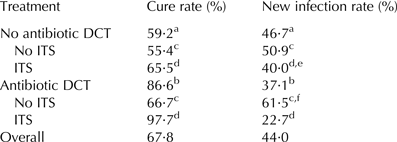
The overall cure rate during the dry period was 67·8% (Table 3). Cows receiving antibiotic DCT had a significantly higher cure rate than those not treated with antibiotic DCT (P ≤ 0·001). In both groups, cows receiving an internal teat sealant had significantly higher cure rates than unsealed cows (P ≤ 0·001).
Cure and new infection rate in the different treatment groups: with/without antibiotic dry cow therapy (DCT) and with/without internal teat sealant (ITS)

a,bSignificant difference between cows receiving antibiotic DCT and those receiving no antibiotic (P ≤ 0·001).
c,dSignificant difference between cows receiving ITS and unsealed ones (P ≤ 0·001).
e,fSignificant difference between cows only treated with ITS compared with those treated only with antibiotic DCT (P ≤ 0·001).
In the final GEE model antibiotic DCT (OR 8·015; 95% CI 2·450–26·223; P ≤ 0·001), application of an ITS (OR 7·352; 95% CI 1·816–29·762; P ≤ 0·01) and a dry period length >56 d (OR 0·420; 95% CI 0·209–0·845; P ≤ 0·05) were significantly associated with the probability of cure. There was no effect on cure whether the infection at dry-off was caused by minor pathogens, S. aureus, streptococci or other pathogens.
Within 100 DIM, 41 cases of clinical mastitis were detected. Of the affected cows 24·4% were bacteriologically negative after calving, 43·9% were infected with CNS, 31·7% with coryneforms, 14·6% with S. aureus, 4·9% with S. dysgalactiae, 4·9% with S. canis, and 2·4% with S. uberis, enterococci and others, respectively. In the final GEE model the probability of CM within 100 DIM was associated with antibiotic DCT (OR 2·422; 95% CI 1·116–5·256; P ≤ 0·05) and a negative culture result after calving (OR 0·398; 95% CI 0·178–0·892; P ≤ 0·05).
New infection rates
The overall NIR was 44·0% of cows (Table 3). The NIR in the cows receiving antibiotic DCT (with/without ITS) was significantly lower compared with the group receiving no antibiotic DCT (P ≤ 0·001). In both groups cows receiving an ITS had a significantly lower NIR than those unsealed (P ≤ 0·001). When comparing solely application of ITS and solely antibiotic DCT, the NIR was significantly lower in sealed cows (P ≤ 0·001). The GEE model showed that application of an ITS is significantly associated with the risk of NI (OR 0·407; 95% CI 0·210–0·790; P ≤ 0·01). Antibiotic DCT had no significant effect in the final model. An infection with minor pathogens present at dry-off was significantly associated with the risk of NI (OR 0·479; 95% CI 0·257–0·893; P ≤ 0·05). Disregarding NI by minor pathogens, only CNS infections at dry-off showed this effect (OR 0·377; 95% CI 0·147–0·963; P ≤ 0·05).
Decision scheme
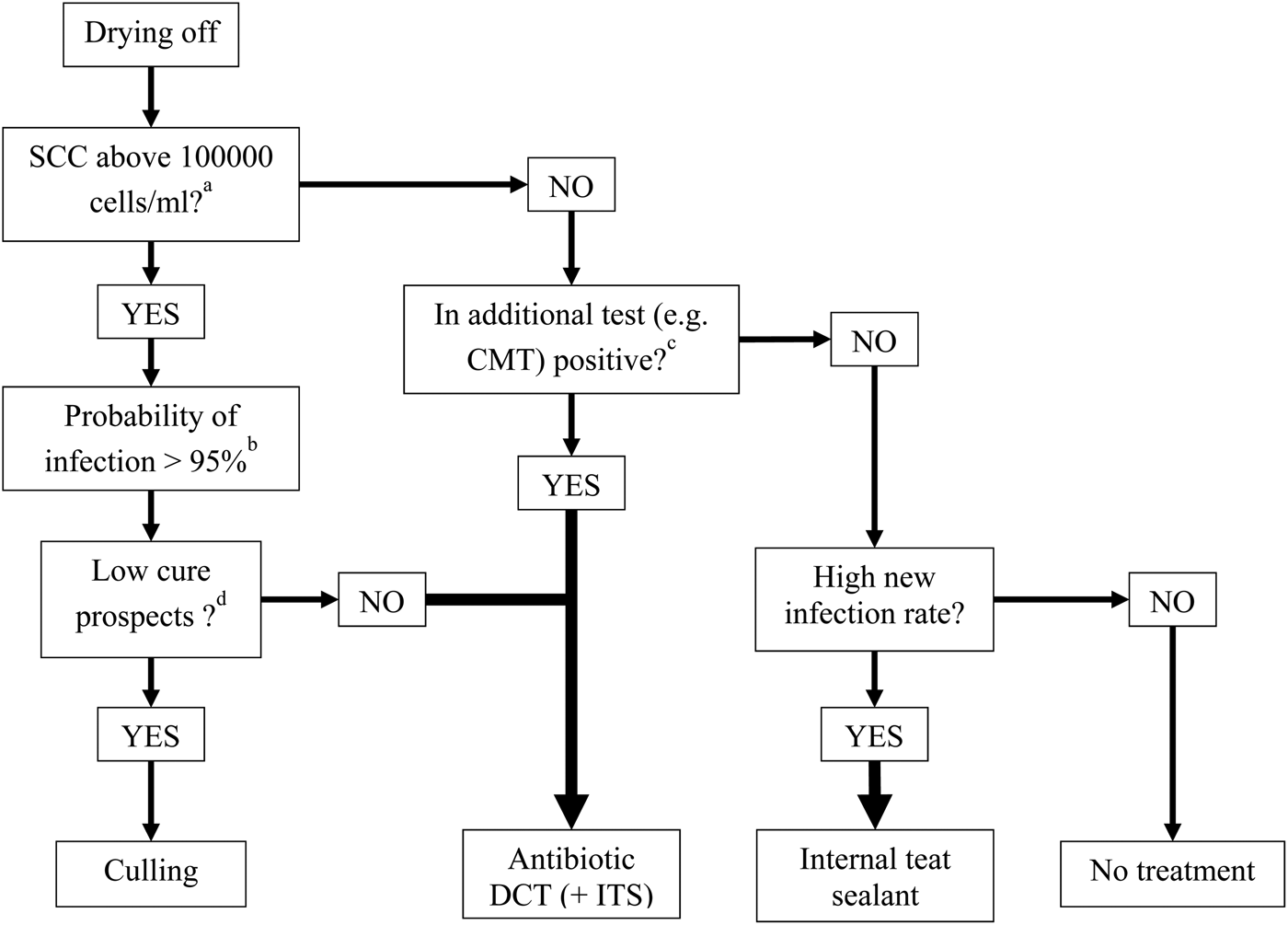
Figure 3 shows the final decision scheme for the application of antibiotic DCT and ITS. Cows with a geometric mean SCC above 100 000 cells/ml for three consecutive DHI records prior to dry-off are considered as infected and should be treated with antibiotic DCT.
Decision scheme for the application of antibiotic dry cow therapy (DCT) and/or an internal teat sealant (ITS) at dry-off. aGeometric mean for 3 months prior to dry-off. bPrevalence 85·6%. cCalifornia mastitis test (CMT), Clinical mastitis during lactation, older cows. dGeometric mean SCC >600–700 000 cells/ml for three consecutive records prior to dry-off (Osteras, Reference Osteras2006).

Cows classified as uninfected by one or more selection criteria can be left untreated or receive an ITS depending on the risk of NI.
Discussion
The present study was performed with no attempt to influence the current dry cow management on the farms, no preselecting or clustering of trial animals. This approach enabled evaluation of realistic farm conditions. Only organic farms were selected for the trial.
Analysis of DCT at cow rather than at quarter level was adopted for practical and biological reasons (Barkema et al. Reference Barkema, Schukken, Lam, Galligan, Beiboer and Brand1997).
The prevalence of infection at dry-off was high (81·2%). Minor pathogens were most frequently isolated. The relatively high rate of infections by S. aureus compared with S. uberis and enterobacteriacae indicates that contagious predominate over environmental pathogens. A similar pattern was reported for organic farms previously (Hayton & Bradley, Reference Hayton and Bradley2004).
Identifying infected cows
Bacteriological culture is commonly used as the reference test for infection status when evaluating diagnostic tests (Sargeant et al. Reference Sargeant, Leslie, Shirley, Pulkrabek and Lim2001; Sanford et al. Reference Sanford, Keefe, Sanchez, Dingwell, Barkema, Leslie and Dohoo2006; Torres et al. Reference Torres, Rajala-Schultz, DeGraves and Hoblet2008).
Like in previous studies SCC was confirmed as an adequate tool to identify infected cows at dry-off. The SE of SCC as a selection criterion in the present study was similar to values reported by Pantoja et al. (Reference Pantoja, Hulland and Ruegg2009) and Torres et al. (Reference Torres, Rajala-Schultz, DeGraves and Hoblet2008). The SP was distinctively higher than in the other studies (80·5 vs 63·0%).
The optimal SCC threshold of 100 000 cells/ml in the present study is consistent with the study by Pantoja et al. (Reference Pantoja, Hulland and Ruegg2009) that achieved balanced SE and SP with the same threshold. Others found 200 000 cells/ml to be a sensible threshold for IMI (Bradley & Green, Reference Bradley and Green2004; Torres et al. Reference Torres, Rajala-Schultz, DeGraves and Hoblet2008). Differences in thresholds can be explained by the overall high prevalence in the present study (Biggs et al. Reference Biggs, Barret, Bradley, Green, Reyher and Zadocks2016). Furthermore, infections caused by minor pathogens normally induce less intense SCC responses in milk (Sargeant et al. Reference Sargeant, Leslie, Shirley, Pulkrabek and Lim2001; Pantoja et al. Reference Pantoja, Hulland and Ruegg2009).
Excluding infections by minor pathogens at dry-off the SE of SCC as the selection criterion was increased. A similar increase in SE has been observed in other studies when detection of all pathogens was compared with detection of major pathogens only (Sanford et al. Reference Sanford, Keefe, Sanchez, Dingwell, Barkema, Leslie and Dohoo2006; Torres et al. Reference Torres, Rajala-Schultz, DeGraves and Hoblet2008).
In terms of the number of DHI records used to identify IMI the three last records prior to dry-off were recommended (Torres et al. Reference Torres, Rajala-Schultz, DeGraves and Hoblet2008; Biggs et al. Reference Biggs, Barret, Bradley, Green, Reyher and Zadocks2016). In the present study, the accuracy of SCC to identify all infected cows was almost similar using results of one or three DHI records prior to dry-off but decreased using all records of the previous lactation. However, cows infected with major pathogens were identified most accurately when all records were considered.
The predictive values change with the prevalence of infection in the population and the test characteristics. Prevalence and accordingly PPV in the present study were distinctively higher than in the studies reported by Pantoja et al. (Reference Pantoja, Hulland and Ruegg2009) and Torres et al. (Reference Torres, Rajala-Schultz, DeGraves and Hoblet2008) with reported prevalence about 34·5% and a PPV of 47·0 and 40·4%, respectively. In contrast, the NPV was lower (31·5 vs 76·0–80·9%). However, with an assumed prevalence below 20%, the NPV was 91%, similar to the results of Torres et al. (Reference Torres, Rajala-Schultz, DeGraves and Hoblet2008).
Sanford et al. (Reference Sanford, Keefe, Sanchez, Dingwell, Barkema, Leslie and Dohoo2006) suggested that screening cows for selective DCT with CMT at dry-off is reasonable, but mostly on herds with a low prevalence of infection. Estimates of SE and SP in the present study, when using CMT as the only selection criterion, were lower than the values of 70 and 48% reported by Sanford et al. (Reference Sanford, Keefe, Sanchez, Dingwell, Barkema, Leslie and Dohoo2006). Similar to other studies, CMT performed better when excluding infections by minor pathogens (Sargeant et al. Reference Sargeant, Leslie, Shirley, Pulkrabek and Lim2001; Sanford et al. Reference Sanford, Keefe, Sanchez, Dingwell, Barkema, Leslie and Dohoo2006).
The occurrence of CM in the previous lactation had no influence on the probability of IMI at dry-off and selecting only cows with CM for antibiotic DCT had a low SE. However, as other studies showed that cows with CM are at a higher risk for infections with major pathogens general selection for antibiotic DCT may make sense (Zadoks et al. Reference Zadoks, Allore, Barkema, Sampimon, Wellenberg, Gröhn and Schukken2001; Bradley & Green, Reference Bradley and Green2004).
Since the prevalence of IMI and pathogens differ between farms, the utility of any selection criterion depends on individual farm conditions. A high prevalence of infections at dry-off requires a selection criterion with a high SE to minimise the number of false negatives (Biggs et al. Reference Biggs, Barret, Bradley, Green, Reyher and Zadocks2016). This applies particularly to contagious pathogens such as S. aureus as leaving infected cows untreated is undesirable for eradication (Huxley et al. Reference Huxley, Green, Green and Bradley2002). If limited use of antibiotics is the goal, as on organic farms, and minor pathogens or pathogens ubiquitous in the environment are most prevalent, the use of a selection criterion that provides optimal accuracy is a reasonable approach (Torres et al. Reference Torres, Rajala-Schultz, DeGraves and Hoblet2008). The same approach and the same selection criteria as described in this study could be used to implement selective DCT on conventional farms in order to reduce drug usage. The optimal SCC threshold might be higher as selective DCT is advisable for conventional farms with low prevalence of IMI (Sanford et al. Reference Sanford, Keefe, Sanchez, Dingwell, Barkema, Leslie and Dohoo2006).
To improve the selection process a combination of selection criteria can be used to increase the NPV. It would be conceivable to implement a second diagnostic test on animals classified as uninfected by SCC in the first step. Performing additional diagnostic tests such as bacteriological culture on ‘problematic’ animals with a high SCC and so already classified as infected to minimise the number of false positives is questionable since erroneously treated cows do not adversely influence the herd`s udder health status, whereas false negatives do.
Compared with the non-strict DCT policy applied on the trial farms, the use of selection criteria with defined thresholds enabled identification of infected cows with a higher SE. The fact, that there were also large differences in the SE of the selection procedure between the farms in spite of having almost the same prevalence indicates potential for further optimisation (Krömker & Volling, Reference Krömker and Volling2007).
It is important to note that, in comparison with selection by the farmers, the implementation of the selection criteria would approximately double the use of antibiotics. However, the percentage of erroneously treated animals would be unchanged.
Cure, new infections and clinical mastitis
The overall cure rate in the present study was high compared with the average at cow level of 46 ± 12% on organic farms (Krömker & Volling, Reference Krömker and Volling2007). As expected, cows receiving antibiotic DCT had a higher probability of cure (Halasa et al. Reference Halasa, Nielen, Whist and Osteras2009). Although such effects could not be shown in the present study, certain animal characteristics are reported to significantly decrease prospects of cure after DCT. Therefore, it can be reasonable that cows with at least one case of clinical mastitis and SCC above 600 000–700 000 cells/ml in the three consecutive records prior to dry-off are considered for culling as the risk of treatment failure is high (Osteras, Reference Osteras2006).
Cows receiving ITS had a higher cure rate compared with unsealed cows, either in combination with or without antibiotic DCT. The same effect has been reported previously (Newton et al. Reference Newton, Green, Benchaoui, Cracknell, Rowan and Bradley2008). Even though the differences in cure rates were not significant in the named study, they suggest that reinfections with the same pathogen during the dry period are important and could lead to an apparently lower cure rate in unsealed cows.
IMI after calving increased the risk of CM within 100 DM as reported previously (Green et al. Reference Green, Green, Medley, Schukken and Bradley2002).
The NIR was high during the dry period, as reported previously for organic farms. Conventional farms using DCT appropriately had a 20% lower NIR (Krömker & Volling, Reference Krömker and Volling2007). Cows with an infection caused by a minor pathogen at dry-off had a lower risk of a NI during the dry period. The effect of infections with minor pathogens at dry-off is controversial, as it has been demonstrated that such quarters are significantly less likely to become infected with major pathogens (Huxley et al. Reference Huxley, Green and Bradley2003).In contrast, others found that minor pathogen-positive quarters are significantly more likely to become infected with environmental streptococci and coliforms (Hogan et al. Reference Hogan, Smith, Todhunter and Schoenberger1988; Berry & Hillerton, Reference Berry and Hillerton2002b). Application of ITS at dry-off provided efficient protection against NI, similar to the results of a meta-analysis evaluating the effect of sealing (Rabiee & Lean, Reference Rabiee and Lean2013). As reported previously, cows receiving only ITS had significantly fewer NI compared with those treated only with antibiotic DCT (Huxley et al. Reference Huxley, Green, Green and Bradley2002). Therefore, in cows classified as uninfected, application of ITS is preferably compared with prophylactic use of antibiotics. A lower NIR during the dry period will lead to an overall improvement of the udder health status in the herd (as well as a lower prospective prevalence) and better future results of any selection criterion.
Conclusion
The present study showed that the use of a selection criterion with a defined threshold may enable identification of infected cows with a higher SE compared with a non-strict DCT policy. Any selection criterion needs to be adapted for on-farm conditions and goals. In herds with a high prevalence of infection, caution should be taken about the use of selection criteria or selective DCT programmes should probably not be considered at all. If selective DCT is mandatory, as on organic farms, and prevalence of IMI high, the farmer and veterinarian need to take into account that the use of any selection criterion implies the probability of false negative cows and that the udder health status may not improve. Besides the use of antibiotic DCT the overall udder health status can be improved by reducing the number of NI during the dry period by using less controversial and less restricted methods like ITS and improvement of housing conditions.
The authors thank the dairy farmers who participated in the study. The study was financially supported by the Ministry of Food, Agriculture and Consumer Protection of Lower Saxony, Germany. The authors declare no potential conflicts of interest.