INTRODUCTION
Remnant trees and isolated shrubs or pioneer species in open landscapes represent natural perches and stepping stones for dispersal agents (Guevara et al. Reference GUEVARA, PURATA and VAN DER MAAREL1986, Howe et al. Reference HOWE, URINCHO-PANTALEON, PEÑA-DOMENE and MARTÍNEZ-GARZA2010). Birds and bats seek protection, shade, rest and food in these natural perches and increase the seed rain of the tree species under them (Galindo-González et al. Reference GALINDO-GONZÁLEZ, GUEVARA and SOSA2000). These attributes make these trees ‘regeneration nuclei’ (Guevara et al. Reference GUEVARA, PURATA and VAN DER MAAREL1986).
Trees with fleshy fruits attract more seed dispersers (Guevara et al. Reference GUEVARA, PURATA and VAN DER MAAREL1986, Slocum Reference SLOCUM2001), and a greater seed arrival occurs under these canopies than under species that produce dry fruits (Slocum & Horvitz Reference SLOCUM and HORVITZ2000, Vieira & Gandolfi Reference VIEIRA and GANDOLFI2006), even during periods when the trees are not producing fruit (Slocum & Horvitz Reference SLOCUM and HORVITZ2000). However, even without attractive food for seed dispersers, trees without fleshy fruits can be important perches and, accordingly, show an increase in seed rain (Carrière et al. Reference CARRIÈRE, ANDRÉ, LETOURMY, OLIVIER and McKEY2002). These authors found that the increase in seed rain was slightly higher in wind-dispersed plants than in those that produce fleshy fruits. In this context, it is clear that the mechanisms for the attraction of animals are not yet fully understood (Slocum Reference SLOCUM2001).
Evaluations of the seed rain under the canopies of female and male plants of dioecious and zoochoric species could clarify mechanisms of attractiveness and highlight the importance of the presence of food resources in the deposition of diaspores under these trees. Studies utilizing this approach, i.e. those exploring the effect of gender on seed rain beneath isolated trees, have not yet been developed. Furthermore, this research could determine the importance of each sex as nucleator trees in natural environments.
Importantly, dioecious plants often exhibit sexual differences in life-history traits, such as plant size, growth rate and phenology, which arise from the different costs of reproduction for male and female plants (Forero-Montaña et al. Reference FORERO-MONTAÑA, ZIMMERMAN and THOMPSON2010, Kuaraksa et al. Reference KUARAKSA, ELLIOTT and HOSSAERT-MCKEY2012). In tropical forests, dioecy can occur in 27% of tree species, and the dioecious condition is associated with fleshy fruits dispersed by animals at both species and generic levels (Ibarra-Manriquez & Oyama Reference IBARRA-MANRIQUEZ and OYAMA1992). Some dioecious trees are recognized as important pioneer species in secondary succession, such as those belonging to the genera Cecropia (Alvarez-Buylla & Martinez-Ramos Reference ALVAREZ-BUYLLA and MARTINEZ-RAMOS1992) and Myrsine (Klein Reference KLEIN1980).
It is pertinent to assume that, in pioneer vegetation, these trees can act as perches for birds and bats, and in the case of female plants, there is also the provision of food resources. Thus, if the food source is the largest element of attraction for animal dispersal, a significant increase in seed rain under the canopy of female trees in relation to male trees would be expected, and both would cause increases in seed rain compared with sites without trees.
In the context stated above, we predict that the seed rain under the canopies of female trees of Myrsine coriacea (Sw.) R. Br. ex Roem. & Schult. (Primulaceae) will be more abundant and more species-rich than that of male trees because female trees offer fleshy fruits as a reward. We also predict that the seed rain under the canopies of these trees will be more abundant and more species-rich than that in sites with only herbaceous vegetation, i.e. areas lacking tree and shrub species.
METHODS
Study area and species
The study was conducted in a 1.8-ha secondary forest fragment in the Atlantic zone (48°48′19″–48°48′25″W, 27°43′46″–27°44′02″S, 290 m asl) adjacent to the state park of Serra do Tabuleiro in the municipality of Santo Amaro da Imperatriz, State of Santa Catarina, Brazil. The climate in the region is classified as humid and mesothermic (Cfa) according to the Köppen system (Castellani & Santos Reference CASTELLANI and SANTOS2005). The average annual temperature is 19 °C. January is the hottest month (mean temperature of 23 °C), and July is the coldest month (mean temperature of 15 °C). The average annual rainfall is approximately 1600 mm. The wettest month is February (average rainfall of 211 mm), and the driest month is June (average rainfall of 68.5 mm) (GAPLAN 1986).
The original vegetation was cut and planted with grass in the 1940s, after which the land was used for pasture until 1990 and was successively cut until 5 y prior to this study (F. M. Brüggemann, pers. comm.). The species present are characteristic of the regeneration process of the Atlantic forest (Klein Reference KLEIN1980, Reference KLEIN1981) and are interspersed with some invasive species. The physiognomy is predominantly herbaceous, with a predominance of grasses such as Melinis minutiflora P. Beauv. and Andropogon bicornis L. Trees are sparse, and Myrsine coriacea is predominant. There are also isolated trees of Clethra scabra Pers., Miconia cinnamomifolia (DC.) Naudin and Tibouchina granulosa (Desr.) Cogn.
Myrsine coriacea is an evergreen heliophytic tree with great capacity for colonizing areas of the Atlantic forest in the process of secondary succession (Klein Reference KLEIN1980, Pinheiro & Carmo Reference PINHEIRO and CARMO1993, Reitz et al. Reference REITZ, KLEIN and REIS1979). Its fruits are consumed by several bird species (Pinheiro & Carmo Reference PINHEIRO and CARMO1993). Myrsine coriacea trees have an elongated crown that is not very dense, their height varies from 6 to 12 m, and the trunk varies from 30 to 40 cm in diameter. These trees bloom from May to June, and their fruits ripen from October to December. The fruits are small globose drupes (3–5 mm) that are black-purple when ripe with a very thin pericarp and one seed with a diameter 1 mm smaller than that of the fruit (Lorenzi Reference LORENZI2002a, Pascotto Reference PASCOTTO2007).
Seed rain under female trees, male trees and sites without trees
In this paper, the term diaspore is used to describe seeds and fruits together as units of dispersal, and the term seed rain, adopted in this work, corresponds to both seeds and fruits deposited in traps under the crowns of M. coriacea and in sites without trees.
Sixty traps were installed to monitor seed rain: 20 under the crowns of 20 female M. coriacea trees (one per tree), 20 under the crowns of 20 male trees and 20 in sites with only herbaceous vegetation (referred to as ‘without trees’). The area under the crown of each M. coriacea tree was divided into four quadrants, and a trap was placed in a randomly chosen quadrant close to the trunk of the tree. The trees chosen for the study were reproductive adults and had no crown overlap with other shrub or tree species. Traps were placed at an average of 5 m away from each other (with a minimum of 3 m), and there was no overlap between species canopies.
Seed traps were made of wood and voile fabric (100% polyester). Each trap was square with an area of 0.5 m2 (Hardesty & Parker Reference HARDESTY and PARKER2002, Pivello et al. Reference PIVELLO, PETENON, JESUS, MEIRELLES, VIDAL, ALONSO, FRANCO and METZGER2006) and was positioned 0.5 m above the ground on wooden legs (Holl Reference HOLL1998). The diaspores were collected every 15 d for 13 mo from October 2009 to October 2010, analysed with the aid of a stereoscopic microscope and separated into morphospecies.
The collected diaspores were identified to the level of species, genus or family by comparing them with fruits and seeds of trees collected in the study area and the surrounding forest. The literature was also consulted (Bacchi et al. Reference BACCHI, LEITÃO FILHO and ARANHA1984, Barroso et al. Reference BARROSO, MORIN, PEIXOTO and ICHASO1999, Leitão Filho et al. Reference LEITÃO FILHO, ARANHA and BACCHI1972, Reference LEITÃO FILHO, ARANHA and BACCHI1975; Lorenzi Reference LORENZI2002a, Reference LORENZI2002b, Reference LORENZI2009) to assist in the identification of diaspores. The diaspores were classified according to dispersal syndrome (van der Pijl Reference VAN DER PIJL1972): (1) zoochoric, (2) anemochoric, (3) autochoric and (4) indeterminate. Only ripe fruits and seeds were included in the analysis.
The male and female trees of M. coriacea selected for the study were measured to determine total tree height, canopy height (from the apex of the canopy to the insertion of the first branch of the trunk) and canopy area (area of the circle generated from the mean radius of the canopy) to assess whether these morphological characteristics differed between the sexes and influenced seed rain.
Data analysis
The abundance of diaspores and richness of seed rain per trap area were compared using analysis of variance (ANOVA) and the post hoc Tukey test using log10-transformed data (Zar Reference ZAR1996). The species composition of seed rain under male and female trees of M. coriacea and in sites without trees was assessed by analysis of similarity (ANOSIM) using R version 2.11.1. The morphological characteristics of male and female trees of M. coriacea were compared using a t-test (Zar Reference ZAR1996) with the program Statistica (version 7).
A principal component analysis (PCA) was performed to explore the combined effects of the richness and abundance of the seed rain and the morphological characteristic of the trees (canopy area). A correlation matrix was employed in the PCA (Legendre & Legendre Reference LEGENDRE and LEGENDRE1998), and the analysis was performed with the standardized measurement data using the program MVSP (version 3.13r).
All of the M. coriacea fruits that were deposited by falling naturally (i.e. those without signs of use by fauna) were removed from the analysis; thus, only the diaspores manipulated by animal dispersal agents were included.
RESULTS
Abundance and richness of the seed rain under female trees, male trees and sites without trees
We collected 365071 diaspores in the 60 traps. Of these, 53% (191652) were under female trees, 29% (106533) were under male trees and 18% (66886) were in sites without trees. The proportion of M. coriacea diaspores that were deposited by falling naturally was 8.14% of the total (29728 diaspores). Excluding this percentage, 335343 diaspores were employed in the analyses. A total of 115 morphospecies belonging to at least 37 plant families were recorded in the seed rain. Of these morphospecies, 97 were found under female trees, 92 were found under male trees and 57 were found in sites without trees.
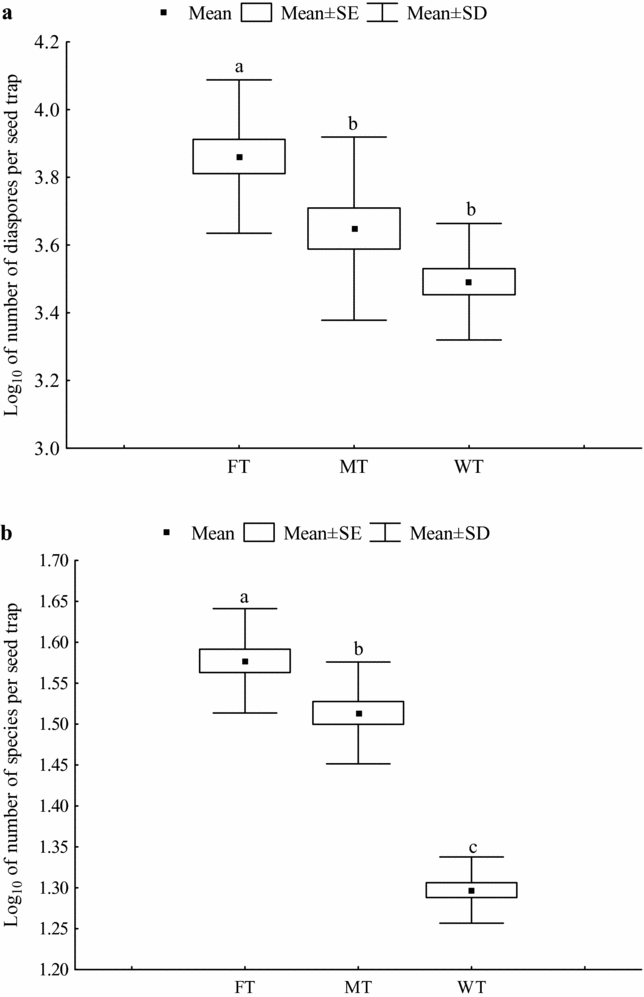
The three types of trap site differed significantly with respect to the number of diaspores deposited (F(2,57) = 13.4, P < 0.05). The average abundance of diaspores under female trees differed from the abundance found under male trees and in sites without trees (Figure 1a). We also found significant differences in the richness of species deposited in the three sites (F(2,57) = 135, P < 0.05), with female trees differing from the male trees and the sites without trees. The male trees also differed from the sites without trees (Figure 1b).
Number of diaspores (a) and richness of species of diaspores (b) deposited under the canopy of the female trees (FT, n = 20 seed traps of 0.5 m2) and male trees (MT, n = 20) of Myrsine coriacea and at sites without trees (WT, n = 20) in secondary vegetation of Atlantic rain forest (Santo Amaro da Imperatriz, State of Santa Catarina, southern Brazil). Same letters indicate no significant differences according to Tukey test, P < 0.05.

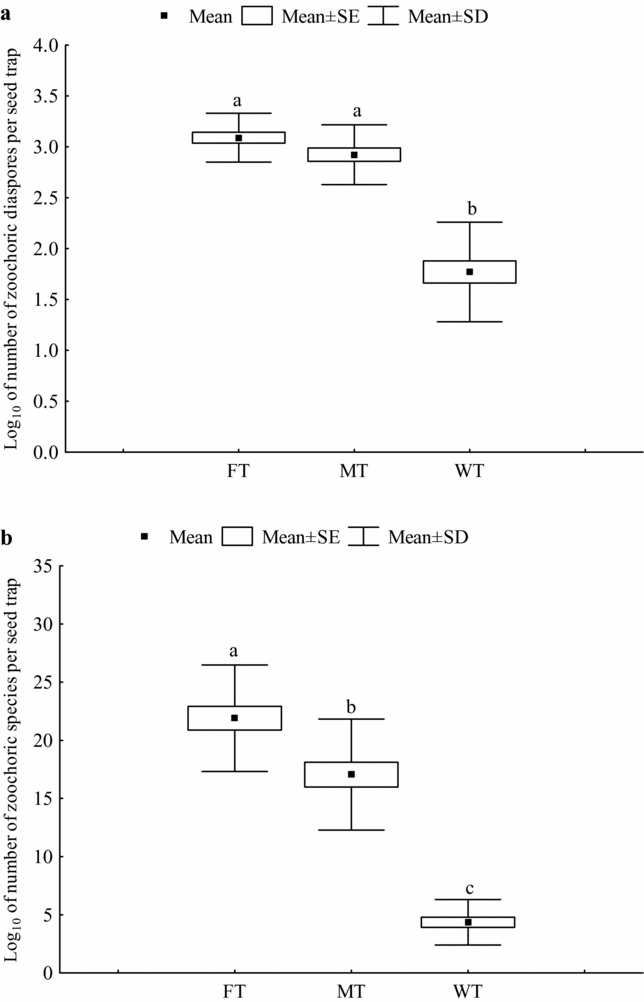
Considering only the diaspores classified as zoochoric, the abundance of diaspores (F(2,57) = 112; P < 0.05) differed significantly between sites containing trees of M. coriacea and sites without trees. The richness (F(2,57) = 155; P < 0.05) differed significantly among the three types of trap sites (Figure 2a, b). The species richness of diaspores under the canopy of female plants was always higher than that under male trees for both zoochoric diaspores and total seed rain (Figure 1b, 2b).
Number of zoochoric diaspores (a) and richness of zoochoric species (b) under the canopy of the female trees (FT, n = 20 collectors of 0.5 m2) and male trees (MT, n = 20) of Myrsine coriacea and at sites without plants (WT, n = 20) in secondary vegetation of Atlantic rain forest (Santo Amaro da Imperatriz, State of Santa Catarina, southern Brazil). Same letters indicate no significant differences according to Tukey test, P < 0.05.
Male and female trees of M. coriacea did not differ in total height (t(38) = 1.1, P > 0.05), canopy height (t(38) = 1.2, P > 0.05) or canopy area (t(38) = 1.8, P > 0.05). These reproductive plants presented average heights of approximately 6 m (female 6.2 ± 1.3 m; male 6.5 ± 0.8 m) and canopy areas of 5.7 ± 2.8 m2 (female) and 7.8 ± 4.4 m2 (male).
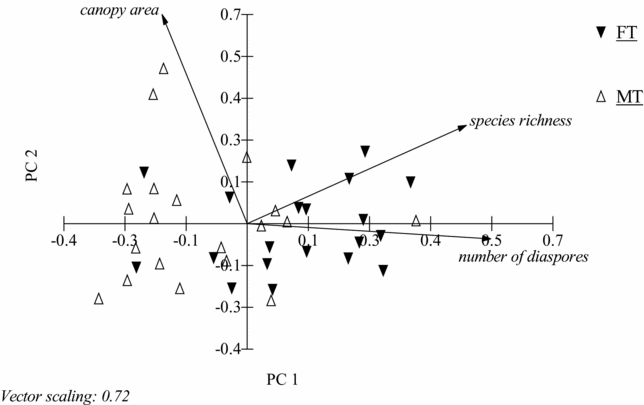
In the principal component analysis (Figure 3) involving the parameters of seed rain and the morphological characteristics of the trees, the first two components accounted for 83.7% of the variance (49.1% and 34.6% for the first and the second, respectively). The number of diaspores (0.72) and species richness (0.65) were more highly correlated with the first component, and canopy area (0.90) was more highly correlated with the second component. Most of the female trees sampled were positioned closer to the vectors of the number of diaspores and species richness, indicating a positive association with these variables. At the same time, most male tree samples were negatively associated with the seed-rain vectors. Additionally, trees with higher values for canopy area did not show increased arrival of diaspores or greater species richness per trap (Figure 3).
Scatter plot of principal component analysis (PCA) of parameters of seed rain (number of diaspores and richness of species) deposited under the canopy of the female trees (FT) and male trees (MT) of Myrsine coriacea and morphological characteristic of the trees (canopy area). (PC1 = 49.0% and PC2 = 34.6%.)
Seed rain composition
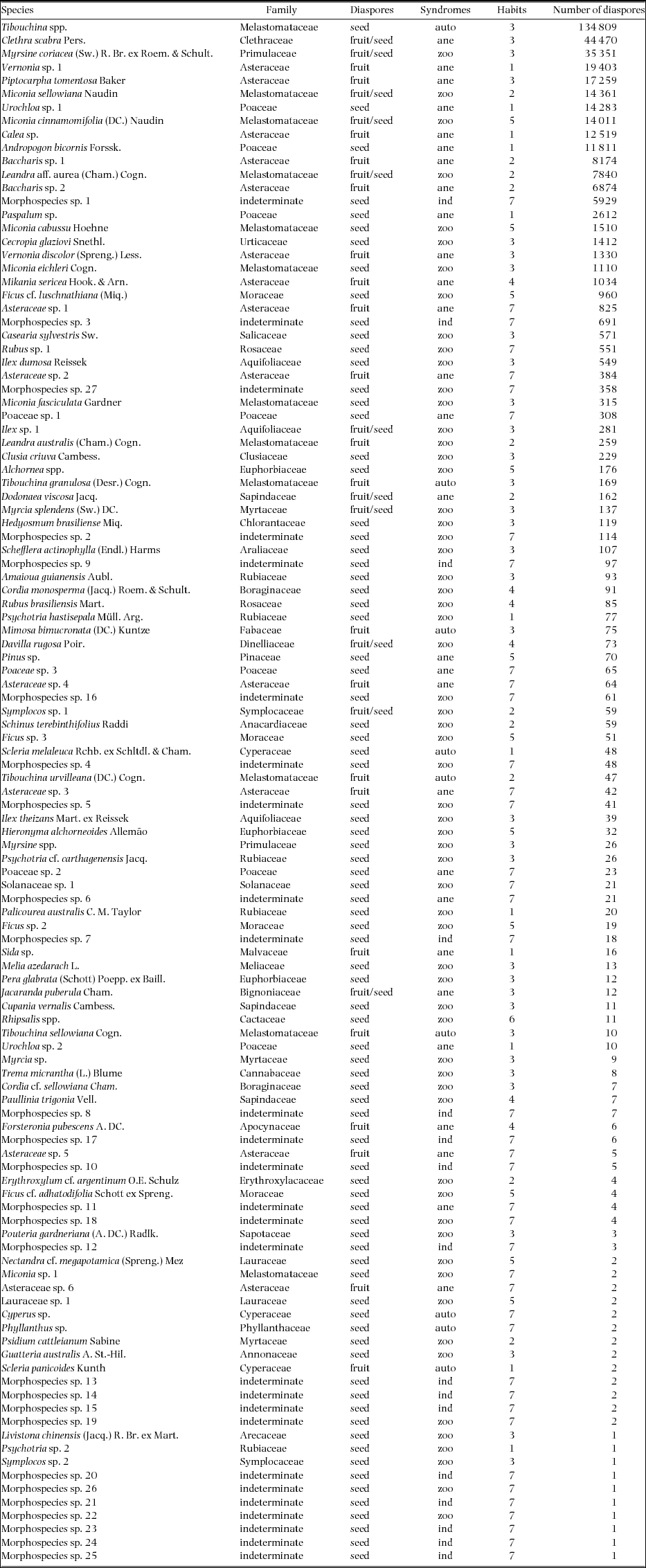
A total of 115 morphospecies were recorded in the evaluation of seed rain, belonging to at least 37 plant families. Species with zoochoric dispersal composed the greatest percentage of the seed-rain richness (53.9%) followed by those with anemochoric (24.3%), autochoric (7.8%) and indeterminate dispersal mechanisms (13.9%). In terms of diaspores, the anemochoric dispersal syndrome was most abundant (39%) followed by autochoric (37%), zoochoric (22.2%) and indeterminate dispersal syndromes (1.8%). Tibouchina spp. (Tibouchina granulosa (Desr.) Cogn., Tibouchina urvilleana (DC.) Cogn. and Tibouchina sellowiana Cogn.), with autochoric seed dispersal, presented the highest number of diaspores, and Clethra scabra Pers., with winged seeds, presented the second-highest number of diaspores collected (Appendix 1).
The predominant growth habit was tree (38.3% of species), comprising medium-sized and tall trees, followed by herbs (10.4%), woody shrubs (9.6%), scandent plants (6.1%), epiphytes (0.9%) and indeterminate (34.8%). Among the tree species recorded in the seed-rain analysis, 35 were zoochoric, and the species Miconia cinnamomifolia, M. cabussu, M. eichleri and Cecropia glaziovi stand out due to the arrival of larger numbers of diaspores, which together accounted for 5% of the total. Miconia (six species), Ficus (four species) and Ilex (three species) are the most well-represented genera (11% of the total) among the zoochoric trees in terms of species (Appendix 1).
Regarding the composition of the seed rain under the canopies of female trees, male trees and at sites without trees, the samples differed significantly (R = 0.6; P = 0.001) among the three sites. Samples obtained from under female trees differed from samples obtained from under male trees (R = 0.1; P = 0.007) and from sites without trees (R = 0.9; P = 0.001). Samples from male trees also differed from those collected from sites without trees (R = 0.7; P = 0.001).
DISCUSSION
Abundance and richness of seed rain under female trees, male trees and sites without trees
The results of this study showed that a significant amount of the total seed rain occurred under M. coriacea trees (more than 80% of the total), confirming the assumption that M. coriacea is an important focus for the deposition of diaspores compared with areas lacking trees and corroborating the hypothesis that isolated trees in the landscape are the sites of the deposition of diaspores (Corlett & Hau Reference CORLETT, HAU, Elliott, Kerby, Blakesley, Hardwick, Woods and Anusarnsunthorn2000, Galindo-González et al. Reference GALINDO-GONZÁLEZ, GUEVARA and SOSA2000, Herrera & García Reference HERRERA and GARCÍA2009, Slocum Reference SLOCUM2001, Wilms & Kappelle Reference WILMS and KAPPELLE2006).
Additionally, the effect of gender on seed rain beneath isolated trees of dioecious species was evident with M. coriacea, especially with regard to the species richness of diaspores. Female trees promoted increases in the arrival of zoochoric diaspores and increases in total seed rain under their canopy compared with male trees, confirming our hypothesis. We also observed a greater abundance of seed rain deposited under female trees, with records of 85119 more diaspores under female trees than under male trees. This tendency was also observed with zoochoric diaspores, with 7213 more. We suggest that the fruits of female trees play a key role in attracting dispersers because male and female trees differ only in the presence of fruit. Thus, the male trees act as a control because they have the same characteristics as the female trees but lack fruits.
The male trees are also a focus of diaspore deposition, as shown by the richer seed rain under male trees compared with sites without trees. This result is relevant because it confirms that the dispersers are visiting male trees, which must also offer features that are attractive to dispersers. In some cases, the importance of non-fruit-producing trees can be comparable to that of fruit-producing trees in the seed dispersal landscape, and non-fruit-producing trees may increase the seed rain although they lack a food source that is attractive to dispersal agents. For example, Carrière et al. (Reference CARRIÈRE, ANDRÉ, LETOURMY, OLIVIER and McKEY2002) reported an increase in seed rain under the canopy of anemochoric and zoochoric species compared with open field sites far from the trees evaluated. These authors found an average of 17.2 seeds mo−1 per trap (0.2 m2) under anemochoric trees, compared with 15.5 seeds mo−1 under zoochoric trees.
We believe that both female and male M. coriacea trees offer points of landing, rest and shelter as well as tree-associated insects (pers. obs.) that make them attractive to dispersers. According to Carrière et al. (Reference CARRIÈRE, ANDRÉ, LETOURMY, OLIVIER and McKEY2002), birds with mixed diets may visit the trees to eat items other than fruits. These authors argue that some bird species may visit trees that do not have fleshy fruits to feed on insects. Our findings corroborate the work of these authors and show that trees of M. coriacea are attractive to seed dispersers.
Trees with a larger canopy area showed no major increase in diaspores per trap area. This result suggests that the size of reproductive trees is not a factor that influences the abundance and richness of seed rain, although these results were obtained using a standard trap size, which is a procedure that has been employed in other studies evaluating seed rain (Grombone-Guaratini & Rodrigues Reference GROMBONE-GUARATINI and RODRIGUES2002, Guevara et al. Reference GUEVARA, PURATA and VAN DER MAAREL1986, Reference GUEVARA, LABORDE and SANCHEZ-RIOS2004, Herrera & García Reference HERRERA and GARCÍA2009, Vieira & Gandolfi Reference VIEIRA and GANDOLFI2006).
Seed rain composition
Species with the zoochoric dispersal syndrome showed the highest number of species in their seed rain, corroborating other studies performed on isolated trees in tropical forests (Carrière et al. Reference CARRIÈRE, ANDRÉ, LETOURMY, OLIVIER and McKEY2002, Guevara et al. Reference GUEVARA, PURATA and VAN DER MAAREL1986, Reference GUEVARA, LABORDE and SANCHEZ-RIOS2004; Howe & Smallwood Reference HOWE and SMALLWOOD1982). Nearly 40% of the species recorded were trees, and many of these trees had zoochoric fruits, indicating that the arrival of these species may facilitate the future development of tree patches and forest succession. However, many other post-dispersal factors alter recruitment after seed arrival, e.g. seed predation and seedling competition (Duncan & Chapman Reference DUNCAN and CHAPMAN1999).
In terms of numbers, the anemochoric dispersal syndrome was the most abundant, confirming a trend in the early stages of succession. According to Pivello et al. (Reference PIVELLO, PETENON, JESUS, MEIRELLES, VIDAL, ALONSO, FRANCO and METZGER2006), the initial species involved in the succession of tropical rain forests are commonly dispersed by wind. This feature is also mentioned by van der Pijl (Reference VAN DER PIJL1972), who indicated that anemochoric dispersal tends to predominate in the early stages of colonization.
The composition of the seed rain was different in each site, suggesting that the arrival of species is modified by the presence and absence of individual trees and by the gender of the same tree species. Thus, we believe that species with diaspores dispersed by animals would benefit from the presence of local trees as perches (Corlett & Hau Reference CORLETT, HAU, Elliott, Kerby, Blakesley, Hardwick, Woods and Anusarnsunthorn2000, Duncan & Chapman Reference DUNCAN and CHAPMAN1999, Guevara et al. Reference GUEVARA, PURATA and VAN DER MAAREL1986, Reference GUEVARA, LABORDE and SANCHEZ-RIOS2004; Herrera & García Reference HERRERA and GARCÍA2009).
CONCLUSIONS
Myrsine coriacea trees were shown to be foci of diaspore deposition, as evaluated by their richer and more abundant seed rain compared with sites lacking trees. Female trees showed significantly greater abundance and richness of seed rain compared with male trees. A greater richness of zoochoric diaspores was deposited under the canopy of female plants. Thus, there is a gender effect on seed rain beneath trees of dioecious species. Male trees were important foci of diaspore deposition compared with sites lacking trees. Resources, including landing areas, rest areas, the presence of insects and the presence of fruits, were likely responsible for the attraction of dispersal agents, which deposited a large number of diaspores from many species of trees under the canopy of M. coriacea, thus contributing to the process of the arrival of new species and secondary succession in the Atlantic forest.
ACKNOWLEDGEMENTS
We thank Coordination for the Improvement of Higher Education Personnel (CAPES) for granting a scholarship to the first author and all colleagues of the Laboratory of Plant Ecology, especially Cecília Dalotto, Piera Ostroski Bellani, Priscilla Amaral de Sá and Alexander T. Xavier, who helped with screening and field work. We also thank professors Ademir Reis, Ana Zanin and Rafael Trevisan of the Department of Botany at Universidade Federal de Santa Catarina (UFSC), the Masters student Cássio Daltrini Neto for assistance with the identification of tree species, biologist Fernando M. Brüggemann and the Hotel Caldas da Imperatriz for the use of the area and the infrastructure offered.
Diaspores collected in the seed rain in secondary vegetation of Atlantic rain forest (Santo Amaro da Imperatriz, State of Santa Catarina, southern Brazil) ranked by abundance of diaspores. Syndromes: ane = anemochoric, auto = autochoric and zoo = zoochoric; Habits: 1 = herbs, 2 = woody shrubs, 3 = medium-sized trees, 4 = scandent plants, 5 = tall trees, 6 = epiphytes and 7 = indeterminate.