Introduction
The development of electronic devices for energy conversion and storage has increased in recent years due to the damage caused by using fossil fuels.[ Reference Bustamante, Hubler, Gaustad and Babbitt 1 ] The global need has motivated research for generating alternative energy resources through, for example, fuel cells, photovoltaics, and electrochemical devices.[ Reference Sivula and van de Krol 2 ] To allow mass production, material components of these devices must be inexpensive and efficient. A large class of materials that have been widely studied for this purpose are transition metal oxides.[ Reference Toroker and Carter 3 ]
Specifically, nickel oxide-based materials have attracted significant interest for a variety of applications, including sensors, batteries, photovoltaics, and electrochemistry.[ Reference Kudo and Miseki 4 ] A promising material is nickel oxyhydroxide (β-NiOOH), which is already being used as an electrode in the battery industry. Furthermore, recent studies have integrated β-NiOOH into electrochemical devices as an anode since this is one of the best catalysts for the oxygen evolution reaction under alkaline conditions.[ Reference Trotochaud, Ranney, Williams and Boettcher 5 – Reference Trotochaud, Young, Ranney and Boettcher 7 ]
One of the most puzzling issues about β-NiOOH is that the crystal structure is not fully known.[ Reference Fidelsky, Butera, Zaffran and Toroker 8 – Reference Conesa 10 ] That is, the locations of the hydrogen (H) atoms have not been determined. One reason for the structure being still unknown is that it is difficult to detect the location of H atoms experimentally. Another reason is that during electrochemical operating conditions the H vacancies are formed.[ Reference Van der Ven, Morgan, Meng and Ceder 11 – Reference Diaz-Morales, Ferrus-Suspedra and Koper 14 ]
Control over H vacancy generation may be useful for solid oxide fuel cells. Different components of a solid oxide fuel cell should have specific ionic and electronic conductivity properties. For example, solid electrolytes should generally maintain a high ionic conductivity with negligible electronic conductivity (<1% of total conductivity) in order to allow ionic movement without electric leakage between the anode and the cathode. This imposes a restriction on the desired band gap of the material, with typical values for the band gap, E g > 3 eV.[ Reference Keer 15 , Reference Tuller 16 ] On the other hand, for a material to serve as an anode, high ionic and electronic conductivity is crucial in order to allow ions to transport toward the surface for chemical oxidation and for the electrons to transport through the circuit. Hence, the main challenge is to identify a material with a high-enough ionic conductivity with an inherent option to synthetically control the electronic conductivity depending on the operating conditions. One such method is by exploiting “defect engineering”, i.e., the incorporation of various defects, such as H vacancies, to control and possibly lower the electronic band gap.[ Reference Tuller 16 ]
To understand the effect of H vacancies on the β-NiOOH material, we perform first principles calculations, namely Density Functional Theory+U (DFT+U) validated against hybrid DFT. We analyze changes in electronic structure of bulk β-NiOOH with several H vacancies and find that the band gap reduces, while the bulk modulus and the delocalized orbital nature remain the same, with increasing concentration of vacancies. These results demonstrate good stability and electronic conductivity for β-NiOOH.
Methods and calculation details
The Vienna Ab-initio Simulation Package (VASP) program was used to perform spin-polarized DFT calculations[ Reference Kresse and Hafner 17 , Reference Kresse and Furthmüller 18 ] with the Perdew–Burke–Ernzerhof (PBE)[ Reference Perdew, Burke and Ernzerhof 19 ] exchange–correlation (XC) functional. We chose the DFT+U formalism of Dudarev et al.,[ Reference Dudarev, Botton, Savrasov, Humphreys and Sutton 20 ] where the effective U–J term was taken to be 5.5 eV for Ni, as well as the PBE0 hybrid functional for validation,[ Reference Perdew, Ernzerhof and Burke 21 ] as previously done for modeling stoichiometric NiOOH.[ Reference Fidelsky, Butera, Zaffran and Toroker 8 , Reference Tkalych, Yu and Carter 9 , Reference Li and Selloni 22 – Reference Zaffran and Caspary Toroker 24 ] Projected-augmented wave potentials replaced the core electrons of Ni 1s2s2p3s3p and O 1s.[ Reference Blöchl 25 , Reference Kresse and Joubert 26 ]
The unit cell for β-NiOOH was built using the more commonly accepted unit cell for this material.[ Reference Li and Selloni 23 ] The cell was duplicated into a 2 × 2 × 1 supercell in order to mimic lower concentrations of H vacancies and in order to justify the reduction in k -points that would accelerate the PBE0 calculation, as we have done in a previous publication.[ Reference Zaffran and Caspary Toroker 24 ] The energy cutoff of 600 eV and k-point Gamma-centered grid of 1 × 1 × 1 were converged to within <1 meV. The ion positions were converged until the force components on all ions were <0.03 eV/Å. For the cells with two or more vacancies, geometry optimization was done with DFT+U to save computational expense since in our previous work[ Reference Zaffran and Caspary Toroker 24 ] we found little dependence of structure on the results using different XC functionals. Optimized unit cells are presented in the supporting information. The Brillouin zone was integrated with the Gaussian smearing method using a smearing width of 0.01 eV, while a smearing of 0.2 eV was used for density of states (DOS) visualization since lower smearing caused large numerical instabilities in the integration.
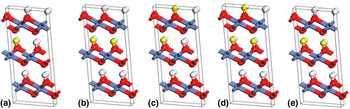
Different amounts of H vacancies were modeled, as apparent in Fig. 1: a single H vacancy, two H vacancies located in the same layer in order to amplify the effect of these vacancies, and three H vacancies. The corresponding H vacancy concentrations are 2.1, 4.2, and 6.3 at.%, respectively. We selected a number of cells representing the extreme case of H vacancies located in proximity within the same layer and H vacancies located farther away in different layers.
Bulk models for β-NiOOH with H vacancies. The positions of H vacancies are shown in yellow. (a) A single H vacancy, (b) two nearby H vacancies, (c) two H vacancies in different layers, (d) three H vacancies in different layers, and (e) three H vacancies in the same layer.

The formation energy of H vacancies was calculated according to the following formula:
 $$E_{\rm f} (n{\rm H}) = E_{\rm t}^{{\rm vac}} + \displaystyle{n \over 2} \cdot E({\rm H}_2 ) - E_{\rm t}^{{\rm pure}}, $$
where n is the number of H vacancies,
 $E_{\rm t}^{{\rm vac}} $
is the total energy of a unit cell with a vacancy,
 $E_{\rm t}^{{\rm pure}} $
is the total energy of a unit cell without vacancies, and E(H2) is the total energy of an H2 molecule. The reference of an H2 molecule is most popular for calculations of H vacancy formation energies[
Reference Fernandez, Ferro and Kato
27
] since the synthetic control over the stoichiometry of the solid would depend on the thermodynamic stability of its constituent entities.[
Reference Toroker and Carter
28
] Furthermore, in a proton-conducting solid oxide fuel cell, H2 is decomposed into protons that penetrate the solid-state material. In an electrochemical environment, the standard H electrode is the reference counter electrode where protons convert to H2 molecules. In an electrochemical environment where pH and voltage is applied then two terms are added to the above formula, according to the conventional protocol of implicitly adding these macroscopic effects,[
Reference Rossmeisl, Logadottir and Nørskov
29
] namely − K
B
T · ln 10 · pH according to the Nernst equation (K
B is the Boltzmann constant and T is the temperature) and a constant energy −eU of the applied bias.
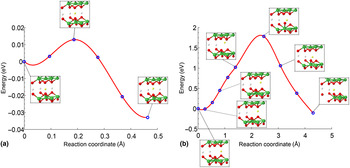
The H transport activation barriers were calculated with the nudged elastic band method (NEB) in order to find the minimum energy path for H transport between two oxygen sites. We have considered cells with a single H vacancy, which acts as a donor/acceptor site. Hence, the donor and acceptor sites are the H positions in the crystal structure of β-NiOOH. We have considered two possibilities for final states: (a) inter-layer and (b) intra-layer transports. For the inter-layer transport, we used four images and fully converged all atoms. For the intra-layer transport we were able to converge the minimum energy pathway with eight images, while all atoms are frozen, except for the H and three oxygen atoms involved in the transfer. Adding more images and allowing all atoms to move did not converge the pathway.
Results
In this section, we present the electronic structure properties of bulk β-NiOOH with H vacancies. First, we report the H vacancy formation energy under operating conditions. Next, we consider the effect of H vacancies on the structure, charge density difference, band gap, and DOS of β-NiOOH. We then calculate the energy barriers required for H transport. Finally, we calculate the bulk modulus for β-NiOOH with and without an H vacancy.
According to our DFT+U calculations, the energy for H vacancy formation is high compared with the thermal energy: 2 eV for first vacancy generation (2.1 at.%) and 4 eV for the second and third vacancies (4.2 and 6.3 at.%, respectively) at temperature 298.15 K, which is the operating temperature of electrochemical devices and batteries. Much higher temperatures are expected for solid oxide fuel cells (700–1000 K), but proton-conducting solid-oxide fuel cells operate at much lower temperatures. As a result of applying pH = 14 and V = 1 V that are typical conditions for many electrochemical systems,[ Reference Trotochaud, Young, Ranney and Boettcher 7 ] the formation energy decreases by −1.83 eV. Hence, the formation of 2.1 at.% H vacancies is quite feasible at these conditions. Note that the formation energy of H vacancies is important for H+ ionic transport since H+ ions need to have vacant acceptor sites. However, the structure of β-NiOOH already has inherently available oxygen sites since, according to the stoichiometry, half of the oxygen atoms in each layer do not have H atoms.
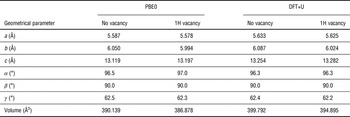
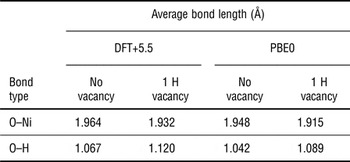
We examined the structural changes in β-NiOOH that result from the addition of a single H vacancy with both the DFT+U and PBE0 methods. As can be seen in Table I, for both methods, the overall volume decreases. The c vector increases due to the larger distance between the layers that is generated from the absence of van der Waals forces held by the absent H atom. As a result, a and b vectors decrease in length due to compensating bonding within the layers and structural relaxation. The latter is more significant and overall volume decreases. This trend can be observed from the longer O–H bonds and the shorter Ni–O bonds for the case with an H vacancy, as given in Table II. We note that these trends are consistent between DFT+U and PBE0, and slight decrease in distances can be observed for PBE0 due to the more localized orbital character (more ionic and tighter binding) that results from using this XC functional.
Lattice vector values and volume for β-NiOOH with no vacancy and a single H vacancy.

Average bond lengths for β-NiOOH with no vacancy and a single H vacancy.

The local magnetic moments on the atoms reveal that the oxidation states of the Ni atoms are +3 without an H vacancy. That is, the calculated magnetic moment of 1 Bohr magneton using both PBE0 and DFT+U, which corresponds to an electronic configuration of
 $t_{2g}^6 e_g^1 $
, and can be associated with a +3 oxidation state. Once an H vacancy is generated, then a nearby Ni atom changes to an oxidation state of +4 (calculated magnetic moment 0, which corresponds to an electronic configuration of
 $t_{2g}^6 $
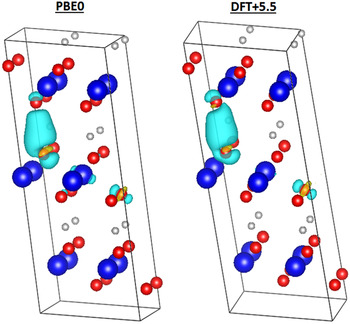
). The absence of charge on a Ni atom can be visualized from the blue charge density difference in Fig. 2. The charge density on the Ni atom is more apparent for the PBE0 functional since in this method the charge is more localized on the atoms. There is some effect on neighboring atoms since the bonding in β-NiOOH is characterized by hybridization, as seen from the DOS plots that are explained below.
Charge density of β-NiOOH with an H vacancy minus the charge density of β-NiOOH with no vacancy. Light blue density is negative charge density difference and yellow density is positive charge density difference. Blue, red, and white spheres represent Ni, O, and H atoms, respectively.

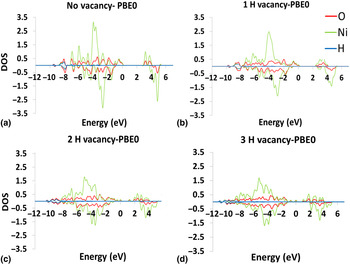
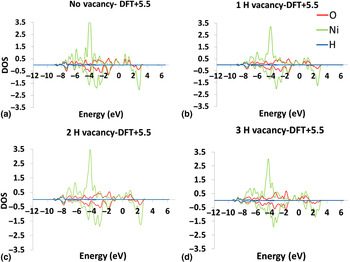
The DOS for β-NiOOH has the same properties once H vacancies are introduced. That is, both valence and conduction band edges have a mixture of oxygen and nickel states; this result is consistent for both DFT+U and PBE0 (see Figs. 3 and 4 for several representative cells; other cells show similar behavior as seen in the supporting information). The β-NiOOH material has been suggested to be a good electronic conductor, hypothetically due to strong hybridization and delocalization of states.[ Reference Burke, Zou, Enman, Kellon, Gabor, Pledger and Boettcher 30 ] Our results in Figs. 3 and 4 show that the states are still hybridized upon introducing H vacancies. Hybridization is apparent from the mixed nickel and oxygen chemical character of the valence and conduction band. The hybridization is an indicator of high electronic conductivity, and hence, excellent electronic conductivity should remain when H vacancies are present.
DOS for β-NiOOH with and without H vacancies calculated with PBE0: (a) no vacancies, (b) one H vacancy, (c) two H vacancies, and (d) three H vacancies. The vacancy locations are selected according to representative unit cells of Figs. 1(a), 1(b) (vacancies on same layer), and 1(d) (two vacancies in the same layer and one on another layer). Zero energy marks the highest occupied states.

DOS for β-NiOOH with and without H vacancies calculated with DFT+U: (a) no vacancies, (b) one H vacancy, (c) two H vacancies, and (d) three H vacancies. The vacancy locations are selected according to representative unit cells of Figs. 1(a), 1(b) (vacancies on same layer), and 1(d) (two vacancies in the same layer and one on another layer). Zero energy indicates the highest occupied states.

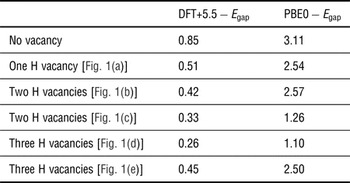
The most dramatic change is the decrease in the band gap with increasing H vacancy concentration (see Table III). The reduction of the band gap is consistent for both levels of theory, DFT+U and PBE0. The latter method gives a much wider gap in the stoichiometric case and has been suggested to be the best method for calculating a wide band gap for β-NiOOH,[ Reference Li and Selloni 22 ] in agreement with studies on other oxides.[ Reference Fuchs and Bechstedt 31 – Reference Isseroff and Carter 33 ] Notice that the band gap from the DFT+U calculation is not significantly large. In our recent study, we performed a thorough and systematic comparison between the performance of different functionals for predicting the properties of bulk NiOOH.[ Reference Zaffran and Caspary Toroker 24 ] Furthermore, another recent study of ours shows good agreement between the band gap obtained with PBE0 and the one obtained from a GW method (PBE0/G0W0).[ Reference Fidelsky and Caspary Toroker 34 ] One of the yet unresolved mysteries regarding β-NiOOH is what is the true band gap for this material, since several values have been suggested in the literature.[ Reference Fidelsky, Butera, Zaffran and Toroker 8 ] Hence, since DFT+U and PBE0 give different band gaps and the experimental value is unavailable, then we do not know which exchange–correlation functional to trust and must settle on observing trends that are consistent among both methods.
Band gap values for β-NiOOH with different hydrogen contents. Energies are in eV. The vacancy locations are selected according to representative unit cells of Fig. 1.

According to either method, the band gap monotonically decreases with the addition of H vacancies. This trend of band gap decrease generally holds as a function of H vacancies concentration increase or inter-vacancy distance decrease. For example, the band gap with two H vacancies in the same layer is smaller than the band gap of two H vacancies at different layers (0.33 versus 0.42 eV, respectively). An anomaly is the case of three H vacancies in the same layer. In contrast to this trend, this case does not exhibit the smallest band gap. The reason could be the high H vacancy concentration, which reaches the limit of possible phase transformation, and therefore β-NiOOH does not exhibit the same electronic structure as the stoichiometric β-NiOOH case.
The decrease in the band gap as a result of vacancy defects does not involve the appearance of new states far within the band gap energy regime. Some states do appear in conjunction to the edge of the conduction and valence band and are responsible for the decrease in the band gap. This is quite unusual for material defects which often create energetically narrow states much lower in energy than the conduction band edge that “trap” charge carriers.[ Reference Yatom and Toroker 35 – Reference Liao, Toroker and Carter 37 ] Fortunately, this is not the case and H vacancies should maintain the good electronic conductivity of β-NiOOH. This result strengthens the motivation to consider NiOOH as an anode material,[ Reference Muñoz-García, Ritzmann, Pavone, Keith and Carter 38 ] in addition to its potential to serve as an electrolyte. This was demonstrated by the feasibility of generating H vacancies in typical electrochemical conditions.
We also explored the possibility of H transport between oxygen sites, which is a relevant process for proton-conducting solid-oxide fuel cells. We find that H can transport between layers with very little amount of free energy: the calculated energy barrier is 0.01 eV by the NEB method [Fig. 5(a)] and 0.04 eV by the linear path approximation (a linear interpolation between initial and final atomic positions). In contrast, the energy required for H transport within a layer (between two potential H sites at the same layer) is 1.8 eV as seen in Fig. 5(b), which means voltage may be required to drive H atoms along this direction. Note that the H transport pathway between two H sites in the same layer is interesting since the path includes two stages: at the first stage, H transports to the adjunct layer and afterwards H transports back to the original layer. The first image, which has a small barrier ~0 eV [as seen in Fig. 5(b) in the first two data points] corresponds to transport first to the adjunct layer, before requiring a large energy to return to a different site in the previous layer.
Plot of energy versus H transport pathway for β-NiOOH with a single H vacancy as calculated by the NEB method: (a) inter-layer transport and (b) intra-layer transport.

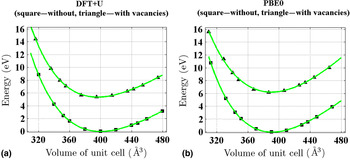
The total energy changes as a result of strain (expansion and contraction) were calculated for β-NiOOH without and with a single H vacancy (see Fig. 6). The results show that the potential energy of β-NiOOH relative to the energy minimum is hardly affected by the presence of H vacancies. Moreover, the value of the bulk modulus is not too different for both DFT+U and PBE0 calculation methods (see Table IV). This result implies that the mechanical properties of β-NiOOH should remain the same once H vacancies are introduced.
Plot of energy versus unit-cell volume of β-NiOOH with and without a single H vacancy as calculated by the methods: (a) DFT+U (U = 5.5 eV) and (b) PBE0. The green lines are curve fits to the third-order Birch–Murnaghan equation of state.

The values of the bulk modulus
 $K_0 = - V_0 (\partial p/\partial V)_{V = V_0} = V_0 (\partial ^2 E/\partial V^2 )_{V = V_0} $
and of the
 $K{\rm ^{\prime}}_0 = (\partial K_0 /\partial p)_{\,p = 0} $
parameter found by the non-linear curve fitting to the third-order Birch–Murnaghan equation of state. The rows are given for the four different curves in Fig. 6. Also the values of R
2 for each fit are given. The absolute and the relative errors given are the 95% confidence bounds.

Conclusions
The effect of H vacancies on the electronic structure of β-NiOOH was investigated using DFT-type methods since these vacancies are dominant at electrochemical operating conditions and are responsible for the good ionic conductivity of solid electrolytes. The band gap of β-NiOOH was found to continuously reduce upon the addition of H vacancies. Despite the decrease in the band gap, no energetically isolated states are apparent far within the energy gap. Therefore, H vacancies do not create unfavorable “trapping sites” for charge carriers. Furthermore, good electronic conductivity is also revealed from the strong hybridization of oxygen and nickel states in both the valence and conduction band, which appears from the distributed charge density difference and the mixed Ni–O character of projected DOS. The calculated H transport activation barriers show that inter-layer crossing is possible, while intra-layer H transport is inhibited by a large activation barrier. The latter may be improved if, for example, other phases of NiOOH are considered, such as the γ phase that includes inter-layer adsorbates that may aid transport by binding to H. This suggests that NiOOH should be a promising candidate to serve as solid electrolyte and mixed ionic–electronic anode in the next generation solid oxide fuel cells. The bulk modulus also shows little influence from the addition of an H vacancy and implies that the material should remain mechanically stable. These results are consistent using either DFT+U or PBE0 methods.
We conclude that the generation of H vacancies is a feasible process at electrochemical cell operation conditions. The vacancies have marginal effect on the mechanical and electronic properties of β-NiOOH. Hence, β-NiOOH has a strong potential to be a robust material for practical usage in energy-related devices.
Acknowledgements
This research was supported by the Nancy and Stephen Grand Technion Energy Program, the I-CORE Program of the Planning and Budgeting Committee, and The Israel Science Foundation (Grant no. 152/11), and the Pazy Foundation. This work was supported by the post LinkSCEEM-2 project, funded by the European Commission under the 7th Framework Programme through Capacities Research Infrastructure, INFRA-2010-1.2.3 Virtual Research Communities, Combination of Collaborative Project and Coordination and Support Actions (CP-CSA) under grant agreement no RI-261600. V.F. acknowledges scholarship by the Jacob Isler Foundation.
Supplementary material
The supplementary material for this article can be found at https://doi.org/10.1557/mrc.2017.26.